

Prehistoric hunter-gatherers undeniably drew on plant resources to meet their dietary needs. However, there is little good evidence to indicate what plants were consumed and how they were harvested and processed (but see Cane Reference Cane, Harris and Hillman1989; Wright Reference Wright1991, table 7). Ethnographic research suggests that manual techniques like hand-picking and seed-collecting were widespread. However, sometimes more sophisticated means were employed (Kelly Reference Kelly1995 for examples and discussions). These means usually consisted of composite tools – like sickles – specifically designed to increase efficiency (Bousman Reference Bousman1993); they did so by facilitating more accurate movements that could be applied with less force and sustained for longer durations. These sickles were composed of a main body (or the haft) and flint inserts that were affixed in various ways (Keeley Reference Keeley1982). Their specific shape relates to the function of the tool and the way it was operated (eg, Stordeur Reference Stordeur1987), allowing the cutting blades to be replaced or different blanks to be used instead of replacing the entire tool (retooling: see Keeley Reference Keeley1982).
In the southern Levant, archaeological evidence for such tools dates back to the late Upper Palaeolithic. Use-wear analysis of flint implements from the site of Ohalo II (c. 23 kyr) indicated that hafted knives were used to harvest near-ripe semi-green wild cereals (Groman-Yaroslavski et al. Reference Groman-Yaroslavski, Weiss and Nadel2016). This observation was corroborated by botanic evidence for cereal exploitation (Piperno et al. Reference Piperno, Weiss, Holst and Nadel2004; Snir et al. Reference Snir, Nadel and Weiss2015) and the appearance of grinding and pounding tools at the site (Spivak & Nadel Reference Spivak and Nadel2016). However, the use of composite harvesting tools was likely irregular and at least partially interchangeable with hand-held flint knives, hand-picking, or even collecting the seeds from the ground. It was only several millennia later during the time of the Natufian culture (c. 15–11.7 kyr) that composite harvesting tools became more common, forming one element within an increasingly specialised plant processing tool kit (eg, Samzun Reference Samzun1994; Wright Reference Wright1994; Dubreuil Reference Dubreuil2004; Edwards & Webb Reference Edwards and Webb2012; Rosenberg et al. Reference Rosenberg, Kaufman, Yeshurun and Weinstein-Evron2012; Rosenberg Reference Rosenberg2013).
Most scholars consider these composite harvesting tools as ‘sickles’ – instruments designed for reaping herbaceous plants. They consist of a bone haft into which bladelets, blades, or flakes were inserted to produce a sharp working edge. The harvesting procedure entailed one hand bundling plants together while the other used the sickle to cut the stalks, often near their base. In this manner, a plant’s edible and non-edible components were collected, providing an opportunity to use the latter for various auxiliary purposes like roofing, bedding, or basketry (Bohrer Reference Bohrer1972).
However, despite their homogeneous designation as sickles, there is considerable diversity in structure, morphology, and size. This diversity, in turn, suggests significant functional and operational variability that may call the inclusivity of their designation as sickles into question. Accordingly, our intention in this paper is to systematically compile all available examples of Natufian sickles or, more precisely, hafts (see also Campana Reference Campana1989). In so doing, we set out to chart the distribution of their formal properties and explore their technical implications. We will discuss three possible tracks to explain the high morphometric variability of these items: a techno-functional explanation, a resource range explanation, and a novel-technology explanation. Acknowledging that these hypotheses are not mutually exclusive, we suggest that the variation is best understood as a manifestation of a novel technology’s formative stages, involving on-going experimentation by way of trial and error.
THE NATUFIAN CULTURE & ITS PLANT ECONOMY
Before we delve into the details of the Natufian hafts, let us set the scene and briefly describe the broader cultural context of their appearance and operation. The Natufian culture of the southern Levant is considered the harbinger of agriculture in the region. It was marked by the emergence of sedentary or semi-sedentary communities (eg, Garrod Reference Garrod1957; Bar-Yosef Reference Bar-Yosef, Cuyler-Young, Smith and Mortensen1983; Reference Bar-Yosef, Fitzhugh and Habu2002; Henry Reference Henry, Price and Brown1985; Reference Henry1989; Bar-Yosef & Belfer-Cohen Reference Bar-Yosef and Belfer-Cohen1989; Byrd Reference Byrd1989; Belfer-Cohen Reference Belfer-Cohen1991a; Olszewski Reference Olszewski and Clark1991; Belfer-Cohen & Bar-Yosef Reference Belfer-Cohen, Bar-Yosef and Kuijt2000; Goring-Morris & Belfer-Cohen Reference Goring-Morris and Belfer-Cohen2013; Valla Reference Valla2018), the consolidation of a rich and diverse material culture, a plethora of artistic representations, and hundreds of burials (eg, Noy Reference Noy and Hershkovitz1989; Reference Noy1991; Belfer-Cohen Reference Belfer-Cohen1991b; Bar-Yosef Reference Bar-Yosef, Fitzhugh and Habu2002; Shaham & Belfer-Cohen Reference Shaham and Belfer-Cohen2013; Rosenberg et al. Reference Rosenberg, Chasan, Lengyel and Nadel2020).
Admittedly, our knowledge of the Natufian subsistence economy is biased in favour of faunal resources. While a great deal has been said about the exploitation of hunted and trapped mammals, birds, reptiles, and occasionally fish (eg, Bar-Oz et al. Reference Bar-Oz, Dayan, Kaufman and Weinstein-Evron2004; Munro Reference Munro2004; Stutz et al. Reference Stutz, Munro and Bar-Oz2009; Yeshurun et al. Reference Yeshurun, Bar-Oz and Nadel2013; Munro et al. Reference Munro, Petrillo and Grosman2021), our knowledge of plant resources is rarely as direct and abundant. Most of what we know derives from ancillary types of evidence: sickle inserts (eg, Belfer-Cohen Reference Belfer-Cohen1988, 115–22; Unger-Hamilton Reference Unger-Hamilton1989; Grosman et al. Reference Grosman, Ashkenazy and Belfer-Cohen2005; Stanin Reference Stanin2012), pestles, mortars, bedrock features (mainly cupmarks and mortars), and, less frequently, upper and lower grinding tools (eg, Wright Reference Wright1994; Rosenberg et al. Reference Rosenberg, Kaufman, Yeshurun and Weinstein-Evron2012; Rosenberg & Nadel Reference Rosenberg and Nadel2014 and references therein). These all suggest substantial growth in the volume and types of plant foods harvested and consumed (Bar-Yosef Reference Bar-Yosef2011; Rosenberg & Nadel Reference Rosenberg and Nadel2017).
Moreover, recent years witnessed a growing number of studies on macro-botanic (eg, Hopf & Bar-Yosef Reference Hopf and Bar-Yosef1987; Hillman Reference Hillman, Moore, Hillman and Legge2000; Colledge Reference Colledge2001; Reference Colledge2012; Barlow & Heck Reference Barlow, Heck, Mason and Hather2002; Olszewski Reference Olszewski and Delage2004; Rosenberg Reference Rosenberg2008; Colledge & Conolly Reference Colledge and Conolly2010; Asouti & Fuller Reference Asouti and Fuller2013; Tanno et al. Reference Tanno, Willcox, Muhesen, Nishiaki, Kanjo and Akazawa2013; Caracuta et al. Reference Caracuta, Weinstein-Evron, Kaufman, Yeshurun, Silvent and Baoretto2016; Arranz-Otaegui et al. Reference Arranz-Otaegui, Carretero, Roe and Richter2018a) and micro-botanic remains (eg, Valla et al. Reference Valla, Khalaily, Valladas, Kaltnecker, Bocquentin, Cabellos, Bar-Yosef Mayer, le Dosseur, Reger, Chu, Weiner, Boaretto, Samuelian, Valentin, Delerue, Poupeau, Bridault, Rabinovich, Simmons, Zohar, Ashkenazi, Delgado Huertas, Spiro, Mienis, Rosen, Porat and Belfer-Cohen2007; Portillo et al. Reference Portillo, Rosen and Weinstein-Evron2010; Rosen Reference Rosen2010; Reference Rosen2012; Power et al. Reference Power, Rosen and Nadel2014; Liu et al. Reference Liu, Wang, Rosenberg, Zhaoi, Lengyel and Nadel2018). These studies show that a variety of resources was used by Natufian communities: large- and small-seed grasses (eg, sedges and reeds, including wheat and barley), legumes (eg, lupin seeds, fava beans, lentils, and possibly peas), fruits, and nuts (eg, acorns and Pistacia). On some occasions, particular foodstuffs were identified, including remains of bread (Arranz-Otaegui et al. Reference Arranz-Otaegui, Carretero, Ramsay, Fuller and Richter2018b) and fermented beverages (Liu et al. Reference Liu, Wang, Rosenberg, Zhaoi, Lengyel and Nadel2018). The botanic remains also suggest that the Natufian communities’ reliance on grasses, reeds, and sedges increased with time, probably due to a recession of the Mediterranean zone’s vegetation belt (Rosen Reference Rosen2012).
Against this background, a working hypothesis that equates Natufian hafts with sickles seems highly suitable. It agrees with the increasing reliance on grasses and speaks for an efficient harvesting technique that increases yields while conserving time and energy (Hillman & Davies Reference Hillman and Davies1990). Sickles would have been especially advantageous given the narrow window between cereal ripening and shattering (Unger-Hamilton Reference Unger-Hamilton1989). The reaping hypothesis is also supported by use-wear studies that found gloss on blades and bladelets, attributed to the harvesting of green monocotyledons (eg, Unger-Hamilton Reference Unger-Hamilton1989; Reference Unger-Hamilton1991; Anderson Reference Anderson1991; Stanin Reference Stanin2012, 203; Groman-Yaroslavski Reference Groman-Yaroslavski2014, fig. 5.4).
However, some questions regarding this interpretation can be raised. It was noted, for instance, that the Natufians demonstrate no systematic preference for wheat and barley over the other grasses (eg, Rosen Reference Rosen2013), that other harvesting techniques at their disposal may have been more efficient (eg, Harlan Reference Harlan and Anderson1999), that many potential flint inserts lack the gloss correlated with cereal reaping (eg, Edwards Reference Edwards1991, 541), and that the gloss could be attributed to a host of other siliceous plants or even soil (eg, Anderson Reference Anderson1991, 525). While acknowledging these challenges and responding to them, we trace in the next section the range of formal and technical variation within the Natufian hafts. This will elucidate their operational possibilities and limitations.
THE NATUFIAN HAFTS
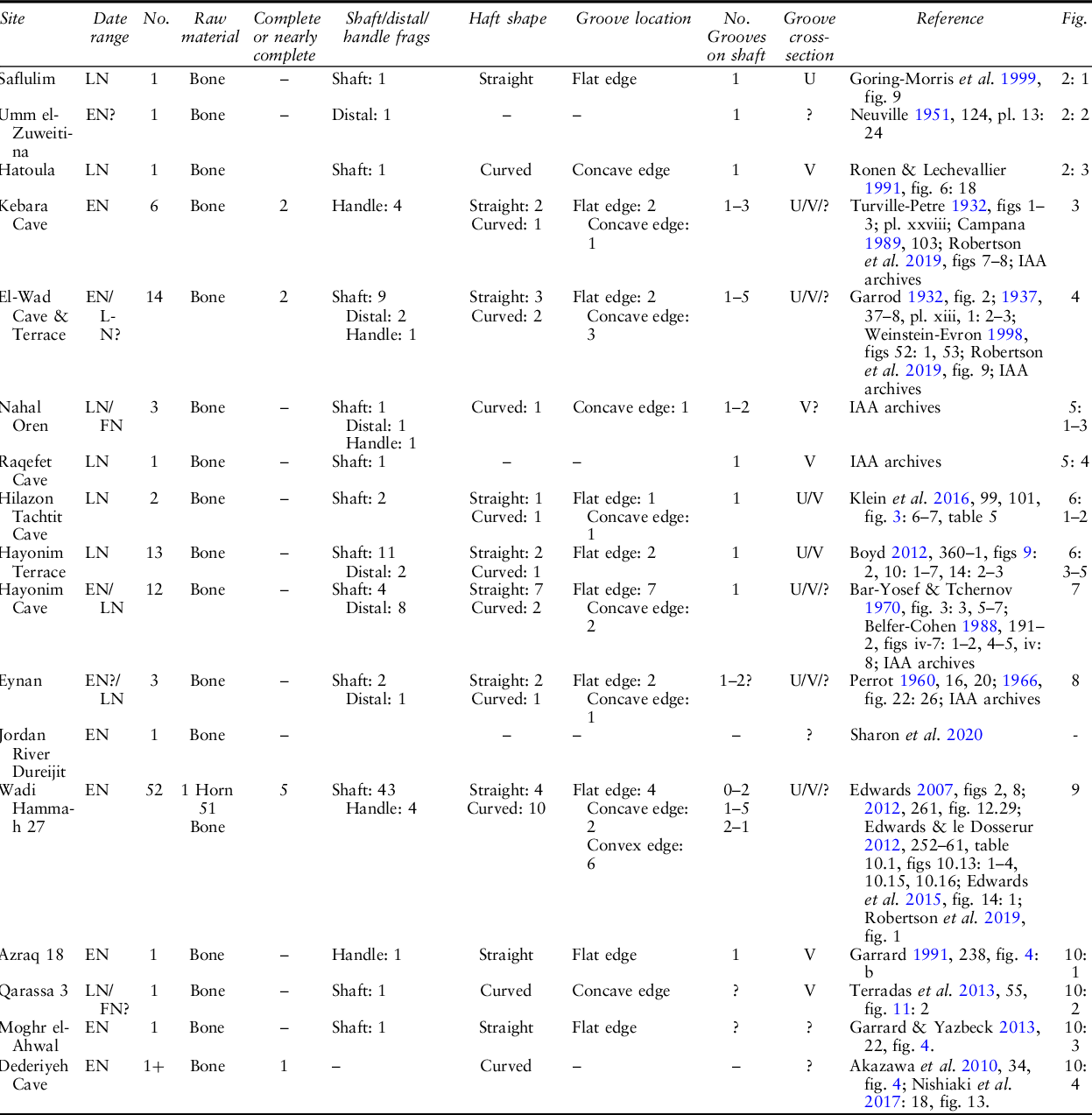
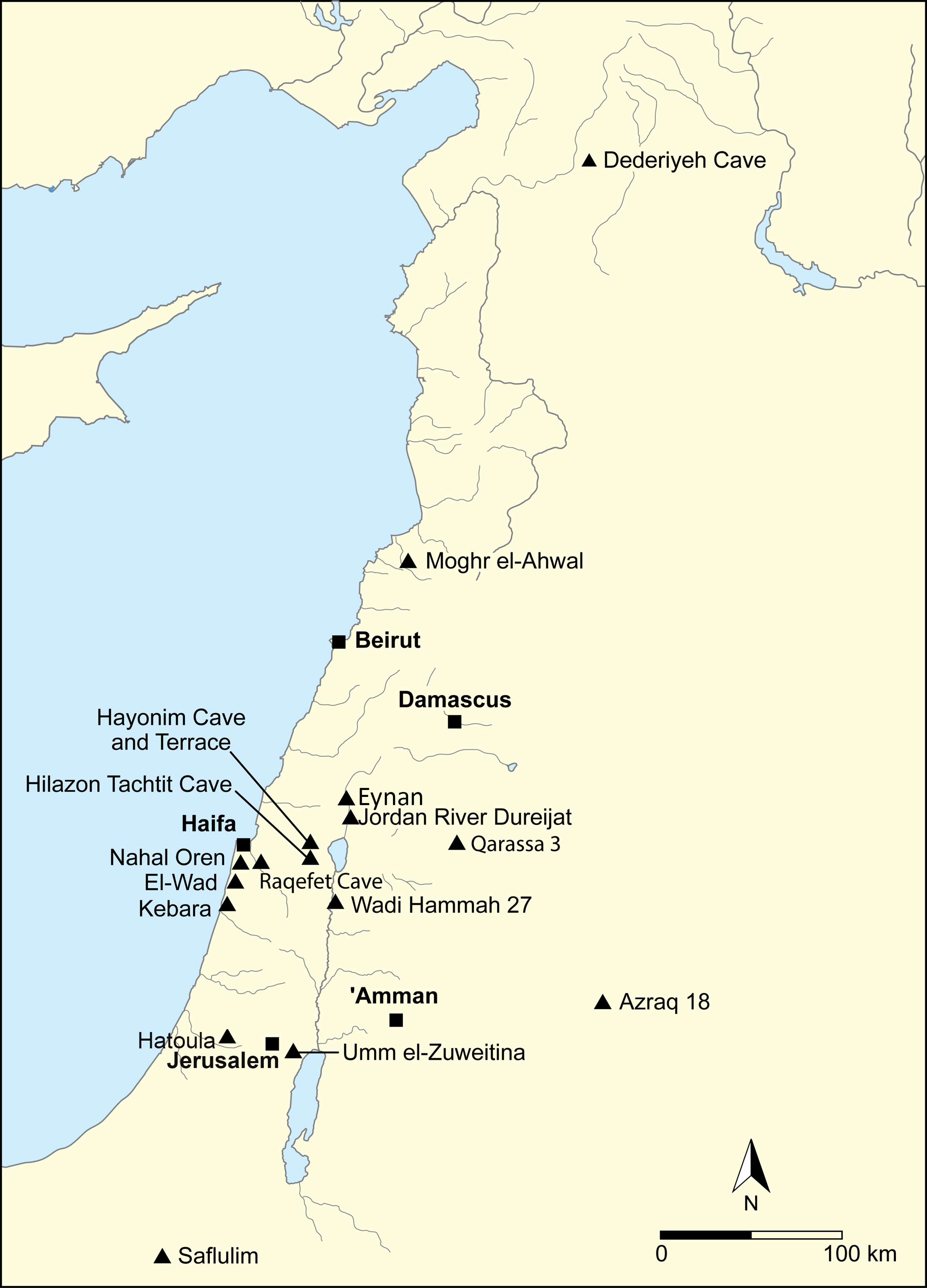
In this section we review all published instances of Natufian hafts from the Levant (Fig. 1). While paying close attention to the items’ formal properties (eg, dimensions, shape, material) and their state of preservation (Figs 2–10; Table 1), we seek to formulate broad and viable generalisations about these items. In turn, these generalisations are expected to provide the necessary ground for an adequate assessment of their functions and significance.
Map showing the distribution of Natufian sites with hafts
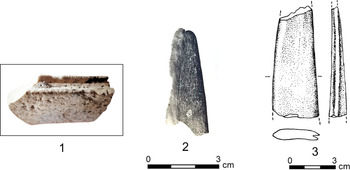
Haft fragments: 1. Saflulim (courtesy of N. Goring-Morris), 2. Umm el-Zuweitina (after Neuville Reference Neuville1951, pl. xiii: 24); 3. Hatoula (after Ronen & Lechevallier Reference Ronen and Lechevallier1991, fig. 6: 18)

INDEX OF NATUFIAN HAFT BEARING SITES, ARRANGED IN ROUGH GEOGRAPHICAL ORDER FROM SOUTH TO NORTH (EN=EARLY NATUFIAN; LN= LATE NATUFIAN; FN=FINAL NATUFIAN)

Altogether, more than 100 hafts and haft fragments were reported from 17 sites, spanning a wide range of eco-zones (notably, about half of these were retrieved from Early Natufian Wadi Hammeh 27). These include the Negev and Judean deserts, the Shephelah, Mt Carmel, the Galilee, and the Hula Basin in Israel, the Jordanian highlands and the Azraq Basin in Jordan, the Leja Plain and the Middle Euphrates Valley in Syria, and the Qadisha Valley in Lebanon (Fig. 1). These sites include hamlets, caves, cave terraces, and open-air base camps. They also cover a variety of purposes (domestic, funerary, and task-specific) and span the entire Natufian sequence (Table 1), including the Early Natufian (n≥64), Late Natufian (n=25), and probably the Final Natufian as well.
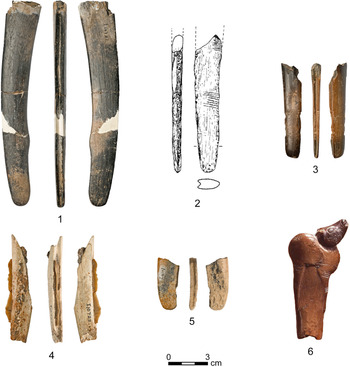
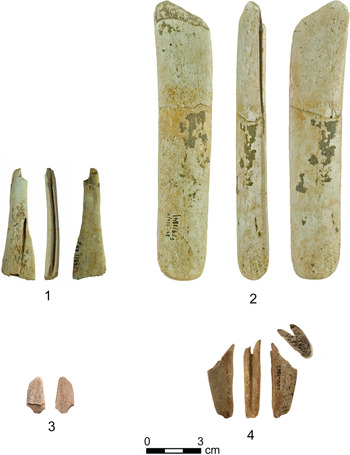
Nearly all Natufian hafts were made of bone, with a preference for ungulate long-bones and ribs. Only one definite exception was recorded to date – a haft made of a caprine horn from Wadi Hammeh 27. Production procedures included rounding (eg, Fig. 5: 2), abrading, shaving (eg, Figs 4: 1, 3; 7: 9; 10: 2), smoothing, and polishing (eg, Figs 3: 1–2, 4; 4: 3, 6; 7: 9; 8: 3). Sometimes holes were drilled into the haft (1–4; see eg, Fig. 3: 3), possibly for fastening it to a cord (Garrod Reference Garrod, Garrod and Bate1937, 38). Burning or exposure to heat was sometimes documented and may have also been used to fashion the haft (eg, Hilazon Tachtit Cave; Klein et al. Reference Klein, Belfer-Cohen and Grosman2016, 101).
Hafts and haft fragments: Kebara (courtesy of the Israel Antiquities Authority & the Israel Museum in Jerusalem)

The fully preserved dimensions show that Natufian hafts varied greatly in size: 9.5–32.0 cm in length, 0.5–6.0 cm in width (most measure between 1.5 and 3.5 cm), and 0.5–4.0 cm in thickness (most measure between 0.5 and 2.5 cm). The haft morphology frequently followed the bone’s natural profile, so considerable diversity was noted. The hafts’ cross-sections are bi-plano, plano-convex, convex-concave, triangular, or bi-convex, and they end with round, square, blunt, or convergent distal terminations.
Importantly, the hafts are divided into two major forms: straight to slightly curved hafts (eg, Figs 3: 1–3; 4: 2; 5: 2; 8: 2–3; 10: 1, 3; 11: A–F) and perceptibly curved to angled hafts (eg, Figs 4: 1; 6: 2–3; 8: 1; 9: 1–6; 10: 4; 11: G–L). The form dictates the curvature of the tools’ working edge, allowing it to be straight, convex (eg, Fig. 9: 1–5), or concave (eg, Figs 4: 1; 6: 2; 8: 1; 9: 6; 10: 4). The curvature of the tool and working edge in turn dictate the motion of the arm (ie, the angles, vis-à-vis the ground, plant, and body of the harvester) and hand during harvesting.
Haft fragments: El-Wad (after Weinstein-Evron Reference Weinstein-Evron1998, fig. 52: 1 & courtesy of the Israel Antiquities Authority & the Israel Museum in Jerusalem)

Haft fragments: 1–3. Nahal Oren (courtesy of the Israel Antiquities Authority & the Israel Museum in Jerusalem); 4. Raqefet Cave (courtesy of the Israel Antiquities Authority)

Haft fragments: 1–2. Hilazon Tachtit Cave (after Klein et al. Reference Klein, Belfer-Cohen and Grosman2016, fig. 3: 6–7); 3–5. Hayonim Terrace (after Boyd Reference Boyd2012, figs 9: 2; 14: 2–3 & courtesy of F. Valla)

Haft fragments: Hayonim Cave (after Bar-Yosef & Tchernov Reference Bar-Yosef and Tchernov1970, fig. 3: 3, 5–7; Belfer-Cohen Reference Belfer-Cohen1988, figs iv-7: 1–2, 4–5; iv-8 & courtesy of Israel Antiquities Authority)

Haft fragments: Eynan (after Perrot Reference Perrot1966, fig. 22: 26 & courtesy of the Israel Antiquities Authority & the Israel Museum in Jerusalem)

Hafts and haft fragments: Wadi Hammeh 27 (after Edwards Reference Edwards2012a, fig. 12.29; Edwards & le Dosseur Reference Edwards and Dosseur2012, figs 10.11, 10.13, 10.15, 10.16; Edwards et al. Reference Edwards, Shewan, Webb, Delage, Valdiosera, Robertson, Shev and Valka2015, fig. 14; Robertson et al. Reference Robertson, Edwards and Coates2019, fig. 5).

Hafts and haft fragments: 1. Azraq 18 (after Garrard Reference Garrard1991, fig. 4: b); 2. Qarassa 3 (after Terradas et al. Reference Terradas, Ibáñez, Braemer, Gourichon and Teira2013, fig. 11, right); 3. Moghr el-Ahwal (after Garrard & Yazbeck Reference Garrard and Yazbeck2013, fig. 4); 4. Dederiyeh Cave (courtesy of Y. Nishiaki et al. Reference Nishiaki, Yoneda, Kanjo and Akazawa2017, fig. 7 13).

A schematic representation of Natufian haft ‘types’ based the curve of the hafts and the location of the grooves.

An elongated groove – and on one occasion two grooves (Fig. 9: 1; Edwards Reference Edwards2007, fig. 8) – marked the working edge and accommodated flint inserts: blades, flakes, or bladelets, similar to glossed items found at many Natufian sites (eg, Belfer-Cohen Reference Belfer-Cohen1988, figs iii-17–19; Grosman et al. Reference Grosman, Ashkenazy and Belfer-Cohen2005, fig. 7; Nishiaki et al. Reference Nishiaki, Yoneda, Kanjo and Akazawa2017, table 3). The grooves’ cross-sections are either U-shaped (eg, Figs 2: 1; 6:1) or V-shaped (eg, Figs 2: 3; 4: 2; 5: 4; 7: 1–4; 10: 1–2). V-shaped grooves were probably designed to accept Helwan retouched bladelets (Garrod Reference Garrod1932, fig. 2; Reference Garrod, Garrod and Bate1937, 37–8, pl. xiii); however, they would accommodate other backed morphologies (straight, oblique, etc.) as well. Notably, most grooves are shallow, c. 1.0–2.0 mm deep, and moderately wide, c. 2.0–5.0 mm, questioning their capability to hold flint inserts securely. A strong adhesive such as resin or bitumen could be used to keep the inserts in place despite the grooves’ shallow nature and it would further allow for a simple replacement of the inserts when they became dull. While adhesive residues are not always clear in the few hafts with intact flint inserts (Figs 2: 2; 4: 4; 9: 1), this hypothesis is reinforced by mastic documented on flint microliths and other tools (Büller Reference Büller and Cauvin1982; Bar-Yosef & Belfer-Cohen Reference Bar-Yosef and Belfer-Cohen2000; Stanin Reference Stanin2012, 200–1). These suggest that adhesives were regularly used in hafting of composite tools during the Natufian timespan.
There are also some notable idiosyncrasies in the assemblage. One such peculiarity is that several items lacked grooves (eg, Fig. 9: 8). These are perhaps unfinished (Edwards et al. Reference Edwards, Shewan, Webb, Delage, Valdiosera, Robertson, Shev and Valka2015, fig. 14: 1), or maybe their classification as sickles was premature. On the other hand, grooves were sometimes cut along the full length of the haft, including the part presumed to be the handle (eg, Figs 4: 1; 8: 2–3). Occasionally, carved knobs were noted on the back of the tools (eg, Figs 3: 1–2; 8: 3; 10:3). They are circular in outline, 1.0–2.0 cm across, and they occur on the proximal (Fig. 8: 3) and distal ends (Fig. 3: 1–2).
Finally, sometimes hafts were accompanied by symbolic or decorative features. The time and effort invested in adornment and fine finishing suggests that the hafts were made for long-term use, with replaceable inserts. On one example from Dederiyeh Cave, painted black lines were recorded (Fig. 10:4 and see Nishiaki et al. Reference Nishiaki, Yoneda, Kanjo and Akazawa2017, 18). However, most striking are hafts bearing carefully carved zoomorphic figures, presumably representative of a bovine, deer, or gazelle (Fig. 3: 1–2; 4; 4: 6; 9: 11). Somewhat more common are incisions forming a wide range of patterns. These patterns include cross-hatched incisions (Turville-Petre Reference Turville-Petre1932; IAA archives), two sets of oblique incisions (Figs 4:2, 7:2), short horizontal incisions (Figs 7: 1; 9: 7), and 1–3 perpendicular grooves (Fig. 7: 9; 8: 1; 10: 1). Irregular depressions were also noted on one example (Fig. 7: 2).
DISCUSSION AND CONCLUSIONS
The hafts are but one of a wide range of Natufian technological and socio-economic innovations that targeted various realms: mobility and settlement patterns, material culture, ritual and burial practices, and subsistence economies. Some of these entailed significant transformations in the way people viewed their environment and manipulated natural resources and they coincided with climatic changes (eg, Olszewski Reference Olszewski and Delage2004; Bar-Yosef Reference Bar-Yosef2011; Maher et al. Reference Maher, Banning and Chazan2011; Rosen & Rivera-Collazo Reference Rosen and Rivera-Collazo2012) that had direct repercussions on the accessibility and availability of vegetal resources (Rosen Reference Rosen2010; Reference Rosen2012).
In this framework, one major question arises regarding the hafts. How can we account for the wide morphometric diversity of the Natufian hafts (eg, Fig. 11) and by extension the sickles? At least three explanations can be posited for this variability. For purpose of convenience, we will call them the techno-functional explanation (TFE), the resource-range explanation (RRE), and the novel-technology explanation (NTE). According to the TFE, the Natufian hafts were not exclusively sickles. Rather, they served various functions, and their formal diversity stemmed from accommodating different practical demands. The RRE, on the other hand, posits that all hafts were used to harvest plants including cereals and other species. Thus, their formal diversity is a function of the plant resources reaped. Lastly, according to the NTE, the diversity of hafts and sickles’ manifests from the formative stages of a yet unconsolidated technology that was still experimenting with various features by way of trial and error.
All three hypotheses are plausible, and none of them excludes the others. Further, all three are supported by other lines of evidence: the range of tasks flint tools were used for (eg, Campana Reference Campana1989, 25–42; Richter Reference Richter2007; Yaroshevich et al. Reference Yaroshevich, Kaufman, Nuzhnyy, Bar-Yosef and Weinstein-Evron2010), experimental parallels that show hafted flint tools can be used for different activities (eg, threshing, D’Errico et al. Reference D’Errico, Giacobini, Gather, Powers-Jones and Radmilli1995), the diversity of botanic remains (Olszewski Reference Olszewski and Delage2004; Rosenberg Reference Rosenberg2008; Colledge & Conolly Reference Colledge and Conolly2010; Rosen Reference Rosen2010; Reference Rosen2012; Arranz-Otaegui et al. Reference Arranz-Otaegui, Carretero, Roe and Richter2018a), and the intricate dialectics of technological consolidation (eg, Rogers Reference Rogers1983, 231; van der Leeuw Reference Leeuw1990; Arthur Reference Arthur2007; Klimscha Reference Klimscha, Brumlich, Lenhard and Meyer2020).
Nevertheless, we are inclined to support the NTE hypothesis. The Natufians were probably pressured by the narrow catchment area and the narrow window between cereal ripening and ear-shattering (Unger-Hamilton Reference Unger-Hamilton1989) to produce high yields of cereals in a short time. The sickle helped achieve this by enabling a fast, efficient, and more comfortable way to harvest. However, the best way to manufacture and handle a sickle was yet to be determined, setting in motion a prolonged experimentation process whereby different sickle forms and sizes were tested.
Ergonomically, different morphologies of the hafts and the handle-blade angle reflect different movements of the harvester’s hand and arm while cutting the stalks. A concave working edge is considered best suited for cereal reaping; it operates as an extension of the arm, gathering the stems before cutting them (Sutjana et al. Reference Sutjana, Adiputra, Manuaba and O’Neill1999; Astruc et al. Reference Astruc, Ben-Ykaya and Torchy2012; Mazzucco et al. Reference Mazzucco, Capuzzo, Pannocchia, Ibáñez and Gibaja2018). To achieve this for both left-handed and right-handed individuals, opposite placement of the working edge may have been required. Further, while many of the Natufian hafts followed this logic and had a concave working edge, others with a straight or convex working edge relied on different principles. These differences coupled with variations in shape, length, groove measurements, inserts used, and other parameters reinforce the suggestion that we are observing an immature technology and experimentation phases aimed at testing combinations of morphologies with different harvesting motions. These testing stages likely targeted other variables related to harvesting, such as the optimal time to harvest the stems (ripe or near-ripe) and even the time of the day when it is best to harvest (early or late in the day, bearing in mind the possible impact of temperature and humidity on the stalks). This reflects the multi-dimensional nature of the experimental trial and error phase of sickle development and its evolution.
Either way, these hafts appeared hand-in-hand with a considerable rise of gloss-bearing inserts and sickle blades with no apparent gloss (discarded before use or which had not yet developed sheen). This co-occurrence is yet another case of a Natufian technological breakthrough associated with this culture’s early stages of consolidation, intertwined with its shift towards sedentism and growing demand for increased food production (eg, Keeley Reference Keeley1988, 404; Miller Reference Miller, Cowan and Watson1992, 51; Watkins Reference Watkins and Scarre2005, 208; Stutz et al. Reference Stutz, Munro and Bar-Oz2009; Rosenberg Reference Rosenberg2013). While the creation of sickles undoubtedly entailed substantial costs in terms of time, energy, and ingenuity, it must have considerably improved the harvesting yields compared to hand-picking or ground collecting seeds. Their effectiveness and long-term durability assuredly rendered the investment profitable in the long run (eg, Bender Reference Bender1978).
Acknowledgements
This paper is dedicated to the memory of Prof. Ofer Bar-Yosef, a mentor who thrived on learning and helping others learn. We would like to thank N. Goring-Morris for his permission to use the original images of the Saflulim haft, F. Valla for his permission to use the original images of the Hayonim Terrace sickles, to Y. Nishiaki for the sickle drawing and information regarding the Dederiyeh Cave; to G. Sharon for insights regarding JDR sickle and to J. Ibáñez, for the image information regarding Qarassa 3. Acknowledgements also go to N. Conard and A. Kandel for information about Baaz rock shelter and Kaus Kozah Cave. We thank S. Haad for her infinite help with the graphics and to E. Marcus and A. Nativ for many valuable comments and suggestions. Thanks also go to N. Gubenko and N. Biman of the IAA and N. Luria from the Israel Museum in Jerusalem, for their help locating the tools and obtaining the images. IAA and IMJ images were taken by M. Salzberger, C. Amit, M. Suchowolski, V. Neichin, Y. Yolovich, L. Lachman, and A. Hay.