Lift your heads, O gates, and lift your everlasting doors, and the King of Glory will enter
(Psalms 24:9)Most research has a preliminary story embedded in earlier writings, which raise questions and spawn new inquiries conducive to new findings. The present study was born of other circumstances: I was asked by the directors of the early music group Ensemble LucidariumFootnote 1 if, for purposes of performance, I knew of a translation of Samuel Archivolti's Hebrew wedding ode “Keḥi kinnor” (Take a lyre). I had run across the ode in various listings,Footnote 2 but was unfamiliar with any translation, so I suggested doing my own. That is where the problems began. To establish a clean reading for the poem, I consulted its manuscript and printed sources; to confront its verbal obscurities, and pinpoint its meanings, I traced its references to biblical and rabbinical literature; and to satisfy my own curiosity about how it was sung, I looked into the few recorded examples of its melodies. It follows that in this article, I shall be concerned mainly with semantics and music. Yet, to begin, I shall present some information about the author, sources, and prosody of the poem; and, to conclude, I shall compare it with other wedding odes of his and his contemporaries, and, in an epilogue, appraise its singularity.
For the poem as numbered for its lines and footnoted for its citations, the reader should consult the threefold transcription (Hebrew, transliteration, and translation) in Appendix 1. References below to its verses (e.g., 3.2 or R.1, R standing for refrain) are to the numbering found there. For details about its manuscript and printed sources, see Appendix 2.
A number of ideas emerge from reading “Keḥi kinnor.” The first is that it is almost impossible, in the Hebrew tradition, to separate poetry from music. Their conjunction was evident in David's psalms and, after their precedent, in the postbiblical piyyut. It is a conjunction based on the primacy of song in the ritual of the Temple and, through the cantillation of Scriptures, in the prayer services of the synagogue. A second idea is that music underlies all forms of Jewish celebration, of which one of the most salient examples, from the sixteenth century on, is the wedding ode. It is no wonder that so many poets tried their hand at its composition. A third is that Hebrew poetry, like music, can be perused and understood on many levels. There is no better example than “Keḥi kinnor”—its words and melodies are rich in their semantic plurality. Voices (kolot) that pertain to music and speech, as made clear from the ode, also pertain to rejoicing in its literal and metaphorical demonstration—from praising the bride and groom in song under the wedding canopy to symbolizing the voices that preceded the revelation of Torah as an epiphany. The wedding that, in this and other odes, validates the union of man and woman also connotes the union of God with His people. Fourth, and last, is that the ode has much to tell us about its author—the verses and his comments to them, beyond revealing his erudition, show the centrality of words and sounds to his notions of poetry, and to his search for meaning in the sources. “Keḥi kinnor” is an exercise in exegesis for both the author and the reader. It defines the Jews in relation to past and future, from the glories of the Temple to the hope for better times when, with the return from captivity, all will “deliver a song . . . to the Supreme God” (7.1).
Author, sources, prosody
Author
Born in Cesena in the region of Emilia Romagna around 1530, Samuel ben Elḥanan Jacob Archivolti lived, from 1568 until his death in 1611, in Padua. There, in addition to proofreading for publishing houses in Venice, he served the Jewish community as secretary, head of a yeshiva, and after 1579, rabbi. His activities can be reconstructed from the people and situations mentioned in his letters and rabbinical responses.Footnote 3 Three of his four larger works were published in the 1550s. Degel ahava [Banner of Love]Footnote 4 is a story designed to illustrate the behavioral traits of suitors as they pass through the various states of amorous desire—hope, joy, suffering, and despair—to avoid which Archivolti advises that they spend their time studying and that they actuate love through marriage (1551); He‘arot (Comments) to Sefer he-‘arukh, a talmudic and midrashic dictionary by Nathan ben Jeḥiel of Rome (d. ca. 1110), takes the form of marginal annotations with source references for the separate entries (1553); and Ma‘yan ganim [Fountain of Gardens]Footnote 5 is a manual of letter writing providing fifty examples to suit the needs of different correspondents—sons, fathers, friends, judges, and women (1553). His fourth and most influential work, ‘Arugat ha-bosem [Bed of Spices],Footnote 6 treats Hebrew grammar and, in its last chapter, Hebrew verse forms, which the author illustrates with twenty-seven examples of his own composition (1602).Footnote 7 To these poems one may add another fifty-four variously published in his or others’ works (often as dedications in the latter) or, in the case of “Keḥi kinnor,” in prayer books.Footnote 8 Archivolti has been called “a poet [who], acclaimed in his own time and in the generation following him, may perhaps be described, to a certain extent, as a pioneer and founder of the ‘new’ Hebrew poetry in Italy”Footnote 9—“new” referring to the cultivation of Italian verse forms, among them the sonnet (which, though introduced by Immanuel ha-Romi around 1300, dwindled thereafter, only to be revived in the sixteenth century), and to a heightened concern with the sonority of end rhymes.Footnote 10 The inclusion of “Keḥi kinnor” (not a sonnet) along with at least three other of his poems in prayer books may be taken as a shibboleth for their popularity.Footnote 11 Leon Modena wrote of Archivolti, his teacher, in an epitaph for Archivolti's tombstone, that he was “a master of elegant rhymes: the language of the Hebrews will mourn over him.”Footnote 12
Autograph
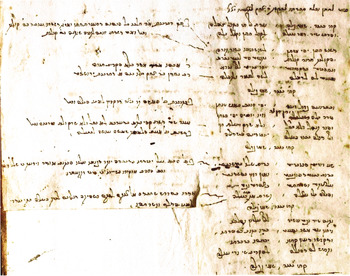
A manuscript copy of “Keḥi kinnor” was inscribed in the author's hand on the recto of the endleaf (followed by a blank flyleaf) of Sefer ha-shorashim [Book of Roots], a biblical dictionary that David Kimḥi (d. ca. 1255) prepared as Part 2 of his Sefer mikhlol [An All-Inclusive Book] on Hebrew grammar. Archivolti, who owned Sefer ha-shorashim in its Venetian print by Giustinian (1546), combined it with his copy of Sefer mikhlol printed in Venice by Daniel Bomberg (1545; on its title page he writes of having purchased it, for “eight Venetian pounds,” in 1553) and had both of them bound together in leather with his name gold-stamped on the back cover (in Latin letters, as Semuel de Archevolti).Footnote 13 The volume, in its two parts, is now in the library of the Jewish Theological Seminary in New York.Footnote 14 Beyond “Keḥi kinnor,” Archivolti inscribed seventeen other original poems variously on the preliminary flyleaf (of Sefer mikhlol, before the title page) and on the final printed folio (verso) and following two leaves (of Sefer ha-shorashim). It has been estimated, from the dates for the three obituary epitaphs among them, that Archivolti wrote out the full set no earlier than 1584,Footnote 15 which year might be fixed as the terminus a quo for “Keḥi kinnor.”Footnote 16
The autograph forms the basis of the transcription in Appendix 1 (see there, Figure 2, for a reproduction). Its importance is unassailable. For one, it establishes an authentic textual reading, thus solving problems of discrepancy or uncertainty in the sources.Footnote 17 For another, it refers, in the inscription, to the person who requested that Archivolti write the poem, “Rabbi Isaac Luzzatto,” a name omitted from other versions.Footnote 18 For a third, it has an emendation (in 3.2), of philological interest: Archivolti deletes ve-shikhlulah (and her beauty), replacing it with ve-ḥen ḥen lah (with all her graces). For a fourth, it clarifies the verse structure in its ordering as a series of distichs (see below). Its major importance, however, lies in the comments that Archivolti added to several lines in explication of their content and reference to his sources.Footnote 19 The only two drawbacks to the autograph are the author's omission of vowel points from the verses, and not his, but someone else's excision of the comments to the last two distichs (Figure 2 reveals how the paper was cut and pasted over the larger folio). Though the vowel points can easily be supplied from the rules for Hebrew vocalization as modified, here and there, by the scansion of the verse,Footnote 20 the absence of the final comments, presuming there were such comments, is unfortunate. The poem is abstruse and further remarks of the author would have been useful for its elucidation.
For four manuscript copies of the poem, one from the mid-eighteenth century—of particular interest because it is inscribed as to be sung to “the tune [of] ‘Aftir lashon’ (I will release my tongue)” by David Pardo (d. 1790)Footnote 21—and three from the nineteenth, see Appendix 2.
Printed Sources
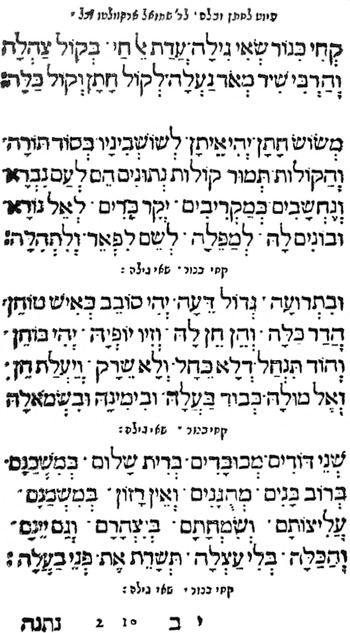
“Keḥi kinnor” appears a number of times in printed formularies intended for practical use in Italian-Jewish communities. They are variously entitled Davar be-‘itto [Everything in its Time], Siddur mi-berakhah [Siddur with Blessings], and Siddur berakhah [Siddur of Blessings]. The poem can be traced to at least thirteen such formularies from 1618 to 1739. They served different rites, mostly benei Roma (nine prints, starting from 1618; see Figure 1),Footnote 22 yet also Ashkenazi (three prints),Footnote 23 and possibly Sephardi (one print).Footnote 24 From its exclusion from an early Siddur mi-berakhah dated 1578, perhaps the first in that series,Footnote 25 one may assume its composition in the later sixteenth or early seventeenth century (see above, under Autograph, for its earliest plausible date).
Archivolti, “Keḥi kinnor,” from Siddur mi-berakhah ke-minhag kehilot kodesh Italyani yishmerehem Ẓuram vi-yeḥayyehem [Siddur with Blessings According to the Rite of the Sacred Community of Italiani, May their Rock Preserve them and Give them Life!] (Venice: Pietro e Lorenzo Bragadini, 1618), sig. 10:2a (first three stanzas, with the remaining stanza on 10:2b). (Courtesy, Jerusalem, National Library of Israel, shelf mark R 0 75 A 689)

Prosody
“Keḥi kinnor” consists of a refrain and four stanzas, with the refrain returning after each one.Footnote 26 The verses are composed as distichs, or two-line units, nine in all (one for the refrain, two for the individual stanzas). Each line divides into four feet, with two in the first hemistich and two in the second (Archivolti marks the midpoint, or break between the hemistiches, by a caesura; see Figure 2). Of identical construction, the feet read quantitatively as a short plus three longs, or more precisely, a peg (yated), that is, short-long, plus two cords (tenu‘ot), that is, longs, in a meter known as marnin (joyous).Footnote 27 The lines are counted, after the example of Italian verse, by their syllables, in this case eight for each hemistich. Line 1 of distich 4, at the beginning of stanza 2, may serve as example. It separates metrically into a fixed number of syllables ordered by duration (as shorts and longs, according to the underlying quantitative paradigm, though both, in the “new” Italian Hebrew verse, are of equal measure) or by tonic stress (in patterns of iambs).
Autograph of “Keḥi kinnor” as written on recto of final endleaf (followed by a blank flyleaf) of Archivolti's copy of David Kimḥi's Sefer mikhlol [An All-Inclusive Book] (Venice: Bomberg, 1545). (Courtesy, New York, Jewish Theological Seminary, shelf location identifier SHF 1987:13)Footnote 132

Distich 4, line 1 (or as numbered in transcription, 3.1), with its composite feet, reads thus:
Marked for their duration: 1Ŭ-vī-t′rū‘āh .2gĕdōl dē‘āh / 3yĕhī sōvēv .4kĕ-īsh tōḥēn
Marked for their accents: 1Ŭ-ví-t′rŭ‘áh .2gĕdól dĕ‘áh / 3yĕhí sŏvév .4kĕ-ísh tŏḥén
The rhyme scheme for the refrain and stanzas would lead one to describe the verses as a seeming girdle poem (shir ezor). In each stanza the last line repeats the end rhyme of the refrain (-lah) while lines 1–3 of the separate stanzas have their own rhymes (rah or ra for stanza 1, ḥen for stanza 2, nam for stanza 3, and to for stanza 4).Footnote 28
Semantics
For whom did Archivolti compose the verses? In the inscription to the autograph, he informs us that he wrote them as a “piyyut for a groom and a bride . . . upon the request of Rabbi Isaac Luzzatto,” who may be assumed to be the same Luzzatto in whose house in Venice Leon Modena's family resided after fleeing the earthquake in Ferrara (1570)Footnote 29 and Leon himself was born (1571).Footnote 30 LuzzattoFootnote 31 no doubt intended it for a specific bride and groom, though no names are mentioned (unless perhaps their initials or other identifying marks are cleverly woven into the verses).Footnote 32 He is likely to have presided as rabbi over the wedding ceremony and to have been the “great man of learning” to whom Archivolti referred in verse 3.1.
Luzzatto's name is absent from the remaining sources, yet most of them inscribe the poem, after the autograph, as a piyyut for “a groom and a bride” (ḥatan ve-kallah)Footnote 33 (when rubrics are given in Italian, sposo e sposa),Footnote 34 for “a wedding couple” (ḥatanim)Footnote 35 (in Italian rubrics, sposi),Footnote 36 or, less specifically, for “a wedding” (nisu'in).Footnote 37 A few others designate the groom as the recipient (“piyyut for a ḥatan”),Footnote 38 as might be sustained, from within the poem, by the reference to “the rejoicing of the groom” (1.1). If not Isaac Luzzatto, “the great man of learning” may, in this case, have been the groom himself, schooled in Torah and setting an example thereby for his “attendants” (again 1.1).Footnote 39 One other protagonist might be mentioned, not as a recipient but as an active participant: the “congregation,” or Jewish community, called upon, in the vocative, at the outset (“Take a lyre, . . . O congregation,” R.1). It is the “created people” (1.2), who, toward the end, speak out in first-person plural (“Let us deliver a song,” 7.1). In a sense, there is no contradiction between recipients and participants. The groom and bride are individual members of the community, and the wish for their welfare coincides with that for the welfare of the Jews as a “people” (God “will spare the people who are troubled,” 7.2).
The ode would have been sung before the Seven Blessings pronounced under the wedding canopy and after saying grace at the wedding banquet on the same day. Should the festivities continue, it would have been repeated on successive days.Footnote 40 Its main theme is gladness (“joy,” “merriment,” “rejoicing,” “jubilation,” “cheerfulness,” “happiness”)Footnote 41 for the bride and groom and, vicariously, for the congregation, both now and in years to come (about which more below). Music, along with dance, enters the picture as a natural vehicle for celebration (“Take a lyre, lift your joy . . . in a voice of merriment,” “sing many songs . . . to the voice of the groom and the voice of the bride,” “may the voices . . . be given to a created people,” “Let us deliver a song,” “How do they dance before the bride?”).Footnote 42 In the background are the passages in Samuel where David “took a lyre” (R.1) to relieve Saul of his melancholyFootnote 43 or where he “danced before the Lord,”Footnote 44 and more significantly in the Book of Psalms where praises of God are effected by “lifting” voices and instruments (“Rejoice unto God . . . lift your song and use a timbrel, a pleasant lyre with a psaltery”),Footnote 45 by exulting (“Sing a new song unto Him, play your best in jubilation”),Footnote 46 and by dancing (“Let them praise His name in dance”).Footnote 47 It is obvious that “songs,” when spiritually “lifted” (as in the Psalms), become “exalted” (R.2). The musical imagery of Psalms was commonplace in postbiblical Hebrew poetry. Joseph Jedidiah Carmi (flourished in the early seventeenth century) composed a piyyut, for example, with words strongly reminiscent of the refrain in Archivolti's wedding ode. Its verses 1–2 read: “Be comforted, O congregation, and a lyre and psaltery /Take in your hands and lift a song to your Maker.”Footnote 48 The reason why music was a source of delight not only to God but also to humans was explained by Judah Moscato (d. 1590) as having to do with their intrinsic musical construction. “All those called by His name and for His honor,” Moscato wrote, “did He create, form, and even make according to the ratios of music, just as He Himself—may He be blessed!—is the master of perfect music. In His wisdom He formed man in His image, after His likeness, as most ordered in harmonic relations.” Therefore it behooves us, he continues, quoting Psalms 98:5, to “sing to the Lord with a lyre, with a lyre and a voice of song.”Footnote 49
Archivolti departs from the practice, in most wedding odes, of identifying the groom and bride in the inscription or the contents.Footnote 50 Rather he delineates their ideal traits. The groom, he implies, pursued studies of “Torah” (and, by insinuation, its talmudic and rabbinical commentaries), and thus penetrated its “secrets” (1.1). In another, anonymous wedding ode, two folios away from Archivolti's in one of the sources, the groom is described, “on the day of [his] wedding, [as] a vest of wisdom and much understanding.”Footnote 51 It is no wonder that he is “honored” (4.2). His bride, in her “splendor” and “graces,” “glow[s]” in “her loveliness” (3.2).Footnote 52 Though plain in appearance (“not by being powdered or painted”; see comments to 4.1 and 4.2), she “attain[s] majesty” as a “graceful gazelle” (4.1) in the eyes of her husband who stands “across from her” (4.2). His role is to “honor her” and, by so doing, he guarantees a happy marriage, and hence becomes “enriched” (see comment to 5.1).
The poet goes on to augur their destiny. Their wedding contract, or ketubbah, to which “two uncles,” i.e., beloved onesFootnote 53 “of eminence” appear to have been witnesses, assures them of “peace in their dwelling” (5.1 and comment thereto).Footnote 54 The wife will see to it that her husband lacks for nothing. She “will serve” him “without idleness” (6.2 and comment thereto)Footnote 55 and bear him “many sons” (5.2). They, too, will “know no scarcity in their prosperity” (5.2) and, because of their success in producing “oil” and “wine,” will ever be “cheerful” and “happy” (6.1).
From the well-being of husband, wife, and sons, the poet deduces the future of the “congregation” (R.1), conceived as encompassing the Jews as a whole. The link between the family nucleus and the larger national or religious entity appears to reside in the “contract of peace” (berit shalom; in a broader sense, “covenant of peace”) attested by the “two uncles,” i.e., beloved ones. Archivolti may be referring to the “two” tablets on which the Ten Commandments were engraved or, by analogy, the “two” rollers for holding the scrolls of the Law in the sanctuary. The vocabulary matches Ezekiel 37:26: “I will make a covenant of peace [berit shalom] with them, and it will be an everlasting covenant [berit ‘olam] with them . . . and I will put my sanctuary in their midst forever.”
The future of the Jewish people lies in its renewal. By strengthening the connection with Torah (1.1 and comment thereto) and rebuilding the sanctuary (2.2, and comments to 2.1 and 2.2; 8.1–2), they will enjoy “peace” (5.1); they will multiply, having “many sons” (5.2);Footnote 56 and they will “prosper” (5.2) and know “happiness” (6.1). Though “troubled” from exile and dispersion, they will eventually be “spare[d]” (7.2) and, in better times, they will return to offer sacrifices in the Temple, rebuilt after its destruction (2.1–2 and comments thereto, 8.1–2).
Pieces of the puzzle now begin to fit together. The gladness of the bride and groom foreshadows the return from captivity and a “sacrifice of thanksgiving” in God's house.Footnote 57 The people will faithfully serve the Lord, as does the wife her husband (6.2 and comment thereto). The “oil” and “wine” (6.1) cultivated by the bride's and groom's “many sons” (5.2)—to be read as Jews in generations to come—are tropes for joy and radiance (“Wine will gladden man's heart and oil will make his face shine,” Psalms 104:15). It is no wonder that the sons are “cheerful” and “happy” (6.1). “Oil,” of course, had sacred usages, as in the anointing of high priests and sacred vessels.Footnote 58 The passage “I anointed you with oil” (Ezekiel 16:9) was said by the biblical commentator David Kimḥi, for example, to denote a “softening of the skin hardened from working with clay and bricks: this is a metaphor [mashal] for the respite they had” from trials and tribulations (cf. 5.1, 7.2). Not only was “wine” imbibed for the kiddush and on festive occasions (among them, in the present context, weddings),Footnote 59 but it also marked the beginning of a new era signaled in the culmination of the wedding ode (8.1–2). “Behold, the days come,” Amos predicted, “and sweet wine will drop from the heavens” (9:13).
Stanza 1 is the most difficult to decode. It combines “the secrets of Torah” with other elements: giving “the voices, instead of voices . . . to a created people”; “sacrificing the splendor of fattened sheep to an awesome God”; and rebuilding the Temple, after destruction, for its renewed “fame, praise, and glory” (1.1–2.2 and comments thereto). Behind the stanza is a passage from B. Berakhot (6b) that cites Jeremiah 33:11 for its “five voices”: one of joy, one of gladness, one of the bridegroom, one of the bride, and one of those who praise the Lord, namely, the “community” (R.1). They are compared to the “five voices,” alias sounds preceding the revelation of Torah (thunder, lightning, a shofar, Moses’ voice, and God's voice; Exodus 19:16, 19—see comment to 1.1). Those who attend the wedding and rejoice for the groomFootnote 60 are said to identify with the voices behind Torah, and thus become privy to its “secrets” (1.1). “Whoever enjoys the wedding meal of the bridegroom,” as the passage from Berakhot begins,
and does not rejoice with him, does violence to the five voices, for it is said: “The voice of joy and the voice of gladness, the voice of the bridegroom and the voice of the bride, the voice of those who say ‘Give thanks to the Lord of Hosts’ ” [Jeremiah 33:11]. And if he does gladden him, what is his reward? . . . The privilege of acquiring [the knowledge of] Torah which was given with five voices, for it is said: “And it came to pass on the third day, when it was morning, that there were voices [of thunder] and [of] lightning and a thick cloud was on the mountain and the [loud] voice of a shofar,” etc. [Exodus 19:16], “and the voice of the shofar [became even louder, and Moses spoke] and God answered him with a voice” [Exodus 19:19]. . . . These voices came before the giving of Torah.
“The voices, instead of voices, [to] be given to a created people” (1.2) are thus the voices of those who, created by God, rejoice with the bridegroom and, by analogy, rejoice in their Maker for giving them Torah through Moses. They speak not in the voices of thunder, lightning, and so on, that heralded its transmission, but in their own voices that acknowledge its reception and implementation. The same passage in Berakhot continues by relating how the act of rejoicing can be construed as a sacrifice in the Lord's sanctuary and, after the return from captivity, as a step toward rebuilding it from its wreckage:
It is as if he [who rejoices with the bridegroom] made a sacrifice of thanksgiving, for it is said: “They bring offerings of thanksgiving into the house of the Lord.” . . . It is as if he restored one of the ruins of Jerusalem, for it is said: “ ‘For I will return the captivity of the land to be as it was at first,’ said the Lord” [Jeremiah 33:11].
The obscurities of the poem, as they concern voices, Torah, and sacrifices, are thus lifted.Footnote 61 But there is a darker side lurking under its surface. The refrain and verses 3.1–2 relate to Isaiah 23:16, namely: “Take a lyre” (Keḥi kinnor); “sing many songs” (harbi shir); and “circle about the city” (sobbi ‘ir), or as varied in the poem, “circle about . . . the splendor of the bride” (yehi sovev . . . hadar kallah). Verse 2.2 that describes the destruction of Jerusalem relates further to Isaiah 23:1, 7–9, 11, and 15 that describe the destruction of Tyre. But that is where the similarities end. For one thing, in the poem, it was the congregation that the author enjoined to sing and play; in Isaiah 23:16, it was a whore (“Take a lyre, circle about the city, forgotten whore; play well, sing many songs, so that you may be remembered”). For another, in the poem, Jerusalem was ruined, yet rebuilt; in Isaiah 23, Tyre, castigated for its abominations, was razed and left to lie fallow for seventy years, after which it sang as a harlot,Footnote 62 in order, as one commentator said, “to be remembered by her lovers and thus awaken the attention of merchants to come to her as they did before.”Footnote 63 Archivolti may purposely have generated the parallels as a contrast, for the intuitive reader, between ruin and repair, mourning and rejoicing, exile and return, and captivity and release. They form substructural binaries in Jewish history and Jewish thought. Yes, the Jews knew misery, but Archivolti hastens to assure them that their lot will be improved.
The clinching piece of evidence for reading the poem tropologically resides in its function as a song to be performed directly before the Seven Blessings.Footnote 64 In its vocabulary, the poem can be identified as a paraphrase of Blessing 7, which reads:
Blessed are You, O Lord our God, King of the universe, who created joy and gladness, bridegroom and bride, mirth and exultation, pleasure and delight, love and brotherhood, peace and friendship. Soon, O Lord our God, may there be heard in the cites of Judah, and in the streets of Jerusalem, the voice of joy and the voice of gladness, the voice of the bridegroom and the voice of the bride, the jubilant voice of bridegrooms from their canopies, and of youths from their feasts of song. Blessed be You, O Lord, who make the bridegroom rejoice with the bride.Footnote 65
Like the blessing that presages the voices of joy, love, and peace in the future, so the wedding ode. It implies that to rejoice in the bride and groom is to reaffirm the laws that God gave for the life and preservation of his people for now and evermore.
Music
To move from the poem to the music to which it was sung is to take a quantum leap from the seventeenth to the twentieth century. The three melodies to which I had access were recorded by Leo Levi (d. 1982) in the 1950s. To my knowledge, they are the earliest, if not the only ones, to be preserved. Whether they can be related to the unknown melody or melodies to which the poem was sung in Archivolti's time is an open question, to which I shall return.
Of the three melodies, sung by separate informants, one is Ashkenazi and two are Italiani in their ritual affiliation.Footnote 66 Since the stanzas are sung to the tune of the refrain, and not all the recordings are textually complete, I shall limit the transcription, for all three, to the refrain. Variants in the reading of the text (by comparison with its reading in Appendix 1)Footnote 67 are those of the singers. With all three melodies in a major mode, I transcribed them, for ease of comparison, in G major. The point, in their quotation here, is to determine their similarities and differences as raw material for answering the “open question” posed above.
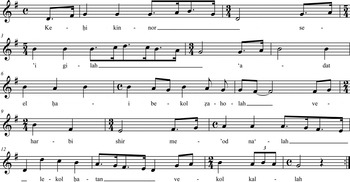
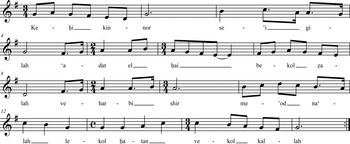
The first melody, from Casale Monferrato, appears in Example 1.Footnote 68
Casale Monferrato, Ashkenazi, after rendition by Angelo Hirsch recorded by Leo Levi on 28 August 1956. (Courtesy, National Sound Archives, Jerusalem, National Library of Israel, Y/01311, item 1)

There the eight feet of the two lines are clearly separated, usually by an ornament on the last syllable of the foot with an extension of its last noteFootnote 69 or, less often, by the extension only.Footnote 70 Duple meter prevails, with some irregularities (a measure in 5/4 time and five measures in 3/4). Melodically, line 1 circles about G, touching lower and higher pitches of the triad G-B-D (feet 1–2), with declamation on B (foot 3), and it ends unexpectedly on an F-sharp, the seventh of the mode (foot 4); line 2 begins with the same F-sharp (foot 1) and moves via a D-major triad to D (feet 2–3), then back to the tonic G (foot 4). The two lines and their root notes can be summarized thus:

When reduced to essentials, the two lines yield the underlying progression to be seen in Example 2.
The Grundlinie for the melody from Casale Monferrato

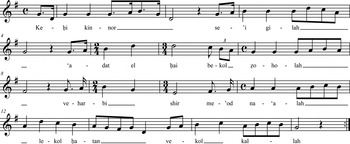
The second melody, from Alessandria, about 28 kilometers (or 17 miles) from Casale Monferrato, in the same region (Piedmont), yet now from the Italiani rite, appears in Example 3.Footnote 71
Alessandria, Italiani, after rendition by Michael Amar recorded by Leo Levi in 1954 (no month or day is specified). (Courtesy, National Sound Archives, Jerusalem, National Library of Israel, Y/00152, item 3)

As in Example 1, the four feet of the two lines are clearly separated, usually by an ornament on the last syllable of the foot with an extension of its last noteFootnote 72 or, less often, by its extension alone.Footnote 73 Again the meter is basically duple, though here with fewer irregularities (two measures in 3/4 time). Dotted-note figures are also fewer;Footnote 74 thus, the rhythm seems smoother. Melodically, line 1, as before, circles about G, touching lower and higher pitches of the triad G-B-D (feet 1–3, yet now without declaiming on B in the third of them) and ending unexpectedly on an F-sharp, the seventh of the mode (foot 4); line 2 begins on G (and not on F-sharp, as in the previous melody) and in its second foot declaims on A (without touching on F-sharp and D, as before), then emphasizes D (foot 3, through a descending scale from d″ to d′, as before), closing again on G (foot 4). The two lines and their root notes can be summarized as follows:

Clearly, the melody from Alessandria (A) is a variant on the one from Casale Monferrato (C-M) or vice versa. But it is also somewhat less interesting. True, in line 1, C-M and A share a surprising cadence, in foot 4, on F-sharp, which serves as a stimulus for tonal variety at the beginning of line 2. But while C-M, for line 1, has foot 2 almost artfully repeat the motive of foot 1 up a fourth, and foot 3 introduces a declamatory figure for variety's sake, A, less articulated in its motives, has feet 1–3 rather aimlessly sound the pitches of a G triad. As for line 2, C-M starts in foot 1, as if by design, from the F-sharp at the end of line 1, then revolves around a dominant triad in foot 2, leaping up an octave, with dramatic effect, to launch foot 3. Yet A, for the same line, positions its first note more blandly on G, then revolves around A in foot 2, moving up a fourth, not an octave, to foot 3. These are minor differences, however, and may reflect the idiosyncrasies of the performers more than the particularities of separate melodies. When all is said and done, the two melodies are of the same cloth, as can be illustrated by their common substructural pitches (G-F#-E-D-G; see above, Example 2).Footnote 75
The third melody is from Pitigliano, in the region of Tuscany, and thus is geographically farthest removed from the previous ones—Pitigliano is about 379 kilometers (or 234 miles) away from Casale Monferrato. Like the one from Alessandria, it belongs to the Italiani rite, but its content is different (see above, Example 4).Footnote 76
Pitigliano, Italiani, after rendition by Azelio Serbi recorded by Leo Levi on 17 February 1954. (Courtesy, National Sound Archives, Jerusalem, National Library of Israel, Y/01301, item 2)

As in the two previous examples, the four feet of the two lines are clearly separated. Unlike them, however, the articulation is generally not achieved through an ornament on the last syllable of the foot with an extension of its last note but, with few exceptions, through extension only.Footnote 77 Indeed, by comparison with the earlier examples, the present one is noticeably less ornamental. Yet the real difference lies in its meter, which is triple (with a few irregularities: 2/4 time in measures 5 and 9, and 4/4 in measure 13). The result is a change in character—the tune is light, joyous, and dancelike, as might befit the revelry of wedding festivities. Melodically, line 1 circles around G, touching on lower and higher notes of its triad (feet 1–2), then moves to the dominant (feet 3–4), unlike the earlier melodies in which the dominant was introduced, via F-sharp, at the end (in foot 4); line 2 begins, as is logical, in the dominant (foot 1), then hits on B and D, the third and fifth of a G triad (foot 2), returning even more conclusively thereafter to G (feet 3–4). Unlike the earlier melodies, the one from Pitigliano has no moments of declamation, nor does it have the dramatic leap of an octave found in the one from Casale Monferrato. All in all, the movement for the two lines is conjunct. Its one “surprise” occurs in line 2, with foot 3 ending not on D, but on C; and its one “anomaly” is in the same line, foot 4, which, by comparison with previous feet, seems more breathless, thus depriving the ending of conclusiveness. The two lines and their root notes can be summarized thus:
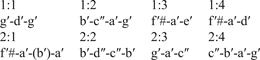
When reduced to essentials, they yield the tonal progression in Example 5 (see above).
The Grundlinie for the melody from Pitigliano

The last example leads back to the question raised at the beginning of this section, namely to what extent can the three melodies to which the poem was sung in the 1950s be related to the one or more hypothetical ones in Archivolti's time? Despite the noticeable melodic, metrical, and rhythmic differences between the Pitigliano melody and the two others, it is clear that all three have the same underlying melodic structure. Bearing this in mind, one might premise, as a reasonable possibility, a prototypical melody for “Keḥi kinnor” over an extended period (as was the case, for example, in “Ha-tikvah,” which can be traced, under different names and shapes in art and folk music, from the early seventeenth century on).Footnote 78 But without evidence from the seventeenth and eighteenth centuries, one can neither confirm nor deny the existence of a prototypical melody or its long-term operability, that is, its structuralist potential for generating variations. Melodies similar to the ones recorded in the 1950s may or may not have been sung in Archivolti's time. It is more likely that they were. But supposition is clearly no substitute for hard evidence.
Wedding Odes by Archivolti and His Contemporaries
I limit the purview, under “contemporaries,” to Leon Modena (d. 1648), the author of thirty-five wedding odes (and, as said before, Archivolti's pupil), and Moses Zacuto (d. 1697), the author of twenty-seven wedding odes.Footnote 79 Beyond “Keḥi kinnor,” Archivolti composed at least two others, if not several more, an assumption that can only be sustained when the full extent of his poetry is uncovered.Footnote 80 Despite the few examples at hand, some preliminary conclusions can be drawn from comparing them with those by Modena and Zacuto. Since broader studies on early Hebrew wedding odes are sparsely found in the literature,Footnote 81 all conclusions here are conditional on further investigation.
There appear to be at least four categories of wedding odes: those written for a particular bride and groom, whose names are indicated in a dedication or incorporated into the verses; those with a riddle to be unraveled (and veiled references to the names of bride and groom), as illustrated particularly by Zacuto;Footnote 82yoẓerot or hymns sung to honor the groom in the morning service of Yom he-ḥatan (the groom's day) on the Sabbath following the wedding;Footnote 83 and those intended to be sung at weddings in general. For present purposes, the second and third categories can be omitted as they form genres unto themselves.
“Keḥi kinnor” belongs to the fourth category while the wedding odes of Modena belong to the first, and those of Zacuto to the first and second. It is probably because of its being unattached to specific individuals that it entered the prayer manuals—those by Modena and Zacuto, at any rate, did not. Archivolti's two other wedding odes are, by contrast, works that, like Modena's and Zacuto's, name their recipients. The first, “ ‘Uri yeḥidati ve-‘anpei tomer” (Awake, my soul,Footnote 84 on branches of a palm tree), in terza rima (with nineteen tercets and a final quatrain), was written for Jacob ben Moses Todros and his bride Penina bat Joseph Levi;Footnote 85 the second, “Im omar lakh gisi” (If I tell you, my brother-in-law), in seven lines (with four feet to a line, each foot composed of six longs), was written for Jacob—no further details are given—and his unnamed bride, who appears to have been Archivolti's sister.Footnote 86
It is in their thematics that the three authors’ poems reveal similarities. Nor does the difference in categories—poems for specific persons, poems for general usage—seem to have been of relevance in determining their content.Footnote 87 Of the various “themes” cited above for “Keḥi kinnor,” two will be illustrated for their centrality: rejoicing and music. The coverage is not meant to be complete. Rather, I focus on certain representative examples.
For “rejoicing,” in its various noun and verb forms, one finds, in Modena's wedding odes, “. . . a prayer for the groom and the bride to make them rejoice [le-samḥam] in joy [gilah] and mirth [rinah]”;Footnote 88 “To the voice of the groom, to the voice of the bride, to the voice of joy [gilah] much happiness [simḥah], / To a full voice in rejoicing [sason] and joy [gil]”;Footnote 89 “On the day of the happiness [simḥah] of your wedding the heart of friends will be glad [yagel] for you, / They will look at the splendor of your glory with much gaiety [ḥedvah]”;Footnote 90 “Happiness [simḥah] for the house of Simḥah for the glory of your name” (the groom's first name was Simcha);Footnote 91 “Isaac [Yiẓḥak] will laugh [yiẓḥak], he will rejoice [yismaḥ], his heart will be glad [yagel]” (the groom's first name was Isaac);Footnote 92 “Thus every heart in Israel will be glad [yagel], will rejoice [yismaḥ], will thank God”;Footnote 93 and “I will say in a voice of joy [sason] and a voice of happiness [simḥah]: let there be further rejoicings [semaḥot] in Israel.”Footnote 94
Zacuto writes in a similar vein: “Beloved ones, friends, be jubilant [ẓahalu]”;Footnote 95 “Joy [sason] and happiness [simḥah], groom and bride, / Mirth [rinah] and rejoicing [gilah], revelry [diẓah] and gaiety [ḥedvah]”Footnote 96 (a restatement of the last of the Seven Blessings);Footnote 97 “. . . on this day . . . every soul will rejoice [tasis] and be happy [tismaḥ]”;Footnote 98 “Honor to God will he give in a voice of rejoicing [sason] and joy [gil]”;Footnote 99 and “[The kingdom of] Judah will be glad [yagel], [the kingdom of] Ephraim will revel [ya‘aloz].”Footnote 100
Rejoicing, it might be noted, was underscored in one of Archivolti's two other wedding odes. “On this day,” the poet writes, “may the groom together with his adornment of great worthies from the community of the sons of Living God noisily approach together in happiness [sason].”Footnote 101 The vocabulary (the groom's attendants, the congregation of a Living God) recalls “Keḥi kinnor.”
Music, too, figured in the same ode in words that connect with “Keḥi kinnor,” or better throw light on its reading. By “Praises and a voice of song [zimrah] in exchange for sacrifice,”Footnote 102 Archivolti implies that with the destruction of the Temple, songs and praises (in the synagogue) substituted for sacrificial rites. Hence the verses, in “Keḥi kinnor,” “And may the voices” be those of a people “thought to be sacrificing the splendor of fattened sheep to an awesome God” (1.2, 2.1) and “And you will hasten . . . to offer a sacrifice and a proper burnt offering” (8.2) may be construed to refer to an offering made through song when, as predicted in the ode, the Temple is rebuilt and its ceremonial reinstated.Footnote 103
Music, for Modena, was a natural way to rejoice in wedding festivities—he argued for it there in a response about the legitimacy of song in the synagogue.Footnote 104 His wedding odes are rife with musical imagery, for example: “. . . on the parting of the Red Sea all broke into song [shirah], including Moses”;Footnote 105 “Friends, lift a psaltery [nevel], a tambourine [tof] with a pleasant lyre [kinnor] for his [the groom's] happiness”;Footnote 106 “Now will those lift a voice of gladness and a song [shir] who pluck a tune [niggun] on a psaltery [nevel]”;Footnote 107 or “Kithara [kidros] and the voice of a sambuca [sabkha], psaltery [psanterin], tambourines [tupin] and lyres [kinnorin] and all [kinds of] song [zimra].”Footnote 108 Modena composed a particularly memorable ode for the wedding of David Portaleone, son of Abraham Portaleone, who, in his treatise on the ancient temple Shiltei ha-gibborim [Shields of Heroes], spoke of King David's lyre that, hanging over his bed, played of itself at midnight.Footnote 109 The first five distichs of Modena's ode read thus:
Zacuto followed suit with a similar wedding ode dedicated to David ben Abraham Ferrara and his bride Leah bat Immanuel Vallensi.Footnote 111 Its first stanza reads:
Zacuto's musical images are all the more interesting for their being less conventional at times than Modena's. The poet writes: “By the hearing of my ear I heard a poet [meshorer] and singer [mezammer] finish / Praises in our streets [and reach] the depths of song [shir] with the sound of melody [zemer]”;Footnote 116 “All bearers of song [ba‘alei shir]: gird your loins, shout [ẓahlu] in a voice of shouting [ẓoholah] and with cymbals [meẓiltayim]; / Get ready, also prepare your throat and palate, lips and tongue and teeth; / Let singers [sharim] come first and players [nogenim] follow them; / Give praise to residents of the heavens”;Footnote 117 “If poets [shorerim] sing [sharim] to the song [shir] of singers [sharim]”;Footnote 118 “I will come with a special song [shir], / I will make pleasant melodies [zemirot] of mirth [gil] and put together songs [shirim]”;Footnote 119 “From the opening of the lips of the song [shir] and of the doors of the tune [zemer] / There is no end to the praise and glory of this couple”;Footnote 120 and as a paean to poetico-musical inspiration, “The wing of song [shirah] will rise in flight, / In flight will rise the melody of melodies [zimrat zimrah]; / Awake, awake, praises [in song] are fancied, / [Sing] a song [shir] to the chief musician [menaẓẓeaḥ] on a shoshan.”Footnote 121
Epilogue
Archivolti's “Keḥi kinnor” commands interest for at least three reasons. First, it is a wedding ode that, to all appearances, won such popularity as to be printed and reprinted in earlier and later prayer manuals. In this it holds its own against Modena's and Zacuto's wedding odes, which, because of their specificity in being composed for particular weddings, were excluded from them. Who the addressee was in “Keḥi kinnor” is uncertain. It could have been a specific bride and groom, or brides and grooms in general, or, on a metaphoric level, the congregation rejoicing in their nuptials or its members as an emblem for Jews at large.
Second, it contains melodies that, because of their common substructural pitches, raise the possibility of a connection with one or more unknown tunes to which the text was sung in Archivolti's time. Serious questions of methodology come to the fore. To what extent does a prototypical melody, such as the one plotted above, testify to historical longevity? To what extent does it apply if not in fact, at least in theory to the determination of earlier melodies? Distance between communities and not their ritual affiliation seems to have engendered the differences between the three melodies recorded in the 1950s, but can one premise the same for melodies sung to one or another text in the seventeenth and eighteenth centuries?
A third reason is its content. The poet suggests that those who rejoice in the bride and groom rejoice in God and Torah: voices of gladness, among them the voice of God, correlate with the voices that preceded the revelation of his laws (1.1–2.1 and comment to 1.1). Marriage as the union of bride and groom is an allegory for the union of God with his people. The union is premised on the centrality of Torah as a behavioral and ethical guide.
The supreme legislator is a “Living God” (R.1), “living” because, by “keeping His commandments and His statutes and His judgments” as prescribed in Torah, his people “will live and multiply” (Deuteronomy 30:16). “Choose life,” for “He is your life” (30:19–20). The “Living God” is “the spirit of life,” his words are “on our tongue,” as said in the refrain to another wedding ode close to “Keḥi kinnor” in the printed sources:Footnote 122
We are told, in the continuation, that he hearkens to our pleas, responding from the heights (“On earth we will call and You will answer us / And the mountains answer before us: / In the name of Living God”)Footnote 123 and that, as our Creator, he undertakes our protection and at the end of time will see to our revival:
The “hidden” connections, in Archivolti's “Keḥi kinnor,” between marriage, Torah, and renewal emerge with full clarity in a passage from Zohar.Footnote 125 Like the last of the Seven Blessings, it cites voices of merriment after Jeremiah, then draws them into the domain of the Song of Songs, only to form its own conclusions. The passage reads thus:
The Holy One, blessed be He, will make a [wedding] canopy in Jerusalem for every righteous man. It is written: “. . . the voice of mirth, and the voice of gladness, the voice of the bridegroom, and the voice of the bride” [Jeremiah 16:9] when the Shekhinah returns to the King and He becomes engaged to her, as it is written: “Go forth, O daughters of Zion, and behold . . . on the day of His wedding, and on the day of the gladness of His heart” [Song of Songs 2:11]. “The day of His wedding” is the giving of Torah, and “the day of the gladness of His heart” is the building of the Temple, may it be built soon in our days.Footnote 126
We learn, as the conceptual backdrop for Archivolti's verses, that the wedding of bride and groom is the wedding of the Shekhinah and the King, namely, God as manifest in one of his attributes (Tif'eret). The King is the King of Glory, who, as predicted in Psalms 24:9, will “enter” when the gates of heaven are lifted (see epigraph). On the day of his wedding one hears joyful voices. It was the day on which Torah was given and the day on which the Temple was built (see comments to 1.1 and 2.1). But these are images projected into a future messianic era, to be introduced when the Temple is reconstructed (see comment to 2.2): Torah and Temple are to be understood in a universal sense. It could be that Archivolti said something to this effect in the missing comments to the concluding verses in the autograph copy.
Reference was already made to Archivolti's second wedding ode (“ ‘Uri yeḥidati ve-‘anpei tomer”). It may hold the key to these same missing comments. Its verses mark the coming of the Messiah as a return to origins, a paradisiac situation with no blight of sin, no suffering from exile. As in the berit shalom assured by the wedding contract in “Keḥi kinnor” (5.1), so here the covenant of peace that God signed with his people will guarantee their security forever after. But unlike the Garden of Eden that gave humans life but denied them wisdom, the new era will provide them with both. The concluding stanza reads:
The true meaning of “cleaving to each other” in the next-to-last line above is revealed, as is perhaps another “hidden message” in “Keḥi kinnor,” in a further passage from Zohar. It speaks of “the Holy Ancient One [‘Atika Kadisha], the hidden of hiddens, separate and divided from everything, yet not separate, since everything cleaves [mitdabbek] to Him and He cleaves to everything; He is everything.”Footnote 128 Ineffable happiness lies in the “wedding” of humans both with one another, as a man who “cleaves” to his wife,Footnote 129 and with “the Holy Ancient One,” as God's creatures who “cleave” to their Maker.Footnote 130 Bound by his covenant, he, in turn, “cleaves” to them for their own protection.Footnote 131
Appendix 1 Keḥi Kinnor
after the autograph along with the author's comments there
Inscription
פיוט לחתן וכלה חיברתיו לבקשת ר׳ יצחק לוצאטו יצ״ו [ישמרהו צורו ויחיהו]
Piyyut le-ḥatan ve-khallah ḥibartiv le-vakashat Rabbi Yiẓḥak Luẓato yishmerehu Ẓuro vi-yeḥayyehu
Piyyut for a groom and a bride: I composed it upon the request of Rabbi
Isaac Luzzatto (may the Rock preserve him and give him life!)Footnote 133
Refrain (Distich 1)
R.1 קְחִי כִּנּוֹר . שְֹאִי גִילָה / עֲדַת אֵל חַי . בְּקוֹל צַהְלָה
Keḥi kinnor .se'i gilah / ‘adat El Ḥai .be-kol ẓahlah
Take a lyre,Footnote 134. lift your joy, / O congregation of Living God, . in a voice of merriment;Footnote 135
R.2 וְהַרְבִּי שִׁיר . מְאֹד נַעְלָה / לְקוֹל חָתָן . וְקוֹל כַּלָּה:
Ve-harbi shir .me'od na‘lah / le-kol ḥatan .ve-kol kallah
And sing many songs,Footnote 136. greatly exalted,Footnote 137 / to the voice of the groom . and the voice of the bride.Footnote 138
Stanza 1 (Distichs 2–3)
1.1 מְשֹוֹשֹ חָתָן . יְהִי אֵיתָן / לְשׁוֹשְׁבִינָיו . בְּסוֹד תּוֹרָה
Mesos ḥatan .yehi eitan / le-shosh′vinav .be-sod Torah
May the rejoicing of the groomFootnote 139. be strong, / for his attendants,Footnote 140. in the secrets of Torah
Comment to 1.1
בפ״ק [בפרק קמא] דברכות א״ר [אמר רבי] חלבו כל הנהנה מסעודת חתן ואינו משמחו עובר בה׳ קולות וכו׳ ואם משמחו זוכה לתורה שנתנה בה׳ קולות
Be-ferek kamma di-Verakhot amar Rabbi Ḥelbo kol ha-neheneh mi-se‘udat ḥatan ve-eino mesamḥo ‘over be-ḥamishah kolot ve-khulei ve-im mesamḥo zokheh le-Torah she-nitnah be-ḥamishah kolot
In the first chapter of Berakhot [one reads]:Footnote 141 “Rabbi Ḥelbo said . . . :Footnote 142 ‘Anyone who enjoys the banquet of the groom and does not rejoice with him does violence to the five voices,’ ” and so forth,Footnote 143 “ ‘and if he does rejoice with him . . . ,Footnote 144 he acquires [the knowledge of] Torah which was given with five voices.’ ”
1.2 וְהַקּוֹלוֹת . תְּמוּר קוֹלוֹת / נְתוּנִים הֵם . לְעַם נִבְרָא
Ve-ha-kolot .temur kolot / netunim hem .le-‘am nivra
And may the voices, . instead of voices,Footnote 145 / be givenFootnote 146. to a created peopleFootnote 147
2.1 וְנֶחְשָׁבִים . כְּמַקְרִיבִים / יְקַר כָּרִים . לְאֵל נוֹרָא
Ve-neḥshavim .ke-makrivim / yekar karim .le-El nora
ThoughtFootnote 148. to be sacrificing / the splendor of fattened sheepFootnote 149. to an awesome God
Comment to 2.1
ר׳ אבהו אמר כאלו הקריב תודה
Rabbi Abbahu amar ke-ilu hikriv todah
Rabbi Abbahu said [it was] as if heFootnote 150 sacrificed a thanksgiving offering.Footnote 151
2.2 וּבוֹנִים לָהּ . לְמַפֵּלָה / לְשֵׁם לִפְאֵר . וְלִתְהִלָּה:
U-vonim lah .le-mappelah / le-shem li-f′’er .ve-li-t′hillah
And to be building it,Footnote 152. from ruin,Footnote 153 / for its fame, praise, . and glory.
Comment to 2.2
רב נחמן ב״ר [בן רב] יצחק כאלו בנה א׳ מחרבות ירושלים
Rav Naḥman ben Rav Yiẓḥak ke-ilu banah aḥat mi-ḥurvot Yerushalayim
Rav Naḥman ben Rabbi Isaac [said it was] as if he [re]built one of the ruins of Jerusalem.Footnote 154
Refrain (Distich 1)Footnote 155
קחי כנור שאי גילה
Stanza 2 (Distichs 4–5)
3.1 וּבִתְרוּעָה . גְדוֹל דֵּעָה / יְהִי סוֹבֵב . כְּאִישׁ טוֹחֵן
U-vi-t′ru‘ah .gedol de‘ah / yehi sovev .ke-ish toḥen
In jubilation . may a great man of learningFootnote 156 / circle about,Footnote 157. as a miller,Footnote 158
Comment to 3.1
כיצד מרקדין לפני הכלה וכו׳ [בכתובות פ׳ [פרק] האשה ת״ר [תנו רבנן
Bi-Khetubot perek ha-ishah tanu rabbanan keiẓad merakkedin li-fenei ha-kallah ve-khulei
In Ketubbot, chapter “The woman,” our rabbis taught: “How do they dance before the bride?” and so forth.Footnote 159
3.2 הֲדַר כַּלָּה . וְחֵן חֵן לָהּ / וְזִיו יָפְיָהּ . יְהִי בוֹחֵן
Hadar kallah .ve-ḥen ḥen lah / ve-ziv yofyah .yehi voḥen
The splendor of the bride . with all her graces,Footnote 160 / and the glow of her loveliness . may he examine;Footnote 161
4.1 וְהוֹד תִּנְחַל . דְּלָא כֵּחָל / וְלֹא שֵֹרָק . וְיַעְלָת חֵן
Ve-hod tinḥal .de-lo keḥal / ve-lo serak .ve-ya‘′lat ḥen
And she will attain majesty . not by being powdered / or paintedFootnote 162. but as a graceful gazelle,Footnote 163
Comment to 4.1
ועוד שם משרו קמי כלתא במערבא לא כחל ולא שרק ולא פרכוס וכו׳
Ve-‘od sham mesharu kammai kalleta be-ma‘arava lo keḥal ve-lo serak ve-lo firkus ve-khulei
And there further: “They sing before the bride in the West without her being powdered or painted or having waves [in her hair],” and so forth.Footnote 164
4.2 וְאֶל מוּלָהּ . כְּבוֹד בַּעֲלָהּ / וּבִימִינָהּ . וּבִשְֹמֹאלָהּ:
Ve-el mulah .kevod ba‘alah / u-vi-y′minah .u-vi-s′molah
And across from her . is her honored husband,Footnote 165 / while to her right . and her left
Comment to 4.2
במשנת פ׳ [פרק] אע״פ [אף על פי] מלאכות שאשה עושה לבעלה
Be-mishnat perek af-‘al-pi mal'akhot she-ishah ‘osah le-va‘alah
[See], in Mishnat [Torah], the chapter about the restrictions on things a woman does to [attract] her husband.Footnote 166
Refrain (Distich 1)
קחי כנור שאי גילה
Stanza 3 (Distichs 6–7)
5.1 שְׁנֵי דּוֹדִים . מְכוּבָּדִים / בְּרִית שָׁלוֹם . בְּמִשְׁכָּנָם
Shenei dodim .mekhubbadim / berit shalom .be-mishkanam
Two beloved ones . of eminence / have a contract of peace . in their dwelling.Footnote 167
Comment to 5.1
בפ׳ [בפרק] הבא על יבימתו המכבדה יותר מגופו עליו הכתוב אומר וידעת כי שלום אהלך ובפ׳ [ובפרק] הזהב אוקירו נשייכו כי היכי דתתעתרו
Be-ferek ha-ba ‘al yevimto ha-mekhabbedah yoter mi-gufo ‘alav ha-katuv omer va-yadaʿta ki shalom oholekha u-ve-ferek ha-zahav okiru neshaikhu ki heikhi de-tit‘atteru
In the chapter “If a man cohabited with his deceased brother's wife” [i.e., the childless widow of his brother]Footnote 168 [one reads]: “. . .Footnote 169 who honors her [his wife] more than his own self . . . ,Footnote 170 about which it is said [in Scripture]: ‘Then you shall know that your tent is in peace,’ ”Footnote 171 and in the chapter “The gold”Footnote 172 [one reads]: “Honor your wives in order for you to be enriched.”Footnote 173
5.2 בְּרֹב בָּנִים . מְהוּגָנִים / וְאֵין רָזוֹן . בְּמִשְׁמַנָּם
Be-rov banim .mehuganim / ve-ein razon .be-mishmannam
With many sons [will she be blessed,Footnote 174. and they will be] respected / and know no scarcity . in their prosperity;
6.1 עֲלִיצוֹתָם . וְשִֹמְחָתָם / בְּיִצְהָרָם . וְגַם יֵינָם
‘Aliẓotam .ve-simḥatam / be-yiẓharam .ve-gam yeinam
Their cheerfulnessFootnote 175. and happiness / is in their oil . as well as their wine.Footnote 176
6.2 :וְהַכַּלָּה . בְּלִי עַצְלָה / תְּשָׁרֵת אֶת . פְּנֵי בַעֲלָהּ
Ve-ha-kallah .beli ‘aẓlah / tesharet et .penei va‘alah
And the bride . without idleness / will serve . her husband.Footnote 177
Comment to 6.2
אמרו במדרש שחכמה א׳ [אחת] צותה לבתה כשהיתה מוליכה לבית בעלה כך עמדי לפני המלך ותשרתהו
Ameru be-midrash she-ḥakhamah aḥat ẓivtah le-vitah ke-she-hayetah molikhah le-veit ba‘alah kakh ‘imdi lifnei ha-melekh va-tesharetehu
They said in a parable that one wise woman would command her daughter when she led her to her husband's house: “Stand thus before the king,” and she served him.Footnote 178
Refrain (Distich 1)
קחי כנור שאי גילה
Stanza 4 (Distichs 8–9)
7.1 נְתַנֶּה שִׁיר . וְגַם נַישִׁיר / לְאֵל עֶלְיוֹן . תְּהִלָּתוֹ
Netanneh shir .ve-gam naishir / le-el ‘elyon .tehillato
Let us deliver a songFootnote 179. and also direct, / to the Supreme God, . His praises,Footnote 180
7.2 וְיָחוֹן עָם . אֲשֶׁר נִפְעַם / כְּמוֹ כָּתוּב . בְּסִפְרָתוֹ
Ve-yaḥon ‘am .asher nif‘am / kemo katuv .be-sifrato
And He will spare the people . who are troubled, / as is written . in His book.Footnote 181
8.1 וּמִקְדָּשׁוֹ . מְעוֹן קָדְשׁוֹ / יְכִינֵהוּ . כְּדִבְרָתּוֹ
U-mikdasho .me‘on kodsho / yekhinehu .ke-divrato
His Temple, . the home of His sanctity, / will He prepare for them, . as He promised;Footnote 182
8.2 וְתָחִישׁ לָהּ . מְהוּלָלָה / לְהַקְרִיב שַׁי . וְדֵי עוֹלָה:
Ve-taḥish lah .mehulalah / le-hakriv shai .ve-dei ‘olah
And you will hasten unto it,Footnote 183. in its glory, / to offer a sacrifice . and a proper burnt offering.
Refrain (Distich 1)
קחי כנור שאי גילה
Appendix 2 Sources of “Keḥi Kinnor”
I. Catalog Listing (for Prints)
Israel Davidson, comp. Oẓar ha-shirah ve-ha-piyyut mi-zeman ḥatimat kitvei ha-kodesh ‘ad reshit tekufat ha-haskalah [Thesaurus of Medieval Hebrew Poetry from the Time of the Completion of Scriptures to the Beginning of the Period of Enlightenment]. 4 vols. New York: Beit midrash ha-rabbanim de-Amerikah, 1925–33; repr. New York: KTAV, 1970. 3:343, sec. 316.
II. Autograph
Archivolti inscribed the poem together with its heading and comments to eight of the eighteen verses on the recto of the final endleaf (itself followed by a blank flyleaf) of his copy of David Kimḥi's Sefer mikhlol [An All-Inclusive Book] (Venice: Bomberg, 1545). New York, Jewish Theological Seminary, shelf location identifier SHF 1987:13.
III. ManuscriptsFootnote 184
Amsterdam, Gans, D 68, entitled Seder berit milah [Ritual for the Ceremony of Circumcision], from nineteenth century, fol. 68b, with the inscription “Piyyut le-ḥatan” (Piyyut for a Groom). Microfilm copy in Jerusalem, National Library of Israel, no. 41279.Footnote 185
Jerusalem, Meir Benayahu, 141, entitled Seder nisu'in [Ritual for Weddings], from nineteenth century; appears twice, pp. [7–8] and [9–10], with the inscription “Piyyut she-yised ha-rav Arkivolti le-ḥatanim” (Piyyut that Rabbi Archivolti formed for persons to be wed). Microfilm copy in Jerusalem, National Library of Israel, no. 44579.
London, the Valmadonna Trust Library, 122, entitled Rinah u-tefilah ve-taḥanunim [Joy and Prayer and Supplications], from 1870–74, pp. 172–73, with the inscription “Le-Rabbi Shemu'el Arkivolti” (by Rabbi Samuel Archivolti). Microfilm copy in Jerusalem, National Library of Israel, no. 46029.Footnote 186
New York, Jewish Theological Seminary, 4104, entitled Zemirot u-renanim [Songs and Hymns], copied in 1752 by Solomon ben Yeḥiel Ḥai Vital, fol. 49a, with the inscription “Pizmon le-ḥatan she-ḥiber Shemu'el Arkivolti laḥan ‘Aftir lashon’ ” (Song for a groom, composed by Samuel Archivolti [and sung to] the tune [of] “Aftir lashon” [I will release my tongue]). Microfilm copy in Jerusalem, National Library of Israel, no. 25006.
“Aftir lashon” was a pizmon le-ḥatan ve-kallah (song for a groom and bride) by David Samuel ben Jacob Pardo (1718–90): for the text, so inscribed, see Eliezer ben Shem Tov Papo, Sefer appei zutrei [Book of Small Faces] (Sarajevo: n.p., 1876), 149–50. Though metrically identical with “Keḥi kinnor,” it lacks a refrain and has a total not of nine distichs (including that of the refrain), but of six. But the difference is of no significance, for, as is clear, “Keḥi kinnor” was meant to be sung to “the tune” of “Aftir lashon,” which tune would have been introduced in the refrain and repeated in the successive distichs. Pardo's distich 1 reads thus (vowel signs have been added):
1.1 אַפְטִיר לָשׁוֹן . לְאֵל רִאשׁוֹן . יִשְׁמוֹר אִישׁוֹן . בְּכָל שָֹשֹוֹן
Aftir lashon .le-el rishon .yishmor ishon .be-khol sason
I will release my tongue . to the Prime God; . He will keep His eyes open [to protect us] . in all rejoicing,
1.2 כִּי בִּבְרָכָה . וּבִרְוָחָה . גַם הַצְלָחָה . וְכָל שִֹמְחָה
Ki bi-v′raḥah .u-vi-r′vaḥah .gam haẓlaḥah .ve-khol simḥah
For with His blessing . and in comfort . will there also be success . and all happiness.
IV. Prints (in Three Different Series)
1. Davar be-‘itto
1653
Davar be-‘itto: re'eh natatti le-faneikha et ha-ḥayyim ve-et ha-tov ve-et ha-mavet u-vaḥarta ba-ḥayyim . . . pizmonim na'im she-nohagim le-zammeram . . . bi-verit milah . . . ‘im birkat ha-se‘udah u-virkhot eirusin ve-nisu'in ‘im pizmonim . . . [“Everything in its time” (Proverbs 15:23): “Look, I presented you with life and prosperity and death” (Deuteronomy 30:15) “and you chose life” (30:19). Pleasant Pizmonim (songs) that One is Accustomed to Sing . . . for Circumcisions . . . with a Table Blessing and Blessings for Engagement and Marriage with Pizmonim . . . ]. Leghorn: Yedidyah Gabbai, 1653, fols. 19b–20b, with the inscription “Piyyut le-ḥatan ve-kallah le-Rabbi Shemu'el Arkivolti zekher ẓaddik li-verakhah” (Piyyut for a groom and a bride by Rabbi Samuel Archivolti, may his saintly memory be blessed!). Copy in Jerusalem, National Library of Israel, shelf mark S 2001 A 10204.
2. Siddur mi-berakhah
1618
Siddur mi-berakhah ke-minhag kehilot kodesh Italyani yishmerehem Ẓuram vi-yeḥayyehem: ‘im seder ha-berakhot u-feirushan [Siddur with Blessings According to the Rite of the Sacred Community of Italiani, May their Rock Preserve them and Give them Life! With the Order of Blessings and their Explanation]. Venice: Pietro e Lorenzo Bragadini (in the printing shop of Giovanni Calleoni), 1618, sig. 10:2a–b [fol. 73a–b], with the inscription “Piyyut le-ḥatan ve-kallah le-Rabbi Shemu'el Arkivolto zekher ẓaddik li-verakhah” (Piyyut for a groom and a bride by Rabbi Samuel Archivolto [sic], may his saintly memory be blessed!). Copy in Jerusalem, National Library of Israel, shelf mark R 0 75 A 689.
1623
Siddur mi-berakhah ke-minhag kehilot kodesh Ashkenazim yishmerehem Ẓuram vi-yeḥayyehem [Siddur with Blessings According to the Rite of the Sacred Community of Ashkenazim, May their Rock Preserve them and Give them Life!]. Venice: Pietro e Lorenzo Bragadini (in the printing shop of Giovanni Calleoni), 1623, sig. 4:1a–b [fol. 20a–b], with the inscription “Piyyut le-ḥatan ve-kallah le-morenu ha-rav Rabbi Shemu'el Arkivolti” (Piyyut for a groom and a bride by our teacher Rabbi Samuel Archivolti). Copy in Jerusalem, National Library of Israel, shelf mark R 0 86A 554.
1627
Siddur mi-berakhah . . . [Siddur with Blessings . . . ]. Davidson, Oẓar 3:343, sec. 316, with “Keḥi kinnor” on fol. [73]. I could not trace a copy of this volume, but it seems to be a reprint of 1618.
1641
Siddur mi-berakhah ke-minhag kehilot kodesh benei Roma: kolel kol mah she-ba ba-rishonim [Siddur with Blessings According to the Rite of the Sacred Community of Benei Roma, Including all Basic Things]. Venice: Giovanni Vendramin (in the printing shop of Giovanni Martinelli), 1642, fol. 70a–b, with the inscription “Piyyut le-ḥatan ve-kallah le-Rabbi Shemu'el Arkivolti zekher ẓaddik li-verakhah” (Piyyut for a groom and a bride by Rabbi Samuel Archivolti, may his saintly memory be blessed!). Microfilm copy in Jerusalem, National Library of Israel, no. 98 F 75.
1673
Siddur mi-berakhah ke-minhag kehilot kodesh benei Roma [Siddur with Blessings According to the Rite of the Sacred Community of Benei Roma]. Venice: Bragadin, 1673, fol. 70a–b, with the inscription “Piyyut le-ḥatan ve-kallah le-Rabbi Shemu'el Arkivolti zekher ẓaddik li-verakhah” (Piyyut for a groom and a bride by Rabbi Samuel Archivolti, may his saintly memory be blessed!). Copy in New York, Jewish Theological Seminary, shelf mark BM675.B4 A3 1673.Footnote 187
1693
Siddur mi-berakhah ke-minhag kehilot kodesh Italyani yishmerehem Ẓuram vi-yeḥayyehem ‘im seder kol ha-berakhot u-feirushan [Siddur with Blessings According to the Rite of the Sacred Community of Italiani, May their Rock Preserve them and Give them Life! With the Order of All Blessings and their Translation]. Ferrara: Joseph Nissim and Abraham Ḥayyim of Fano (in the printing shop of Filoni), 1693, fols. 124a–126a, with the inscription “Piyyut le-ḥatan ve-kallah le-Rabbi Shemu'el Arkivolto zekher ẓaddik li-verakhah” (Piyyut for a groom and a bride by Rabbi Samuel Archivolto [sic], may his saintly memory be blessed!). Copy in Jerusalem, National Library of Israel, shelf mark R 8 = 23 V 3325.
1698
Siddur mi-berakhah ke-minhag kehilot kodesh Ashkenaz . . . [Siddur with Blessings According to the Sacred Rite of Ashkenaz . . . ]. Venice: Vendramin, 1698, fols. 23b–24b, with the inscription “Piyyut le-nisu'in, piyyut le-Rabbi Shemu'el Arkivolti zekher ẓaddik li-verakhah” (Piyyut for a wedding, piyyut by Rabbi Samuel Archivolti, may his saintly memory be blessed!). Copy in Jerusalem, National Library of Israel, shelf mark R 8 = 76 A 577.
1716
Siddur mi-berakhah ke-minhag kehilot kodesh Ashkenazim yishmerehem Ẓuram vi-yeḥayyehem: kolel kol mah she-ba ba-rishonim ve-hosafnu bo ha-mizmorim shel yemei ha-shavua‘: nidpas le-ta'avat ve-li-teshukat ha-na‘ar ha-na‘im Yosef Maẓliaḥ ben ha-gevir ha-meromam ‘al kol berakhah u-tehillah [Siddur with Blessings According to the Rite of the Sacred Community of Ashkenazim, May their Rock Preserve them and Give them Life! Including All Basic Things, to Which We Added Psalms for the Days of the Week. Printed for the Delight and Pleasure of Joseph Maẓliaḥ, Son of the Lord “Exalted above every blessing and praise” (Nehemiah 9:5)]. Venice: Nella Stamparia Bragadina, 1716, fols. 15b–16a, with the inscription “Piyyut le-ḥatan le-Rabbi Shemu'el Arkivolti zekher ẓaddik li-verakhah” (Piyyut for a groom by Rabbi Samuel Archivolti, may his saintly memory be blessed!). Copy in Jerusalem, National Library of Israel, shelf mark R 8 = 23 V 3317.
3. Siddur berakhah
1708
Siddur berakhah ke-minhag kehilot kodesh benei Roma . . . [Siddur of Blessings According to the Sacred Rite of Benei Roma . . . ]. Venice: Bragadin, 1708, fol. 55a–b, with the inscription “Canto per il sposo, e sposa, composto dal Ecc.[ellente] Rabi Samuel Archivolti B.[eatae] M.[emoriae]” (Song for the groom and bride, composed by the excellent Rabbi Samuel Archivolti, of blessed memory”). Copy in Jerusalem, National Library of Israel, shelf mark R 0 72 A 275.
1731
Siddur berakhah . . . [Siddur of Blessings . . . ]. Davidson, Oẓar 3:343, sec. 316, with “Keḥi kinnor” on fol. 45. I could not trace a copy of this volume, yet, to judge from its foliation for “Keḥi kinnor,” it appears to be identical to 1737.
1737
Siddur berakhah ke-minhag kehilot kodesh Italyani, yagen ‘aleihem Elohim, con tutte le dichiarationi in volgare, & l'haggadah con la sua cerimonia ben distinta . . . [Siddur of Blessings According to the Sacred Rite of the Italiani, May God Protect them! With All the Explanations in Italian and the Haggadah with its Very Clear Ceremonial . . . ]. Venice: Bragadin, 1737, fol. 45a–b, with the inscription “Canto composto per li Sposi dal E.[ccellente] R.[abbi] Samuel Archivolti B.[eatae] M.[emoriae]” (Song composed for the wedding couple by the excellent Rabbi Samuel Archivolti of blessed memory). Copy in Jerusalem, National Library of Israel, shelf mark R 8 = 40 A 193.
1739
Siddur berakhah ke-minhag kehilot kodesh benei Roma yishmerehem Ẓuram vi-yeḥayyehem [Siddur of Blessings According to the Sacred Rite of Benei Roma, May their Rock Preserve them and Give them Life!], fol. 51b, with the inscription “Canto composto per li sposi dal E.[ccellente] R.[abbi] Samuel Archivolti B.[eatae] M.[emoriae]” (Song composed for the wedding couple by the excellent Rabbi Samuel Archivolti of blessed memory). Venice: Vendramin, 1739. Copy in Jerusalem, National Library of Israel, shelf mark R 8 = 50 A 1281.
V. Similarly Entitled Prints from Which “Keḥi kinnor” Was Excluded
1556
Davar be-‘itto: mah tov . . . [“Everything in its time: How good it is . . .”]. Ferrara: Abraham Oshki, 1556. Copy in Jerusalem, National Library of Israel, shelf mark R 8 = 60 A 937.
1578
Siddur mi-berakhah ke-minhag kehilot kodesh benei Roma ‘im seder kol ha-berakhot u-peirushan [Siddur with Blessings According to the Sacred Rite of the Benei Roma with the Order of All the Blessings and their Translation]. Mantua: Meir ben Ephraim, 1578 (described on title page as third printing). Copy in Jerusalem, National Library of Israel, shelf mark R 8 = 93 A 2500.
1617
Siddur berakhah ke-minhag kahal kadosh Sefarad [Siddur of Blessings According to the Sacred Rite of Sefarad]. Venice: Pietro e Lorenzo Bragadin (in the printing shop of Giovanni Calleoni), 1617 (described on title page as fourth printing). Copy in Jerusalem, National Library of Israel, R 0 81 A 527.
1698
[Siddur mi-berakhah] [Siddur with Blessings]. Venice: [Bragadin], 1698. Copy in Jerusalem, National Library of Israel, R 0 89 A 510 (the title page is missing).