


1. INTRODUCTION
In this decade, vital researches on laser-driven plasma-based acceleration of charged particles have achieved great progress in high-energy, high-quality electron beams with energies of GeV-level (Leemans et al., Reference Leemans, Nagler, Gonsalves, Toth, Nakamura, Geddes, Esarey, Schroeder and Hooker2006; Clayton et al., Reference Clayton, Ralph, Albert, Fonseca, Glenzer, Joshi, Lu, Marsh, Martins, Mori, Pak, Tsung, Pollock, Ross, Silva and Froula2010; Lu et al., Reference Lu, Liu, Wang, Wang, Liu, Deng, Xu, Xia, Li, Zhang, Lu, Wang, Wang, Liang, Leng, Shen, Nakajima, Li and Xu2011), qualities of 1%-level energy spread (Kameshima et al., Reference Kameshima, Hong, Sugiyama, Wen, Wu, Tang, Qihua Zhu, Gu, Zhang, Peng, Kurokawa, Chen, Tajima, Kumita and Nakajima2008), 1-mm-mrad-level transverse emittance (Karsch et al., Reference Karsch, Osterhoff, Popp, Rowlands-Rees, Major, Fuchs, Marx, Hörlein, Schmid, Veisz, Becker, Schramm, Hidding, Pretzler, Habs, Grüner, Kraus and Hooker2007), and 1-fs-level bunch duration (Lundh et al., Reference Lundh, Lim, Rechatin, Ammoura, Ben-Ismaïl, Davoine, Gallot, Goddet, Lefebvre, Malka and Faure2011), ensuring that the stability of reproduction is as high as that of present high-power ultra-short-pulse lasers (Osterhoff et al., Reference Osterhoff, Popp, Major, Marx, Rowlands-Rees, Fuchs, Geissler, Hörlein, Hidding, Becker, Peralta, Schramm, Grüner, Habs, Krausz, Hooker and Karsch2008; Hafz et al., Reference Hafz, Jeong, Choi, Lee, Pae, Kulagin, Sung, Yu, Hong, Hosokai, Cary, Ko and Lee2008). These high-energy high-quality particle beams make it possible to open the door for a wide range of applications in fundamental researches, medical, and industrial uses. For many applications of laser wakefields accelerators, stability and controllability of the beam performance such as beam energy, energy spread, emittance, and charge are indispensable as well as compact and robust features of the system. In particular, there are great interests in applications for high energy physics and astrophysics that explore unprecedented high-energy frontier phenomena much beyond 1 TeV, for which laser-plasma accelerator concepts provide us with promising tools if beam-quality issues are figured out as well as an achievable highest energy.
To date, most of experimental results have been obtained from interaction of ultra-short laser pulses, τL = 30 − 80 fs with a short-scale plasma such as a few mm long gas jet and a few centimeter long plasma channel at the plasma density in the range of n p = 1018−1019 cm−3, where a large amplitude plasma wave on the order of 100 GV/m is excited and likely candidates for the next generation of compact accelerators (Nakajima, Reference Nakajima2000; Malka, Reference Malka2002; Weber et al., Reference Weber, Riazuelo, Michel, Loubere, Walraet, Tikhonchuk, Malka, Ovadia and Bonnaud2004). The leading experiments that demonstrated the production of quasi-monoenergetic electron beams (Mangles et al., Reference Mangles, Murphy, Najmudin, Thomas, Collier, Dangor, Divall, Foster, Gallacher, Hooker, Jaroszynski, Langley, Mori, Norreys, Tsung, Viskup, Walton and Krushelnick2004; Geddes et al., Reference Geddes, Toth, Tilborg, van, Esarey, Schroeder, Bruhwiler, Nieter, Cary and Leemans2004; Faure et al., Reference Faure, Glinec, Pukhov, Kiselev, Gordienko, Lefebvre, Rousseau, Burgy and Malka2004; Glinec et al., Reference Glinec, Faure, Pukhov, Kiselev, Gordienko, Mercier and Malka2005), have been elucidated in terms of self-injection and successive acceleration of electrons in the nonlinear wakefield, referred to as a “bubble” that is a region where plasma electrons are blown out by radiation pressure of a laser pulse with the relativistic intensity given by its normalized vector potential a L = eA L/mc 2≫1, where A L is the peak amplitude of the vector potential and mc2 is the rest energy of electron (Kostyukov et al., Reference Kostyukov, Pukhov and Kiselev2004; Lu et al., Reference Lu, Huang, Zhou, Mori and Katsouleas2006). The self-injection is a robust method relying on self-focusing and self-compression that occur during the propagation of relativistic laser pulses. In this mechanism, initially heated electrons with large transverse momentum are injected into nonlinear wakefields that excite betatron oscillation of accelerated electrons due to strong focusing field. Hence, suppressing the self-injection and the deterioration of beam qualities, high-quality electron beams required for most of applications have been produced with controlled injection schemes, such as colliding optical injection (Faure et al., Reference Faure, Rechatin, Norlin, Lifschitz, Glinec and Malka2006; Kotaki et al., Reference Kotaki, Daito, Kando, Hayashi, Kawase, Kameshima, Fukuda, Homma, Ma, Chen, Esirkepov, Pirozhkov, Koga, Faenov, Pikuz, Kiriyama, Okada, Shimomura, Nakai, Tanoue, Sasao, Wakai, Matsuura, Kondo, Kanazawa, Sugiyama, Daido and Bulanov2009; Wang et al., Reference Wang, Sheng and Zhang2009), density-transition injection (Schmid et al., Reference Schmid, Buck, Sears, Mikhailova, Tautz, Herrmann, Geissler, Krausz and Veisz2010), and ionization-induced injection (Pak et al., Reference Pak, Marsh, Martins, Lu, Mori and Joshi2010; McGuffey et al., Reference McGuffey, Thomas, Schumaker, Matsuoka, Chvykov, Dollar, Kalintchenko, Yanovsky, Maksimchuk and Krushelnick2010), in the quasi-linear regime of wakefields driven by a laser pulse with a moderate intensity a L~1. These injection schemes provide us with high-quality electron beam injectors for a front end of the multi-stage laser-plasma accelerators, aiming at the high-energy frontier. Recently, two-stage laser-plasma acceleration has been successfully demonstrated in combination with ionization-induced injection (Liu et al., Reference Liu, Xia, Wang, Lu, Wang, Deng, Li, Zhang, Liang, Leng, Lu, Wang, Wang, Nakajima, Li and Xu2011; Pollock et al., Reference Pollock, Clayton, Ralph, Albert, Davidson, Divol, Filip, Glenzer, Herpoldt, Lu, Marsh, Meinecke, Mori, Pak, Rensink, Ross, Shaw, Tynan, Joshi and Froula2011). Based on recent results of vital experiments and large-scale particle-in-cell simulations (Martins et al., Reference Martins, Fonseca, Lu, Mori and Silva2010), the design considerations and the feasibility studies on applications for high-energy frontier collider with the TeV-class center-of-mass energy have been carried out (Schroeder et al., Reference Schroeder, Esarey, Geddes, Benedetti and Leemans2010; Nakajima et al., Reference Nakajima, Deng, Zhang, Shen, Liu, Li, Xu, Ostermayr, Petrovics, Klier, Iqbal, Ruhl and Tajima2011). In these considerations, the most critical issue is a choice of the operating plasma density that is an underlying parameter controlling the size, the performance, and the beam dynamics. Generally speaking, from the viewpoint of the beam qualities, the higher energy regime is in favor of the lower operating density, although such option leads to a larger size and a higher laser peak power. In laser plasma acceleration, electrons are accelerated by the ultra-high gradients on the order of 10–100 GV/m and undergo the strong transverse focusing force with the same order of the accelerating force. Initially heated electrons with large transverse momentum are injected and accelerated in plasma waves, and exhibit the betatron oscillation that generates the emission of intense synchrotron radiation. On one hand, the intense betatron radiation from laser-plasma accelerated electrons is an attractive X-ray/gamma-ray radiation source and on the other hand, it produces a radiation loss of the beam energy and a significant effect on the beam qualities such as the energy spread and the transverse emittance via the radiation reaction force (Michel et al., Reference Michel, Schroeder, Shadwick, Esarey and Leemans2006).
Here we consider the feasibility of accelerating electron beams up to energies much beyond 1 TeV and evolution of the beam qualities such as emittance and energy spread at the final beam energy. First we review the scaling formulas for designing laser-plasma accelerators in the quasi-linear laser wakefield regime, and work out the basic equations describing evolution of the normalized transverse emittance and the energy spread, taking into account radiative damping due to the betatron oscillation of electrons that undergo strong acceleration and focusing forces simultaneously. As an example, we present the parameters for 100 TeV laser-plasma linac in the operating plasma density n p = 1015 cm−3 and numerical solutions for evolution of the normalized emittance and the energy spread as well as their analytical solutions. We show that the betatron radiative damping causes a very small normalized emittance that promises future applications for the high-energy frontier physics.
2. LASER-PLASMA ACCELERATORS
In underdense plasma, an ultra-intense laser pulse excites a large-amplitude plasma wave with frequency  and electric field of the order of

for the plasma density n p due to the ponderomotive force expelling plasma electrons out of the laser pulse, and the space charge force of immovable plasma ions restoring expelled electrons on the back of the ion column remaining behind the laser pulse. Since the phase velocity of the plasma wave is approximately equal to the group velocity of the laser pulse  for the laser frequency ωL and the accelerating field of about 100 GV/m for the plasma density n p~1018 cm−3, electrons trapped into the plasma wave are likely to be accelerated up to about 1 GeV energy in a 1-cm plasma.
In the quasi-linear laser wakefield regime, the normalized laser intensity,

is set to be a L ≈ 1, where I L is the laser intensity and λL = 2πc/ωL is the laser wavelength. In this regime, the wake potential Φ is obtained by

where ζ = z − v pt, k p = ωp/c and a(r,ζ) ≡ eA(r,ζ)/mc 2 is the normalized vector potential of the laser pulse. The wake potential is calculated by

and the axial and radial electric fields are obtained by

respectively. Considering a bi-Gaussian laser pulse with 1/e half-width σL and 1/e 2 spot radius r L, of which the ponderomotive potential is given by

Behind the laser pulse at ζ≪ − σL, the axial and radial wakefields are

and

respectively. Setting k pσL = 1, i.e., the full width at half maximum (FWHM) pulse length, 
 , the maximum accelerating field is

In this condition, the laser pulse length is shorter enough than a half plasma wavelength so that a transverse field at the tail of the laser pulse is negligible in the accelerating phase of the first wakefield. The net accelerating field E z that accelerates the bunch containing the charge Q b = eN b, where N b is the number of electrons in the bunch, is determined by the beam loading that means the energy absorbed per unit length,

where r e = e 2/mc 2 is the classical electron radius and 1 − E z2/E zmax2 ≡ ηb is the beam loading efficiency that is the fraction of the plasma wave energy absorbed by particles of the bunch with the rms radius σr. In the beam-loaded field  , the charge is obtained as
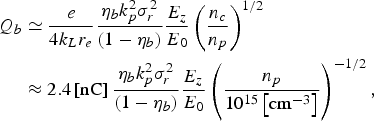
where n c = mωL2/4πe 2 = π/(r eλL2) ≈ 1.115 × 10²¹ [cm−3](λL[μm])−2 is the critical plasma density and for  . Since the loaded charge depends on the accelerating field and the bunch radius, it will be determined by considering the required accelerating gradient and the transverse beam dynamics.
First we consider a design of multi-TeV linear accelerators composed of multi-staging TeV laser-plasma accelerators, each of which can provide a single-stage energy gain of 1 TeV in a relatively compact scale. Ideally, the stage length L stage is limited by the pump depletion length L pd for which the total field energy is equal to half the initial laser energy. For a Gaussian laser pulse with pulse length k p σL = 1, the pump depletion length is given by

In laser wakefield accelerators, accelerated electrons eventually overrun the acceleration phase to the deceleration phase, of which the velocity is approximately equal to the group velocity of the laser pulse. In the linear wakefield regime, the dephasing length L dp where the electrons undergo both focusing and acceleration is approximately given by

In the condition for the dephasing length less than the pump depletion length, L dp ≤ L pd, the normalized vector potential should be a L ≤ 1.5. Setting a L = 1.5, the maximum accelerating field is E zmax ≈ 0.79E 0 for k pσL = 1. Assuming the beam-loaded efficiency ηb = 0.5, the net accelerating field becomes

For the stage length approximately equal to the dephasing length,
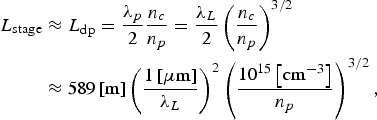
and the accelerating field Eq. (14), the energy gain per stage is given by
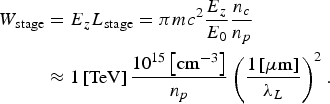
The total number of stages becomes
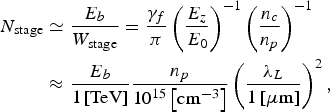
where γf = E b/m c 2 is the Lorentz factor at the final beam energy. The overall length of a linac consisting of periodic structures of an accelerator stage and a coupling section that installs both beam and laser focusing systems leads to be
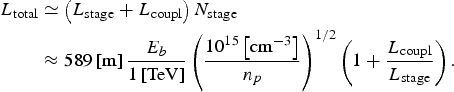
The laser spot size is bounded by conditions for avoiding bubble formation,  and strong self-focusing, P L/P c = k p2 r L2a L2/32 ≤ 1, where P c = 2(m 2c 5/e 2)ωL2/ωp2 ≃ 17(n c/n p)[GW]. These conditions put bounds to the spot size 2.5 ≤ k pr L ≤ 3.8 for a L = 1.5. Accordingly we choose k pr L = 3. For a given spot radius,

the peak laser power becomes

With the FWHM pulse duration given by

the required laser pulse energy is obtained as

3. BETATRON OSCILLATION
Beams that undergo strong transverse focusing forces F ⊥ =− mc 2 K 2 x β, in plasma waves exhibit the betatron oscillation, where x β is the transverse amplitude of the betatron oscillation. From the axial and radial fields, Eqs. (7) and (8), the focusing constant K is given by

where Ψ = k p (z − v pt) + Ψ0 is the dephasing phase of the wakefield and Ψ0 is the injection phase. The envelope equation of the rms beam radius σr is given by

where ɛn0 is the initial normalized emittance. Assuming the beam energy γ is constant, this equation is solved with the initial conditions σ′r0 = (dσr/dz)z=0 and σr0 = σr(0) as

where  is the focusing strength, C = 2σ′r0 + κ2 σr02/2 + 2ɛn02/γ2 σr02 is the constant

The beam envelope oscillates around the equilibrium radius  with the wavelength 2π/κ = π/k β, where 2π/κ = π/k β the betatron wavelength. For the condition C/κ = 2ɛn0/γ that leads to σr02 = 2ɛn0/κγ with σ′r0 = 0, the beam propagates at the matched beam radius

4. BEAM DYNAMICS AND RADIATIVE DAMPING
The synchrotron radiation causes the energy loss of beams and affects the energy spread and transverse emittance via the radiation reaction force. The motion of an electron traveling along z-axis in the accelerating force eE z and the radial force eE r from the plasma wave evolves according to

where FRAD is the radiation reaction force and u = p/mc is the normalized electron momentum. The classical radiation reaction force (Jackson, Reference Jackson1999), is given by

where γ = (1 + u 2)1/2 is the relativistic Lorentz factor of the electron and τR = 2r e/3c ≃ 6.26 × 10⁻²⁴ s. Since the scale length of the radiation reaction is much smaller than that of the betatron motion, assuming that the radiation reaction force is a perturbation and u z≫u x, the equations of motion Eqs. (28) approximately turn to the following coupled equations,

and

The radiative damping rate is defined by the ratio of the radiated power, P s ≃ (2e 2γ2/3m 2c 3)F ⊥2 to the electron energy as νγ = P s/γm c 2 ≃ τRγF ⊥2/m 2c 2.
Corresponding to the single particle equations Eqs. (30) and (31) with radiation damping, the envelope equation is written as

and

Here we define the transverse emittance,

and consider the matched beam case, defined by Eq. (27) with the normalized emittance ɛn, i.e.,  , using the following dimensionless variables and parameters; ζ ≡ k pz, Ω(ζ) ≡ k pɛn, χ ≡ E z/E 0 and K/k p = αχ1/2. The coupled equations on the normalized emittance is obtained as


and

where

and

For given χ = E z/E 0 and α = (K/k p)χ−1/2, the normalized emittance, energy and energy spread are obtained by integrating the coupled equations, Eqs. (35)–(37) as a function of ζ = kp + z, provided with the initial conditions γ0, (δγ/γ)0, Ω0 and (dΩ/dζ)0.
5. LASER-PLASMA ACCELERATION BEYOND 1 TEV
Harnessing the state-of-the-art high-energy lasers on the order of 10 kJ and the ongoing development of ultra-intense lasers with the peak power on the order of 10 PW and the pulse duration on the order of 1 ps, we explore the feasibility of accelerating electron beams up to energies much beyond 1 TeV in a realistic scale on the order of tens of kilometers and evolution of the beam qualities such as emittance and energy spread at the final beam energy, using the equations describing the beam dynamics in Section 4. Relying on the state-of-the-art laser-plasma acceleration technologies and/or the conventional radio frequency (RF) linac technologies, we assume the initial electron beam with energy of 1 GeV, relative energy spread of 1%, and bunch duration of 10 fs, which is externally injected from a high-quality electron beam injector into the laser-plasma accelerator stage. According to the scaling formulas described in Section 2, the stage energy gain W stage = 1 TeV can be achieved in the stage length L stage ≈ 590 m, which is operated at the plasma density n p = 1015 cm−3. With the coupling length between consecutive stages, L coupl ≈ 10 m, the total length per stage is 600 m and the total linac length at the final beam energy E b turns out to be L total[km] ≈ 0.6E b [TeV]. Making reference to the currently ongoing large-scale collider projects such as international linear collider (ILC) and compact linear collider (CLIC) based on RF accelerator technologies, which reach 47 km at 1 TeV collider and 42 km at 3 TeV collider, here we present the feasibility study of 10–100 TeV class linear accelerators in the scale of 6–100 km, based on laser-plasma accelerators. Table 1 show the underlying parameters of the laser-plasma accelerator for the stage energy gain 1 TeV, which are used as the basis for the present study.
Example parameters of a 1 TeV laser-plasma accelerator stage

The coupled equations, Eqs. (35)–(37), can be integrated numerically as a function of ζ = k pz, using the Runge-Kutta algorithm. The results of energy γ, relative energy spread δγ/γ, normalized emittance ɛn, and relative radiation loss rate R at the plasma density n p = 1015 cm−3 are shown for various initial normalized emittances ɛn0 as a function of the acceleration distance z in Figure 1. Here the relative radiation loss rate R is defined as the ratio of the radiation loss rate to the acceleration gradient χ = E z/E 0, i.e.,

Figure 2 shows the evolution of these beam parameters for the plasma densities n p = 1015−1018 cm−3 as a function of the dimensionless distance ζ = k pz. In all figures, as the beam energy increases, keeping the radiation loss rate small, the emittance growth initially occurs, while the relative energy spread reduces. This behavior is attributed to conservation of the total phase space volume as a result of the adiabatic properties of the electron beam. After the emittance growth balances with radiative damping of the betatron motion at its maximum, the normalized emittance turns to damping as the radiation loss rate R increases quickly until reaching a constant rate R T = 2τR ωp α3 χ1/2ΩγT3/2 = 2/3 at the transition energy γT, where the radiation loss rate reaches the maximum rate R ≃ R T. It is noted that the R T is evaluated without regard to the initial condition ɛn0 and the plasma density n p. In the energy region γ ≥ γT, as the radiation loss rate is R ≃ R T = 2/3, the normalized emittance is approximately evaluated as

where E b is the electron beam energy, as shown in Figures 1d and 2d.
Evolutions of (a) energy γ, (b) relative radiation loss rate R, (c) relative energy spread δγ/γ, and (d) normalized emittance ɛn for an electron beam with the initial emittance ɛn0 = 3, 30, 300, and 3000 µmrad, and the initial energy E i = 1 GeV with initial energy spread δγ/γ = 0.01, injected into the plasma channel with density n p = 1015 cm−3 as a function of the acceleration distance z. Plotted are numerical integrations of the coupled equations Eqs. (35)–(37) for the accelerating field E z = 1.7 GV/m (E z/E 0 = 0.56), and the focusing constant K/k p = 0.35 (α = 0.47).

Evolutions of (a) energy γ, (b) relative radiation loss rate R, (c) relative energy spread δγ/γ, and (d) normalized emittances ɛn of electron beams with different plasma densities of 1015 cm−3, 1016 cm−3, 1017 cm−3, and 1018 cm−3, respectively, as a function of the dimensionless acceleration distance ζ = k pz. The initial conditions of beam energy, normalized transverse emittance and energy spread are γ0 = 2000, ɛn0 = 3000 µm rad and δγ/γ = 0.01, respectively.

6. DISCUSSIONS AND CONCLUSIONS
We have carried out the feasibility study on laser-plasma acceleration in the multi-TeV regime, where strong betatron radiations dominate the beam dynamics of electrons that lead to radiative damping of the normalized emittance, and the energy spread as a result of synchrotron radiation due to the focusing force in plasma wakefields. The radiative damping effects due to betatron oscillation are quite different from other radiative damping or cooling mechanisms such as synchrotron radiation damping in an electron or positron storage ring (Chao & Tigner, Reference Chao, Tigner, Chao and Tigner1999), and the radiative cooling via laser-electron Compton scattering (Telnov, Reference Telnov1997; Huang & Ruth, Reference Huang and Ruth1998; Esarey, Reference Esarey2000; Mao et al., Reference Mao, Kong, Ho, Che, Ban, Gu and Kawata2010). In the electron storage ring, the damping is caused by emission of synchrotron radiation due to the uniform bending fields and by recovering the energy loss only in the longitudinal direction. However, the radiative energy loss limits the highest beam energy, at which the energy loss surpasses the power of recovering it. In the laser-plasma acceleration, the radiative energy loss is proportional to the emittance and does not surpass the acceleration gradient, indicated in Eq. (36),

for γ ≥ γT. This implies that the beam energy can be increased without limit due to the radiative loss and the normalized emittance decreases without saturation. However, the net accelerating gradient reduces to one-third of the initial accelerating gradient due to the betatron radiation loss for γ ≥ γT so that three times longer acceleration distance, 180 km, is required to reach the final beam energy 100 TeV.
In a plasma focusing channel, multiple Coulomb scattering between a beam electron and a plasma ion counteracts the radiation damping due to betatron radiation. The damping rate of the normalized emittance is given by

The growth rate for the normalized emittance due to multiple Coulomb scattering (Schroeder et al., Reference Schroeder, Esarey, Geddes, Benedetti and Leemans2010) is given by

where Z is the charge state of the ion, λD = (T e/4πn pe 2)1/2 is the Debye length for the plasma temperature T e eV and R N is the effective Coulomb radius of the nucleus, which is approximated as R ≈ 1.4A 1/3 fm with the mass number A. The equilibrium emittance is obtained from balancing the radiation damping with the emittance growth due to multiple Coulomb scattering, i.e., (dɛn/dt)RAD + (dɛn/dt)Scatter = 0. Solving this equation with respect to γ gives an estimate of the equilibrium energy γEQ at which the radiative damping reaches the balance with the emittance growth as

where Λ is calculated from

Thus, the equilibrium emittance is estimated as

For the underlying parameters of the laser-plasma accelerator given by Table 1, the equilibrium emittance becomes ɛnEQ = 71 nm at γEQ ≃ 9.6 × 10⁹ (4.9 PeV) in a hydrogen plasma with Z = 1 and A = 1.
The quantum mechanical consideration of radiation damping in the continuous focusing channel results in the minimum normalized emittance (Huang et al., Reference Huang, Chen and Ruth1995) ɛnmin = ƛ/2 ≃ 0.2 pm, where ƛ = ℏ/mc is the Compton wavelength, which is the fundamental emittance limited by the uncertainty principle, in case no other excitation sources than radiation reaction are present. According to the emittance scaling Eq. (41) in the energy region γ ≥ γT, this quantum limit may be achieved at the electron energy E b = 2.4 × 10¹⁹ eV for n p = 1015 cm−3.
ACKNOWLEDGEMENTS
The authors would like to thank T. Tajima for useful discussions. The work has been supported by the National Natural Science Foundation of China (Project Nos. 10834008, 10974214, and 60921004) and the 973 Program (Project Nos. 2011CB808104, 2011CB808100, and 2010CB923203). K. Nakajima is supported by Chinese Academy of Sciences Visiting Professorship for Senior International Scientists (Grant No. 2010T2G02).



