Introduction
Most of the territory of Laos belongs to Indo-Burma sensu Myers et al. (Reference Myers, Mittermeier, Mittermeier, Fonseca and Kent2000), which extends from eastern Bangladesh to the coastal lowlands of southern China, and southwards to the north of the Isthmus of Kra, including most of Thailand. The region has been recognised as one of 34 world biodiversity hotspots, both containing high levels of biodiversity and requiring priority for conservation measures (Mittermeier et al., Reference Mittermeier, Gil, Hoffman, Pilgrim, Brooks, Mittermeier, Lamoreux and Fonseca2004; BirdLife International, 2007; de Bruyn et al., Reference De Bruyn, Stelbrink, Morley, Hall, Carvalho, Cannon, Bergh, Meijaard, Metcalfe, Boitani, Maiorano, Shoup and Rintelen2014).
The flora of Laos remains one of the least known in the region. The Ministry of Agriculture and Forestry and Science, Technology and Environment Agency of Laos (2003) estimated 8000–11,000 species of flowering plants, but the most recent checklist (Zhu, Reference Zhu2017), which is largely based on the that of Newman et al. (Reference Newman, Ketphanh, Svengsuksa, Thomas, Sengdala, Lamxay and Armstrong2007), enumerates only 5005 species, excluding introduced species. This limited knowledge is in large part owing to poor botanical exploration, hampered by the Indochinese wars and also a lack of local expertise. As emphasised by Newman et al. (Reference Newman, Ketphanh, Svengsuksa, Thomas, Sengdala, Lamxay and Armstrong2007), the intensity of plant exploration in Laos until the early 1990s was comparatively lower (roughly three specimens per 100 km2) than in neighbouring countries such as Vietnam or Thailand (14 and 50 specimens per 100 km2, respectively). Until now, floristic inventories in Laos have lagged behind. By contrast, in Vietnam more than 200 new vascular plant taxa, including 13 new genera, were described between 1993 and 2003 (Regalado et al., Reference Regalado, Nguyen, Phan, Averyanov, Harder, Friis and Balslev2005).
The topography of Laos is shaped by the easternmost foothills of the Himalayas to the north and the Annamite range to the east, along the Vietnamese border. Two-thirds of the country are dotted with karst formations. In the centre of Laos, the Khammouane Limestone forms a spectacular belt of karst, 290 km long and 30–120 km wide, which stretches north-west to south-east across the full width of the country (Kiernan, Reference Kiernan2009). This formation extends into Vietnam to form the larger central Indochina limestone belt (Rundel, Reference Rundel, Baltzer, Thi Dao and Shore2001). With highly distinctive ecosystems rich in endemic species, limestone karsts are “arks” of biodiversity (Clements et al., Reference Clements, Sodhi, Schiilthuizen and Ng2006), and often contain high levels of endemism.
Recently, an attempt was made to document the biodiversity of one such under-explored karst formation in Laos, using canopy-accessing facilities provided by the Canopy Raft (formerly called Radeau des CîmesFootnote 1 ). Previously, the Canopy Raft organised such expeditions in Central and South America and in Africa (Hallé & Pascal, Reference Hallé and Pascal1991; Hallé et al., Reference Hallé1998, Reference Hallé1999, Reference Hallé, Cleyet-Marrel and Ebersolt2000). This is the first time that such a canopy survey has been carried out in Asia.
In 2012, the Canopy Raft and the Lao National Council of Sciences organised a survey of the karst valley in Khammouane province. It involved a multidisciplinary and international group of 35 scientists divided into six teams covering a wide range of fields: botany, entomology, herpetology, mammalogy, ornithology and virology. About half of the participants were national counterparts, including lecturers and students from the National University, curators and technicians from the National Herbarium of Laos, and researchers from the Institut Pasteur, Vientiane.
The data presented here result from a larger project devoted to the study of the flora and fauna of Phou Hin Poun National Biodiversity Conservation Area (NBCA). Examination of this material is still in progress. The richness of botanical collections, the lack of reference herbarium specimens and the rarity of relevant taxonomic literature make the work of taxonomic identification rather lengthy. This paper presents a list of 27 taxa collected in the karst formations and adjoining vegetation of Phou Hin Poun NBCA that are new national additions to the latest checklists (Newman et al., Reference Newman, Ketphanh, Svengsuksa, Thomas, Sengdala, Lamxay and Armstrong2007; Zhu, Reference Zhu2017).
Methods
Fieldwork location
Phou Hin Poun NBCA (17.746°N, 104.8°E), also known as Khammouane Limestone NBCA, was created in 1993. It covers an area of about 1500 km2 in the south-west of the Upper Hin Boun catchment (UNEP–WCMC & IUCN, 2014–2017). The area is characterised by well-developed closed depressions, and large underground streams and caves (Kiernan, Reference Kiernan2009). The mean annual rainfall in Khammouane province is about 2250 mm, whereas the driest areas of the central lowlands receive only 1400 mm (Rundel, Reference Rundel, Baltzer, Thi Dao and Shore2001).
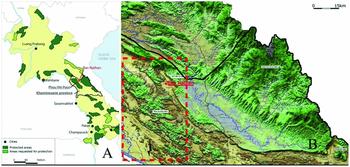
A base camp was built in the north-east of Phou Hin Poun NBCA, in the upper valley of the Hin Boun River, a tributary of the Mekong, near the village of Ban Nathan (Fig. 1), a few kilometres from the famous Konglor Cave.
Fieldwork location. A, Phou Hin Poun National Biodiversity Conservation Area, Khammouane province, Laos; B, location of Ban Nathan and the study site outlined in red.

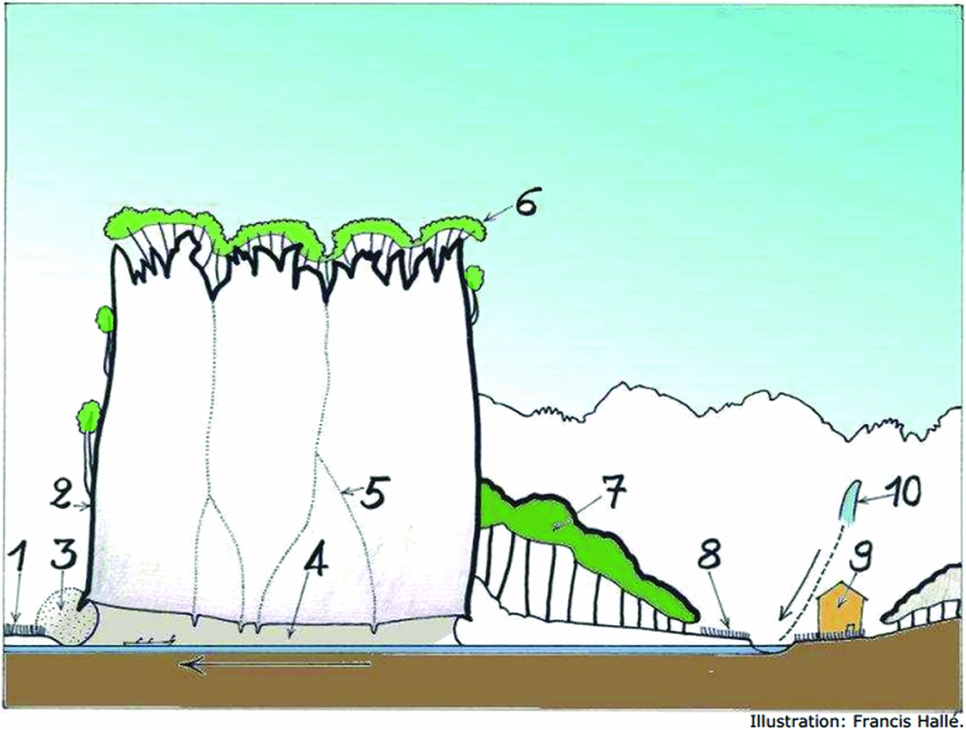
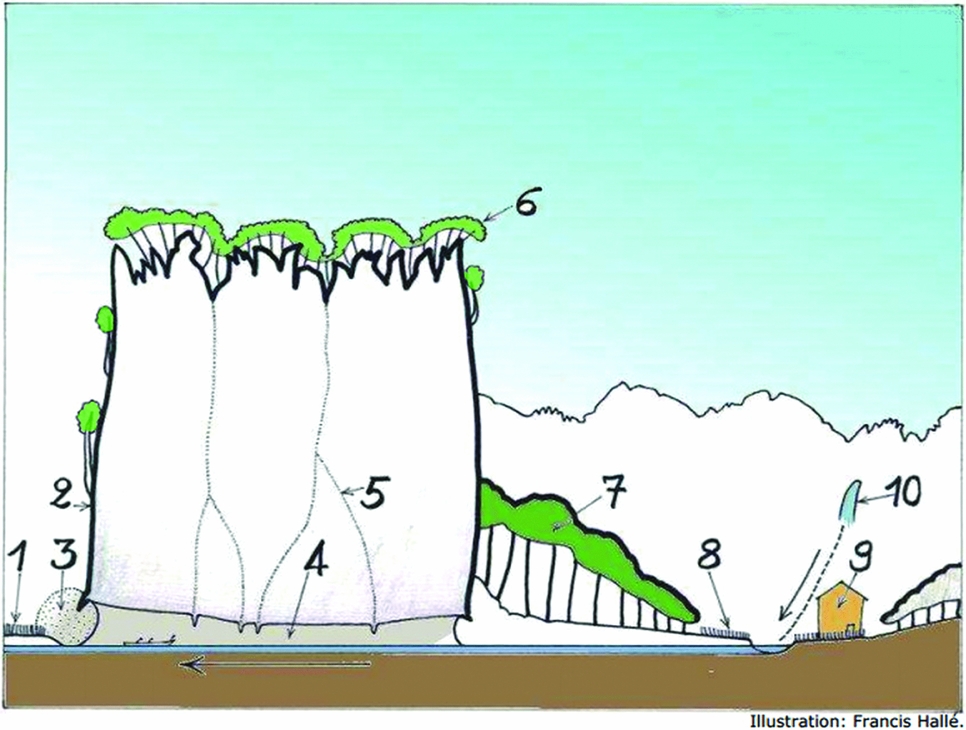
Enclosed by sandstone cliffs to the east and karst to the west, the valley is remarkable for its ecological contrasts and the diversity of its habitats, each of which provides access to a distinct flora. Plants were collected in the area surrounding the base camp (17°59′N, 104°49′E), ranging between 200 and c.700 m in altitude, in the following habitats: piedmont evergreen forests (f), dry dipterocarp forests on karst scree and dry summit forests on karst outcrops (k), riparian forests (rh) and secondary growth (s) (Fig. 2).
The variety of landscapes in the study area. 1, Rice-growing plain in the lower valley; 2, karst cliff; 3, mist at the resurgence of the underground river; 4, the underground river and the direction of the current; 5, infiltration in the karst; 6, summit forest; 7, piedmont forest, including dipterocarp and Lagerstroemia forest; 8, tobacco crop in the upper valley; 9, tobacco driers; 10, Maitok waterfall at the source of the Hin Boun river.
Plant collecting
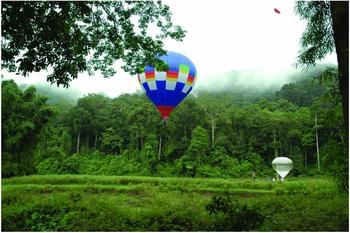
In 2012, botanical explorations were carried out during two field trips, each of 2 weeks’ duration: in January during the dry season, and in May at the onset of the rainy season. Some herbaceous groups, such as Begoniaceae and Gesneriaceae, tend to flower later in the rainy season. These groups are likely to be under-represented in our results. Fertile plant specimens from the most inaccessible forest sites were collected from the canopy using the facilities provided by the Canopy Raft team (Fig. 3), as well as from the ground with the contribution of three professional trekkers and tree climbers. More than 800 plant specimens were collected (with at least three duplicates of most numbers, therefore amounting to some 2500 samples), and may represent more than 500 species. The plant samples were referenced and preliminarily identified, at least to genus, by the botanical team (the authors) using literature available at the base camp. Duplicates of each specimen were collected, and the vouchers deposited at HNL, NUoL and P. A partial set of duplicates was deposited at HIFP.
The cinébulle (the coloured hot air balloon with a small propeller engine) in flight, and the Bulle des Cimes (the white helium balloon) on the ground. Between the two balloons is a rope attached to the tree crowns on which the Bulle moves.

Taxonomic identification work was done at P, with the help of existing volumes of printed regional floras such as the Flora of Thailand (Santisuk, Reference Santisuk1970 to present) and Flore du Cambodge, du Laos et du Vietnam (Aubréville et al., Reference Aubréville, Tardieu-Blot, Leroy and Morat1960 to present); historical reference works, namely the Flore Générale de l'Indochine (Lecomte, Reference Lecomte1907–1950) and Flore Forestière de la Cochinchine (Pierre, Reference Pierre1833–1905); online floras, mainly the Flora of China (Wu et al., Reference Wu, Raven and Hong1994–2013) and Flora Malesiana (Steenis, Reference Steenis1948 to present); and other relevant taxonomic literature, such as revisions of individual taxa. Identification is quite often made difficult by the lack of an updated comprehensive flora, and the need to refer to several reference taxonomic works covering different regions. Comparisons with already identified specimens, type specimens whenever available, made it possible to ascertain the identifications. Advice was also sought from taxonomists at P and L. Identifications of which we could not be fully confident are indicated by ‘cf’. We retain them in the list, because they may be of interest to specialists of the respective families (Annonaceae, Apocynaceae, Ebenaceae, Myrtaceae, Phyllanthaceae and Rhamnaceae). The family names were updated by reference to the Angiosperm Phylogeny Group III classification (Angiosperm Phylogeny Group, 2009).
The distribution of taxa is based on Species 2000 & ITIS Catalogue of Life (Roskov et al., Reference Roskov, Abucay, Orrell, Nicolson, Bailly, Kirk, Bourgoin, DeWalt, Decock, De Wever, Nieukerken, Zarucchi and Penev2017), and when not available, it was completed by information from GBIF (2016). For synonyms, synonymic checklists by Hassler (Reference Hassler, Roskov, Abucay, Orrell, Nicolson, Bailly, Kirk, Bourgoin, DeWalt, Decock, De Wever, Nieukerken, van and Penev2017) were used as a reference.
Results
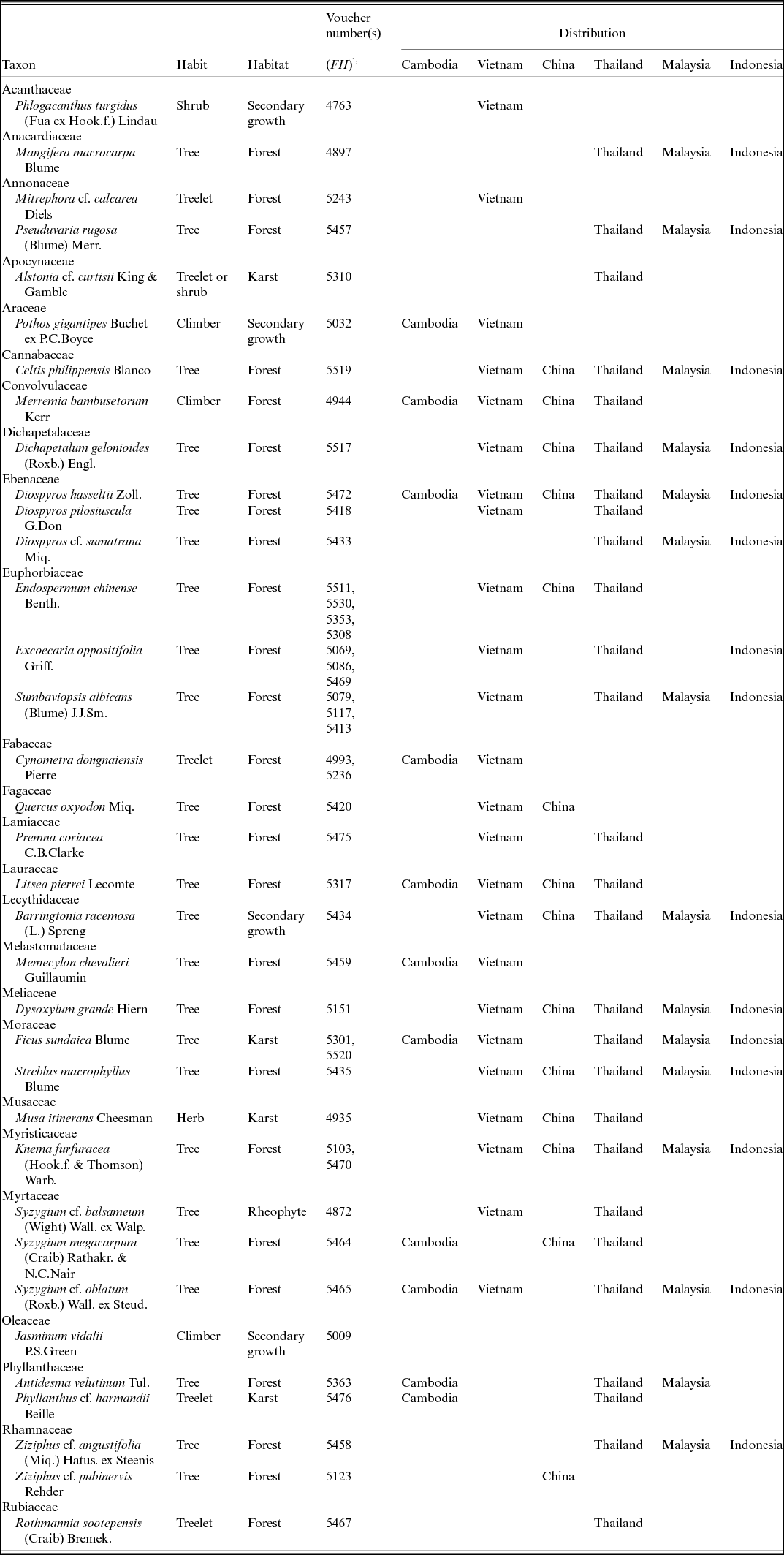
To date, 27 of 245 species identified (11%) are additions to the most recent country checklists (Newman et al., Reference Newman, Ketphanh, Svengsuksa, Thomas, Sengdala, Lamxay and Armstrong2007; Zhu, Reference Zhu2017), and the number may amount to 35 if our tentative (cf.) identifications of 8 species are confirmed (Table 1).
Additions to the botanical checklists of Laos, collected in the Phou Hin Poun National Biodiversity Conservation Area, Khammouane provinceFootnote a

a Editor's note: Tagane et al. (the following article in this issue of the Edinburgh Journal of Botany) independently report the occurrence in Bolikhamxay province of four species in this table, namely, Celtis philippensis Blanco, Dichapetalum gelonioides (Roxb.) Engl., Diospyros pilosiuscula G.Don and Pseuduvaria rugosa (Blume) Merr.
b All herbarium numbers are labelled FH (Francis Hallé). Vouchers were deposited at HNL, NUoL and P.
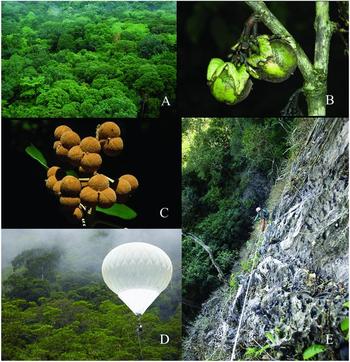
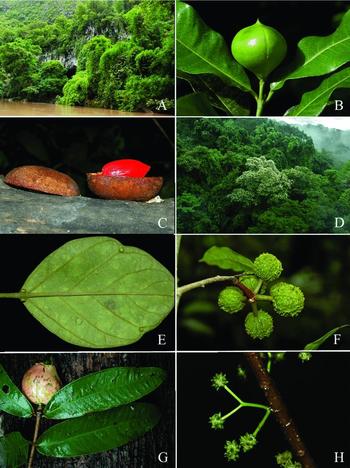
The 27 species belong to 25 families and 30 genera, showing a relatively high diversity of a rather small sample. The Ebenaceae, Euphorbiaceae and Myrtaceae are the families with the highest species number (Figs 4, 5). The best represented genera are Diospyros and Syzygium, with three species each.
A, Canopy view from the cinébulle, piedmont forest; B, Diospyros hasseltii Zoll.; C, Sumbaviopsis albicans (Blume) J.J.Sm.; D, collecting with the Bulle des Cimes on an Endospermum chinense Benth. crown; E, surveying the karst cliff particularly difficult to access.

A, Karst forest overlooking the river; B, Excoecaria oppositifolia Griff.; C, Knema furfuracea (Hook.f. & Thomson) Warb.; D, canopy view from the cinébulle, crown in bloom; E, laminar glands of Endospermum chinense Benth.; F, Pseuduvaria rugosa Blume (Merr.); G, Syzygium megacarpum (Craib) Rathakr. & N.C.Nair; H, Oreocnide integrifolia (Gaudich.) Miq.

They are mostly trees (71%, 25 species) and treelets (14%, 5 species), and were mostly found in forest and karst habitat (71% and 9%, respectively). In secondary growth including disturbed habitats, we found contrasting results, collecting rather common trees such as Barringtonia racemosa (L.) Spreng. (Lecythidaceae) but also a rare species, viz. Jasminum vidalii P.S.Green (Oleaceae), omitted from previous checklists and known so far only from the type specimen.
By comparing the 27 species (excluding doubtful identifications) with available taxonomic distribution information (Roskov et al., Reference Roskov, Abucay, Orrell, Nicolson, Bailly, Kirk, Bourgoin, DeWalt, Decock, De Wever, Nieukerken, Zarucchi and Penev2017), it appears that:
-
1. The majority (74%) of these additions are known to occur in Vietnam.
-
2. At least four species are endemic to Indochina (Cambodia, Laos and Vietnam): Cynometra dongnaiensis Pierre, described by Rundel (Reference Rundel, Baltzer, Thi Dao and Shore2001) as a tree reaching 20 m in height, reported only from Cambodia and southern Vietnam; Jasminum vidalii, a climber known only from the type specimen collected by Vidal in 1954 in the province of Vientiane (Green, Reference Green1999); Memecylon chevalieri Guillaumin, a tree described by Guillaumin in the Bulletin de la Société Botanique de France (Reference Guillaumin1921), then in the Flore Générale de l'Indo-Chine (Reference Guillaumin1921), from Cambodia and southern Vietnam; and Pothos gigantipes Buchet ex P.C.Boyce, a climber studied by Boyce (Reference Boyce2000) in his work on this genus in Thailand and Indochina.
-
3. Most of the remaining species (22%) are found in Thailand, Malaysia and Indonesia. Species such as Pseuduvaria rugosa (Blume) Merr. (Annonaceae; Fig. 5F), Dysoxylum grande Hiern (Meliaceae) and Rothmannia sootepensis (Craib) Bremek. (Rubiaceae) have never been reported from the Indochinese Peninsula (Cambodia, Laos and Vietnam).
-
4. Besides Jasminum vidalii, several of these additions to the most recent checklists have already been reported from Laos: Barringtonia racemosa in Flore Générale de l'Indo-Chine (Gagnepain, Reference Gagnepain and Lecomte1921) and in the monograph of the genus by Payens (Reference Payens1967); Syzygium megacarpum (Craib) Rathakr. & N.C.Nair (Fig. 5G) and Syzygium oblatum (Roxb.) Wall. ex Steud. in Soh & Parnell's revision of Indochinese Syzygium (Reference Soh and Parnell2015).
Discussion
Taxonomic comments on selected species
The region's geographical position at the transition between several biogeographical regions, its history of dramatic changes in land area, and its habitat fragmentation in a mountainous landscape explain the high biodiversity of the area. Moreover, eastern Asia served as a late Tertiary or Quaternary refugium for many taxa (Manchester et al., Reference Manchester, Chen, Lu and Uemura2009; Lohman et al., Reference Lohman, de Bruyn, Page, Rintelen, Hall, Ng, Shih, Carvalho and Rintelen2011).
Various floristic influences converge and meet in Laos. Plants belonging to the ‘temperate’ flora of the lower mountain regions of the Himalayas and southern China (the Sino-Himalayan floristic region) mix along Annamite reliefs with the ‘tropical’ flora elements of the western Malesian floristic region. Examples of these influences are reflected in our botanical findings.
Several taxa of the Sino-Himalayan floristic region, whose current distribution is centred in a region extending from Nepal or Assam to southern China, reach, in Laos, their southern distribution limits. They include, for instance, Quercus oxyodon Miq. (Fagaceae, also in Vietnam) and Merremia bambusetorum Kerr (Convolvulaceae, also in Cambodia, Thailand and Vietnam).
Many tropical Asian taxa, belonging to the Indo-Malesian flora, reach in Laos (or Vietnam) their northern distribution limits, such as Antidesma velutinum Tul. (Phyllanthaceae), Excoecaria oppositifolia Griff. (Euphorbiaceae) and Ficus sundaica Blume (Moraceae). Our new record of Mangifera macrocarpa Blume (Anacardiaceae) significantly extends northwards the distribution range of this species, which mostly occurs in western Indonesia, Malaysia, Singapore and peninsular Thailand.
Last, these preliminary results illustrate our limited knowledge of the flora of the area surveyed and of the flora of Laos in general. It is noteworthy that such a small sample contains so many species that have never been encountered here before.
Acknowledgements
We thank the Laotian government authorities for permission to collect material, and the curator of HNL, Ms Somsanith Bouamanivong; Soulivanh Lanorsavanh, (Department of Biology, NUoL), a Rubiaceae specialist; and NUoL students Thatsaphone Phaxaysombat and Phaivone Thamuangkhoun, for their valuable fieldwork contributions. We are grateful to the directors and staff of P who welcomed us during the identification work, especially Dr Thierry Deroin. We would like to thank Dr Paul Keßler (Hortus Botanicus Leiden), who kindly identified some Annonaceae specimens. We thank two anonymous reviewers for their helpful suggestions.
This inventory was conducted at the request of the National Science Council, with financial support mainly from the MAVA Foundation. We also thank the Institut Français de Pondichéry (India) and CIRAD, through its AMAP French Research Laboratory and the Delegation for International Scientific Exchanges, for their support.