




No CrossRef data available.
Paradigm lost, or is top-down forcing no longer significant in the Antarctic marine ecosystem?
Published online by Cambridge University Press: 13 July 2007
Abstract
Investigations in recent years of the ecological structure and processes of the Southern Ocean have almost exclusively taken a bottom-up, forcing-by-physical-processes approach relating various species' population trends to climate change. Just 20 years ago, however, researchers focused on a broader set of hypotheses, in part formed around a paradigm positing interspecific interactions as central to structuring the ecosystem (forcing by biotic processes, top-down), and particularly on a “krill surplus” caused by the removal from the system of more than a million baleen whales. Since then, this latter idea has disappeared from favour with little debate. Moreover, it recently has been shown that concurrent with whaling there was a massive depletion of finfish in the Southern Ocean, a finding also ignored in deference to climate-related explanations of ecosystem change. We present two examples from the literature, one involving gelatinous organisms and the other involving penguins, in which climate has been used to explain species' population trends but which could better be explained by including species interactions in the modelling. We conclude by questioning the almost complete shift in paradigms that has occurred and discuss whether it is leading Southern Ocean marine ecological science in an instructive direction.
Information
- Type
- Opinion
- Information
- Copyright
- Copyright © Antarctic Science Ltd 2007
Footnotes
“New opinions are always suspected, and usually opposed, without any other reason but because they are not already common.” John Locke (1690), “An Enquiry Concerning Human Understanding”
References
Ackley, S., Wadhams, P., Comiso, J.C. & Worby, A.P. 2003. Decadal decrease of Antarctic sea ice extent inferred from whaling records revisited on the basis of historical and modern sea ice records. Polar Research, 22, 19–25.CrossRefGoogle Scholar
Ainley, D.G. 2002a. The Adélie penguin: bellwether of climate change. New York: Columbia University Press, 310 pp.CrossRefGoogle Scholar
Ainley, D.G. 2002b. The Ross Sea, Antarctica: where all ecosystem processes still remain for study. CCAMLR Document WG-EMM 02/60. Hobart, Australia.Google Scholar
Ainley, D.G., Clarke, E.D., Arrigo, K., Fraser, W.R., Kato, A., Barton, K.J. & Wilson, P.R. 2005. Decadal-scale changes in the climate and biota of the Pacific sector of the Southern Ocean, 1950s to the 1990s. Antarctic Science, 17, 171–182.CrossRefGoogle Scholar
Atkinson, A., Siegel, V., Pakhomov, E. & Rothery, P. 2004. Long-term decline in krill stock and increase in salps within the Southern Ocean. Nature, 432, 100–103.CrossRefGoogle ScholarPubMed
Ballance, L., Pitman, R.L., Hewitt, R.P., Siniff, D.B., Trivelpiece, W.Z., Clapham, P.J. & Brownell, R.L. Jr 2006. The removal of large whales from the Southern Ocean: evidence for long-term ecosystem effects? In Estes, J.A., Demaster, D.P., Doak, D.F., Williams, T.E. &Brownell, R.L. Jreds. Whales, whaling and ocean ecosystems. Berkeley, CA: University of California Press, 215–230.Google Scholar
Barbraud, C. & Weimerskirch, H. 2001. Emperor penguins and climate change. Nature, 411, 183–186.Google Scholar
Barbraud, C. & Weimerskirch, H. 2006. Antarctic birds breed later in response to climate change. Proceedings of the National Academy of Science, 103, 6248–6251.Google Scholar
Barrera-Oro, E. 2003. Analysis of dietary overlap in Antarctic fish (Notothenioidei) from the South Shetland Islands: no evidence of food competition. Polar Biology, 26, 631–637.Google Scholar
Barrera-Oro, E.R., Casaux, R.J. & Marschoff, E.R. 2005. Dietary composition of juvenile Dissostichus eleginoides (Pisces, Nototheniidae) around Shag Rocks and South Georgia, Antarctica. Polar Biology, 28, 637–641.Google Scholar
Beddington, J.R. & May, R.M. 1982. The harvesting of interacting species in a natural ecosystem. Scientific American, November 1982, 62–69.Google Scholar
Bengtson, J.L. & Laws, P.M. 1985. Trends in crabeater seal age at maturity: an insight into Antarctic marine interactions. In Siegfried, W.R., Condy, P.R. & Laws, R.M., eds. Antarctic nutrient cycles and food webs. Berlin: Springer, 669–675.CrossRefGoogle Scholar
Best, P.B. 1993. Increase rates in severely depleted stocks of baleen whales. ICES Journal of Marine Science, 50, 169–186.CrossRefGoogle Scholar
Branch, T.A. & Williams, T.M. 2006. Legacy of industrial whaling: could killer whales be responsible for declines of sea lions, elephant seals, and minke whales in the Southern Hemisphere? In Estes, J.A., Demaster, D.P., Doak, D.F., Williams, T.E. & Brownell, R.L. Jreds. Whales, whaling and ocean ecosystems. Berkeley, CA: University of California Press, 262–278.Google Scholar
Branch, T.A., Matsuoka, K. & Miyashita, T. 2004. Evidence for increases in Antarctic blue whales based on Bayesian modelling. Marine Mammal Science, 20, 726–654.CrossRefGoogle Scholar
Brierley, A.S., Axelsen, B.E., Buecher, E., Sparks, C.A.J., Boyer, H. & Gibbons, M.J. 2001. Acoustic observations of jellyfish in the Namibian Benguela. Marine Ecology Progress Series, 210, 55–66.CrossRefGoogle Scholar
Brodeur, R.D., Sugisaki, H. & Hunt, G.L. Jr 2002. Increases in jellyfish biomass in the Bering Sea: implications for the ecosystem. Marine Ecology Progress Series, 233, 89–103.CrossRefGoogle Scholar
Brown, M.R. & Brownell, R.L. 2001. Review of catches of great whales taken in the proposed South Pacific sanctuary region. International Whaling Commission SC, 1–10.Google Scholar
Bushula, T., Pakhomov, E.A., Kaehler, S., Davis, S. & Kalin, R.M. 2005. Diet and daily ration of two nototheniid fish on the shelf of the sub-Antarctic Prince Edward Islands. Polar Biology, 28, 585–593.CrossRefGoogle Scholar
Casaux, R.J., Mazzotta, A.S. & Barrera-Oro, E.R. 1990. Seasonal aspects of the biology and diet of nearshore nototheniid fish at Potter Cove, South Shetland Islands, Antarctica. Polar Biology, 11, 63–72.CrossRefGoogle Scholar
Carpenter, S.R. & Kitchell, J.F. 1988. Consumer control of lake productivity. BioScience, 38, 764–769.CrossRefGoogle Scholar
Clapham, P.J. & Baker, C.S. 2001. How many whales were killed in the Southern Hemisphere in the 20th century? Report of the International Whaling Commission, 53, 3 pp.Google Scholar
Condy, P.R., Van Aarde, R.J. & Bester, M.N. 1978. The seasonal occurrence and behaviour of killer whales (Orcinus orca) at Marion Island. Journal of Zoology, 184, 449–464.CrossRefGoogle Scholar
Croxall, J.P. 1992. Southern Ocean environmental changes: effects on seabird, seal, and whale populations. Philosophical Transactions of the Royal Society, B338, 319–328.Google Scholar
Croxall, J.P., Trathan, P.N. & Murphy, E.J. 2002. Environmental change and Antarctic seabird populations. Science, 297, 1510–1514.Google Scholar
Curran, M.A.J., Van Ommen, T.D., Morgan, V.I., Phillips, K.L. & Palmer, A.S. 2003. Ice core evidence for sea ice decline since the 1950s. Science, 302, 1203–1206.Google Scholar
De La Mare, W.K. 1997. Abrupt mid-twentieth century decline in Antarctic sea ice extent from whaling records. Nature, 389, 57–60.Google Scholar
El-Sayed, S. 1994. Southern Ocean ecology: the BIOMASS perspective. Cambridge: Cambridge University Press, 399 pp.Google Scholar
Emslie, S.E. & McDaniel, J.D. 2002. Adélie penguin diet and climate change during the middle to late Holocene in northern Marguerite Bay, Antarctic Peninsula. Polar Biology, 25, 222–229.CrossRefGoogle Scholar
Forcada, J., Trathan, P.N., Reid, K., Murphy, E.J. & Croxall, J.P. 2006. Contrasting population changes in sympatric penguin species in association with climate warming. Global Change Biology, 12, 411–423.Google Scholar
Frank, K.T., Petrie, B., Choi, J.S. & Leggett, W.C. 2005. Trophic cascades in a formerly cod-dominated ecosystem. Science, 308, 1621–1623.CrossRefGoogle Scholar
Fraser, W.R. & Patterson, D.L. 1997. Human disturbance and long-term changes in Adélie penguin populations: a natural experiment at Palmer Station, Antarctica. In Bataglia, B., Valencia, J. & Walton, D.W.H., eds. Antarctic communities: species, structure and survival. Cambridge: Cambridge University Press, 445–452.Google Scholar
Fraser, W.R. & Hofmann, E.E. 2003. A predator's perspective on causal links between climate change, physical forcing and ecosystem response. Marine Ecology Progress Series, 265, 1–15.Google Scholar
Fraser, W.R., Trivelpiece, W.Z., Ainley, D.G. & Trivelpiece, S.G. 1992. Increases in Antarctic penguin populations: reduced competition with whales or a loss of sea ice due to environmental warming? Polar Biology, 11, 525–531.CrossRefGoogle Scholar
Guinet, C. 1992. Comportement de chasse des Orques (Orcinus orca) autour des Iles Crozet. Canadian Journal of Zoology, 70, 1656–1667.CrossRefGoogle Scholar
Guinet, C. & Bouvier, J. 1995. Development of intentional stranding hunting techniques in killer whale (Orcinus orca) calves at Crozet Archipelago. Canadian Journal of Zoology, 73, 27–33.CrossRefGoogle Scholar
Heymans, J.J., Shannon, L.J. & Jarre, A. 2004. Changes in the northern Benguela ecosystem over three decades: 1970s, 1980s, and 1990s. Ecological Modelling, 172, 175–195.Google Scholar
Hilton, G.M., Thompson, D.R., Sagar, P.M., Cuthbert, R.J., Cherel, Y. & Bury, S.J. 2006. A stable isotopic investigation into the causes of decline in a sub-Antarctic predator, the rockhopper penguin Eudyptes chrysocome. Global Change Biology, 12, 611–625.Google Scholar
Jackson, J.B.C. 2006. When ecological pyramids were upside down. In Estes, J.A., Demaster, D.P., Doak, D.F., Williams, T.E. & Brownell, R.L. Jreds. Whales, whaling and ocean ecosystems. Berkeley, CA: University of California Press, 27–37.Google Scholar
Jacobs, S. 2006. Observations of change in the Southern Ocean. Philosophical Transactions of the Royal Society, A364, 1657–1681.Google Scholar
Jacobs, S.S., Guilivi, C.F. & Mele, P.A. 2002. Freshening of the Ross Sea during the late 20th century. Science, 297, 386–389.Google Scholar
Jenouvrier, S., Weimerskirch, H., Barbraud, C., Park, Y.-H. & Cazelles, B. 2004. Evidence of a shift in the cyclicity of Antarctic seabird dynamics linked to climate. Proceedings of the Royal Society, B272, 887–895.Google Scholar
Jenouvrier, S., Barbraud, C. & Weimerskirch, H. 2005. Long-term contrasted responses to climate of two Antarctic seabird species. Ecology, 86, 2889–2903.Google Scholar
Kawachuchi, S.O., Kasamatsu, N., Watanabe, S., Odate, T., Fukuchi, M. & Nicol, S. 2005. Sea ice changes inferred from methanesulphonic acid (MSA) variation in East Antarctic ice cores: are krill responsible? Antarctic Science, 17, 211–212.Google Scholar
Kasamatsu, N., Kawaguchi, S., Watanabe, S., Odate, T. & Fukuchi, M. 2004. Possible impacts of zooplankton grazing on dimethylsulfide production in the Antarctic Ocean. Canadian Journal of Fisheries and Aquatic Sciences, 61, 736–743.Google Scholar
Kock, K.-H. & Everson, I. 1997. Biology and ecology of mackerel icefish, Champsocephalus gunnari: an Antarctic fish lacking hemoglobin. Comparative Biochemistry and Physiology, 118A, 1067–1077.Google Scholar
Kuhn, T.S. 1962. The structure of scientific revolutions. Chicago, IL: University of Chicago Press.Google Scholar
Laws, R.M. 1977. The significance of vertebrates in the Antarctic marine ecosystem. In Llano, G.A., ed. Adaptations within Antarctic ecosystems. Washington, DC: Smithsonian Institution, 411–438.Google Scholar
Loeb, V., Siegel, V., Holm-Hansen, O., Hewitt, R., Fraser, W., Trivelpiece, W. & Trivelpiece, S. 1997. Effects of sea-ice extent on krill or salp dominance on the Antarctic food web. Nature, 387, 897–900.Google Scholar
Lynam, C.P., Hay, S.J. & Brierley, A.S. 2005. Jellyfish abundance and climatic variation: contrasting responses in oceanographically distinct regions of the North Sea, and possible implications for fisheries. Journal of the Marine Biological Association of the United Kingdom, 85, 435–450.Google Scholar
Lynam, C., Gibbons, M., Axelsen, B., Sparks, C., Coetzee, J., Heywood, B. & Brierley, A. 2006. Jellyfish overtake fish in a heavily fished ecosystem. Current Biology, 16, R492–R493.Google Scholar
Lynnes, A.S., Reid, K., Croxall, J.P. & Trathan, P.N. 2002. Conflict or co-existence? Foraging distribution and competition for prey between Adélie and chinstrap penguins. Marine Biology, 141, 1165–1174.Google Scholar
McMahon, C.R., Bester, M.N., Burton, H.R., Hindell, M.A. & Bradshaw, C.J.A. 2005. Population status, trends and a re-examination of the hypotheses explaining the recent declines of the southern elephant seal Mirounga leonina. Mammal Review, 35, 82–100.Google Scholar
Mikhalev, Y.A., Ivahim, M.H., Savusin, V.P. & Zelenaya, F.E. 1981. The distribution and biology of Killer whales in the Southern Hemisphere. Reports of the International Whaling Commission, 31, 551–566.Google Scholar
Mills, C.E. 2001. Jellyfish blooms: are populations increasing globally in response to changing ocean conditions? Hydrobiologia, 451, 55–68.Google Scholar
Mills, L.S., Soulé, M.E. & Doak, D.F. 1993. The keystone-species concept in ecology and conservation. BioScience, 43, 219–224.Google Scholar
Mitchell, B. & Sandbrook, R. 1980. The Management of the Southern Ocean. London: International Institute for Environment and Development, 162 pp.Google Scholar
Murphy, E.J. 1995. Spatial structure of the Southern Ocean ecosystem: predator-prey linkages in Southern Ocean food webs. Journal of Animal Ecology, 64, 333–347.Google Scholar
Myers, R.A. & Worm, B. 2003. Rapid worldwide depletion of predatory fish communities. Nature, 423, 280–283.CrossRefGoogle ScholarPubMed
Nicol, S. 2005. Krill, currents, and sea ice: Euphausia superba and its changing environment. BioScience, 56, 11–120.Google Scholar
Nicol, S., Pauly, T., Bindoff, N.L., Wright, S., Thiele, D., Hosie, G.W., Strutton, P.G. & Woehler, E. 2000. Ocean circulation off east Antarctica affects ecosystem structure and ice extent. Nature, 406, 504–507.Google Scholar
NSF. 1998. (OEUVRE Ocean Ecology: Understanding and Vision for Research). Workshop Report (www.joss.ucar.edu/joss_psg/project/oce_workshop/oeuvre/report).Google Scholar
Pakhomov, E.A. 1997. Feeding and exploitation of the food supply by demersal fishes in the Antarctic part of the Indian Ocean. Journal of Ichthyology, 37, 360–380.Google Scholar
Pakhomov, E.A. & Pankratov, S.A. 1992. Feeding of juvenile notothenioid fishes of the Indian Ocean sector of the Antarctic. Journal of Ichthyology, 32, 28–37.Google Scholar
Parkinson, C.L. 2002. Trends in the length of the Southern Ocean sea ice season, 1979–99. Annals of Glaciology, 34, 435–440.CrossRefGoogle Scholar
Pauly, D., Christiansen, V., Dalsgaard, J., Froeser, R. & Torres, F. Jr 1998. Fishing down marine food webs. Science, 279, 860–863.Google Scholar
Pauly, D. & Maclean, J. 2003. In a perfect ocean: the state of fisheries and ecosystems in the North Atlantic Ocean. Washington, DC: Island Press, 175 pp.Google Scholar
Pauly, D., Watson, R. & Alder, J. 2005. Global trends in world fisheries: impacts on marine ecosystems and food security. Philosophical Transactions of the Royal Society, B360, 5–12.CrossRefGoogle Scholar
Payne, M.R. 1977. Growth of a fur seal population. Philosophical Transactions of the Royal Society, B279, 67–79.Google Scholar
Pitman, R.L. & Ensor, P. 2003. Three forms of killer whales in Antarctic waters. Journal of Cetacean Research and Management, 5, 1–9.Google Scholar
Post, D.M., Conners, M.E. & Goldberg, D.S. 2000. Prey preference by a top predator and the stability of linked food chains. Ecology, 81, 8–14.Google Scholar
Prévost, J. 1961. Ecologie du manchot empereur, Aptenodytes forsteri. Expéditions Polaires Françaises, Publication no. 222. Paris: Hermann, 206 pp.Google Scholar
Priddle, J. 1992. Antarctic whales and seals. Cambridge: British Antarctic Survey, 17 pp.Google Scholar
Reid, K. & Croxall, J.P. 2001. Environmental response of upper trophic level predators reveals a system change in an Antarctic marine ecosystem. Proceedings of the Royal Society, B268, 377–384.Google Scholar
Scheffer, M., Carpenter, S. & De Young, B. 2005. Cascading effects of overfishing marine systems. Trends in Ecology and Evolution, 20, 579–581.Google Scholar
Schindler, D.E., Essington, T.E., Kitchell, J.F., Boggs, C. & Hilborn, R. 2002. Sharks and tunas: fisheries impacts on predators with contrasting life histories. Ecological Applications, 12, 735–748.Google Scholar
Siegel, V. 2005. Distribution and population dynamics of Euphausia superba: summary of recent findings. Polar Biology, 29, 1–22.Google Scholar
Smetacek, V. & Nicol, S. 2005. Polar ocean ecosystems in a changing world. Nature, 437, 367–368.Google Scholar
Soulé, M.E., Estes, J.A., Miller, B. & Honnold, D.L. 2005. Strongly interacting species: conservation policy, management, and ethics. BioScience, 55, 168–176.CrossRefGoogle Scholar
Smith, R.C., Domack, E., Emslie, S., Fraser, W., Ainley, D.G., Baker, K., Kennett, J., Leventer, A., Stammerjohn, S., Mosley-Thompson, E. & Vernet, M. 1999. Marine ecosystem sensitivity to climate change. BioScience, 49, 393–404.Google Scholar
Springer, A.M., Estes, J.A., Van Vliet, G.B., Williams, T.M., Doak, D.F., Danner, E.M., Forney, K.A. & Pfister, B. 2003. Sequential megafaunal collapse in the North Pacific Ocean: an ongoing legacy of industrial whaling? Proceedings of the National Academy of Sciences, 100, 12223–12 228.CrossRefGoogle ScholarPubMed
Taylor, R.H. & Wilson, P.R. 1990. Recent increase and southern expansion of Adélie penguin populations in the Ross Sea, Antarctica, related to climate warming. New Zealand Journal of Ecology, 14, 25–29.Google Scholar
Terborgh, J., Feeley, K., Silman, M., Nuňez, P. & Balukjian, B. 2006. Vegetation dynamics of predator-free land bridge islands. Journal of Ecology, 94, 253–263.Google Scholar
Xian, W., Kang, B. & Liu, R. 2005. Jellyfish blooms in the Yangtze Estuary. Science, 307, 41.Google Scholar
Verity, P.G. & Smetacek, V. 1996. Organism life cycles, predation, and the structure of marine pelagic ecosystems. Marine Ecology Progress Series, 130, 277–293.Google Scholar
Weimerskirch, H., Inchausti, P., Guinet, C. & Barbraud, C. 2003. Trends in bird and seal populations as indicators of a system shift in the Southern Ocean. Antarctic Science, 15, 249–256.Google Scholar
Williams, T.M., Estes, J.A., Doak, D.F. & Springer, A.M. 2004. Killer appetites: assessing the role of predators in ecological communities. Ecology, 85, 3373–3384.Google Scholar
Wilmers, C.C. & Getz, W.M. 2005. Gray wolves as climate change buffers in Yellowstone. PLoS Biology, 3, 1–5.Google Scholar
Wilmers, C.C., Sinha, S. & Brede, M. 2002. Examining the effects of species richness on community stability: an assembly model approach. Oikos, 99, 363–367.Google Scholar
Wilson, P.R., Ainley, D.G., Nur, N., Jacobs, S.S., Barton, K.J., Ballard, G. & Comiso, J.C. 2001. Adélie penguin population change in the Pacific sector of Antarctica: relation to sea-ice extent and the Antarctic Circumpolar Current. Marine Ecology Progress Series, 213, 301–309.CrossRefGoogle Scholar
Woehler, E.J., Cooper, J., Croxall, J.P., Fraser, W.R., Kooyman, G.L., Miller, G.D., Nel, D.C., Patterson, D.L., Peter, H.-U., Ribic, C.A., Salwick, K., Trivelpiece, W.R. & Weirmirskirch, H. 2001. A statistical assessment of the status and trends of Antarctic and Subantarctic seabirds. Cambridge: SCAR, 45 pp.Google Scholar
Zwally, H.J., Comiso, J.C., Parkinson, C.L., Cavalieri, D.J. & Gloersen, P. 2002. Variability of Antarctic sea ice 1979–1998. Journal of Geophysical Research, 107, doi: 10.1029/2000JC000733.CrossRefGoogle Scholar
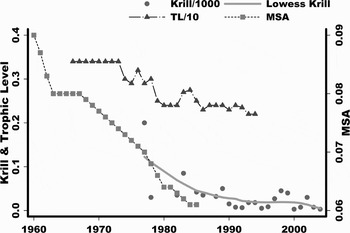
Fig. 1. Comparison of trends in 1) mean trophic level (×10-1) of fishery landings from FAO areas 48, 58 (Scotia Sea) and northern 88 (does not include cetaceans already depleted in 1950s–early 1960s; from Pauly et al. 1998), 2) krill density from net tows taken in Scotia Sea region, with salps having a mirror-image trend [no. m-2 1000-1; line shows predicted values from locally-weighted regression (lowess smoothing), data from Atkinson et al. 2004], and 3) 20 yr running mean of methanesulphonic acid (MSA, μM), a derivative of phytoplankton-produced dimethylsulphide (DMS), found in glacial ice-core annual layers at Law Dome, (western) East Antarctica (Curran et al. 2003). Less DMS and MSA are produced if salps rather than krill are grazing the phytoplankton (Katamatsu et al. 2004).
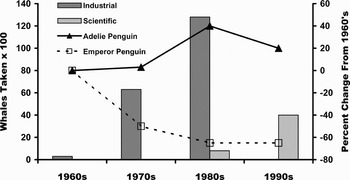
Fig. 2. Numbers of minke whales (×100) removed from IWC areas V and VI (Adélie Land and Ross Sea sector) by decade in the industrial and scientific whaling eras, compared to percent differences relative to 1960s numbers of Adélie penguins breeding at capes Royds and Bird, Victoria Land, and emperor penguins at Pointe Géologie, Adélie Land. The Cape Royds colony, the longest monitored in the Antarctic, was the same size in 1959 as it was in 1909, with no evidence that it had been larger in historical times (Ainley 2002a). These penguins and whales spend the late summer, autumn and winter in the same habitat and region; minke whales and Adélie penguins have the same diet (Ainley 2002b). Data on penguins are from Wilson et al. (2001) and Weimerskirch et al. (2003); those for whales from Brown & Brownell (2001).
 You have
Access
- 98
- Cited by
“New opinions are always suspected, and usually opposed, without any other reason but because they are not already common.” John Locke (1690), “An Enquiry Concerning Human Understanding”
Introduction
According to Thomas Kuhn (Reference Kuhn1962), most science, which he called “normal science,” is conducted within existing, well-accepted paradigms. Anomalous findings are set aside until they become so numerous that they overwhelm an existing paradigm's explanatory power, after which a breakthrough is realized and for a short time “revolutionary science” reigns. Through an intellectual tussle, the anomalies are consolidated into a coherent body of thought and the older paradigm gives way, sometimes requiring the passing of a generation before full adoption of the new paradigm.
In Southern Ocean (SO) marine science, such a shift in paradigm (or at least a central unifying concept) occurred during the early 1990s, but without the passing of a generation and with few attempts to forestall it (Croxall Reference Croxall1992, Murphy Reference Murphy1995). Before then, and reaching a climax in large-scale, international programs like BIOMASS and FIBEX (El-Sayed Reference El-Sayed1994, Siegel Reference Siegel2005), the accepted paradigm proposed that between-species interactions were considered of great importance in structuring the “Antarctic marine ecosystem” (AME), particularly with regard to the removal of more than a million baleen whales during the 1950–60s, thought in turn to have resulted in a huge surplus of their prey, Antarctic krill Euphausia superba Dana (e.g. Laws Reference Laws and Llano1977, Fraser et al. Reference Fraser, Trivelpiece, Ainley and Trivelpiece1992 and references cited therein). Krill was viewed as a central species in the AME, i.e. the pelagic-continental slope ecosystem (e.g. Beddington & May Reference Beddington and May1982), and international survey efforts were organized to quantify krill abundance and importance to non-cetacean species.
If interspecific interactions (such as competition for prey) were important in the AME, certain predictable patterns should have emerged. This has been well substantiated where a top-trophic species or a trophic competitor has been experimentally removed or re-introduced, as is the case in terrestrial, limnetic and certain other marine ecosystems (e.g. Carpenter & Kitchell Reference Carpenter and Kitchell1988, Mills et al. Reference Mills, Soulé and Doak1993, Verity & Smetacek Reference Verity and Smetacek1996, Terborgh et al. Reference Terborgh, Feeley, Silman, Nuňez and Balukjian2006, Jackson Reference Jackson, Estes, Demaster, Doak, Williams and Brownell2006). Ensuing studies testing this expectation in the SO found some evidence of a krill surplus but also found many inconsistent or conflicting patterns (see also Ballance et al. Reference Ballance, Pitman, Hewitt, Siniff, Trivelpiece, Clapham, Brownell, Estes, Demaster, Doak, Williams and Brownell2006). For example, while investigating the expected compensatory response of first or second order krill predators, researchers found an inconsistent decrease in age of maturity among crabeater seals Lobodon carcinophagus (Hombron & Jacquinot) (Bengtson & Laws Reference Bengtson, Laws, Siegfried, Condy and Laws1985); increasing or recovering populations of various fur seals Arctocephalus spp but simultaneously decreasing populations of southern elephant seals Mirounga leonina L. (Payne Reference Payne1977, Priddle Reference Priddle1992, Reid & Croxall Reference Reid and Croxall2001, McMahon et al. Reference McMahon, Bester, Burton, Hindell and Bradshaw2005); increasing chinstrap Pygoscelis antarctica Forster but decreasing Adélie P. adeliae (Hombron & Jacquinot) penguin populations (both should have increased as both are first-order krill predators; Woehler et al. Reference Woehler, Cooper, Croxall, Fraser, Kooyman, Miller, Nel, Patterson, Peter, Ribic, Salwick, Trivelpiece and Weirmirskirch2001, Lynnes et al. Reference Lynnes, Reid, Croxall and Trathan2002); and, finally, while recovery in populations of the baleen whales is proceeding most remain severely depleted, even to this day (Best Reference Best1993, Branch et al. Reference Branch, Matsuoka and Miyashita2004). Despite lack of clear support, the species-interaction paradigm persisted long enough (especially the krill surplus portion) that a fishery treaty emerged from an effort to understand krill better. This was the Convention for the Conservation of Antarctic Marine Living Resources (CCAMLR), a formal attempt to manage resource extraction as fishery nations began to look closely at the supposed krill surplus. Ironically in retrospect (see below), CCAMLR hoped to avoid the situation where human fisheries rather than natural competitors would replace the whales and affect top-down structuring of the AME in their stead (Mitchell & Sandbrook Reference Mitchell and Sandbrook1980, Bengtson & Laws Reference Bengtson, Laws, Siegfried, Condy and Laws1985, Murphy Reference Murphy1995).
In the early 1990s a few authors (e.g. Taylor & Wilson Reference Taylor and Wilson1990, Fraser et al. Reference Fraser, Trivelpiece, Ainley and Trivelpiece1992) theorized that climate change and its affect on sea ice, rather than a krill surplus, explained some of the inconsistent trends and patterns evident in certain ecosystem components. This idea was closely followed by additional studies and a quickly rising tide of acceptance of what became the new central paradigm - bottom-up forcing by physics and climate change as the single most important ecosystem driver - and it is within this that the majority of researchers now interpret their data (see summaries in Croxall et al. Reference Croxall, Trathan and Murphy2002, Siegel Reference Siegel2005, Nicol Reference Nicol2005). The paradigm shift was perhaps partly facilitated by the increasing ease with which physical data could be acquired owing to the technological revolutions also underway (e.g. powerful computers, satellite imagery and remote sensing, moorings of electronic instruments, etc). Under the new paradigm not only was there never a krill surplus but, in effect, whales were replaced not by krill but by gelatinous salps Salpa thompsoni (Foxton)! Atkinson et al. (Reference Atkinson, Siegel, Pakhomov and Rothery2004) showed that the increase in salps was correlated with decreased sea ice extent during the 1960s–early 1970s; many other statistically significant correlations also have been shown to relate species' trends with sea ice at varying temporal scales (e.g. Loeb et al. Reference Loeb, Siegel, Holm-Hansen, Hewitt, Fraser, Trivelpiece and Trivelpiece1997, Fraser & Hofmann Reference Fraser and Hofmann2003, Jenouvrier et al. Reference Jenouvrier, Barbraud and Weimerskirch2005, Forcada et al. Reference Forcada, Trathan, Reid, Murphy and Croxall2006).
Progressing beyond the description of correlations, but perhaps emboldened by the plethora of the fine work about species' relationships to climate change, as referred to above, other researchers have looked for and believe that they have found biotic proxies indicating major change in climate and the large-scale sea ice regime, also during the 1960s, well before the era of remote sensing (De La Mare Reference De La Mare1997, Curran et al. Reference Curran, Van Ommen, Morgan, Phillips and Palmer2003, Hilton et al. Reference Hilton, Thompson, Sagar, Cuthbert, Cherel and Bury2006). Such results, in accordance with the new paradigm, have been cited widely and with little questioning are used to confirm the current “normal science,” emphasizing the supreme, direct importance of physical factors in structuring the AME (e.g. Smetacek & Nicol Reference Smetacek and Nicol2005, Barbraud & Weimerskirch Reference Barbraud and Weimerskirch2006). Problematically, but in keeping with the rules of normal science, contrary views about climate and sea ice change during that period have been ignored and relegated to the status of anomalies. For example, in contrast to an analysis of whale catch records (De La Mare Reference De La Mare1997, postulating a reduction of mean sea ice extent during the 1960s), Ackley et al. (Reference Ackley, Wadhams, Comiso and Worby2003), examining historical, direct observations of sea ice from ships as well as comparing more recent observations with satellite imagery, found no evidence of a large-scale shift from higher to lower mean ice extents from the 1950s to the 1970s. Zwally et al. (Reference Zwally, Comiso, Parkinson, Cavalieri and Gloersen2002), using satellite imagery, have also found no evidence for a dramatic multi-year decrease in ice extent anywhere other than the Antarctic Peninsula region in recent decades, a finding acknowledged recently by Siegel (Reference Siegel2005) and Nicol (Reference Nicol2005) but ignored by many other biologists. We do not dispute that climate change has been occurring around Antarctica, affecting changes in sea ice extent, ice thickness and the sea ice season (also Parkinson Reference Parkinson2002) as well as some populations - especially in the Antarctic Peninsula region (e.g. Smith et al. Reference Smith, Domack, Emslie, Fraser, Ainley, Baker, Kennett, Leventer, Stammerjohn, Mosley-Thompson and Vernet1999) but also elsewhere (see above, also Barbraud & Weimerskirch Reference Barbraud and Weimerskirch2001, Ainley et al. Reference Ainley, Clarke, Arrigo, Fraser, Kato, Barton and Wilson2005). We do find it perplexing, though, that recent studies have rarely considered the extent of the total biotic variation explained by physical factors, or that factors other than physical ones could also be involved in explaining temporal and regional variation in the AME foodweb structure.
It cannot all be climate
While momentum for this physical forcing/climate change paradigm accelerated, overtaking the species-interactions paradigm, Pauly et al. (Reference Pauly, Christiansen, Dalsgaard, Froeser and Torres1998) published an analysis that introduced the concept of “fishing down the food web.” This concept has gained acceptance for marine environments other than the SO as more and more researchers detail the loss of top-down trophic structuring owing to over-fishing of top- and middle-trophic level species (e.g. NSF 1998, Schindler et al. Reference Schindler, Essington, Kitchell, Boggs and Hilborn2002, Soulé et al. Reference Soulé, Estes, Miller and Honnold2005, Scheffer et al. Reference Scheffer, Carpenter and De Young2005, Frank et al. Reference Frank, Petrie, Choi and Leggett2005). Included in the Pauly et al. analysis, among examples from around the world, was a tally of the SO (non-cetacean) fishery landings that showed the now characteristic successively downward depletion of trophic levels in order to maintain economic viability of burgeoning fishing fleets (see also Myers & Worm Reference Myers and Worm2003, for independent, corroborating analysis for the Scotia Sea). According to this analysis, ostensible fishery-driven food-web shift in the SO (not to mention the large-scale whale extraction), also took place during the 1960s, much later than elsewhere on the globe. And, more critical to the old SO paradigm and perhaps providing reasons for inconsistent support of a krill surplus, it was not just cetaceans that had been depleted. Also removed were large predatory fish, a fact that is critical to consider in an analysis of food-web structure as fish are the most important predators in most marine ecosystems (Sheffer et al. 2005, and others). What is not surprising within the current confines of normal science is that we have yet to find even one paper in the SO literature that has cited Pauly et al., even though that paper provides crucial support for the importance of interspecific interactions required for the credibility of the between-species-interactions paradigm. Moreover, many Antarctic papers published over the past decade that have shown correlations between a long-term biological variable and a physical one, such as sea-surface temperature or sea ice extent (or their proxies), probably would find an equally compelling correlation if observations were compared instead against the declining trophic level/commercial fisheries data of Pauly et al. The latter are also characterized by a steep decline beginning in the 1960s (cf. De La Mare Reference De La Mare1997, Curran et al. Reference Curran, Van Ommen, Morgan, Phillips and Palmer2003, Atkinson et al. Reference Atkinson, Siegel, Pakhomov and Rothery2004; Fig. 1). The ocean around the colonies of polar penguin species (whose diet trophic level has also been declining - a metric that has been suggested as a proxy for decreased phytoplankton production (Hilton et al. Reference Hilton, Thompson, Sagar, Cuthbert, Cherel and Bury2006)) historically has been one of the most heavily fished, and depleted, waters on the globe (Pauly et al. Reference Pauly, Watson and Alder2005). It seems, therefore, that the Pauly et al. analyses are included in those that most researchers have relegated, under the climate change paradigm, to the category of anomaly, even though they certainly appear to be relevant to understanding the AME.
Comparison of trends in 1) mean trophic level (×10-1) of fishery landings from FAO areas 48, 58 (Scotia Sea) and northern 88 (does not include cetaceans already depleted in 1950s–early 1960s; from Pauly et al. Reference Pauly, Christiansen, Dalsgaard, Froeser and Torres1998), 2) krill density from net tows taken in Scotia Sea region, with salps having a mirror-image trend [no. m-2 1000-1; line shows predicted values from locally-weighted regression (lowess smoothing), data from Atkinson et al. Reference Atkinson, Siegel, Pakhomov and Rothery2004], and 3) 20 yr running mean of methanesulphonic acid (MSA, μM), a derivative of phytoplankton-produced dimethylsulphide (DMS), found in glacial ice-core annual layers at Law Dome, (western) East Antarctica (Curran et al. Reference Curran, Van Ommen, Morgan, Phillips and Palmer2003). Less DMS and MSA are produced if salps rather than krill are grazing the phytoplankton (Katamatsu et al. 2004).
Assuming that the rate of commercial take of resources can be a proxy for their availability (see references above regarding top-down forcing; also Myers & Worm Reference Myers and Worm2003), these data also indicate that a major shift has occurred in the food-web structure of the AME (Pauly et al. Reference Pauly, Christiansen, Dalsgaard, Froeser and Torres1998), and this shift has little to do with climate. Many feed-back loops and competitive and synergistic relationships are now probably gone (Pauly & Maclean Reference Pauly and Maclean2003) due to the loss of major portions of upper- and middle-trophic levels - especially around most sub-Antarctic and lower latitude Antarctic islands and northern Antarctic continental shelves, although food webs in some more southerly areas, e.g. the Ross Sea, remain to date intact. This loss occurred within the professional lifetimes of still-practicing SO ecologists and their students, and occurred just before the dramatic advances of modern technology that now define SO marine science (mid-1970s onward), as noted above. Thus, the vast majority of data supporting the physically-forced view of the AME have been collected well after the depletion of top predators in the system was well underway.
Unfortunately this depletion probably continued coincident with apparent or real shifts in physical factors (Zwally et al. Reference Zwally, Comiso, Parkinson, Cavalieri and Gloersen2002, Parkinson Reference Parkinson2002, Jacobs et al. Reference Jacobs, Guilivi and Mele2002, Jacobs Reference Jacobs2006). Because fishing down the food web can affect ecosystems just as dramatically as climate change (Pauly & Maclean Reference Pauly and Maclean2003), causes of patterns have merged and what is concluded about the AME may primarily be distorted by researcher bias and the lack of long-term data on food-web structure. In the Bering and North seas and Benguela Current, for instance, where researchers accept the idea of major climate change as well as heavy fishing pressure, the dramatic rise in the abundance of gelatinous organisms has been explained by the fishery pressure that has reduced grazing on their larvae (Brierly et al. 2001, Brodeur et al. Reference Brodeur, Sugisaki and Hunt2002, Heymans et al. Reference Heymans, Shannon and Jarre2004, Lynam et al. Reference Lynam, Hay and Brierley2005), with similar arguments being made for other, smaller systems (e.g. Mills Reference Mills2001, Xian et al. Reference Xian, Kang and Liu2005). On the other hand, in the mind-set of most scientists working under the climate change paradigm in the “relatively pristine” AME (e.g. a concept used in the summaries by Croxall et al. Reference Croxall, Trathan and Murphy2002, Smetacek & Nicol Reference Nicol2005), the current hypothesis is that it is simply changed sea ice that is responsible for a similar dramatic rise in gelatinous creatures (Atkinson et al. Reference Atkinson, Siegel, Pakhomov and Rothery2004, Kawaguchi et al. 2005). However, because both heavy fishing and salps are concentrated and/or dominant in waters of non-existent, reduced or declining ice cover in the AME (see Nicol et al. Reference Nicol, Pauly, Bindoff, Wright, Thiele, Hosie, Strutton and Woehler2000), a positive correlation between heavy fishing and increased salps could well be involved (see also Lynam et al. Reference Lynam, Gibbons, Axelsen, Sparks, Coetzee, Heywood and Brierley2006). In the case of the gelatinous salps, although notoriously difficult to detect in the highly acidic stomachs of fish, they have been found in the diet of certain SO piscine species (Casaux et al. Reference Casaux, Mazzotta and Barrera-Oro1990, Pakhomov Reference Pakhomov1997, Barrera-Oro Reference Barrera-Oro2003, Bushula et al. Reference Bushula, Pakhomov, Kaehler, Davis and Kalin2005), though not yet in the little-researched diets of pelagic juveniles of commercially important benthic fish (e.g. Pakhomov & Pankratov Reference Pakhomov and Pankratov1992, Koch & Eversen 1997, Barrera-Oro et al. Reference Barrera-Oro, Casaux and Marschoff2005). Finally, it is very likely that salps eat eggs and early larvae of krill (reviewed by Siegel Reference Siegel2005), a scenario consistent with the decline in krill as salps proliferate (cf. Atkinson et al. Reference Atkinson, Siegel, Pakhomov and Rothery2004).
Whale extraction may well have had a major effect
Some of us, exercising “normal science,” recently presented ideas about how changes in climate, weather and sea ice may have affected the long-term population trends of certain Antarctic penguin species breeding in the Ross Sea/western Pacific Ocean sector and elsewhere in the SO (Ainley et al. Reference Ainley, Clarke, Arrigo, Fraser, Kato, Barton and Wilson2005). By contrast, we compare the Ross Sea penguin trends to the rate of extraction of a major trophic competitor of Adélie penguins, the Antarctic minke whale Balaenoptera bonaerensis Burmeister, from the same region (Fig. 2). The population of this pagophilic cetacean, which completely overlaps the penguins' habitat and food preferences (an important coincidence; Murphy Reference Murphy1995), was aggressively targeted two decades later than the other, more open-water baleen whales (Bengtson & Laws Reference Bengtson, Laws, Siegfried, Condy and Laws1985). The effects to the population of the more than 116 600 taken (Clapham & Baker Reference Clapham and Baker2001), about 20% from the region of the Ross Sea (Brown & Brownell Reference Brown and Brownell2001) is unknown. Adélie penguins, seemingly released from trophic competition, show the appropriate demographic lag as increased penguin productivity and survival result in population growth for this slow-to-mature (up to seven years) upper-level predator. The fact that coastal polynyas were increasing in size during this time as well would facilitate the penguin increase (cf. Ainley Reference Ainley2002a, Parkinson Reference Parkinson2002, Ainley et al. Reference Ainley, Clarke, Arrigo, Fraser, Kato, Barton and Wilson2005). As the take of minke whales slackened beginning in 1987 (Brown & Brownell Reference Brown and Brownell2001), and best demonstrated in the Ross Sea, the penguin increase slackened.
Numbers of minke whales (×100) removed from IWC areas V and VI (Adélie Land and Ross Sea sector) by decade in the industrial and scientific whaling eras, compared to percent differences relative to 1960s numbers of Adélie penguins breeding at capes Royds and Bird, Victoria Land, and emperor penguins at Pointe Géologie, Adélie Land. The Cape Royds colony, the longest monitored in the Antarctic, was the same size in 1959 as it was in 1909, with no evidence that it had been larger in historical times (Ainley Reference Ainley2002a). These penguins and whales spend the late summer, autumn and winter in the same habitat and region; minke whales and Adélie penguins have the same diet (Ainley Reference Ainley2002b). Data on penguins are from Wilson et al. (Reference Wilson, Ainley, Nur, Jacobs, Barton, Ballard and Comiso2001) and Weimerskirch et al. (Reference Weimerskirch, Inchausti, Guinet and Barbraud2003); those for whales from Brown & Brownell (Reference Brown and Brownell2001).
We then began to question the rapid decline attributed to a mysterious short-term episode of adult mortality in emperor penguins Aptenodytes forsteri Gray in the same region (Weimerskirch et al. Reference Weimerskirch, Inchausti, Guinet and Barbraud2003), a mortality event correlated to climate effects (Barbraud & Weimerskirch Reference Barbraud and Weimerskirch2001, Jenouvrier et al. Reference Jenouvrier, Barbraud and Weimerskirch2005). Also considered subsequently have been effects of changed climate on this species' inability to recover from that mortality event (Jenouvrier et al. Reference Jenouvrier, Weimerskirch, Barbraud, Park and Cazelles2004, Ainley et al. Reference Ainley, Clarke, Arrigo, Fraser, Kato, Barton and Wilson2005). In accord with massive adult mortality, the population decline in Adélie Land, a short distance west of the Ross Sea, was sharp (see Jenouvrier et al. Reference Jenouvrier, Barbraud and Weimerskirch2005) and it occurred in the early part of the Adélie penguin increase (Fig. 2). Not coincidentally we suggest, the mortality event happened at the time when minke-whale-eating killer whales Orcinus orca (L.) type A (Pitman & Ensor Reference Pitman and Ensor2003), inhabiting the waters frequented by these penguins (again, see Murphy Reference Murphy1995), were being challenged by a major, rapid large-scale removal of their main prey, i.e. the minke whale. Until that time it was thought that minke whale and killer whale populations, prey and predator, were in equilibrium (N.V. Doroshenko in Mikhalev et al. Reference Mikhalev, Ivahim, Savusin and Zelenaya1981). Did these top predators switch to alternate prey including emperor penguins, especially penguins whose vulnerability was increased by a possible short-term divergence in sea ice (as proposed by Jenouvrier et al. Reference Jenouvrier, Barbraud and Weimerskirch2005), and a habitat frequented only at its periphery by type A killer whales (Pitman & Ensor Reference Pitman and Ensor2003)? Emperor penguins have been found in killer whale stomachs (type unknown; Prévost Reference Prévost1961), and it is well known that these predators (type A) eat high numbers of the closely related king penguin A. patagonicus in the northern part of this SO region (e.g. Condy et al. Reference Condy, Van Aarde and Bester1978, Guinet Reference Guinet1992, Guinet & Bouvier Reference Guinet and Bouvier1995). Owing to confounding climate effects (warmer winter temperatures, stronger winds, thinner sea ice on which to breed), the emperor penguin population has not been able to recover from the initial massive mortality (cf. Barbraud & Weimerskirch Reference Barbraud and Weimerskirch2001, Jenouvrier et al. Reference Jenouvrier, Weimerskirch, Barbraud, Park and Cazelles2004, Ainley et al. Reference Ainley, Clarke, Arrigo, Fraser, Kato, Barton and Wilson2005). This scenario is reminiscent of a hypothesized killer whale prey switch, in this case from whales to sea otters Enhydra lutris L., an idea developed to explain changes in the fauna of the Aleutian Islands (Springer et al. Reference Springer, Estes, Van Vliet, Williams, Doak, Danner, Forney and Pfister2003), and a hypothesized switch to sea lions (Otaria flavescens (Shaw)) and elephant seals in the Southern Ocean (Branch & Williams Reference Branch, Williams, Estes, Demaster, Doak, Williams and Brownell2006). Moreover, an emperor penguin is far more of a meal for a killer whale than is the similar sized sea otter, both weighing 25–35 kg as the high fat content of the penguin would make it superior prey, probably equivalent to an energy-rich sea lion pup (Williams et al. Reference Williams, Estes, Doak and Springer2004).
Modelling Southern Ocean ecosystem structure and change
We will end here with some questions, hoping that the reader has at least given some credence to the hypothesis that the AME is vastly different from the pre-1970s due not just to climate effects but equally to biotic extractions from the ecosystem. We point out that in ecology, but not the physical sciences, it is important to keep in mind how paradigms have evolved or been replaced (Dunlap Reference Dunlap2006). Why did the paradigm involving the massive 1960s whale loss and its possible effect on the AME fall out of favour so quickly and with very little contest? Why have the possible ecological effects of the concurrent massive extraction of finfish from the SO not been acknowledged by ecologists? By keying on physical, bottom-up forcing, are most SO marine biologists, in effect, now acknowledging that the AME no longer has the resiliency it once had when numerous biotic feedback loops were in place to ameliorate climate effects? That is, lacking the biotic feed-backs, is the AME now more susceptible to physical forcing (see Balance et al. 2006), as is now being argued for depleted non-marine ecosystems (e.g. Post et al. Reference Post, Conners and Goldberg2000, Wilmers et al. Reference Wilmers, Sinha and Brede2002, Wilmers & Getz Reference Wilmers and Getz2005)? Indeed, the dramatic year-class cycling evident in the krill that dominate the Adélie penguin diet off the Antarctic Peninsula (Fraser & Hofmann Reference Fraser and Hofmann2003) - and where alternate prey (fish) are no longer available in quantity (see above, also Emslie & McDaniel Reference Emslie and McDaniel2002) - is reminiscent of the simple food webs of the terrestrial Arctic, where predator populations closely track their limited prey. No wonder that in this area strongly affected by both climate change and fishery depletion, unlike high-latitude portions of the Antarctic, the Adélie penguins are being replaced only in part by other, open water species (Fraser & Patterson Reference Fraser, Patterson, Bataglia, Valencia and Walton1997, Ainley et al. Reference Ainley, Clarke, Arrigo, Fraser, Kato, Barton and Wilson2005, Forcada et al. Reference Forcada, Trathan, Reid, Murphy and Croxall2006).
No doubt a strong mix of factors is involved in the re-structuring of the AME food web, with both climate change and depletion of top- and middle-trophic level species playing a role (as noted earlier, e.g. by Croxall Reference Croxall1992), but surely it is time for some serious re-thinking on their relative contributions and what it is we are actually measuring or managing in the observed trends of SO organisms? Finally, will we not be able to answer some of these questions better if portions of the SO, such as the Ross Sea, are kept free of intensive biotic extractions? The latter, following the progression experienced by other ocean systems (Pauly et al. Reference Pauly, Christiansen, Dalsgaard, Froeser and Torres1998), has now begun in that neritic system (Ainley Reference Ainley2002b).
Acknowledgements
We thank T. Branch, R. Brownell, J. Estes, W. Fraser, M. Hauber, R. Hofman, S. Jacobs, R. Marinelli, P. Penhale and an anonymous reviewer for their comments, which contributed to the improvement of this paper. DA and GB wish to acknowledge support of grant NSF-OPP 0440643; and AL support of a Marie Curie International Fellowship within the 6th European Community Framework Programme. This is PRBO contribution #1513.