INTRODUCTION
Traditionally, the study of Roman writing habits has been focused on the written and iconographic evidence. Latin literature, epigraphy, graffiti, papyri, tablets, paintings and reliefs have been employed in major studies as the primary sources of information to quantify the levels of literacy and describe the identity and social position of writers.Footnote 1 In recent years, however, the limitations of text-only-based approaches to the study of ancient literacy in Roman Britain have been pointed out: in particular, the scarcity of written documents and their concentration in towns and military settlements produce biased results.Footnote 2 At the same time, scholars noticed a substantial lack of engagement with the writing materials preserved in the archaeological record and started to adopt a series of artefact-based approaches to investigate literate identities and writing practices.Footnote 3 Studies of the social and spatial distribution, as well as of the materiality, of Roman inkwells and signet rings (although the latter are only partially related to writing) provided new insights into how writing materials were employed, where and by whom.Footnote 4
In Roman archaeology, the term stylus defines a writing implement that features a slender shaft – sometimes swelling to allow for a better grip – with a pointed tip on one end and a small spatula on the other end. The object was held in the hand, using the tip for inscribing and the spatula as an eraser to smooth and flatten the inscribed surface.Footnote 5 Although styli were made to be used on waxed tablets, it appears that they were also employed to write on different materials, such as defixiones, ostraka and other ceramic surfaces, wooden or bone objects and plastered walls.Footnote 6 Styli were in use throughout the entire Roman period until late antiquity.Footnote 7
In the general literature on Roman writing materials, styli constitute an overlooked category of objects. In fact, despite being very common finds in many archaeological sites, these writing tools have been rarely investigated in relation to Roman writing practices and writers. Through a comparative analysis between the London material and examples from elsewhere in Britain and continental Europe, this article explores the geographical and social distribution of different types, in order to broaden our understanding of these objects and to demonstrate their potential as new sources of information on Roman writing practices. The evidence will be examined to shed light on writers’ identities and to explore the hypothesis that different types of stylus were used for different functions and by different social actors across the territory of the Empire.
STYLI IN THE ARCHAEOLOGICAL RECORD AND PREVIOUS STUDIES
The earliest examples of styli (late Republic) are made of bone and usually have an olive-shaped globular head instead of a spatulate eraser.Footnote 8 From the first century a.d., the most common material for styli was iron, but there are examples made of copper alloys. Gold, silver and stone styli are also attested, but extremely rare.Footnote 9 Moreover, although the majority of commentators believe that wooden styli were common,Footnote 10 only a very small number of them have been found and they do not seem to be common on archaeological sites where organic materials are particularly well preserved. Despite their fairly simple design, styli show an impressive range of typological variation. In fact, not only can each basic component (tip, grip, shaft, neck and eraser) vary in shape and dimensions, but there are also several possibilities for the decorative apparatus. A few examples bear a maker's mark, inscriptions or other distinctive symbols on them.Footnote 11
Widely attested in iconographic and literary sources,Footnote 12 styli are also common archaeological finds and there are exceptional cases where hundreds of them have been recovered on the same site (e.g. Augusta Raurica in Switzerland or Magdalensberg in AustriaFootnote 13). Unfortunately, as taphonomic factors have a great impact on styli, they are often badly corroded, difficult to recognise and thus under-recorded, especially on excavations where iron is not routinely X-rayed.Footnote 14
In the general literature on Roman writing materials, it is rare to find more than a paragraph dedicated to styli and they are usually simply described in relation to waxed tablets.Footnote 15 There are, however, a few authors that have focused in more detail on single aspects of these objects, such as references in written sourcesFootnote 16 or their aesthetic characteristics and chronology.Footnote 17 In archaeological reports, there appears to be no standard way of describing them and they are often inadequately reproduced, either because the illustration is too simple, or because it focuses on corrosion rather than on functional features. Schaltenbrand Obrecht's work represents the most complete analysis of Roman styli and it is mainly based on continental European material (focusing in particular on styli found in Augusta Raurica).Footnote 18 In addition to a typology, it includes a review of the literary, iconographic and archaeological sources, an assessment of production techniques (supported by the creation of metal replica) and a survey of the find contexts on the site of Augusta Raurica. Other scholars have discussed similar topics in separate articles.Footnote 19 For Britain, the most relevant studies of styli as physical artefacts are concerned with typology.Footnote 20 A single article examines stylus distribution as evidence of literacy across a number of Romano-British villas and rural settlements, concluding that the substantial number of styli found on these sites seems to attest literate identities in areas where written texts are unpreserved or uncommon.Footnote 21 Recently, the distribution of writing equipment (including styli) in rural sites has been mapped as part of the Rural Settlement of Roman Britain Project, revealing that almost all of it occurs on villas and roadside settlements, as opposed to farmsteads and other types of sites.Footnote 22
METHODOLOGY AND DATA COLLECTION
London represents a remarkable case study for an analysis of Roman styli in relation to ancient writing and writers. The quantity of artefacts is exceptional for Britain, and the great majority of them are in good condition due to the waterlogged and anaerobic nature of many deposits that favoured the preservation of metal objects.
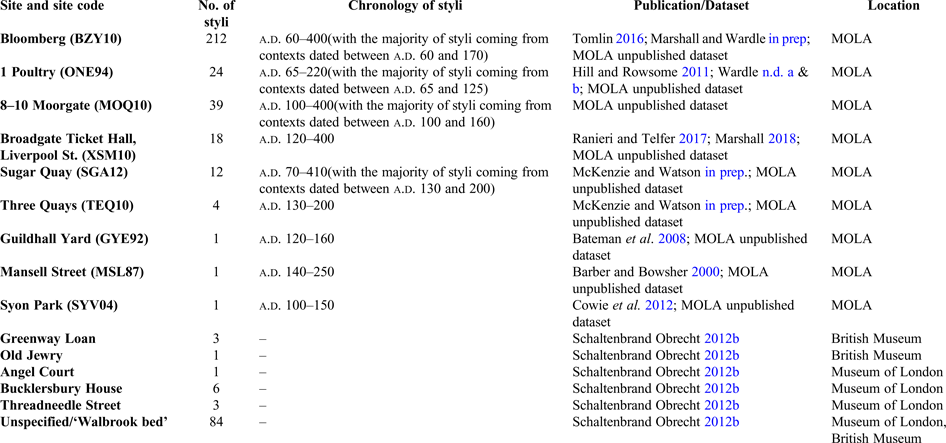
I am aware of at least 464 styli from London, held by major institutions (Museum of London, British Museum, MOLA). This study was undertaken during the Covid-19 pandemic and it is based on the 410 examples (appendix table 1) for which I could access sufficient information – images and/or detailed description – to assign a typological classification. More precisely, information regarding 312 styli has been retrieved from a dataset of Roman writing materials from recent excavations in London supplied by MOLA;Footnote 23 missing data have been integrated, when possible, from reports available on the Archaeological Data Service website and MOLA publications.Footnote 24 The remaining 98 styli are illustrated and described in Schaltenbrand Obrecht's catalogue (2012b), and they encompass examples in the Museum of London and in the British Museum.Footnote 25 The objects’ dates range from a.d. 40 to 400, allowing for a study of Roman writing practices across the entire duration of the Roman Imperial period. However, the majority of them are dated to the first two centuries a.d., and in this period the find-spots are usually dated with more precision compared to those of later styli. The main focus for this study is therefore on the period between a.d. 60 and 250/300.
This large assemblage comprises an interesting variety of different types. The research questions that this paper aims to answer are the following: ‘how do styli types found in London compare to those found elsewhere?’, and ‘what can we infer about ancient writing practices and writers?’ The main aim of this analysis is to evaluate the hypothesis that different types of styli show geographical and social patterns of distribution that can reveal information about production centres, the identity of users and their movement across the Empire.
Twenty-one sites located in Britain and continental Europe have been selected for a comparative analysis, on the basis of the quality and quantity of data available in regard to styli, relevance in the literature and geographical location (appendix table 2). Information about the artefacts and pictures were retrieved from the relevant publications. I fully acknowledge that the selection of sites and artefacts reflects inherent biases (notably sites with well-published assemblages, and ones that were easily accessible even during Covid-19 lockdown). Therefore, as the sample of sites considered is limited, this study cannot produce universal and definitive results. Instead, it aims to recognise and interpret the role of styli in defining ‘networks’ that link specific sites together and that can be singularly significant for furthering our understanding of Roman writing habits.Footnote 26 The assemblages of styli from these sites were examined, and parallels of styli from London are included in the discussion. Incomparable styli from the sites were excluded, because the objective was to find and interpret connections.
A ‘site type’ has been assigned to each find-spot, distinguishing in particular between urban towns, military settlements and rural settlements. These categories are inspired by those employed in other artefact-based studies and constitute a tool for recognising patterns of social distribution.Footnote 27 The most evident patterns have thus been connected with the activity of specific social actors. With respect to this particular study, assigning a ‘site type’ to London – urban or military – poses some challenges, due to the heterogeneity of the contexts within the city where styli have been recovered, and their association with different or multiple communities. The simple definition of ‘urban town’ would be misleading, considering that some sites included in the analysis have possible links with the military: notably BZY10, where the army features quite strongly in the texts of wax tablets, but also TEQ10 and SGA12, as port sites.Footnote 28 For this reason, London – and indeed a few other towns such as Augst, Iulia Concordia and Aquileia – have been classified here as ‘urban large towns with military forts’, in order to highlight the important military presence at these sites. The classification of ‘military’ has only been attributed to military bases, forts and legionary camps where the urban component is secondary to the activity of the army. The numerous parallels between London styli types and types appearing in European sites connected with the military – which will be systematically noted throughout the paper – might be explained with the above-mentioned military influence in London during the time period and in the contexts under analysis; such similarities, I will argue, might also suggest that styli were first introduced and popularised in London and in the northern regions by members of the army.
For analytical and descriptive purposes, all styli have been typologically classified according to Schaltenbrand Obrecht's system of families and types.Footnote 29 This typology encompasses eight families defined by the shape of styli's shaft (referred to with letters), which are further subdivided into 34 types (referred to with a letter and a number) on the basis of the transition from shaft to tip, the shape of the eraser and the presence, type and position of decoration. This recent classification was chosen because, in contrast to Manning's typology, traditionally employed in Britain, it encompasses a larger number of types which are also chronologically defined. Furthermore, a preliminary assessment of Schaltenbrand Obrecht's types in relation to the London assemblage gave promising results, while other typologies produced heterogeneous groups that were chronologically unrelated.Footnote 30 It must be noted, however, that finding a perfect correspondence in terms of chronology and identification between London styli and Schaltenbrand Obrecht's types is not always possible. In general, the typological classification of styli poses many challenges, related to their degree of preservation, to the subtle variability of their features and crucially to how they should be interpreted. This paper does not aim to propose a classification of London styli: the typology is here used as an instrument to visualise different objects and explore whether we can find similar examples in other sites. Peculiar or possibly new subtypes are presented when appropriate.
LONDON IN BRITAIN AND EUROPE
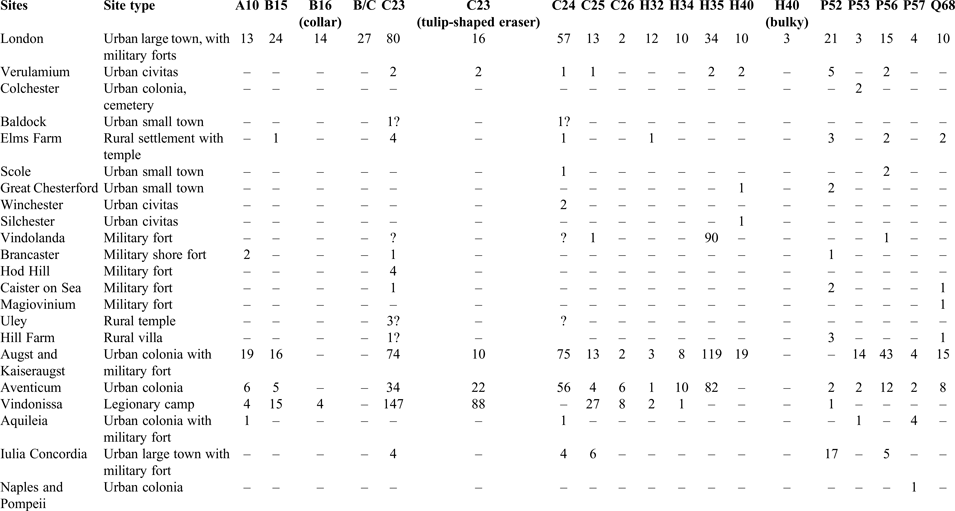
In the assemblage of London styli under analysis, it was possible to recognise at least 25 different types, which belong to Schaltenbrand Obrecht's families A, B, C, H, P and Q.Footnote 31 These families comprise styli with swelling shafts (family A), shafts tapering from the eraser to the tip (B), straight shafts (C), shafts tapering to the eraser (H), shafts tapering to the eraser but their grip is less thick compared to family H (P) and styli with straight shafts and a swelling and often decorated grip (Q). This paper will focus on 19 types (comprising 368 styli), as they show the most relevant patterns of social and geographical distribution within the 21 sites selected for the comparative analysis. Seven styli found in London do not fit into any of Schaltenbrand Obrecht's types, and they are preserved in only one example each which does not find close parallels anywhere. Five of them are illustrated in Schaltenbrand Obrecht's catalogue.Footnote 32 This paper will briefly present two more recently excavated examples from well-documented London contexts. table 1 indicates the number of styli per type found on each site, and more information concerning their chronology and publication can be found in appendix table 2 (this also specifies the total number of styli from each site). fig. 1 is a map showing the location of all sites.
Map of British and continental sites selected for comparative analysis.

number of styli per site and type

It should be noted that the majority of London styli come from sites located in a quite restricted area along the Walbrook stream: these are Bucklersbury House, Bloomberg, One Poultry, possibly ‘Walbrook Bed’ sites; as well as Moorgate and Broadgate Ticket Hall further north. This is due to a preservation bias associated with the waterlogged environment at these sites, which favours the survival of perishable artefacts such as iron and wooden writing materials. An important implication of this is that, in London and elsewhere in Britain, there were probably many more styli than previously thought, which do not survive in the archaeological record. The fact that the three styli-rich Swiss archaeological sites considered in this analysis (Augst and Kaiseraugst, Aventicum and Vindonissa) are also waterlogged sites, suggests that a similar conclusion may apply to Europe as well.
In the following sections, styli types will be divided and presented in four groups: types that only appear in London, types that show military character, types that have a more urban or rural character and unique styli which do not find parallels. These groups have been defined on the basis of the geographical and contextual distribution of the types, but they also take into account their aesthetic characteristics or decorations. More precisely, a few very standardised types appear in larger quantities on military sites compared to urban sites and in rural sites – these will be discussed in the ‘military’ group. The ‘urban and rural’ group comprises styli found with less frequency or never on military sites, and sometimes appearing on rural sites. These styli seem to be overall ‘less standardised’ in terms of decoration and characteristics. These groups should not be considered rigid categories, but as a possible way to interpret some of the most evident consumption and preference patterns which emerged in the analysis.
LONDON PRODUCTION OF STYLI?
Three types/subtypes of styli are found exclusively or prevalently in London (fig. 2). Although they do not appear in Schaltenbrand Obrecht's classification, their designations here have been assigned adapting Schaltenbrand Obrecht's system. Type B16 (collar) was distinguished by M. Marshall,Footnote 33 while the other two are here defined for the first time.
Styli types that are almost exclusively found in London. (VSO = Vera Schaltenbrand Obrecht).

The first type (B/C), encompassing styli with straight shafts or tapering towards the tip and erasers with very narrow or no shoulders, appears to be a hybrid between Schaltenbrand Obrecht's families B and C. The second (B16 collar) is a peculiar subtype of B16 styli, with a small collar around the neck. The third (H40 bulky) is a very rare type, somewhat similar to Schaltenbrand Obrecht's H40, but characteristic for its heavy and bulky form. Despite its similarity with type H40, this is probably not a variant or an imitation, but a genuinely different type, possibly made with these characteristics to fit the requirements of particular users (e.g. someone who needed a solid tool which does not get lost easily and with a large tip).
It appears that styli of type B/C and H40 (bulky) are only found in London (see table 1). They are very likely to represent a local production: in fact, despite being very simple in shape, they can be easily distinguished – on the basis of their main features – from other styli of families B, C and H found elsewhere in the same time period (cf. figs 5a–b with examples family B, C and H styli from London). A similar conclusion might be proposed for type B16 (collar) styli, as the only other location in which they appear is Vindonissa, a legionary camp, but in minor quantity (four), and they are absent from all other sites with styli dated to the second half of the first century a.d. It has been suggested by R. Tomlin that one type B16 stylus (BZY10 <8700>) came from Rome, because it bears an inscription that starts with: ‘I have come from the City, I bring you a welcome gift’.Footnote 34 The occurrence of many styli of this type in London and the fact that the speaker of the inscription is a person and not the object cast doubts on this interpretation; although a Roman provenance cannot be completely excluded, it is also possible that the stylus was purchased in London by a traveller who came from Rome – if we accept the assumption that the word urbs always indicates Rome when no other identification is provided.Footnote 35 The four B16 (collar) styli from Vindonissa, however, might be more significant than we think: if this type was commonly produced in northern Europe in the same period, a traveller could have bought an example at any point on the way to Britain.Footnote 36 Further work on continental and British assemblages is necessary to identify whether this type is really absent from sites other than London and Vindonissa. Interestingly, moreover, all type B16 styli found in London are from the Bloomberg and One Poultry sites, which show connections with the activity of the army, as does Vindonissa. It is possible, therefore, that this type – which one might be tempted to interpret as a “London invention” – derives from or reproduces European examples used by soldiers, officials or administrators.
STYLI AND THE MILITARY
The distribution and characteristics of a small number of styli types suggest a connection with the activity of the Roman army and its movements across the territory of the Empire (fig. 3). These types are found in high quantities in military bases and with less frequency in major towns, while they are not attested on rural sites and smaller towns. In addition, within these types, styli are extremely similar in terms of aesthetic characteristics.
Styli types connected with the Roman army.

Styli of type C23 with long tulip-shaped erasers are here defined as a subtype or a variation of Schaltenbrand Obrecht type C23 (featuring erasers with rounded shoulders), and they date to the second half of the first century a.d. in London. They have been described as outstanding among the others by Hill and Rowsome, who hypothesised a local production for them.Footnote 37 Around the same time, however, they are extremely common at Vindonissa, a legionary camp, and they also appear at Augst and Kaiseraugst, a major city connected to the largest Roman military base in Switzerland. Interestingly, five examples from Vindonissa, one from Augst and four from London bear similar makers’ stamps (fig. 4).Footnote 38 Only two of these stamps are legible, one from London and one from Vindonissa, and they bear the identical inscription probably referring to the name ‘Reginus’.Footnote 39 This indicates an interesting connection between these sites, and the large concentration of styli with this particular eraser in Vindonissa might suggest a military character or origin for the type.Footnote 40 Moreover, one example found in London bears an inlaid decoration on the eraser which resembles designs appearing on military studs.Footnote 41
Similar styli of type C23 with a tulip-shaped eraser and maker's stamps. (a) Example from London, held in the British Museum (Schaltenbrand Obrecht Reference Schaltenbrand Obrecht2012a, 66, detail of fig. 59, by kind permission of the author); (b) Two examples from Vindonissa (Schaltenbrand Obrecht Reference Schaltenbrand Obrecht2012a, 68, detail of fig. 61; Reference Schaltenbrand Obrecht2012b, cat. nos Vi.151, Vi.186, by kind permission of the author).

Styli types that have an urban and rural character.

Styli types that have an urban and rural character.

From the end of the first century a.d. and especially during the first half of the second, styli of type C25 are very common at Augst, Vindonissa and Iulia Concordia, while styli of type H35 are abundant at Augst, Aventicum and Vindolanda. Type C25 styli in London are made of iron and characteristic for their squared eraser with one rounded shoulder and a prominent spur on the other side; their neck and sometimes their grip are decorated with very fine grooves. Type H35 styli, also made of iron, usually have trapezoidal or rectangular erasers and are decorated at the grip with a bead and reel moulding, followed by a zig-zag motif (forming small triangles), grooves or cross-hatching. Considering the expertise of the army in metalworking, a high number of ‘standardised’ styli found in forts and legionary camps could be interpreted as a production of the army for its soldiers and officials. Alternatively, rather than indicating exclusive access, this might be an interesting sign of a strong customer preference for this type by members of the army. It should be also noted that, at Vindolanda, type H35 styli constitute almost half of the entire assemblage found at the site, and the number goes up to more than half if their variations are included. Type P57 styli are slightly later in date and appear at the same sites but are less frequent. However, they could be included in this discussion as they often show the same decorations with bands of small triangles as type H35 styli. Being more elaborate, slender, and often entirely realised in copper alloys, these styli are probably high-status versions of their simpler iron H35 counterparts, perhaps reserved to higher officials. Copper and copper-alloy styli are in general less frequent than iron ones (4 per cent of the London assemblage) – possibly because non-ferrous metals are less resistant and bend more easily – but they are usually elaborated, fine or unusual. For this reason, it seems plausible that they were high-status objects made for a sporadic use, perhaps on special occasions where aesthetic qualities were more important than the tool's performance, or by people who did not write daily. Interestingly, one stylus preserved in the Archaeological Museum of Naples has been classified by Schaltenbrand Obrecht as P57; if compared to the other examples under analysis, it does feature the same type of decoration, but from the illustration it appears to be slightly thicker and with a larger tip.
The occurrence of small numbers of C23 (long tulip-shaped erasers), C25 and H35 styli in Verulamium and Aventicum, urban towns where the presence of the army is less prominent, is of interest. In fact, on one hand, it might be an indication of soldiers passing by. On the other hand, particularly in the case of the early types C23 and C25, which are simple in shape and easy to reproduce, it leads us to suspect that the use of some of these styli was probably not restricted to the army.
Similarities between styli found in military bases scattered across the Empire suggest that soldiers not only used to travel with their styli – causing them to appear in major towns – but they also possibly kept reproducing them with the same distinctive features when they settled in new locations. Although production centres cannot be identified here with certainty, this distribution of styli also shows that sites that are particularly connected with the imperial power (through the presence of the military and/or political figures) shared a common material culture of writing. Recent studies on globalisation in the Roman world argued – particularly in the Flavian period – for the existence of an important and standardised shared material culture package connected to Roman military and colonial centres, attesting an intense long-distance exchange of ideas and technologies.Footnote 42 Writing with a stylus was probably one of these shared practices, and it is possible that some of the types presented in this section – particularly C23 with long tulip erasers, C25 and perhaps P57 – rather than ‘military types’, were ‘universal Roman’ styli which the military contributed to spread.
Finally, it is interesting to notice that styli from London are quite different in terms of shape and materials from those found in Pompeii and Naples around the same time period,Footnote 43 but they find parallels in military sites in northern Italy. The hypothesis, here proposed, that styli types of the northern European regions developed from ‘military styli’ brought by soldiers and bureaucrats during the conquest is an interesting one which future studies could investigate.
STYLI AND THE URBAN AND RURAL COMMUNITIES
A larger number of styli types show an urban character (figs 5a–c). Some of them are still prevalently found on military sites, but the frequency of styli and their characteristics do not allow attributing the use and production of these objects solely or predominantly to the army. Some others, instead, appear also in more peripheral centres and rural sites. In addition, these styli show a higher degree of variability in their features compared to the previously mentioned ones, appearing overall ‘less standardised’. It has to be noted, however, that particularly types A10, C23 and C24 are quite heterogeneous categories in Schaltenbrand Obrecht's classification (and here), and this might make them appear unstandardised when instead they are simply too broadly defined by us. Identifying more subtypes in the future (as C23 with tulip-shaped erasers) will help in finding new interesting patterns of distribution.
The concentration of types A10, B15, C23 and C24 styli in sites such as Augst, Aventicum, Vindonissa and London is due to the better preservation and publication of these objects compared to other sites. Thanks to their simple form, they were produced everywhere during the first century a.d.: many styli in the archaeological reports of Romano-British sites described as Manning types 1 and 2 would probably fall into these categories, but they could not be recognised due to imprecise or missing drawings and descriptions (‘?’ in table 1). Their association with commercial and legal wax tablets in London suggests that they were everyday objects produced in urban contexts.
Not enough examples of C26 and H34 styli are found on the sites to recognise relevant patterns. Type C26 styli, made of iron, can be recognised from their long and elongated eraser with no shoulders. Type H34 styli, also made of iron, typically have neck and grip decorated with bead and reel or groove mouldings. Interestingly, styli of type H34 are sometimes similar in shape and decoration to H35 styli – although they do not have a band of triangles – and might have a connection with power and the military.
Styli of type P56 are the most ‘standardised’ of this group. In continental Europe, their distribution does not exclude the possibility that they were produced by the army and in Switzerland they are all very similar to each other. However, in Britain, these styli show slightly different aesthetic characteristics and appear in a few rural settlements or small towns such as Elms Farm and Scole. At Augusta Raurica and at Aventicum they usually have a gear-shaped moulding before the tip, while in London and in Britain this feature is less frequent and simple deep grooves are more common (fig. 6). Curiously, such styli from small town sites appear to be thicker and irregular, as if they were imitations of the more slender European examples.
Styli of type P56, comparison (images not to scale). (a) Stylus from Augusta Raurica (Schaltenbrand Obrecht Reference Schaltenbrand Obrecht2012b, 447; cat. no. AR 740, by kind permission of the author); (b) Stylus from Aventicum (Schaltenbrand Obrecht Reference Schaltenbrand Obrecht2012b, 567; cat. no. Av. 377, by kind permission of the author); (c) BZY10 <6732> from Bloomberg (photo: © MOLA); (d) Stylus from Scole (Bagshawe et al. Reference Bagshawe, Green, Gregory, Rogerson, Wade-Martins and Edwards1977, 143, cat. no. 7); (e) Stylus from Verulamium (Stead and Rigby Reference Stead and Rigby1989, 34, cat. no. 189); (f) Stylus from Elms Farm (Major Reference Major, Atkinson and Preston2015, cat. no. 9, by kind permission of Mark Atkinson, © Essex County Council).

Styli of types P53 and H32 are also quite homogeneous in their appearance, but they are very rare, and their distribution is unusual. In particular, two examples of P53 styli have been found in a grave at Colchester: being made of copper alloy, such styli were probably high-status objects appreciated in the entire territory of the Empire for the efficiency of their replaceable tip. On the other hand, H32 styli are the only type that is more common in London than in the other European sites. The similarity between the unique elongated erasers of H32 styli and spatulas found in London might suggest that they are ‘two in one’ objects that were used for writing and erasing large portions of a tablet, but also possibly by craftsmen in other activities.Footnote 44
Conversely, examples of types P52, H40 and Q68 styli can be very different from one another and are attested in a wider range of sites. The most interesting type is Q68: styli of this type have a swelling grip decorated with a sequence of ring mouldings, spheres or grooves, sometimes covered with copper-alloy inlays, and the tip is rhombic or bulbous in shape. In Britain, only one stylus from Hill Farm and possibly one from London are comparable to those found in continental Europe, while the others are either crude imitations or very elaborated examples (fig. 7) – this is a similar phenomenon to the irregular P56 styli noted above. The presence of highly decorated styli such as type Q68 on rural sites at Hill Farm and Elms Farm might indicate that great prestige was attributed to literacy well beyond the large urban centres. In this respect, the settlement at Elms Farm is noteworthy as it comprises a small town with a temple.Footnote 45 On this site, one of the two Q68 styli (undated) was found in Area I, which is located near the temple and seems to have had an associated religious function from the mid-second century a.d.Footnote 46 Moreover, within the temple precinct, two styli (not illustrated in publications) were deposited in pits together with votive offerings.Footnote 47
Styli of type Q68, comparison (images not to scale). (a) Stylus from Augusta Raurica (Schaltenbrand Obrecht Reference Schaltenbrand Obrecht2012b, 453; cat. no. AR 787, by kind permission of the author); (b) Stylus from Aventicum (Schaltenbrand Obrecht Reference Schaltenbrand Obrecht2012b, 569; cat. no. Av. 391, by kind permission of the author); (c) Stylus from London (Schaltenbrand Obrecht Reference Schaltenbrand Obrecht2012b, 743; cat. no. MoL 77, by kind permission of the author); (d) Stylus from Elms Farm (Major Reference Major, Atkinson and Preston2015, cat. no. 1, by kind permission of Mark Atkinson, © Essex County Council); (e) Stylus from Elms Farm (Major Reference Major, Atkinson and Preston2015, cat. no. 2, by kind permission of Mark Atkinson, © Essex County Council); (f) Stylus from Hill Farm (Draper Reference Draper1985, 51, cat. no. 200); (g) Stylus from Caister on Sea (Darling and Gurney Reference Darling and Gurney1993, 101, cat. no. 422).

In conclusion, it appears that, outside the military context, styli show a higher degree of variability in their features (while being still attributable to the same type), and this is likely due to many different workshops producing them independently according to the current fashion. However, the occurrence of similar styli (such as types P56, H32 and P53 and isolated examples for other types) in London and in European cities suggests that some of them might have travelled, attesting the international relations between the cities of the Empire and revealing the writers’ itineraries. If not soldiers, these people may well have been bureaucrats or merchants.
UNIQUE STYLI
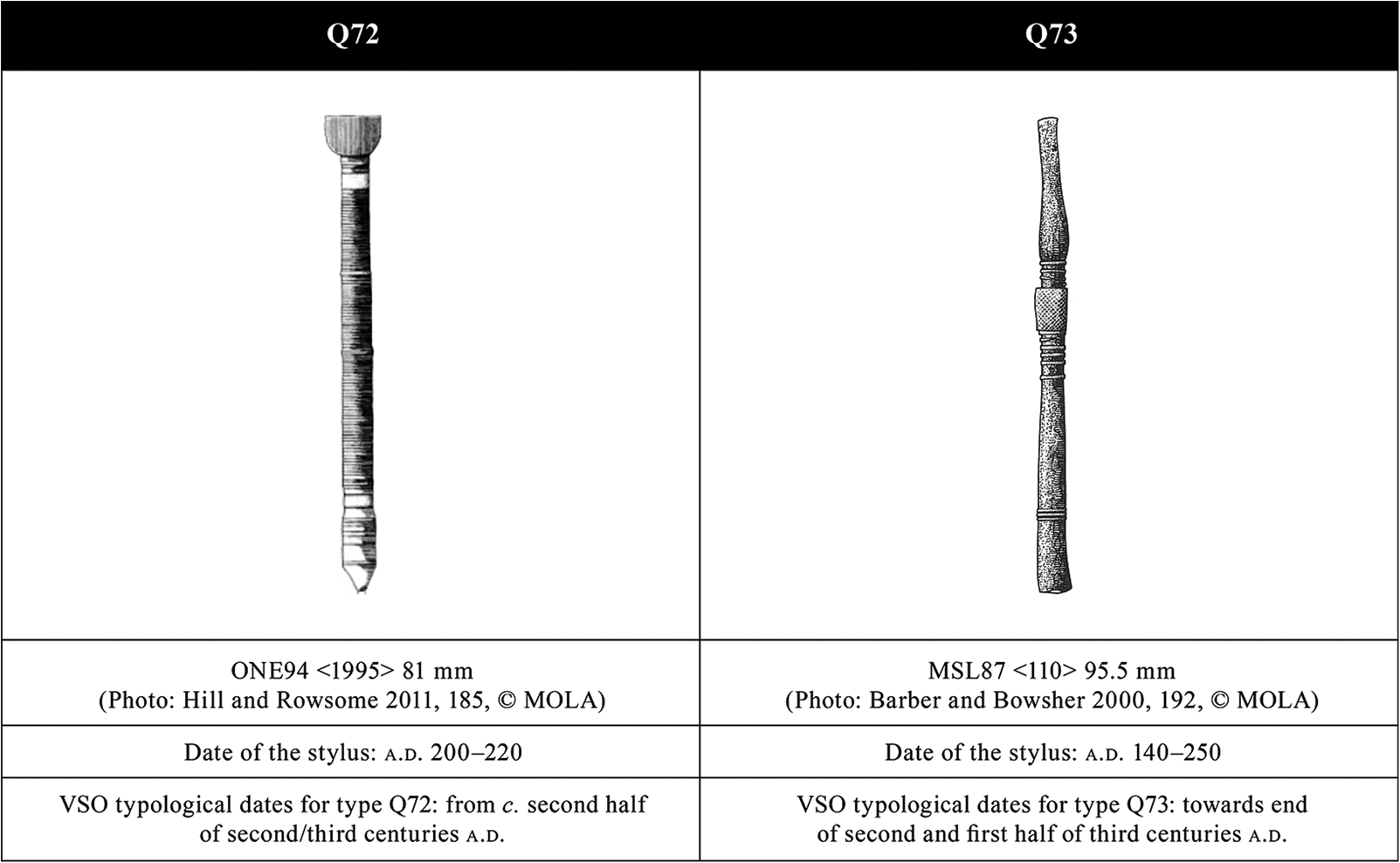
No close parallels could be found for London styli illustrated in fig. 8. For this reason, their typological identification is problematic. They have been described here as Schaltenbrand Obrecht's Q72 and Q73 on the basis of their general characteristics, but this classification has to be considered indicative.
Unique styli.

For these objects, hypothesising a British or European provenance is impossible. Certain decorative patterns are recurring (for example, the band of punched dots on MSL87 <110> appears on other examples found in LondonFootnote 48), but their differences are more significant than the similarities: as a ‘standardised’ production of decorated styli already existed, it is possible that these styli were meant to be unique, personal or prestigious objects. Their cultural significance is proved by the fact that, in London, a Q73 stylus (MSL87 <110>) was carefully deposited in the burial of its owner, probably as a symbol of status and education.
CONCLUSION
This comparative analysis between styli found in London and in other British and continental European sites has shown that there are patterns of distribution of different types that link certain locations together, demonstrating the existence of a Roman ‘international’ culture of writing during the Imperial Period.
Certain types of stylus are only found in centres that have a connection with imperial power, attesting classes of administrators travelling across the Empire. Among these styli, it has been possible to identify a few types that, in different moments in time, show a connection with the activities of the military. A few of them would have been produced in series by the army, as it seems to be the case of H35 styli in Vindolanda. Others, such as C23 (long tulip-shaped eraser) styli and C25, appear to be generally preferred and used by soldiers, but their occurrence in major towns suggests that they were ‘universal Roman’ styli which the military contributed to spread. Also widely diffused in urban contexts were ‘less standardised’ types such as A10, B15, C23 and C24.
Interestingly, types P56 and Q68 in Britain have slightly different features compared to their European counterparts, and in Britain they appear also in peripheral settlements and rural villas. These have been interpreted as local and urban products, possibly imitating European types, and the presence of highly decorated examples in rural settlements suggests that great importance was attributed to writing outside of major towns. At least two well-defined and ‘plain’ types (B/C and H40 bulky) do not find parallels outside of London, and therefore they have been interpreted as being of local manufacture. The production centres of unique styli and types of decoration (such as silver bands with punched dots) found in London are impossible to identify. Some of them would have come from very far away, some others might have been made locally on commission, but in both cases, they represent prestige objects that reflect the identity of individual writers.
In the London, British and continental assemblages, copper-alloy styli constitute a small percentage if compared to iron ones, and they are always decorated or of unusual forms (such as P53 styli with a replaceable tip). Less resistant but very aesthetic, they were probably high-status objects designated to the élite or made for sporadic use on special occasions. The analysis has also pointed out the possible use of styli (at least one of them decorated) in ritual or votive practices at Elms Farm: however, the exact nature of their involvement in such practices is far from being clearly understood. In this respect, a future study on the occurrence of styli in cult places would be of great interest.
These interesting patterns represent an advancement in our understanding of these objects’ use and variability, but they should not be considered as definitive results and could be in part distorted by the small amount of data. However, despite its limitations, this study shows that it is ultimately possible to recognise interesting relations between certain types of styli and different social actors or communities, meaning that these writing implements can inform us about the identities and preferences of ancient writers. In particular, it appears that soldiers, administrators, merchants in major cities and inhabitants of small rural settlements were choosing, making and using their writing implements in different ways. The fascinating array of examples in London reflects chronological variation, but also possibly the activity of different members of the society. This conclusion has fundamental implications for our understanding of ancient literacy: although the practice of writing with a stylus was common throughout the Empire, the experience, significance and cultural perception of it is likely to have varied across different regions, social contexts, and through time. A similar study on a larger sample of sites from the entire territory of the Empire is certainly worth undertaking in the future, and it could test the hypothesis – here proposed – that styli types of the northern European regions developed from ‘military styli’ brought by soldiers and bureaucrats during the conquest.
FINDSPOTS OF LONDON STYLI

BRITISH AND EUROPEAN SITES SELECTED FOR COMPARISON

ACKNOWLEDGEMENTS
Special thanks are due to my supervisors Dr Andrew Gardner and Dr Rachael Sparks, for all their help and suggestions. I am also indebted to Michael Marshall, who introduced me to the study of Roman styli and provided me with illustrations and photographs: throughout the research, his advice and insight have been invaluable. I would like to thank Michael, Dr Hella Eckardt, Dr Anna Willi, Richard Henry and the anonymous reviewers for their stimulating comments on earlier versions of this paper, Dr Verena Schaltenbrand Obrecht, Mark Atkinson and MOLA, for allowing me to reproduce images from their previous publications. Lastly, I am grateful to Michele La Rosa for editing the illustrations.