The proposition that democratic states do not fight interstate wars against each other is one of the most enduring and influential ideas in international relations. The idea is theoretically rooted in the work of Immanuel Kant, who argued that interactions between states with a republican form of government give “a favorable prospect for the desired consequence, i.e., perpetual peace.”Footnote 1 This has led to a large literature empirically documenting a negative association between democracy and conflict,Footnote 2 leading one scholar to comment that the democratic peace is “the closest thing we have to an empirical law in the study of international relations.”Footnote 3
Despite the law-like nature of this association, no scholarly consensus has emerged on whether the observed association reflects a causal relationship or a spurious correlation. According to a recent survey, more than 30 percent of international relations scholars disagree with the democratic peace theory.Footnote 4 In particular, skeptics have challenged the democratic peace by arguing that alliance structures from the Cold War,Footnote 5 capitalism,Footnote 6 and contract-intensive economiesFootnote 7 confound the observed association. These authors find that adding certain confounding variables to regression models eliminates the statistical significance of the estimated coefficient for the joint democracy variable.Footnote 8
How should we resolve this empirical debate regarding the democratic peace?Footnote 9 Unfortunately, in the absence of randomized experiments, we can never completely rule out the possible existence of confounding biases that arise from omitted variables. While scholars in this literature have exclusively relied on parametric regression models, this approach requires strong assumptions, namely that the model accurately characterizes the true data-generating process (correct set of variables, right functional form, valid distributional assumption, etc.). Given that these assumptions may not be verifiable from observed data, it is no surprise that various scholars advocate different regression models with diverging sets of variables, resulting in contradictory findings. The difficulty of adjudicating between these alternative modeling approaches has led to the ongoing controversy in the empirical democratic peace literature.
We propose an alternative approach based on nonparametric sensitivity analysis to formally assess the robustness of the empirical evidence.Footnote 10 Specifically, we quantify the strength of confounding relationships that could explain away the observed association between democracy and peace. That is, we compute the precise level of unobserved confounding needed to render the observed association between democracy and conflict spurious. The idea is that although not all correlations imply causation, a very strong correlation suggests it. Unlike the parametric regression modeling approach prevalent in the literature, the proposed nonparametric sensitivity approach directly addresses the existence of unobserved confounders without assuming a particular regression model.Footnote 11 Although one can never know with certainty from observational data whether democracy causes peace, this nonparametric sensitivity analysis can formally assess the robustness of empirical evidence for the democratic peace.
Our analysis applies the nonparametric sensitivity analysis method originally developed by Cornfield and colleagues, who were concerned with the robustness of the positive association between cigarette smoking and lung cancer in the potential presence of unobserved confounders.Footnote 12 The study of the causal relationship between smoking and lung cancer closely parallels the dispute on the democratic peace. In both cases, randomized experiments cannot be conducted for ethical and logistical reasons, and critics contend that the observed association suffers from confounding biases. While no definitive conclusion can be drawn from observational data, Cornfield and colleagues argue that no existing confounder can explain the strong association between smoking and cancer and therefore this relationship is likely to be causal. Their conclusion is worth quoting here:
Cigarette smokers have a ninefold greater risk of developing lung cancer than nonsmokers, while over-two-pack-a-day smokers have at least a 60-fold greater risk. Any characteristic proposed as a measure of the postulated cause common to both smoking status and lung-cancer risk must therefore be at least nine-fold more prevalent among cigarette smokers than among nonsmokers and at least 60-fold more prevalent among two-pack-a-day smokers. No such characteristic has yet been produced despite diligent search.Footnote 13
Our application of nonparametric sensitivity analysis to the democratic peace yields striking results. Depending on the definition of democracy, we find that a confounder must be at least forty-seven times more prevalent in democratic dyads than in other types of dyads. Thus, any potential confounder that could explain the democratic peace would have to be at least five times as prevalent as a similar confounder for smoking and lung cancer. In other words, according to our analysis, the positive association between democracy and peace is much more robust than that between smoking and lung cancer.
While no such confounder has yet been found for the relationship between smoking and lung cancer, we examine whether the confounders identified in the democratic peace literature meet the conditions of nonparametric sensitivity analysis. For example, we consider a set of economic confounders proposed by Gartzke who argues that the democratic peace can be explained by capitalism.Footnote 14 We also consider other confounders, such as military alliances.Footnote 15 Overall, our findings imply that for a potential confounder to explain away the democratic peace, it must be much more strongly associated with regime types and conflicts than the confounders that have been proposed to date. This finding again demonstrates the robustness of empirical evidence for the democratic peace.
Finally, we believe that a nonparametric sensitivity analysis, such as the one we use here, can play an important role in international relations research, where the threat of omitted variable bias is almost always present. Although sensitivity analysis has been applied in international relations, almost all such applications have been based on parametric regression models. In the democratic peace literature, Kadera and Mitchell conduct a parametric sensitivity analysis in the spirit of Leamer.Footnote 16 In addition, Chaudoin, Hays, and Hicks apply a parametric sensitivity analysis of Altonji, Elder, and Taber to the effects of the GATT/WTO, whereas Hegre and Sambanis use the method of Sala-i-Martin to examine the sensitivity of empirical results on civil war onset.Footnote 17 The only exception we found is Davis and Shirato, who use a nonparametric sensitivity analysis to assess the robustness of their findings to possible sample selection bias.Footnote 18 Unlike parametric approaches, nonparametric sensitivity analyses avoid modeling assumptions and hence offer a robust method to examine the strength of empirical conclusions.
Nonparametric Sensitivity Analysis: A Review
We briefly review the nonparametric sensitivity analysis originally developed by Cornfield and colleagues before applying it to the democratic peace. Consider a potential causal relationship between a binary treatment X and binary outcome Y. Following the smoking and lung cancer example, we define the treatment variable such that it is positively correlated with the negative outcome.Footnote 19 In our application, X represents whether a pair of countries are both democratic in a given year (X = 0) or not (X = 1), and Y indicates whether the dyad has a conflict during the same year (Y = 1) or not (Y = 0). Finally, U represents a binary variable that confounds the causal relationship between X and Y.Footnote 20 Note that because we observe the universe of countries and conflicts rather than a random sample from a target population, we ignore statistical estimation uncertainty that would arise when inferring population characteristics from a sample.Footnote 21 This does mean, however, that our empirical conclusions may not generalize beyond the data analyzed in our paper. Our data set covers all dyads used by Gartzke.Footnote 22 These data cover dyads with 186 countries between 1950 and 1992.
To formalize the sensitivity analysis advocated by Cornfield and colleagues, we use notation similar to that of Ding and VanderWeeleFootnote 23 and define the observed relative risk of the nondemocratic dyad X for conflictual relation Y as
 $$ {\rm RR}_{XY}^{obs} \ = \ \frac{{\rm Pr}(Y = 1 \mid X = 1)}{{\rm Pr}(Y = 1 \mid X =0)}.$$
Without loss of generality, we assume  $RR_{XY}^{obs}\ge 1$ (i.e., democratic dyads are more likely to be peaceful), since the democratic peace is represented by a positive association between nondemocratic dyads and conflictual relations. If the association is negative (
 $RR_{XY}^{obs} < 1$), then there is no democratic peace phenomenon to be explained.
We are interested in knowing whether the following true relative risk is also positive:
 $$RR_{XY}^{true} =\displaystyle{{{\rm Pr} (Y(1)=1) \over {\rm Pr} (Y(0)=1)}, \;}$$
where Y(x) is the potential outcome that would be realized when the treatment variable X takes the value of  $x \in $\left\{ 0, \;1\right\}$. In our application, Y(1) represents the existence of a conflictual relation between two countries under the scenario that at least one of them is nondemocratic, while Y(0) corresponds to the potential outcome when both are democratic. Note that we observe only one of the two potential outcomes for each country pair, Y = Y(X). For example, if two countries are both democratic, we observe Y(0) but Y(1) remains unknown. This implies that
 $RR_{XY}^{obs} $ does not necessarily equal
 $RR_{XY}^{true} $.
If the regime types are randomly assigned, the observed relative risk  $RR_{XY}^{obs} $ equals the true relative risk
 $RR_{XY}^{true} $. Unfortunately, the absence of randomized experiments in the democratic peace literature means that there likely exists an unobserved confounding variable U as a common cause of democracy X and peace Y, such as common interests and shared ideology. Following Cornfield and colleagues, we consider a potential confounder U that completely explains away the association. That is, conditional on U, the regime type of a dyad is exogenous to its relationship, as shown formally by
 $$\{Y(1), Y(0)\} \indep X \mid U.$$
Cornfield and colleagues show that if a potential binary unmeasured confounder U were to explain away the observed relative risk of X on Y (i.e.,  $RR_{XY}^{true} = 1$ as implied by Equation (3) although
 $RR_{XY}^{obs} \ge 1$), then the relative risk of X for U must be greater than or equal to the observed relative risk of X on Y:
 $${\rm RR}_{XU}= {{\rm Pr}(U = 1 \mid X = 1) \over {\rm Pr}(U = 1 \mid X = 0)} \ge {\rm RR}_{XY}^{obs}.$$
For example, if a common interest between two countries explains away the democratic peace as Farber and Gowa suggested,Footnote 24 then a nondemocratic dyad must be more likely than a democratic dyad to lack a common interest (U = 1) by at least as much as it is more likely to be conflictual.
Importantly, Equation (4) is not the only necessary condition for the unobserved confounder U to explain away the observed correlation between X and Y. This is because U has to be a cause of Y as well as of X. Schlesselman further shows that the relative risk of U for Y must be greater than or equal to the observed relative risk of X for Y:Footnote 25
 $${\rm RR}_{UY} = {{\rm Pr}(Y = 1 \mid U = 1) \over {\rm Pr}(Y = 1 \mid U = 0)} \ \ge \ {\rm RR}_{XY}^{obs}.$$
In the current example, this condition implies that a dyad without a common interest (U = 1) must be more likely to have a conflictual relationship than other dyads by at least as much as a nondemocratic dyad is more likely to have a conflictual relationship than a democratic dyad.
Putting Equations (4) and (5) together, we have the classical Cornfield condition
 $$\min({\rm RR}_{XU},\; {\rm RR}_{UY}) \ge {\rm RR}_{XY}^{obs}.$$
More recently, there have been several refinements of the classical Cornfield condition.Footnote 26 In particular, Ding and VanderWeele derive the following additional necessary condition:Footnote 27
 $$\max({\rm RR}_{XU},\ {\rm RR}_{UY}) \ \ge \ {\rm RR}_{XY}^{obs} + \sqrt{{\rm RR}_{XY}^{obs}({\rm RR}_{XY}^{obs} - 1)}.$$
This condition requires the greater of the two relative risks associated with U to exceed  $RR_{XY}^{obs} $ by an additional amount, which is an increasing function of
 $RR_{XY}^{obs} $ and is given by the second term in the right-hand side of Equation (7). Thus, this condition demands that the unobserved variable U is a strong confounder to explain away the observed association between X and Y.
While simple, this nonparametric sensitivity analysis enjoys several advantages over competing alternatives. Chief among these is that sensitivity analysis using the Cornfield condition is nonparametric and does not rely on a regression model. That is, there are no distributional or functional form assumptions (normality, linearity, etc.) invoked at any stage, and the risk ratios used for this method can be easily calculated and intuitively interpreted.
Empirical Evidence
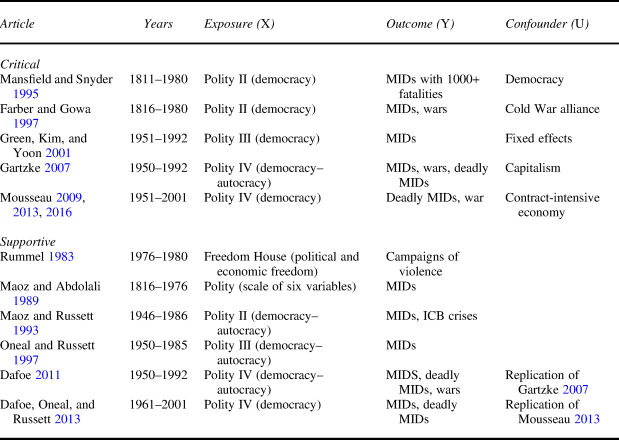
In this section, we apply the Cornfield conditions (Equations (6) and (7)) to the democratic peace debate. While it is widely accepted that democracies seldom fight each other, a substantial debate about the underlying causes of the democratic peace persists. Table 1 gives a partial list of the existing research in the democratic peace literature, including articles that are either supportive or critical of the idea that joint democracy is a core component of that peace. Notably, existing studies consider different outcome variables—militarized interstate disputes (MIDs), deadly MIDs (MIDs with casualties), and wars (deadly MIDs with 1,000 or more casualties)—and analyze different, observed potential confounders. In recent years, many of these critiques have focused on the role of economic confounders in explaining the liberal peace.
Partial review of articles from the democratic peace literature

Note: “Democracy–autocracy” refers to the difference between the Polity democracy and autocracy variables.
Our application of the Cornfield conditions to the study of the democratic peace focuses on three separate studies: Gartzke's capitalist peace,Footnote 28 Mousseau's contractualist peace,Footnote 29 and the claim by Farber and Gowa that alliance structures confound the democratic peace.Footnote 30 In each case, we examine whether the main confounder meets the Cornfield conditions. As noted earlier, although the focus of our analysis is the uncertainty about identification, we do not compute measures of estimation uncertainty. This is because our data set captures the full population of conflict outcomes and is not a random sample of cases from a target population. Our analysis shows that in almost all cases the Cornfield conditions are not satisfied. This suggests that none of these confounders are strong enough to overturn the evidence for the democratic peace. Our data set covers all the dyads used by Gartzke.Footnote 31 These data cover dyads with 186 countries between 1950 and 1992.
The Capitalist Peace
Gartzke advances the argument that capitalism rather than democracy is responsible for the positive association between democracies and peaceful relations. According to this “capitalist peace” thesis, economic development, free markets, and similar interstate interests all reduce the likelihood of MIDs and wars. Gartzke uses five variables—the IMF financial openness index, trade openness, GDP per capita, the interaction of GDP per capita and geographic contiguity, and interest similarity—as the key confounding variables for the capitalist peace.Footnote 32 We investigate whether these confounding variables are sufficient to explain away the democratic peace.
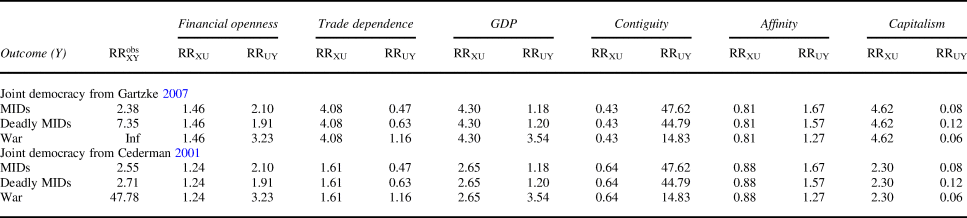
Table 2 presents the main result of this analysis. Following Gartzke, our data come from Zeev Maoz's dyadic MIDs, and we consider three measures of conflict that are commonly used in the literature: MIDs, deadly MIDs, and wars. Our exposure variable is joint democracy (i.e., both members of the dyad are democracies). Following the standard in the democratic peace literature, we employ Polity IV data,Footnote 33 and use two different dichotomous versions of joint democracy.Footnote 34 The first measure is Gartzke's Both Democ variable, which combines Polity democracy and autocracy variables and classifies whether both dyad members have a monadic score above 6.Footnote 35 Our second measure is a more standard measure that defines a democracy as a state with a Polity democracy score of at least 6.Footnote 36 For each of the six combinations of exposure and outcome measures, we compute the relative risk  $RR_{XY}^{obs} $ (see Equation (1)), the key quantity needed for the Cornfield condition.Footnote 37
Sensitivity analysis for capitalist peace

Notes: Nondemocratic dyad is the treatment (X), and conflict is the outcome (Y). We examine whether any of the confounding variables (U) used by Gartzke meets the Cornfield condition. None of the posited confounders listed here meet the Cornfield conditions, regardless of the measure of democracy or conflict outcome chosen.
It is worth looking at the distribution of relative risk,  $RR_{XY}^{obs} $, closely. First, note that the risk varies significantly with both the conflict and the choice of democracy measure. Overall, using the standard Polity measure tends to yield more robust estimates of the democratic peace over the measure used by Gartzke. The democratic peace result becomes more robust for wars:
 $RR_{XY}^{obs} $ exceeds 47 with the standard Polity measure, and is infinite using the democracy measure used by Gartzke. To put this result in context, the relative risk of smoking with respect to lung cancer is approximately 9 for one-pack-a-day smokers, 60 for two-packs-a-day smokers, and 20 for smokers overall. Thus, for an unmeasured confounder to explain the democratic peace, the relative risk of that confounder would have to more than double what we would require for a confounder to explain the relationship between smoking and lung cancer. Stated differently, the democratic peace as measured for wars is about twice as robust as the relationship between smoking and lung cancer.
We next consider five potential confounders proposed by Gartzke: financial openness, trade dependence, GDP per capita, geographic contiguity,Footnote 38 and shared interests. While the author uses continuous measures of these variables, we dichotomize them at their median value to construct binary measures of the same concepts.Footnote 39 In addition to these five original confounders, we consider a sixth capitalism variable. This binary variable is constructed by first running a factor analysis of the five continuous confounders, and then dichotomizing the factor score at its median. For each observed potential confounder U that is listed, we calculate the relative risks, RR XU and RR UY. Using the quantities calculated in Table 2, we assess whether the Cornfield conditions are met. We consider six different exposure–outcome combinations and assess their sensitivity to the six different potential confounders, for a total of thirty-six possible comparisons. In none of the thirty-six comparisons are the Cornfield conditions met: RR XU or RR UY (or both) is always less than  $RR_{XY}^{obs} $. Thus, none of the posited confounders listed can independently explain the democratic peace, regardless of the measure of democracy or the conflict outcome chosen.
We conduct the same analysis for each decade and for MIDs (top panel) and deadly MIDs (bottom panel), with results shown in Table A1 of the online appendix. For wars using the Gartzke joint democracy variable,  $RR_{XY}^{obs} $ is infinite in all decades, so none of the proposed confounders meet the Cornfield conditions. Among a total of seventy-five tests we consider for conflicts other than wars (five potential confounders over five decades with three conflict outcomes), only IMF financial openness in the 1980s for MIDs barely meets the Cornfield conditions, with
 $\min(RR_{XU}, RR_{UY}) = 1.38 \ge RR_{XY}^{obs} = 1.36$.Footnote 40 Such divergent findings may arise due to the small number of observations in some cells. When repeating this test using the joint democracy variable from Cederman,
 $RR_{XY}^{obs} < 1$ in the 1980s when the outcome is deadly MIDs—that is, there is no observed positive relationship between nondemocracy and conflicts to be explained in that subset of the data. In all other cases, the Cornfield conditions are not met. We also find no clear pattern about how the degree of robustness varies across decades, although there may be a theoretical reason to expect the democratic peace to be strengthened over time.
We also conduct the same analysis separately for each geographic region (see Table A2 in the online appendix for the results). This analysis suffers from small sample sizes. Nevertheless, we find that only three of the seventy-five comparisons meet the Cornfield conditions: trade dependence for Middle Eastern MIDs, GDP for North American MIDs, and affinity for South American MIDs.Footnote 41 In addition, four cases have  $RR_{XY}^{obs} < 1$, showing no positive empirical relationship between democracy and peace to be explained. Thus, our findings imply that these observed confounders cannot overturn the democratic peace result even if we examine each decade and each region separately.
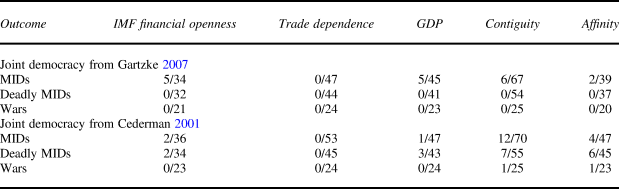
Our analysis to this point conditions on each of the five observed confounders individually. Next, we consider these variables jointly by conducting our analysis for each variable within a stratum defined by the values of the other confounding variables. For example, when considering IMF trade openness as a potential confounder, we condition on the values of trade dependence, GDP per capita, affinity, and contiguity. As before, we consider three conflict outcomes (MIDs, deadly MIDs, and wars) and two different measures of democracy, for six separate combinations.
The analysis requires each confounder to be discretized. We trichotomize the trade dependence, GDP per capita, and affinity variables at their values at the thirty-third and sixty-seventh percentile. IMF financial openness is first trichotomized in the same way, but a fourth category is added for missing values. Contiguity is dichotomized to indicate whether there is geographic contiguity. Thus, a total of 33 × 2 = 54 different analyses can theoretically be conducted for each exposure–outcome combination. However, many of these strata have little or no data as a consequence of conditioning on multiple variables. In fact, for the thirty different exposure–outcome combinations we consider, there would theoretically be 1,620 different strata, but 473 of them have no data.
In each stratum, the denominator is the actual number of cases that had enough data to examine a Cornfield condition, and the numerator is the number of instances in which the Cornfield conditions are met. Thus, using the Gartzke joint democracy measure with MIDs, and considering IMF trade openness, we can say that thirty-four of the fifty-four different combinations of covariates had some data in them that allowed a sensitivity analysis. In five of those thirty-four tests, the Cornfield conditions were met. In total, we are able to conduct 1,147 different comparisons using the five variables, three conflict outcomes, and two measures of joint democracy. And 1,090 (about 95 percent) of the 1,147 analyses fail to satisfy the Cornfield conditions, implying that within those strata the confounder cannot explain away the positive association between joint democracy and the absence of conflicts. Of the remaining fifty-seven cases, only two have  $RR_{XY}^{obs} > 1$, meaning that there is a positive association between democracy and peace to be explained.Footnote 42 In the other fifty-five, there is a negative association between joint democracy and the absence of conflicts.
The Contractualist Peace
We now turn to a closely related claim from a series of papers by Mousseau that argue for a “contractualist peace.”Footnote 43 Similar to Gartzke, Mousseau argues that economic factors underlie the democratic peace. However, Mousseau's specific theoretical argument is that contractual norms between nations confound the democratic peace. To that end, he introduces measures of the “contract-intensive economy” (CIE), which are proxied by insurance contracts subject to third-party state enforcement.
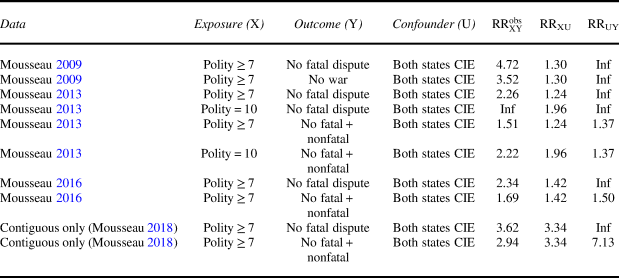
We conduct the same sensitivity analysis using different versions of the Mousseau data. Each of the three Mousseau papers measures the CIE differently and is separately refined to apply different data imputation procedures and account for the informal economy in different ways. The three papers also measure conflict using different outcome variables, separately considering wars, fatal MIDs, and nonfatal MIDs. The papers also employ different measures of joint democracy based on Polity scores. As in our previous analysis, we employ dichotomous measures of the CIE and joint democracy. Consistent with our previous analysis, we also employ the same data set used by Mousseau in each of his analyses, assuming that the variables are measured without error.Footnote 44
The results of this analysis are shown in Table 4. Of the fourteen analyses that most closely parallel those published in the papers we mentioned, thirteen fail to meet the Cornfield conditions. The sole example that meets the Cornfield conditions is using Mousseau's data, using only states that are geographically contiguous, for both fatal and nonfatal MIDs. However, combined fatal and nonfatal MIDs is not Mousseau's preferred outcome measure. Mousseau lists three reasons to suspect bias in analysis of this set of MIDs, arguing that “disputes with at least one fatality … are more likely to reflect confrontations intended by the leaders of both states in a dyad, which is what our theories are designed to model.”Footnote 45 In conclusion, our sensitivity analysis indicates that the democratic peace is resistant to unobserved confounding whose strength is similar to that of the confounding relationships implied by the contractualist peace thesis.
Sensitivity analysis conditional on the other confounding variables

Notes: We conduct sensitivity analysis within strata defined by the values of the other confounding variables. In each entry of the table, the numerator is the number of cases that meet the Cornfield conditions, and the denominator is the number of cases. The results are shown only for the strata where sufficient data are available. Across all analyses, only fifty-seven of the 1,147 analyses (about 5 percent) satisfy the Cornfield condition.
Sensitivity analysis of contractualist peace advanced by Mousseau

Notes: CIE = contract-intensive economy. Different data sets using different combinations of joint democracy, conflict, and measurement of confounder are considered. Note that there are changes to the measures across papers, especially for CIE. The Cornfield conditions are met in only the final condition.
Military Alliances
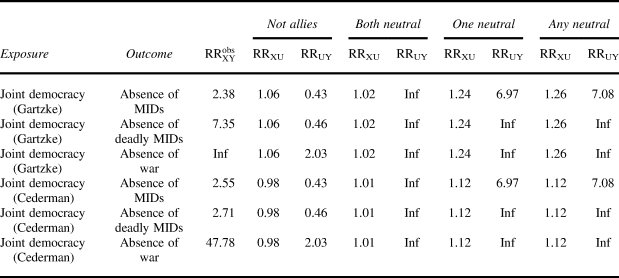
Another prominent critique, advanced by Farber and Gowa, is that Cold War alliance structures account for the democratic peace.Footnote 46 We examine this possibility by reanalyzing the data from Gartzke. Here, we examine several possible confounders related to military alliances. First, we consider a military-alliance variable that was used as a control variable in the original Gartzke study.Footnote 47 We also consider a political-neutrality variable.Footnote 48 We look at cases where both members of the dyad are politically neutral, where only one member is neutral, and where any members are neutral. Our sensitivity analysis using these four potential confounders is reported in Table 5, using both measures of democracy and all three measures of conflict, as in our earlier analysis of Gartzke.
Sensitivity analysis of military alliances

Note: All variables here fail to meet the Cornfield conditions.
Overall, we find that unobserved confounding similar to what would be expected from military alliances cannot explain the democratic peace. Specifically, the original military-alliance variable of Oneal and Russett fails to meet the Cornfield conditions by a large margin.Footnote 49 For the three neutrality variables, all results fail to meet the Cornfield conditions. Although the relative risk of neutrality on conflict, RR UY, is extremely large, the magnitude of RR XU, the relative risk of nonjoint democracy on the proposed confounder, is generally quite small. Thus, the analysis suggests that the democratic peace is resistant to unobserved confounding whose magnitude is similar to that due to Cold War alliances. In addition, we partially address McDonald's argument that the existence of democratic peace depends on great power hierarchy.Footnote 50 Table A4 in the online appendix shows that this potential confounder of great power hierarchy does not meet the Cornfield conditions. But our empirical conclusions may not apply to the pre-World War I era, as the analysis is confined to 1950 to 1992.
Limitations
Like any method for observational studies, the proposed application of the nonparametric sensitivity analysis has limitations. First, the nonparametric nature of the methodology implies that only a relatively small number of categorical variables can be used as covariates. The method cannot directly accommodate continuous variables without coarsening, and the use of many observed confounding variables requires a large sample size, as seen by some cells in our analysis having few observations, or none. This is often a common feature of nonparametric methodologies such as coarsened exact matching.Footnote 51 As a result, dimension reduction may be required prior to the sensitivity analysis. An alternative is a parametric sensitivity analysis that can flexibly allow for many variables of different types but imposes strong modeling assumptions.Footnote 52 Thus, there is a clear trade-off between the functional-form assumptions and the ability to handle a large number of variables.Footnote 53
Second, although our focus has been the assessment of how robust the observed associations between regime types and conflicts are, such an analysis gives only a partial examination of the democratic peace debate. Indeed, one cannot draw a more definitive conclusion without understanding more micro-level causal mechanisms.Footnote 54 Medical scientists have shown how cigarette smoking led to the formation of covalent bonds between the carcinogens and DNA, resulting in the accumulation of permanent somatic mutations in critical genes.Footnote 55 Similarly, settling the democratic peace debate demands the empirical testing of possible causal pathways from democracy to peace.Footnote 56
Finally, like any sensitivity analysis for omitted variable bias, the proposed methodology does not address the problem of causal simultaneity or reverse causation, which some refer to as “endogeneity”: democracy and peace might affect each other at the same time. In fact, causal effects are fundamentally unidentifiable in such situations. For example, the assumption of no simultaneity is explicitly made in causal directed acyclic graph models by excluding any cycles.Footnote 57 Thus, to directly address this issue, we need alternative research designs and identification assumptions rather than different statistical methods.
Conclusion
Unobserved confounding in observational research is one of the most fundamental methodological problems in social science. Although the randomization of treatments enables the identification of causal effects, such randomization is rarely feasible in many areas of social science, including political science. In such circumstances, different assumptions can yield conflicting results and yet it is impossible to assess the validity of competing assumptions. As a result, scholarly debates often end up in a scientific deadlock in which neither side is able to provide convincing evidence.
We believe that sensitivity analysis can play an essential role in making scientific progress in these difficult situations. While it cannot draw a definitive conclusion about causal relationships, sensitivity analysis allows researchers to evaluate the robustness of empirical findings by quantifying the minimum strength of unobserved confounding that must exist to explain away an observed association. An open-source software package, Evalue, is available for implementing the sensitivity analysis used here.Footnote 58
In this research note, we apply a nonparametric sensitivity analysis to the democratic peace debate in international relations. We find that the positive association between democracy and peace is at least five times as robust as that between smoking and lung cancer. To explain away the democratic peace, researchers would have to find confounders that are many times more strongly associated with democracy and conflicts than the confounders that have been identified until now. Since such confounders have yet to be found, for now we conclude that the existing empirical evidence overwhelmingly supports the democratic peace.
Supplementary Material
Supplementary material for this research note is available at <https://doi.org/10.1017/S0020818321000126>.
Acknowledgments
We thank Joanne Gowa, Julia Morse, Tyler Pratt, two anonymous reviewers, and the editors for helpful comments and suggestions.