


Introduction
Nuclear disasters can generate not only potential radiation exposure, but also substantial social disruption and challenges to community resilience.Reference Paton and Johnston 1 Following the Fukushima Daiichi Nuclear Power Plant accident, affected populations experienced prolonged psychological distress, and concern about radiation risks was associated with psychological distress.Reference Suzuki, Yabe and Yasumura 2
During large-scale nuclear emergencies, public health officials, who represent the non-clinical frontline within local governments, serve as critical operational actors in disaster-related public health response. Their responsibilities include evacuation coordination, shelter management, radiation measurement, contamination screening, and direct communication with residents. These tasks are frequently performed under conditions of uncertainty, time pressure, and heightened public anxiety. Such operational demands highlight the need for preparedness approaches that support both technical competence and situational decision-making within non-clinical public health settings.
Based on our experiences in Ibaraki during the Fukushima Daiichi accident, several operational challenges became apparent that are relevant to public health preparedness. Staff were required to support evacuees continuously over extended periods, perform contamination screening tasks with limited prior hands-on experience, and coordinate shelter-based public health activities, which were largely led by public health personnel. These operational realities exposed a gap between procedural knowledge and practical readiness during large-scale nuclear emergencies.
Planning considerations are particularly important in Ibaraki, where the population within nuclear emergency planning zones exceeds 900,000 residents based on regional emergency planning estimates. 3 A comparable incident in this setting could require large-scale contamination screening and shelter management operations. These contextual factors underscore the importance of training approaches that allow repeated, accessible, and scenario-based rehearsal of both cognitive decision-making and procedural workflows for public health staff.
Despite ongoing preparedness activities, public health officials continue to face practical training gaps, including limited opportunities to rehearse contamination screening workflows, insufficient hands-on experience with radiation measurement, and difficulty translating theoretical instruction into situational decision-making during simulated emergencies. Although national frameworks mandate periodic nuclear disaster training, in our experience, many exercises remain procedural demonstrations involving a limited number of participants and provide few opportunities for repeated, scenario-based practice. Radiation emergency training has traditionally incorporated hands-on exercises using conventional measurement devices and scenario-based approaches, while recent studies have explored virtual reality and online simulation as alternative or complementary educational methods.Reference Tsujiguchi, Ito and Sato 4 -Reference Tomisawa, Hosokawa and Kudo 6 Radiation detection simulators using smartphones and other digital technologies have also been developed to facilitate training without relying on conventional radiation detection sources.Reference Tsuchiya, Moritake, Ishigaki, d’Errico and Malizia 7 However, implementing hands-on and scenario-based training in routine training environments can present practical challenges for local public health officials. To our knowledge, no previous reports have described a modular training program that combines AR-based situational simulation with a radiation source-free procedural contamination screening simulator for public health officials within routine training environments. This highlights the need for practical and scalable training approaches that can bridge knowledge acquisition and self-rated procedural confidence in routine training settings.
Effective nuclear disaster responses require multiple competency domains. Cognitive competencies include spatial awareness, situational assessment, and decision-making under uncertainty, while procedural competencies involve accurate radiation measurement and high-throughput contamination screening. Different competency domains may benefit from different instructional approaches for public health staff within routine administrative training environments. Practical preparedness therefore requires training approaches that deliberately align learning objectives with educational methods while remaining feasible for repeated implementation in non-specialist settings.Reference Jeffries 8 , Reference Cook, Hatala and Brydges 9
To directly address these operationally observed needs, we designed a modular training program that intentionally separated cognitive and procedural learning objectives. Augmented reality (AR)-based contamination search exercises were designed to support situational awareness and exploratory decision-making in simulated radiation environments.Reference Brown, Margus and Hart 10 , Reference Kyaw, Saxena and Posadzki 11 A radiation source-free measurement system (USOTOPE: Utilizing Safety-radiation source Object + radioisoTOPE) was introduced to enable repetitive procedural practice of contamination screening workflows without the radiation-source management requirements associated with conventional source-based training. Delivering these modules within a complementary structure aimed to create a realistic yet accessible training environment tailored to the practical demands observed in our public health operational context.Reference Jeffries 8 , Reference Cook, Hatala and Brydges 9 , Reference Akanuma, Tsuchiya and Ishigaki 12
The objective of this pilot study was to evaluate the feasibility and preliminary educational outcomes of this modular simulation-based training program incorporating radiation source-free simulation modules for public health officials. By focusing on knowledge and procedural confidence, this study aimed to inform scalable disaster-related public health training strategies for personnel involved in community-level nuclear emergency response.
Methods
Study Design and Setting
This pilot study employed a single-arm pre-post intervention design to evaluate a modular training program for local government public health officials in Ibaraki Prefecture, Japan. The training was designed to enhance participants’ knowledge, procedural confidence, and familiarity with practical response procedures for nuclear disasters. It combined didactic lectures, hands-on practice with conventional radiation measurement devices, and innovative simulation exercises using augmented reality (AR) and a radiation source-free system (USOTOPE).Reference Akanuma, Tsuchiya and Ishigaki 12
Participants
Twenty local government public health officials participated in the training, including staff from three local health centers and two prefectural public health administrative officials from the Ibaraki Prefectural Government. One participant joined midway; thus, paired pre-post comparisons were available for 19 participants. As a feasibility-focused pilot study, no a priori sample size calculation was performed because the primary objective was exploratory assessment of implementation feasibility and preliminary educational outcomes. The sample size was comparable to prior simulation-based pilot training studies.Reference Zhao and Li 5 , Reference Tomisawa, Hosokawa and Kudo 6 Participants were informed of the study through an institutional opt-out procedure approved by the National Institutes for Quantum Science and Technology Certified Review Board, and anonymized data were used for analysis unless individuals requested exclusion.
Educational Goals and Learning Objectives
The overarching goal of the training was to strengthen the capacity of local government officials to respond effectively to nuclear emergencies, particularly in tasks such as contamination screening, radiation measurement, and workflow management in shelters. Specific learning objectives included:
-
1. Understanding fundamental radiation concepts, health effects, and post-accident exposure assessment.
-
2. Acquiring practical skills in operating conventional radiation survey meters.
-
3. Developing spatial awareness, exploratory measurement skills, and decision-making through AR-based contamination searches.
-
4. Practicing high-throughput body surface contamination screening using a radiation source-free simulator (USOTOPE).
-
5. Enhancing procedural confidence during a nuclear disaster response.
Training Program
The program consisted of four sequential components:
-
1. Lecture on Basic Radiation Principles and Nuclear Disaster Scenarios (20 min)
-
○ The lecture covered fundamental radiation concepts, health effects, radiation protection principles, and post-accident exposure assessment, including considerations for thyroid dose assessment after nuclear emergencies.
-
-
2. Hands-on Practice with Conventional Radiation Measurement Devices (60 min)
-
○ Practice with the basic operation of survey meters, measurement procedures, interpretation of readings, and principles of radiation protection (distance, shielding). Measurement and shielding exercises were conducted using a lantern mantle containing low-level naturally occurring thorium, providing participants with hands-on experience in conventional radiation measurement.
-
-
3. AR-based Contamination Search Exercises (10 min per group, 40 min total)
-
○ Participants were divided into 4 groups of 5, and each group participated in a 10-minute scenario-blind AR exercise, with the location and extent of contamination undisclosed. The 4 groups used the same AR environment sequentially, resulting in a total exercise time of 40 minutes.
-
○ A marker-based AR system overlaid a virtual radiation field onto a training space with mannequins. Using a tablet as a simulated survey meter, participants searched an indoor environment without prior knowledge of contamination locations, adapting their measurement strategy in response to spatially varying virtual dose-rate fields to identify contaminated areas and guide subsequent response actions. The system was implemented using a commercially available tablet device and a custom-developed application, enabling flexible deployment in standard training environments. AR/VR simulations have been reported to support immersive learning, situational understanding, and decision-making in disaster-related training.Reference Cook, Hatala and Brydges 9 , Reference Kyaw, Saxena and Posadzki 11
-
○ The AR system employed a marker-based framework in which predefined visual markers triggered superimposed virtual radiation fields with adjustable intensity gradients, allowing standardized reproduction of contamination scenarios across sessions.
-
-
4. Body Surface Contamination Screening Using the USOTOPE System (40 min)
-
○ The USOTOPE system is a radiation source-free simulator that employs small ferrite magnets as surrogate contamination targets and the built-in magnetic sensor of a commercially available smartphone instead of radioactive materials. As the smartphone approaches the magnet, the magnetic sensor detects changes in magnetic field strength according to the distance from the magnet. The system converts the detected magnetic field strength signals in real time into survey meter-like count rate values, accompanied by audible counting sounds and a visual display resembling a conventional radiation survey meter. This enables trainees to repeatedly perform realistic contamination screening procedures without radioactive sources.
-
○ Participants conducted repeated body surface contamination screening for numerous evacuees, including elderly and medically vulnerable individuals, to practice workflow management, throughput, and sustained instrument operation. The system has been shown to be operationally feasible for short-range contamination screening.
-
○ Detailed system specifications, operational workflow, and representative use cases of the USOTOPE simulator have been described elsewhere and were followed without modification in the present training.Reference Akanuma, Tsuchiya and Ishigaki 12
-
○ Because the simulator reproduces the operational behavior of a survey meter without radioactive sources, repeated hands-on practice can be conducted without the specialized facilities and radiation protection measures required for training involving radioactive sources.
-
-
• Active Learning Approach:
-
○ The program integrated hands-on practice and simulation immediately after lectures to reinforce learning through active participation.Reference Jeffries 8 , Reference Cook, Hatala and Brydges 9
-
Evaluation Measures
To assess the educational outcomes of the training, the following outcomes were measured:
-
1. Knowledge Acquisition:
-
○ A 10-item true/false knowledge test, designed to reflect the training content, was administered pre- and post-training (Supplementary Material 1). Scores were interpreted as indicators of short-term learning. The instrument was used as a content-specific, formative assessment tool designed to assess short-term learning aligned with the training content rather than a validated psychometric scale.
-
-
2. Self-rated Procedural Confidence:
-
○ Participants rated their confidence in performing nuclear disaster response procedures on a 5-point ordinal scale, both before and after the training.
-
-
3. Perceived Realism and Educational Value:
-
○ All participants rated the AR and USOTOPE exercises for realism and educational value on a 5-point Likert scale.
-
Statistical Analysis
Given the small sample size and the bounded/ordinal nature of the outcome measures, non-parametric analyses (Wilcoxon signed-rank test) were used to assess pre-post changes in knowledge and self-rated confidence. Descriptive statistics (mean ± SD, median) were used to summarize realism and educational value ratings. Descriptive statistics are reported for transparency, while inferential analyses relied on non-parametric methods.
Ethical Considerations
This study was approved by the National Institutes for Quantum Science and Technology Certified Review Board (approval No. N25–024, approved on 16 February 2026).
The board reviewed and approved the use of an opt-out consent process, in which study information was publicly posted for a defined notification period prior to data collection. The opt-out period was fully completed, and no individuals requested exclusion from the study. All procedures were conducted in accordance with the ethical standards of the institutional review board and the principles of the Declaration of Helsinki.
Results
Participants comprised local government public health officials, including staff from three local health centers and two prefectural public health administrative officials. Of the 20 participants enrolled in the training, 1 joined partway through the program; therefore, paired pre-post comparisons were available for 19 participants. Ratings of realism and educational value for the AR and USOTOPE exercises were obtained from all 20 participants.
Knowledge Acquisition
Mean knowledge scores among the 19 participants with both pre- and post-training data increased from 7.74 ± 1.45 (median 8) before training to 9.42 ± 1.26 (median 10) after training. The increase was statistically significant (Wilcoxon signed-rank test, P = 0.001). At the individual level, 11 of 19 participants (58%) demonstrated an increase of ≥2 points in the knowledge test (Figure 1). Post-training knowledge scores showed clustering toward the upper end of the scale. This ceiling effect should be considered when interpreting the magnitude of observed gains. Item-level analysis showed that the largest gains were observed in items addressing practical contamination management and context-specific knowledge (Supplementary Material 2).
Spaghetti plot showing individual pre-post changes in radiation knowledge scores (10-item test; score range: 0-10) among the 19 participants with complete paired data. Each line represents 1 participant. The plot illustrates the overall upward trend and inter-individual variability in changes in knowledge scores following the training.

Figure 1 Long description
Spaghetti plot showing individual pre–post changes in radiation knowledge scores (10-item test; score range, 0–10) among 19 participants with complete paired data. Each line represents one participant. The plot shows an overall upward trend in knowledge scores after the training, with variability in the magnitude of change between participants.
Self-Rated Procedural Confidence
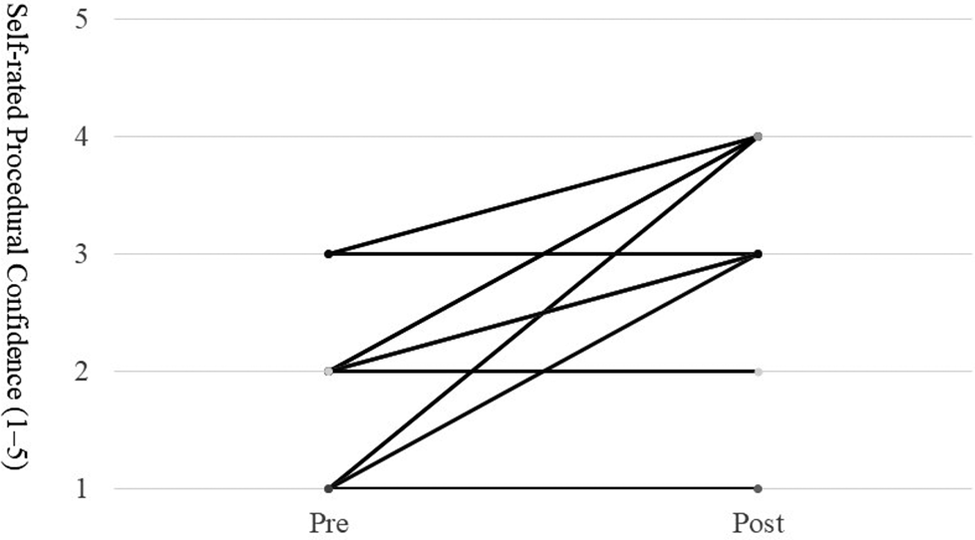
Mean self-rated procedural confidence improved from 1.84 ± 0.69 (median 2) before training to 3.05 ± 0.91 (median 3) after training. Given the ordinal distribution of the scale, a Wilcoxon signed-rank test demonstrated a statistically significant increase (P < 0.001).
At the individual level, 15 of 19 participants (79%) reported an increase of ≥1 point in perceived confidence (Figure 2).
Spaghetti plot showing individual pre-post changes in self-rated procedural confidence regarding radiation measurement and contamination screening (5-point scale) among the 19 participants with complete paired data. Each line represents 1 participant. The plot illustrates the overall upward trend and inter-individual variability in changes in procedural confidence following the training.

Figure 2 Long description
Spaghetti plot showing individual pre–post changes in self-rated procedural confidence regarding radiation measurement and contamination screening (5-point scale) among 19 participants with complete paired data. Each line represents one participant. The plot shows an overall upward trend in procedural confidence after the training, with variability in the magnitude of change between participants.
Evaluation of AR and USOTOPE Exercises
All 20 participants rated the realism and educational value of both simulation components (Table 1). Participants rated both modules as highly realistic and educationally valuable.
Participant ratings of the realism and educational value of the AR-based contamination search and USOTOPE screening exercises, reported as mean ± SD on a 5-point Likert scale (n = 20)

Table 1. Long description
Participant ratings of the realism and educational value of the AR-based contamination search and USOTOPE screening exercises, reported as mean ± SD on a 5-point Likert scale (n = 20).
Discussion
Principal Findings
In large-scale nuclear disasters such as the Fukushima Daiichi Nuclear Power Plant accident, public health officials are expected to play a central role over an extended period, managing indoor evacuation, shelter operations, contamination screening, and health consultations. However, current emergency radiation medicine primarily focuses on clinical response and may insufficiently address the operational realities of public health challenges in disasters. Initiatives that strengthen preparedness among non-clinical public health personnel are therefore essential. Training involving radioactive sources may present practical challenges related to source management, facilities, and regulatory requirements.
Unlike approaches that use simulation primarily for situational learning or conventional exercises involving radioactive sources, our program integrated complementary cognitive and procedural simulation within a single modular training framework. Specifically, AR was designed to support situational assessment and decision-making, whereas the source-free USOTOPE simulator enabled repetitive procedural contamination screening without radioactive materials. This modular design allowed repeated simulation-based practice within routine public health training, where opportunities for hands-on radiation exercises are limited. This modular framework was intended to support familiarity with operational procedures and procedural confidence, although objective operational performance and real-world preparedness were not directly evaluated in the present study.
Participation in this pilot program was associated with significant short-term improvements in knowledge and self-rated procedural confidence. The training program was feasible to implement within routine public health preparedness activities. Overall, participants gave high ratings for the realism and educational value of the modules. These findings support the feasibility of incorporating radiation source-free simulation modules into a brief, modular training approach in routine public health settings, although further studies are needed to determine whether such training improves operational performance or real-world preparedness.
Item-Level Gains
Item-level analysis revealed the largest gains in items addressing practical contamination management (Q1, Q5, Q9) and local contextual knowledge (Q2). Knowledge related to post-accident thyroid dose assessment (Q3) also improved despite a relatively high baseline score. In contrast, items representing well-established foundational knowledge (Q4, Q7, Q8) showed relatively limited improvements. Although Q4 and Q5 shared the same educational objective of basic radiation protection knowledge, Q5 required participants to apply this knowledge in a practical contamination management context, which may have contributed to the observed difference. Given the relatively high pre-training performance for these items, the smaller gains may partly reflect limited room for improvement.
Items involving procedural details (Q6, Q10) demonstrated smaller improvements compared with the other questionnaire items. However, given the small sample size and absence of a comparison group, these item-level differences should be regarded as exploratory and hypothesis-generating rather than evidence of differential effectiveness among the training components.
Implications for Training Practice
The integration of cognitive (AR) and procedural (USOTOPE) modules offers a potentially scalable, safe, and repeatable approach to repeated simulation-based practice without dedicated radioactive sources.Reference Tsuchiya, Moritake, Ishigaki, d’Errico and Malizia 7 , Reference Akanuma, Tsuchiya and Ishigaki 12 Such modular programs may help address practical barriers to repeated hands-on, scenario-based training for public health officials. The approach is intended to familiarize public health officials with emergency response workflows through repeated practice. Although the simulator does not use radioactive sources, it reproduces key operational elements of contamination screening, including instrument handling, search strategies, and decision-making during screening procedures. Accordingly, it is intended to complement, rather than replace, training with actual radioactive sources where such training is feasible.
Importantly, the AR and USOTOPE simulation modules did not require dedicated radioactive sources or the specialized personnel, facilities, or regulatory controls associated with training involving such sources. Compared with approaches requiring radioactive sources or specialized simulation infrastructure, this modular framework may lower practical barriers to routine implementation in local public health settings.
Strengths and Limitations
Strengths include the novel modular integration of AR and source-free procedural simulation, structured evaluation of knowledge and self-rated procedural confidence, and item-level analysis of knowledge gains. Limitations include the small, single-region sample, absence of a control group, short-term outcomes, and lack of objective performance metrics. Some of the mechanisms proposed above are interpretive and hypothesis-generating. Long-term retention was not evaluated.
The small sample size is an important limitation. Only 20 participants were enrolled, and paired pre-post analyses were available for 19 participants. Therefore, the observed statistical changes should be interpreted cautiously and cannot be generalized to public health officials more broadly. In addition, post-training knowledge scores were clustered toward the upper end of the scale, indicating a ceiling effect that may have limited the magnitude of observable improvement for some items. Conversely, the larger gains observed for other items should not be interpreted as evidence that particular training components were more effective than others, given the small sample size, absence of a comparison group, and the exploratory nature of the item-level analysis.
The observed pre-post improvements may also partly reflect the characteristics of a small pilot cohort. Self-rated procedural confidence may not necessarily reflect objective operational competence. Accordingly, the findings should be considered preliminary and hypothesis-generating rather than evidence of improved operational performance or real-world preparedness.
Future Directions and Broader Application
Future validation studies should incorporate objective measures of operational performance, such as contamination detection accuracy, screening throughput, adherence to standardized measurement protocols, and screening time, rather than relying primarily on knowledge scores and self-rated procedural confidence. Larger controlled or comparative studies are also needed to determine whether the observed short-term improvements translate into sustained procedural competence and improved performance in realistic nuclear emergency settings. Assessment of whether trained public health officials can effectively lead resident-focused evacuation and screening operations within community drills represents an important next step.
Broader application of modular, radiation source-free simulations may be feasible beyond Japan. Such approaches could provide scalable, safe, and repeatable training opportunities for non-clinical disaster personnel across diverse administrative settings. However, their effectiveness and transferability should be evaluated in different populations and operational contexts. Future studies should also evaluate how source-free simulation can complement, rather than replace, practical training using radioactive sources where such training is feasible.
Conclusion
This pilot study supported the feasibility of a modular training program incorporating radiation source-free simulation modules, including an AR-based contamination search and the USOTOPE radiation source-free measurement system, for training non-clinical local government officials. The training was associated with short-term improvements in radiation knowledge and procedural confidence. By integrating cognitive and procedural simulation within a modular framework, the program offers a practical approach to repeated training in routine public health settings. Further validation using objective measures of operational performance and preparedness is warranted to determine the effectiveness and broader applicability of this approach.
Supplementary material
The supplementary material for this article can be found at http://doi.org/10.1017/dmp.2026.10466.
Acknowledgments
This work was supported by the Japan Society for the Promotion of Science, KAKENHI Grant Number 24K01115 and 25K08232.
Competing interests
None.



 Open access

