The ecstatic hymn of Shadrach, Meshach and Abednego from the Book of DanielFootnote 1 was sung in Milan in two parts as the first and eighth canticles of Ambrosian Matins on all Sundays and festivals. The first part, the subject of this article, had a special importance in the Milanese liturgy:Footnote 2 it was not only the first lection of the day, but was also seen as providing a common theme that unified the morning office.
Remarkably, the first canticle of the three children is not even mentioned in the Manuale,Footnote 3 the oldest and most comprehensive of the Ambrosian service books. In the ordinal,Footnote 4 as it was compiled by Beroldus, Benedictus es domine is referred to a number times, but usually en passant, without details of the hymn's complicated performance. (We will return later to the two exceptions.) The rubrics in the ordinal that merely mention the canticle are the following:
In omnibus illis festis vel solemnitatibus in quibus ordinarii Footnote 5 comedunt in domo cum archiepiscopo quando incipitur Benedictus es domine deus patrum nostrorum tunc primicerius lectorum ex praecepto archiepiscopi vel sui legati invitat eos … dicendo reficite cum domino [archiepiscopo]Footnote 6
(On all of these feasts and solemnities, when the celebrants on the weekly roster5 dine in [his] residence with the archbishop, at the beginning of the Benedictus es domine deus patrum nostrorum, the leader of the lectors, at the behest of the archbishop or his representative invites them … saying ‘take refreshment with the lord [archbishop]’)
In vigiliis natalis domini … diaconus incipit [antiphona] Laudabilis ante altare. Clerus subsequitur [cantans] Benedictus es domine, totum. Tunc ebdomadarius cicendelarius Footnote 7 dat thuribulum…Footnote 8
(On Christmas Eve … a deacon intones [the antiphon], Laudabilis, in front of the altar. The clergy follows on [singing] Benedictus es domine, all of it. Then the cicendelarius of the week hands the thurible…)
Incoepto matutino, et Benedictus es, cicendelarius porrigit duos cereos rotulatio Footnote 9 episcopi… Footnote 10
(When Matins has begun, and the Benedictus es, a cicendelarius hands two candles to the rotulatius of the bishop…)
The second of these three scant references to the canticle of the three children is problematic: it mentions Laudabilis, an ‘antiphon’ (apparently non-existent) for the Benedictus es domine. More about this ghost chant later, but it should be noted that neither of the two antiphons needed for the performance of the canticle is included in any Ambrosian antiphoner.Footnote 11
The Latin version of the canticle included in the Ambrosian Psalter is idiosyncratic. It is not a translation of the text of Daniel in either of the ancient Greek Bibles (the Septuaginta and the Theodotion) nor can it be traced to any known source of the Vetus Latina or the Vulgate, Jerome's revision of earlier Latin translations – a task he was assigned by Pope Damasus I and completed in the early years of the sixth century, that is, shortly after the death of Ambrose. These circumstances all speak to the antiquity of the Milanese text.
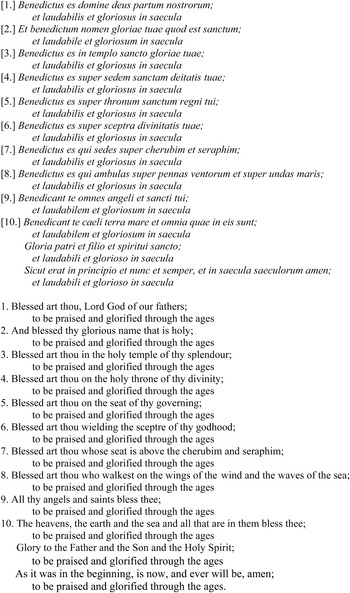
Both hymns from Daniel were included in the Ambrosian Psalter.Footnote 12 The text and translation of the first are given in Example 1, together with the special doxology that is found in the sixteenth-century Psalterium ambrosianum (Milan: Matthaeus Besutius, 1574).Footnote 13 The second semi-verse in each of the ten verses of the hymn (and the two verses of the doxology) is a refrain, adjusted slightly for the Latin grammar.Footnote 14
Canticle of the Three Children in the Fiery Furnace, Benedictus es domine, Ambrosian Psalter, with doxology, Psalterium ambrosianum (Milan: Matthaeus Besutius, 1574), fols. 178v–179r, text and translation.

The earliest record of the complications of the Benedictus es domine (these no doubt in force long before it was thought necessary to put them in writing) is found in the Expositio matutini officii sancto ambrosianae mediolanensis ecclesiae edita a sancto Theodoro archiepiscopo eiusdem ecclesiae (Exposition of the office of Matins of the Milanese Church of St Ambrose, issued by St Theodore, archbishop of this same church). This document (but without the introduction naming its author) is included in a revised version of the Ambrosian ordinal, the so-called Beroldo novo, produced by Giovanni Boffa about 1269.Footnote 15 The text of the Expositio is related in a number of places to the Manuale and to the original compilation of the ordinal of Beroldus.Footnote 16 The redoubtable Magistretti tentatively assigns the Expositio to the eleventh century,Footnote 17 but it should not be ruled out that the text we know is an expanded version of the original.
As for the authorship of the Expositio: two bishops named Theodore are listed on the website of the Archdiocese of Milan.Footnote 18 The earlier, St Theodore, is said to have occupied the see from 475 to 490; the reign of the other, Theodore II, is given as 732–46. That the first bishop wrote the Expositio as we know it is out of the question: the text refers repeatedly to Amalarius of Metz, who was probably born in the last quarter of the eighth century and died about the middle of the ninth. Some revised liturgical details in Boffa's version of the ordinal (the Beroldo novo) and some text from the Expositio, including the introduction, were incorporated into the Breviarium ambrosianum of 1490 to supplement the sparse rubrics of the breviaries printed between 1475 and 1477.Footnote 19
We read in the Expositio that a deacon was assigned the first chant of Matins, the responsorium post hymnum and that ‘tunc cantatur hymnus quem cantabant tres pueri in furnace … Hunc hymnum primum [i.e., canticum primum] cantamus cum antiphona et suaFootnote 20 Gloria’Footnote 21 (‘then is sung the hymn that was sung by the three children in the furnace … This first hymn [i.e., first canticle] we sing with an antiphon and its Gloria’). A reader of the Expositio would know, from a detail entered just previously in the document, that the same deacon intoned the antiphons for the canticle.Footnote 22
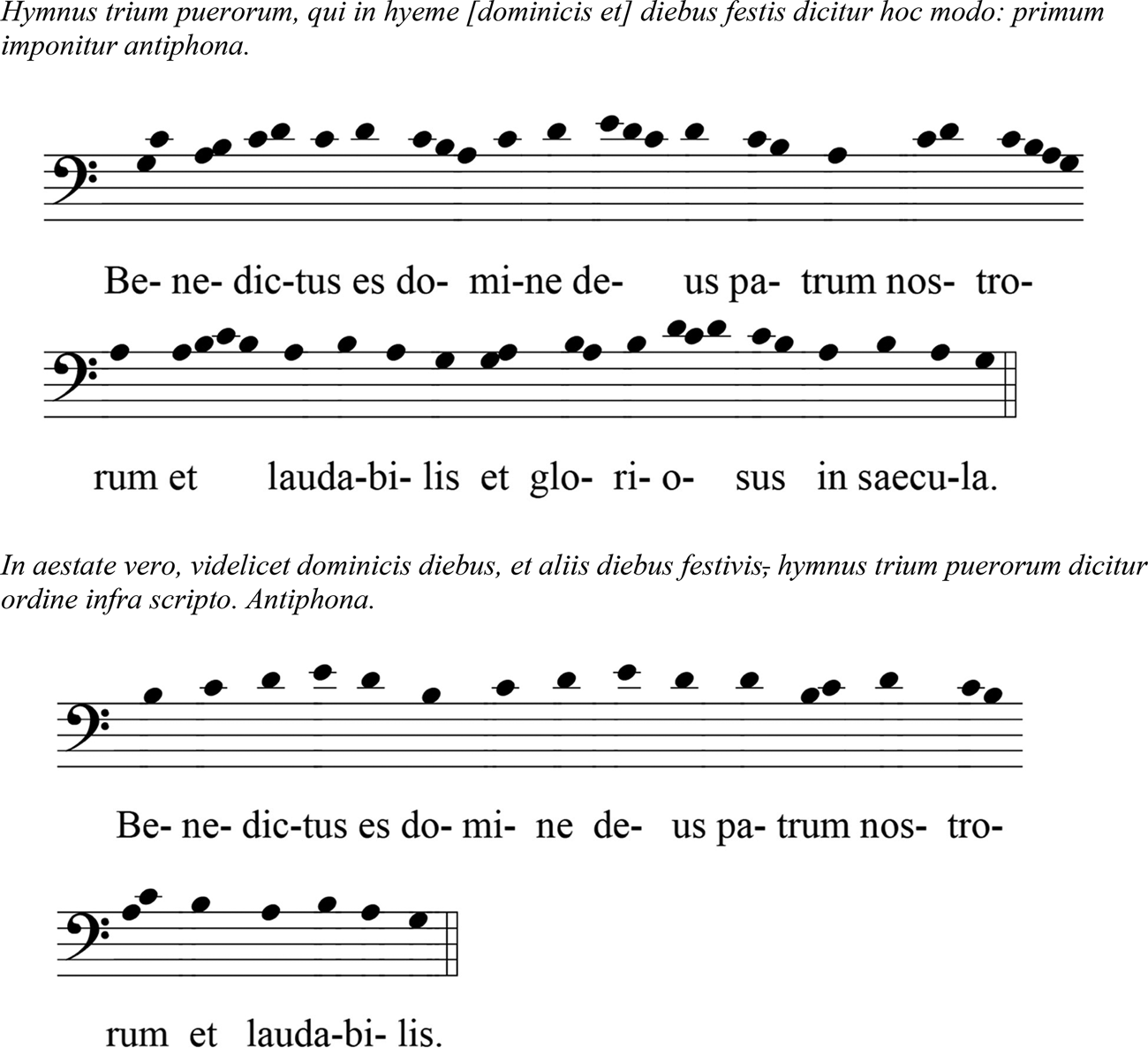
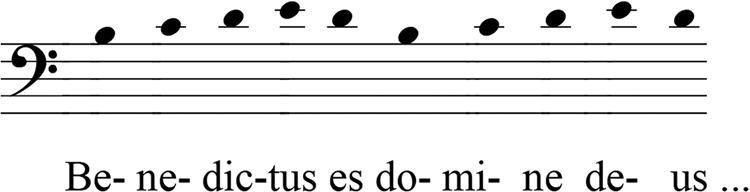
It has been mentioned that the word laudabilis is problematic: there is no trace of such an antiphon,Footnote 23 and the difficulty is not simply that some words in the Expositio have been lost. ‘Laudabilis’, seemingly a reference to a second antiphon for the canticle of the three children, is mentioned in the ordinalFootnote 24 as it was compiled by Beroldus, and also in the Beroldo novo.Footnote 25 But the fact is that both of the antiphons for the canticle included in the Psalterium ambrosianum of 1574 (fols. 78v–79r) begin alike with the words Benedictus es. It is, of course, conceivable that the assignment had changed at some point and that there was once an antiphon that began with Laudabilis. However, it seems more likely that this word – the last word of the second antiphon for the canticle (see Ex. 2) – was not meant as an incipit but an offhand cue to the truncated text sung in summer, a scribal expedient to save copying the opening six words of the antiphon a second time.
The Psalterium of 1574 is, of course, post-medieval, but since the changes in the Ambrosian liturgy documented in service books printed in the sixteenth century and later all brought the Milanese rite closer to the Roman, it can safely be taken for granted that the two antiphons transcribed from this Psalterium Footnote 26 in Example 2 were sung in the ancient cathedrals and not newly composed.
Two antiphons for the Canticle of the Three Children in the Fiery Furnace, Benedictus es domine, and their introductory rubrics, Psalterium ambrosianum (Milan: Matthaeus Besutius, 1574), fols. 178v–179v.

The continuation of the first of these passages from the Expositio introduces another of the complications involved in the performance of first hymn of the three children:
Hymnus iste capitellum habet in fine, per inceptorem officii dicendum: Benedictus es deus. Hoc autem capitellum ab eodem hymno, velut intercallare [inter nocturnos]Footnote 27 per omnes psalmos sive [in dominicis et festivis] per singula cantica nocturni eodem ordine repetitur, unde perspicere possumus sequentes psalmos [et cantica] ad ipsium hymni figuram intendere.Footnote 28
(This hymn, at the end, has a versicle, Benedictus es deus, that must be said to begin the office. Moreover, this versicle, taken from the hymn itself, is repeated as an interpolation [between the nocturns] throughout the psalms [on ordinary weekdays], and [on Sundays and festivals] between each of the canticles. This brings to our attention that the psalms [and canticles] that follow hark back to the theme of this hymn.)
There is no trace of such a repeated versicle in the Manuale. In the ordinal of Beroldus, however, we read of an occasion not mentioned in the Expositio, and not an interpolation:
Et notandum quia si archiepiscopus adfuerit debet incipere matutinum et dicere: Benedictus es deus.Footnote 29
(Note that when the archbishop is present, he will always start Matins and say the Benedictus es deus.)
Additionally, in the Psalterium ambrosianum of 1574, this same versicle (with the response: amen) is specified after the first canticle of the three children, and also (inconsistently), between the nocturns of the psalms sung at Matins on weekdays.Footnote 30 The freighted interpretation of the brief versicle may be nothing more than a pious invention of the author of the Expositio, but the recurrent repetition of Benedictus es deus was probably an old custom, so automatic as to not require mentioning in the service books.
It might appear from the similarity of the words that the ‘capitellum’ specified in the Expositio is related to the ‘capitulum’, a similar verse specified in the ManualeFootnote 31 after the Laudate canticle. However, the text of the ‘capitellem’ is unchanging – repeated, we are told, to remind us of the theme of the first lection of Matins. The verse chosen as the ‘capitulum’ varies and, moreover, is always from one of the four psalms that constitute the last canticle.
In the Breviarium ambrosianum of 1490,Footnote 32 one reads of further complications in the chanting of the canticle:
[tunc] dicitur responsorium post hymnum. Quo dicto in diebus dominicis [et festivis] imponitur [antiphonam] Benedictus es, et sequitur versus hymni trium puerorum, incipiendo Et benedictum nomen gloriae tuae,Footnote 33 etc. usque in fine. Et non dicitur [verba] gloriosum nec et gloriosus a festo Resurrectionis domini usque ad primam dominica octobris, exclusive, sed solum dicitur et laudabilem aut et laudabilis,Footnote 34 excepto in ultimo loco, quando replicatur primus versus, videlicet, Benedictus es, quia tunc semper dicitur totus. Et a prima dominica octobris usque ad Resurrectionem dicuntur versus [hymni] integre, videlicet [cum] et gloriosus in secula, et sic servatur in aliis diebus festivis.
([then] the responsory after the hymn is sung, and when this is done, on Sundays [and festivals], [the antiphon] Benedictus es is sung, and the verses of the hymn of the three children follow, from Et benedictum nomen gloriae tuae, etc., to the end. And [the words] gloriosum and et gloriosus are not sung between Easter and the first Sunday of October, exclusively, but only et laudabilem or et laudabilis, except at the very end when the first verse, i.e., Benedictus es [domine deus patrum nostrorum et gloriosus in saecula] is repeated in full. And after the first Sunday of October through to Easter, the verses [of the hymn] are sung integrally, that is to say, [including] et gloriosus in secula. And this applies [not only to Sundays but] also to festivals on other days.)
In the preceding excerpt, the direction, ‘excepto in ultimo loco, quando replicatur primus versus, videlicet, Benedictus es, quia tunc semper dicitur totus’ seems to say that in the summer season the words omitted from the hymn were sung ‘at the very end’, presumably at the end of the hymn. However, in the Psalterium of 1574 (fols. 78v and 79r), the words of the canticle as it was recited ‘in the summer’ (in aestate) and ‘in the days of winter’ (in hyeme diebus) are written out in full, and in neither case is there any indication that the first verse of the canticle was repeated at the close. It may therefore be that the ultimo loco is not a place in the recitation, but the last occasion mentioned (locus can have this meaning). If so, however, the information is redundant (the Latin adverb exclusive seems enough), but it may nevertheless have been intended to drive home that the words gloriosum and et gloriosus were indeed sung on Easter Day.
It might be helpful to say something about the remarkable binary nature of the Ambrosian liturgy. The roots lie in the circumstance that there were two ancient cathedrals in Milan, Santa Maria Maggiore and Santa Tecla. The former was the principal locus of the liturgy in the winter; the latter was the minor cathedral,Footnote 35 the ecclesia aestiva, the church of summer.Footnote 36 The archbishop and his clergy migrated ceremonially from one to the other twice a year: on Holy Saturday, after the alleluia of the principal Mass, from the church of winter (the ecclesia hiemalis) to the summer cathedral, where the Mass was concluded;Footnote 37 and on the last Sunday after Pentecost, after the alleluia of the principal Mass, from the summer cathedral back to conclude Mass in the cathedral of winter.Footnote 38 Reflecting this alternation, the Ambrosian antiphoner was divided into two volumes. The part of the antiphoner for winter (the pars hiemalis) contains chants that were chiefly sung in the ‘winter church’ of Santa Maria Maggiore; those for the summer were in the other volume (the pars aestiva), and sung chiefly in Santa Tecla, the lesser cathedral.
There were winter and summer antiphoners, winter and summer versions of the antiphon for the Benedictus es domine canticle, and winter and summer versions of the text of the canticle. It is hardly surprising, therefore, that there were also two reciting tones. These are mentioned in the two overlapping rubrics from the ordinal that do give more than a passing reference to the first hymn of the Three Children. In both excerpts, six dots of ellipsis indicate where Magistretti concluded that text was missing:
A primo die dominico kalendarum octobrium usque ad ramos palmarum cum canticis cantatur Domine audivi (et Benedictus es domine deus patrum nostrorum)Footnote 39 in tono majori, et in Natale domini usque ad octavam, et in Epiphania similiter … . Reliquo spatio, Clamavi ad dominum deum [sic]Footnote 40 et Benedictus es [cantantur] in aestivali tono. Footnote 41
(After the first Sunday in the month of October until Palm Sunday, among the canticles, Domine audivi is sung (and Benedictus es domine deus patrum nostrorum) to the major reciting tone, and on Christmas through the octave, and on Epiphany similarly … . The rest of the time, Clamavi ad dominum deum [sic] and Benedictus es [are sung] to the summer tone.)
The second rubric deals with the same matter:
A primo die dominico kalendarum octobrium usque ad [dominicam in] ramos palmarum … cantatur … Benedictus es domine deus patrum nostrorum in tono majori, et in Natale domini usque ad octavam, et in Epiphania similiter … Reliquo spatio … Benedictus es [cantatur] in aestivali tono.Footnote 42
(After the first Sunday of the kalends of October until Palm Sunday … Benedictus es domine deus patrum nostrorum is sung to the major tone, and also on Christmas Day through the octave, and similarly on Epiphany … The rest of the time … Benedictus es [is sung] to the summer tone.)
It seems clear that in both of these rubrics other occasions had once been specified, among them, probably, the last occasion of the year for the ‘major tone’. But without it being specified, we can be reasonably sure that the last day of the ‘winter’ season was that following the last Sunday after Pentecost.
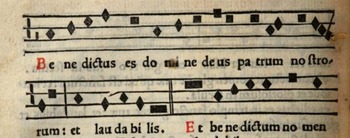
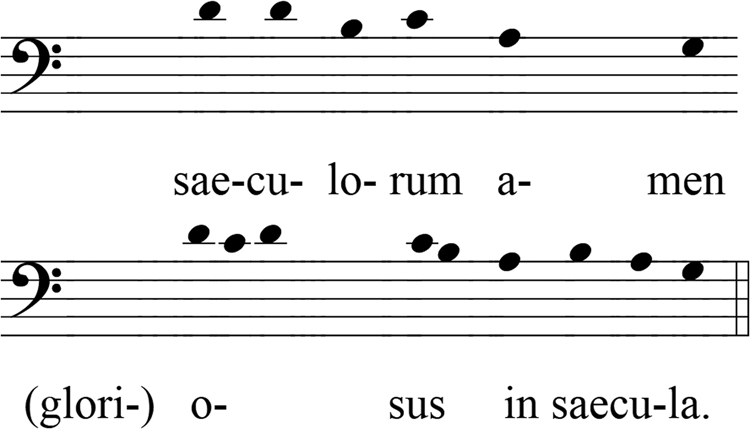
The ‘winter’ tone for the canticle is not specified in the Psalterium of 1574, nor in any medieval source, but we do have the tone used in summer. It was entered by the compositor (to use a modern word) who, in preparing folio 79v, was faced with a stave that (owing to the hymn's truncated refrain for summer) would otherwise be half-empty. The formula entered is typical of most of the differentiae employed in Milan's Divine OfficeFootnote 43 – nothing more than a pitch of recitation and a cadence. Nevertheless, what we see on folio 79v requires some explanation (see Fig. 1).
Second antiphon for the Canticle of the Three Children in the Fiery Furnace, Benedictus es domine, Psalterium ambrosianum (Milan: Matthaeus Besutius, 1574), fol. 179v.

First, the seven syllables and seven pitches in the second half of the second stave are evidently aligned. However, this misleading arrangement (encountered again and again in the manuscript antiphoners) was automatic and unthinking and must be ignored: in the present case it aligns the opening syllables of the second verse of the canticle with the pitches of the cadence sung at the end of the verses.
There is a further difficulty. An Ambrosian differentia was often written as six pitches – as though for the last syllables of the doxology, saeculorum amen. The compositor probably had this in mind on fol. 79v of the Psalterium when he entered a cadence of six pitches. In summer, however, the second semi-verse of successive lines of the Benedictus es domine – including the two phrases of the doxology – was a refrain of only five syllables. There were well-understood provisions for this eventuality (ignored in this instance): when the second part of a psalm- or canticle-verse was short, as in the present instance, the pitch of recitation need not appear at all in the differentia.
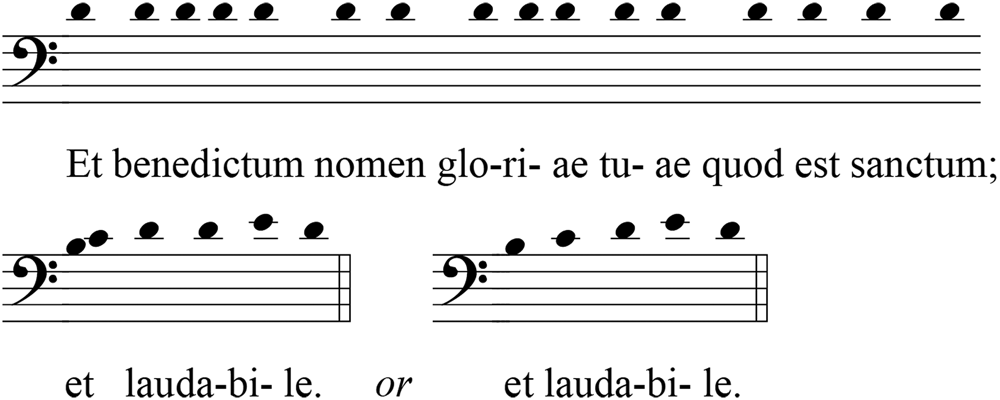
If the lack of any system in the manuscripts can be seen as a gauge, the Milanese did not attach much importance to the details of the reciting tones; they seem almost to have been a matter of the moment. In the present case, we cannot be sure what was intended: more than one adaptation of the six pitches entered for the summer cadence for the five syllables of the refrain suggests itself. The first of the two adaptations given in Example 3 (not the most likely) employs all the pitches written in the second half of the second stave on fol. 79v, including the repeated d'. The second adaptation (Ex. 4) seems more likely to have been intended, since the five pitches of the summer cadence (repeated) are exactly the first ten pitches of the summer antiphon.
Reciting tone, conjectural adaptation 1.

Reciting tone, conjectural adaptation 2.

It was mentioned that the ‘major’ reciting-formula used for the Benedictus es domine in winter was not written out, but we may nevertheless guess what it was. The clue is in the brief citation from the Expositio given earlier: ‘this hymn we sing with an antiphon and its Gloria’. The Gloria patri et filio… was unchanging, so the ‘its’ in this context does not connect the doxology and the antiphon. The link is between the antiphon and the differentia.
If in Milan, as the lack of any system suggests, the choice of recitation tone could be ‘a matter of the moment’,Footnote 44 it could have been suggested by the melody of the antiphon. We have seen that d' was the summer pitch of recitation specified in the Psalterium. The melody of the winter antiphon for Benedictus es domine centres around this d' (it is sung eight times), and this is a pretty clear indication that d' was also the pitch of recitation in winter.
One of the differentiae that recited on d' was assigned at least twenty times in the Ambrosian antiphoners.Footnote 45 That this differentia was also the choice in winter for the first of the hymns of the three boys is suggested not only by its assignment for Benedictus deus Sydrach, an antiphon for the Benedicite, the second Matins canticle from the Hymn of the Three Children, but also by its melodic outline. The differentia entered for Benedictus deus Sydrach and the last notes of the winter antiphon, Benedictus es domine, are aligned in Example 5.
Comparison of the differentia for Benedictus deus Sydrach and the last notes of the winter antiphon, Benedictus es domine.

That the Manuale and the ordinal of Beroldus could almost ignore liturgical items is quite typical of the Ambrosian service books. None of them is complete, and most likely to be omitted are items sung so frequently that they did not need to be mentioned. Many versicles and their responses (such as Benedictus es deus; amen) were automatic; similarly, the very frequent triple Kyrie that marks off discrete sections in the Ambrosian liturgy. Such items are not specified nearly as often as they were sung.
The first canticle of Matins is far from the only substantive component of the offices to be omitted or given scant mention in the medieval service books. It is clear that hymns, to mention only one other example, were not included in the archetype of the antiphoner, and consequently the number contained in later copies varies widely. Some contain no hymns at all; others contain a few; manuscripts produced around the middle of the thirteenth century and later may contain many hymns. However, none of the surviving antiphoners contains all that were needed in the Divine Office: the clergy in their performance of the liturgy relied significantly – and not only for details – on unwritten information preserved in their collective memory.
It might seem curious that Magistretti, who was a canon of the Duomo and its Master of Ceremonies, says so little in his indispensable edition of the Manuale about discrepancies between it and the Expositio, and does not, as a rule, comment when important information is obviously missing. Yet the old liturgy that for centuries was preserved in the memory of the clergy charged with it had changed radically. In 1490, when Pietro Casola printed a new Breviarium, and in 1574 when Matthaeus Besutius brought out a new Psalterium, there would still be many who could supply information that was not available in the official service books. Nevertheless at the end of the nineteenth centuryFootnote 46 there was no one alive to answer questions about the liturgy when the documents Magistretti was editing were silent or their rubrics inadequate.
It is not known how long the clergy continued to sing Matins in the enormous structure that replaced the two ancient cathedrals of Milan. We do not know whether in the sixteenth and seventeenth centuries the office was sung regularly in the Duomo or only occasionally, whether it was sung as it was in the medieval service books or was abridged, or whether polyphony replaced some of the chants.Footnote 47 No doubt, in the seventeenth century, on important occasions, some semblance of the old Matins could have been sung communally by the canons of the Duomo or their deputies. However, they would have to make use of manuscript antiphoners: most of the Matins chants mentioned in this article have been unavailable in print since the sixteenth century. The fact is, many of the Ambrosian melodies have never been available in print – except, of course, in recent decades, in scholarly publications that would hardly serve in the performance of the liturgy.
By the eighteenth century it had become acceptable, even in cathedrals, for the clergy to sit in the chancel and read the offices individually from printed breviaries or even to say the breviary in private. We may take for granted that Magistretti and his fellow canons usually read the texts of the Benedictus es domine and the other chants of Matins in this way. On certain important occasions, he probably recited these texts together with his colleagues in the choir stalls, but recto tono – the words chanted in the simplest manner on a single pitch. From time to time, if only for the purpose of producing a commercial recording, the old melodies of Matins are still rehearsed and sung, but this is everywhere the increasingly rare exception: recto tono is far more usual, even at Solesmes, the great bastion of Latin ecclesiastical chant, and the centre of its (ultimately unsuccessful) modern revival.