With the increasing secularization of the West,Footnote 1 scholars have argued that the traditional role of churches and clergy as repositories and nurturers of social capital in local communities has declined markedly.Footnote 2 In contrast, the importance of religious actors in large-scale social and political mobilization in the Islamic world has been steadily increasing for many years,Footnote 3 ranging from fundraisingFootnote 4 to direction of anti-government protestsFootnote 5 to recruitment for political violence (particularly among the poor and uneducated)Footnote 6 to public outreach campaigns.Footnote 7 How should we understand the power of Muslim clerics to motivate collective action?
Because ‘[a cleric’s] “industry” is, in an important sense, not of this world’,Footnote 8 a cleric may be acting as a religious prime. He may be seen as having a special affiliation with God and therefore reminds his audience of higher moral ideals and/or divine rewards and punishment.Footnote 9 Given the literature that has shown the effectiveness of political elites in cueing behaviorFootnote 10 and the religious priming literature that has shown higher prosocial behavior in subjects exposed to stimuli as wide ranging as biblical quotesFootnote 11 to being in a chapel,Footnote 12 one would expect clerics to wield this power.Footnote 13 But the empirical evidence testing this theory is quite mixed,Footnote 14 with only weak support for the argument that clergy have substantial effects through this channel.
It is critical that the test for the spiritual influence of religious positional authority is isolated from other confounds, which are many. Clerics may be effective mobilizers just because especially charismatic and persuasive individuals (who would have been influential in any profession) select into the clergy. Their influence may also have been aided by the social mechanisms (self-selection and social network dynamics)Footnote 15 within their congregation. In addition, they regularly employ tools that are known as religious primes: quoting scripture and interacting with their audience in sacred settings (for example, churches and mosques). At the same time, it is important that the extent of the cleric’s influence is investigated in a setting in which he is actually present, because subtle dynamics that signal relative status are often communicated in face-to-face interactions,Footnote 16 and where the behavior being measured is private, costly and empirically relevant to real-world collective action.
To our knowledge, our experiment is the first to test a cleric’s influence independent of these confounds in a setting that satisfies these conditions.Footnote 17 We conduct our study in Afghanistan, where religious identity is strong and religious authority is consequential in motivating public goods provision. In our experiment, a Muslim cleric in Kabul appears in person to solicit contributions for a public good (a hospital) from low-income day laborers under three experimental conditions: while dressed as a civilian (Civilian), while dressed as a cleric (Cleric) and while dressed as a cleric adding a quote from the Qur’an at the end of the solicitation script reminding subjects that God rewards giving (Cleric+Scripture).Footnote 18 If the cleric motivates behavior through a perceived association with God, his solicitation should result in behavior similar to what is accomplished by direct religious priming: an increase in average contributions, driven by an increase in both the extensive (donation incidence) and intensive (amount conditional on giving) margins relative to Civilian. Here, scripture as an additional prime would move contributions in the same directions, or possibly be redundant since the spiritual channel has already been activated.
What we found was surprising: contributions were 66 per cent more likely when the solicitor was dressed in his clerical garments (83 per cent) compared to when he was dressed as a civilian (50 per cent). However, giving among those who gave at all decreased from 26 AFN to 16 AFN (denominated in Afghan currency; 1 AFN=$0.02 at time of experiment), resulting in no increase in average contribution between these groups. The drop in the intensive margin was only restored with the quote from the Qur’an, doubling average contributions from that of the Civilian and Cleric conditions.
These results are strongly suggestive that the power to activate spiritual channels lies in the scripture, not with the human wielding religious authority. However, the clerical garb clearly had an effect. Revisiting the behavioral economics and psychology literatures, we find that the positive effect in the extensive margin (likelihood of giving) coupled with the negative effect in the intensive margin (size of the contribution) can be explained by motivational crowding out.Footnote 19 This phenomenon refers to how some extrinsic incentives, such as interventions that induce comparison of one’s behavior to external norms (self-image concerns),Footnote 20 drive away intrinsic motivation without offering enough incentives to make up for that deficit. We interpret the clerical garb as activating one’s religious identity and, due to the importance of religion in Afghanistan, stronger self-image concerns than in the Civilian condition. However, without explicit association with the scripture, conformance to the external norms appears to be a legalistic interpretation of the Islamic sadaqah norm of ‘give what you can’, resulting in ‘the minimum will do’. Exploratory analysis reveals that this is especially true among those who feel poorFootnote 21 – who may feel that the opportunity cost of giving is especially high – and the educatedFootnote 22 – who may be better able to discern between human and divine authority in religion and accord different levels of legitimacy to each.
This article makes several contributions to our understanding of how religious authority mobilizes the faithful toward collective action. First, we show that when presented face to face, a Muslim cleric’s identity alone can have considerable effects on people’s willingness to contribute to a public good, behavior that is extremely meaningful for politics in developing countries.Footnote 23 Secondly, we find that – at least in this context – the Muslim cleric’s influence comes from his position as a human authority by virtue of the crowding-out effect. Thirdly, we find that formal education mediates one’s readiness to follow religious authority, which may provide some context to the Taliban’s opposition to formal education.Footnote 24 Overall, our results suggest that religious authorities’ position may be insufficient to mobilize effectively for collective action, that the use of scripture separately invokes God’s will and authority to mobilize, and that groups will respond differently to these sources of legitimacy.
LITERATURE AND BACKGROUND
Does being recognized as a religious authority endow an individual with unique powers to motivate collective action? Given the substantial literature showing that political elites can affect behavior and attitudes through cueing,Footnote 25 it might seem natural to assume that clerics, as religious elites, could do the same.Footnote 26 Observational studies show a positive association between religion and activism, volunteering or contributing to public goods, all of which are actions commonly grouped under the umbrella of prosocial behavior,Footnote 27 but it is difficult to isolate the causal influence of religious authority in such studies.Footnote 28 Indeed, examination of this question has returned mixed results. Some studies have found evidence that clergy are able to affect congregants’ opinions,Footnote 29 in line with the elite cueing literature, but most have found weak or no support for arguments expecting to see evidence of elites’ persuasive power.Footnote 30 The reason for this divergence in results is unclear, but as Djupe and Calfano argue, the mixed results indicate that ‘clergy effects may currently be masked by our choices of design and theory’.Footnote 31
The existing literature on religious priming also suggests that religious authority can have a very powerful impact on behavior. Exposure to a large range of stimuli relating to God induces subjects in psychology and behavioral experiments to act less selfishly.Footnote 32 For example, in a highly cited study,Footnote 33 scrambling sentences with religious content before a dictator game increases the likelihood of giving (the extensive margin) as well as the size of the contribution (the intensive margin). The religious prime doubled overall average giving, partly buoyed by the higher frequency of very generous contributions. Similarly, subjects are much less likely to cheat after reading the Ten Commandments,Footnote 34 co-operate at a much higher rate in the Prisoner’s Dilemma after reading a biblical quote on the importance of charityFootnote 35 and give significantly more in a public goods game when playing in a chapel.Footnote 36 It is therefore natural to expect that the mere presence of a religious authority could ‘religiously prime’ its audience.
The exact mechanism underlying this increase in moral behavior is still highly debated. Two oft-discussed explanations are that religious priming: (1) increases intrinsic generosity by reminding one of the higher ideals associated with God or (2) makes God the audience of one’s action, who as an omnipresent agent has the ability to punish or reward actions based on their morality. Several influential studies have advanced this latter explanation, noting that these priming treatments do not appear to affect self-reported empathy for others,Footnote 37 but result in behavior similar to studies in which subjects are exposed to stylized images of eyes (‘eyespots’) when making decisions.Footnote 38
What would be the ideal conditions in which to test this hypothesis from the literature: that the power of religious positional authority comes from being associated with God, resulting in an audience that behaves as if it is religiously primed? First, the test needs to separate two factors that are difficult to disentangle in real-world religious leaders: (1) the audience’s recognition of his position as a religious authority and (2) his use of religious tools (such as scripture) that are already known in the literature to prime religiosity independently of being used by a religious authority. Secondly, the measured behavior has to relate to the real-world setting and tie our investigation to the previous literature. Thirdly, the religious authority should be present in person, as people may respond differently to face-to-face interactions with authority compared to less personal and artificial interaction.Footnote 39 Fourthly, the environment should be one in which these questions are important, namely, places where the state’s provision of public goods provision is weak and religious authority has stepped in to fill this role.
Taking these four conditions together, our experiment takes place in Afghanistan, an administratively weak state where Islam is the religion of almost all citizens. As in most charitable giving contexts, in Islam giving is honorable, and the more generous one can be, the better.Footnote 40 There are clear directives in the Qur’an describing sadaqah, a private and voluntary act of giving motivated by charity and sincerity of faith.Footnote 41 A believer can offer sadaqah in whatever amount they wish, regardless of income or the basis of their wealth. In our experiment, a Muslim cleric, following a neutral (non-religious) script, solicited monetary contributions to a real public good (a hospital) in person in three conditions: when dressed in civilian clothing (Civilian), when dressed in clerical garb (Cleric), and when a verse from the Qur’an is added to the script while he is dressed in clerical garb (Cleric+Scripture). (Scripts are printed in the next section.)
Following other studies on giving, we separately analyze whether people give at all from the contributed amount, since it is well known that ‘the willingness to give anything is indeed not driven by the same forces as the choice of the size of the contribution’.Footnote 42 If the Cleric functions as a religious prime, his presence should increase contributions in the intensive and extensive margins. The addition of scripture would be redundant, or at the very most would only move subjects’ behavior further along the same direction as Cleric. However, if Scripture and Cleric work in opposite ways, then Cleric must not be a religious prime.
EXPERIMENTAL SETTING AND DESIGN
Afghanistan provides an ideal setting in which to pursue our research questions. Religion plays a central role in Afghanistan, and self-reported religiosity is extremely high across commonly measured dimensions: 99 per cent of respondents identify as Muslims, 92 per cent report that God is ‘very important’ in their lives, 91 per cent report praying multiple times each day, and 97 per cent of men report attending mosque for salah and Jumah prayer.Footnote 43 Religion is not only a matter of private practice, however. Like many developing and post-conflict countries, civilian institutions in Afghanistan suffer from a deficit of legitimacy, and public goods provision has historically been ceded to communities due to state weakness.Footnote 44 Religious authority has stepped in to fill this void: citizens generally expect them to lend their presence and opinion even on secular issues, and clerics have become very influential in the social and political life of Afghan citizens.Footnote 45 This increased role for religious authorities notwithstanding, however, the Taliban’s austere interpretation of Islam during their rule of Afghanistan in the 1990s, coupled with the organization’s perceived failure to bring peace and prosperity to the country after the war with the Soviet Union, undermined the credibility of religious leaders and institutions in the eyes of some Afghans, particularly the educated. Some have argued that the uneducated are more prone to radicalization and joining the Taliban, while the educated have become increasingly difficult to mobilize.Footnote 46
We conducted our field experiment in Kabul, Afghanistan in June 2014. As discussed above, our interventions were chosen with an eye toward maximizing connections to ‘their real-world modalities’.Footnote 47 The experiment raises money for a widely known and well-regarded hospital, EMERGENCY; studying monetary contributions allows us to tie our experiment most closely to existing empirical results. The solicitor for the public good for the entire experiment is an actual Muslim cleric who leads a mosque in Kabul and teaches students sharia law in an Islamic seminary. As such, the baseline influence of a charismatic, educated leader over our subjects is held constant across all our treatments, with the only difference being whether this individual appears dressed as a religious authority or not.
Our subjects, Afghan day workers, are men without steady jobs who congregate at public markets and wait there to be solicited for employment opportunities for the day. When they are hired, employers transport these men to various work sites, paying them about 500 AFN ($8.60) for a full day of employment. However, jobs are scarce and day workers often go a few days without being hired. Taking any job and leaving the market area for a few hours means that one has very likely forgone other job opportunities for the day; participants therefore expect to support themselves that day solely on what they earn on that job.
Each morning, our Afghan field personnel drove several buses to one or more of the public markets in the city to recruit subjects. We chose different market locations each morning to avoid duplicate recruitment and to maximize the geographic breadth of our sample.Footnote 48 Field personnel approached potential subjects in the markets to participate in a survey about the labor force in Kabul for 500 AFN, an amount that compensates them for their forgone wage for that day; under these circumstances it is unlikely that they consider the survey earnings a windfall. Subjects who provided oral consent were transported to the enumeration location, where they waited in the courtyard once they arrived.
Based on national statistics and our own knowledge, we had good reason to assume that many of the subjects were illiterate and could not complete the survey alone. As such, we paired each subject with an enumerator. At the beginning of every session, five to seven enumerators retrieved their subjects from the courtyard and brought them to the room where the experiment took place.Footnote 49 After each pair was seated behind a privacy partition, the enumerator verbally asked the survey questions and recorded the subject’s responses. The survey focused on their work experience and individual background (see the online appendix for details). While it would be natural to inquire about an individual’s religiosity, we did not for two reasons: first, it would cause religious priming that might interact with the treatment, and secondly, given Afghans’ high degree of self-reported religiosity, it is not clear how to ask the question in a way that would produce meaningful and adequate variation.
When all subjects in the room had completed the survey, the enumerators told them the survey was completed and handed them their payment in an envelope (six 50 AFN bills, five 20 AFN bills and ten 10 AFN bills). A solicitor (the cleric) then requested contributions to the hospital under one of three experimental conditions (described below). The solicitor and all enumerators then left the room to allow subjects to make their decisions in private. Any contribution was to be left in the original envelope and dropped into a box as subjects exited the room.Footnote 50 Outside the room, subjects were then directed to exit the enumeration location; a random sample was asked to guess the identity of the solicitor on their way out.
In all treatments, the solicitor delivered the following neutral script:Footnote 51
Thank you for completing this survey. To thank you for your participation, we would like to compensate you with 500 AFN for your time. On the table in front of you there is an envelope with 500 AFN inside. Today you also have the opportunity to donate part of your compensation to EMERGENCY in Helmand Province, in the south. As you know, EMERGENCY is committed to caring for the victims of war. The organization provides treatment to our Pashtun brothers and sisters who are victims of war in the south. We invite you to contribute to the treatment of victims of war in the region. If you would like to donate to EMERGENCY, please leave the money you wish to donate in the envelope. Remove the money you wish to keep for yourself from the envelope. If you decide not to make any donations, you can leave the envelope empty. Before you leave the room, please drop the envelope in the box by the door.
We conducted three treatments. In the Civilian treatment, he wore typical Afghan civilian clothes. In the Cleric treatment, he read the same script while dressed in his normal clerical garments, which constitute only the addition of a dark turban and a dark prayer scarf over his civilian clothing. In the Cleric+Scripture treatment, the solicitor wore his clerical garments and read the same script with the addition of a verbatim quote from the Qur’an at the end: ‘Those who spend [for/in] Allah’s cause, in prosperity and adversity, who repress their anger, and who pardon men; verily, Allah loves good-doers’ (-Surah 3 (Al-Emran), verse 134).
DATA AND EMPIRICAL RESULTS
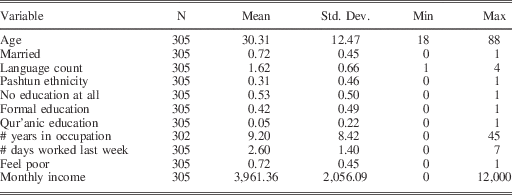
Our subject pool consisted of 305 Muslim male day laborers. The average age was thirty years old; 72 per cent of them were married (Table 1). The sample reflects the ethno-linguistic diversity in Afghanistan: 69 per cent of the sample identify with one of the ethnic minority groups (Tajiks, Hazaras, Uzbeks), while 31 per cent identify ethnically as Pashtuns. About half of the day laborers (53 per cent) had no formal education at all. Those who did spent an average of eight years in school: 129 (42 per cent) had formal education with a science-based curriculum, while fifteen (5 per cent) went to Qur’anic schools where the education centers on religious texts.Footnote 52 Subjects had been working as day laborers for about nine years, on average. They are often unable to find work: they reported that they had only been employed for 2.6 days in the previous week, and the majority of subjects (72 per cent) reported feeling poor.Footnote 53 Their average income is 3,961 AFN a month (about $69), equivalent to eight full days of employment in a month.
Summary Statistics on Demographics (All Treatments)

We ran fifty-one experimental sessions with five to seven individuals per session: sixteen Civilian sessions, nineteen Cleric sessions, and sixteen Cleric+Scripture sessions. To assess how subjects perceived the solicitor, we verbally surveyed a random sample of subjects as they were leaving their session. About 35 per cent of subjects across all treatments declined to guess the solicitor’s profession. Among those who ventured a guess in the Civilian condition, 80 per cent of the guesses involved a high-status profession, with doctor as the most frequent guess, followed by government official. This suggests that the baseline condition is one of civilian authority. In the Cleric and Cleric+Scripture condition, all guesses were of cleric.Footnote 54
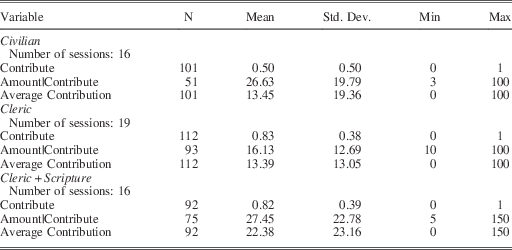
Table 2 presents the summary statistics of the contributions across treatments. In the Civilian treatment, 50 per cent of subjects contributed, and the average conditional amount contributed was 26.63 AFN, resulting in an average of 13.45 AFN raised per subject. In the Cleric treatment, there was a dramatic increase in the extensive margin as 83 per cent (p<0.01) of subjects made a monetary contribution, however, the average conditional contribution size dropped to 16.13 AFN (p<0.01).Footnote 55 As a result, the amount raised per person remained at 13.39 AFN (p=0.98). Layering scripture over the Cleric treatment does not further increase the extensive margin, though with 82 per cent of subjects contributing in Cleric+Scripture, we might have hit a ceiling effect. However, scripture was not at all redundant since the intensive margin rose significantly to 27.45 AFN (p<0.01). Overall, the amount raised per person in Cleric+Scripture was more than 50 per cent (p<0.01) higher than in the other two treatments.
Contribution Summary Statistics by Treatment Condition

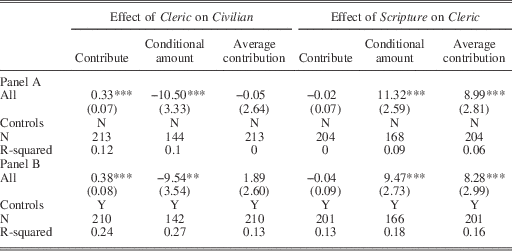
These findings are robust to different specifications. Appendix Table A1 confirms the findings through Mann-Whitney Wilcoxon tests of session averages,Footnote 56 while Appendix Tables A2a–c do so by conducting ordinary least squares regressions on both treatment dummies for the entire sample.Footnote 57 However, for simplicity we will focus on regression results in which we analyze one treatment at a time using split samples (Table 3). The first three columns include data from Civilian and Cleric to isolate the effect of the solicitor’s clerical garb, while the last three include the Cleric+Scripture treatment to isolate the effect of the cleric’s use of scripture.Footnote 58 Panel A includes the estimates without controls: the clerical garb increases the likelihood of contribution by 33 per cent (Column 1), but simultaneously decreases the contribution size by 10.50 AFN (Column 2), thus resulting in no net gain (Column 3). The cleric is unable to further increase the likelihood of contributions by reading scripture (Column 4), but is able to significantly increase contribution size by doing so (11.32 AFN, Column 5), thus raising 8.99 AFN more per person (Column 6).Footnote 59 The inclusion of extensive (individual- and session-level) controls has little effect on these coefficients (Panel B).Footnote 60 All regressions estimate robust standard errors clustered at the session level to account for within-session correlation; session fixed effects are not included, as treatments are administered at the session level.
Summary of Treatment Effects

Note: robust standard errors clustered on sessions in parentheses. Extensive controls and enumerator FE included in Panel B. See Appendix Tables A3 and A4 for the full results. ***p<0.01, **p<0.05, *p<0.1.
The opposing effects of Cleric in the extensive and intensive margins, together with the dramatic difference brought upon by scripture, strongly suggest that Cleric is not functioning as a religious prime. One might argue that the decrease in the size of contributions is not necessarily incompatible with Cleric being a religious prime, since subjects might have viewed fundraising for EMERGENCY as outside the purview of religion, thus creating an environment in which a religious prime has a negative effect.Footnote 61 However, this explains neither the positive impact of Cleric on the extensive margin, nor the increase in giving resulting from raising the prominence of religion (by adding scripture). Furthermore, the increase in the extensive margin cannot be evidence that the cleric primes religiosity, since it is accompanied by a drop in the intensive margin that is then reversed by scripture. Overall, the spiritual channel does not appear to be activated until scripture is introduced.
DISCUSSION
What, then, is the mechanism through which Cleric affects behavior? To find out, we revisit the theoretical underpinnings of prosocial behavior. Extensive research on this topic models it as a function of three factors: intrinsic motivation (‘warm glow’, or the joy of givingFootnote 62 and one’s private valuation for the public good), the cost of giving and extrinsic incentives for contributing.Footnote 63 Extrinsic incentives can be broadly categorized as either rewards/punishment or reputational concerns (shame/honor). Rewards can vary from receiving a token gift in exchange for volunteering to increasing one’s chances of salvation in the afterlife. Reputational concerns arise when one’s action is judged in light of the norms of a reference group. Importantly, reputation concerns do not require an external audience: a person may judge himself poorly when his private behavior does not meet what is expected of a group with whom he identifies. These ‘self-image concerns’Footnote 64 are most relevant to what follows in this article, since subjects in our experiments make anonymous contributions.
Extrinsic incentives, including interventions that heighten one’s awareness of external expectations, sometimes result in unintended consequences: a puzzling decrease of large contributions accompanying the expected decrease of small contributions.Footnote 65 This phenomenon is referred to as ‘motivational crowding out’,Footnote 66 in which extrinsic incentives drive away intrinsic motivation without offering enough incentives to make up for the difference in lost motivation. Because people appear to be more motivated by the desire to avoid the stigma of falling below expectations than by the desire to gain the honor of exceeding it, contributions are often clustered around some norms, as those who were not intrinsically motivated, as well as those who were, are now both giving simply to meet the minimum.Footnote 67
In the course of socialization, humans develop standards that serve as guidelines for behavior in their many social roles. Authority works by making certain roles, and the norms governing acceptable behavior for those roles, more salient.Footnote 68 Recalling that most subjects had perceived the solicitor to be either a doctor or a government worker in the baseline Civilian condition, we can construct two potential post hoc explanations of the cleric’s influence using the framework above. The first assumes that the presence of any human authority (be it doctor, cleric, etc.) induces equal pressure on the subjects to conform to the salient norms in their private actions,Footnote 69 but that what constitutes the salient norm varies according to the authority figure (for example, 20 AFN to doctors, 10 AFN to clerics, etc.). In this scenario, since intrinsic motivation is equally crowded out by self-image concerns in both the Civilian and Cleric treatments, we would expect contributions in both to be clustered around some non-zero amount (since a norm of giving nothing does not exert any reputational motivation to give), though what this specific value is will be different across treatments.
The second explanation assumes that the Cleric treatment induces stronger self-image concerns for subjects than the Civilian treatment, possibly because religion is more important to our subjects’ identity than public health awareness or civic duty. If the Islamic sadaqah norm of ‘give what you can’ is observationally indistinguishable from non-religious voluntary contribution norms in our setting, this would suggest that the differences across treatments do not come from the salient norms. Here, the intrinsic motivation present in Civilian is crowded out in Cleric by self-image concerns, clustering the contributions of those who were not intrinsically motivated, as well as those who were, around the norm.
The second explanation also assumes that while the Cleric treatment induces norms (‘give what you can’) that are observationally indistinguishable from non-religious voluntary contribution norms, self-image concerns are stronger in the Cleric treatment than in the Civilian treatment. This could be due to how important religion is for identity in Afghanistan. Here, the intrinsic motivation present in Civilian is crowded out in Cleric by self-image concerns. As a result, the contributions of those who were not intrinsically motivated, as well as those who were, cluster tightly around the minimum donation level.
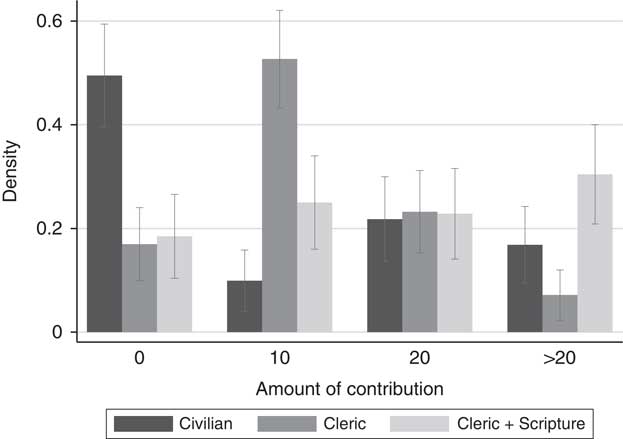
Examining the histogram of contributions in Figure 1 suggests some support for the second mechanism.Footnote 70 There do not appear to be any non-zero modes in the Civilian condition (black bars) that are comparable to the dramatic 10 AFN mode (53 per cent) in the Cleric condition (dark gray bars).Footnote 71 Additionally, large contributions (>20 AFN) drop from 17 per cent in Civilian to 7 per cent in the Cleric condition (p<0.05).Footnote 72 A counterfactual simulation in the online appendix further suggests that the prevalence of small contributions in Cleric is indeed made up of both people who are not expected to contribute and those who are expected to contribute more. Overall, the distribution suggests that the Cleric treatment, but not the Civilian treatment, induces norm convergence. Interpreting this behavioral framework as a phenomenon commonly observed in studies of religion, we are reminded of legalism, which the Oxford Dictionary defines as: ‘Attribution of great importance to law or formulated rule; strict adherence to the letter rather than the spirit of law.’
Amount contributed to EMERGENCY hospital (all subjects)

Moving on to the distribution of contributions in the Cleric+Scripture condition (light gray bars), we see that there is no longer evidence of norm convergence, as the mode at 10 AFN disappears and contributions become equally spread across all levels: 18 per cent give nothing, 23 per cent give 10 AFN, 22 per cent give 20 AFN and 17 per cent give 50 AFN. Large contributions not only recovered, but rose above those in Civilian, with 30 per cent giving more than 20 AFN (p<0.05). Interpreting this within the religious priming literature, quoting the Qur’an could have either refocused attention on the public good or reminded people that ‘God is watching’, and that God rewards generous behavior, counteracting the legalistic response.Footnote 73 Either mechanism can explain why religious priming works. In mechanism 1 (reminder of ideals associated with God), the focus is returned to one’s intrinsic motivation to support the public good. In mechanism 2 (God as audience), the external incentive (for example, afterlife punishment or salvation) is large enough to overcome any drop in intrinsic motivation due to social pressure. In other words, these two mechanisms are observationally equivalent.
We also explore whether the treatment effects are mediated by demographic characteristics. The full discussion and analysis is in the online appendix: Heterogeneity. In summary, we find that while the effect of the treatments on the extensive margin appears consistent across demographic variables, the opposing changes of Cleric and Cleric+Scripture in the intensive margin affect those who are formally educated and those who feel poor. One possible interpretation of this result is that, due to the importance of religion in Afghanistan, all subjects recognize the cleric’s religious authority as well as scripture’s reminder that a Muslim should contribute in this context (extensive margin). But the cleric, on his own, is unable to overcome the legalistic behavior among those who feel poor – who have a large opportunity cost associated with contributing – and the educated – who may be better able to distinguish between human and divine authority in religion and accord different levels of legitimacy to each. Our results also suggest that religious authorities have to employ additional tools of justification and persuasion to engage these two groups, and that using scripture to make explicit associations between God’s will and the behavior they are advocating is one effective way to do so.
CONCLUSION
We test the effect of a Muslim cleric’s authority on contributions to a public good by low-income Muslim men. We find that, holding constant our ‘civilian’s’ perceived educational and charismatic qualities, the donning of clerical garments induces dramatic changes in subjects’ willingness to support a public good. This is noteworthy in itself, given mixed results in the literature on the ability of clergy to affect behavior, particularly outside the congregation. The evidence strongly suggests, however, that the cleric’s effect on behavior is not accomplished by connecting people to God.
As for the mechanism through which the cleric affects behavior, the results suggest that clerical garb activated participants’ religious identity and, due to the importance of religion in Afghanistan, self-image concerns were strong enough to shift the reason for contributing away from private valuation of the public good toward religious norms. Unfortunately, without explicitly bringing in the Qur’an, this norm appears to be a legalistic interpretation of sadaqah: ‘give what you can’, which results in ‘the minimum will do’. We reason that scripture acts as the religious prime and a justification for the cleric’s solicitation, restoring intrinsic motivation and generosity by reminding subjects that God approves of and rewards charitable giving. The negative (positive) effects of the cleric (scripture) are particularly acute among the educated and those who, controlling for income, feel poor, suggesting that religious authorities may need to employ additional religious reasoning to mobilize these two groups.
The study’s experimental design lends confidence to our estimates of these effects over and above observational studies, quasi-experimental studies or even ones that employ near-random assignment, at least in terms of their internal validity.Footnote 74 Our experiment is conducted in a way that addresses common concerns about issues of external validity in lab and field experiments, including critiques of the artificiality of the setting and intervention. Rather than playing a game, our subjects have the opportunity to contribute to a real public good by participating in the familiar and relevant activity of charitable giving. Our subjects were taken from the population – low-income Afghans – about which we wish to make inferences and were enumerated in a neighborhood setting familiar to them. This is in stark contrast to other studies, particularly in the United States, which often use university students as their subjects and cannot readily generalize their findings beyond that sample. More importantly, our intervention was designed and delivered in co-operation with an actual cleric, taking advantage of his relevant professional expertise and everyday experience in communicating to believers.
These advantages notwithstanding, we note two particularly important scope conditions in considering how to generalize our framework and findings beyond this experiment. The first is that there is a relevant norm in this context that religious authority and scripture can cue, which then guides the faithful’s behavioral choices. In our experiment, religious authority cues self-sacrifice through sadaqah, a norm that allows freedom in choices about contributions, and positional and scriptural authority affect those choices in different ways. This is less of a restrictive condition than one might think, however, as there are many other norms in Islam (as well as other religions) through which authority can influence relevant behavior, such as the sanctity of human life (Qur’an 5:32, 17:33), honesty (Qur’an 26:181–3), forgiveness (Qur’an 42:37) or the use of violence (Qur’an 4:74).Footnote 75 While we have shown evidence of the effects of religious authority when such a norm exists, this may not even be a necessary condition.
The second scope condition involves the degree of authority over behavior that people accord to scripture in other contexts.Footnote 76 Adherents to the faith must hold their scripture as authoritative or else it is unlikely to have any power. ‘Religions of the Book’ – Judaism, Islam and Christianity – meet this criterion, while this distinction is likely to be less relevant for religions – like Hinduism and Buddhism – that do not view scripture as ‘revealing divine, eternal truths and laws’.Footnote 77
Bearing these conditions in mind, our theoretical framework that separates the power derived from a religious leader’s position as an authority and his use of scripture or other direct references to the supernatural may be applicable to other religious and geographic contexts. Consider Djupe and Gwiasda’s study of American evangelical Christians’ reaction to public policy against which they are predisposed: pro-environmental government policies.Footnote 78 When told that a reverend leader (instead of just a leader) supported the position, evangelicals’ support for the controversial position actually decreased. However, when evangelicals were told that the reverend leader had arrived at that position after careful reflection on scripture, their support for the policies increased dramatically, showing that elites are judged based on their decision-making processes.Footnote 79 This example illustrates that even in a setting that is very different from our experiment, a backlash can be observed when positional authority is wielded without the backing of scriptural authority. The two authorities must be combined in order to effect a change.
Finally, our explanation of the experimental results takes seriously the fact that religion has a powerful effect on behavior, especially where it can be a tool that elites use to outbid one anotherFootnote 80 and where elites act as issue and interest entrepreneurs in mobilizing people for collective action on the basis of religious identity.Footnote 81 The implications across relevant policy domains are intriguing but require more research to develop them fully. In the context of public goods provision, for example, development practitioners, trying to enhance ‘good governance’ outcomes in weak states, seek ‘to implement interventions designed to increase a community’s collective capacity’.Footnote 82 This study shows how religious authority affects such capacity in the environment of interest for this policy domain. Elites’ use of religious authority for mobilization is important in other areas of politics, as well. One is the production of violence, such as recruitment to terrorist organizationsFootnote 83 and suicide terrorism,Footnote 84 or even the ‘de-radicalization’ of terrorists using religious authority;Footnote 85 we know extremely little about how that authority affects behavior in either case. Our findings show that the way in which religion generally (and religious authority in particular) affects social and political mobilization is underspecified in current scholarship, and needs much more careful empirical testing in order to determine how it affects behavior in different contexts.