




No CrossRef data available.
Article contents
Joining Lapland and the Topinambes in Flourishing Holland: Center and Periphery in Linnaean Botany
Published online by Cambridge University Press: 01 December 2003
Abstract
Argument
During the early modern period, European naturalists were confronted with a rapidly growing body of new objects due to the recent geographic discoveries. According to Bruno Latour's model of “action at a distance” naturalists managed this situation by mobilizing and stabilizing specimens and inscriptions at the periphery of the known world, as well as accumulating, reshuffling, and processing that material in “centers of calculation.” This paper tries to resolve an ambiguity that lies in this model: While the work of naturalists was clearly dependent on local institutions, collections, and botanical gardens in particular, they nevertheless claimed universality for the interpretations of the natural world they propounded. Analysis will be based on a case study: In the 1730s Carl Linnaeus produced a series of manuscripts and printed books that allow us to reconstruct the sequence of translations which led from the first encounter with a “new” plant at the periphery of the known world (in the case of Linnaeus, Lapland, which he visited in 1732) to a major botanical center (the botanical garden of George Clifford, former director of the Dutch East India Company, who employed Linnaeus in 1736 and 1737 to catalog his collection). I will argue generally that the abstraction process that was constitutive of Linnaeus' universal plant taxonomy – the separation of “constant” species and genera from local “varieties”- did not take place exclusively in the centers of knowledge production. This abstraction process was rather coextensive with the global network of translation and exchange that connected such centers with each other and with their peripheries. The “map” of the plant world outlined by Linnaeus did not represent “things drawn together,” but rather “things being exchanged,” and the global circulation of specimens and inscriptions was the foundation on which its claim to universality rested.
Information
- Type
- Articles
- Information
- Copyright
- © 2003 Cambridge University Press
Many shall run to and fro and knowledge shall be increased (Daniel 12:4). Motto of Hans Sloane, Voyage to the Islands Madera, Barbados, Nieves, S. Christophers and Jamaica, 1707
The rapid expansion, if not explosion, of natural history during the sixteenth and seventeenth centuries may be (and countless times has been) explained by the simple fact that, due to colonial expansion, a “New World” was opened for European naturalists full of equally “new” objects hitherto unknown to them. In this respect, and at least in the case of natural history,1
It is worthwhile, however, to remember Merton's classic discussion of the association of research in mechanics and problems of long-distance navigation in the seventeenth century (Merton [1938] 1970, 165–182). Vogel (1993, 135–138) discusses the importance of the discovery of America for the argument of Copernicus De revolutionibus.
One of the most important techniques developed during the early modern period to achieve such a “distant viewpoint” was mapping (Schäffner 1997; Turnbull 1996; (Alpers [1983] 1989, 119–168), and this technique was not restricted to geographic research proper: Carl Linnaeus – the Swedish eighteenth-century botanist who revolutionized botanical method and nomenclature – identified the “natural system,” in which “all plants exhibit mutual affinities, like territories on a geographical map” as the “ultimate goal” of botany (Linnaeus 1751, 27; on the structure of Linnaeus' natural system, see Foucault 1966, 149; Rheinberger 1986; Pratt 1985; Lesch 1990; Müller-Wille 1999, ch. 3). However, there is a deep ambiguity in this mapping metaphor with its implicit claim to universality: Drawing a map inevitably necessitates, as has prominently been argued by Bruno Latour, “action at a distance,” i.e., the stabilization and mobilization of information (traces, inscriptions, specimens) at the periphery, and the accumulation, reshuffling, and processing of that information in “centers of calculation” (Latour 1987, 215–257; Latour 1988; for Latourian accounts of eighteenth-century natural history, see Stemmerding 1993; Bourguet 1996; Spary 2000, ch. 2). Equally, Linnaeus' “natural system” depended on strategies of “drawing things together,” basically in the form of plant specimens, and thus depended on the infrastructure of commercial centers (Müller-Wille 2001a). How did these two aspects of the Linnaean quest for a “natural system” – its proclaimed universality and its constriction to specific European technologies and institutions – actually go together? Or to put it differently: How were local contingencies articulated in Linnaean natural history to form the space of the “natural system” that not just idiosyncratically expanded a Swedish professor's taxonomy over the plant world, but successfully transformed that world to the extent that modern botanists speak of a pre- and a post-Linnaean era?2
I am following a question here that Ophir and Shapin (1991, 20) have identified as the “successor problem” to studies devoted to displaying the situatedness of knowledge.
In this paper I want to resolve this question by analyzing the way in which instances of local encounters with plants and their subsequent translations in various media and contexts formed the space that allowed Linnaeus to draw the outlines of his “map” of the plant world. In this analysis I will follow the traces that certain plants left in a set of interrelated documents: the diary prepared by Linnaeus in the summer of 1732 when he traveled to Lapland, which was then an exotic region; the Flora lapponica published 1737 in Holland, in which Linnaeus presented his Lapland findings to the learned world; and two of his seminal taxonomic works, the Hortus cliffortianus and the Genera plantarum, both also published in 1737. In particular I will try to unravel the story of how Linnaeus identified a plant specimen reportedly stemming from the tropical island Topinambou (Brazil, Amazone delta, according to the Encyclopédie 1765, s. v. Topinambes, îles de) with a boreal plant genus that eventually was named Linnaea after him. My general argument will be that the processes of abstraction that led to the “natural system” (resulting in identifications as the one just mentioned) were not going on exclusively in centers of knowledge production, but were rather coextensive with the vast network of translation and exchange that connected such centers with each other and with their peripheries.
Travel and Presentation
On 12 May 1732, Linnaeus – then a 25-year-old student of medicine – left Uppsala for a natural history research journey to Lapland.3
All biographical data, if not otherwise indicated, relies on Fries 1903.
Dettelbach (1996, lxvi) and Carey (1997, 270) draw an analogy between such instances and “experiment.” One should keep in mind, however, that travel reports had a natural tendency to exaggerate the “exoticness” of their destinies. On Linnaeus' hilarious exaggerations in this respect, see Koerner 1999, 61–62.
Despite the reputed confusion, the report continues with an interview Linnaeus had with the “furia” which is framed by a description of her habitus, complexion, and garment. Within this description the following revealing portrayal of the “furia's” gender is given: “Over her breast, which looked like a frog's skin, dangled long, brown tits, covered by brass loops.” This portrayal, applying criteria Linnaeus would use later in his career to define mammals in general (Schiebinger 1993), is “zoological” to the brink of obscenity, depriving the woman encountered of her terrifying and, as it were, “Laplandic” individuality. And indeed, in the interview she appears as a quite communicative and helpful person, patiently answering Linnaeus' questions about direction and food. Linnaeus, on his part, had something to give in return: he carefully noted down her complaints about being compelled by law to visit church each Sunday. This text, by its intricate involution of picturesque anecdote and technical description, demonstrates that Linnaeus – notwithstanding his alleged isolation – was quite able to build up and maintain a network of local informants, assistants, and trade partners to pursue his journey's goals: translating Lapland, its inhabitants, and its natural and cultural products into representations he could bring home.5
Throughout the travel diary, one finds frequent indications of Linnaeus' reliance on a network of local informants in the repeated occurrence of the formula “Q[uaero] …? R[espondit] …” (Linnaeus 1913, passim). On Linnaeus' complex and highly ambivalent “exchange” with Sàmi inhabitants of Lapland, see Koerner (1999, 56–81). Cf. Dettelbach (1996, lxxii-lxxiv) on “commerce” as the basis for Georg Forster's anthropology.
In one instance the travel diary makes such translation work explicit: Supplemented by an illustration (fig. 1), Linnaeus describes a plant encountered in the Laplandic swamps:
Chamaedaphne Buxb. or Erica palustris pendula, fl. petioliolo purp. was now standing in its highest beauty, decorating the swamp most agreeably. … As I looked at her, I remembered Andromeda as depicted by poets. … She was chained in the middle of water. She always stands fixed on some tussock in the wet swamp, as on a rock in the sea. She stands in water up to her knees, up above the root, namely. She is always surrounded by poisonous dragons and animals, i.e. by mean toads and frogs, which here during spring time squirt water upon her while mating. She stands and bows her head down with sorrow. Her capitula florum [little flower heads] bend down with rosy cheeks, the cheeks turn pale more and more, capitula pallescunt magis magisque, hinc Andromeda dixi, folliis acutis [the cheeks turn pale more and more, therefore I called her Andromeda with pointed leaves]. She almost lies down, the neck is bare, hinc carneus [therefore fleshy]. (Linnaeus 1913, 73–74)

Fig. 1 Drawing from Linnaeus' travel journal. Courtesy Linnaean Society of London.
As has been pointed out by Gunnar Eriksson, this description associates an element of Laplandic nature with classical mythology in a way reminiscent of what has been termed “the emblematic world view” that characterizes pre-classical natural history (Eriksson 1994, 168–177; cf. Bredekamp 1992, 82–83; Ashworth 1990). It thus documents, it seems, an anachronistic extension of this worldview into the otherwise strictly “classical” work of Linnaeus. But what Eriksson's characterization misses is the fact that both the text and the accompanying picture conjoin the two seemingly exclusive ways of representing nature – “emblematically” and “taxonomically.” On one side, the “fictional, mystical, figurative” way, as Linnaeus designates it in the drawing, where both text and drawing describe the plant in terms of a mythological life history. The plant is thus represented as a concrete, living individual interacting with its particular environment (even Linnaeus' own situation can be seen to be projected into it). On the other side, the “true, genuine, depicted” way, where both text and drawing render a taxonomic representation of “Andromeda,” textually by using descriptive terms from botanical terminology (thus the use of Latin expressions), pictorially by exhibiting the plant in a rather stiff, upright position, which allows recording its characteristic morphologic features (on the taxonomic contents of eighteenth-century botanical drawings, see Nickelsen 2002). Thus by identifying certain of its parts and their individual form, Linnaeus analytically refers Andromeda to plant forms already determined within extant botanical knowledge.6
Notwithstanding the new baptism, “Andromeda” was indeed already known to Linnaeus as the beginning of the passage quoted shows. One of the names listed there (Erica palustris etc.) had been used by Rudbeck to designate one of the plants he brought back from Lapland, so that Linnaeus most certainly had studied the plant in the drawing produced by Rudbeck before his travel (see Rudbeck jun. [1695] 1988, vol. 1: p. 69).
The correlation of analytic and metaphoric description, which prepared the ground for their mutual translation, depended, however, on the presence of the object that was thus represented in a twofold way. How could that presence be secured? Another passage from the travel diary and a parallel one from a report Linnaeus sent back to the academy in Uppsala during the trip answers this question. In order to finally reach truly exotic plants, Linnaeus undertook a vertical shortcut to regions that had never been previously researched. Starting from a settlement connected to a mine, he climbed up a high mountain, Mount Vallivare. From its top he reports the following:
I did not know whether I was in Asia or Africa, as both the soil, the situation and all the plants were unknown to me. I had now reached the fjeld. … All the rare plants, that I had seen and rejoiced in before, were present here in miniature; yes, and besides these so many others, that I shuddered and believed to get more than I could take care of. (Linnaeus 1913, 106–107)
I sat down, to collect and describe plants, so that I completely forgot time. (ibid., 102, n. 2)
Again, as in Lyckelse-Lappmark, Linnaeus describes himself as conceptually disorientated: the plants themselves, the soil they grow in, and ultimately their whole “situation” are unknown to him. And again, the first effect of this environment is awe-inducing, but mastered in a different way from that in Lyckelse-Lappmark: Linnaeus settles down at a spot giving him some kind of overview, and starts to “describe” and “collect.”
The results of the first activity – “describing” – are documented by the notes that follow immediately on the passage just quoted (fig. 2): Linnaeus pinned down the exotic plant kinds in a numbered list of “names,” i.e., of short phrases beginning with the name of an already known plant genus and followed by a few, descriptive adjectives. Two entries in this list, for two further, “new” species of Andromeda, may illustrate such “names”:
- 18. Andromeda foliis Empetri, flore ceoruleo.
- 19. Andromeda foliis Lycopodii, flore albo, semiovato, semi-5fido. (ibid, 109)

Fig. 2 List of plants found on Mount Vallevare from Linnaeus' travel journal. Courtesy Linnaean Society of London.
For economic reasons obvious for fieldwork, such “names” reduce description to the utmost extreme in two ways. First, by subsuming the “new” plant kind under a known plant genus, and second, by specifying it as a “new” plant species by stating features that presumably distinguish it from its known congeners, these features either formulated in technical terms (thus the strange expression “semi-5fido”), or in comparative terms by referring to features of other known plant kinds (foliis Empetri- vs foliis Lycopodii). As economic as this way of appropriating “new” plant forms may seem, it is equally obvious how tentative and problematic it is: On the one hand, the descriptive “names” imply identifications and differentiations reaching far beyond the material actually at hand (the list in the diary neither contains an entry for Empetrum or Lycopodium, nor for other Andromeda-species). On the other hand, no further information on the plants is provided than that implied by the “names.” Implicitly the list says too much and explicitly too little. And the rough sketches added were certainly not enough to overcome these limitations.
The second activity of appropriation – “collecting” – could effectively transcend the limitations of field description. In his travel equipment, Linnaeus carried “a bunch of sheeted paper, to lay plants in” (Linnaeus 1913, 11). Collecting essentially consisted of preparing plants for a herbarium, i.e. transferring dried plant individuals on sheets of paper. This enabled Linnaeus to align his list with stabilized specimens – “immutable mobiles” that were unchanged, or hardly changed, by transport – of the species referred to in the list (on this practice, see te Heesen 2000). These specimens could be used again and again as referents for renewed attempts at representation, either on the journey while collecting information on their medicinal uses, or after the journey in refined and extended attempts at their representation. In this series of re-representations a multitude of views or aspects of the specimens would be created that would always retain a common relation to the specimens thus represented, and thus to the species represented metonymically by the specimens. As a matter of fact, without such specimens, the list of “names” produced on Mount Vallivare would have hardly made any sense later. Essentially it was a provisional list of specimens collected for further scrutiny at a later date: some of the names on the list were changed by Linnaeus' hand, and to other names, questions were added, such as “maybe another genus? (an aliud genus?).”
Thus, Linnaeus' Laplandic experiences were translated twofold, as a series of inscriptions in his diary and also as stabilized specimens that those inscriptions referred to. However, he did not find an opportunity to present his findings to a wider public until he went to Holland early in 1735 to get his degree as a doctor of medicine.7
Linnaeus prepared short, preliminary accounts on the flora of Lapland immediately after his return for the journal, Vetenskaps Societet. The respective volumes were published much later though (Linnaeus 1738 and 1742).
See the report on the performance in Hamburg in Linnaeus 1919, 103–105. Linnaeus repeated this performance in front of the Holländische Gelehrte Gesellschaft (Hagberg 1940, 79). He had made sure to arouse curiosity by launching short announcements of his “return” from Lapland to Central Europe in news papers. For Linnaeus' “public relations” policy during his Holland travel, see Eriksson 1979; for Linnaeus' ambivalent position towards magic and folklore, see Wikman 1970 and Koerner 1995.
In both contexts now – performance and presentation – the objects of curiosity were isolated from their original settings. The person in the Laplandic garment was not a Sámi shaman using his garment in a certain coherent way to achieve a certain outcome, but someone acting as if he did so. Similarily, the specimens in his collection were not part of their natural environment, but were presented as dead objects glued onto sheets of paper. Thus stabilized and isolated from their original context, they acquired an abstract individuality in terms of mutual independence and indifference: In an oil portrait of Linnaeus posing in his Laplandic costume (fig. 3), he wears a “curious hat” which his diary describes (in the passage about the encounter with the “furia”) as a headwear exclusively worn by “lap-women” (Linnaeus 1913, 60; for a corresponding description and sketch of the hat worn by men, see ibid., 55). Rather than actually personifying a Sámi shaman, Linnaeus quite consciously acted as a stage for the simultaneous and recombinant presentation of diverse specimens of Laplandic culture and nature.9
On Linnaeus' “ad-hoc assemblage of souvenirs,” the channels through which he had achieved them, and the anthropology underlying their use for Linnaeus' self-presentation as a Lapp, see Koerner 2000, 65–69. According to her account, Linnaeus had received the hat from a Swedish tax collector. As Linnaeus' travel diary does not contain a description of a shaman performance, it is likely that Linnaeus never personally witnessed a Sámi shamanic ritual, but had relied for information on such performances on Scheffer's Lapponia (Scheffer [1673] 1674, 47–58). Linnaeus (1913, 133) reports on how magic drums could be cheated away from Sámi in Norway, however!

Fig. 3 “Linnaeus in his Lapland dress”. Print after a painting by M. Hoffman, 1737. From B. H. Soulsby, A catalogue of the works of Linnaeus, London (British Museum) 1933.
Now, such recombinant presentation was not only possible for the collection of Laplandic objects brought along by Linnaeus, but equally for that collection and collections provided from older sources. The frontispiece to the Flora Lapponica (1737), Linnaeus' final, comprehensive publication on Laplandic matters, features a Laplandic landscape with the midnight sun at its lowest point in mid-summer and various Sámi engaged in their peculiar, reindeer-dependent economy (fig. 4; for a discussion of this frontispiece, see Broberg 1980). In the center resides a figure in a Sámi garment with a magical drum in its lap. The figure has Linnaeus' features, but he is not pictured as a traveler but as someone contemplating objects spread around him. On a closer look, indeed, the assemblage of these objects turns out to be of a completely heterochronic and heterotopic composition, some drawn from Linnaeus' travel diary, some from other sources. Thus the figure carrying a boat in the center of the frontispiece is copied from a sketch in Linnaeus' diary – but according to the accompanying diary text it does not represent a Sámi, but a Swedish peasant (Linnaeus 1913, 41). And the reindeer-sled below is copied from a woodcut in Schefferus' Lapponia (Scheffer [1673] 1674, 106), though it does not fit at all into the mid-summer landscape. The frontispiece presents a landscape-like picture of Lapland as a whole, composed out of reshuffled, heterogenous bits and pieces of information on that exotic region to create a “virtual” landscape exposing a combination of typically “Laplandic” elements. This becomes especially conspicuous in the appearance of a small, flowering plant in the frontispiece's lower right hand corner, named Linnaea in the Flora lapponica in honor of its discoverer (see the respective dedication on plate XII in Linnaeus 1737b): It seems to be “pasted” on the picture, its naturally creeping stalks upright and the root laid bare. And, in fact, it was simply copied from a wood-cut accompanying Rudbeck's Index of Laplandic plants, published in 1724 (cf. fig. 6b), and it would reappear on almost all portraits of Linnaeus (cf. fig. 4). Linnaea has become a timeless and placeless emblem on the frontispiece, signifying the flora of Lapland, and, as it were, its compiler.

Fig. 4 Frontispiece to Carolus Linnaeus, Flora Lapponica, Amstelaedami (Salomon Schouten) 1737.
The heterochronic and heterotopic order created by re-producing and reshuffling extant pieces of information about Lapland and concurrent shifts in meaning also appear in the main text of the Flora lapponica (cf. Foucault [1967] 1986; Ophir and Shapin 1991 on “heterotopias”). It contains a lot of the information Linnaeus gathered during his travels, together with references to older literal and pictorial sources, in each case tied to an entry for a particular plant species. Thus, both the “mythological” account of the life history of Andromeda as well as the trip to Mount Vallevare are integrated into the description of the respective Andromeda-species, together with a collection of references to older literature on these species (Linnaeus 1737b, 129–130); in the description of the common birch, Linnaeus assembles what he had been able to find out about Sámi medicine and that of the dwarf birch is used to report on their housing (ibid., 261–270), etc. These connections between plant species and bits and pieces from the travel report were at times highly artificial, but they allowed Linnaeus to publish a considerable amount of his findings on Lapland. In clear-cut difference from the travel report, however, the Flora lapponica distributes the information contained in the travel diary in the tabular order of a taxonomic system. It does not follow the linear day-to-day and mile-after-mile order of the travel diary, nor does it try to treat the plants in the order of their natural habitats (though this order is analyzed in the introduction to the Flora lapponica). Accordingly, one does not have to read the Flora lapponica in a linear fashion as would be the case with a travel narrative. Instead, one may read it jumping at random from one species entry to the other. What was accessible only in a serial fashion in the context of travel was now simultaneously and universally accessible through a taxonomic system.10
Thus it is possible to interpret the fact that Linnaeus never succeeded in getting his travel report published not as a failure, but rather, as a deliberate move: Linnaeus preferred a taxonomically structured context for the presentation of his Lapland findings over the linear context of a travel report (cf. Koerner 1999, 63).
Corresponding to this change in context, one can note a considerable change in the kind of information provided by the Flora lapponica in comparison with the travel diary: The morphology of each of the “new” plant species discovered in Lapland is described in extensive detail under the separate heading “descriptio,” strictly following a certain standard pattern and rigidly excluding any other information but morphological. Thus, e.g., we saw that Linnaeus' travel diary may describe a plant's leaves as being like those of another plant; such references are systematically lacking in the descriptiones contained in the Flora lapponica.11
The references have not vanished completely, though. They are set apart from the descriptio as comments: “outside the time of flowering,” one of the two Andromeda-species is said to be “hardly discernable from the tender Lycopodium,” while the other species is reported to have been identified with Empetrum by Rudbeck (Linnaeus 1737b, 128–131).
While describing a Diapensia-species, that he allegedly discovered first (see Linnaeus 1957, 139), Linnaeus explicitly states that the corresponding plate was produced from a dried exemplar (Linnaeus 1737b, 55).
Collation and Catalog
The Flora lapponica was published during a most productive period of Linnaeus' life, August 1736 to October 1737. Among various other books, to which we will have to return, Linnaeus published a seminal plant taxonomic work in January 1737: the Genera plantarum. Compared to the Flora lapponica, its content appears extremely unintuitive, abstract, and formal: It consists solely of definitions of plant genera, each headed by a serial number, the generic name (only one in each case), and references to previous authors who attempted a definition, each determining a certain set of morphologic variables in a highly technical terminology (fig. 5). All other information, e.g., habitus, life-history, physiology, ecology, cultural significance, or geographic distribution – information in which the Flora lapponica so luxuriantly abounds – is systematically lacking. Linnaeus called a definition of this kind “natural character (character naturalis)” to distinguish it from the “artificial character (character factitius)” on the one hand, which adduces only a few, diagnostic features in a dichotomous fashion to distinguish a genus from a particular set of other genera, and from the “essential character (character essentialis)” on the other hand, which adduces a “singular” feature to distinguish a genus from all other genera at once, but which can only be established after all genera have been detected (Linnaeus 1737c, Ratio operis §§ 15–17 [unpag.]). In contrast to the latter two kinds of “characters,” the “natural” one distinguishes a genus from all other genera at once (as it combines a whole group of features independently from their diagnostic virtue in respect to certain other genera) and does so even under the condition of a successively growing body of botanical knowledge, and not only after that growth has been completed (ibid §18; cf. Linnaeus 1737a, Lectori [unpag.]). In short: Linnaeus claimed that his natural characters embody a universal taxonomy of plant forms.

Fig. 5 Definition of Linnaea from Carolus Linnaeus, Genera plantarum, Editio quinta, Holmiae (Laurentii Salvii), [1737] 1754, p. 179
At first glance, the relation of the Genera plantarum to the Flora lapponica appears clear-cut: As the latter assembles its species entries under headings that state a generic name and the serial number under which the corresponding generic definition can be found in the Genera plantarum, it seems that the Genera plantarum just elucidates the taxonomic criteria according to which Linnaeus grouped his Laplandic material in order to get a grip on its diversity (Linnaeus 1737b, Lectori [unpag.]). The definitions in the Genera plantarum function as “higher-order inscriptions” which “make the many act as one” (Latour 1987, 234–237). While this is certainly true, it does not, however, provide an answer to an interesting question: The definitions in the Genera plantrarum are restricted to a very specific set of features – “number, figure, position, and proportion of all the parts of the fructification [i.e. flower and fruit only]” as Linnaeus has it (1737c, Ratio operis § 19 [unpag.]). Why just these variables, and not others, e.g. features pertaining to the vegetative parts (leaves, root a. s. o.) or the overall “habitus” as in the age old distinction of herbs and trees? Why call these and others like “taste, smell, color, magnitude” “vague and slippery,” while the selected variables are proclaimed as “certain and real,” “certain and firm mechanical principles”? As Linnaeus himself states, there are no arguments, neither a priori nor a posteriori (in the sense of merely empirical), to justify this selection (ibid. § 11). Must the imposition of generic definitions on the diversity of Laplandic plants be seen as a one-sided, usurpatory, and ultimately arbitrary act to force material into some kind of manageable order?
To answer these questions, one has to take a look at another publication of 1737, which the introduction of the Genera plantarum mentions alongside the Flora lapponica, as presenting the species forming the scope of its generic definitions: the Hortus cliffortianus, a catalog of plants contained in the large, private botanical collection of George Clifford, a merchant banker and for some time director of the Dutch East India Company. On recommendation by two of Holland's leading botanists, Hermann Boerhaave at Leyden and Johan Burmann at Amsterdam, Linnaeus had been assigned by Clifford, for free lodging and a generous salary, to compile this catalog of his collection, which encompassed a garden on his estate at Hartekamp near Harlem, a herbarium, and a rich botanical library (Wijnands and Heniger 1991, 130–133). The time spent on this task is explicitly referred to in the Genera plantarum as a precondition to their completion.
In the Hortus cliffortianus one finds frequent references to the “collation (collatio)” of plant material to decide upon taxonomic questions. Thus Linnaeus refers to “the collation with a specimen [received] from Sherard” as proof that a species of Saxifraga, which he had collected in Lapland, was really a distinct, new species of Saxifraga (Linnaeus 1737d, 167; this had remained undecided in Linnaeus 1737b, 172). Similar remarks are found in the Flora lapponica: After expressing doubts that the genus Andromeda is really distinct from the genus Erica, Linnaeus adds, that “this will be taught by collated flowers of more species from both genera” (Linnaeus 1737b, 126). “Collation,” it seems, simply refers to a comparison of two or more specimens. Now, in the preface to the Genera plantarum Linnaeus described his procedure for establishing “natural characters” in terms reminiscent of such comparisons:
In establishing definitions, all detected species have to be called in. The fourfold features [the four “mechanical principles,” i.e. number, figure, position and proportion] exhibited by each part of the fructification [i.e. flower and fruit] have to be described accurately and those which do not agree in all species are to be excluded, and only those that agree are to be retained (Linnaeus 1737c, Rat. op. §20 [unpag.]).
Taken at face value, this procedure would amount to the following: Considering species representations – living exemplars, herbarium specimens, pictorial representations and/or written descriptions – locally available in a given collection, certain sets of them are combined to represent one and only one genus. Morphological variables will then be recorded for these sets, those exhibiting differences within the set being systematically discarded, those identical throughout the set being systematically retained to enter the genus definition (for a more detailed analysis, see Svensson 1945; Müller-Wille 2001b). In principle, enough material for such a procedure was at hand in Clifford's collection (the Hortus cliffortianus lists about 2500 species!). But to see more closely how it determined the taxonomy presented in the Genera plantarum it is necessary to take a look at 1) how that collection was organized, 2) how it had been assembled, and 3) how the catalog compiled by Linnaeus related to that collection.
To answer the first question one can take a look at the way Linnaeus described the collection in the dedication to Clifford introducing the Hortus cliffortianus:
I saw Your garden right in the middle of Holland bright with flowers, between Haarlem and Leiden, a charming spot amongst two throughways, where boats, where carts pass by. … I was dumbstruck when I entered Your hot-houses, filled up with so many and so varied shrubs as to bewitch the son of the North-wind, who did not know into which strange world You had led him. In the first house You nursed the flocks of southern Europe, plants from Spain, southern France, Italy, Sicily, and the Isles of Greece. In the second the treasures of Asia. … In the third plants of Africa, singular in their construction if not to say monstruous in their nature … And in the fourth, the graceful inhabitants of America and all that the new world brings forth. … Disporting among these, the world's most remarkable Musa, the most beautiful Hernandia, silvery Protea, costly Camphera. In Your own house, truly fit for a king, in Your magnificent Museum, the contents of Your herbarium were opened to me, and in them a no less ample collection extolled the praise of its owner, and enthralled me, the stranger. … In Your paradise I have now gone through two years of utmost innocence, forgetful of my fatherland, friends and relatives, forgetful of the future and of past misfortunes. (Linnaeus 1737d, Dedicatio [unpag.])
There is a surprising resemblance with the account from Mount Vallivare: Again a situation of geographic disorientation and of social isolation is stated. This is surprising because the context differs so widely: Clifford's garden is not situated at the border of the known world, but – as stated right from the start – in one of its commercial centers. Accordingly it is not a lack of knowledge that is responsible for the alleged disorientation. Quite the opposite is true: The disorienting impression is said to result from the fact that certain plants known to come from widely different regions of the world are nevertheless growing at a single spot. The exoticness of Clifford's garden is not emphasized in terms of an untouched and never before experienced wilderness, but in terms of an artfully contrived collection of plants in order to demonstrate Clifford's economic and political power in drawing together spectacular and precious plant specimens from all over the world, his power in creating, so to speak, his own “new” world in the old. With this, Clifford's plant collection clearly was an exemplar of the kind of collections typical for seventeenth-century court and urban patrician culture (see Olmi 1993; Findlen 1994, pt iii; Findlen 1996; Cunningham 1996, 41–47; Whitaker 1996; Drayton 2000, 26–49; Spary 2000, 22–25).
To see how Clifford had been able to assemble such a collection – he was, after all, no professional botanist as Boerhaave or Burman – one may take up a clue contained in the passage quoted above: One of the four exotic plants mentioned in that quote is called Hernandia, a designation introduced for the plant in question by Charles Plumier in 1703 to honor Francisco Hernandez, the first trained botanist to explore the flora of South America in the late sixteenth century (Linnaeus 1737d, 485; on Hernandez, see López Piñero and Pardo Tomás 1996; Varey et al. 2000). This practice of naming was also employed by Linnaeus in the Hortus cliffortianus to specifically honor those which had contributed plants to Clifford's collection (Hagberg 1940, 101–106; Koerner 1995, 251–252). The most prominent figure among these contributors was Hermann Boerhaave “to whose liberality [Clifford's collection] owed more plant specimens than to that of anyone else” (Linnaeus 1737d, 17). Boerhaave had been in the right position to be so liberal: Among his duties as a professor for medicine at Leyden University was that of superintendent for the university garden, in which plants of more than 6000 different kinds were cultivated. The sources for this wealth were various and their tapping had in part already begun at the end of the sixteenth century: During the time of its first superintendent, Carolus Clusius, arrangements had been made with the Dutch East and West India Companies, that sea captains and ship surgeons should bring back living specimens, seeds, or dried specimens of exotic plants from their journeys to the nascent colonies of the Habsburg realm (Stearn 1962, 146). Clusius had also established good relations with Spanish gardeners, receiving seeds from them, and it was thus mainly he who was responsible for the first introduction of South-American plant material into central Europe (López Piñero and López Terrada 1997). Some amount of material would also be ordered specifically from overseas trading posts, as in 1719 when Boerhaave requested specimens from Surinam to substitute items collected by Prince Maurits von Hessen in Brasil which had decayed due to humidity in the garden's “rariteytcamer” (Heniger 1971, 18). A considerable part of material finally came from individual correspondents who either traveled the colonies for some time, or held official posts there. Through such channels a small herbarium containing specimens collected in Surinam would reach Paul Hermann in his later position as superintendent of the Leyden garden (Wijnands 1988, 273). The activities of such correspondents could reach enormous dimensions: Thus Hendrik Adriaan van Reede tot Drakenstein, governor of the Dutch possessions in Malabar since 1669, engaged Paul Hermann to travel the southern coast of India and Ceylon from 1670–1677 as a medical officer of the West Indian Company and to collect, dry, describe, and draw plants during his trip. In this, Hermann enjoyed the assistance of a network of local collaborators including no less than 16 Brahminic scholars and four local artists (Burkill 1953, 849–852; Stearn 1988, 779; Heniger 1986). Prince Maurits van Nassau's botanical activities in Brazil reached a similar scale (Boogaart 1979).
The resources thus amassed in the Leyden garden were used to further multiply its collection by exchanging duplicate material (seeds, living plants, dried specimens), to a large degree reproduced in the garden itself, for “new” material from other collectors, individual and institutional (Stearn 1962 calls the Leyden garden the “mother of all gardens”). Thus official contracts were placed for a regular exchange with the Amsterdam municipal garden, which for a time had directly been involved in the agricultural and horticultural development of the Surinam colony (Wijnands 1988, 72), or with the Chelsea Physick Garden near London, which paid individual collectors in the Americas (Stearn 1961, lxxiii-lxxix; cf. Stearn 1962). Botanical gardens began to form a “garden circuit,” within which a large-scale and continuous exchange of locally reproduced plant material – seeds, living, and dried specimens – was realized (Wijnands 1988, 72–74). Taking into consideration that Clifford, in his position as director of the East India Company, had considerable political and financial power – thus, e.g., being able to let Linnaeus act as a temporary plant agent for his collection on trips to France and England – it is not surprising that he occupied an important position within this circuit, such that the great majority of his herbarium sheets should carry the handwriting of the leading botanists and gardeners of his time, as foremost Boerhaave (Wijnands and Heniger 1991). Clifford had something to return in terms of “new” species for the services he enjoyed, as is evident from the “Index Seminum Satorum” in which Boerhaave registered from whom he had received the seeds sown out in the Leyden garden. According to this list he had received seeds for 42 different plants from Clifford (Heniger 1971, 75).
Living and dried plant specimens, procured, accumulated, and reproduced on a vast historical, geographical and social scale, and, accordingly, stemming from the most diverse cultural and natural contexts, had thus been assembled in Clifford's garden in a movement which, following Latour (1987, 219–223), may be aptly called a “cycle of accumulation.” Two important qualifications are in place in this respect, however:
- 1) Each of the specimens had ended up in Clifford's garden with its own, highly idiosyncratic trajectory of repeated translations behind it, which could not be controlled to the extent of being strictly standardized – trajectories of natural history exploration analogous, though not necessarily similar, to the ones discussed in the preceding section for two Laplandic plants collected by Linnaeus, Andromeda and Linnaea. While the specimens themselves, especially herbarium specimens, at least to some extent moved as “immutable mobiles” through the garden circuit, they would nevertheless be invested with different meanings depending on the context, and thus excite very different representations (cf. Spary 2000, 96–98). In the case of seeds and living exemplars, even direct changes of the objects through horticultural reproduction under varying circumstances had to be expected (Müller-Wille 2001a). In these two respects, one could speak of specimens as “mutating mobiles” as mobile and combinable elements that may and do change in unforeseen directions.
- 2) The accumulation of specimens did not so much result from a capitalization on the ebb and flow movement of standardized inscriptions and disciplined personnel equipped with ever more sophisticated inscriptions from the center to the periphery and back, but to a larger extent from a capitalization on exchange among individual and institutional collectors, where those who were in the position to offer many “new” specimens in return would attract even more “new” specimens, thus being able to offer even more, thus attracting more again, etc. (for a detailed analysis of the mechanisms of this exchange in terms of a peculiar version of a “gift economy” see Müller-Wille, in press).
We may now consider the relation in which Clifford's collection, organized and assembled in the way just described, stands to its catalog, the Hortus cliffortianus. At first sight this relation seems to be of an extremely barren and formal nature: The variety of plant specimens present in Clifford's garden is reduced to a mere list of some two-and-a-half thousand species “names,” stating first a generic name and second an adjectival extension of that name adducing a few characters distinguishing the respective species from its congeners (Linnaeus 1737d, Lectori botanico [unpag.]). And as in the case of the list of Vallivare-plants discussed in the previous section, the Hortus cliffortianus makes almost no sense at all without its referents, the specimens. There is, however, a second level to the Hortus cliffortianus, which does after all disclose the full diversity of Clifford's possessions. Each species entry is followed by a list of “synonyms,” containing further species “names” considered “synonymous” with the species “name” in the entry heading and complemented by a literary reference pointing to the source (texts, plates, or herbarium sheets) where that name was used. A guide to the literature is provided in the Hortus cliffortianus under the separate heading of “Bibliotheca cliffortiana” (see Heller 1983, 115–145) and it may thus be induced, that the sources referred to had been accessible to Linnaeus in Clifford's library while he compiled the Hortus cliffortianus.
On the whole then, the Hortus cliffortianus is not simply a catalog of Clifford's collection, centered systematically upon its proprietor (Baudrillard 1994 discusses collections as “systems” in this sense). The synonymy lists do not refer to books as collectable objects, but conjoin complex sets of textual and pictorial pieces isolated from a historically grown body of literature as offering information on one and the same plant species, on its particular morphology, life-history, ecology, cultural significance, and, as it were, literary tradition. And this conjunction is effected by redistributing botanical information around a multiplicity of centers constituted by the system of Cliffordian specimens – botanical information produced, re-produced, and precipitated in publications alongside the movement of specimens within the “circuit of gardens,” of which Clifford's collection, at a given point in time, represented a momentary state.
To illustrate what this intricate system of cataloging effects, we may once again return to the traces that Andromeda and Linnaea left in it. Among the Andromeda-species listed one finds an entry for “Andromeda foliis alternis lanceolatis, margine reflexis.” The long synonymy list attached identifies this species among others with a “Ledum palustre nostras, arbuti flore” mentioned by John Ray in his Synopsis methodica stirpium Britannicarum (1724, 472), with an “Erica humilis, rosmarini foliis” mentioned in Plukenet's Phytographia (1691, tab. clxxv, fig. 1), and – as a matter of course – with the respective Andromeda-species mentioned in the Flora lapponica (Linnaeus 1737d, 162–163) where this Andromeda-species' life history is related in terms of classical mythology (see above).
Even including such seemingly eccentric pieces, the synonymy list thus identifies and correlates various sources of information on a certain species to form a concatenated series of representations that are as widely different in content as in origin. The same can be shown for references to pictorial information contained in the synonymy lists (fig. 6): The oldest pictorial representation of Linnaea is in Caspar Bauhin's Prodromus Theatri Botanici (1620), and features a “stalk with flowers” collected by Bauhin and his brother Johan in the Alps (Bauhin 1620, 35) in a somewhat entangled state, the little flowers hardly discernible. This is distinctly a naturalistic presentation of the plant's habitus, more naturalistic indeed than the second one from Rudbeck's Index plantarum in Laponica observavit of 1724, again produced from a dried specimen, excavated by Rudbeck in Lapland, but, in contrast to Bauhin, shown with spread out parts to allow for a “much more accurate picture” (Rudbeck jun. 1724, 96), which, as was seen in the last section, would later serve as an emblem for the Laplandic flora. Finally, the plate of Linnaea in Linnaeus' Flora lapponica is referred to, which exhibits the stalk in a more natural position again, but sets apart the flower parts to expose their supposedly characteristic morphologic features (Linnaeus 1737b, 207). Stemming from different representational contexts, but equally referred to the species represented by the Linnaea-specimen in Clifford's collection, none of these illustrations can actually be said to simply supersede the other. Rather, they are equated by their common relation to a specimen, thus interacting with and mutually elucidating each other and rendering a fragmented but nevertheless rich or “thick” picture of that plant species' peculiar habitus, composition, morphology, and range of variability.

Fig. 6 Engravings of Linnaea from a) Caspar Bauhin, Prodromus Theatri Botanici, Francofurti ad Moenum (Paulus Jacobus) 1620; b) Olaus Rudbeck fil., Index plantarum praecipuarum, quas in Laponico anno 1695 observavit, in Acta Literaria Sveciae, Vol. 1 (1724); c) Carolus Linnaeus, Flora Lapponica, Amstelaedami (Salomon Schouten) 1737, tab. XII, fig. 4.
The effect of synonymy lists is thus trivial, but important: What at face value appears to be straightforwardly different in terms of origin, appearance, significance etc., is rendered as being different aspects of one and the same object. The effect is a “man made uniformity” of the plant world, as William T. Stearn (1988, 781) has put it, in which plants from origins spanning widely across the continents can be found under one and the same generic or specific heading. Thus, e.g. information on Laplandic plants is found dispersed all over the Hortus cliffortianus, together with information on plants of quite different origin. The Laplandic flora, so to speak, is dissolved in the mass of plant species present in Clifford's collection. To give just one especially telling example: The text accompanying Bauhin's illustration of Linnaea had maintained that Joachim Burser “communicated a similar” plant to Bauhin “born on the Brazilian Island of Topinambault” (Bauhin 1620, 35). This information is reiterated in the Hortus cliffortianus (Linnaeus 1737d, 321), and without any hesitation Linnaeus thus equated a plant serving as a symbol for the boreal flora (and, as it were, Linnaeus' own nothern origin) with a plant supposedly stemming from tropical South America. Both the inhabitants of Lapland and Topinambou had served the eighteenth century quite commonly to point to the exotic extremes of humanity (see e.g. Swift [1729] 1969, 17). To have a plant of such wide geographic distribution named after him indicated Linnaeus' mastery of matters botanical.13
Both Linnaeus and Bauhin were mistaken, of course, though there is no indication that they were conscious of this: the specimen in Burser's herbarium came from the St. Lawrence region in Canada. On this point and Burser's herbarium in general, see Stearn 1957, 116–118.
Now, such equations of plants of widely distinct origin were not mere mental acts: just as Bauhin (as he expressly stated) had had access to some of the material collected by Burser, so did Linnaeus and Rudbeck, as Burser's herbarium had ended up in the library of Uppsala University due to the military engagement of Charles X in 1657–1658 (Stearn 1957, 116). Burser, Bauhin, Rudbeck, and finally Linnaeus, notwithstanding their geographical and historical detachment, could commonly refer to a stock of specimens moving within the “circuit of gardens” and exciting various attempts at their reproduction or representation (as Swiss, Laplandian, and Brazilian plants, e.g.) and it was this circulation of material – translation in a first sense – that formed the common ground for regarding the various outcomes of such attempts, material, textual, pictorial, as pertaining to one and the same plant species – translation in a second sense.
It is this two-tiered system of translations that extends from the “garden circuit” into the center with the method of “collation” described in the Genera plantarum. As we saw above, “collation” isolates features which distinguish a genus universally by letting various specimens of that genus stand in for each other and by recording only those features that remain identical throughout these permutations. In a sense, the procedure exchanges one species' representation for the other to see in what respects they can be regarded as exchangeable and in what respects not. Something similar happens in botanical exchange, though on a much vaster scale: This exchange, and its cumulative nature, depends on successfully producing something “new” for the recipient. But specimens will be accepted as representing “new” kinds only if the features presumably distinguishing them remain distinctive under their translation from one context to the other. The movement of plant specimens in the “circuit of gardens” thus sets apart those variables that are dependent on particular contexts from those that are not, which are “stable” instead of “variable.” And this behavior is constantly monitored by botanists in the inscriptions they produce from specimens, most notably in the proliferation of diagnostic names and diagnostic systems (cf. Daudin 1926, 26–27), but also in species descriptions which may expressly state changes due to the transport of living specimens from one place to the other. It is in this sense, as a record of the changes specimens underwent while being exchanged and reproduced in and among botanical gardens, that Linnaeus should begin to speak of the “history” of a species (Müller-Wille 2001c).
A final publication by Linnaeus in 1737, the Critica botanica, uses the historical experience gathered in this respect to sift botanical definitions so far produced for “constant,” “reliable,” and “certain” characters against “deceitful,” “accidental,” and “swaying” ones. Thus “time of flowering and germinating is a very deceitful difference” as “Colchicum autumnale, which always flowers in autumn in [central] Europe,” transferred to Lapland “flowered in August in the first, and in June in the second and third year” (Linnaeus 1737e, 172). “Colour counts nothing in differences” as it is “certain that blue, red, purple and violet colours easily change into white”; “Use supplies the Botanist with a vain difference,” as “many [plants] are officinal plants in one region, but not in others” (ibid. 183); etc. In contrast to that, “certain” characters, notably the number, shape, position, and proportion of flower parts, are observed to be constant and reproducible in all possible botanical transactions, including the representation of plants in various media. As summed up by Linnaeus:
On these four [i.e. number, shape, position, and proportion] depends the external structure of plants, by which one plant is represented to us as different from others. These features, not others, do we represent in drawings. These we preserve in herbaria: all others can be accidental (accidentales). (Ibid. 201)
This separation of “mechanical” and “accidental” attributes on the basis of translation in exchange is the fundamental abstraction of Linnaean botany, laying the ground for its concept of organic reproduction (Müller-Wille 1998), its species concept (Müller-Wille 2001a), and its concept of an “economy of nature” (Müller-Wille in press). Most notably, for our purposes here, it provides the background knowledge by which the “collation of species” becomes an almost mechanical procedure: One starts with a given specimen or representation, describes its morphology in terms of those variables which had sedimented in the “garden circuit” as reliably distinctive, moves to another specimen or representation judged to belong to that same genus, rules out features from the original description which turn out to differ among the two, moves on to a further specimen, and so on. Linnaeus should later, in his textbook for botany, the Philosophia botanica, describe the fashioning of a “natural character” in this sense also: “The natural definition is made from a most accurate description of a first species. All the other species are compared with the first species of the genus. If all deviating features are excluded, it will at last become elaborated.” The important point about this procedure is, that it is neither “merely” empirical, nor “purely” logical.14
That Linnaeus tried to follow some kind of “Aristotelian” logic in his botanical method has prominently been argued by Arthur J. Cain (1958). James L. Larson (1971) developed a similar view, but conceded that experience, in the form of a merely intuitive knowledge of plant forms, played a role in this. Lindroth ([1966] 1983) describes “two faces” in Linnaeus, an “empirical” and a “scholastic” one. For a critique of these views see Müller-Wille 1999.
As I said, Botany is indeed very difficult, especially as regards exotic plants; yes, but it is also very costly, since the earth does not produce everything everywhere, since those innumerable families of plants are scattered all over the world. To hurry forth to the far-off Indies, to enter the New World, to strike one's head against the limits of the world, to view the sun, where it never sets, this is not for the life of a single Botanist, or for his purse; and his resources will fail at the undertaking. The Botanist requires world wide commerce, libraries of practically all books published about plants, gardens, greenhouses, hothouses, and gardeners. (Linnaeus 1737d, Dedicatio [unpag.])
Conclusion
The result of the last section opens a possibility for understanding the ambiguous relation reigning between the claim to universality of the Genera plantarum and the localness of their production: It reflects the equally ambiguous relation between periphery and center reigning within botanical exploration as it is mediated by exchange. The system of natural plant genera unfolded in the Genera plantarum does not simply re-present on yet a further, more general level a local accumulation of plants. Brought about by the permutation of plant constellations through collection, accumulation, and exchange in and among sites of knowledge production, the “natural” system of plant genera transcends any such sites, while it nevertheless is instantiated materially in any one of them. With Foucault one may therefore maintain that a taxonomy like the one presented in the Genera plantarum indeed “pushes back all language deposited upon things by time to the utmost limit” (1966, 142). Yet in contrast to Foucault it should be stressed that this taxonomy nevertheless presupposed that very language not only as its distant past, but as its very presence. Thus it is clearly possible to retrieve the whole history of botanical exploration from the Genera plantarum by simply following up the respective synonymies in the Hortus cliffortianus. Accordingly, and now against Latour, the Genera plantarum present a taxonomy that does not depend solely on the cascades of inscriptions produced, gathered, and reproduced within any one particular “center of calculation” (say, Clifford's garden). The very possibility of that taxonomy presupposed the formation of a worldwide system of plant circulation mediating a plurality of sites of knowledge production, both peripheral and central, in which “stable” and “variable” features could fall apart. Linnaeus' “map” of the plant world did not represent “things drawn together” but “things being exchanged.” As Peter Galison (1997, 830–840) pointed out against Kuhn's concept of incommensurability, a multitude of viewpoints, exchange, and the formation of specific languages at the boundaries between groups – “pidgins” and “creoles” – form the material condition of knowledge, and not its limits.
Acknowledgments
I would like to thank Dorinda Outram and Abigail Lustig for discussions in an early stage that made clear to me where I was heading, and Ineke Phaf for the continuing inspiration I enjoyed from her during the long time it took to complete this essay. I also thank two anonymous referees for preventing me from obscurities and errors.
References
Alpers, Svetlana. [1983] 1989. The Art of Describing: Dutch Art in the Seventeenth Century. London: Pelican Books.
Ashworth, William B. Jr. 1990. “Natural History and the Emblematic World View.” In Reappraisals of the Scientific Revolution, edited by D. C. Lindberg and R. S. Westman, 303–332. Cambridge: Cambridge University Press.
Baudrillard, Jean. 1994. “The System of Collecting.” In The Cultures of Collecting, edited by J. Elsner and R. Cardinal, 7–24. London: Reaction Books.
Bauhin, Caspar. 1620. Prodromus Theatri Botanici. Francofurti ad Moenum: Paulus Jacobus.
Boogaart, E. van den., ed. 1979. Johan Maurits van Nassau-Siegen 1604–1679: A Humanist Prince in Europe and Brazil. The Hague: The Johan Maurits van Nassau Stichting.
Bourguet, Marie-Noëlle. 1996. “Voyage, collecte, collections. Le catalogue de la nature (fin 17e – début 19e siècles).” In Terre à découvrir, terres à parcourir, edited by D. Lecoq, 185–207. Paris: Publications de l'Université Paris 7 Denis Diderot.
Bredekamp, Horst. 1992. Antikensehnsucht und Maschinenglauben. Das Ende der Kunstkammer und die Zukunft der Kunstgeschichte. Berlin: Wagenbach.
Broberg, Gunnar. 1980. “Naturen på bild: Anteckningar och linneanska exempel.” Lychnos 1979–80:231–256.Google Scholar
Burkill, I. H. 1953. “Chapters on the History of Botany in India: From the Beginning to the Middle of Wallich's Service.” Journal of the Bombay Natural History Society 51:846–878.Google Scholar
Cain, Arthur J. 1958. “Logic and Memory in Linnaeus' System of Taxonomy.” Proceedings of the Linnean Society London 169:144–163.Google Scholar
Carey, Daniel. 1997. “Compiling Nature's History: Travellers and Travel Narratives in the Early Royal Society.” Annals of Science 54 ():269–292.Google Scholar
Cunningham, Andrew. 1996. “The Culture of Gardens.” In Cultures of Natural History, edited by Nicholas Jardine, James A. Secord, Emma C. Spary, 38–56. Cambridge: Cambridge University Press.
Daston, Lorraine and Katharine Park. 1998. Wonders and the Order of Nature: 1150 – 1750. New York: Zone Books.
Daudin, Henri. 1926. De Linné à Jussieu. Méthodes de la classification et idée de série en botanique et zoologie (1740–1790). Paris: Alcan.
Dettelbach, Michael. 1996. “A Kind of ‘Linnaean Being’: Forster and Eighteenth-Century Natural History.” In Johann Reinhold Forster: Observations Made during a Voyage round the World, edited by Nicholas Thomas, Harriet Guest, and Michael Dettelbach, lv–lxxiv. Honolulu: University of Hawai'i Press.
Drayton, R. 2000. Nature's Government: Science, Imperial Britain, and the ‘Improvement’ of the World. New Haven: Yale University Press.
Eriksson, Gunnar. 1979. “The Botanical Success of Linnaeus: The Aspect of Organization and Publicity.” Svenska Linné-Sällskapets Årsskrift 1978:57–66.Google Scholar
Eriksson, Gunnar. 1994. The Atlantic Vision: Olaus Rudbeck and Baroque Science. Uppsala Studies in History of Science, Vol. 19, edited by Tore Frängsmyr. Canton: Science History Publications.
Findlen, Paula. 1994. Possessing Nature: Museums, Collecting, and Scientific Culture in Early Modern Italy. Berkeley: University of California Press.
Findlen, Paula. 1996. “Courting Nature.” In Cultures of Natural History, edited by Nicholas Jardine, James A. Secord and Emma C. Spary, 57–63. Cambridge: Cambridge University Press.
Foucault, Michel. 1966. Les mots et les choses. Une archéologie des sciences humaines. Paris: Gallimard.
Fries, Sigurd. 1971. “Linnés resedagböcker. Deras språk och stil i jämförelse med de tryckta reseskildringarnas.” In Linnés språk och stil, edited by Sigurd Fries, 111–142. Stockholm: Prisma.
Fries, Thomas Magnus. 1903. Linné. Lefnadsteckning. 2 vols. Stockholm: Fahlcrantz.
Galison, Peter. 1997. Image and Logic: The Material Culture of Microphysics. Chicago: University of Chicago Press.
Hagberg, Knut. 1940. Carl Linnaeus. Ein grosses Leben aus dem Barock. Hamburg: H. Goverts.
Heesen, Anke te 2000. “Boxes in Nature.” Studies in the History and Philosophy of Science 31():381–403.Google Scholar
Heller, John L. 1983. Studies in Linnaean Method and Nomenclature. Marburger Schriften zur Medizingeschichte, Vol. 7. Frankfurt/M.: Lang.
Heniger, Johannes. 1971. “Some botanical activities of Hermann Boerhaave, professor of botany and director of the botanic garden at Leiden.” Janus 58:1–78.Google Scholar
Heniger, Johannes. 1986. Hendrik Adriaan van Reede tot Drakenstein (1636–1691) and Hortus Malabaricus – A contribution to the history of Dutch colonial botany. Rotterdam: A. A. Balkema.
Koerner, Lisbet. 1995. “Women and Utility in Enlightenment Science.” Configurations 2:233–255.Google Scholar
Koerner, Lisbet. 1996. “Carl Linnaeus in His Time and Place.” In Cultures of Natural History, edited Nicholas Jardine, James A. Secord, and Emma C. Spary, 145–162. Cambridge: Cambridge University Press.
Koerner, Lisbet. 1999. Linnaeus: Nature and Nation. Cambridge, Mass.: Harvard University Press.
Larson, James L. 1971. Reason and Experience: The Representation of Natural Order in the Work of Carl Linnaeus. Berkeley: University of California Press.
Latour, Bruno. 1987. Science in Action: How to Follow Scientists and Engineers through Society. Cambridge, Mass.: Harvard University Press.
Latour, Bruno. 1988. “Drawing Things Together.” In Representation in Scientific Practice, edited by Michael Lynch and Steve Woolgar, 19–68. Cambridge, Mass.: The MIT Press.
Lesch, John E. 1990. “Systematics and the Geometrical Spirit.” In The Quantifying Spirit in the Eighteenth Century, edited by Tore Frängsmyr, John L. Heilbron, and Robin E. Rider, 73–111. Berkeley: University of California Press.
Lindroth, Sten [1966] 1983. “The Two Faces of Linnaeus.” In Linnaeus: The Man and His Work, edited by Tore Frängsmyr, 1–62. Berkeley: University of California Press.
Linnaeus, Carl. 1737a. Corollarium Genera Plantarum. Lugduni Batavorum: Wishoff.
Linnaeus, Carl. 1737b. Flora Lapponica. Amstelaedami: Salomon Schouten.
Linnaeus, Carl. 1737c. Genera plantarum. Lugduni Batavorum: Wishoff.
Linnaeus, Carl. 1737d. Hortus Cliffortianus. Amstelodami: No publ.
Linnaeus, Carl. 1737e. Critica botanica. Lugduni Batavorum: Wishoff.
Linnaeus, Carl. 1738. “Florula lapponica.” Acta Literaria Scientiarum Sveciae 3 (1732–1734):46–58.Google Scholar
Linnaeus, Carl. 1742. “Florula lapponica.” Acta Literaria Scientiarum Sveciae 4 (1735–1738):12–23.Google Scholar
Linnaeus, Carl. 1751. Philosophia botanica. Stockholmiae: Kiesewetter.
Linnaeus, Carl. 1879. Carl von Linné svenska arbeten. Första Bandet. Bref til Svenskar. Stockholm: Albert Bonniers.
Linnaeus, Carl. 1913. Iter lapponicum. Edited by Thomas M. Fries. Skrifter af Carl von Linnaeus utgifna af Kungl. Vetenskapsakademien. Vol. 5. Upsala: Almqvist and Wiksells.
Linnaeus, Carl. 1919. Linnaeus im Auslande. Linnaeus gesammelte Jugendschriften autobiographischen Inhaltes aus den Jahren 1732–1738. Edited by F. Bryk. Stockholm: In eigenem Verlage.
Linnaeus, Carl. 1957. Vita Caroli Linnaei. Carl von Linnés självbiografier. Edited by Elis Malmeström and Arvid H. Uggla. Stockholm: Almqvist and Wiksell.
López Piñero, José Maria and Maria Luz López Terrada. 1997. La influencia española en la introduccion en Europa de las planatas americanas (1493–1623). Cuadernos Valencianos de Historia de la Medicina y de la Ciencia, Serie A, Vol. 53. Valencia: Instituto de Estudios Documentales e Historicos sobre la Ciencia.
López Piñero, José Maria and José Pardo Tomás. 1996. La influencia de Francisco Hernandez (1515–1587) en la constitucion de la botanica y la materia medica modernas. Cuadernos Valencianos de Historia de la Medicina y de la Ciencia, Serie A, Vol. 51. Valencia: Instituto de Estudios Documentales e Historicos sobre la Ciencia.
Merton, Robert K. [1938] 1970. Science, Technology and Society in Seventeenth Century England. New York: Howard Fertig.
Müller-Wille, Staffan. 1998. “‘Varietäten auf ihre Arten zurückführen’ – Zu Carl von Linnés Stellung in der Vorgeschichte der Genetik.” Theory in Biosciences 117:346–376.Google Scholar
Müller-Wille, Staffan. 1999. Botanik und weltweiter Handel. Zur Begründung eines Natürlichen Systems der Pflanzen durch Carl von Linné (1707–1778). Studien zur Theorie der Biologie, edited by Olaf Breidbach and Michael Weingarten, Vol. 3. Berlin: Verlag für Wissenschaft und Bildung.
Müller-Wille, Staffan. 2001b. “Carl von Linnés Herbarschrank. Zur epistemischen Funktion eines Sammlungsmöbels.” In Sammeln als Wissen. Das Sammeln und seine wissenschaftsgeschichtliche Bedeutung, edited by Anke te Heesen and Emma C. Spary. Wissenschaftsgeschichte, Vol. 3, edited by Hans-Jörg Rheinberger Michael Hagner. Göttingen: Wallstein.
Müller-Wille, Staffan. 2001c. “La storia raddoppiata. La sintesi dei fatti nella storia naturale di Linneo.” Quaderni Storici 108 (3):823–842. English original in A History of Facts, edited by Lorraine Daston, Staffan Müller-Wille, and Hans Otto Sibum, 23–36. . Berlin: Max-Planck-Institute for the History of Science.
Müller-Wille, Staffan. In press. “Nature as a Market Place: The Political Economy of Linnaean Botany.” In Oeconomies in the Age of Newton, edited by Neil de Marchi and Margaret Schabas. History of Political Economy Annual Supplement, Vol. 35. Durham, North Carolina. Duke University Press.
Nickelsen, Kärin. 2002. “Wissenschaftliche Pflanzenzeichnungen – Spiegelbilder der Natur?” Botanische Abbildungen aus dem 18. und frühen 19. Jahrhundert. Bern studies in the history and philosophy of science. Bern: No publisher.
Olmi, Giuseppe. 1993. “From the Marvellous to the Commonplace: Notes on Natural History Museums (16th-18th centuries).” In Non-Verbal Communication in Science prior to 1900, edited by R. G. Mazzolini, 235–278. Biblioteca di Nunci. Studi e Testi, Vol. 11. Firenze: Leo S. Olschki.
Ophir, Adi and Steven Shapin. 1991. “The Place of Knowledge: A Methodological Survey.” Science in Context 4:3–22.Google Scholar
Outram, Dorinda. 1995. The Enlightenment. Cambridge: Cambridge University Press.
Plukenet, Leonard. 1691. Phytographia, sive, Stirpium illustriorum, & minus cognitarum icones. Londini: Sumptibus autori.
Pratt, Mary Louise. 1992. Imperial Eyes: Travel Writing and Transculturation. London: Routledge.
Pratt, Vernon. 1985. “System-Building in the Eighteenth Century.” In The Light of Nature: Essays in the History and Philosophy of Science presented to A. C. Crombie, edited by John D. North and John J. Roche, 421–431. Dordrecht. Martinus Nijhoff.
Ray, John. 1724. Synopsis methodica stirpium Britannicarum. Editio tertia. Londinium: Innys.
Rheinberger, Hans-Jörg. 1986. “Aspekte des Bedeutungswandels im Begriff organismischer ?hnlichkeit vom 18. zum 19. Jahrhundert.” History and Philosophy of the Life Sciences 8:237–250.Google Scholar
Rudbeck jun., Olaus. [1695] 1988. Iter lapponicum. Skissboken från resan till Lapland 1695. 2 vols. Edited by Tomas Anfält. Stockholm: Coeckelberghs.
Rudbeck jun., Olaus. 1724. “Index plantarum praecipuarum, quas in Laponico anno 1695 observavit.” Acta Literaria Sueciae 1 (1720–1724):91–100.Google Scholar
Schäffner, Wolfgang. 1997. “Operationale Topographie.” In Räume des Wissens. Repräsentation, Codierung, Spur, edited by Hans-Jörg Rheinberger, Michael Hagner, and Bettina Wahrig-Schmidt, 63–90. Berlin: Akademie-Verlag.
Scheffer, Johannes. [1673] 1674. The History of Lappland. Wherein are shewed the Original, Manners, Habits, Marriages, Conjurations, &c. of that People. Oxford: At the Theater in Oxford.
Schiebinger, Londa. 1993. “Why Mammals are Called Mammals: Gender Politics in 18th-century Natural History. American Historical Review 98():382–411.CrossRefGoogle Scholar
Sörlin, Sverker. 1994. “La Laponie, terre d'exploration et le résau scientifique.” In Le Soleil et l'Etoile du Nord: La France et la Suède au XVIIIe siècle, 213–222. [Exposition] Galeries nationales du Grand Palais, Paris, 15 mars-13 juin 1994. [Organisée par l'] Association franĉaise d'action artistique. Paris: Réunion des Musées nationaux.
Spary, Emma C. 2000. Utopia's Garden: French Natural History from Old Regime to Revolution. Chicago: University of Chicago Press.
Stearn, William T. 1957. [Introduction]. In Carl Linnaeus. Species plantarum. A Facsimile of the first edition 1753, edited by William T. Stearn, 1–176. London: Ray Society.
Stearn, William T. 1961. “Botanical Gardens and Botanical Literature in the Eighteenth Century.” In Catalogue of Botanical Books in the collection of Rachel McMasters Miller Hunt. Vol. 2/1: Introduction to printed books 1701–1800, edited by James Quinby and Allan Stevenson, xli-cxl. Pittsburgh, PA.: The Hunt Botanical Library.
Stearn, William T. 1962. “The Influence of Leyden on Botany in the Seventeenth and Eighteenth Centuries.” The British Journal for the History of Science 1:137–159.CrossRefGoogle Scholar
Stearn, William T. 1988. “Carl Linnaeus's Acquaintance with Tropical Plants.” Taxon 37:776–781.CrossRefGoogle Scholar
Stemmerding, Dirk. 1993. “How to make Oneself Nature's Spokesman? A Latourian Account of Classification in Eighteenth and Early Nineteenth-Century Natural History.” Biology and Philosophy 8():193–223.CrossRefGoogle Scholar
Svensson, Henry K. 1945. “On the Descriptive Method of Linnaeus.” Rhodora 47():273–302, 363–388.Google Scholar
Swift, Jonathan. [1729] 1969. A Modest Proposal. Edited by Charles Beaumont. Columbus, Ohio: Merrill.
Turnbull, David. 1996. “Cartography and Science in Early Modern Europe: Mapping the Construction of Knowledge Spaces.” Imago Mundi 48:5–24CrossRefGoogle Scholar
Varey, Simon, Rafael Chabrán, and Dora B. Weiner. 2000. Searching for the Secrets of Nature: The Life and Works of Dr. Francisco Hernández. Stanford, Cal.: Stanford University Press.
Vogel, Klaus A. 1993. “Das Problem der relativen Lage von Erd- und Wassersphäre im Mittelalter und die kosmographische Revolution.” Mitteilungen der österreichischen Gesellschaft für Wissenschaftsgeschichte 13:103–143.Google Scholar
Whitaker, Katie. 1996. “The Culture of Curiosity.” In Cultures of Natural History, edited by Nicholas Jardine, James A. Secord, and Emma C. Spary, 64–75. Cambridge etc.: Cambridge University Press.
Wikman, K. Robert. 1970. Lachesis and Nemesis: Four Chapters on the Human Condition in the Writings of Carl Linnaeus. Scripta Instituti Donneriani Aboensis, Vol. 4. Stockholm: Almqvist and Wiksell.
Wijnands, D. Onno. 1988. “Hortus auriaci: The Gardens of Orange and Their Place in Late 17-th century Botany and Horticulture.” Journal of Garden History 8:61–86, 271–304.Google Scholar
Wijnands, D. Onno and Johannes Heniger. 1991. “The Origins of Clifford's Herbarium.” Botanical Journal of the Linnean Society 106:129–146.CrossRefGoogle Scholar
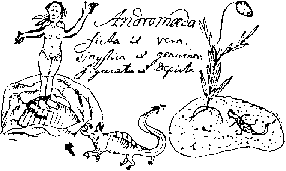
Fig. 1 Drawing from Linnaeus' travel journal. Courtesy Linnaean Society of London.
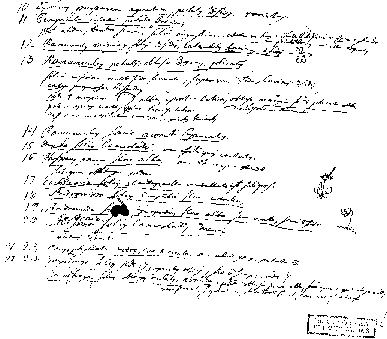
Fig. 2 List of plants found on Mount Vallevare from Linnaeus' travel journal. Courtesy Linnaean Society of London.
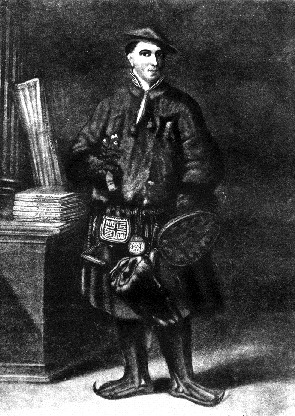
Fig. 3 “Linnaeus in his Lapland dress”. Print after a painting by M. Hoffman, 1737. From B. H. Soulsby, A catalogue of the works of Linnaeus, London (British Museum) 1933.
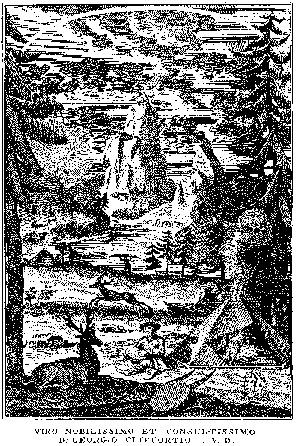
Fig. 4 Frontispiece to Carolus Linnaeus, Flora Lapponica, Amstelaedami (Salomon Schouten) 1737.
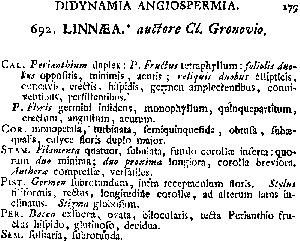
Fig. 5 Definition of Linnaea from Carolus Linnaeus, Genera plantarum, Editio quinta, Holmiae (Laurentii Salvii), [1737] 1754, p. 179
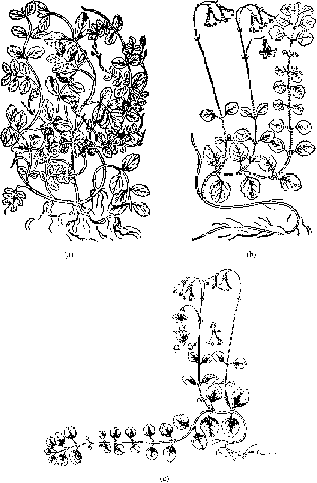
Fig. 6 Engravings of Linnaea from a) Caspar Bauhin, Prodromus Theatri Botanici, Francofurti ad Moenum (Paulus Jacobus) 1620; b) Olaus Rudbeck fil., Index plantarum praecipuarum, quas in Laponico anno 1695 observavit, in Acta Literaria Sveciae, Vol. 1 (1724); c) Carolus Linnaeus, Flora Lapponica, Amstelaedami (Salomon Schouten) 1737, tab. XII, fig. 4.
 You have
Access
- 16
- Cited by