Introduction
Mild cognitive impairment (MCI) has become a major research topic in the field of dementia and associated disorders. Petersen (Reference Petersen2004; 2011) defines MCI as a condition of objectifiable cognitive impairment that is of insufficient severity to warrant a diagnosis of early dementia or to cause substantial functional impairment, but that nevertheless results in subtle deficits, noted by the individual or a relative. The prevalence of MCI varies between studies, depending on the setting and the inclusion criteria. Population-based studies in adults 60 years and older have reported a prevalence ranging from 11% to 17% (Mariani et al., Reference Mariani, Monastero and Mecocci2007).
MCI encompasses a heterogeneous group of four subtypes (Petersen, Reference Petersen2004) from which amnestic MCI (a-MCI) is considered to be important since it is seen as the preclinical phase of Alzheimer's disease (AD). It is associated with an increased risk of rapid progression and even reduced survival (Petersen, Reference Petersen2004). Recently, the added value of biomarkers has been noted for the identification of prodromal AD although biomarkers can be considered as supportive only in the diagnostic framework (Dubois et al., Reference Dubois2010).
The identification of MCI patients remains difficult and could benefit from refinement of clinical measurement tools. Presently, the diagnosis is mainly based upon clinical judgment and a multidisciplinary approach. The criterion regarding the activities of daily living (ADL) which states that basic-ADL (b-ADL) are preserved and a minimal impairment in instrumental-ADL (i-ADL) is allowed (Winblad et al., Reference Winblad2004), is pivotal in the distinction between normal cognitive aging, MCI, and early AD. The notion of minimal impairment determines the difference between MCI and normal aging or AD, but presently neither age-specific norms for levels of functioning nor normal rates of age-related functional decline are available. Moreover, commonly used instruments like the Lawton scale (Lawton and Brody, Reference Lawton and Brody1969) are not sensitive enough to detect mild limitations in functioning. Refinement of existing items and inclusion of contemporary items, taking into consideration an increased use of technology in housekeeping and daily living, is needed (Nygard, Reference Nygard2003; Sanchez-Benavides et al., Reference Sanchez-Benavides, Manero, Quinones-Ubeda, de Sola, Quintana and Pena-Casanova2009). Another difficulty is that most ADL-assessment tools do not distinguish between motor and processing skills (Nygard, Reference Nygard2003), while only functional loss due to cognitive deficits has to be considered for the diagnosis of MCI.
The question remains which ADL domains may be impaired and to what extent, since controversy exists whether functional limitations are part of the MCI complex or announce already a conversion toward AD (Farias et al., Reference Farias, Mungas, Reed, Harvey, Cahn-Weiner and Decarli2006; Reference Ferguson and Cox2008; Perneczky et al., Reference Perneczky2006; Mariani et al., Reference Mariani, Monastero and Mecocci2007; Jefferson et al., Reference Jefferson2008; Petersen, Reference Petersen2011). Several typologies are available to describe daily activities. In the distinction between b-ADL, i-ADL, and a-ADL, as proposed by Reuben et al. (Reference Reuben, Laliberte, Hiris and Mor1990), ADL is stratified according to difficulty and complexity. The b-ADL describe the activities that meet basic physiological and self-maintenance needs. These are relatively uniform across people and cultures. The i-ADL include more complex activities, essential to maintain independent living. The a-ADL cover those activities that are volitional, influenced by cultural and motivational factors, expressing a personal engagement in satisfying activities which are beyond what is needed to be independent (Reuben et al., Reference Reuben, Laliberte, Hiris and Mor1990).
Functioning is complex and requires cognitive, motor, and psychological skills, as well as the appropriate environmental conditions (WHO, 2001). The more complex the activities, the more complex are the cognitive functions involved. The i-ADL require a greater complexity of cognitive organization than b-ADL and are assumed to be more vulnerable for early cognitive changes (Njegovan et al., Reference Njegovan, Hing, Mitchell and Molnar2001; Tuokko et al., Reference Tuokko, Morris and Ebert2005; Peres et al., Reference Peres, Chrysostome, Fabrigoule, Orgogozo, Dartigues and Barberger-Gateau2006; Yeh et al., Reference Yeh, Lin, Chen, Lin, Chen and Wang2011). Therefore, the subtle cognitive changes in MCI might first cause problems in a-ADL before they appear in i-ADL assessment (Pedrosa et al., Reference Pedrosa2010).
For this study, we hypothesized that patients with MCI already show subtle functional deficits in a-ADL. Moreover, we explored which a-ADL were impaired and to what extent. An additional objective of this study was to gain a deeper understanding of the functional decline in the process of MCI.
Participants and methods
Instruments and data collection
In contrast to earlier published quantitative studies (Farias et al., Reference Farias, Mungas, Reed, Harvey, Cahn-Weiner and Decarli2006; Pedrosa et al., Reference Pedrosa2010; Geda et al., Reference Geda2011), a qualitative inductive design was chosen in order to explore the individual's point of view and his/her unique lived experience. The topics of the individual, semi-structured, in-depth interviews covered the participant's experiences with regard to his or her daily activities and changes in performance occurring over time. The subjective cognitive complaints were taken as a start for the interview and were followed by the simple question “can you describe a typical day?” Then, interview questions focused on the a-ADL performed by the subject and the problems experienced. By using eliciting probes, the interviewees were encouraged to elaborate and deepen their answers. Each interview lasted approximately one hour. The collected data consisted of “oral narratives of personal experiences,” which is, according to Lindseth and Norberg (Reference Lindseth and Norberg2004) “an appropriate method for disclosing the meaning of the phenomenon under investigation.” Interviews were taped and transcribed verbatim.
Participants and sampling strategy
Using homogeneous purposive sampling, patients were recruited from the geriatric day hospitals of the Universitair Ziekenhuis Brussel and the Ghent University Hospital. We included consecutive patients, newly diagnosed with a-MCI, using the criteria described by Winblad et al. (Reference Winblad2004). Only patients with a-MCI were included, since this subtype has the highest risk of progressing to AD. Exclusion criteria were dementia, Mini-Mental State Examination (MMSE) (Folstein et al., Reference Folstein, Folstein and McHugh1975) score below 24/30, any other mental disease, and any condition that precluded the participants from being interviewed.
A multidisciplinary evaluation was performed, encompassing MMSE (Folstein et al., Reference Folstein, Folstein and McHugh1975), Cambridge Examination for Mental Disorders of the Elderly, Cognitive part (CamCog) (Roth et al., Reference Roth1986), educational level (expressed in years), and Geriatric Depression Scale (GDS) (Yesavage et al., Reference Yesavage1982), b-ADL, according to a modified Katz scale (scores calculated as a percentage, higher scores representing higher dependence) (Katz et al., Reference Katz, Ford, Moskowitz, Jackson and Jaffe1963), i-ADL, according to a modified gender specific Lawton Scale (Lawton and Brody, Reference Lawton and Brody1969) (for women an eight-item version (food preparation, housekeeping, laundry, ability to use telephone, shopping, transportation, and handling medication and finances); for men a six-item version (ability to use telephone, shopping, transportation, handling medication, and handling finances an handyman work), scores calculated as a percentage, higher scores representing higher dependence), physical examination, the Charlson Comorbidity Index (Charlson et al., Reference Charlson, Pompei, Ales and MacKenzie1987), extensive laboratory testing, and imaging of the brain (CT scan or MRI).
As additional validation we applied a triangulation approach within the data collection by interviewing as many proxies as possible in order to gather different perspectives of the investigated phenomenon. Subjects were included until saturation of the data was achieved. Data saturation occurs when no new information is obtained during analysis. At the Universitair Ziekenhuis Brussel, 29 patients and 20 proxies (9 spouses and 11 adult children) were included. Interviewing the last of these 49 subjects and analyzing the narratives, gave no new information regarding the research questions. Based on the same sampling strategy eight new patients and two proxies (two children) were sampled in the Ghent University Hospital, in order to validate the ongoing analysis and to ascertain that saturation has occurred. This cohort did not reveal any new information.
Data processing and analysis
In the analysis, we used an open-minded approach, looking for relevant phenomena. For this purpose, we constantly compared data gained in the different interviews (Bogdan and Biklen, Reference Bogdan and Biklen2003).
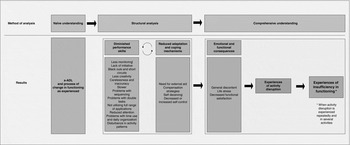
A first analysis, line by line, resulted in a description of the activities performed by the participants. These activities were clustered according to the International Classification of Functioning, Disability and Health (ICF) (WHO, 2001), using the linking rules (Cieza et al., Reference Cieza, Geyh, Chatterji, Kostanjsek, Ustun and Stucki2005). Subsequently, the data were read several times in order to understand their meaning, the so-called naïve understanding (Lindseth and Norberg, Reference Lindseth and Norberg2004). These preliminary results were presented to a panel consisting of physicians, psychologists, gerontologists, and occupational therapists, specialized in geriatrics. After peer review, a structural analysis of the data was conducted seeking to identify meaningful themes. Finally, in a more in-depth analysis, themes were reflected on in relation to the research questions, resulting in a comprehensive understanding of the process of functional decline in MCI (see Figure 1).
The process of functional decline in MCI.

The study was approved by the Ethical Committees of both hospitals. The participants gave their informed consent. All data were collected in concordance with the Declaration of Helsinki.
Results
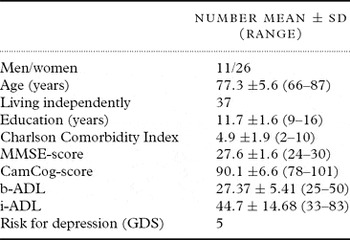
We included 37 participants (11 men, 26 women; mean age 77.3 years; SD 5.6; range 66–87 years), all of them meeting the criteria of a-MCI and 22 proxies. Table 1 shows the characteristics of the participants. All patients were found to be very capable of sharing experiences about their daily life.
Characteristics of the participants (n = 37)

MMSE = Mini-Mental State Examination; CamCog = Cambridge Examination for Mental Disorders of the Elderly, cognitive part; b-ADL = basic activities of daily living according to Katz scale with higher % representing higher dependency; i-ADL = instrumental activities of daily living according to Lawton scale with higher % representing higher dependency; GDS = geriatric depression scale; SD = standard deviation.
Naïve understanding
Description of the activities performed by the participants
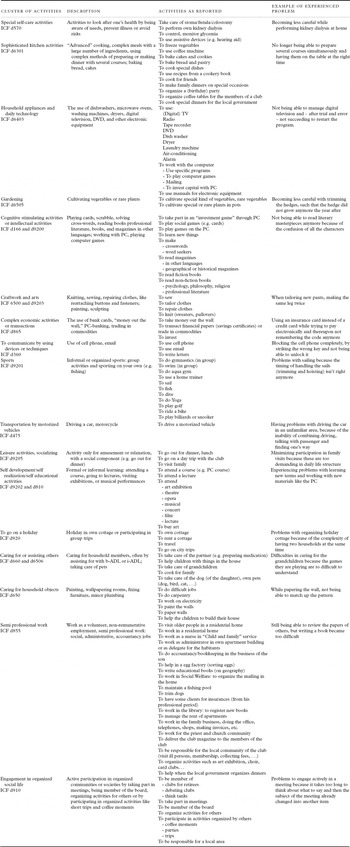
Although the number of activities could vary, all the participants were engaged in a range of meaningful activities. “What”, “how”, and “how much” differed among participants and was influenced by personal factors (such as personal occupational life history, cultural context, individual capacities and limitations, and environmental barriers or facilitators). The activities reported by the participants were clustered based on the ICF. We identified a variety of clusters and relevant ICF-codes for each activity. For each participant, the reported activities covered multiple clusters (see Table 2 for a definition of each cluster and a complete list of these activities).
Clusters of activities based on the International Classification of Functioning, Disability and Health (ICF) (ICF-codes) and description; activities as reported and an example of a reported problem

Description of the functional problems as experienced by the participants
The participants did not report any functional problem due to cognitive problems. However, when asked to describe a "typical" day, they all reported subtle difficulties with, for example, their hobby and leisure activities. Table 2 provides a typical example of the reported problems for each cluster.
The process of change was characterized by a slow and fluctuating onset. All participants mentioned that their performance problems went unnoticed at first and the unpredictability of the impairment. Even when they came to the hospital, seeking help and answers, the performance problems were not continuously apparent. The participants acknowledged that they had reduced the number of activities, possibly because it required more energy to perform them. They discussed in this context the process of giving up activities. Generally, the process of quitting an activity evolved slowly. Sometimes they discontinued an activity, intending to start again later on or “when they got better.” In the latter case, they really expected that their situation would improve again. Because the activities demanded more energy and more attention, they kept postponing them thereby increasing the threshold needed to take up the activity. Some participants reported a complete cessation of their favorite activities due to the problems experienced while performing them. Giving up was most often due to a combination of factors: for example, feeling one's own mental limitations combined with the loss of a friend to enjoy the activity with, the occurrence of a medical problem, or an event like moving to an apartment and leaving familiar surroundings.
Structural analysis
Whereas the naïve understanding showed the various impaired activities, the structural analysis revealed the underlying deficient capacities and the associated consequences, regardless of the activity involved. The phenomena that appeared to have a major impact on the occupational performance of the participants are incorporated in Figure 1 as “diminished performance skills” and “reduced adaptation and coping mechanisms.” We observed a strong relationship between these factors.
Diminished performance skills
Participants were less able to monitor the different steps of a task, which consequently was not performed correctly, leading to less satisfaction, thereby initiating a vicious circle. In addition, the participants reported a lack of initiative and perseverance. Making plans, starting things, and keeping them going was found to be difficult. The participants mentioned black-outs or short circuits. From their point of view, the difficulties occurred occasionally and not continuously. It felt like sudden and unexpected moments of errors, taking them by surprise. Afterwards, everything went back to normal. The cognitive problems seemed to have a negative impact on the participants’ creativity, leading to less creativity. Often mild mistakes occurred, characterized by carelessness or inaccuracy and generally not harmful. The participants acted slower than they used to and double tasks became a major problem. They reported problems with sequencing (performing the components of a task in the right sequence). It could happen that a necessary step in the activity was forgotten, affecting the final result. Many participants did not make full use of their electronic devices (e.g. cell phones). They said that it was too difficult to learn all those new things. Many participants seemed to suffer from reduced attention. They reported difficulties in staying focused on a task or going back to the task after distraction. The mild cognitive problems seemed to affect the functional orchestration in particular, as the participants reported problems with time management and organization of their daily activities. They were not able to organize their daily living and to make their own daily schedule and mentioned problems with the subjective experience of the duration and passage of time. Some participants reported disturbances in their normal routine activity patterns and consequently lived in a chaotic way.
Insufficient adaptation and coping mechanisms
When trying to cope with their functional problems, participants mentioned having difficulties adapting to a new situation or a diminished flexibility to react to unexpected events. In order to be able to continue their preferred activities, participants used several adaptation strategies. Some performed the activities in a different, easier way, using compensation. Some participants used selection and continued only those activities they loved most and abandoned others. Some participants reported a need for external aid in performing activities. This external aid could be the assistance of another person, or an assistive device, such as a recipe, a manual, a (self) written note. On the other hand, they also reported difficulties with the "usual" external aids available such as following a manual for electronic equipment. Decreased or increased self-control or the use of self-deceiving strategies were additional mechanisms reported by the participants.
Participants described a process of mutual influence between the diminished performance skills and reduced adaptation and coping mechanisms. Some participants did not experience problems with executing an activity because they could rely on strong adaptation mechanisms, while others did not succeed in overcoming minor daily problems.
Comprehensive understanding
The interaction of diminished performance skills with reduced adaptation and coping mechanisms, reinforcing each other, resulted in a process leading to emotional and functional consequences (see Figure 1).
Emotional and functional consequences
If the diminished skills on the one hand and insufficient adaptation and coping strategies on the other hand enforced each other, the participants were caught in a vicious circle, since the mechanisms described above led to a variety of emotional and functional consequences, primarily feelings of general discontent. The participants admitted that they felt they were less accurate in what they were doing and that it became difficult to be meticulous in their activities. The results of the activity were not sufficiently satisfying anymore, provoking a feeling of general discontent. Although this caused no emotional problems for some of them, others felt overwhelmed by life stress. As activities took more energy and the participants experienced problems in performing them, they reported experiencing less pleasure. The feeling of making mistakes led to uncertainty about themselves and doubt about their performance. This process resulted in a decreased satisfaction with functioning.
Experience of activity disruption
The diminished skills on the one hand and the reduced adaptation and coping strategies on the other, resulting in negative emotional and functional consequences, could lead to an “activity disruption.” This was experienced as a transient or temporary condition of not being capable of performing an activity as desired. In Figure 1, it is represented as an intermediate condition between the negative emotional and functional consequences and the more permanent experience of insufficiency in functioning.
Experiences of insufficient functioning
If the disruption persisted over time and resulted in discontinuity of daily life and occurred in different activities, it might lead to an insufficiency in functioning. Some participants were not able to adjust and their activities did not match their skills. One of the participants gave an explicit description of the process. She had recently moved into a new house and reported problems functioning in this new environment. She could not act as well as she used to. It started with little things, such as not finding her belongings, nothing really problematic.
. . . I need to think and keep my attention on what I am doing, and I am tired of thinking! In earlier days, I managed to do a thousand things at the same time . . .
Subtle problems appeared:
. . . To estimate the needed ingredients for cooking is becoming difficult, I have too much food in my fridge these days. . .
She liked to cook special dishes but at this moment she was not able to do so without a recipe. Her daughter had to write it down for her.
. . . I know I have difficulties preparing special dishes, particularly dishes from long ago. I have to be in control of myself, I cannot permit myself to forget thinking while I act . . . I received a coffee machine for my birthday and I like it a lot. It is a very easy way to make coffee now I am alone. I use it every day, for my morning coffee and in the afternoon. And what happened yesterday? I forgot to put the coffee pad in the machine !. . .
At the end, she expressed her feelings of insufficiency.
. . . I have problems with organizing my daily life. I am not able anymore to structure the day. I am sad, frustrated. . . .
On the other hand, activity disruption does not necessarily lead to insufficient functioning. Some participants felt that they were in balance since they were able to organize and participate in activities congruent with their capacities, desires, and values and they felt able to adjust or respond to changing circumstances.
. . . I feel complete and I am satisfied with my activities. I know objectively, I am doing less than before, and not that good anymore, but it feels OK. It doesn't feel like I am performing less or poorer . . . I like to do things, regularly, I need that. I want to have something to do every day and I want to do it well . . .
Discussion
Currently, the distinction between cognitive healthy aging, MCI, and early AD remains difficult. Particularly with regard to the ADL-criterion, there is still uncertainty as to how much activities have to be impaired and in which domains the impairment should be observed. The present qualitative study was conducted to explore the decline in ADL performance in patients with MCI. We hypothesized that people with MCI are facing problems in a-ADL and we investigated which activities were impaired and to what extent.
Many quantitative studies show that persons with MCI have more deficits in ADL than cognitively normal people although these deficits are subtle (Farias et al., Reference Farias, Mungas, Reed, Harvey, Cahn-Weiner and Decarli2006; Perneczky et al., Reference Perneczky2006; Mariani et al., Reference Mariani, Monastero and Mecocci2007; Jefferson et al., Reference Jefferson2008; Yeh et al., Reference Yeh, Lin, Chen, Lin, Chen and Wang2011), which is in line with our results. These studies have documented problems with shopping, self administration of drugs, handling financial affairs, checking ones bank account, housekeeping, finding things at home, keeping appointments, and remembering things from a conversation or from television, organizing travel, or leisure. The results of our study show that people diagnosed with MCI do not have performance problems in b-ADL and i-ADL due to cognitive problems, as could be expected according to the currently used definition (Winblad et al., Reference Winblad2004). However, all participants reported subtle problems in performance when it concerned the more complex ADL such as leisure, self development, or (semi) professional work. Geda et al. (Reference Geda2011) have reported a significant difference between cognitively normal people and people with MCI concerning the frequency of performing cognitively demanding activities, such as reading books, playing games, doing craft activities, etc. Based on the analysis of our narrative data we succeeded in documenting the mild diminished performance skills observable in MCI: people with MCI could still carry out cognitively demanding activities, albeit with mild but disturbing performance problems.
In the present study, we described these advanced activities in detail. Earlier studies do not discuss all a-ADL items in depth. Moreover, there is no uniformity in reporting of the ADL items and most of these studies do not bring structure in the functional deficits. Some studies focused on social activities (James et al., Reference James, Boyle, Buchman and Bennett2011) like going to restaurants, doing voluntary work, etc. Others focused on cognitive activities (Geda et al., Reference Geda2011) or on complex ADL (Perneczky et al., Reference Perneczky2006; Pedrosa et al., Reference Pedrosa2010), which included also the common i-ADL besides activities such as the ability to maintain a job, play games etc. In our study, we tried to operationalize the concept of a-ADL as introduced by Rueben et al. (1990) which clearly distinguishes between the various domains of ADL. Moreover, we have extensively described the various activities, providing also a systematic clustering. We succeeded in classifying all the a-ADL which were mentioned by our participants according to the ICF terminology. The use of the ICF classification allows us to structure these heterogeneous a-ADL functions and thus facilitate the communication between healthcare workers, as recently recommended (Freedman, Reference Freedman2009; Jette, Reference Jette2009).
Although b-ADL and i-ADL are commonly assessed, the evaluation of a-ADL is currently not systematically included in clinical practice, and the diagnostic criteria for cognitive disorders mainly focus on i-ADL (Nygard, Reference Nygard2003; Petersen, Reference Petersen2004; Winblad et al., Reference Winblad2004; Farias et al., Reference Farias, Mungas, Reed, Harvey, Cahn-Weiner and Decarli2006; Reference Farias2008; Peres et al., Reference Peres, Chrysostome, Fabrigoule, Orgogozo, Dartigues and Barberger-Gateau2006; Giovannetti et al., Reference Giovannetti2008; Jefferson et al., Reference Jefferson2008). When evaluating ADL at three levels – b-ADL, i-ADL, and a-ADL – all the activities one can perform in daily living are covered. The results of our study assert the need to include an evaluation of the a-ADL in the diagnostic approach of older patients, thus extending the scope of a comprehensive geriatric assessment.
A difficulty in the assessment of older participants is that an observed functional decline can be caused by the interplay of several factors. Besides the cognitive and emotional problems as reported here, physical limitations and environmental barriers can hamper performance (WHO, 2001). In this study, a major challenge was to direct the focus of the interviews to the cognitive problems and the associated functional consequences.
The a-ADL clusters that we describe might be used in new assessment tools. Since these activities are influenced by cultural and motivational factors, and present a strong individual variation (Reuben et al., Reference Reuben, Laliberte, Hiris and Mor1990), it will be a challenge to assess them in a standardized way. Future measurement tools have to take into account the personal preferences of people in order to capture limitations in the meaningful activities of the individual.
Through further analysis, a sequential and cyclic process of functional decline emerged. This is summarized in Figure 1. In the light of what most people would consider a meaningful and active life, several problems with performance occurring in MCI could be distinguished. Diminished skills emerged, regardless of the activity involved. We noticed that adaptation and coping mechanisms interacted with the process of reduced skills. In dementia, it has already been described that the cognitive disorder particularly undermines the coping resources of the individual (Kitwood, Reference Kitwood1993; Preston et al., Reference Preston, Marshall and Bucks2007). Based on the narratives of the participants, we assume that this process has already started in MCI. A study focusing on how people with dementia cope with ADL problems (Nygard and Ohman, Reference Nygard and Ohman2002) revealed that they mainly use intuitive coping strategies such as trial and error, verbalizing or seeking external help. Besides these strategies, we also observed those such as avoidance (minimizing the impact of the memory problems), emotional regulation (Ferguson and Cox, Reference Ferguson and Cox1997), and problem-focused strategies (Lazarus and Folkman, Reference Lazarus and Folkman1984).
The narratives of the participants showed that the cyclic process of adaptation and coping mechanisms interacting with the process of reduced skills could lead to a variety of emotional and functional consequences. It is known that the development of coping and adaptation strategies is crucial in order to optimize well-being (Robinson et al., Reference Robinson, Clare and Evans2005) and successful aging (Baltes and Baltes, Reference Baltes and Baltes1990). For some participants who failed to adapt to the changing situation, it led to life stress. The continuing presence of negative elements enforcing each other led to activity disruption. If this disruption persisted over time and occurred in different activities, an insufficiency in functioning was observed. This may suggest that the absence of adequate coping strategies in this early stage of cognitive decline contributes to the process of functional decline. Although the participants were not always fully aware of this insufficient functioning, it was apparently at this point that they started to seek professional help for their cognitive complaints.
In conclusion, we have tried to further elaborate the concept of a-ADL. We have described a comprehensive model of functional decline, grounded in the bio-psycho-social framework of the ICF, which places impairment in relation to personal and contextual factors, trying to capture the complex interplay of all elements of advanced functioning. We propose that the standard approach of evaluating b-ADL and i-ADL should be completed by a-ADL assessment when the early signs of cognitive deterioration are apparent.
Conflict of interest
None.
Description of authors' roles
All authors have agreed to be listed as authors. They all have actively participated in the collaborative work. P. De Vriendt, E. Gorus, M. Petrovic, and T. Mets designed the study; P. De Vriendt collected data, supervised the data collection of the other researchers, analyzed the data and wrote the paper. E. Cornelis collected and analyzed the data, and assisted with the writing of the paper. E. Gorus, A. Velghe, M. Petrovic, and T. Mets participated in the analysis and interpretation of the data and in the writing of the paper. All authors have seen the final version and approved it.
Acknowledgment
This study was partly supported by the Lundbeck Geriatric Medicine Grant, Belgium.