1. Introduction
In 2023, 46,629 organs were transplanted into living recipients in the United States, of which nearly 40,000 came from deceased donors. Despite the increasing prevalence and success of transplant surgeries, there continues to be a severe supply/demand mismatch, with over 100,000 people on a waitlist for an organ, according to Organ Procurement and Transplantation Network Data from 2023. To address this shortage, the transplant community is increasing attention to donation after circulatory determination of death (DCD) in addition to the more conventional donation after brain/neurologic determination of death (DBD). Currently, more than a quarter of organs from deceased organ donation are the result of DCD.Reference Wall 1 Though it is a promising opportunity to increase the availability of transplantable organs, the timing and implementation of DCD creates ethically challenging scenarios, especially in relation to the withdrawal of life-sustaining therapies (WLST). In order to continue expanding the potential of DCD responsibly and with respect for potential donors’ autonomy, we must critically assess the current regulatory framework that exists for DCD.Reference Bernat 2
Existing policy directing DCD is intentionally separated or “decoupled” from policy directing WLST to prevent organ donation intentions from influencing patient care decisions. However, these regulations do not specify how to navigate instances when WLST might preclude organ donation, especially in cases where the patient has not left legal documentation of their preferences for organ donation or WLST. The result is often confusion and distress for loved ones, and tension between intensive care unit (ICU) clinicians and organ procurement organization (OPO) representatives. This paper seeks to elucidate these scenarios, describe the regulatory gap between health care decisions acts and anatomical gift acts, and call for further research into and amendment of policy around communication between ICU staff, OPO representatives, and donor loved ones. These improvements are likely necessary to realize the promise of DCD organ recovery while preserving trust in organ donation and protecting patient values.
2. State of the Relevant Policy
2.1 Health Care Decisions Acts and Anatomical Gift Acts
End-of-life care, including the decision to withdraw life-sustaining therapies, is primarily regulated by health care decisions acts. The Uniform Law Commission published its most recent Health-Care Decisions Act (HCDA) (a model law on which many states base their own) in 2023, while the latest version in New York State, the Family Health Care Decisions Act, went into effect in 2010. Each state’s version of the HCDA establishes the authority of a patient’s loved one to make health care decisions for the patient in cases where they lack decisional capacity and did not leave prior instructions or appoint a health care agent. 3 This surrogate decision-maker (SDM) may also direct WLST in situations including when the patient has an incurable condition and continuing life-sustaining treatment would involve suffering that could “be deemed inhumane or extraordinarily burdensome.” 4 HCDAs exist primarily to protect the patient from unnecessary distress and to direct who is empowered to make decisions for them while they are incapacitated. They do not, however, comment on the timing, prioritization, or overlap of these health care decisions with many other choices which may arise simultaneously, including organ donation.
Anatomical gift acts, or AGAs, govern the decision-making process for organ donation. Like its HCDA, New York State’s most recent AGA is largely modeled after the Uniform Law Commission’s version, the Uniform Anatomical Gift Act. Each state’s AGA delineates the circumstances and order of operations by which a patient-donor can gift organs to a living recipient. It lays out who is eligible to become a donor, and who may authorize organ donation in the patient’s stead in situations where there are or are not documents such as First Person Authorization (FPA) or an advance directive. 5 The person who can authorize organ donation in the patient’s stead is known as the authorized decision-maker (ADM) and is designated by a separate process from the surrogate decision-maker identified by health care decisions acts. The purpose of AGAs is twofold: to protect potential donors and their decision to make an anatomical gift, and to improve rates of organ procurement and transplantation to address the dire organ shortage. Inherent to and assumed within AGAs is the “dead donor rule,” which is not law but an ethics principle that states that donors of vital organs must be declared dead (by either neurologic or circulatory criteria) before organ procurement begins, rather than dying as a result of donation.Reference Gross 6 AGAs do not prioritize guidance on WLST other than to compel its delay until an organ donation decision has been made.
2.2 Separation of WLST and DCD Decision-Making
The intentional separation of the regulatory frameworks that guide end-of-life decision-making and organ donation reflects a concept sometimes called “decoupling.”Reference Serri and Marsolais 7 This is intended to protect the priorities of the potential patient-donor and their loved ones and to align with the dead donor rule, by ensuring that the goal of recovering organs for transplantation never supersedes or unduly influences the quality and type of health care a patient receives. Following this logic, the decision to withdraw life-sustaining treatment occurs before the patient or family is prompted by an organ procurement organization to consider organ donation. This enables the patient or their SDM to decide whether to continue life-sustaining treatment strictly based on the patient’s goals of care, without the possibility of organ donation influencing the decision. Finalizing the decision to withdraw life-sustaining treatment before discussing organ donation also provides the patient’s loved ones time to process the idea of the patient’s death, before being asked to make decisions for next steps, which may be overwhelming. Finally, the temporal separation makes it abundantly clear that the clinician’s priority is the patient and their comfort, rather than the procurement of their organs, which has historically been important to maintain trust in the organ donation process.Reference Overby, Weinstein and Fiester 8
Decoupling of these regulatory guidelines is usually practical and poses fewer logistical problems during DBD, in contrast to DCD. In donation after brain/neurologic determination of death, withdrawal of life-sustaining treatment does not affect how or when the donor passes away, because they have already been declared dead (legally and clinically) by neurologic criteria. 9 The deceased then remains physiologically maintained while the patient’s loved ones take time to process the patient’s death and consider next steps such as organ donation. In contrast, the moment of death in DCD is entirely predicated on the decision to withdraw life-sustaining treatment. Until WLST occurs, DCD donors remain at risk for the same ethical transgressions and pain sensations as any other living patient. The initiation of organ preservation and donation must occur within minutes of circulatory death, tightly linking WLST and DCD. For patients in the intensive care unit who do not meet brain death criteria, the decision to pursue organ donation has profound effects on the circumstances of their eventual death, including timing, location, and even who will be present. Because death in this scenario generally occurs via withdrawal of life-sustaining therapies, the complete separation of decisions regarding WLST and organ donation is very difficult to maintain. Especially when the patient has left little or no guidance in the form of a living will or FPA, integration of WLST and organ donation decision-making is necessary to provide end-of-life care that is respectful of the patient’s values and to avoid unnecessary confusion and distress for their loved ones.Reference Seshadri 10 The intentional separation of regulatory frameworks guiding WLST and organ donation has made this integration challenging, often creating tension between patient families, ICU clinicians, and organ procurement organization representatives and obscuring the clearest path to congruent end-of-life care for patient-donors. It is important to note that, while this article will focus on these tensions in the context of DCD, some of the same conflicts may also arise and negatively affect end-of-life and organ donation decision-making in DBD.
3. Gaps in the Current Framework
3.1 Limbo Period
The temporal separation of decisions regarding WLST and organ donation creates the potential for a “limbo period.” This is the point in a patient’s life when there is little chance of goal-concordant recovery and WLST is the most appropriate next step in their care, but organ donation is still under consideration. While a donation decision is being ascertained, maintaining the patient’s eligibility for organ donation may cause delay in implementation of the patient’s WLST wishes, escalation of medical interventions, and ultimately distress for the patient and their loved ones.
Centers for Medicare and Medicaid Services recommends that ICU physicians notify the organ procurement organization of a potential organ donor within one hour of specified clinical triggers, including contemplation of a brain death exam or initiation of a discussion that may lead to WLST.Reference Kotloff 11 While the OPO is required to be expeditious (ideally arriving within one to three hours), patients may wait up to 24 hours for the OPO to initiate the organ donation conversation and evaluation process.Reference Park 12 During this time, the decision may be made to deescalate or withdraw life-sustaining therapies, either through review of the patient’s living will or by the SDM as authorized by a health care decisions act. 13 Legally, this decision must be honored, but neither the uniform AGA nor the uniform HCDA, nor any available guidelines, speaks to the timing of implementation of WLST after it is requested. Once the OPO receives a referral for a potential donor, AGAs do generally prohibit the hospital from withdrawing any intervention that may compromise an organs’ suitability for transplant until the OPO representative has been able to perform an examination of the donor for medical suitability. 14 In New York State, the hospital may not withdraw such measures until steps are taken toward informing the authorized decision-maker of the possibility of donation (if there is no FPA), and apparent conflicts between plans for WLST and organ donation are resolved. 15 This can result in a delay in WLST for an unspecified amount of time, with the purpose of honoring the patient’s right to be considered for organ donation. This may leave the patient and their loved ones in a legal and ethical limbo due to delay and/or compromise of aspects of the patient’s end-of-life goals while determining whether the patient can or should be an organ donor. AGAs provide guidance for this only in situations where the patient has a living will requesting WLST and is also a registered organ donor. In this circumstance, both the uniform and New York statutes recommend that the clinician and SDM resolve the conflict expeditiously. 16 The vast majority of patients undergoing evaluation for DCD, however, do not have both of these documents, leaving the patient and their loved ones, clinical staff, and OPO without any guidance on how to time or prioritize next steps.
Delaying or changing the circumstances of WLST has the potential to harm patients and their loved ones. Harm to the patient may include physical pain despite palliative treatments, being subject to medical interventions that are not concordant with their goals of care, and being required to continue living in a state that they would never have wanted to be in. Delaying WLST on an order of hours may align with the ethical principle of justice, by preserving the potential to save the lives of up to eight people if the patient becomes an organ donor. However, this must be balanced with non-maleficence, which prohibits unnecessary harm to the patient. 17 New York’s HCDA authorizes WLST in the case that medical interventions are inflicting inhumane or excessive suffering, suggesting that postponing WLST would prolong this suffering. 18 The patient’s SDM and other loved ones may also experience trauma as a result of the limbo period. Family members of patients who underwent evaluation for organ donation have identified delays in WLST as painful, citing lack of prognostic clarity and visible clinical worsening as sources of added stress.Reference Takaoka 19
Besides life-sustaining interventions such as ventilators and vasopressors, few guidelines exist for clinicians around the initiation or continuation of other, non-life-sustaining clinical interventions during the limbo period. Established guidelines do exist to direct the management of confirmed organ donors. These protocols were developed for patients who have been declared neurologically dead, and may include hormone replacement therapy, systemic antibiotics, and blood transfusion.Reference Kotloff 20 These interventions are intended to preserve organs for transplantation, and are also frequently indicated in the care of the living ICU patient to maximize chances of meaningful recovery.Reference Maciel, Hwang, Greer, Wijdicks and Kramer 21 However, non-brain dead patients in the limbo period for whom WLST is warranted are neither confirmed organ donors nor likely to recover, which would suggest that unless and until the patient is a confirmed organ donor, these interventions would not be indicated. This is emphasized by the fact that loved ones of potential patient-donors often request non-escalation of care, indicating an explicit preference to forgo these interventions. 22 The uniform AGA and New York AGA explicitly prohibit the withdrawal of organ-preserving treatments prior to OPO arrival, but they do not comment on other aspects of clinical management, leaving clinicians without guidance on whether non-escalation requests can be honored prior to obtaining an organ donation decision.Reference Le Dorze 23 In a consensus document intended for ICU clinicians, the Critical Care Committee for the American Association for the Surgery of Trauma recommended managing these scenarios by expediting the donation authorization discussion and integrating organ donation decision-making into standard end-of-life care. 24 This guideline is not compatible with the current regulatory framework, which intentionally separates decisions on end-of-life care and organ donation in time and in content.
The separation of WLST and organ donation decision-making and the timing of the related processes frequently does occur smoothly. However, this requires that the OPO representative is immediately available, the patient is stable, WLST decisions and organ donation conversations occur separately, and the steps necessary to realize donation do not unreasonably delay WLST or interfere with the patient’s end-of-life goals. It takes only one complication in this sensitive set of events to cause miscommunication or confusion, which may deteriorate into conflict between ICU clinicians, OPO representatives, and the patient’s loved ones. This conflict can lead to moral injury among clinicians, frustration among OPO representatives, and feelings of distrust among family members, as will be further described in the following sections.
3.2 Determining Precedence of Guiding Documents
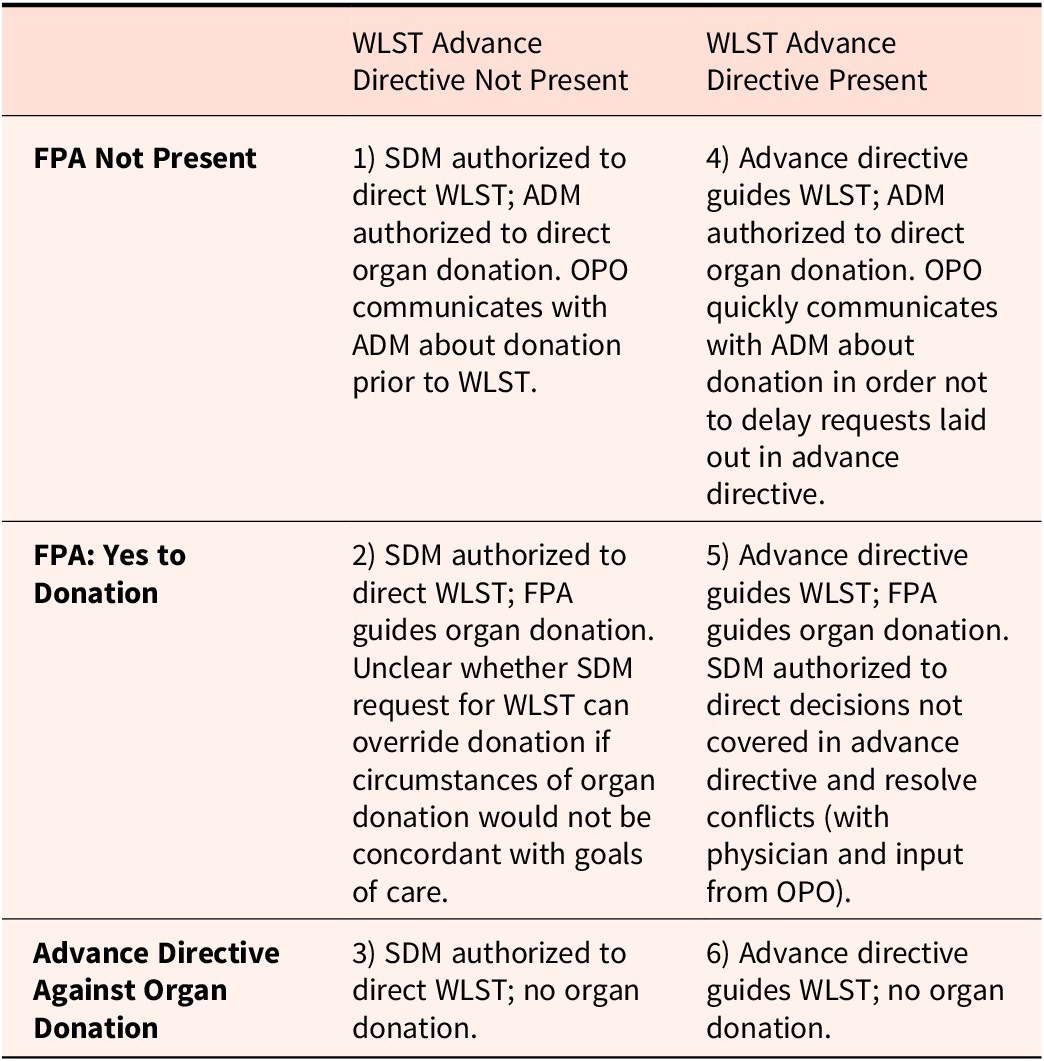
In their efforts to achieve distinct goals, AGAs and HCDAs grant authority to different documents and surrogates to communicate the wishes of the potential patient-donor when they are incapacitated. When these sources, including first person authorization, advance directives, and decisions by ADMs and SDMs, are not aligned regarding WLST and organ donation, there is no clear guidance to determine which takes precedence. Table 1 provides a framework to understand the current regulatory guidelines for situations in which neither, one, or both an FPA and advance directive were established by the patient before their incapacitation, and which decision is understood to take priority if they conflict. The process for determining which source takes precedence is rarely explicit in regulation and differs by state and institution.
Determining Precedence of Documents Guiding WLST and DCD

In all 50 states, FPA previously established by the potential patient-donor is considered sufficient to move forward with organ donation. 25 The uniform AGA states that this authorization may only be rescinded if there is legal documentation of revocation of the anatomical gift by the patient themselves. 26 However, it is likely that an advance directive explicitly rejecting organ donation would be sufficient to override the patient’s first person authorization, particularly if the advance directive was created at a later time than the FPA was established (most often obtained with a driver’s license). The law is less clear if organ donation authorization is not explicitly revoked by name. If the advance directive does not expressly reject organ donation, but the indicated goals of care are incongruent with the medical interventions, timing, or logistical requirements of organ donation, AGAs direct this conflict to be resolved expeditiously by the patient’s SDM and attending physician, with necessary information provided by the OPO representative. 27 They do not provide further guidance on the limitations of this conflict resolution, especially in the case of DCD. For example, it is not clear how long goals of care, such as WLST, laid out in the advance directive may be delayed in order to prepare for organ donation, or if organ donation may be forgone entirely if implied by the advance directive’s terms. In addition, there is no guidance for conflict resolution in the case that the potential patient-donor does not have an advance directive or other form of living will (Table 1, cell 2). HCDAs provide that the patient’s SDM directs end-of-life care in the patient’s stead, including withdrawal of life-sustaining treatments. 28 However, the SDM’s consent is not required to move forward with organ donation if the patient is a registered donor with first person authorization. If the goals of care laid out by the SDM, which represent the patient’s own wishes, conflict with some aspect of organ donation, it is unclear if those requests have any legal authority to delay, override, or otherwise influence the organ donation process. Individual agreements between specific OPOs and hospitals may speak to the preferred resolution of these conflicts, but there are no standardized guidelines available for clinicians, OPOs, or the patient’s loved ones. This creates the opportunity for organ donation via DCD to be carried out in direct conflict with the goals of care provided by the SDM, bypassing the patient’s autonomy to affect certain aspects of their end-of-life care, and leaving the patient’s loved ones feeling that they lack the ability to communicate or carry out those preferences. AGAs are intended to protect the patient’s right to make an anatomical gift, but it is unclear if this should supersede their right to determine other aspects of their end-of-life care.
After authorization for DCD has been obtained, medical interventions solely for the purpose of organ donation, or antemortem medical interventions, may be requested by the OPO or donation team before life-sustaining therapies are withdrawn. These include procedures such as arterial catheterization or medications such as heparin, which are exclusively intended to improve outcomes for the recipient of the donor’s organs, but may reasonably risk causing pain or discomfort to a patient-donor who is not brain dead.Reference Mone and Danovitch 29 While first person authorization is sufficient to authorize organ donation in DCD, it is unclear if it also authorizes these interventions. Consensus by Societies of Anesthesiology and Thoracic Surgery posit that additional informed consent from a surrogate or proxy is required for procedures or medications for the purposes of organ donation that occur prior to WLST.Reference Gries 30 This may create confusion in cases where organ donation is authorized via FPA. Antemortem medical interventions may not occur if the SDM does not provide consent. Proceeding with DCD without these interventions may conflict with the hospital or OPO’s protocols or prevent optimal organ recovery. Additionally, it may be unclear who is responsible for requesting consent for these interventions. OPO or hospital institutional policy dictates who bears this responsibility, requiring all involved parties to be familiar with these policies.Reference Hardart 31 In addition, most medications and many invasive procedures in intensive care settings do not normally require explicit informed consent, which may lead to misunderstanding of whether interventions for the sole purpose of organ preservation require additional authorization.Reference Manthous 32 The lack of accessible regulatory guidance on requirements for antemortem medical interventions creates multiple opportunities for communication breakdown and confusion, particularly when the patient-donor’s surrogate decision-maker and first person authorization are not aligned on organ donation.
AGAs provide some guidance on resolution of conflicts between a patient’s advance directive and FPA, 33 which may be sufficient in relevant cases. However, these conflicts are uniquely complicated during DCD, in which preparation for organ donation affects the care of the patient-donor before they die. Due to a lack of detailed and consistent regulatory guidance for navigation of conflicts between organ donation and other aspects of end-of-life care, these scenarios may be handled differently by different clinicians, OPOs, or institutional agreements. To ensure that patient-donors’ values and preferences are sufficiently respected and clinical and organ procurement parties are protected from moral injury, there is unmet need for additional conflict resolution guidance in organ donation authorization and its effects on the patient’s preferred end-of-life care.
3.3 Resource Requirements and Logistics of DCD
Even after decisions are finalized for both WLST and organ donation, DCD continues to evoke ethical conflicts and logistical challenges that are not accounted for in the current regulatory guidelines. Organ procurement requires extensive resources, from operating rooms to surgical teams to transportation of donated organs. DCD requires additional resources compared to DBD, including time, space, and a separate ICU team to manage the patient during withdrawal of life-sustaining therapies and the dying process. 34 Assembly of these resources can take 12–36 hours after authorization for organ donation, and may require physical transport of the patient or their family members.Reference Nakagawa 35 This prolongs the potential for physical and psychological distress for patients and their loved ones, and may even increase the likelihood of refusal to authorize DCD.Reference Siminoff 36
The resource-intensive process of DCD may make it difficult to faithfully carry out the patient’s or surrogate decision-maker’s goals for the end-of-life process. Because clinicians are not supposed to discuss organ donation with patients and their families (decoupling clinical and organ donation decisions), non-donation-related goals of care will have been discussed in detail prior to explanation of the requirements of DCD. Patient goals may include that WLST occur in a private space (i.e., an ICU room) or in the presence of family members, friends or religious figures, or specific requests around the timing, location, or other circumstances of the patient’s death.Reference Kelso 37 Once authorization has been obtained for organ donation, however, the logistical requirements of organ procurement are often given legal precedence over these end-of-life expectations. In DCD, the withdrawal of ventilators and other life support, and the resultant death of the patient-donor, often must occur in an operating room instead of the ICU, limiting the presence of loved ones, access to the patient’s body, and supportive non-clinical measures such as music or physical mementos.Reference Kelso and Lebovitz 38 The patient-donor may be transferred to the operating room whenever space and clinical teams are available, irrespective of the family’s schedule, including in the middle of the night. In addition, many hospitals cannot provide the personnel or support required for organ recovery and/or transplant, necessitating transfer to a different institution altogether.Reference Lehr and McCurry 39 Moving the patient-donor to a separate donor management center may delay WLST by many additional hours, further upset expectations and place undue stress on the patient’s family to travel to an unfamiliar location.
The logistical requirements of DCD are unlikely to have been considered by the patient if and when they established an advance directive or signed FPA. It is also unlikely that the surrogate decision-maker would have cognized these logistics when initially considering withdrawing life-sustaining care, given the intentional temporal separation of the two decisions. This makes it likely that DCD logistics will, at minimum, make it challenging for the patient’s decision-makers to determine whether organ donation still aligns with the patient’s values, or will disrupt the patient-donor’s preferences for WLST (explicit in an advance directive, or as determined by an SDM). It is evident that the combined effects of the unique logistics of DCD, separation of organ donation and WLST decision-making, and lack of guidance for reconciliation of conflicts create a less-than-ideal environment for honoring patient-donors’ values. This environment may encourage bending or dismissing end-of-life care expectations in favor of organ donation, at the risk of increased trauma, dissatisfaction, and distrust in the organ donation process by loved ones and the general public.
3.4 Effective Counseling
From the perspective of the patient and their loved ones, the separation of WLST and organ donation legislation manifests in the counseling and authorization conversations they participate in with hospital and OPO personnel. Various guidelines stipulate that authorization for organ donation should be obtained after discussions about withdrawal of life-sustaining care, by a trained individual who is not the patient’s primary clinician. 40 However, there is no uniform legal guidance on the appropriate timing or content of these discussions or who is best qualified to participate in them, and certainly no direction specific to DCD.
Legislative decoupling ensures the temporal separation of decision-making discussions around WLST and organ donation in DCD. First, ICU or palliative care physicians conduct goals-of-care discussions including withdrawal of life-sustaining therapies. At this point, the organ procurement organization must promptly be notified. 41 The OPO representative must then confirm election of WLST before discussing organ donation, as required by the Organ Procurement and Transplantation Network. 42 Finally, clinicians must delay the withdrawal of life-sustaining treatment until the OPO representative has had said discussion and an organ donation decision has been made. 43 The timing of and person responsible for carrying out each step in this process is generally described in individual agreements between hospitals and OPOs, and may vary significantly, rather than following a uniform legal protocol. 44 For each of these responsibilities to be performed smoothly and with minimal confusion for the patient-donor and their loved ones, it is imperative that there is clear communication between hospital and OPO staff and familiarity with the agreement they are operating under. Clinical providers must be acutely aware of procurement staff needs so as to place the OPO referral at the appropriate time and with the appropriate information.Reference Howard, Cochran and Cornell 45 They also must prepare the prospective patient-donor for the organ donation discussion, by conveying cooperation with the OPO without compromising separation of the decisions. Otherwise, the patient’s loved ones may be blindsided by the arrival of an organ procurement organization or the idea of DCD, especially if they have already communicated their decision to withdraw treatment.Reference Siminoff, Agyemang and Traino 46 The OPO representative must also obtain key information from the patient-donor’s clinical team in order to plan and frame their approach to allow loved ones to process the patient’s death, but avoid unnecessary delays. 47 To best facilitate communication among hospital and OPO employees, initiatives such as placing in-house OPO coordinators in high-volume trauma centers have shown some preliminary improvements in handling of organ donation authorization, and even in rates of authorization. 48 Still, the sensitivity in timing of these steps remains threatened by heterogeneity of hospital/OPO agreements and by a concerning lack of established regulatory guidelines.
Uniform guidance is also lacking regarding who is qualified to provide counseling on organ donation. The Organ Procurement and Transplantation Network and the OPO State Operations Manual require that the person who obtains authorization for organ donation is a “designated requestor,” defined only as someone who is trained to participate in the donation consent process, without specification of what that training should include or who should provide it. 49 In practice, these designated requestors are usually OPO representatives, but physicians, nurses, and social workers have also been shown to serve effectively in this role. 50 The designated requestor requirement is based on studies demonstrating increased rates of authorization for organ donation from trained personnel, but does not consider the efficacy of that counseling to achieve goal-concordant care for the prospective patient-donor.Reference Rodrigue, Cornell and Howard 51 The exclusion of the patient’s primary ICU team from these discussions, while intended to protect the potential patient-donor from conflicts of interest, may make it more difficult to achieve end-of-life care that aligns with the patient’s values. 52 ICU clinicians are experienced at discussing goals of care for patients at the ends of their lives, given that a large proportion of patients in the ICU fit this description. Before the OPO arrives, the primary physician may have spent significant time discussing the patient’s values, assessing the family’s health literacy, or deliberating with palliative care teams to understand the patient’s objectives and options. This suggests that ICU clinicians could provide needed support to the family in making a goal-concordant organ donation decision, while making it clear that they are not involved in the actual organ procurement process. Despite this, clinical staff are usually uninvolved in these discussions. Even if the ADM asks about organ donation before the OPO arrives, guidelines direct physicians to “be careful to ensure that the decision to withdraw life-sustaining treatments is separate from the decision to donate.” 53 This is generally interpreted, by the provider or hospital/OPO agreement, to mean that physicians are unable to engage in even superficial discussions about organ donation with the patient. As one ICU physician reflected, when organ donation is broached, they “can no longer be completely open and fully honest,” for fear that they will violate a law or OPO policy. 54
The heterogeneity of hospital/OPO agreements guiding organ donation counseling and the absence of overarching protocols indicates a need for more consistent legal guidance on the timing and involved parties in organ donation authorization conversations. The current guidelines, consisting of a conglomeration of legal and institutional documents, vary by state, OPO, and hospital, leaving ample opportunity for confusion among hospital staff, OPO representatives, and the patient and their decision-makers. To provide the most goal-concordant end-of-life care and donation authorization process, clear guidelines for donation counseling should be established. Although beyond the scope of this article, parameters for these guidelines could be incorporated into an amendment of the uniform AGA, including baseline expectations for timing and counseling content, and defining those who would be authorized to provide counseling. While addressing the dearth of transplantable organs is a priority, achieving an outcome for each patient that best reflects their wishes and values must be paramount in the development of these guidelines.
3.5 Surrogate and Authorized Decision-Makers
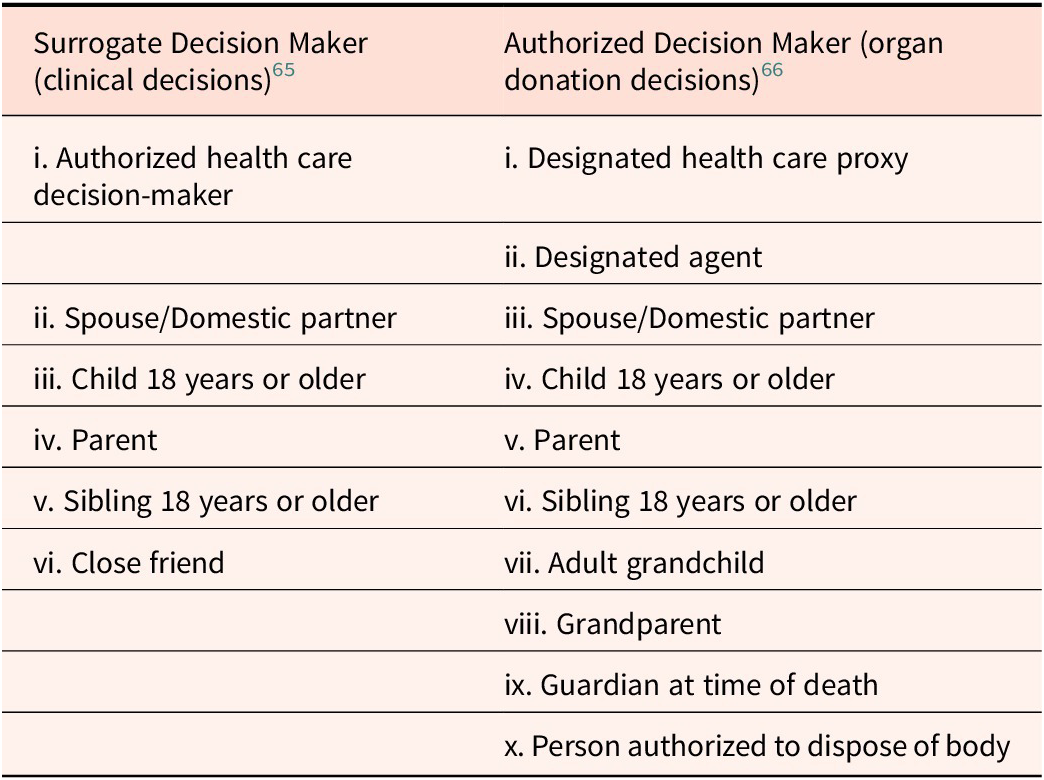
Even prior to the challenge of reconciling WLST and organ donation decisions, there is potential for confusion in determining who can make such decisions. Most patients for whom WLST or organ donation is considered are unable to contemporaneously communicate their values around these choices due to severe injury or illness. They must rely on a family member, friend, or other substitute decision-maker to make these judgments in their stead, as designated by the relevant legislation. The separation of legal documents guiding WLST and organ donation means that the person who is authorized to make each of these decisions is designated through a different process (Table 2). The lists follow similar patterns, but their differences create the potential for conflict and confusion among the patient’s loved ones, or between clinical or OPO staff and loved ones during evaluation for DCD.
Determination of SDM and ADM in New York State

Because of the difference in the prioritized lists seen in Table 2, it is possible that the surrogate decision-maker designated by the HCDA to communicate decisions about withdrawal of life-sustaining therapies is different from the authorized decision-maker designated by the AGA to authorize organ donation for the patient. Due to the delicate interplay in the timing and logistics of WLST and DCD, this may create problematic delays or lapses in communication if these two decision-makers do not agree on the patient’s goals of care. For example, the SDM may request that life-sustaining treatment be withdrawn, but a distinct ADM may have different requests around the circumstances of WLST in conjunction with their organ donation decision. Because of the time separation of these decisions, conflict may allow one agent to be overridden, or organ donation authorization not to be obtained. Thus, there is potential for the patient’s values or preferences not to be honored because of this inconsistency. These differences also require additional expertise for hospital or OPO employees to determine the appropriate decision-maker for each aspect of end-of-life care. Identifying the SDM and ADM requires time and familiarity with the state legislation and the patient’s family, and may be difficult to assess when multiple family members are at bedside or mentioned in documents such as an emergency contact form or living will.Reference Song and Ward 55 Given these risks, it is important that separate decision-maker appointments for WLST and organ donation be examined for clarity and necessity. Risk to the patient and their loved ones may be minimized by revising or combining the appointments of decision-makers, by amending the relevant HCDA or AGA to mirror or refer to the other’s decision-maker list.
4. Manifestations of Regulatory Separation
4.1 Dennis
To illustrate how separate legislation guiding WLST and organ donation decision-making may lead to conflict and difficulty in honoring patient values and preferences, it is useful to examine example scenarios. The following cases demonstrate how, while anatomical gift acts and health care decisions acts are in many ways complementary, they leave gaps which fall upon clinicians, OPOs, and families and may result in unnecessary stress and outcomes not concordant with the patient’s goals.
First, consider Dennis, who has suffered a myocardial infarction leading to cerebral edema and devastating brain injury, but who does not meet criteria for brain death. Just months before, Dennis wrote a detailed advance directive, asserting that in the event of an adverse medical event, he has no desire to live while dependent on machines or medications. In fact, he wants to die a quick and peaceful death rather than be kept alive on a ventilator for any amount of time if he is unlikely to return to his independent lifestyle. Dennis’s SDM and ADM is his daughter. She agrees that his advance directive reflects his values in life, and requests that all life-sustaining medical interventions be discontinued. At this point, the ICU team has already notified the organ procurement organization of a devastating neurologic injury, but all OPO representatives in the catchment area are en route to other hospitals and will not arrive for at least six hours to initiate the organ donation discussion. When the ICU physician informs the daughter that Dennis’s life-sustaining treatments cannot be discontinued until after the OPO arrives, she feels that his right to withdraw care, as provided by the HCDA, 56 is being overlooked and that he continues to needlessly suffer. While in this limbo period, it is unclear to both the clinical team and the patient’s family when the next steps in Dennis’s journey can be taken, and what clinical management would be compliant with both the AGA (to preserve his organs for potential donation) and his advance directive (which requests minimization and withdrawal of interventions). If his blood pressure drops, he will likely receive vasopressors to retain physiologic circulation and avoid organ ischemia, despite his advance directive stating that he does not wish to be dependent on medications. If he spikes a fever, there is no regulatory guidance on whether he should receive antibiotics (technically a non-life-sustaining intervention), which would be consistent with standard ICU care, but would not comply with the non-escalation stipulated in his advance directive.
When the OPO designated requestor arrives to speak to Dennis’s daughter, he informs her that when Dennis last renewed his driver’s license, he signed first person authorization to become an organ donor. Therefore, he is eligible for DCD and will move forward in the evaluation process for donation. However, Dennis’s daughter was not aware that Dennis was an organ donor and does not believe that her father knew he had signed the FPA. She feels that his advance directive, which was written more recently and matches his values in life, would matter more to him with regard to his goals of care. Upon learning that DCD would require additional waiting time and withdrawal of the ventilator in the operating room, she does not believe that Dennis would have wanted to become an organ donor in this way. As required by the New York AGA, 57 Dennis’s daughter and primary physician attempt to resolve this conflict with input from the OPO representative. The physician encourages her to prioritize her father’s wishes and comfort, while the OPO designated requestor asks whether her father would have placed his own desires before saving lives. Dennis’s daughter already feels that she and his health care team have let down her father by allowing his request for a quick and painless death to be significantly delayed while waiting for the OPO’s arrival, subsequent testing, and assembly of the surgical supplies and team. Regardless of her decision at this point, she has suffered emotional distress which may have been avoided, had WLST and organ donation been considered earlier and together. As it is, she feels disillusioned by the organ donation process, leading her to revoke her own FPA and encourage close friends and family to do the same.
The potential outcomes of this scenario are complex. On one hand, it could be a case of successful DCD, resulting in valuable additions to the available organ pool and the opportunity to save lives. This outcome was likely consistent with the patient’s wishes at some point, given that he had registered as an organ donor. On the other hand, the patient’s end-of-life requests, as set forth in an advance directive and corroborated by a family member, were explicitly delayed in favor of organ donation. It is unclear if these more recent requests should supersede his desire to be an organ donor, or how to integrate both goals while minimizing harm to all. This scenario, which is not uncommon, jeopardizes the trust of those on both the patient and clinician side in the process of organ donation, particularly DCD. It also compromises decision-makers’ ability and duty to protect and represent the values of their vulnerable, dying loved ones. To prevent these outcomes and maximize organ donation without unduly influencing end-of-life care, regulatory frameworks should be amended to provide additional guidelines for organ donation counseling and reconciling tension between WLST and organ donation decisions.
4.2 Sally
Next, consider the case of Sally, a young mother who suffered severe injuries in a car accident. Like Dennis, she has little to no chance of meaningful recovery but does not meet the criteria for brain death. She has a large family at her bedside, including her husband, two school-age children, and parents. The ICU physician informs the family of Sally’s prognosis; she does not have an advance directive, so her husband, acting as surrogate decision-maker, makes the decision to withdraw life-sustaining treatment. The clinical team contacts the OPO but does not specifically mention organ donation to the family, both because they feel that the family is still processing the imminence of Sally’s death, and because they are not trained to obtain organ donation authorization. The family begins to prepare for Sally’s death, bringing friends and extended family to the hospital, asking their beloved pastor to be present, and requesting days off school for her children. They believe that Sally would have wanted her death to be a beautiful occasion, full of the people she loved. At this point, the OPO representative arrives. He informs Sally’s husband that Sally had signed first person authorization and is now a candidate for organ donation by DCD. Her husband remembers Sally being excited at the prospect of helping people when she had signed up to be an organ donor and hopes that her organs will be a legacy of her generosity. He confirms her authorization to be an organ donor, and consents to any medical procedures that may be required for donation.
Unfortunately, Sally is at a small hospital far from a transplant center and without resources to carry out DCD. It is determined that Sally will be transferred by ambulance to the nearest transplant center with a donor care unit, several hours away. There, the withdrawal of her ventilator and other life-sustaining interventions will occur in an operating room. Sally’s husband is told that the operating room will accommodate three family members, and that religious objects and children’s toys must be left outside for purposes of sterility. He is devastated; he feels that she would have prioritized a death surrounded by loved ones and in keeping with her religious beliefs above all else, and that she did not consider these limitations when she opted to be an organ donor. Furthermore, the soonest Sally’s sister can arrive is in two days, but the OPO wants to transfer and begin DCD tomorrow based on resource availability. Sally’s husband now must decide whether to oppose organ donation and fight to have Sally’s whole family present in her last moments, or enable organ donation, requiring some family members to say goodbye now, and denying her sister the opportunity to say goodbye at all. These choices are significantly more complicated because they were not considered during the initial conversations about WLST, and because the timing and location of withdrawal is being dictated by organ recovery requirements.
Neither Sally nor her husband had fully considered the logistical implications of DCD when they consented to organ donation, due in part to the separation of WLST and DCD decisions by timing, content, and the staff who provided counseling. As a result, Sally’s end-of-life care was at risk of being inconsistent with her values, despite the initially unanimous agreement to proceed with DCD. In this situation, the logistical details of organ donation were essential to communicate to ensure that both WLST and DCD could be carried out in a way that was congruent with the patient’s goals of care. A collaborative discussion between the clinical team, OPO representative, and patient’s family members and involving details of both WLST and DCD may have avoided this less-than-ideal outcome.
5. The Path Forward
5.1 Provider Education
Health care workers who regularly encounter organ donation and DCD in their clinical practice may become involved in complex legal and ethical discussions or conflicts. Providers may not be well-versed in the various regulations which apply to these situations. This is due to a combination of factors, including lack of educational opportunities, the ever-changing legal landscape, variance by state, and individual expectations in each hospital/OPO agreement. 58 Although organ procurement organization representatives are usually responsible for requesting organ donation authorization, it is imperative that clinicians understand the regulatory landscape of organ donation. This knowledge will enable providers to be more effective partners to the OPO, to provide appropriate clinical management during the donation evaluation process, and to avoid moral injury in their interactions with patients in the sensitive end-of-life period. 59 The OPO is often expected to train clinicians on these duties,Reference Kao 60 but more accessible training opportunities may lead to improved uptake and more holistic education which incorporates other aspects of end-of-life care, such as the withdrawal of life-sustaining therapies. Currently, few educational programs are available to physicians seeking more information about organ donation counseling and regulations. Some available resources include the Communicating Effectively about Organ Donation Library,Reference Siminoff, Traino and Genderson 61 the Gift of Life Institute, 62 and the Organ Donation and Transplantation Alliance’s DCD Educational Guide. 63 Donor care units with specialized staff trained in organ donation and end-of-life care have been trialed and even demonstrated some improvement in authorization rates. However, these programs may introduce additional complications in circumstances requiring hospital transfer after donation authorization. 64 Further research on the needs of clinical staff involved in organ donation, particularly DCD, is necessary to develop educational resources and ensure that all parties have adequate understanding of the complex regulatory framework guiding these processes.
5.2 Conclusion
Although DCD is a promising opportunity to address the dire organ shortage, the current regulatory framework directing this method of organ donation leaves open the possibility of moral and ethical harm to several parties, from clinical staff to OPO representatives to the patient and their loved ones. To preserve the potential of DCD and maintain the trust of the public in its practice, we must prioritize the protection of the patient-donor and their goals of care during DCD. To do so, it is necessary to re-examine the current legal landscape of DCD, beginning with the separation of decision-making guidelines for withdrawal of life-sustaining therapies and organ donation. The decoupling of these paradigms creates the potential for a limbo period, during which the patient’s wish for WLST may be delayed while organ donor status is determined. It is also unclear how to proceed when there is conflict between or absence of first person authorization and advance directives or goals of care determined by the surrogate decision-maker. Current legislation does not provide guidance for correct clinical management during these periods of ambiguity, leaving both provider and patient vulnerable to moral injury by inappropriate implementation of the patient-donor’s wishes. Finally, separation of conversations about WLST and organ donation and lack of clarity regarding involved parties makes it difficult to appropriately reconcile the patient-donor’s preferences in end-of-life decisions.
The identified gaps indicate a need for further investigation into and guidance for the appropriate management of conflicts and delays which arise during evaluation for and implementation of DCD. It may be necessary to update the current uniform AGA and HCDA to address these conflicts and provide specific guidance around ethical DCD practices. Potential amendments to be considered should include detailed and DCD-specific guidance for managing conflicts between documents and/or representatives of patient-donor wishes, and increased clarity in guidelines for organ donation counseling, including who may discuss organ donation and when these conversations should occur. If uniform laws are amended, states would then have to assume responsibility by updating their versions of the adopted regulations. These amendments may also have the effect of standardizing heterogenous hospital/OPO agreements which currently affect the management of conflicts in DCD. Further research and consideration of these amendments are a crucial next step in promoting and protecting the potential of DCD, and maintaining the trust of the public and the physical and ethical welfare of the DCD donor.
Note
CO has no conficts of interest to disclose. BP is a scientific and ethics advisory board member for ProCure OnDemand and has presented on the ethics of DCD NRP for Lifecenter Northwest. All disclosure forms are on file with the Journal.