Introduction
War will always have physically and psychologically effects on all of the people involved—soldiers and civilians, including the contingents of refugees, migrants, prisoners, hostages, and residents from the involved territories. War can lead to radical changes in every aspect of life, even to the point where time is henceforth demarcated as “before the war” and “after the war.”
Considerations about the undoubted effects of war on mental health depend significantly on the social and political structures of the affected populations. According to The Experience of Soviet Medicine in the Great Patriotic War of 1941–1945,Reference Davidenkov 1 the “high consciousness and true patriotism of the Soviet soldier caused a significant overall reduction of neuroses in the army and an extremely favorable clinical course of neurotic diseases.” Obviously, this is pure Soviet propaganda. Indeed, according to the evidence-based data, mental health disorders and associated psychosomatic disorders among participants in armed conflict causes huge medical and social burdens everywhere.Reference Kessler and Üstün 2 , 3 Not surprisingly, the prevalence of posttraumatic stress disorder (PTSD) is 0.3– 6.1% in the general population, but its rate in individuals who have faced the conflict of war is 15.4%.Reference Kessler and Üstün 2 , Reference Steel, Chey, Silove, Marnane, Bryant and van Ommeren 4
Mental health is defined as a state of well-being in which an individual realizes his or her own potential, can cope with the normal stresses of life, can work productively and fruitfully, and is able to make a contribution to her or his community. 5 In this sense, mental health is the basis of well-being and effective functioning for the individual and their society. Mental health depends upon and simultaneously significantly affects physical health and socioeconomic circumstances.
The psycho/pathological effects of emergency situations have been described since the occurrence of the American Civil War (1861–1865) in the form of the psychological and psychosomatic consequences that have been widely confirmed after subsequent conflicts. Other dramatic emergencies—like nuclear power plant disasters and earthquakes—have been reported to provoke depression, anxiety, PTSD, substance-related and addictive disorders, and a variety of medically unexplained symptoms.Reference Stratta, de Cataldo, Bonanni, Valenti, Masedu and Rossi 6 – Reference Legha and Solages 8
Since the Chernobyl disaster, another traumatic crisis, the war in the Donets Basin (the Donbass) has occurred in the Ukraine, and it has had a massive impact on Ukrainian society. Before this war, 3.8 million people lived in the occupied territories of the Donbass. That number is now close to 2 million, as 1.8 millions have escaped to the western parts of the country and become internally displaced persons (refugees and migrants). Around 150,000 combatants have participated in antiterrorism operations (ATO) there. The conflict has resulted in a dramatic and long-term deterioration of the mental and physical health of all its participants.Reference Napryeyenko, Syropyatov and Druz 9 – Reference Kutko, Panchenko and Linev 18 Resolution and possible prevention of such consequences will most probably require institution of an integrated biopsychosocial approach.
The goal of the present study was to explore the neuropsychiatric characteristics of the ATO combatants in the Donbass and to propose therapeutic strategies for managing their mental healthcare.
Subjects and Methods
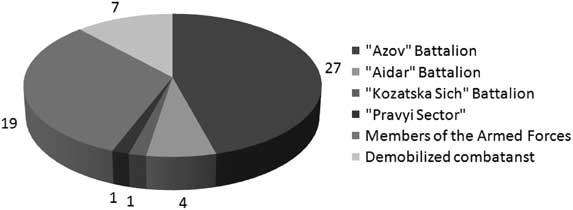
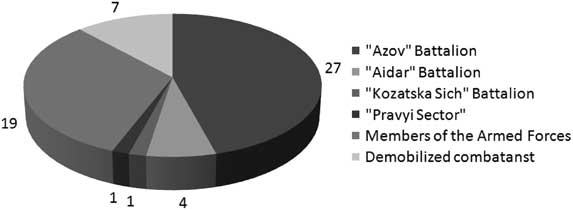
In the period January 2015–May 2016, a random sample (the study group) of 54 ATO combatants (53 men and 1 woman, mean age±SD=30.8±8.2 years) underwent inpatient psychological, neurological, and psychiatric assessment and given care at the Department of Radiation Psychoneurology of the National Research Center for Radiation Medicine of the National Academy of Medical Sciences (NRCRM) in Kyiv. The distribution of soldiers by military unit is depicted in Figure 1. It should be emphasized that almost all surveyed ATO participants were under the constant patronage of volunteers from non-governmental organizations (NGOs). All the examined ATO combatants took part in continuous active fighting (combat exposure range=one month to two years; mean=one year). ATO combatants from the Military Forces of Ukraine were reservists who had served before in the army (USSR or Ukraine). Volunteers (the “Aidar,” “Azov,” “Kozatska,” and “Pravyi” groups) belonged to the Euromaidan movement and were former civilians.
Distribution of ATO combatants (n=54) by military units (the Azo, Aidar, Kozatska, and Pravyi groups were volunteers).
In order to compare the mental state of the ATO combatants with that of other subjects exposed to emergencies, the following groups were employed for comparisons:
■ Group A: individuals exposed in utero and at 0–1 years of age at the time of the Chernobyl disaster (26 April 1986) and a control group of unexposed persons of the same age (n =189 and 139, respectively; mean age±SD=25.5±5.8 years).
■ Group B: cleanup workers from the Chernobyl accident (liquidators, n=81, mean age±SD=55.5±6.6 years) suffering from PTSD and comorbid chronic cerebrovascular pathology.
■ Group C: subjects evacuated from the Chernobyl exclusion zone (n=76, mean age±SD=50.7±8.0 years) suffering from PTSD and comorbid chronic cerebrovascular pathologies.
■ Group D: veterans of the Afghan War (n=28, mean age±SD=47.2±6.3 years) with PTSD following a closed head injury.
Diagnosis of psychiatric, behavioral, and central nervous system (CNS) disorders was carried out according to the criteria of the International Statistical Classification of Diseases and Related Health Problems, 10th revision (ICD–10). 19
The Mini-Mental State Examination (MMSE) was employed to screen for cognitive impairment.Reference Folstein, Folstein and McHugh 20 This scale is the one most often used in modern epidemiological and clinical studies to assess overall mental status and includes several subtests that allow for a quick and effective evaluation of orientation in time, place, and state; short- and long-term memory; language function; gnosis; and praxis (i.e., the basic cognitive functions). Scoring levels for the MMSE were categorized as follows: 28–30=without cognitive deficit (almost healthy); 24–27=mild cognitive impairment; ≤23=dementia.
The following scales were utilized for qualitative and quantitative evaluation of psychopathological symptoms, personality disorders, and psychiatric disorders: (1) the General Health Questionnaire (GHQ–28), which measures somatoform symptoms, anxiety/insomnia, social dysfunction, and severe depression;Reference Goldberg 21 , Reference Goldberg, Gater and Sartorius 22 (2) the Zung Self-Rating Depression Scale (SRDS) for depression;Reference Shafer 23 and (3) PTSD was assessed with the Impact of Events Scale (IES), the Irritability, Depression, Anxiety (IDA) Scale, and the Mississippi Scale for Combat-Related PTSD (M–PTSD). These self-rating scales evaluate the characteristic symptoms of PTSD and are generally used to study psychological distress.Reference Horowitz, Wilner and Alvarez 24 – Reference Loganovsky and Zdanevich 26
Two personality profile analyses—one before ATO participation (retrospectively) and one at the time of the survey—were carried out to investigate possible individual personality changes following combat operations. The questionnaires used for this purpose were the Questionnaire for the Determination of Accentuated PersonalitiesReference Schmieschek 27 and the Eysenck Personality Questionnaire.Reference Eysenck and Eysenck 28 , Reference Loganovsky and Gresko 29
The functional state of the brain was evaluated using quantitative electroencephalography (qEEG), based on topographic mapping with a 16-channel analyzer DX-4000 (Kyiv, Ukraine). Spectral power and visual EEG analyses were also performed. In order to study cerebral hemodynamics, ultrasound duplex scanning of the extracranial parts of the brachiocephalic vessels with cerebral insonation (Willis’ circle) on the front and rear occipital temporal ultrasound window was carried out with the SonoAce 9900 and 8000 apparatus (Medison, Seoul, Korea).
Excel 2010 spreadsheets were employed to structure our database. Statistical analysis was performed by parametric and nonparametric analyses with Statistica software (v. 10.0, StatSoft, San Francisco, California).
Results
A comparison of the ages of the study groups showed that the age of ATO combatants (M±SD=30.8±8.2 years) was higher than that of group A (25.5±5.8 years), but lower than that of groups B (55.5±6.6 years), C (50.7±8.0 years), and D (47.2±6.3 years).
The most frequent complaints of ATO combatants were as follows: permanent diffuse headache, dizziness, tinnitus, hearing loss, back pain along the spine, blurred vision, heart discomfort, poor sleep involving dreams with military themes, anxiety, depressive mood, emotional tension, irritability, confusion, and persistent memories of combat situations.
On neuropsychiatric examination, they were found to have clear consciousness, productive contacts, and full orientation toward time, space, and personality. Their insight was mainly preserved, and their thought process was logical. Their main complaints were emotional lability, anxiety, tension, dyssomnia, psychopathological phenomena, “flashbacks” (retrospection, “looking back,” “reverse shot”), increased irritability, and physiological reactivity. Their language (speech) skills were not impaired.
The most common neurological symptoms were dizziness, dyscoordination, and ataxia, suggestive of cerebellum and brain stem impairment, while the pyramidal and extrapyramidal systems and sensitivity were less involved. In contrast, a marked paravertebral pain on palpation together with muscle-tonic and neuro-reflex syndromes were recorded. Meningeal signs were absent.
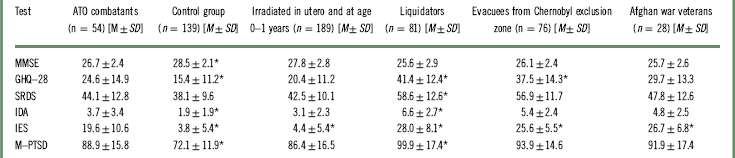
The results of the neuropsychological and psychological tests are presented in Table 1. It is evident that the mental state of combatants was significantly worse than that of control subjects, with more severe manifestations of PTSD, low health self-esteem, somatic concerns, anxiety, sleep–wake cycle disruptions, depression, social dysfunction, and mild cognitive impairment.
Neuropsychological and psycho/pathological examinations in АТО combatants (n=54), control subjects, and comparison groups

ATO=antiterrorism; GHQ–28=General Health Questionnaire–28; IDA=Irritability, Depression, Anxiety Scale; IES=Impact of Events Scale; MMSE=Mini-Mental State Examination; M–PTSD=Mississippi Scale for Combat-Related PTSD; SD=standard deviation; SRDS=Self-Rating Depression Scale.
According to the Bonferroni’s correction, differences were considered to be significant at p<0.001.
*Significantly different compared with the study group (ATO combatants), p<0.001.
ATO combatants tended to have a better mental state than Afghan War veterans or the liquidators and evacuees from the Chernobyl exclusion zone. In particular, they showed a more appropriate emotional perception of the traumatic event. Their mental status was almost similar to that of the comparison group exposed to trauma during early development.
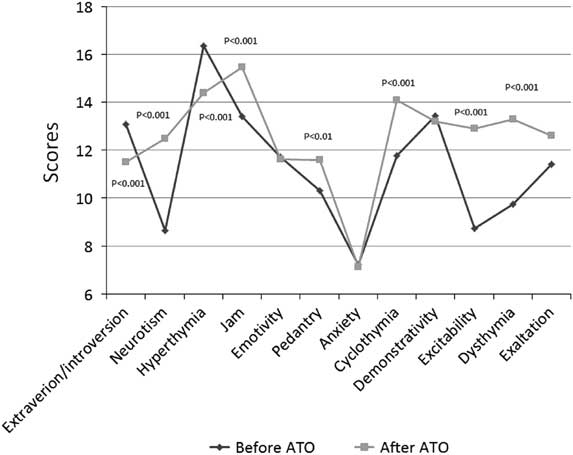
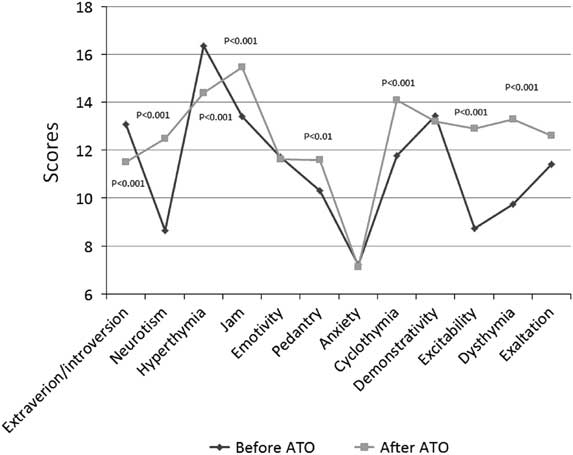
The personality profiles of the study group before ATO participation (assessed retrospectively) and at the time of examination showed marked personality deformations, revealing significantly (p<0.001) reduced extraversion, hyperthymia, increased neuroticism, jams, pedantry, excitability, dysthymia, and cyclothymia (see Figure 2).
Profiles of personality before and after ATO participation.
Significant changes in cerebral brain activity, probably organic in nature, with bilateral paroxysmal activity, and increased spectral power in the beta range and decreased in the alpha range as revealed by qEEG, were detected only in ATO combatants.
Ultrasonic duplex scanning of the extracranial parts of the brachiocephalic vessels showed a thickening of the intima media in ATO combatants older than 50 years, while patients with commotio cerebri were characterized by venous dyshemia in the basal veins of Rosenthal.
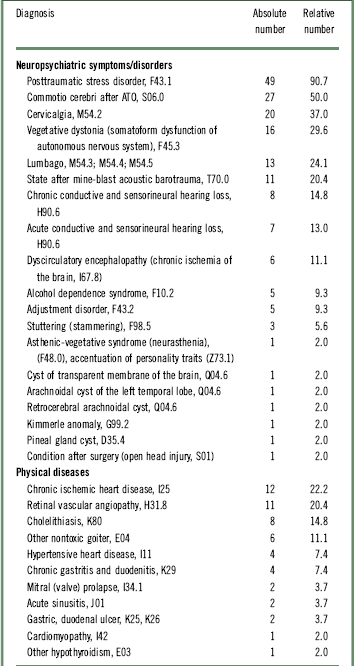
The results of our clinical diagnoses of the study group are presented in Table 2. The main diagnoses were PTSD (91%) and commotio cerebri (50%). Also common were cervicalgia and lumbago, somatoform dysfunction of the autonomic nervous system, consequences of acoustic barotrauma, and conductive and sensorineural hearing loss. Several combatants suffered from comorbid somatic disorders. The syndrome of alcohol dependence was found in a small number of patients, mainly those from the armed forces (15%).
Clinical diagnoses according to the ICD–10 criteria in ATO combatants (n=54)

Patients may show more than one diagnosis (all suffered from about four neuropsychiatric plus one physical diagnoses).
ATO=antiterrorism; ICD–10=International Statistical Classification of Diseases and Related Health Problems, 10th revision.
The empirical treatment of ATO combatants was based on pharmacotherapy, including antidepressants (sertraline, escitalopram, amitriptyline, S-adenosyl-methionine); benzodiazepine (gidazepam) and non-benzodiazepine tranquilizers (hydroxyzine, aphobazolum, phenybutum); neuroprotective and vasoactive drugs (nicergoline, citicolinum, cortexin, cerebrolysin, actovegin, cavinton); and antiinflammatory and analgesic drugs (e.g., ibuprofen, diclophenac). Individual psychotherapy, eye movement desensitization and reprocessing, Erickson’s therapy with hypnotic effect, neurolinguistic programming with training of control over one’s emotional state, cognitive behavioral therapy, and/or positive psychotherapy were employed in combination with pharmacological treatments.
Discussion and Conclusions
The aim of our study was to assess the psychological and neuropsychiatric characteristics of 54 ATO combatants and to compare them with other subject groups: individuals exposed in utero at the time of the Chernobyl disaster; Chernobyl cleanup workers suffering from PTSD and comorbid chronic cerebrovascular pathology; subjects evacuated from the Chernobyl exclusion zone suffering from PTSD and comorbid chronic cerebrovascular pathology; and veterans of the Afghan War with PTSD following a closed head injury. Our results demonstrated that ATO combatants were characterized by low health self-estimation, somatic concerns, a high prevalence of PTSD, anxiety, insomnia, depression, social dysfunction, mild cognitive impairment, and neurological soft signs. In these respects, ATO combatants were quite similar to both the individuals involved in the Chernobyl disaster and the Afghan War veterans. Cervicalgia and lumbago, somatoform dysfunction of the autonomic nervous system, the consequences of acoustic barotrauma, and conductive and sensorineural hearing loss were also common.
Quantitative EEG showed abnormalities suggestive of irritation of the corticolimbic system and diencephalic structures. Ultrasonic duplex scanning of extracranial parts of the brachiocephalic vessels showed intima media thickening among ATO combatants older than 50 years of age and venous dyshemia in the basal veins of Rosenthal in patients with commotio cerebri.
Interestingly, personality changes were recorded retrospectively before as well as after armed conflict—in particular, while ATO combatants before the conflict showed extraversion and hyperthymia, upon returning home they demonstrated increased neuroticism, jams, pedantry, excitability, dysthymia, and cyclothymia.
The care of ATO combatants was based on a comprehensive approach including pharmacological/psychopharmacological drugs and different psychological techniques and psychotherapies. Although ours is an ongoing study, the preliminary data would suggest that this approach might be clinically very effective (data not shown).
The armed conflict in the Donbass is characterized by specific geopolitical and sociopsychological features. (1) It is a hybrid war within one nation state, the Ukraine, which provokes the ethnocultural and sociopsychological characteristics of the “Donbass syndrome,” with predominant severe social frustration and destruction of old relationships. (2) There are different kinds of populations involved in the conflict (ATO combatants, internal refugees and migrants, inhabitants of the occupied territories). (3) In the area where the antiterrorism campaign is being conducted (the temporarily occupied territories of the Donbass), there are many dangerous radioactive objects that could be used in terrorist attacks or, as a result of the fighting, present the danger of accidents caused by improper use and faulty maintenance. (4) There are many pregnant women and children who are among the groups of internally displaced persons and residents of the occupied territories. The armed conflict undoubtedly negatively affects the psychological and physical development of children.
The scope and affected populations of the armed conflict in the Donbass are more similar to those of the victims of the Chernobyl disaster and its aftermath than to other local military conflicts. It would certainly be worthwhile to try to overcome the medical and social consequences of the Donbass crisis based on our 30 years of experience with the consequences of the Chernobyl disaster and the related development by the NRCRM of systematic measures for mental healthcare following radiation accidents at nuclear reactors, radiological terrorist attacks using a radiological dispersive device (“dirty bomb”), or the use of tactical nuclear weapons.Reference Loganovsky, Bomko and Chumak 30 – Reference Loganovsky, Petrychenko and Morozov 32
As emphasized almost 25 years ago,Reference Niagu, Noshchenko and Loganovskiĭ 33 the key point in protecting the mental and physical health of those involved in traumatic emergencies is freedom of choice when it comes to risk. The results of our study confirm this opinion. The mental state of the surveyed ATO combatants is better than that of the liquidators and Afghan War veterans. Of course, much more time has passed since the Chernobyl disaster and the war in Afghanistan, compared to the trauma suffered by our ATO veterans. However, it should be underlined that most of the surveyed ATO participants were members of volunteer battalions. Therefore, the better mental state of the ATO combatants could be reasonably explained by their conscious and voluntary choice to accept the risks of war. In addition, volunteers from NGOs are likely to also play a significant role in supporting and maintaining the mental health of ATO combatants.
The present research is just a pilot study. However, combining the results of several decades of experience in facing and overcoming the health and social consequences of the Chernobyl disaster and our many years of neuropsychiatric research with war veterans, we feel confident in endorsing our scientific and organizational approaches to mental healthcare for ATO combatants, refugees, and migrants from the Donbass, which perhaps could be useful in other current conflicts.
The following guidelines are suggested:
1. Voluntary participation and awareness of risk should be required for engagement in hostilities.
2. Accurate and stringent professional selection of special contingents (military and other security forces, rescue workers) based on stability of mental activity, a sthenic personality, and resistance to stress.
3. An adequate information policy: true, meaningful, and timely coverage of the current situation by the media (as well as online sources).
4. Panic prevention, detection, and isolation of elements that induce panic.
5. Formation of psychological and psychiatric teams with special skills. Crews are now working closely with ATO headquarters, local authorities, and health services (e.g., ambulance corps, specialized mental health facilities).
6. Preventive, sanitary, and educational work concerning risk management of mental disorders, especially regarding the harm of psychoactive substance use in emergencies.
7. Permanent active monitoring of the mental health of soldiers and settlers for early detection of mental and behavioral disorders and provision of evacuation.
8. Use of the maximal approach (“as close as possible”) of psychological and psychiatric care in the theater of military operations and among immigrants.
9. An awareness that there is an increased risk of mental/behavioral disorders in those who need the most attention: the chronically mentally ill, the elderly and very elderly, children, and (especially pregnant) women.
10. Active engagement of religious and community organizations, volunteers, and local communities in providing psychological and psychiatric care.
11. Creation of a network of crisis and psychological rehabilitation centers and unification of the interdepartmental psychological/psychiatric areas.
12. Creation of special scientific and practical departments for emergency psychological and psychiatric care (emergency centers), as well as neuropsychiatric and mental rehabilitation centers within the structure of multidisciplinary hospitals/research centers and institutions.
13. Spa treatment and mental rehabilitation.
Implementation of the proposed approaches would constitute a significant and concrete step toward adequate mental healthcare for ATO combatants, refugees, and migrants from the Donbass, thus strengthening the capabilities and security of the Ukraine, and perhaps those of other conflict areas.
Disclosures
Konstantin Loganovsky, Natalia Zdanevich, Marina Gresko, Donatella Marazziti, and Tatiana Loganovskaja hereby declare that they do not have anything to disclose.