Since Quine (Reference Quine1960), many developmental psychologists as well as linguists have investigated the kind(s) of mechanisms children adopt in the task of word learning. The goal is to reconcile the huge gap between the inherent complexity of what children need to acquire and their ease and speed of acquisition. In particular, the task of verb learning has attracted considerable attention because it involves a complex association between a verb and various argument and event structures, as well as speakers' perspectives (Naigles, Reference Naigles1990). One widely studied strategy children are said to follow in verb learning was first developed by Gleitman and her colleagues (Reference Gleitman1990; Fisher, Hall, Rakowitz & Gleitman, Reference Fisher, Hall, Rakowitz and Gleitman1994; Landau & Gleitman, Reference Landau and Gleitman1985); namely, Syntactic Bootstrapping. That is, children have been proposed to use syntactic frames as guides to the meanings of verbs because the frames narrow down the set of possible interpretations. For example, in English, many verbs with a causative meaning appear in transitive frames (You broke the truck) whereas many non-causative motion verbs appear in intransitive frames (She is coming/walking/running). Research has demonstrated that English learners choose different meanings for novel verbs depending on whether they hear them in transitive or intransitive frames (e.g. Naigles, Reference Naigles1990; Fisher, Reference Fisher1996).
An obvious question about the Syntactic Bootstrapping hypothesis concerns its universality across languages. In particular, some researchers have suggested that children who are acquiring so-called argument-drop languages, such as Japanese or Hindi, might rely on cues for verb learning that are not necessarily syntactic (e.g. Rispoli, Reference Rispoli1987; Reference Rispoli, Tomasello and Merriman1995; Goldberg, Reference Goldberg2004; Narasimhan, Budwig & Murty, Reference Narasimhan, Budwig and Murty2005; Bowerman & Brown, Reference Bowerman and Brown2007). Rispoli (Reference Rispoli1987) has argued that Japanese children group action verbs using semantic specifications, and Narasimhan et al., (Reference Narasimhan, Budwig and Murty2005) have suggested that Hindi child learners construct their verb argument structures based on discourse–pragmatic constraints on argument realization. This article asks whether Japanese children can use morphosyntactic information to learn the meanings of novel verbs in an experimental setting where no pragmatic and semantic cues are available.
Japanese argument structure: case marking, word order, ellipsis
Japanese can be characterized as a nominative−accusative head final (SOV) language that allows pervasive argument ellipsis (Shibatani, Reference Shibatani1990). Case markers may be considered the primary means of indicating argument structure; in what follows, we consider only those markers that apply to subjects and direct objects. Barring some exceptional cases, subject NPs are followed by a post-position (ga)Footnote 1 and object NPs are followed by another post-position (o in neutral, non-predicational contexts; Kuno, Reference Kuno1972; Kuroda, Reference Kuroda1979; Shibatani, Reference Shibatani, Aikhenvald, Dixon and Onishi2001; Takezawa, Reference Takezawa1987). A basic textbook example of Japanese is given in (1):
(1) John-ga Mary-o osi-ta.John-nom Mary-acc push-past‘John pushed Mary.’
Case markers have a close relationship with thematic roles. In accordance with UTAH (Uniformity of Theta Assignment Hypothesis; Baker, Reference Baker1988), John in (1) with nominative case is assigned an agent theta role and Mary with accusative case is assigned a patient theta role (see also Fillmore, Reference Fillmore, Bach and Harms1968). The verb osita ‘push’ inherently has a causative interpretation, with John as an agent and Mary as a patient of the pushing event. Japanese is classified as a nominative–accusative language because the case markers reflect the grammatical functions of subject-hood and object-hood rather than theta relations, as illustrated in (2):
- (2)
a. Netu-ga koori-o tokasi-ta.Heat-nom ice-acc melt-past‘Heat melted ice.’
b. Koori-ga toketa.Ice-nom melt-past‘Ice melted.’
Notice that koori ‘ice’ receives a theme role in both (2a) and (2b); however, it is followed by an accusative marker (o) in (2a) and ga in (2b).
There are, however, some exceptions to this overall pattern. Specifically, in colloquial Japanese speech, case markers (especially the accusative o) tend to get omitted (Fukuda, Reference Fukuda1993; Kuno, Reference Kuno1972; Saito, Reference Saito1985; Takezawa, Reference Takezawa1987). Moreover, pragmatic contexts and the verb semantics can influence the choice of case markers. That is, Japanese uses different particles for a subject NP in order to disambiguate the multiple interpretations supported by a single English sentence, such as (3):
(3) John kissed Mary.
According to Kuno (Reference Kuno1972), (3) has at least following four interpretations:
- (4)
i. Theme interpretation: ‘Speaking of John, he kissed Mary.’
ii. Contrastive interpretation: ‘John kissed Mary but Bill did not.’
iii. Exhaustive listing interpretation: ‘John (and only John) kissed Mary.’
iv. Neutral description: ‘What happened next?’ ‘John kissed Mary.’
Kuno argues that the particle wa is used to mark John in (4i) and (4ii), and ga is used to mark John in (4iii) and (4iv). Finally, ga replaces o in stative constructions, as shown in (5) (Kuno, Reference Kuno1972; Rispoli, Reference Rispoli1991; Takezawa, Reference Takezawa1987):
- (5)
a. [+stative] Hanako-ga aisukuriimu-ga sukida. Hanako-nom ice cream-nom like-pres ‘Hanako likes ice cream.’
b. [−stative] Hanako-ga aisukuriimu-o taberu. Hanako-nom ice cream-acc eat-pres ‘Hanako eats ice cream.’
Although Japanese has been considered non-configurational (i.e. without any fixed word order; Hale, Reference Hale1980; Farmer, Reference Farmer1980), Hoji (Reference Hoji1985) and Saito (Reference Saito1985) have argued that the basic word order of Japanese is SOV (see (1)), based on the fact that some movements of arguments do cause violations. Having said that, Japanese does allow a few other word orders, including OSV (a ‘scrambled’ order), and OV,S and SV,O, which are called extrapositional. These orders are allowed only when discourse–pragmatic constraints (DuBois, Reference DuBois1987) are met and when they satisfy constrains on movement such as island effects (Ross, Reference Ross, Binnick, Davison, Green and Morgan1969). Finally, constructions such as OV and SV are also possible in Japanese. This is because argument NPs can be omitted if they are easily recoverable from the context (DuBois, Reference DuBois1987; Kuroda, Reference Kuroda1979; Rispoli, Reference Rispoli1989; Shibamoto, Reference Shibamoto1985), as in (6):
- (6)
a. Usagi-san-ga ishi-o hirot-tabunny-nom stone-acc pick.up-past‘The bunny picked up a stone.’
b. Usagi-san-ga hirot-tabunny-nom pick.up-past‘The bunny picked up (the thing).’
c. Usagi-san-ga warat-ta.bunny-nom laugh-past‘The bunny laughed.’
Example (6a) is transitive with both subject and object overt; (6b) is a grammatical variant of (6a) with an elided object. Note that (6b) has the same surface form, namely SV, as (6c).
Manifestations of Japanese structure in language use
Research on Japanese language use has found that both nominative and accusative case markers are omitted in both adult-directed and child-directed Japanese. Analyzing a small sample of several hundred utterances, Rispoli (Reference Rispoli1989; Reference Rispoli, Tomasello and Merriman1995) observed caregivers omitting ga over 80% of the time, and o around 87% of the time. NP ellipsis has also been found to be common in colloquial speech. Rispoli (Reference Rispoli1989) reported (based on Shibamoto, Reference Shibamoto1985) that utterances such as (6b) are very frequent in Japanese speech between adults, comprising 56% of utterances containing transitive verbs. Moreover, transitive verbs in this dataset occurred with both arguments only 13% of the time. To our knowledge, there are no published reports of the frequency of the different word orders in colloquial Japanese.
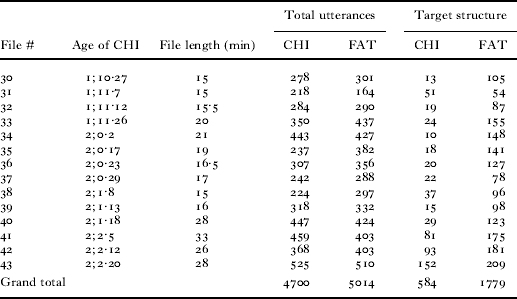
Because these observations were based on small datasets, we next analyzed a larger corpus of child-directed Japanese, to ascertain how often arguments and case markers are omitted in natural interaction, and to investigate the frequency of use of different word orders. We chose to analyze the paternal utterances in the Jun corpus from the CHILDES database (Ishii, Reference Ishii1999; MacWhinney, Reference MacWhinney2000) because both transcriptions and audio and video files were available, and because it was the most recent, and densest corpus that covered the age range we were interested in. We coded and analyzed the corpus from when Jun was 1 ; 10·27 to 2 ; 2·20 because children's first case markers usually appear between 1 ; 6 and 2 ; 0 (Okubo, Reference Okubo1967). During this period, Jun and his father were recorded four times a month and in the thirteen files we analyzed, there were 9,717 lines of father–child conversation (see ‘Appendix’).
We hand-coded and analyzed the utterances that included either a verb (either transitive or intransitive) or a predicate adjective, excluding any repetition sentences. Predicate adjectives were included in our analysis because diachronically they used to be a verb and because they involve structural case marking as shown in (5) (Nishiyama, Reference Nishiyama1999). This resulted in a total of 1,779 utterances by the father. We further coded these utterances for the types of verbs, adjectives and word orders, whether an argument was realized or dropped, and whether a case marker was supplied or not. Moreover, the utterances were coded for whether an argument was first, second or third person, and whether an argument was introduced into discourse for the first time (new) or it was mentioned in the previous twenty clauses (old). We followed the criteria used by Du Bois (Reference DuBois1987) and Guerriero, Oshima-Takane and Kuriyama (Reference Guerriero, Oshima-Takane and Kuriyama2006) in order to differentiate argument drop from Topic drop. Following Kuno (Reference Kuno1972), we assumed that topic noun phrases marked with wa are theme phrases that are already introduced into the discourse and that refer to old information. On the other hand, noun phrases marked with ga are newly introduced into the discourse.Footnote 2 This information status (new and given) was coded only for the third person noun phrases − lexical nouns such as ‘a cat’ or people's names such as ‘Mother’, but not for the first and second person, which are by definition always given information.
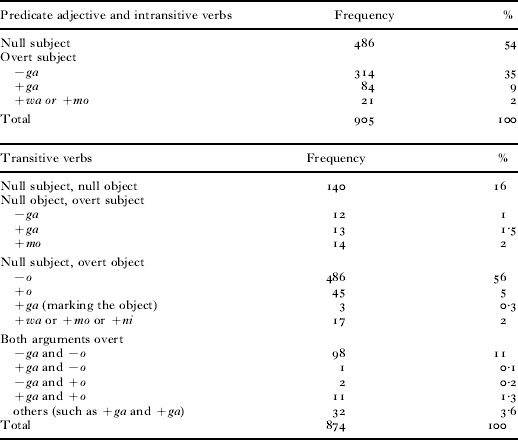
The findings in Table 1 verify and extend the pattern reported in Rispoli (Reference Rispoli1991) in that arguments and case markers were often omitted in parental utterances. Utterances with an intransitive verb or predicate adjective appeared with null subjects 54% of the time. Utterances with a transitive verb appeared with null subjects 82% of the time (‘Null subject, null object’+‘Null subject, overt object’), and with null objects 22% of the time (‘Null subject, null object’+‘Null object, overt subject’). Utterances with a transitive verb appeared with both overt subject and object just over 13% of the time. In the utterances with at least one overt argument, case marker drop was pervasive. Combining the data from utterances with the intransitive and transitive frames, subjects appeared with ga just over 3% of the time, while objects appeared with o just over 6% of the time. Focusing on transitive sentences, overt case marking of both the subject and the object constituted only 1%.
Frequency of subject, object NPs and case marking by Jun's father
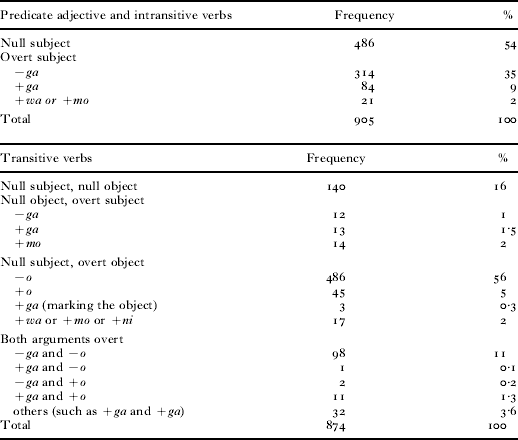
notes: ‘+’ indicates utterances where an overt case marker was used with the realized argument, and ‘−’ indicates utterances where a case marker was omitted for the realized argument. The case markers can be given the following gloss: ga, nominative; wa, topic; mo, ‘also’; o, accusative; ni, dative.
As discussed above, Japanese allows a few different word orders depending on background contexts such as focus and topic. Out of 144 input utterances produced with two arguments, there were 96 instances of SOV (67%), 45 instances of post position (OV,S and SV,O) (31·2%) and three instances of scrambling (OSV) (2%). Among the sentences where either a subject or an object was realized (590 utterances), post position (V,O or V,S) was evident only in 3% of the father's utterances. Thus, while post position is much more common than scrambling, the dominant word order in these child–caregiver interactions was the canonical SOV order for sentences with two arguments and either SV or OV order for sentences with one argument.
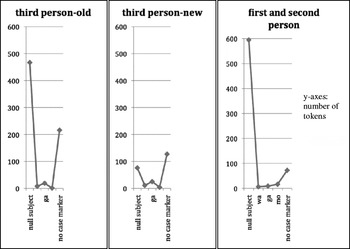
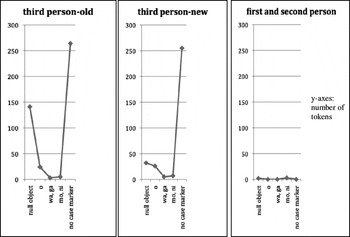
The frequencies of null arguments and lexical arguments (with and without case markers) in Jun's father's utterances are shown in Figure 1 (subject arguments) and Figure 2 (object arguments). Figure 1 reveals two main factors influencing subject omission. First, adults overwhelmingly omit subjects in contexts where the subject has already been mentioned in the preceding discourse. Second, a case marker was omitted much more often in contexts of given information than in new information contexts (see also Guerrieo et al., Reference Guerriero, Oshima-Takane and Kuriyama2006). Because the case marker omitted in contexts of given information tends to be wa and the case marker present in new information is ga, this goes well with the observation in Takezawa (Reference Takezawa1987) that topic-marker drop is much more common than case-marker drop (see also footnote 2). In the case of object omission (Figure 2), Jun's father used more lexical object arguments for new information than for given information. In comparison to subjects, there were many more instances of case-marker omissions with object arguments (see also Morikawa, Reference Morikawa1989), irrespective of their referential status.
Frequencies of null subject, lexical (case-marked and non-case marked) subject arguments referring to third person new information, third person old information and first and second persons (the lexical subjects referring to the first and second persons were all pronouns).

Frequencies of null object, lexical (case-marked and non-case marked) object arguments referring to third person new information, third person old information and first and second persons (the lexical objects referring to the first and second persons were all pronouns).

Argument structure acquisition in children learning Japanese and other case-marked languages
How might these characteristics of Japanese argument structure influence their acquisition by young children? The complexities of the Japanese case system (including dropped accusative o, using wa instead of ga or o, using ga instead of o for the objects of stative verbs) are likely to introduce challenges in mapping the markers onto thematic and syntactic roles. First, scarcity in the input simply provides fewer instances to observe and so acquire the markers. Second, variation in marker use that is governed by pragmatics (i.e. wa for ga) or verb class (i.e. ga for o) requires that children be sensitive to the semantics and pragmatics of language use. If pragmatic and subtle semantic knowledge is needed to master the nominative and accusative case markers, it seems unlikely that these would be acquired early and so used to facilitate early verb acquisition.
Previous research on Japanese child language acquisition has largely borne out these predictions. Nominative and accusative case markers first emerge in spontaneous speech between ages of 1 ; 6 and 2 ; 0; however, errors are observed as late as 2 ; 6 (Clancy, Reference Clancy and Slobin1985; Morikawa, Reference Morikawa1989; Yokoyama, Reference Yokoyama, Kobayashi and Sasaki1997). In Jun's case, his first use of an accusative case marker was observed when he was 2 ; 0. He did not use a nominative case marker at all in the files that were coded, although the use of a topic marker was occasionally observed. As far as we could see, there were no errors in the use of case markers.
In an experimental study, Suzuki (Reference Suzuki2000) tried to elicit case markers from Japanese children between the ages of 3 ; 0 and 6 ; 1. Interestingly, whereas these children made only a few mistakes with the nominative ga, their error rate rose to 38% with the accusative o. These findings are somewhat at odds with the input data we analyzed earlier, in which o appeared twice as frequently as ga (see Table 1). Moreover, it is perhaps remarkable that children acquire at least some aspects of case marking so early. For example, the absolute frequencies of both were quite low in the input data we analyzed (see Table 1: only 3% of utterances included ga and only 6·5% included o; see also similar findings in Rispoli, Reference Rispoli1991).
Given such spare case marker use in the input, it is perhaps not surprising that young Japanese learners are reported to interpret the thematic structure of a transitive sentence using the argument order rather than case markers. Hakuta (Reference Hakuta1982) asked children aged between 2 ; 6 and 5 ; 6 to enact sentences in SOV and OSV orders, and found that they usually followed SOV order, ignoring case markers that indicated the first NP was the patient or theme. Both Suzuki's (Reference Suzuki2000) and Hakuta's (Reference Hakuta1982) findings are consistent with the observation that young children adopt a ‘1st NP=agent’ strategy (Bever, Reference Bever and Hayes1970). However, such a strategy could result in ambiguities when children are faced with a sentence with a novel verb and only one overt argument, because this may refer to the agent of a causative action, as in (6b) or to the actor of a non-causative action, as in (2b) or (6c).
In sum, the extant evidence from Japanese child learners would yield the prediction that if they were to use grammatical forms to learn about verb meanings, they should be more likely to use syntactic frames (i.e. the number of arguments) than case markers (i.e. the presence/absence of the accusative o). However, recent findings from other case-marked languages may cause us to reconsider this prediction. For example, Dittmar, Abbot-Smith, Lieven and Tomasello (Reference Dittmar, Abbot-Smith, Lieven and Tomasello2008) showed that German-speaking two-year-olds could correctly identify the agent and the patient of a sentence with a novel transitive verb when the verb was presented in a sentence frame in which both case marking and canonical word order provided information about the thematic roles of the two noun phrases. This finding is striking because the children's performance was at chance when the sentence frame contained only one of the two cues. They argued that two-year-olds benefit especially from prototypical sentences with multiple converging cues. That is, the combination of the cues had a superadditive effect. Therefore, when combined with other cues, case markers may still play a crucial role in children's inference of the meaning of a novel verb (see also Göksun et al., Reference Göksun, Küntay and Naigles2008).
No studies have directly investigated the role of argument number in Japanese learners' comprehension of the transitive/intransitive distinction; however, recent findings from two other languages that also allow NP ellipsis suggest that children learning these languages are sensitive to the number of arguments verbs take and to the different meanings that arise in different syntactic frames. Göksun et al. (Reference Göksun, Küntay and Naigles2008) and Lee and Naigles (Reference Lee and Naigles2008) have argued that Turkish- and Mandarin Chinese-learning children as young as two years old do make use of the number of arguments to infer verbs' meanings. Lee and Naigles (Reference Lee and Naigles2008) asked Mandarin Chinese-speaking two-year-olds to act out an event described by familiar intransitive and transitive verbs (such as ‘go’ and ‘push’) with one or two overt arguments. The nature of the enactments indicated that children associated a causative meaning with two-argument sentences (e.g. ‘the pig goes the lion’ was enacted as ‘the pig makes the lion go’) and a non-causative meaning with one-argument sentences (e.g. ‘the pig pushed’ was enacted as ‘the pig moved’). Using the same methodology with Turkish children, Göksun et al. (Reference Göksun, Küntay and Naigles2008) found similar results; moreover, the presence of accusative case markers independently directed children towards causative interpretations. These studies have demonstrated that young children can use the number of arguments to extend the meaning of familiar verbs; however, no published studies have yet investigated whether children learning argument-drop languages can use the number of arguments to infer the meaning of novel verbs, encountered for the first time.
Aims of this research
Despite the absence of clear syntactic frame and case marker contrasts in their input, Japanese children do not have any apparent problems or delays in verb learning (Clancy, Reference Clancy and Slobin1985; Rispoli, Reference Rispoli1987). One possibility is that, as Rispoli (Reference Rispoli1987) and Narasimhan et al. (Reference Narasimhan, Budwig and Murty2005) have suggested, Japanese learners rely heavily on discourse–pragmatic cues in verb learning (but see Guerrioro et al., Reference Guerriero, Oshima-Takane and Kuriyama2006). However, the aim of this article is to investigate whether Japanese children might also be able to use syntactic and morphological cues − verb frames and case markers – in learning novel verbs.Footnote 3
This study is based on Naigles (Reference Naigles1990), who presented two-year-olds with novel verbs in either transitive or intransitive syntactic frames, as in (7) and (8):
(7) The bunny and the duck are gorping. (intransitive)
(8) The bunny is gorping the duck. (transitive)
Naigles found that English-speaking children aged 2 ; 1 were able to use such information to infer verbs' meanings. The current study investigated whether Japanese-speaking children aged 2 ; 4 could use similar syntactic cues to assign causal vs. non-causal meaning to novel verbs. We have two research questions: (i) do Japanese children prefer the causative action in the transitive condition and the non-causative action in the intransitive condition? And (ii) do Japanese children infer the meaning of a novel verb better when case markers provide a converging cue, with argument number, to the verb meaning?
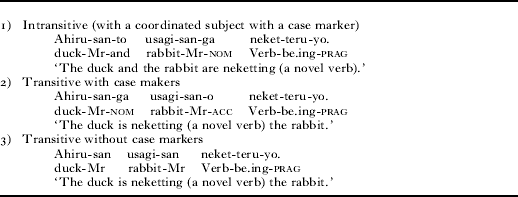
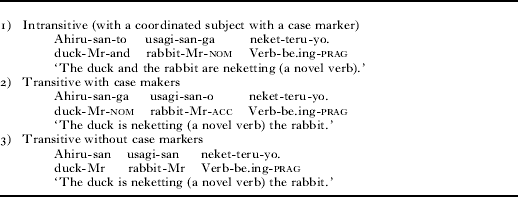
To answer these questions, we carried out an Intermodal Preferential Looking experiment equivalent to Naigles (Reference Naigles1990) . We introduced novel verbs in three types of morphosyntactic frames: the intransitive frame with case markers, the transitive frame with case markers, and the transitive frame without case markers, and tested whether children mapped these onto causative vs. non-causative actions. The experiment consisted of three phases: a learning phase, a control trial, and two test trials. In the learning phase, a novel verb was introduced in a certain sentence frame along with a ‘double-action’ scene, in which two characters performed two possible referent actions simultaneously, one causative and one non-causative. In the control trial, each of the two actions was presented separately in side-by-side scenes, and the audio (without using the novel verb) prompted the child to pay attention to the scenes. In the test trials, the same video as the control trials was presented and the audio prompted the child to look at the referent of the novel verb.
The stimulus sentences in this study had the simplest construction, with no omissions or moved arguments; they followed the pattern of (1). Although the presence of input involving the above-mentioned exceptional cases might delay children's acquisition of the case marking system, the neutral frame with nominative–accusative case marking and agent–patient thematic hierarchy is likely to be one of the first patterns for young children to learn. All transitive test sentences thus included two NPs (subject and object) in the canonical order (SOV). If children inferred different meanings for the novel verb depending on the sentence frame in which the verb was presented, children in different conditions should look preferentially at different scenes during the test trials. In particular, children hearing verbs in the transitive frames (both with and without case markers) should look at the causative action whereas children hearing verbs in the intransitive frame should look at the non-causative action. Furthermore, the child should look at the preferred scene more in the test trials than in the control trials if the causative or non-causative meaning is attributed to the verb.
METHOD
Participants
Ninety-five Japanese children formed the final participant pool; one additional child participated but was not included in this pool because he looked more than 80% to one side throughout. The children's average age was 2 ; 4 (SD=0 ; 2); they were recruited from public nurseries in Chiba prefecture in Japan during the summers of 2006 and 2007. Official approval was granted from the education department of the local council as well as the public nurseries themselves. In total, twenty-two nurseries took part in the study; however, the children from two nurseries were excluded from the final analysis because the environment where the experiment took place was too noisy and the children were distracted. The children were assigned randomly to one of three audio conditions (Table 2): intransitive (n=34; 17 boys; mean age=2 ; 4, SD=0 ; 2), transitive-with-case-markers (n=33; 17 boys; mean age=2 ; 4, SD=0 ; 2) and transitive-without-case-markers (n=28; 12 boys; mean age=2 ; 4, SD=0 ; 3). No standardized test scores were available for these children, but the nurseries reported all to be developing normally.
Sentence frames used during the learning phase in the three conditions in the verb learning task (examples with the novel verb, nekeru)
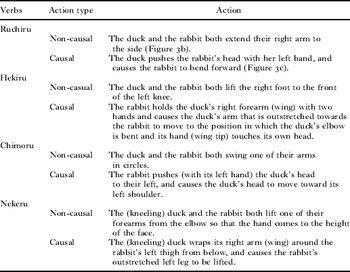
The four non-causal and causal actions used in the test trials

note: The two animals were positioned side-by-side, facing the participants. They were standing unless otherwise specified.
Stimuli
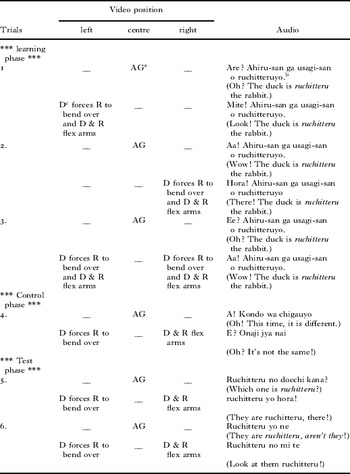
The video stimuli were identical to those in Naigles (Reference Naigles1990) . The videos began with a sequence that familiarized the children with the two characters (a duck and a rabbit). The experimental phase consisted of three parts: the learning phase, the control trial, and the two test trials (see Table 4). For each of the four verbs, these three parts were repeated. The audio stimuli were Japanese translations of the audio stimuli in Naigles (Reference Naigles1990) with four novel Japanese verbs, nekeru, ruchiru, chimoru and hekiru, and were recorded by a female adult native speaker of standard Japanese in infant-directed speech.
The video layout and audio stimuli for the verb ruchiru in the transitive-with-case-markers condition

a AG stands for an attention getter (a pink flashing light).
b The English translations of the Japanese sentences are shown in parentheses. Ruchiteru is the progressive form of a novel verb ruchiru.
c ‘D’ refers to the duck and ‘R’ refers to the rabbit.
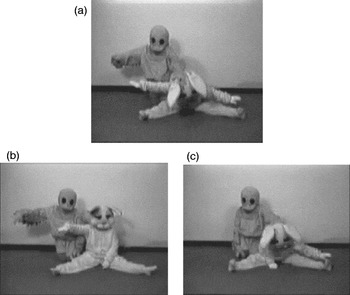
In the learning phase, the two characters engaged in two actions simultaneously (Figure 3a). One of the actions was causal, in which one character caused the other character to repeatedly move in a particular way (e.g. the duck pushed the rabbit's head with her left hand, causing the rabbit to bend forward; see Figure 3c). The other action was non-causal, with both characters repeatedly performing in synchrony (e.g. the duck and the rabbit both extended their right arm to the side; see Figure 3b). Different sets of actions were used for each of the four verbs (see the descriptions of the four causal and non-causal actions in Table 3). The ‘double action scene’ (Figure 3a) was played three times: on the right, on the left, and then simultaneously on the right and the left (Trials 1–3 in Table 4). All video clips (i.e. all trials) lasted six seconds. During this phase, the nonsense verb was presented in one of the three morphosyntactic frames, depending on the condition to which the participant was assigned (see Table 2). By hypothesis, it is during these trials that Syntactic Bootstrapping occurs, as the children would focus their attention on either the causative (if the frame was transitive) or non-causative (if the frame was intransitive) action.
Example of video clips in the stimuli. (a) The two characters simultaneously perform a causative action (the duck pushing the rabbit) and a non-causative action (the rabbit and the duck flexing their extended arms). This was shown in the trials in the learning phase. (b) The characters perform the non-causative action. (c) The characters perform the causative actions. (b) and (c) were presented side-by-side in the trials in the control and test phases.

During the next three trials, the video stimuli were identical. Two video clips (one on the right and the other on the left) were shown simultaneously. One video clip showed only the causal action, and the other video clip showed only the non-causal action. The first pair of these trials served two roles: they familiarized the children with the separated actions and they provided a baseline of which movie attracts more looking when no novel verb was requested. Thus, we consider these trials (Trial 4 in Table 4) to be indicators of stimulus salience at the moment right before we prompted children to look at the referent of the verb in the test phase; that is, they served as comparisons against the test trials that followed.Footnote 4 During these two test trials, the audio asked the children to find the referent action of the novel verb (Trials 5–6 in Table 4). None of these test sentences included the arguments of the verb. Our prediction is that the effect of sentence frame (i.e. from the learning phase) will be seen during the test trials only because that is when the children are directed to find the referent of the novel verb.
The side of the target scenes varied within participants on an L(eft)R(ight)RL or RLLR pattern; half of the participants saw the left-first pattern and half the right-first pattern. The four novel verbs were presented in the following fixed order: ruchiru, hekiru, chimoru, nekeru.
Apparatus and procedure
The set-up for Intermodal Preferential Looking was similar to that used by Swensen, Kelley, Fein and Naigles (Reference Swensen, Kelley, Fein and Naigles2007) . It was a portable set-up with an LCD projector, a screen, a speaker, and an Apple iPod. Using video editing software (Final Cut Pro), we created stimuli as QuickTime movies with the video clips placed on a black background. The QuickTime movies also contained an attention-getter, a flashing light, which illuminated between the action scenes for three seconds, serving to orient the participants' attention to the middle. The QuickTime movie was played on the iPod, from which the video portion was fed to the LCD projector, and the audio portion to the speaker located below the screen in the middle. Each child was seated alone in a corner of a classroom on a chair about 1 metre away from the middle of the screen. A camcorder located in front of the participant recorded his/her face for coding. The session lasted about five minutes.
Coding and analyses
The children were videotaped while watching the videos; their eye movements were coded from the tapes frame by frame. The coders were blind to the specific condition each child participated in because they could not hear the audio that the children had listened to (i.e. the trials were temporally aligned via the visual onset of the speech waveform; the audio itself was not heard). The children's direction and duration of looking was coded for each event during the control trial (Trial 4 in Table 4) and test trials (Trials 5 and 6 in Table 4), measured in hundredths of a second. Trials where the child did not look at the blinking light preceding the trial for a minimum of 0·3 seconds, and where the child had not looked at either screen (once the events appeared) for a minimum of 0·3 seconds, were excluded. A total of 7·5% of the trials were unusable and so excluded (9·2% for the intransitive condition, 6·4% for the transitive-with-case-markers condition, and 6·7% for the transitive-without-case-markers condition); these empty cells were filled with the group mean for that verb in the same condition. Reliability assessments with 10% of the data (all data from ten children) revealed a mean correlation between coders of 0·914, p<0·01.
The dependent measure was the percentage of looking time to the matching scene (compared with the non-matching scene) during the first of the two test trials for each verb. This was compared to the percentage of looking time to the same scene in the familiarization/control trial. The children's looking patterns during the second test trial (Trial 6 in Table 4) were not included in the analyses because preliminary analyses revealed that the children became very distracted during the second test trials. For example, the number of empty cells for the second test trials was more than twice that for the first test trials; consequently, the mean looking percentages were much less reliable for these trials. The use of a single test trial has become common in other reports using Intermodal Preferential Looking with this age group (e.g. Naigles, Bavin & Smith, Reference Naigles, Bavin and Smith2005; Schafer & Plunkett, Reference Schafer and Plunkett1998; Swensen et al., Reference Swensen, Kelley, Fein and Naigles2007).
RESULTS
Our first question concerned whether the children looked longer at the matching screen during the test trials, relative to their preferences during the control trials. That is, did the children in the intransitive condition look longer at the non-causative actions while the children in the transitive-with-case-markers condition and the transitive-without-case-markers condition looked longer at the causative actions? One-tailed tests were used because the prediction was that the children would shift towards the matching screen from control to test trials. We first conducted an omnibus ANOVA (analysis of variance) with five factors: audio condition (3: intransitive, transitive-with-case-markers, transitive-without-case-markers)×counterbalance (2: LRRL vs. RLLR)×gender (2: male vs. female)×verb (4) by trial (2: Control vs. Test). Preliminary analyses revealed no effects or interactions with counterbalance or gender; therefore, these variables were omitted from further analysis. The final 3-factor ANOVA yielded no significant main effects (that is, no effect of audio such that the children in the transitive-without-case-makers condition looked longer overall than those in the intransitive condition); the only significant interaction was of audio condition and trial (F(2, 91)=2·34, p<0·05, partial eta-squared=0·04) (see Figure 4). To explore this interaction, we conducted three planned comparisons in which the children's preferences during the control and test trials were compared for each audio condition.
Mean percentage looking time to the causative screen during the control and test trials for children in the three conditions with different sentence frames: intransitive (with a coordinated subject with a case marker), transitive with case markers, and transitive without case markers. The error bars indicate the standard error of the means.

Children in the transitive-with-case-markers condition shifted significantly towards the matching screen from control to test trials (F(1, 91)=5·64, p=0·018, partial eta-squared=0·10); however, children in neither of the other two conditions significantly shifted their attention between the control and test trials. These analyses were also conducted without replacing the empty cells with the group means (and also, hence, without the Verb factor) with almost identical results. Further scrutiny of the children in the transitive-with-case-markers condition revealed that of the 21 children who shifted towards the matching screen, 15 demonstrated large shifts (more than 5%) and 6 children demonstrated small shifts (1–4·9%). In contrast, only 7 children demonstrated large shifts in the wrong direction (away from the matching screen) and 6 children demonstrated small shifts in the wrong direction. Thus, the modal response in this condition was clearly towards the matching screen. In sum, children who heard the novel verbs in the transitive frame, complete with case markers, reliably mapped those verbs onto the causative action over the non-causative action. Children who heard the novel verbs in the intransitive frame, or in the transitive frame without case markers, showed little evidence of such robust learning when compared to their baseline preferences.
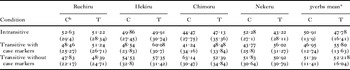
We next examined the children's looking patterns for each verb separately. As shown in Table 5, the children in the intransitive condition and the transitive-with-case-markers condition generally showed little preference for either action during the control trials of each of the four verbs. This pattern can be seen as supporting our interpretation of Trial 4 as a good control: if the transitive training audio, for example, had led the children to focus on the causative action overall, rather than ‘just’ as the referent of the novel verb, then we would have expected to see increasing causative preferences during the control trials of the transitive-with-case-markers condition as the video progressed. However, the children in the transitive-without-case-markers condition did show an unexpectedly strong causative preference during the control trial of the third verb in the sequence, chimoru. We are not sure to what to attribute this preference, but it is unlikely to have resulted from an overall increasing causative preference, because the causative preference during the control trial for the fourth verb was much lower.Footnote 5
Mean (SD) percent looking to the causative screen by verb and trial in the three conditions

a The ‘3verbs mean’ column presents the children's average looking time over the three verbs, ruchiru, hekiru and nekeru, excluding the anomalous verb chimoru.
b C and T stand for control trials and test trials, respectively.
The final columns of Table 5 show the mean percentages if we remove the children's responses to chimoru from the analyses. The new ANOVA (Condition by Trial) again yields only a significant interaction of condition and trial (F(1, 92)=4·34, p=0·04, partial eta-squared=0·045) and the control vs. test comparisons for each condition separately yield significant effects only for the transitive-with-case-markers condition (F(1, 32)=5·72, p=0·023, partial eta-squared=0·152). Moreover, the children in the transitive-with-case-markers condition looked significantly longer at the matching screen than at the non-matching screen during the test trials alone (p=0·01). It is potentially interesting that the transitive-without-case-markers condition included the highest percentage of young toddlers (2 ; 0–2 ; 2, n=11, 39%, compared with 26% in the intransitive condition and 21% in the transitive-with-case-markers condition), and 8 of these 11 displayed causative preferences in excess of 60% during the control trial of chimoru. However, it is also important to point out that no tests for inequality of variance across the three conditions reached significance; moreover, the statistical comparisons were re-conducted with a subset of the dataset in which all children aged 2 ; 0 were omitted (n=1 in the intransitive condition, 2 in the transitive-with-case-markers condition and 5 in the transitive-without-case-markers condition), with almost identical results.
Our final question concerned whether the children in the different audio conditions demonstrated significantly different looking patterns during the control and test trials. That is, was the children's causative preference in the transitive-with-case-markers condition different from that of their peers in the intransitive condition and the transitive-without-case-markers condition? Three two-way ANOVAs (audio×trial) were run (excluding the data from the anomalous verb chimoru); the dependent variable in each was the percentage looking to the causative action during the test trials, collapsed across the three verbs. One-tailed tests were used because the prediction was that the transitive-with-case-markers condition and the transitive-without-case-markers condition would yield more looking to the causative action than the intransitive condition. The first ANOVA, comparing the children in the transitive-with-case-markers condition and the intransitive condition, yielded a significant interaction of audio and trial (F(1, 65)=5·976, p<0·01, partial eta-squared=0·084) and no other significant effects; the post-hoc t-test revealed that the children differed significantly in their looking during the test trial only (t(65)=2·17, p<0·05) (see the two right-most columns in Table 5). The second ANOVA, comparing the children in the transitive-without-case-markers condition and the intransitive condition, yielded no significant effects or interactions. The third ANOVA, comparing the children in the transitive-without-case-markers condition and the transitive-with-case-markers condition, yielded only a significant effect of trial (F(1, 59)=3·385, p<0·05, partial eta-squared=0·054). In sum, the transitive audio with case markers directed significantly more looking towards the causative action than the intransitive audio did. The transitive audio without case markers directed looking towards the causative action numerically (but not significantly) more than the intransitive audio, but less than the transitive audio with case markers.
DISCUSSION
This study investigated whether Japanese two-year-old children could infer the meaning of a novel verb from the morphosyntactic frame in which the verb was introduced. More specifically, we tested whether they could utilize the number of arguments in the sentence to assign a causal vs. non-causal meaning to a novel verb, and whether case markers helped Japanese children in this assignment. Using the Intermodal Preferential Looking paradigm, we found that Japanese two-year-olds did not assign a non-causal meaning to a novel verb when the verb was presented in an intransitive sentence frame. However, our Japanese two-year-olds did assign a causal meaning to a novel verb when the verb was presented in a sentence frame with two arguments with case markers. The children looked significantly longer at the causative action during the test trials than during the control trials in the transitive-with-case-markers condition, but not in the intransitive (with a coordinated subject with a case marker) condition nor the transitive-without-case-markers condition. Moreover, pairwise comparisons of the conditions revealed that children in the transitive-with-case-markers condition looked longer at the causal action during the test trials than their peers in the intransitive condition. However, the transitive-without-case-markers condition did not significantly differ from the transitive-with-case-markers condition or the intransitive condition. Thus, it is not clear exactly how children interpreted novel verbs in the transitive-without-case-markers condition.
These findings demonstrate morphosyntactic bootstrapping with novel verbs by two-year-old children learning a language with general NP ellipsis (i.e. Japanese). Whereas both Göksun et al. (Reference Göksun, Küntay and Naigles2008) and Lee and Naigles (Reference Lee and Naigles2008) showed that Turkish and Mandarin Chinese learners (respectively) interpret verbs presented in a two-argument frame as causative, in those studies the verbs were familiar intransitive ones placed in the ungrammatical transitive frame. This study goes further, demonstrating that children interpret entire novel verbs as causative when heard in a two-argument frame. As shown by our corpus analysis and Rispoli (Reference Rispoli1991), Japanese learners often hear transitive verbs without subject and object arguments; nevertheless, by two years of age they are able to use the link between transitive frames (including case markers) and causative meaning. Thus, this ability develops even when children do not receive input with a very consistent mapping between the number of argument and causal meaning of the verb, as shown by our corpus analysis (see Tables 1, 2 and 3) and by Rispoli (Reference Rispoli1991) .
The fact that only the transitive-with-case-markers condition showed a significant effect on the looking time for causative vs. non-causative events indicates that the presence of case markers on both NPs provides a stronger cue to verb transitivity than the two NPs alone. This may be similar to the superadditive effect of case markers and canonical word order in a study where two-year-old German children inferred agents and patients in sentences with a novel transitive verb (Dittmar et al., Reference Dittmar, Abbot-Smith, Lieven and Tomasello2008). German children succeeded when both cues were present, but not when only one cue was present. Interestingly, Turkish two-year-olds have demonstrated independent effects of argument number and case markers (Göksun et al., Reference Göksun, Küntay and Naigles2008), possibly because case markers are more salient or reliable cues to thematic relations in Turkish, and/or because their task may be have been easier, as it involved interpreting familiar verbs rather than learning novel ones. The Japanese children's sensitivity to case marking in the current study is especially striking as case markers are omitted in a large majority of input utterances (Rispoli, Reference Rispoli1991; see also Table 1). How Japanese children learn enough about case marking from minimal exposure, and use the knowledge in verb learning, are important topics for future studies. Finally, our conclusion on the role of case markers remains tentative as the pairwise comparison of the transitive-with-case-markers condition and the transitive-without-case-markers condition did not yield significant effects of condition.
Children in the transitive-with-case-markers condition behaved differently from those in the intransitive condition, but the intransitive frame did not specifically direct the children towards non-causative meanings. That is, whereas the children in the transitive-with-case-markers condition preferred the causative action, the children in the intransitive condition showed no preference. This may indicate that children know, at some level, that the intransitive frame is inherently ambiguous between intransitive vs. transitive with object omission. Object omission is especially frequent when the information is given (old) in the input (Figure 2). In an ostensive word-learning situation, as in the current experiment, the referents are visually available to the child and the caretaker. This may make it more likely that the child considers the patient to be given information and the object of a transitive frame to be likely to be omitted. This may be part of the explanation as to why the children in the intransitive condition in the current experiment showed no preference. This finding differs from Naigles' (Reference Naigles1990) findings; however, others have also found that the coordinate-subject intransitive frame is a less consistent indicator of non-causative actions for English-learning toddlers (Naigles & Kako, Reference Naigles and Kako1993; Golinkoff, Jacquet, Hirsh-Pasek & Nandakumar, Reference Golinkoff, Jacquet, Hirsh-Pasek and Nandakumar1996). Hirsh-Pasek et al. (Reference Golinkoff, Jacquet, Hirsh-Pasek and Nandakumar1996) reported better performance, though, when children heard intransitive sentences of the form X verbs with Y, and, in future work we also plan to test Japanese-learning children with 1-NP sentences while also manipulating the different case markers.
Conclusion
Our findings show that morphosyntactic bootstrapping facilitates novel verb learning in an argument-drop language. Japanese children inferred a causative meaning to a novel verb when they heard the verb in a two-argument sentence frame with case marking. Inferring a causal meaning of a verb from a two-argument sentence frame – albeit also case-marked in some languages – is thus shown to be a cross-linguistically robust feature of the learning process of two-year-olds, found in both non-argument-drop languages such as English (Naigles, Reference Naigles1990) and argument-drop languages such as Turkish (Göksun et al. Reference Göksun, Küntay and Naigles2008), Chinese (Lee & Naigles, Reference Lee and Naigles2008) and Japanese. Two-year-olds' inferences are, however, modulated also by specific features of the language they are learning: Japanese-speaking children significantly anchored a causal meaning to novel verbs only when case markers and the presence of two NPs provided converging cues to the transitive frame (see also Dittmar et al., Reference Dittmar, Abbot-Smith, Lieven and Tomasello2008). In sum, despite frequent omission of arguments and case markers in Japanese caregivers' speech, Japanese two-year-old children utilized the number of overt arguments and case markers to infer the meaning of a new verb.
APPENDIX
The total number of utterances and utterances including verbs and predicate adjectives (target structure), excluding repetitions by Jun (CHI) and his father (FAT).