Accurate diagnosis of adenoviral conjunctivitis is important for infection control because of the threat of chronic vision impairment and the high transmission rate of the worst presentation, epidemic keratoconjunctivis (EKC), which has forced the closure or near-closure of clinics, hospitals, and long-term care facilities.Reference Hamada, Gotoh, Hara and Iwahashi 1 – Reference Piednoir, Bureau-Chalot, Merle, Gotzmanis, Wulbout and Bajolet 7 Adenoviral conjunctivitis is characterized by bulbar conjunctival injection, excessive tearing, and photophobia. In more severe cases, patients can present with ocular or periorbital pain, and the eyelids may be severely edematous. In the worst infections (EKC), the conjunctiva forms adhesions (“membranes”), and the cornea develops opacities that can lead to chronic visual distortion. Transmission occurs through contact with ocular secretions. The virus is known to persist on fomites for up to 35 days; therefore, infection can spread through contact with instruments like tonometers, lid specula, and slit lamps. In 2011, as a result of a collaborative effort among several departments (ie, Occupational Health, Ophthalmology, Pathology, and Hospital Epidemiology/Infection Control), Johns Hopkins Medicine (JHM) instituted a “red-eye” policy to ensure swift triage, accurate diagnosis, and appropriate work furlough for employees with adenoviral conjunctivitis.Reference Kuo, Espinosa, Forman, Pehar, Maragakis and Valsamakis 8 , Reference Kuo, Espinosa, Michael Forman and Valsamakis 9 This policy was instituted to prevent transmission of this infection and EKC in particular. Under this policy, employees are triaged by the Occupational Health Clinic, and conjunctival swabs of those suspicious for having adenoviral conjunctivitis, are submitted for polymerase chain reaction assay (PCR), which was developed and validated for conjunctival specimens by the Department of Pathology at JHM. No PCR test is commercially available for the detection of adenovirus in conjunctival specimens. Diagnosis by viral culture or by PCR is the gold standard;Reference Thompson and Kowalski 10 however, clinical diagnosis by ophthalmologists may be 50% accurate at best,Reference O’Brien, Jeng, McDonald and Raizman 11 and diagnosis by other professionals is probably even less accurate.
We have continued to monitor outcomes of this policy, a JHM quality improvement initiative, in terms of employees with (1) red eye, (2) PCR-positive adenoviral conjunctivitis, and (3) EKC. Adenoviral typing has been done in EKC outbreaks in Japan,Reference Hamada, Gotoh, Hara and Iwahashi 1 , Reference Hiroi, Morikawa, Takahashi, Komano and Kase 2 where adenoviral conjunctivitis is part of its national infectious disease surveillance. Adenoviral typing has also been done in some outbreaks in the United StatesReference Vastine, West, Yamashiroya, Smith, Saxtan, Gieser and Mufson 3 , Reference Warren, Nelson and Farrar 4 as well as in nonocular infections as part of sporadic, short-term (eg, 2–4 years) epidemiologic tracking.Reference Sriwanna, Chieochansin, Vuthitanachot, Vuthitanachot, Theamboonlers and Poovorawan 12 , Reference Berciaud, Rayne and Kassab 13 One report compared adenoviral types in life-threatening infections in military personnel versus civilians over a 2-year period.Reference Gray, McCarthy and Lebeck 14 Another report documented changes in adenoviral type causing conjunctivitis in the general population over a 10-year period in Glasgow, Scotland.Reference O’Donnell, McCruden and Desselberger 15 To our knowledge, there has been no ongoing epidemiologic tracking of adenoviral conjunctivitis in any specific work environment. Given the history of large EKC outbreaks in hospitals and clinics, tracking in this environment has implications for infection control and patient safety.
Herein, we describe recent findings of the red-eye policy regarding medical center employees with adenoviral conjunctivitis (including those with EKC), patterns of causative adenoviral types, and other findings that may lead to improvements in infection control to prevent outbreaks of adenoviral conjunctivitis.
Materials and methods
The Institutional Review Boards of Johns Hopkins Medicine deemed that publication of an evaluation of this quality improvement initiative did not require approval because it “does not involve human subjects research under the Department of Health and Human Services or Food and Drug Administration regulations.”
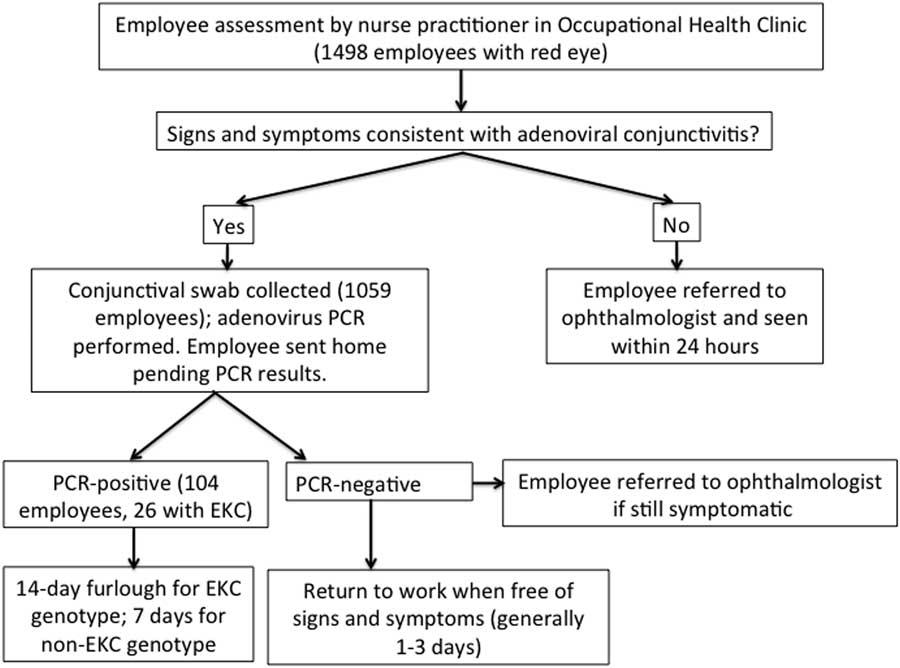
Employees with health concerns arising during work hours that may affect their ability to work report to the Occupational Health Clinic. To limit transmission risk at this clinic, it is recommended that employees call for a same-day evaluation at this clinic as soon as symptoms appear. The red-eye employee practice algorithm, in effect at all times, is shown in Figure 1. For employees with signs and symptoms consistent with adenoviral conjunctivitis, nurse practitioners in the Occupational Health Clinic perform the initial evaluation and swab the conjunctiva for rapid diagnostic testing by a senior medical technologist in the Virology Laboratory using real-time PCR.Reference Kuo, Espinosa, Forman, Pehar, Maragakis and Valsamakis 8 , Reference Kuo, Espinosa, Michael Forman and Valsamakis 9 As described in the pilot study,Reference Kuo, Espinosa, Forman, Pehar, Maragakis and Valsamakis 8 PCR for adenovirus in conjunctival specimens of employees was developed and validated in the Johns Hopkins Hospital Molecular Microbiology Diagnostic Laboratory. The analytical sensitivity (95% detection rate or limit of detection) is 300 copies per milliliter, and the assay detects at least 16 adenovirus serotypes, including strains from 6 of 7 adenovirus serogroups (A–F). When adenovirus was detected, the serotype was determined using nested PCR of the hexon gene hypervariable regions 1–6Reference Lu and Erdman 16 using previously extracted total nucleic acid. The ability to identify serotypes associated with ocular disease (types 8, 19, 37) and other serotypes that commonly cause ocular disease (types 3, 4, 7, 11) was confirmed in-house using acquired strains (American Type Culture Collection, Chantilly, VA).Reference Lu and Erdman 16
Schema of red-eye employee triage system at the Johns Hopkins Hospital with employee totals for the 5-year (60-month) period from November 2011 through October 2016. In all cases, employees are required at the end of their furlough to return to Occupational Health for clearance before return to duty. NOTE. PCR, polymerase chain reaction.

While awaiting the results of PCR, employees are sent home. Employees whose conjunctival samples are PCR positive for adenovirus are furloughed from work.Reference Kuo, Espinosa, Michael Forman and Valsamakis 9 Furlough length depends on the signs and symptoms the employee exhibits and on the adenoviral type in employees whose conjunctival swabs are PCR positive. Tailoring the length of furlough to the diagnostic and clinical details rather than granting a “blanket” 2-week furlough became possible as results of this policy implementation emerged.Reference Kuo, Espinosa, Michael Forman and Valsamakis 9 The PCR-positive employees with adenoviral types not associated with EKC are told they will likely be furloughed 7 days, based on the natural history of most non-EKC, adenoviral conjunctival infections.Reference Kuo, Espinosa, Michael Forman and Valsamakis 9 Employees with conjunctivitis types associated with EKC (types 4, 8,19, 37) are advised that they may be furloughed 14 days or longer, based on the natural history of time to resolution of signs and symptoms in EKC, corroborated by data collected by the nurse practitioners regarding infected employees.
The nurse case manager calls the employee with the result of PCR within a few hours and then makes a follow-up call a few days later with the typing result and implications for length of work furlough. The manager also obtains updates related to eye symptoms and schedules a follow-up examination at the clinic, which is required before return to duty. Persistent signs and symptoms require that the furlough be continued. Regardless of type, employees must return to the Occupational Health Clinic for examination by a nurse practitioner prior to returning to duty.
The nurse practitioners send employees to the Department of Ophthalmology for consultation regarding conditions the staff deem an emergency: symptoms including but not limited to persistent redness, tearing, pain, and blurred vision. The PCR-positive employees who have not improved after 2 weeks or who have unusually severe symptoms are referred to the Department of Ophthalmology, as are those with conditions of which the nurse practitioners are unsure of diagnosis or that require follow-up. Employees with red eye but negative PCR results are seen in the Department of Ophthalmology, by community ophthalmologists, internists, or others, and are given a note regarding return to duty that they take back to the Occupational Health Clinic. Their dispositions and diagnoses are recorded by the staff of the Occupational Health Clinic.
The nurse case manager in the Occupational Health Clinic (author C.E.) recorded data for several items: (1) employee’s signs, symptoms, and duration; (2) employee’s diagnosis if not adenoviral conjunctivitis; (3) PCR results if PCR was performed; (4) adenoviral type when PCR positive; (5) length of furlough if given; and (6) work location. Employees were categorized into 30 work areas. Work responsibilities ranged from direct patient contact to nonclinical responsibilities in patient-care areas (eg, Security, Environmental Services, Food Service) to (nonclinical) responsibilities in non–patient-care areas (eg, Medical Records and Claims, Patient Access Management). The 60 months between November 2011 (ie, the month the policy was instituted) and October 2016 were divided into five 12-month periods to account for possible annual variation in infection risk or adenoviral type.
The Cochran-Armitage test for trend, a method of directing χ2 tests toward narrow alternatives that is sensitive to the linearity between response variable and experimental variables, was performed to assess the presence of any association over time. A P value<.05 was considered statistically significant.
Results
In the 60-month period from November 2011 through October 2016, 8,768 employees were seen at the Occupational Health Clinic. Among them, 1,498 (17%) had eye complaints ranging from eye injury to red eye. Of these employees, the eyes of 1,059 (71%) were swabbed because of suspicion of viral conjunctivitis, and 10% (104 of 1,059) were positive for adenovirus by PCR. Of the 104 PCR-positive employees (or 2.5% of the 1,059 employees suspected of having viral conjunctivitis), 26 (26%) had signs and symptoms of EKC as well as an adenoviral type associated with EKC (types 8, 19, 37; type 4 infection can be EKC or non-EKC). The other 78 had adenoviral conjunctivitis that was not EKC. Johns Hopkins Medicine (for which most operations are located at Johns Hopkins Hospital in East Baltimore) has 10,000 full-time equivalent employees and receives ~820,000 annual outpatient visits in the Ambulatory Clinic, Department of Radiology, Outpatient Pharmacy, Same-Day Surgery, and Emergency Room (personal communication, Charles Reuland, ScD, Chief Operating Officer, Johns Hopkins Hospital). An average of 200 employees with suspected viral conjunctivitis per year represents ~2% of all employees in a given year.
“Viral” (nonadenoviral) or “bacterial” conjunctivitis was diagnosed in 673 of 1,059 employees (63%) with red eye who were swabbed for adenoviral PCR. Because they tested negative for adenovirus but appeared to have an infection, they were seen by an ophthalmologist, optometrist, a primary care provider, or urgent care center provider, who most likely made the diagnosis of “viral” or “bacterial” conjunctivitis by clinical examination because no cultures or other testing was reported.
An additional 272 of 1,059 red-eye employees (26%) had nonviral, nonbacterial conjunctivitis. In order of prevalence, the noninfectious etiologies of “red eye” in employees included allergic conjunctivitis (12%), hordeolum (5%), dry eye (4%), blepharitis (4%), contact-lens overuse (3%), corneal abrasion (3%), subconjunctival hemorrhage (2%), episcleritis (2%), corneal or conjunctival foreign body (1%), corneal ulceration (1%), herpes simplex keratitis (1%).
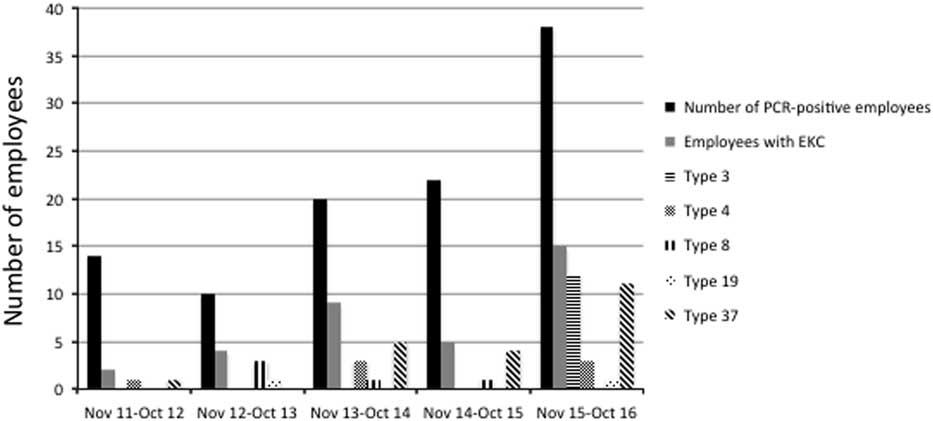
Over the five 12-month periods from November 1, 2011, through October 31, 2016, the proportion of employees with red eye presenting to the Occupational Health Clinic whose conjunctival PCR was positive for adenovirus showed an increasing trend (P=.0043, Cochran Armitage test for trend over time). The proportion of adenoviral PCR-positive employees to the total number of employees who underwent PCR swabbing did not show a trend (P=.33). The number of employees with EKC in each period increased (P=.049), as did the proportion of employees with PCR-positive adenoviral conjunctivitis who were diagnosed with EKC (P=.049). Also, the proportion of employees with EKC with type 37 increased over time (P=.042) (Fig. 2).
Composite results of employees who were PCR positive for adenoviral conjunctivitis, employees with EKC, and causative types in EKC cases per 12-month period for 5 periods from November 2011 through October 2016. NOTE. PCR, polymerase chain reaction; EKC, epidemic keratoconjunctivitis.

From November 2011 through October 2016, a 5-year period, the highest numbers of employees with PCR-positive adenoviral conjunctivitis were from the Outpatient Pharmacy (n=9), followed by the departments of Surgery (n=8), Ophthalmology (n=8), and Medicine (n=8). Of the 8 affected employees in the Department of Surgery, 6 had direct patient contact (eg, doctors, nurses, and medical assistants). Furthermore, 5 employees in the Department of Surgery, all with direct patient contact, developed EKC. In the Department of Ophthalmology, 5 of 8 employees with PCR-positive adenoviral conjunctivitis had direct patient contact (eg, ophthalmologist, surgical technician, optometrist, optician), of whom 4 developed EKC. Of the 8 affected employees in the Department of Medicine, 3 had direct patient contact, and 1 of these developed EKC. Following in number of employees with adenoviral conjunctivitis were the Department of Pediatrics (5 employees of whom 3 were in clinical roles), Security (n=5 employees), Environmental Services (n=4), the Department of Neurology (n=4), the Department of Hematology/Oncology (n=4), and Food Service (n=4). Employees from these 10 of 30 work areas accounted for 60% of employee cases of adenoviral conjunctivitis. Of the 26 employees with EKC over the 5-year period, 13 (50%) had direct patient contact, and 6 employees (23%) with EKC worked in patient-care areas without direct patient contact (ie, Security, Environmental Services, Food Service).
For employees without EKC but PCR positive for adenovirus, the median furlough length from the date of conjunctival swabbing was 10 days (range, 3–25 days; interquartile range [IQR], 7–11 days). For employees with EKC, the median furlough length from the date of conjunctival swabbing was 14 days (range, 4–22 days; IQR, 11–16 days). The difference in median furlough length was statistically significant (Wilcoxon test, P=.0033).
Discussion
In the time since a triage algorithm for red-eye employees based on screening and diagnosis by PCR was implemented at our medical center in 2011, no outbreak of adenoviral conjunctivitis or EKC has occurred, despite an increase in the number and proportion of employees with EKC and an increase in the proportion of red-eye employees with PCR-positive adenoviral conjunctivitis. With this study design, we cannot prove that our policy (rapid isolation, accurate diagnosis, and furlough of infected employees) has curtailed transmission of adenoviral conjunctivitis at our medical center, but the policy has made epidemiologic monitoring possible because of triage at a single site and diagnosis using PCR.Reference Kuo, Espinosa, Forman, Pehar, Maragakis and Valsamakis 8 , Reference Kuo, Espinosa, Michael Forman and Valsamakis 9 Our findings also include a change in the relative proportions of EKC types over time since the policy was implemented. To our knowledge, this may be the first report of viral types and detailed work environment of persons with adenoviral conjunctivitis in a setting other than an outbreak of EKC, during which typing is sometimes performed.Reference Hamada, Gotoh, Hara and Iwahashi 1 – Reference Warren, Nelson and Farrar 4
As a quality improvement initiative at JHM, the red-eye policy enables us to record and monitor cases of PCR-positive adenoviral conjunctivitis, cases of EKC, and adenoviral type. As we discovered at 36 months,Reference Kuo, Espinosa, Michael Forman and Valsamakis 9 the proportion of employees who test positive for adenoviral conjunctivitis remains low, as does the proportion of employees who have EKC. However, because typing is performed, this policy affords us the unique opportunity to note changes in causative type over time and to be alert to possible outbreaks in a certain area of the medical center, which the Virology Division and Hospital Epidemiology and Infection Control group defined as 2 or more employees with adenoviral conjunctivitis from the same work area seen within the same week at the Occupational Health Clinic and caused by the same type. In this manner, we may be able to identify work areas in need of increased infection control efforts before an outbreak spreads to other departments or divisions.
It is impossible to determine whether employees with EKC were infected at work or outside work, although no community or hospital outbreak at JHM has been recorded since the policy was implemented in 2011. Because of the lack of clustering of adenoviral conjunctivitis in a single work area at any given time, (let alone of the same adenoviral type), we believe that the vast majority of infections were community acquired. Regardless of the source, because most infected employees worked in patient-care areas (which included clinical departments as well as departments like Environmental Services and Security, whose employees have no direct patient contact), the probability of transmission to and from patients and fellow employees in patient-care areas was high. Fellow employees who contract adenoviral infection could infect more patients. Infected individuals could infect communities outside the hospital, as has been described in hospital outbreaks of EKC.Reference Vastine, West, Yamashiroya, Smith, Saxtan, Gieser and Mufson 3 , Reference Warren, Nelson and Farrar 4 Supportive measures such as hand washing, glove use, and use of face and/or eye protection whenever appropriate remain highly important.
Of all departments and divisions, the Outpatient Pharmacy had the largest number of employees with adenoviral conjunctivitis (9 in 5 years). While some might not think of pharmacy employees as having direct patient contact in the same manner as employees of outpatient clinics or inpatient units, the volume of interactions with outpatients (or their family members) in this department is high. Although hand hygiene is not sufficient to prevent or manage an outbreak of EKC because adenovirus is highly resistant to physical and chemical agents, hand hygiene between transactions at the Outpatient Pharmacy is likely a good infection control and prevention tool. Because adenoviruses are nonenveloped and are hydrophilic, alcohol-based hand hygiene will not be effective; soap and water hand washing as a removal process would be the better choice. Other patient-care areas in which employees have no direct patient contact but had a high prevalence of adenoviral conjunctivitis were Security, Environmental Services, and Food Service. Employees in these work areas may lack information about infection control and prevention; they may harbor a false sense of security, thinking that the policy applies only to employees with direct patient contact. In addition to the lack of any cluster of PCR-positive employees in the medical center, finding this infection in employees without direct patient contact suggests community acquisition. It also highlights the importance of employee education.
Given the history of EKC outbreaks occurring in ophthalmology clinics and departments,Reference Vastine, West, Yamashiroya, Smith, Saxtan, Gieser and Mufson 3 – Reference Scharf, Holland, Werker, Roberts and Bryce 6 perhaps it is not surprising that the Department of Ophthalmology, which is located in the hospital, not in the Outpatient Clinic wing, had one of the highest numbers of employees with PCR-positive adenoviral conjunctivitis (ie, 8 employees in 5 years, 4 with EKC). The nature of our specialty plus the fact that not all equipment is disposable likely puts doctors, staff, and patients at increased risk of adenoviral conjunctivitis and/or EKC despite infection control and prevention efforts. This inherent susceptibility underscores the importance of exercising caution when triaging, examining, diagnosing, and discharging patients with adenoviral conjunctivitis. The relatively large number of infected employees in the Department of Medicine may reflect the fact that Medicine is the largest department, almost 3 times as large as the next largest department. The departments of Surgery and Ophthalmology are comparable in size. More education on handwashing and identification of red eye in these heavily clinical departments might benefit their employees; other comparably sized departments like Psychiatry and Radiology (less physical contact with patients) do not have this volume of adenoviral conjunctivitis. Fortunately, no laboratory personnel were infected during this period.
The proportion of employees with PCR-positive adenoviral conjunctivitis remains low;Reference Kuo, Espinosa, Forman, Pehar, Maragakis and Valsamakis 8 , Reference Kuo, Espinosa, Michael Forman and Valsamakis 9 ~10% of employees clinically suspicious for adenoviral conjunctivitis were PCR positive, of whom a quarter had EKC. The proportion of adenoviral PCR-positive employees to the total number of employees swabbed for PCR did not change over 5 years. This finding may be attributable to the consistent clinical threshold at which the nurse practitioners swab the conjunctiva of employees with possible adenoviral conjunctivitis. The proportion of red-eye employees with PCR-positive adenoviral conjunctivitis, the proportion of employees with PCR-positive adenoviral conjunctivitis who had EKC, and the proportion of EKC type 37 all increased over time. Because there may be cyclical changes in baseline adenoviral prevalence in the community as well as in the healthcare environment, the clinical relevance is unclear. Without an historic or concurrent control group, we cannot prove this, but it is possible that our policyReference Kuo, Espinosa, Forman, Pehar, Maragakis and Valsamakis 8 , Reference Kuo, Espinosa, Michael Forman and Valsamakis 9 has limited transmission of adenoviral conjunctivitis or EKC at our medical center. Because this quality improvement initiative is ongoing, we will continue to monitor cases and other characteristics. While the Centers for Disease Control and Prevention (CDC) reported outbreaks of EKC in the US Virgin Islands and in West Virginia within the same period (mostly caused by adenovirus type 8),Reference Killerby, Stuckey, Guendel and Sakthivel 17 , Reference Massey, Henry, Minnich, Lamson and George 18 no outbreaks have occurred in our center or have been reported in the neighboring community in the years the red-eye policy has been in effect.
Overall, 10% of employees whom nurse practitioners swabbed turned out to be PCR positive. This result likely reflects the fact that adenoviral conjunctivitis is difficult to diagnose clinically and that the triage algorithm (Fig. 1) was established to screen with the expectation of some negative test results. Overly stringent requirements for swabbing might have allowed infected employees to slip past the policy and continue to work. Another possible reason for the proportion of positive test results is that there is no ophthalmologist, optometrist, or slit lamp in the Occupational Health Clinic. Similarly, in the community setting, most patients with red eye are seen by primary care providers with no slit lamp. The requirements for swabbing are currently being made more specific, so fewer employees may be swabbed in the future.
In conclusion, in this follow-up report on our institution’s red-eye policy, we discovered an increasing proportion of red-eye employees with PCR-positive adenoviral conjunctivitis, an increasing number and proportion of employees with EKC, and changes in adenoviral type over 5 years. We also identified work areas with the highest number of employees with EKC. Good infection control practice, starting with triage and accurate diagnosis and including hand hygiene, may have helped prevent the spread of EKC and/or an outbreak. Given the hardy nature of adenovirus and the high transmission rate of adenoviral conjunctivitis between healthcare settings and the community,Reference Vastine, West, Yamashiroya, Smith, Saxtan, Gieser and Mufson 3 , Reference Warren, Nelson and Farrar 4 the institution of proper infection control and prevention (ie, triage, isolation, diagnosis, furlough, hand washing) in all patient-care areas—regardless of whether employees have direct patient contact—should be considered. Although no EKC outbreak has occurred since the policy was implemented, monitoring of employee cases and causative type may alert us that an outbreak is occurring or about to occur. Such information is important not only for employees and patients but also for the surrounding community.
Financial support
This study was supported by an unrestricted grant from Research to Prevent Blindness, New York, NY. The Wilmer Biostatistics group is supported by a Wilmer Biostatistics Core Grant (grant no. EY01765).
Potential conflicts of interest
All authors report no conflicts of interest relevant to this article.
Acknowledgments
We thank all the nurse practitioners in the Occupational Health Clinic for their contributions in implementing and enforcing the red-eye policy. We thank Michael Forman, BS, for performing all PCR testing and typing and Heather Saunders, BS, RN, of Hospital Epidemiology and Infection Control for monitoring employee cases of adenoviral conjunctivitis and EKC. We also thank Jing Tian, MS, of the Wilmer Biostatistics group.