Introduction
Okra, Abelmoschus esculentus (L.) Moench (Malvaceae), is an important crop in West Africa. It is cultivated largely for its pods, and contains protein, vitamins and mineral elements such as calcium and iron (Siemonsma and Kouame, 2004). The fruits and leaves may be eaten raw, dry or boiled in water to make soups and sauces (Ahmed et al., Reference Ahmed, Yusuf, Garba and Mustapha2004). In 2007, the world okra production was 4.8 million tons, but most of the production was in India (70%), followed by Nigeria (15%), Pakistan (2%), Ghana (2%), Egypt (1.7%) and Iraq (1.7%) (Gulsen et al., Reference Gulsen, Karagul and Abak2007). In this same year, about 1,280,000 tons were produced in Nigeria from an estimated area of 430,000 ha with an estimated yield of 29,767 kg/ha (FAOSTAT, 2009). Okra is far more represented in West Africa than in other parts of the world (Hammon and Van Sloten, Reference Hamon and Van Sloten1989). Worldwide, there are 2283 accessions out of which 2029 were collected from Africa, with 1769 from West Africa alone. In Nigeria, the local varieties grown by farmers include ‘Dajofolowo’, ‘Iwo-Agbonrin’ and ‘Jokoso’, while the introduced varieties include ‘Clemson spineless’ and ‘Green Emerald’.
Most okra produced in Africa is exported to the UK and The Netherlands, which constitute the two largest markets within the European Union (EU) (Torti, 2009). This is because okra is primarily a food ingredient consumed by the African and Caribbean diaspora in Europe as well as by Asian communities. In most of the East African countries and, especially, Kenya, okra is an important agricultural export commodity to the EU and is thus subjected to stringent EU and Euro-Retailer Produce Working Group (EUREPGAP) regulations concerning maximum residue limits of pesticides, food safety and traceability issues. Such EU quality standards for export of the crop emphasize strict adherence to specific fruit qualities, one of which is that the fruit must be without blemishes and must be erect (Naeve et al., 2007).
A large number of insect pests are reported to attack okra worldwide (Hill and Walter, 1988). Some of these insects are known to feed on different parts of the crop and, at the same time, transmit various diseases to the crop (Varela and Seif, Reference Varela and Seif2004). Flea beetles, Podagrica spp. (Coleoptera: Chrysomelidae), are the major pests of okra (Vanlommel et al., Reference Vanlommel, Duchateau and Coosemans1996) with three or more generations per year. Their larvae feed on the roots of the plants, often riddling them with tunnels or eating off rootlets, while the pupal stage is spent in the soil.
Small round holes (almost as if the plant was hit by buckshot) chewed by adult flea beetles in leaves are the most obvious damage caused by the pest. On small okra plants, this damage can result in plant death and provide entry points for pathogens responsible for blight and wilt diseases (Vanlommel et al., Reference Vanlommel, Duchateau and Coosemans1996). Although leaves and flowers are mostly affected, the beetles also cause damage to pods and render them unsuitable for export. In addition, flea beetles are important vectors of okra mosaic virus (Genus Tymovirus), accounting for the reduction in vegetative growth and about 18–26% yield loss annually in Nigeria (Vanlommel et al., Reference Vanlommel, Duchateau and Coosemans1996).
Quantitative information on the impact of flea beetle damage on the vegetative growth of its hosts is still scanty. Such information is invaluable in determining the economic status of the pest and the various imbalances in plant physiology occasioned by it. The objective of this study was, therefore, to determine the impact of the flea beetle Podagrica uniforma on the vegetative growth and fruit morphometrics of okra.
Materials and methods
Two experiments were conducted on potted okra plants in the screen house, and on field-grown okra over which wire mesh screen (0.5 mm) cages measuring 1.2 × 1.2 × 2.0 m were subsequently installed. The okra variety used for the experiments was NHAe47-4 obtained from the National Horticultural Research Institute, Ibadan, Nigeria. It is an improved, open-pollinated, short-growing (about 1 m in height) and early-flowering (40–50 days) pure line with stout deep green spiny fruits, good viscosity and an average fruit weight of 11.7 g.
Insect culture
The initial stock culture of P. uniforma was obtained from field populations infesting okra plants at the Organic Agriculture Farms at the University of Agriculture, Abeokuta, Nigeria. Twenty pairs of adult beetles were released on potted okra plants covered with wire mesh cages (25 × 25 × 30 cm) for oviposition. These adults were removed 21 days after oviposition and the eggs laid in the potted soil in the cages observed daily for adult emergence. Emerged adults of similar ages were used for all the experiments. Insect culture was maintained in the laboratory under room temperature (24–28 °C) and 79–92% relative humidity (Oke and Odebiyi, Reference Oke and Odebiyi2008).
Screen house experiment
Three okra seeds were planted in 10-litre plastic pots filled with loamy soil. Seedlings were thinned to one seedling per pot 1 week after sowing (WAS). The potted plants were raised in wire mesh screen cages placed in the screen house. Ninety pots containing okra plants were distributed into 18 screen cages at five pots per cage, thus making it five plants per cage.
At 3 WAS, during the vegetative stage, the caged okra plants were infested with freshly emerged P. uniforma adults from the laboratory culture using an aspirator at 0 (control), 5, 10, 20, 30 and 40 pairs per cage, representing six treatments. The cages were arranged in a completely randomized design. The number of insects in each cage was kept constant by the daily replacement of dead individuals with fresh insects of the same sex and approximately the same age from the laboratory culture, until crop harvest. The okra plants in the cages were watered as necessary. The caged okra plants were examined between 07.00 and 10.00 h Greenwich Mean Time daily when the insects were relatively inactive. Data were collected on the number of flowers, the number of days to 50% flowering, the number of days to fruit initiation, pod number and weights, plant height, stem girth, the number of branches and functional leaf area in both experiments. Damaged and functional leaf areas were taken at 11 days after sowing (DAS) using the graph paper method. The numbers of intact and damaged flowers as well as the number of days to 50% flowering and fruit initiation were also taken. At maturity (40–90 DAS), fruits were picked on a weekly basis, sorted into damaged and undamaged categories, and were measured in length and weighed.
Field experiment
Soil was prepared with hand implements and was from the same source as for the screen house experiment. The final planting area was unbedded. As in the screen-house pot experiment, three seeds of okra were sown per hole and later thinned to one plant per hole. Plant spacing was 60 × 30 cm; the same cages used for the screen-house pot experiment were moved to the field and one cage was placed over five young plants selected from a row of okra plants. There were 18 cages in total in which the six treatments (0- (control), 5-, 10-, 20-, 30- and 40-pair insect infestation levels) were replicated three times. A total of 90 plants was used, with 15 plants per replicate. The field was arranged in a completely randomized block design. Flea beetles from culture cages were released onto the caged okra plants at the same population levels as in the screen-house pot experiment. Weeding was done manually. The experimental protocol, observations made in the field, and fruit harvesting procedures were the same as described in the screen-house pot experiment.
Statistical analysis
Data obtained from the experiments were subjected to the analysis of variance procedures (P < 0.05) using SAS (2000); significantly different means were separated using the Student–Newman–Keuls test. Regression and correlation analyses were carried out to determine the relationships between plant height or the number of damaged fruits and insect densities. χ2 analysis was used to test the relationship between the models obtained from the screen house and field trials.
Results
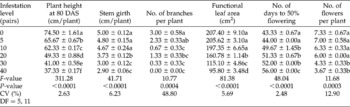
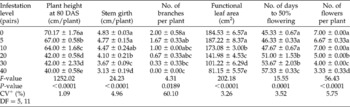
In both experiments, increasing population of the beetles per cage caused a significant reduction (P < 0.05) in the parameters measured relative to the control (Tables 1 and 2). The impact was more pronounced at the 40-pair level in both experiments, and in the infested field-grown okra compared with the potted okra. There were significant reductions (P < 0.05) in plant height at the 5-pair level (11.9%, screen house; 4.5%, field) and the 40-pair okra plants were about 50% shorter compared with the other treatments. Relative to the control, okra stem girths were significantly reduced (P < 0.05) at higher beetle densities in the screen house (42%) and in the field (35%) at the 40-pair level. However, at the 5- and 10-pair levels, stem girths were not significantly different (P < 0.05) from those of the control plants, but were significantly different at the 20-pair level (Table 2).
Vegetative and flowering characteristics of potted okra plants at different population densities of Podagrica uniforma in screen house cages

Values are means ± standard error of the mean.
Means followed by the same letters within a column are not significantly different from one another (Student–Newman–Keuls test, P < 0.05).
DAS, days after sowing; CV, coefficient of variation; DF, degrees of freedom.
Vegetative and flowering characteristics of potted okra plants at different population densities of Podagrica uniforma in the field

Values are means ± standard error of the mean.
Means followed by the same letters within a column are not significantly different from one another (Student–Newman–Keuls test, P < 0.05).
DAS, days after sowing; CV, coefficient of variation; DF, degrees of freedom.
The number of branches was also significantly reduced (P < 0.05) with increasing P. uniforma populations in both experiments. However, compared with the controls, there were no significant differences between the number of branches at the 5- and 10-pair levels in the screen house, and among the 5-, 10- and 20-pair levels in the field. At the 10-pair level, there was up to a 77 and 50% reduction in the number of branches in the screen house and field trials, respectively. At the 40-pair level, no branches were produced in both experiments (Table 2).
A significant reduction (P < 0.05) in functional leaf area occurred at the 20-pair level in the screen house and at the 10-pair level in the field. However, more than 50% reduction in functional leaf area was found at the 40-pair level in both experiments (Tables 1 and 2).
Increasing densities of the flea beetle significantly prolonged the flowering initiation by 13 and 12 days in the screen house and field trials, respectively, at the 40-pair level. Days to 50% flowering were significantly longer at the 10-pair (screen house) and 20-pair levels (field). Significant reductions of about 50% (P < 0.05) in flower production were observed at the 40-pair level in both experiments. There was no insect-induced flower damage in terms of scarification or abortion in the screen house and field experiments, but all the flowers produced by each plant entered the fruiting stage.
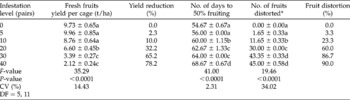
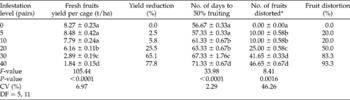
Fruit initiation was significantly delayed by 14 days (P < 0.05) at the 40-pair level in both experiments. A significant reduction in the pod yield occurred at the 20-pair level in both experiments. Both in the screen house and the field over 50% reductions in yield occurred at the 40-pair level.
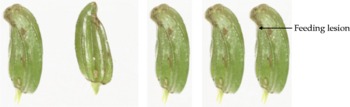
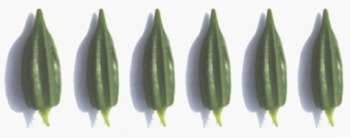
Flea beetles caused fruit distortion consisting of grooves (incisions) and dark brown chlorotic patches on the fruit wall with fruit tips bending towards the direction where insect-induced incisions and scarification were concentrated (Fig. 1). The number of distorted fruits was significantly (P < 0.05) higher at the 5- and 10-pair levels compared with the control in the screen house and field experiments, respectively. The number of such fruits was significantly higher at the 30- and 40-pair levels than in the other treatments, and constituted more than 90% of the entire fruits harvested at these pest densities (Tables 3 and 4). However, fruit distortion was not observed on okra fruits in the control plots (Fig. 2).
Distorted okra fruits with tips bent towards the direction of incisions made at the tips of the fruits

Number of days to fruiting, fruit yield and distortion at different population levels of Podagrica uniforma in the screen house cages

Values are means ± standard error of the mean.
Means followed by the same letters within a column are not significantly different from one another (Student–Newman–Keuls test, P < 0.05).
* n = 50 fruits per treatment.
CV, coefficient of variation; DF, degrees of freedom.
Number of days to fruiting, fruit yield and distortion at different population levels of Podagrica uniforma in the field

Values are means ± standard error of the mean.
Means followed by the same letters within a column are not significantly different from one another (Student–Newman–Keuls test, P < 0.05).
* n = 50 fruits per treatment.
CV, coefficient of variation; DF, degrees of freedom.
Undamaged fruit (control) with an erect tip

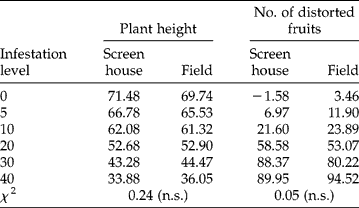
Regression analysis indicated that plant height was a linear function of flea beetle population (Y = 0.9401x+71.4781; r 2 = 0.982 (screen house); Y = − 0.842x+69.737; r 2 = 0.963 (field)). Third-degree polynomial models (Y = − 0.0035x 3+0.174x 2+0.9283x − 1.582; r 2 = 0.99 (screen house); Y = − 0.0018x 3+0.0978x 2+1.2446x+3.4586; r 2 = 0.98 (field)) best described the relationship between insect density and fruit distortion. χ2 analyses revealed that the screen house and field experiment models obtained were similar for all the parameters tested (plant height: χ2 = 0.24, degrees of freedom (df) = 5, P = 0.963; number of bent fruit: χ2 = 0.05, df = 5, P = 0.9781) (Table 5).
Expected plant height and fruit distortion values generated using the regression equations from the screen house and field models
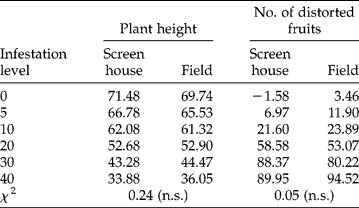
χ20.05 = 11.1; degrees of freedom = 5; n.s., not significant.
Discussion
The negative impact of P. uniforma on the vegetative characteristics of okra in this study is a clear indication and confirmation that the beetle constitutes a biotic stress factor on okra as previously reported by Pitan et al. (Reference Pitan, Alasiri, Kintomo, Babalola and Olatunde2007). Biotic stressors such as arthropods, diseases and weeds have been reported to affect the growth and yield of plants in both agricultural and natural systems (Higley et al., Reference Higley, Browde and Higley1993). From this study, P. uniforma induced stress on okra plants, which eventually influenced okra growth, fruit shape and yield. Therefore, okra height might be a highly sensitive indicator signalling biotic stress intensity.
The significant reduction in okra stem girth by 42% in the screen house and 35% in the field at the 40-pair infestation level is likely to cause low okra yields. This is because stem girth is a good indicator of vegetative productivity. Usually, plants with good growth performance would require thicker stems to support the weight at the crown level and to withhold those in the field safely (Hassan et al., Reference Hassan, Qadir and Cheema2005).
Apparently, the reduction in the number of branches from 22 to 100% caused a reduction in the yield of okra. The number of branches per plant has a direct relationship with crop productivity. It also gives an indication of yield potential of a crop (Dunn and Martin, Reference Dunn and Martin2007). However, the loss of branches in okra plants at the 40-pair level in both experiments may be a result of morphological plasticity in response to biotic stress. Some plant species exhibit dynamic morphological response patterns to biotic and abiotic stressors (Bentley and Clack, 2005). In particular, instability in the number of branches on different okra varieties has been reported to be due to strong environmental influences (Ariyo, Reference Ariyo1990).
In our study, leaf area was reduced by 56% at high infestation levels as a result of ‘buckshots’ caused by flea beetles feeding on the leaves. This insect-induced leaf damage reduced the leaf area available for photosynthesis, thereby decreasing the plants' ability to garner resources for growth, defence and reproduction (Schoonhoven et al., 2005). Leaf area is important for crop light interception and therefore has a large influence on growth (Boote et al., 1988), transpiration (Enoch and Hurd, Reference Enoch and Hurd1979), growth rate (Leith et al., Reference Leith, Reynolds and Rogers1986), energy transference and dry matter accumulation processes in crop canopies (Bhatt and Chanda, Reference Bhatt and Chanda2003).
Flea beetles have been reported to exploit the flowers of okra for food, leading to flower abortions (Varela and Seif, Reference Varela and Seif2004). However, in our study, although okra flowers display entomophilous features such as coloured petals, nectarin, extrose dehiscent anthers and sticky pollen grains (Hamon and Koechlin, Reference Hamon and Koechlin1991), P. uniforma did not exhibit florivory. All the flowers produced by the plants were undamaged and successfully set throughout their ontogeny. From the 20-pair level onwards, flowering and fruit initiation were significantly delayed. This result was not unexpected because at these levels of infestation, growth and the overall performance of the plant were inhibited. Reports have indicated that leaf herbivory can delay flowering indirectly or can alter developing flowers both physically (Strauss et al., Reference Strauss, Conner and Rush1996) and chemically (Karban and Baldwin, Reference Karban and Baldwin1997). Herbert (Reference Herbert2002) also reported phenological delay as a critical response to plant stress.
Fruit damage included a tropic movement of the fruit tip towards the direction of damage where incisions were concentrated. The possible reasons for this bent-tip phenomenon may be the disruption in the transport of plant hormones (cytokinins and auxin) responsible for fruit development, desiccations of fruit tissues at the point(s) of incision(s) or the negative effects of toxins released from the gut of the flea beetle while feeding on the fruit tissues (Pessarakli, 2002).
In conclusion, 20 pairs of beetles per five plants (i.e. eight beetles per plant) appeared to be critical for an okra plant because at this level of infestation, there was a significant reduction in okra growth. This information becomes useful because the population of the flea beetles on field-grown okra may be as high as 11 per plant or more (Agunloye, Reference Agunloye1986; Pitan and Adewole, 2011). Also, models generated from the screen house and field data can serve as a basis for further investigations and predictions for forecasting growth inhibition in okra fields.
Acknowledgements
The authors are grateful to the Research and Development Centre, University of Agriculture, Abeokuta, Nigeria for the provision of funds for this research (RG 215). We also thank the Organic Agriculture Project in Tertiary Institutions in Nigeria, University of Agriculture-Abeokuta Chapter, for the provision of the site used for the field experiment.