Introduction
It is impossible to narrate Southern African colonial frontiers without cattle raiding. From the eighteenth-century Orange River to the nineteenth-century Zuurveld and Maloti-Drakensberg Mountains, cattle raids defined boundaries, set the terms of treaties, and distinguished outlaws from allies among Europeans and Africans alike. Recent work has taken these observations further: building on the identification of ‘Bushman’Footnote 1 raiding as resistance to colonial encroachment (Vinnicombe Reference Vinnicombe2009 [1976]; Wright Reference Wright1971). Geoff Blundell (Reference Blundell2004), Sam Challis (Reference Challis2008; Reference Challis2012; Reference Challis, Hamilton and Leibhammer2016) and Lara Mallen (Reference Mallen2008) have demonstrated that raiding was fundamental to forging cohesive, culturally heterogeneous communities.
Despite the attention given to frontier commandos and ‘Bushman’ raiding in Southern African historiography and archaeology, comparatively little focus has fallen on the cultural function of cattle raiding within chiefly, primarily Bantu-speaking societies, or on examining cattle raiding as a social institution rather than as a transgressive or bellicose act (but see Morton Reference Morton2009 and the discussion below). Historical and historiographic perspectives on cattle raids have treated them as a method of warfare or as social pathology. While these perspectives are often valid, the now apparent significance of raiding as a meaningful practice for ‘Bushman’ raiders encourages a look at the social meaning of raids elsewhere in Southern Africa.
As an archaeologist, these treatments of cattle raiding as disorder – and the underlying implication that raids represent a departure from a particular order – are of particular concern. This is because the material record is especially sensitive to disruptions and anomalies: changes in patterns of consumption, production, subsistence, daily practices, and so on. When we see an efflorescence of settlements on defensible, water-scarce hilltops amid agriculturist townscapes sprawling across the veldt (as on the eighteenth- and nineteenth-century Highveld), those hilltops appear as refugia from something making that agriculturist lifestyle dangerous or untenable, at least temporarily. When large-scale demographic movements result in shifting settlement locations and layouts throughout the Highveld and south-eastern Africa (as occurred between the late eighteenth and early nineteenth centuries), it raises the spectre of disruption on a scale commensurate with this widespread behaviour. Archaeological and historical explanations for these phenomena have hinged (appropriately) on the stress caused by environmental pressures, aggressions among African chiefdoms, and the land disputes and conflict accompanying British and trekboer expansion (see, for example, Eldredge Reference Eldredge and Hamilton1995; Etherington Reference Etherington2001; Guy Reference Guy, Marks and Atmore1980). From these many explanations, cattle raiding emerges consistently as both symptom and cause of social, political and economic distress: people departed from their more stable, predictable agriculturist existences and sought shelter in the face of the disorder and instability that raiding represented, often becoming raiders themselves (see, for example, Hall Reference Hall and Hamilton1995).
But where does this narrative of disorder come from? How did cattle raiding become embedded in our habits of thinking about the recent and precolonial past as a type of antisocial behaviour? In what follows I consider these historiographic trends, and explore some aspects of Southern Africa's past from a perspective that takes cattle raiding as a social institution rather than as a priori disorderly or antagonistic.
Achieving this perspectival shift entails taking up Dan Wylie's (Reference Wylie2010: 288) suggestion to examine in detail the active position of cattle in Southern African cosmologies and political economies, particularly where these can shed light on behaviours that are (mis-)construed as illicit. This harks back to Adam Kuper's (Reference Kuper1982) seminal arguments that, among southern Bantu speakers, cattle were essential to men becoming full members of society. Following Kuper, via bridewealth payments and other loans, cattle orchestrated a series of transfers and alliances, which linked the households and lineages that constituted the ‘popular politics’ of Southern Africa's longue durée (Landau Reference Landau2010). Kuper's observations resonate with those of other ethnographers of Southern Africa, such as W. D. Hammond-Tooke (Reference Hammond-Tooke1984; Reference Hammond-Tooke1999; Reference Hammond-Tooke2002; cf. Reference Hammond-Tooke1957; Reference Hammond-Tooke1962), Marguerite Poland (Oosthuizen Reference Oosthuizen1996: 387–8; Poland et al. Reference Poland, Hammond-Tooke and Voigt2005: 12), and Monica Wilson (Hunter Reference Hunter1979 [1936]), who have drawn attention to the myriad ways in which cattle have been implicated in idioms and experiences of kinship, the natural world and ancestor-based cosmologies. In this article, I am not proposing anything like Kuper's subcontinental model (the use of which in evoking the precolonial past has been hotly debated: see Huffman Reference Huffman2001; Lane Reference Lane and Stahl2005; Mitchell Reference Mitchell2002: 279–84). Rather, I ask what happens if we explore cattle as indexing a range of performances, ontologies and signifiers, and as participants in projects of identity creation and political discourse in the Southern African past.
Taking on this challenge directs us to raiding as a practice whose significance – as social distress and militarism – shifted in part depending on the nature of the animals being raided and on their social and political embeddedness (cf. Hunter Reference Hunter1979 [1936]: 132–3). That historiographic characterizations of ‘war’, ‘peace’ and ‘thieving’ are value-laden is not a novel observation, nor is the stipulation that whether these behaviours were socially sanctioned or aberrant was contingent on a variety of circumstances (Reid Reference Reid2012: 11–2). Reid's observations and work by anthropologists such as Clifford Geertz (Reference Geertz1973: 12) and Tim Ingold (Reference Ingold1980: 9) offer useful reminders that when evoking the past one must be wary of inferring social relations, logic and organization from observed behaviours without a nuanced consideration of socio-cultural context (cf. Henrichsen Reference Henrichsen, Bollig, Schnegg and Wotzka2013). Thus, I want to explore where a focus on ‘cattle-agency’ (cf. Swart Reference Swart2010) and the many intertwined relationships (temporal, cosmological, obligatory) figured in cattle might change some interpretations of raiding in the recent past.
Perhaps the most significant treatment of cattle raiding as related to negotiating political identities has been Fred Morton's (Reference Morton2009) work on rustling among Pilane's Kgatla on the nineteenth-century Transvaal frontier. In his analysis of Kgatla chiefly politics, Morton highlights that raids could serve many purposes beyond acquiring wealth (ibid.: 13–4), that they offered a way to harness the potential of young, unmarried men looking to gain prowess and community responsibilities (ibid.: 35), and that raiding could be a political mechanism for compelling changes to chiefly dynamics (ibid.: 41). The following discussion engages the larger questions arising from Morton's study: to what degree are Morton's observations about the political economy and social significance of cattle raiding confined to Pilane's Kgatla? Given the prevalence of activities described as raiding across the subcontinent, is it possible to investigate raiding as a social institution and meaningful practice in other colonial theatres and within other polities?
A series of vignettes illustrates how addressing this question affords new insights into episodes in the recent past, and offers meditations that lay the groundwork for future investigation. I stress that, by writing in this style, I am proposing neither an ethnographic model nor a cohesive, overarching historical narrative: while some of the individuals and events in these vignettes overlap, there is no linear or essential explanatory thread running through them. Rather, I use this format to offer glimpses of what narratives of the past could look like if perspectives on raiding-as-disorder were revisited and revised, with recourse to ethnographic, archival, folkloric and archaeological matériel (cf. Dawdy Reference Dawdy2008: 9–11).
An ‘essential gesture of savagery’
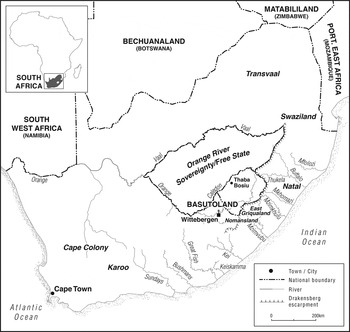
Although cattle raiding was one of the major forces shaping Southern African colonial frontiers (if not the major force), the socio-political functions of raiding remained ambiguous in some places.Footnote 2 Geopolitical context, of course, has much to do with this (Figure 1). On the northern Cape frontier, raiding appeared as an integral part of an economy in which Korana and Griqua ‘middlemen’ used cattle to establish captaincies central to trade networks between the Cape and the interior (Keegan Reference Keegan1996: 178; Legassick Reference Legassick2010 [1969]: 111–2, 176; Penn Reference Penn2005). The impacts of these raids cascaded onto the Highveld and eastern Cape frontier and the ‘internal’ frontiers of south-eastern Africa and the Thukela-Mzimkhulu region, where raids took on a different character (Legassick Reference Legassick2010 [1969]: 162). Taking Moshoeshoe's BaSothoFootnote 3 as a starting point, two broad historiographic perspectives on cattle raiding become apparent: raiding as a means of (and often synonymous with) war; and cattle raiding as a consequence of war, shading into social pathology.
Map of South-eastern Africa showing places mentioned in the text. Regarding eighteenth- and nineteenth-century Southern African historiography, the Cape Colony's eastern boundaries stretched variously to the Bushmans (1778), Fish (1819), Keiskamma (1847) and Kei (1847–65) rivers. Natal's boundaries extended from the Buffalo River to the Mzimkhulu, with the upper portion of the Mzimkhulu boundary contracting when East Griqualand was annexed in 1874.

The former view treats raiding as the primary mechanism by which ascendant African leaders established their paramountcy and ‘impoverished rival lineages’ (Parsons Reference Parsons and Hamilton1995: 340; cf. Landau Reference Landau2010: 84 and below). Although Griqua and Korana attacks may have spurred further cattle raids by chiefdoms of the southern Highveld and north-eastern Cape, as the nineteenth century progressed, raids became the war-making prerogative of chiefs (as heads of state) as much as a means of recouping losses and coping with stress. Norman Etherington (Reference Etherington2001: 154) has proposed that raiding expeditions launched by leaders such as Moshoeshoe in the mid- to late 1820s were ‘more a sign of success than distress’, arguing that disorganized, desperate peoples could not have coped with the demands of launching large-scale raids. This therefore indicated that these groups were in pursuit of power rather than sustenance. Contests for authority hinged on the ability of leaders to secure followings, and while solidarity was fostered through hereditary claims, mythologized shared origins or diplomacy, the social currency of this cohesion was cattle (Etherington Reference Etherington2001: 131; Landau Reference Landau2010: 20–2). Raids formed part of a nation-building dynamo: raiding in the nascent days of a chiefdom procured cattle with which to secure a following, and continued raids provided the wealth and political capital that ensured the growth of these chiefdoms (cf. Morton Reference Morton2009: xxviii; Stapleton Reference Stapleton2001).
Contemporary observers did not, however, interpret or excuse all cattle raiding as state building or war. The missionaries Arbousset and Daumas (Reference Arbousset, Daumas and Brown1968 [1846]: 284–5) described Moshoeshoe's ascension to power through cattle acquisition as ‘his career of plunder’. For some observers, a raiding following appeared as a fully fledged nation when leaders invested the livestock acquired during raids in bridewealth for strategic marriages or loans to constituents, thereby securing loyalty and obligation (see, for example, Orpen Reference Orpen1979 [1857]: 20), or when polities ‘retired’ from raiding (Legassick Reference Legassick2010 [1969]: 163) to establish authority, gaining the capacity to wage war so as to maintain and expand that authority.
Nevertheless, some historians have noted that the differences between cattle raids and wars are often a question of perspective (Ross Reference Ross2014: 155). Within chiefdoms, there certainly may have been a distinction between the two. Morton (Reference Morton2009: 13) alludes to this in his differentiation between opportunistic MaSetedi cattle raids and MaBuru raids aimed at settlement and conquest. In her seminal study of Mpondomise in the early twentieth century, Wilson (then writing under her maiden name) distinguished between military attacks on other chiefdoms (legally sanctioned only by a paramount) and more commonplace raids led by district chiefs against chiefs from other clans (Hunter Reference Hunter1979 [1936]: 412). Drawing on these insights when attempting to enumerate the eastern Cape Frontier Wars, she noted that ‘the number depends at what point raiding and retaliation may be termed war’ (Wilson Reference Wilson, Wilson and Thompson1969: 240).
Jeff Peires (Reference Peires1981: 55–6), however, has disagreed with this proposition, bringing the second historical perspective on cattle raiding (as social pathology) into contrast with the first: ‘Competition for cattle played an important part in maintaining frontier tension, but … [a] sharp increase in raiding was more often the consequence than the cause of a disturbed political situation.’ In the early days of the Cape's eastern frontier, many British settlers sympathized with AmaXhosa and Khoekhoen, for whom cattle raiding was a means of survival when confronted with a loss of pasturage. Traders petitioned British authorities for expanding commerce with Africans, arguing that raiding was a natural reaction to being denied access to colonial markets (Lester Reference Lester2005: 56). For Clifton Crais (Reference Crais1992: 97), raiding was a consequence of expanding internal African and colonial frontiers; the political centralization occurring among powerful chiefdoms along the south-eastern coast was both product and producer of politically motivated raiding, scattering other chiefdoms and disrupting patterns of sedentary agriculture. Matiwane's AmaNgwane, in particular, exemplified this raiding epidemic: forced from their position on the Mfolozi River, they raided cattle for survival and to realign political alliances with raiding partners and subsidiaries, later migrating to the Highveld and displacing other chiefdoms before launching their ill-fated bid for power at Mbholompo. Viewed thus, Mbholompo was not a martial manoeuvre, but socially pathological cattle raiding spiralling out of control and plunging the eastern Cape frontier into chaos (Crais Reference Crais1992: 97–9; Peires Reference Peires and Hamilton1995; Wright Reference Wright and Hamilton1995: 169).
Whether or not cattle raiding was symptomatic of broader socio-political ills, most African leaders were well aware that white settlers and colonial authorities perceived it as antisocial. Xhosa leaders exhorted their countrymen to cease raiding from the British and British-allied chiefdoms, recognizing that such actions were viewed as illicit and aggressive, and would provoke retaliation (Peires Reference Peires1981: 61–3, 81). When establishing his ministries among AmaXhosa and their compatriots, the missionary William Shaw (Reference Shaw1860: 64) informed chiefs of the consequences of continued raiding: ‘Unless they would put an end to these marauding expeditions … it would be of little benefit to me to dwell among them; and that peace which they professed to desire with the English could not be maintained.’ Shaw (Reference Shaw1860: 65) later attributed the complete cessation of raiding by his AmaGqunukhwebe parishioners to his influence. During the 1830s, and often accompanied by his subordinate chief Moorosi, Moshoeshoe launched raids into Thembu territory (Ellenberger and MacGregor Reference Ellenberger and MacGregor1912). He ultimately chose to abstain from these because such practices jeopardized his standing with missionaries and the Cape (Thompson Reference Thompson1975: 83–4). Thus, although raiding was viewed as reprobate behaviour, many administrators and missionaries considered some perpetrators capable of rehabilitation and even salvation.
Nevertheless, perceptions of Africans as inveterate raiders became written into colonial narratives of the frontier. Alan Lester (Reference Lester2005: 18) has illustrated how the trope of cattle raiding was employed in the project of constructing AmaXhosa as a ‘foreign intrusion’ into British settler territory. In the cycle of bilateral raiding, the permission that the ‘spoor law’ granted for settlers to retaliate indiscriminately against African stock thieves prompted further raiding by the spoor law's victims, supplying the requisite ‘moral authority’ for settlers to continue launching their commandos (Lester Reference Lester2005: 21, 61–2). In official discourse, raiding became the ‘essential gesture’ of Xhosa ‘savagery’ (ibid.: 21), licensing certain forms of treatment and retribution.
Finally, and deserving of more discussion than is possible here, the social category of ‘raider’ had the potential to elide, subsume or become synonymous with ethnic identities. This was particularly emphasized when cattle raiding was deployed as a strategy for resistance, as in the late eighteenth-century Cape where Khoi/San raids protested against European expansion and exploitation of African children by European farmers (Adhikari Reference Adhikari2010; Marks Reference Marks1972; Newton-King Reference Newton-King1999: 9, 61–2; Penn Reference Penn2005: 201–10) and the terms Soaqua and Sonqua were used to denote ‘raiding Bushmen’ (Parkington Reference Parkington and Schrire1984); I return to this theme of resistance below. Further east in the Maloti-Drakensberg Mountains, ‘Bushman’ and ‘raider’ became almost interchangeable labels (Challis Reference Challis2012; King and Challis Reference King and Challisforthcoming).
Within this historiographic review, there appears a tension between appearance and reality as it pertains to raiding: historical actors, historians and archaeologists attempting to come to grips with what constituted raids, skirmishes, warfare or resistance, and what may have simply appeared as one or all of these things but in reality held an altogether different meaning. This recalls earlier comments about disorder: were raids a departure from ‘normal’ ways of living or could they in fact have been a norm, or at least more normal than has been allowed? The following vignettes may not resolve the distinction between raiding in appearance and reality, but they highlight that probing this distinction more closely offers rewards for historical and anthropological perspectives on one of the most iconic activities of the Southern African frontier.
The politics of keeping, giving and taking
Implicit in much historical literature on the rise of eighteenth- and nineteenth-century Southern African chiefdoms is that cattle raids were a part of life – disruptive, stressful, politically and economically detrimental, but not necessarily unexpected or even outright condemned. Raids were part of political life, bound up in the same idiom as cattle and ancestors.Footnote 4 I want to explore this tenet of raiding-as-politics via two lines of enquiry: raids in the process of building (and occasionally catalysing) chiefdoms, and the related question of whether and when raiding constituted disorderly or dangerous behaviour.
Landau's description of how Moshoeshoe assembled ‘BaSotho’ is a good place to start. Revisiting the well-documented ascent of Moshoeshoe to paramount of a nation that would become lauded as ‘the most promising native tribe in South Africa’ (Irvine Reference Irvine1881: 31), Landau (Reference Landau2010: 83–4, 109–18, 124–31) offers a nuanced discussion relating cattle to ancestral lineages and chiefly authority, showing how this strategy unified a heterogeneous consortium of followers. Within Landau's broader reading of popular politics on the Highveld, Moshoeshoe's ‘BaSotho’ was, in its ‘pre-tribal’ formulation, fundamentally incorporative: Moshoeshoe drew together pieces of fragmented polities from across Southern Africa, and tied these to him through strategic loans of cattle. Moshoeshoe's mafisa system became one of the defining features of his nascent chieftaincy. Mafisa (singular: lefisa) was in essence a system of clientage in which Moshoeshoe lent out cattle and sheep to help would-be followers rebuild their depleted herds. In return, clients (bahlanka; singular: mohlanka)Footnote 5 repaid Moshoeshoe a portion of the milk and/or their herds’ increase, and pledged their labour and/or political and military support (Thompson Reference Thompson1975: 53). Moshoeshoe also used cattle as a means of securing support from junior chiefs by placing them in charge of cattle posts, and of establishing marriage-based alliances through bridewealth payments in cattle (ibid.: 211).
Moshoeshoe's nation building can thus be seen through two broad but interlinked institutions: systems of obligation embodied and signified in cattle; and a newly forged ancestral mandate placing Moshoeshoe at the head of a lineage that solidified this constituency of cattle-based relations under the heading ‘BaSotho’. Following Landau's formulation, ‘cattle became ancestors’ and the well-known Sesotho proverb that a cow is molimo o nko e metsi can be translated as ‘ancestor with a wet nose’ instead of ‘god with a wet nose’ (Landau Reference Landau2010: 84).
That cattle were such an integral part of Moshoeshoe's statecraft seems to suggest that raiding for cattle was an almost foregone conclusion, particularly given the prevalence of raids throughout the southern Highveld (see, for example, Etherington Reference Etherington2001: 124–37). Indeed, Moshoeshoe's very name implied the centrality of raiding to his chieftaincy: he literally made a name for himself as a skilled raider, replacing his birth name Leqopo with the onomatopoeic moniker shwe-shwe, ‘cattle razor’ (Ellenberger and MacGregor Reference Ellenberger and MacGregor1912: 106). This name, and the story of the raid that inspired it, became incorporated into Moshoeshoe's praise poetry (Guma Reference Guma1967: 152), helping to build his reputation as a leader and warrior.Footnote 6
Indeed, raiding appears to have been an acceptable means of increasing one's herd and stature as long as it was not allowed to consume one's focus and energies: another of Moshoeshoe's praise poems claimed that a cow ‘drives mad the nations’, warning that such a fixation can lead only to ruin (Coplan Reference Coplan1994: 33). In other words, raiders walked a fine line between operating within a set of acceptable modes of conduct; raiding in a way that transgressed social norms (here dubbed ‘reaving’); and raiding in a way that became illegal and earned raiders labels such as ‘brigand’ or droster. This refers us back to the distinction between appearance and reality, as missionaries, chiefs, officials and stock-keepers construed this line based on different (sometimes unreliable or superficial) criteria. I return to this question of the perception of raiding as social, antisocial and illegal behaviour shortly.
For the moment, these observations about the commonplace nature of raids suggest that it is useful to think about cattle loan and transhumance practices in a raiding context. While some men were more cattle-rich than others, social factors checked the aggregation of large numbers of cattle at a single time and place. For an individual to amass such a number was to draw attention to his wealth and make him a target for raiding and, occasionally, accusations of witchcraft (Casalis Reference Casalis1861: 216–17, 228–31; cf. Hunter Reference Hunter1979 [1936]: 135–6, 385; Hammond-Tooke Reference Hammond-Tooke and Hammond-Tooke1974: 358). Under mafisa and the more common system of cattle loans made by many BaSotho, distributing cattle among a number of client herders had the advantage of mitigating losses sustained from raids: if a man loaned out a number of his cattle and his homestead was subsequently raided, the loaned cattle would be saved from theft. Historically, this appears to have been precisely the rationale behind some loans that Moshoeshoe and his subordinates made: Moshoeshoe kept a very small number of livestock around his Great Place at Thaba Bosiu, preferring to distribute his herds among bahlanka and cattle posts (Ellenberger and MacGregor Reference Ellenberger and MacGregor1912: 196; Thompson Reference Thompson1975: 192–3).
The loss of cattle to casual raids was further mitigated by the extent to which cattle circulated through society to create social obligations and alliances. The importance of cattle in structural relationships among BaSotho – and how cattle were kept moving through these – can be seen in social institutions such as bridewealth: in the nineteenth century, the dowry received for a daughter was typically used to pay the bride price for her brother's wife (Burman Reference Burman1981: 37–45). Cattle were sacrificed to communicate with ancestors, cure illness, and in divinatory practices (Casalis Reference Casalis1861: 249–50, 287–9; Ellenberger and MacGregor Reference Ellenberger and MacGregor1912: 256, 258). Cattle were the media of fines for social transgressions, paid either to the chief or to the injured party. Chiefs further had the prerogative to confiscate, or ‘eat up’, the cattle of their followers (Burman Reference Burman1981: 37).
Through these and other functions (described below), cattle acted as social agents in BaSotho communities. This circulation and the web of obligations that they formed meant that, even if casual raids depleted the cattle that a man had on hand, he could draw on these relationships to replenish his herd. The question of the alienability of cattle becomes germane here, and offers an opportunity for anthropological insight. Following Marilyn Strathern's (Reference Strathern1988: 134) concept of enchainment and Kristin Armstrong Oma's (Reference Oma2007) discussion of the reciprocal nature of human–livestock relations, David Orton (Reference Orton2010: 191) describes livestock as ‘sentient property’ that both embodies human relationships and creates an elaborate network of social connections across generations (cf. Ingold Reference Ingold1980: 175) – ensuring that livestock cannot be treated as a typical object (Comaroff and Comaroff Reference Comaroff and Comaroff2005; White Reference White2011). These observations invite consideration of Annette Weiner's (Reference Weiner1992: 149–50) exhortation to look beyond taken-for-granted ‘norms of reciprocity’ in traditional societies and see certain types of things as ‘inalienable possessions’ composed of social relations, never fully surrendered and always potent for their erstwhile owners. Following this line of thought, the social impact of raids was not solely related to the material value of cattle but rather implicated a more complex web of obligations and – as discussed in the following section – beliefs.
Indeed, there was a great deal of tension in terms of social and political context between commonplace cattle raids and forays aimed at pillaging for personal enrichment, which could be seen as reaving or outright theft. This brings us to the second point that I would like to draw out: that cattle raiding did not constitute a priori antisocial behaviour. It is useful here to consider Alexandra Hartnett and Shannon Lee Dawdy's (Reference Hartnett and Dawdy2013) observations on informal economies. Inasmuch as the relative informality of an economy is very much in the eye of the beholder (that is, the state), there is a need to be sensitive to the often-subtle differences between illegal (against the law), illicit (against social norms) and licit (socially acceptable) activities. What was de jure illegal may have been socially licensed (take, for instance, Hobsbawm's (Reference Hobsbawm2000 [1969]) ‘social bandits’), and what was legal may have been illicit in some contexts: for example, the tensions between colonial law and chiefly institutions in nineteenth-century Basutoland (Burman Reference Burman1981: 37). Again, appearances and realities fail to match. Looking to the borderlands between Moshoeshoe's western territories and the Orange River Sovereignty opens a window on the judgements by chiefs on each other's raids, and of Europeans on chiefs’ raids. Three individuals in particular offer useful examples: Mokuoane and Moorosi of the BaPhuthi, and Moshoeshoe's brother Posholi.
According to some ethnohistories, Moshoeshoe brought Mokuoane's BaPhuthi into his BaSotho state as vassals around 1820.Footnote 7 While functioning as Moshoeshoe's representatives, Mokuoane and his son Moorosi acted with considerable autonomy and provided cattle and horses to Moshoeshoe. BaPhuthi earned a reputation as cattle raiders whose forays stretched into the north-eastern Cape, the Highveld, and the area known as Nomansland. Moshoeshoe raided with them for a time and, by supplying Moshoeshoe with his first horse, BaPhuthi have been credited with contributing to BaSotho mounted and martial capacity (Swart Reference Swart2010: 84–5, 93). Although missionaries and officials may have viewed BaPhuthi raiding with distaste, magistrates, land surveyors, civil commissioners and even Cape Governor Sir Benjamin D'Urban acknowledged that Mokuoane and eventually Moorosi carried out these raids as chiefs exercising their prerogatives under Moshoeshoe's aegis (Theal Reference Theal and Thabane2002: 51–66).Footnote 8
In contrast, Moshoeshoe's brother Posholi was ultimately excommunicated from Moshoeshoe's chiefdom and labelled a ‘brigand’ rather than a chief. In seeking to establish his own independent chiefdom, in the late 1840s Posholi settled himself with a group of like-minded malcontents and ‘Bushmen’ in an area along Moshoeshoe's western flank (Theal Reference Theal1883: 238). Posholi raided white farmers for cattle and guns at the head of a ‘commando’ often referred to as ‘Boshuli's [sic] dogs’.Footnote 9 After Moshoeshoe disavowed Posholi and when the 1849 Warden Line placed Posholi outside Moshoeshoe's territory, Moshoeshoe declared that Posholi was a British subject (ibid.: 485).
During this window of time (roughly 1849–52), officials of the Orange River Sovereignty, farmers, Moshoeshoe and missionaries were attempting to resolve disputes over political boundaries, while the Cape government was preoccupied with fears of unrest among Thembu along the eastern Cape frontier. As such, Cape and Sovereignty authorities were concerned that raiders operating on Moshoeshoe's western boundary might have been collaborating with Thembu. The resulting correspondence between British officials and Moshoeshoe about Mokuoane, Moorosi and Posholi discloses attempts to work out which chiefs were acting dangerously, illegally and illicitly.
To calm the violence of the Sovereignty–BaSotho borderland, Cape Governor George Cathcart enumerated the troublemakers that he wanted Moshoeshoe to subdue: they were ‘the people over whom you rule, including Molitsane and Morosi, and your own son Letsie, and certain robbers called Letele and Posuli’ (Theal Reference Theal1883: 617). Cathcart further chastised Moshoeshoe, saying that ‘the Basuto people under your rule have become a nation of thieves’. Cathcart's reprimands echoed reports of Posholi's ‘commando’ allying itself with Thembu and murdering farmers, although Posholi also occasionally served as a British agent to help apprehend Thembu and other raiders (ibid.: 378). For his part, Moshoeshoe took great pains to communicate to the British Resident in the Sovereignty both his opprobrium for Posholi and his desire to protect Moorosi. Moshoeshoe voiced his alarm on hearing that Posholi, in his capacity as sometime British operative, had tortured prisoners taken during skirmishes, making Posholi an even less desirable associate for the Sotho leader. Moshoeshoe emphasized that, contrary to rumours abroad in the Sovereignty, Moorosi was not in league with Thembu leaders and wrote ‘to beg of you to make a distinction so that Morosi may not be mixed up in these sad affairs’ (ibid.: 360).
British officials and farmers alike condemned raiding as a crime and raiders as criminals, whether referring to Posholi or Moorosi. That Cathcart distinguished between Posholi as a robber and Moorosi as a chief, however, is revealing. It suggests that the labels ‘robber’ and ‘chief’ referenced not just the act of raiding but also the political and social context in which raiding occurred. Moorosi, for all the disapproval heaped upon him, operated under Moshoeshoe's sponsorship, which ultimately granted him the status of ‘chief’ in the eyes of the government. When Posholi asserted his independence, acting without Moshoeshoe's protection or approval and committing acts considered illegal in British territory, Posholi was dubbed an undesirable by Moshoeshoe and a ‘freebooter’ by the British.
For his part, Moshoeshoe (in letters written through the missionary H. M. Dyke) appeared more concerned with who and how Moorosi and Posholi raided than with the fact that they raided. He further alluded to the fact that the Sovereignty's attempts at regulating raiding upset the political situation among African polities on the Highveld and eastern Cape frontier, in particular as it related to the circulation of cattle:
I have been placed most awkwardly by what I consider an unwarrantable haste on the part of the agents of Government and a total oblivion on their part of the situation I held towards Morosi, the Tambookies [Thembu], and Posuli. To allude only to the latter, although he be known to be my own brother, he has been made independent of me. The British Resident has taken him to war and rewarded him with cattle without my being consulted. Morosi, the Tambookies, the Fingos, and Posuli have been made deadly enemies to each other, and the cattle question has become much complicated by the strange position of my brother, with whom I can no more interfere lest it should be considered I infringe on the rights of the Queen. (Theal Reference Theal1883: 397)
The ‘cattle question’ refers both to the restitution of cattle stolen from farmers, and also to the disposition of cattle taken from other chiefs during raids; it directs us to ask how far officials and enforcers in the Sovereignty saw raids as just a part of chiefly politics, and when raids merited punitive measures. The use of the word ‘war’ is also interesting. Without the original Sesotho, the nuances of Moshoeshoe's intent remain unknown. Did he mean ‘war’ to suggest something different from a normal raid, or as a synonym? If the former, was he distinguishing between the sorts of incursions against Thembu interests that the British occasionally supported on the one hand, and the prerogatives of an African head of state on the other? In any event, Moshoeshoe's attitude demonstrates that Posholi crossed a line where raiding became illicit, illegal and undesirable, unlike Moorosi, who acted illegally but still in a manner warranting Moshoeshoe's sponsorship. Certainly, a large part of Posholi's undesirability was due to the damage he wrought on Moshoeshoe's relationship with the Sovereignty and with Boer farmers, not to mention his rejection of Moshoeshoe's leadership. What this vignette underscores, however, is the centrality and complexity of raiding in Highveld politics; there was clearly a specific place or series of places for raiding in Moshoeshoe's chiefdom, and Posholi transgressed these while Moorosi stayed within their bounds, at least for a time. Further, we can see how raiding contexts influenced designations of chiefs and robbers, illegality and illicitness. These were by no means stable but constantly in flux, particularly amidst the changing borders of Moshoeshoe's territories and under the gaze of certain outside observers such as missionaries and government officials.
Beasts and beings
Achieving more in-depth perspectives on cattle raiding as a social institution entails examining how cattle themselves functioned socially. Socio-economic perspectives on the significance of cattle have been fundamental to the anthropology and archaeology of southern Bantu-speakers for almost a century (see, for example, Comaroff and Comaroff Reference Comaroff and Comaroff1990; Reference Comaroff and Comaroff2005; Kuper Reference Kuper1982; Huffman Reference Huffman2001). Here, I probe more deeply into the social meaning of raiding by looking closely at the embeddedness of the animals being raided, examining their cosmological value to understand more fully what it means to raid cattle.
Throughout Southern African chiefdoms, cattle were the media through which people communicated with ancestors. If ancestors were part of a living, precolonial vocabulary (Landau Reference Landau2010: 20–1, 84), cattle were a central part of that vocabulary. To speak of the molimo o nko e metsi mentioned above, then, was to speak of ancestors in a cosmology that linked authority, descent and community in both the person of the chief and the relationship between that chief and his beasts (cf. Hunter Reference Hunter1979 [1936]: 389–90).
Taking this further, cattle were ‘metaphysically’ mobile, moving between physical and spiritual worlds in sacrifices to ancestors. Close readings of BaSotho folklore reveal that cattle were highly significant in these realms. This folklore illustrates how, for instance, the bond between man and ox was stronger than, and could withstand, death and avarice (Jacottet Reference Jacottet1908: 76–81). Jealous of one man's wealth in cattle, his neighbours schemed to kill him and his ox. When they were abducted, the ox – a beast called Tololi-phatšoa (‘black ox with white stripes and spots’; cf. Poland et al. Reference Poland, Hammond-Tooke and Voigt2005: 114) – urged the young man to trust him and consented to be slaughtered. The young man was spared and the next day the ox rose from the dead and returned to his master's kraal.
In at least one tale, supernatural figures appeared to chastise a man for disrespecting his herds. When the maiden Thakane disobeyed her father's strictures in the interest of these herds, he punished her by giving her to a cannibal as a wife. En route through the veldt to the cannibal's village, antelope reprimanded the father for his inappropriate behaviour, placing his desire for obedience over his duties to his herds and his daughter (Jacottet Reference Jacottet1908: 114–17).
Although early ethnohistories rendered the BaSotho spirit world as a nebulous domain of ancestors conflated with gods (see, for example, Casalis Reference Casalis1861: 250–1; Ellenberger and MacGregor Reference Ellenberger and MacGregor1912: 238–9), the above story demonstrates that there were certain places (i.e. the veldt) where the supernatural world was particularly immanent. Bodies of water were also believed to contain and disclose aspects of the spirit world that could be accessed by humans and livestock. Likoetsa (lakes), maliba and macholo (deep waters) held not only powerful serpents (noha ea metsi) but also entire villages (Snow Reference Snow2011: 11). These villages were governed by chiefs adhering to many of the same social conventions as their terrestrial counterparts, demanding that justice and bridewealth be negotiated through cattle and dispensing punishment if they were not appeased (Jacottet Reference Jacottet1908: 148, 204). In folk tales, BaSotho children and women went to live in these underwater villages until a living relative or suitor made a gift of cattle, which crossed the water boundary between physical and spiritual realms (ibid.: 154, 174).
Returning to noha ea metsi, while these beings were highly dangerous (Snow (Reference Snow2011: 12–14) documents modern Basotho concerns over noha pulling people into rivers), cattle could mediate relations between men and serpents, even helping to transform serpents into men. An often retold BaSotho tale describes how a young girl was unwittingly given in marriage to a noha; once this was discovered, a group of young men killed him, and his mother subsequently resurrected him in human form by sacrificing a black ox (Jacottet Reference Jacottet1908: 126–39). Pieter Jolly (Reference Jolly1996: 280; Reference Jolly, Chippindale and Taçon1999: 260) has drawn attention to the pervasive connections between snakes, rainmaking and communication with ancestors in Nguni and Sotho divination, suggesting that these beliefs were absorbed into south-eastern San cosmologies. Whichever way cultural influences ran, there was at least a convergence of belief around the cosmological cognate of snakes as potent rain creatures (Challis et al. Reference Challis, Hollmann and McGranaghan2013; Snow Reference Snow2011: 50–1; cf. Hoff Reference Hoff1997), particularly within the dynamic cultural frontier of the Maloti-Drakensberg within the last few centuries (Mitchell Reference Mitchell, Mitchell and Smith2009; King and Challis Reference King and Challisforthcoming). The location of cattle-oriented beliefs in such a system has yet to be explored in any detail but would provide a valuable contribution to this debate.
Elaborating further on the metaphysical potential of cattle, the act of killing monsters and tikoloshe (dwarf-like creatures described as ‘witches’ familiars’) caused cattle to erupt from their wounds, becoming the property of their killers and in some cases empowering them to become chiefs (Casalis Reference Casalis1861: 339–43; Jacottet Reference Jacottet1908: 58–60, 72–3, 76–7). The image or trope of the tikoloshe is a powerful one in Nguni and Sotho folklores, and often denotes improper sexual appetites, mischief upon and theft of cattle, and vengeance wrought by practitioners of magic (Krige Reference Krige1936: 354; Hunter Reference Hunter1979 [1936]: 275–82; Niehaus Reference Niehaus2013: 12–13).
Scholars of African literature have drawn attention to how tikoloshe and other supernatural figures describe relations of being in African narrative forms. Caroline Rooney (Reference Rooney2000: 2, 20–1) has suggested taking the appearance of tikoloshe alongside other non-real and natural phenomena as providing ontological insights rather than as illustrating a conflation or interpenetration of the real and the mythic. In her formulation, tikoloshe were not simply symbols of wrong behaviour and cattle were not simply vehicles of potency conjured to modulate such behaviours. Rather, focusing on how these figures in fiction and folklore behaved towards each other, and within the human and natural worlds in which they were embedded, describes ways in which they were ‘coming-into-being’ through ‘forces’ disclosed within the narrative: through the obligations, movements, emotions and metaphysical elements that together comprise social, natural and narrative context. This was not a teleological process of birth and development but rather a coming-into-being through relations with others (Rooney Reference Rooney2000: 7–8). Rooney's intervention encourages us to consider cattle in folklore as embodying and disclosing aspects of certain cosmologies.
The foregoing discussion and insights from African literature provide an avenue for reconciling material views of cattle with the agentive and socially engaged roles that cattle play in the narratives just described. In Southern Africa, decades of ethnographic research have documented how cattle – in all their socio-political entanglements and material glory – embody a wealth of relations between humans and ancestors (White Reference White2011). The metaphysical and ontological features of cattle as described here illustrate that there is scope to nuance this view, particularly from folklore, literature and oral traditions. Such observations resonate with work by anthropologists of human–animal relations, and with concerns over the degree to which animals are symbolic resources versus sentient, social beings – the latter falling under the purview of the ‘animal’ or ‘ontological turn’ in anthropology. Rather than getting caught up in the polarity of such debates, Matei Candea (Reference Candea2010: 244) has suggested that we examine the roles of animals in human society through a focus on ‘the complexities and ambivalences of relationships based on love and exploitation, trust and domination … engagement and detachment’.
Candea's proposal can be applied to the present discussion to illustrate how the roles of cattle as bridewealth and as loan payments – and also as metaphysically mobile – spoke to the position of these animals on a spectrum from symbolic resource to fully subjective being. This recalls the discussion in the preceding section of animals as ‘sentient property’, and reaffirms not only that cattle are social agents, but also that their effectiveness as such derives from their mobility or potential mobility as they circulate and establish relationships between people.
Raiding and resisting
In certain Southern African contexts, raiding has been described as a means of resistance. This is particularly the case where it appears to have undermined the material resources of colonial power and (seemingly deliberately) contributed to the instabilities of colonial apparatuses. I want to dwell on what raiding-as-resistance as formulated in two historical contexts – ‘Bushman’ raiders and Moorosi's BaPhuthi – discloses about where the dividing line between resistance and illicit or illegal behaviour may lie. Where was raiding a deliberate act of aggression designed to undermine expanding hegemonic forces, and where did raiding conform to a set of behaviours with a longer history that may appear as resistance because they happen to place such people in conflict with the desires of settlers and the state (cf. Cooper Reference Cooper1994: 1532–4)?
Four decades ago, John Wright (Reference Wright1971) and Patricia Vinnicombe (Reference Vinnicombe2009 [1976]) provided seminal treatments of the ‘Bushman raider’ phenomenon as San responding to the constriction of their independent lifeways by encroaching colonial authority. As farmer settlement and the legislative power of successive Afrikaner and British governments in Natal became increasingly entrenched at the base of the Drakensberg Mountains, communities of San were squeezed into ever smaller territories and their movement and subsistence were increasingly curtailed. These communities turned to cattle raiding both to accumulate economic resources and as a means of resisting changes to their socio-economic circumstances. Trends in raiding frequency, numbers and targets shifted during the mid- to late nineteenth century to keep pace with the various strategies enacted to prevent raids and penalize raiders. Wright (Reference Wright and Skotnes2007) and rock art scholars have elaborated upon this historiography, arguing that these ‘Bushman’ raiding groups actually represented consortia of ethnically heterogeneous people coalescing around cattle raiding as a shared practice. Drawing on rock art containing imagistic tropes that disclose elements of San and Bantu cosmologies, Blundell (Reference Blundell2004), Mallen (Reference Mallen2008) and Challis (Reference Challis2008; Reference Challis2012) suggest that raiding – as a means of anticolonial resistance and economic gain – was an institution that united people from hunter-gatherer and farming backgrounds. Challis (Reference Challis, Hamilton and Leibhammer2016) has taken this further, arguing that in the latter half of the nineteenth century when retaliatory efforts against ‘Bushman raiders’ were at their most intense, raids took on the character of guerrilla warfare: some raiders attacked specifically to weaken farmers and militia in Natal.
This detailed body of literature prompts us to think carefully about how we treat ideas of ‘resistance’, especially when taking a longer-term look at institutions such as cattle raiding. How do we distinguish between deliberate acts of resistance and behaviours that fail to conform with colonial desires but may not be specifically enacted as resistance? On the one hand, this is a question about emic perceptions and, following recent work by Alfredo González-Ruibal (Reference González-Ruibal2014), ontologies of resistance: that is, the ability to discern where actions and lifeways were actively constructed ‘in the face of the state’. We have a glimpse of this at the Cape in the mid-eighteenth century when Khoisan commandos proclaimed that stealing Dutch cattle was specifically designed to undermine Dutch settlement (Adhikari Reference Adhikari2010: 31; Cullinan Reference Cullinan1992: 34; Marks Reference Marks1972: 71–2; Penn Reference Penn2005: 132).
On the other hand, resistance is also a question of discerning dispositions towards the past. Resistance comprises a range of responses to new social, economic and political orders, and thus connotes alterations to or ruptures from previous ways of life. This is where an archaeological perspective proves useful: resistance is not so much an event as a complex of material practices that emerge as a way of ‘being against domination’, with behaviours and ways of life that exist precisely because they incorporate an awareness of the hegemony against which they are set (González-Ruibal Reference González-Ruibal2014: 16–20). In this formulation, resistance can be conceived as both short-term and sporadic, and also as a longue durée phenomenon in which longstanding behaviours and patterns are modified in a process of making sense of, evading and undermining authority.
To illustrate a few of these ideas in practice, it is useful to return to Moorosi and his BaPhuthi in the roughly twenty years between the establishment of the Wittebergen Native Reserve and the annexation of Basutoland to the Cape (1850–71).Footnote 10 Briefly, Wittebergen was established as a joint endeavour by the Wesleyan Missionary Society (WMS) and the Cape government. Among other aims, the Reserve sought to place a ‘buffer’ of dispersed Africans between Moshoeshoe's BaSotho and southern Thembu, and to curtail raiding activities around the Reserve. Within the Reserve, authority was enacted through a system of ethnically segregated ‘villages’ administered through carefully restructured traditional leadership, legal restrictions on mobility, requirements for agricultural labour, and severe punishments for transgressing these and other laws. Responsibility for administering these punishments lay with the Reserve Superintendent, a position held for the majority of the time considered here by John Austen (King Reference Kingforthcoming).
Moorosi and his BaPhuthi had moved throughout the territory incorporated into Wittebergen for years prior to the Reserve's establishment, and continued to maintain settlements in the area afterwards. BaPhuthi were not the only raiders to move across this landscape during the first half of the nineteenth century: colonial officials and African leaders alike acknowledged this as a terrain over which diverse raiding parties frequently traversed, congregated, skirmished and retreated, with a variety of widely dispersed but more permanent settlements near the Orange and Mzimvubu rivers and the Maloti-Drakensberg Mountains (see, for example, Theal Reference Theal and Thabane2002: 51–66).Footnote 11 Moorosi's activities within and around the Reserve (many of which were legitimate, such as tending gardens to supply his settlements) therefore had a considerable history and were not in themselves a response to the Reserve's establishment, at least not at first.
Austen, however, saw Moorosi and his BaPhuthi as a threat to the Reserve's security. It is unclear specifically what Moorosi did to raise Austen's ire, but in 1859 Moorosi was expelled from the Reserve. Austen brought the full force of his authority to bear on enforcing this decision, bringing people he believed were Moorosi's followers to court and expelling others. Moorosi responded by launching raids into the Reserve and continuing to cross through it on his travels. Austen retaliated by closing off most of the roads Moorosi was known or believed to have used. While Moorosi continued to treat the Reserve and its inhabitants as raiding targets, he also reoriented his raiding focus farther east into the Maloti-Drakensberg and Natal.
One possible interpretation of Wittebergen and Moorosi's activities there is that they show a way of life forced to modify itself in response to expanding colonial power. While Moorosi and his BaPhuthi had raided across Wittebergen for years prior to 1850, the Reserve's establishment instigated an increasing awareness that these strategies were no longer feasible. Refocusing raids to the east was one way in which Moorosi and his chiefdom responded to the Cape's encroachment, and the continued raids into the Reserve were part of the slow tapering off of their earlier practices.
An alternative, and more resistance-oriented, interpretation is based on discerning the impact of continued raids on the Reserve after Moorosi turned his attentions to the east. Moorosi's antagonism towards Austen and the Reserve when there was no readily apparent need to continue it – as raids elsewhere were providing ample numbers of cattle – could be seen as a deliberate programme of undermining Cape authority, or at least an acknowledgement that raiding was not simply about acquiring large numbers of cattle. Under this reading, raiding itself was not an act of resistance, as raids around Wittebergen predated its establishment. Rather, resistance lay in the combination of those long-term patterns with new strategies tailored to the regulations and presence of the Reserve on the landscape. Put another way, the idiom of raiding remained the same but some of the nuances were modified according to Moorosi's understanding of Austen's actions and the Reserve's laws.
I introduce this debate neither to offer an answer nor to rehearse an argument over terminology. Rather, I do so both because (as illustrated above) the idea of raiding-as-resistance deserves further examination and, perhaps more importantly, because of what the narrow example given here reveals about raiding in appearance versus reality. The point is that whichever interpretation of Moorosi's actions one espouses, his behaviours were almost always construed in the historical record as illegal and thus always acting against the desires of the state. The difficulties of discerning resistance in the historical and archaeological record have been well rehearsed elsewhere. Without insights into Moorosi's intentions and the inner workings of his chiefdom, we may never know if or how these raids were of a different character than those that predated Wittebergen. I raise the issue here to demonstrate how taking an archaeological approach to discerning resistance, and treating raiding as a socially meaningful practice in the longue durée, affects the logical pathways leading us to yoke the two phenomena together.
Conclusion
Tracing the paths of cattle through society and cosmology, it becomes apparent that in many contexts in the recent past cattle raiding was laden with social significance. While often linked to state building, raiding was not always bellicose. While agonistic and disruptive, raiding was not always antisocial or reflective of social ills. To raid cattle was to raid a web of social relations, although victims and aggressors could later ally and thus raided cattle may not (ultimately) have been removed from that web. Cattle had social agency as beings in their own right, and also through their abilities or potential abilities to circulate through society, establishing and maintaining relationships. As such, to speak of raiding cattle is not the same as to speak of raiding goods.
If we accept that raiding indeed constituted a social institution, it becomes possible to revisit historical interpretations of raids as social pathology. In some cases, raiding certainly aimed at rebuilding depleted herds or asserting political independence (see, for example, Fry Reference Fry2010: 30, 32–3). However, to interpret accounts of raids by certain chiefdoms as indices of distress without further enquiry into their social context ignores a wealth of potential interpretations. In the nineteenth century, if not earlier, the spectrum from reaving to casual raiding to warfare was a significant part not only of some chiefdoms but also of the assertion of political identities. The ability to wage wars defined kings such as Moshoeshoe, skill in casual raiding was a central part of Moorosi's chiefdom, and people such as Posholi who were designated reavers or brigands could be enemies of African and European leaders alike.
This observation directs our attention to the performative significance of raiding: as an opportunity to demonstrate and legitimate leadership (cf. Fleisher and Wynne-Jones Reference Fleisher and Wynne-Jones2010); as a process of constructing and contesting political identities such as ‘BaSotho’ or ‘BaPhuthi’; or as enacting other facets of identity such as masculinity (cf. Butler Reference Butler2007 [1990]: 175–93). With respect to this latter point, invaluable insight into raiding practices might be gained from the suite of ethnography, poetry and word music connected with boys’ initiation schools (see, for example, Schapera Reference Schapera1940: 257–8). While this is a field of investigation that is difficult to access due to the necessary secrecy of initiation schools, David Coplan's (Reference Coplan1994) collection of historical and contemporary material fills the gap to some extent, as does John Zulu's (Reference Zulu2016) recent and notable work on initiation and material culture in Matatiele.
I want to end on the recurring theme of appearances and realities, and relate it to the longstanding difficulty of discerning conflict in the precolonial past. Richard Reid (Reference Reid2011; Reference Reid2012) has drawn attention to the lack of research into conflict in Africa's longue durée, particularly relative to the vast body of literature on colonial and contemporary conflict. He cites historians’ concerns that long-term histories of warfare may ‘whiff of Victorian misjudgement’: attempts to discuss precolonial warfare and violence may fall back on – or worse, be read as affirming – the essentializing narratives of savagery that constitute some of the most egregious intellectual violence of anthropology's early days on the continent. Reid (Reference Reid2011: 152) thus exhorts us to challenge views of violence in Africa's past that exaggerate ‘the significance of the colonial moment’, and search instead for insight into how the institutions and gestures that constitute conflict can be located within longer-term African historical dynamics. This article addresses Reid's challenge by tracing ideas of conflict through Southern Africa's recent past. While stopping just shy of the precolonial past, I have endeavoured to illustrate how some ideas about ‘cattle agency’ and raiding as social practice may be relevant further back in time. Talking of war, social distress and conflict in such contexts is indeed a necessary measure; these discussions should proceed with a critical eye towards the social, material and practical elements with which narratives of disorder are composed, and where the potential for mis-recognition and mis-construal resides.
Acknowledgements
A version of this paper was presented at the ‘Izithunguthu’ conference at the University of Cape Town, 16–18 July 2015. I thank Carolyn Hamilton and the Archive and Public Culture Research Initiative for hosting the conference and for their feedback on this research, along with Jochen Arndt, Geoff Blundell, Sam Challis, Simon Hall, Jill Kelly, Paul Landau, Mark McGranaghan, Luíseach Nic Eoin, Robert Ross, Gavin Whitelaw, Justine Wintjes and John Wright. Thanks also to the three anonymous reviewers for comments on earlier drafts of this article.