1. INTRODUCTION
It is often assumed that function is a fundamental concept in engineering design. This would mean that the design of a technical artifact is basically the design of a technical object that can fulfill a particular function, conceived of as what an artifact does (Akiyama, Reference Akiyama1991; Ullman, Reference Ullman2002), or the relationship that an artifact enables between available input and desired output (Otto & Wood, Reference Otto and Wood2001; Pahl et al., Reference Pahl, Beitz, Feldhusen and Grote2007). Various methods enable describing this overall function in terms of a set of simpler subfunctions for which components can then be designed, such as functional decomposition (Van Eck, Reference Van Eck2011) or the functional basis model (Stone & Wood, Reference Stone and Wood2000).Footnote 1
However, the eminence of the function concept in engineering design has recently been challenged by Maier and Fadel (Reference Maier and Fadel2009a). In particular, Maier and Fadel argue that the above-mentioned concept of function is too narrow to properly guide design: by focusing on processes that transform input into output, it cannot take into account nontransformative considerations in design, such as cost, maintenance requirements, aesthetics, and so on (cf. Vaesen, Reference Vaesen2011). In practice, such considerations are often grouped under the separate concept of constraints, or criteria that must be satisfied by a product and require consideration of the entire product to determine the criterion value (Otto & Wood, Reference Otto and Wood2001, p. 151). Maier and Fadel therefore propose an alternative focus for engineering design, namely, the concept of affordances. Affordances are relational entities, depending on characteristics of artifact and user alike. Though definitions vary, I regard affordances here as opportunities for behavior (cf. Pols, Reference Pols2012).
Affordance-based design has been quite successful in creating a space for itself in engineering design literature and practice, as witnessed by this Special Issue. It could even be called a new design paradigm, in the sense that relations rather than processes form the basis of its ontology. However, the philosophical questions related to this new design paradigm have received little attention so far. For example, it is unclear whether affordances are really a more fundamental concept than functions in engineering design, or whether they themselves might depend on still more fundamental concepts. There is also little work on how affordances are related to functions (but see Brown & Blessing, Reference Brown and Blessing2005), which impedes the translation of successful function-based design methods and techniques into affordance-based design and vice versa.
The shortcomings of existing notions of technical functions have also been noticed by philosophers of technology. These philosophers have attempted to repair and improve the notion of technical functions in a project called the Dual Nature of Technical Artefacts (Kroes & Meijers, Reference Kroes and Meijers2006). In particular, they argue that technical artifacts are characterized by having both physical and intentional/social characteristics (thus their “dual nature”), that functions should be regarded as relational properties of artifacts (Meijers, Reference Meijers, Kroes and Meijers2000), and that function ascriptions are normative judgments (Franssen, Reference Franssen2006): “a good screwdriver” makes sense in a way that “a good river” does not.Footnote 2 Some of these philosophers have nevertheless also called for a paradigm shift in the philosophy of technology: from a focus on the notion of function to one on the notion of action/use (Houkes & Vermaas, Reference Houkes and Vermaas2004), and more particularly, use plan (Houkes et al., Reference Houkes, Vermaas, Dorst and De Vries2002; Houkes, Reference Houkes2006; Houkes & Vermaas, Reference Houkes and Vermaas2010).
All these considerations raise a broader question in the philosophy of design, namely, how should we conceptualize, or describe, design? Is there one best way to conceptualize design, and if so, what would “best” mean here? Should different conceptualizations be used at different stages of the design process, or dependent on the kind of artifact that is to be designed? Because a full answer to these questions is beyond the scope of this paper, its more modest aim is to contribute to answering them by comparing three conceptualizations of the design process: the function-based approach, the affordance-based approach, and the use plan approach, and identifying strengths and weaknesses of each.
The structure of this paper is as follows. In Section 2, I explain why the classical concept of function in engineering design is problematic and describe the proposed alternative conceptualizations of affordance-based design and the use plan approach. In Section 3, I link Maier and Fadel's notion of “affordances” to the notion of “function” through the notion of “use.” Basically, I argue that affordances can be understood as opportunities for use (see also Pols, Reference Pols2012), where the function of an artifact is the purpose that can be achieved by using it in a particular kind of way, namely, rational proper use. Rational proper use is the kind of use for which an artifact has been designed (proper) and for which the user can justifiably expect that it can be used (rational). In Section 4, I present my conclusions and recommendations for further research.
2. PROBLEMS WITH THE NOTION OF FUNCTION
Function, understood basically as the input–output relationship that a technical artifact realizes (Otto & Wood, Reference Otto and Wood2001; Pahl et al., Reference Pahl, Beitz, Feldhusen and Grote2007), has long been a core concept of design theory. As a notion to guide design practice, however, it has various shortcomings. Maier and Fadel (Reference Maier and Fadel2009a) argue that its most important one is its focus on transformative processes, at least in the domain of engineering. This focus is very useful for some parts of the design process, such as figuring out how artifact components should interact using functional decomposition methods (Van Eck, Reference Van Eck2011). However, it is unable to inform the design of artifacts that have nontransformative functions (i.e., whose functions have nothing to do with transforming a given input into a particular output) such as chairs, nails, and speed bumps. More important, there are nonfunctional considerations such as cost, intended users, maintenance, and recycling that are important in the design of many artifacts. Function-based design methods can by their nature say little about how to integrate these aspects with an artifact's functionality, meaning that they will at best be addressed through complementary (and not necessarily compatible) design methods, and at worst will be overlooked or addressed through private or implicit considerations.
This problem is particularly urgent because realizing an artifact's functionality is strongly dependent on a host of nonfunctional considerations. For example, mapping the functionality of a family car seems a straightforward, if extensive, exercise, until one considers that such a mapping is full of implicit assumptions about its user (a child cannot use the pedals and few users will be able, and willing, to engage in regular complex technical maintenance), its operating environment (the presence of roads and gas stations; a forest may be full of obstacles that cannot be overcome; and extreme cold affects oil and coolant), and so on. To overcome this problem, either the relationality of the function concept needs to be acknowledged (its fundamental dependence on user and context), or, as Maier and Fadel do, a new, relational notion could be adopted rather than amending the old, transformative function concept.
A similar observation regarding technical functions has been made in the philosophy of technology, though this observation has a quite different history. Historically, philosophical interest in the concept of functions stems from analyses of the notion of biological functions: of wings, hearts, and so on, and their change over the course of evolution. This has led to accounts of functions such as system accounts that define functions in terms of what organs and artifacts do, versions of which can also be found in engineering (Akiyama, Reference Akiyama1991; Ullman, Reference Ullman2002). An example is Cummins (Reference Cummins1975), who holds that the function of a given part of a system is the role it plays in that system. However, Millikan (Reference Millikan1984) and Neander (Reference Neander1991) have argued that referring to a part's actual role leaves no room for normative judgments, such as “this heart should pump blood” or “this artifact malfunctions.” There is a clear difference between artifacts and organs that should play a certain role in a system but do not, and those that do not and should not play that role. Millikan and Neander seek the answer in etiological accounts of function, where the causal history of organs and artifacts determines their function. Often, this causal history is understood as an evolutionary history of the organ or artifact in question. Despite their claims to universality, these theories work better to explain biological than technical functions: biological organs tend to develop through slow evolutionary processes and thus have clear histories, while technical artifacts may be radically innovative and not have a clear “evolutionary” history (Vermaas & Houkes, Reference Vermaas and Houkes2003).
Another criticism of etiological accounts of artifact functions is that the functions of technical artifacts, unlike those of biological organs, are crucially defined by designer intentions: an anvil may be used as a door-stopper, but though it may be used in that way, that is not the anvil's function by virtue of its designer having designed it for a different purpose (Vermaas & Houkes, Reference Vermaas and Houkes2003). Cognitive psychology backs up this conceptual claim, showing that people reliably ascribe functions to artifacts based on designer intentions, unless there are very strong considerations against this, such as a clear mismatch between intended function and physical design or a divergent but well-established use convention (Vaesen & Van Amerongen, Reference Vaesen and Van Amerongen2008). Various philosophers have therefore concluded that there can be no single unifying theory of biological and artifact functions. Their proposal is rather to adopt pluralist accounts that include but are not limited to etiological considerations (Preston, Reference Preston1998; Vermaas & Houkes, Reference Vermaas and Houkes2006).
In an interesting parallel, some design researchers also leave designer intentions out of their definition of function, rather using the term desired output (Otto & Wood, Reference Otto and Wood2001; Ullman, Reference Ullman2002).Footnote 3 Strictly speaking, intentions have an advantage here over desires in that they are generally recognized as incorporating both desires and beliefs: I may desire my pen to enable me to travel at superluminal speeds, but I cannot intend to use or (re)design it for that purpose because I cannot reasonably believe that that is possible.
It should be noted here that others have taken the criticism of system and etiological theories of technical functions even further, arguing that technical functions depend partly or fully on social activity rather than on designer intentions (Scheele, Reference Scheele2006; Schyfter, Reference Schyfter2009). Scheele argues, for example, that if a building is designed as a place of worship but at some point it gets used exclusively for holding semipublic events, this counts as changing the function of the building rather than as using it inappropriately. Thus, artifact functions can be changed by users, but this requires a prolonged change in the pattern of use rather than one or two instances of use for a different purpose. Crilly (Reference Crilly2010) has noted that the term function has been applied, in different scientific fields, to any artifact use for any purpose, including social, ideological, and aesthetic purposes. This completely decouples functions from designer intentions, making “function” almost as general as “affordance.”Footnote 4 However, affordances can also refer to how an artifact can affect an agent or another artifact in a way that is unintended and/or serves no one's purpose (“this huge car affords frustrating bikers”), something that according to Crilly is not covered by most function definitions.
Regardless of whether one comes at this discussion from engineering or philosophy, one can safely conclude that (transformative) function-based design tends to be too narrow and fails to consider the importance of designer and user intention and physical and social context. In the next section, I examine two proposals for alternative conceptualizations of the design process: affordance-based design (Maier & Fadel, Reference Maier and Fadel2009a) and use plans (Houkes & Vermaas, Reference Houkes and Vermaas2004, Reference Houkes and Vermaas2010). I compare these alternatives to function-based design in a number of aspects. I argue that, though there may not be a “best” way of doing design, use plans seem a more fundamental concept in the design process than affordances and functions, and that each approach has particular strengths and weaknesses.
2.1. Affordance-based design
Maier and Fadel claim that design should abandon the transformative function concept and adopt a central concept that is essentially relational. Rather than developing a new concept or working out a function concept that is not necessarily transformative, they use the concept of affordances from the psychology of perception (Gibson, Reference Gibson1979) that has been made popular in the design world by Norman (Reference Norman1988/2002). Maier and Fadel consider affordances as what systems provide to other systems: an artifact may provide humans with particular opportunities for behavior (or vice versa). Because of this, affordances are fully relational, dependent on both systems. Stairs, for example, do not afford climbing per se: they afford climbing to humans who have particular capacities, such as functioning legs of a certain length, motor control, and so on (Warren, Reference Warren1984). Similarly, whether an artifact is maintain-able, afford-able, and so on depends on properties of the system and technical and financial capacities of the user. Thus, the notion of affordances draws designers' attentions much more toward the capacities of the intended users than the transformative function concept does.
Though in an earlier paper I used a more narrow definition of affordances as opportunities for action (Pols, Reference Pols2012), I will extend this here to the broader opportunities for behavior to match the definition of Maier and Fadel. In the narrow definition, “action” is a particular kind of behavior that requires an intention on the part of the agent. Thus, only agents can make use of opportunities for action, though those opportunities can be offered by artifacts and by other agents, such as the opportunity to strike up a conversation. In the broad definition, “behavior” can be exhibited by both agents and artifacts when an opportunity is offered by either an agent or an artifact. The broad definition thus includes artifact–user affordances (Maier & Fadel Reference Maier and Fadel2009a), which can be opportunities for behavior an artifact offers a user or vice versa, and artifact–artifact affordances, such as a cog that affords rotation by another cog (Maier & Fadel Reference Maier and Fadel2009a).
One salient result from replacing functions with affordances as the core concept of design is that it does not so much remove the weakness of the function concept, its narrow focus on transformative considerations, but replaces it with another weakness. This is because affordances on their own cannot differentiate between those that fulfill core and those that fulfill contingent design requirements, and those that are irrelevant or problematic for design requirements. To borrow an example from Maier and Fadel: a chair might afford sitting (core), stacking (contingent), and throwing (irrelevant) to a user, but there is no principled way to prioritize one over the other the way the function concept does (“The function of this chair is to allow/enable sitting.”). Maier and Fadel define design in terms of specifying a system structure that possesses certain desired affordances and does not possess certain undesired affordances. This means that, if throw-ability is neither desired nor undesired, it does not have to be considered during design. (Any artifact will have many affordances that are neither particularly desired nor particularly undesired.) Sit-ability and stack-ability, however, both count as desired affordances for the chair. An advantage of this is that the list of desired affordances defines a general “problem space” for the designer to explore. A disadvantage is that the designer cannot distinguish between core and contingent design requirements (without extending the design framework), and thus has no clear way forward in dealing with conflicting requirements or communicating product information to the user. Sure, the designer knows her product is a “stackable chair” rather than a “sit-able stacker,” but this distinction is not recognized by affordance-based design, according to Maier and Fadel's definition.
I now examine a second alternative to function-based design, namely, use plan-based design, and compare it with affordance-based design.
2.2. The dual nature of technical artifacts and use plan-based design
The use plan account is based on the observation that both “design” and “use” of artifacts are forms of human action. Drawing on philosophical analyses of actions (Anscombe, Reference Anscombe1957/2000; Davidson, Reference Davidson1980), making this observation implies that we can already establish some characteristics of both design and use, for example, that they are done for reasons, have goals, and are preceded by intentions. The use plan account claims that the fundamental activity in design is not so much design of functions or affordances, as well as design of actions, or more generally, design of plans that are “orderings of considered actions, undertaken for a goal” (Houkes et al., Reference Houkes, Vermaas, Dorst and De Vries2002, p. 304).
The concept of a plan is more fundamental in design than the concept of affordances, in the sense that it is where the design process starts. In principle, the design process has to start with a goal or a desired state of affairs; otherwise, there is no reason to start a design process at all.Footnote 5 The design process is then, essentially, though not always explicitly, the creation of a plan to achieve that goal. The notion of “desired affordances” works to guide the design process because it implicitly implies the existence of a goal and a plan: affordances only become desired when the designer has a notion of how, and for what end, the artifact should be used.Footnote 6 In short, affordances become desired in relation to an (envisioned) use plan. Note that this does not mean that the use plan approach is somehow “better” or “more useful” than affordance-based design in informing actual design practice. Rather, it can serve as a theoretical explanation of what makes some affordances “desired.” Nor does it mean that goals and plans are set in stone. All kinds of factors, including the discovery of (un)desired affordances, may lead to changes in plans and even goals.
The use plan account has been elaborated upon in various publications (Houkes & Vermaas, Reference Houkes and Vermaas2004, Reference Houkes and Vermaas2010) and has been used to, for example, examine use know-how (Houkes, Reference Houkes2006) and how designers can transfer moral responsibility for artifact use to users (Pols, Reference Pols2010). It is important to establish here that the use plan account is a rational reconstruction of what a vital part of the design process should look like rather than a concrete step-by-step account. Thus, the use plan account focuses on more abstract steps (construct plan, evaluate whether the client's goal is obtained by executing this plan, etc.), leaving open which practical means are best suited for taking these steps (e.g., user interviews, experimental studies; Maier & Fadel, Reference Maier and Fadel2009b). This also means that use plans can deal with maintenance and recycling, by including the relevant actions or subplans, but do not prescribe for engineers how to deal with practical limitations such as cost and scarce resources.
A use plan is not a relational entity like an affordance, but it is still crucially dependent on properties of both artifact and user for successful execution. It allows a decomposition of the plan into actions needed to achieve the goal with the artifact, not unlike functional decomposition. For example, a plan to phone a friend can be decomposed into a sequence of actions, including pressing buttons and holding the phone to your ear (Houkes et al., Reference Houkes, Vermaas, Dorst and De Vries2002; Pols, Reference Pols2012).
An advantage of focusing on actions and plans is that these concepts are explicitly normative. For example, actions can be criticized if they are not in accordance with the goals or intentions of the agent, as when I claim that I intend to finish my paper today while all I am doing is playing computer games. Actions and plans share this normativity with the function concept: my claim that this is a good pen may be criticized if it is actually impossible to write with. Desires or desired affordances are more difficult to evaluate in this way: it is perfectly possible that I desire to play computer games and desire to finish my paper within the next hour. I just cannot intend to do both, because I do not believe I can do so.
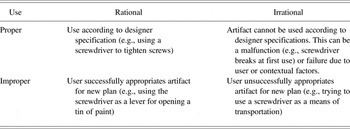
In particular, the use plan approach elaborates two normative aspects of plans: whether they are rational or not and whether they are proper or not. A use plan is rational if its designer justifiably believes that executing the series of actions constituting the plan will lead to the realization of the plan's goal. A use plan is proper if it is the plan the artifact was originally designed for (Houkes, Reference Houkes2006). Similarly, artifact use is rational if the user justifiably expects that the artifact can be used in that way, and proper if that is the kind of use for which the artifact has been designed. The rationality and properness of use plans can be combined in the categorization in Table 1.
Rationality and properness of use plans

Note: Brown and Blessing (Reference Brown and Blessing2005, p. 5) make a similar analysis of ways in which design may go wrong. They distinguish another possibility, where the use plan may be rational and proper but not desired by the user, and thus count as a design failure.
The use plan approach stresses that constructing a use plan is only part of the design work. The other part is communicating the plan to the user, together with any information that the user might need in order to successfully execute the plan.Footnote 7 Houkes and Vermaas write that “in a rational plan, the user believes that the selected objects are available for use—present and in working order—that the physical circumstances afford the use of the object, that auxiliary items are available for use, and that the user herself has the skills necessary for and is physically capable of using the object” (Reference Houkes and Vermaas2004, p. 59).
A difficulty in applying the use plan approach in practice is that it is a rational reconstruction. As such, its purpose is to be an accurate description of an abstract, ideal design process rather than a practical guide to product design. This does not mean that it cannot give practical recommendations, but due to its focus, its prescriptions may be relatively abstract and it is strongly dependent on the rationality and responsibility of the user, requiring only that the plan is communicated clearly. Both practical and theoretical developments in affordance-based design, in contrast, have often been motivated by their potential to contribute to actual design processes. One aspect in which this difference in focus can be seen is the emphasis of affordance-based design's recommendations for making design “idiot-proof” by avoiding or removing undesired affordances. For example, a household ladder of which the horizontal brace contains a sign stating “this is not a step” would qualify as rational design according to the use plan approach. If the brace affords stepping, however, it would count as an undesired affordance and thus be lacking according to affordance-based design (Maier & Fadel, Reference Maier and Fadel2009a, p. 25).
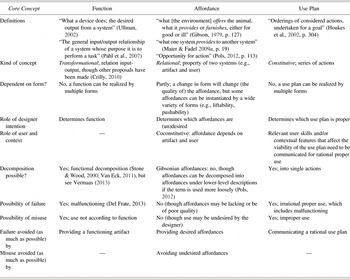
A structured overview of the different features of function-, affordance-, and use plan-based design can be found in Table 2.
Features of function-, affordance-, and use plan-based design approaches

3. THE RELATIONSHIP BETWEEN AFFORDANCES AND FUNCTIONS
In order to show how functions, affordances, and use plans are related, I will link functions to use in Section 3.1. I will then link use to affordances in Section 3.2, using my own work on affordances (Pols, Reference Pols2012).
3.1. Function and rational proper use
The use plan account differentiates between different kinds of artifact use. Of these, “rational proper use” is the counterpart of the classical function concept. The function of a screwdriver is to tighten screws: this is the purpose that can be realized with it by the kind of use for which it is designed (proper), and the purpose for which the user can justifiably expect that it can be used (rational). A designer can describe in different ways how a screwdriver works. The kind of description that is useful differs depending on who is addressed and what they need to know: a description for creating a functional basis model might focus on energy conversion and how torque is transmitted from the user's hand to the screw's head. A use plan description might rather focus on the series of actions the user needs to take with the screwdriver in order to end up with a tightened screw. Both descriptions are valid and differ ultimately only in focus. This translation of functions into use plans highlights why many classical function-based accounts of design fail to take into account user, physical, and social context: they focus on the properness part of functions (e.g., the purpose of a system or its desired output) but neglect their rationality part: under what circumstances the artifact is actually usable according to its function. This includes considerations of who the users are, how they have to interact with the artifact, and whether they have the ability to do this in the “right” way. If we want to take this into account, we can define the function of an artifact as the purpose that can be realized with its rational proper use.
It should be noted, however, that some function-based accounts do take the rationality part into account. Chandrasekaran and Josephson's (Reference Chandrasekaran and Josephson2000) “function as effect,” for example, defines functions as roles + intentions (p. 14). This is remarkably similar to the use plan's definition of rational proper use: the role or mode of deployment of an artifact determines what it can be used for in certain environments by certain users (rationality), and the intention serves to distinguish intended from accidental or unintended use (properness). Thus, while it is a virtue of the use plan account that its definition of function takes both rationality and properness into account, it is not the only (possible) way to do so.
3.2. Use as acting on an opportunity for use
Use, and more generally, action, are broad concepts: they can be interpreted as anything ranging from simple manipulations to complex and prolonged activities. Consequently, if we define affordances as “opportunities for action,” we have to be quite specific about what actions are if the concept is to be usable in design. When Gibson (Reference Gibson1979) worked out what affordances are, he referred to directly perceivable “opportunities for manipulation,” such as grasping or standing on. However, since then various new kinds of affordances have been introduced (e.g., Gaver Reference Gaver, Robertson, Olson and Olson1991; Hartson, Reference Hartson2003).
In an earlier paper (Pols, Reference Pols2012), I argued that actions can be described on different levels, for example, when I brighten the room by turning on the light by flipping the switch by moving my hand, and that affordances can similarly be described on different levels. This yields a fourfold classification of affordances as manipulation opportunities (the Gibsonian affordances: opportunities for simple physical manipulations such as flipping a switch); effect opportunities (opportunities to bring about a certain effect by manipulating an affordance, such as turning on the light); use opportunities (executing a plan of an artifact by performing a series of actions or using the artifact for its function, such as brightening the room); and possibly activity opportunities (opportunities to give your behavior meaning in a social context, such as creating a cozy atmosphere).
This account can be extended to behavior in general because any behavior, doings, and happenings of agents and artifacts can be described on different levels. For example, we can say that a security alarm protects a house by detecting burglars by monitoring motion in specific rooms. This is implicitly incorporated in the use plan approach, where executing a use plan can include instructions for the user to wait while the artifact exhibits particular behavior. For example, once activated, a security alarm requires no further input from the user unless the alarm goes off or the user wishes to deactivate the alarm. Brown and Blessing (Reference Brown and Blessing2005) incidentally present a similar structure for functions: a pen can be said to have the (environment-centric) function of writing by having the (environment-centric) function of causing a piece of paper to have ink on it by having the (device-centric) function of causing ink to flow out of its ink container onto its tip. Here, the artifact's behavior presupposes particular human actions, while the use plan approach does the opposite. As with action descriptions, in this structure there is no “correct” or “true” function description, though different descriptions may serve different practical purposes: all are equally valid, with the caveat that the action or function, under that description, must be intended by the designer. Otherwise, it is not an (intended) function but simply (unintended) artifact behavior.
If we describe actions, affordances, and artifact behavior on different levels, “executing a use plan” is the same as acting on a particular kind of affordance, namely, a use opportunity of an artifact. Given that a use plan is “a considered series of actions undertaken for a goal,” a use opportunity can be regarded as an opportunity for a considered series of actions on manipulation opportunities (Gibsonian affordances), which may or may not include waiting for the artifact to exhibit particular behavior to achieve a goal. This yields us the following, arguably unwieldy, definition of artifact functions in terms of Gibsonian affordances: the function of an artifact is the purpose that may be realized with it by executing a rational and proper series of considered behaviors on affordances of that artifact.
For example, if the function of a screwdriver is to tighten screws, then the screwdriver should support one or more affordances (grasp-ability or turn-ability). The rational and proper series of behaviors on those affordances leads to or constitutes a particular kind of use, namely, that of screw tightening, thus achieving the purpose of tightening screws. What makes this series of behaviors proper is that the user undertakes it for the same use as the designer intended it to be taken. What makes the series rational is that the user justifiably believes that, given the design of the artifact, her skills, and the physical and social context, successful execution of the series of behaviors is possible and will lead to or constitute proper use. By replacing “action” in the definition of use plans with “behaviors (on affordances),” the definition allows for artifact–artifact affordances and can also handle (sub)functions of artifacts that operate without user interaction, as long as their operation is part of some overall goal or use.
In the final section, I draw my conclusions and give three recommendations for further research into conceptualizing the design process.
4. CONCLUSION AND RECOMMENDATIONS
The notion of technical function has come under critical scrutiny from both design researchers and philosophers. Design researchers have argued that the notion is too narrow to properly guide the design process, which requires dealing with many nonfunctional factors, such as cost and maintenance. Philosophers have argued that the notion may not be optimal to use in investigations of what the design process is and how we should conceptualize it. While design researchers and philosophers have thus criticized the notion of technical function for different reasons, some proposed alternatives have gone in similar directions: to move away from examining purposes of artifacts to examining their use.
In this paper, I have compared two alternative conceptualizations of the design process to function-based design approaches: Maier and Fadel's (Reference Maier and Fadel2009a) affordance-based design approach and Houkes and Vermaas's (Reference Houkes and Vermaas2004, Reference Houkes and Vermaas2010) use plan approach. Maier and Fadel are particularly strong in addressing practical designer needs and requirements. The use plan account is a rational reconstruction rather than a practical guide, meaning it is more abstract in its recommendations. In contrast, Houkes and Vermaas have actively included the normativity of function-based design into their account. This has allowed them to distinguish between different kinds of use (rational and irrational, and proper and improper), which seems to have been lost from affordance-based design. I have used this comparison to give a definition of technical functions in terms of actions on affordances, with use as the mediating concept.
I end with three recommendations for further research. First, affordance-based design may be a new design paradigm, but it is clearly not isolated from other paradigms. In this paper, I have given a definition of artifact function in terms of artifact affordances through the intermediary concept of “use,” but this is only one kind of link that could be established. It would, for example, be interesting to see whether models of functional decomposition could have their counterpart in affordance theory, or whether artifact–artifact affordances can be directly mapped to subfunctions for technical artifacts that require little or no direct user input, but operate as part of a bigger technical system, for example, jet engines. Facilitating this translation could not only help designers from different backgrounds to cooperate but also help them to double-check their own designs using a different method. On a more theoretical level, connecting the different approaches could help answering the question of how we should conceptualize and describe the design process. I have suggested the use plan approach as a way to do so. The use plan approach, however, arose partly out of a dissatisfaction with function-based approaches: it would be useful to know whether an affordance-based approach would give a different answer to the question.
Second, an advantage of having multiple design approaches is that one can choose the most appropriate for the task at hand. There is little guidance as of yet, however, which considerations should guide that choice, and if those considerations can be established at all beforehand rather than be the outcome of particular processes such as stakeholder consultation. While this paper has shown some strengths and weaknesses of the different approaches, summarized in Table 2 (e.g., the focus on transformative processes of the function approach and the construction of a general problem space in the affordance-based approach), it has not addressed the question of how multiple considerations should be weighed. This would become important if multiple considerations were to suggest different approaches, for example, when designing an artifact for a transformative process, that at the same time has to operate in a complex environment that cannot be adequately captured by the imposition of simple constraints. A structured exploration of different considerations and their weighing would be very helpful here.
Third, I have argued that a difficulty in comparing the use plan approach to function- and affordance-based approaches is that their goals are different. The use plan approach aims to be a rational reconstruction of a vital part of the design process, while the others have primarily been developed to help guide design practice. Despite this divergence of interests, these approaches can still draw on each other's resources and indicate which considerations they would or would not find important, and why. For example, the use plan approach is very much focused on plans and designer intentions. However, as affordance theory has been extended from user–artifact affordances to artifact–artifact affordances, it would be interesting to compare this move to that of the use plan approach for evaluating artifact (sub)systems such as the jet engine that might otherwise remain black-boxed (Houkes & Vermaas Reference Houkes and Vermaas2010, their section 6.2 on “Use of Components”). Another extension could be an investigation into how use plans could incorporate “idiot proof-ness” and whether the notion of a “rational use plan” has boundaries, for example, when an artifact is extremely unsafe or unreliable to work with.
For affordance-based approaches, a thorough investigation of the notion of “desired affordances” could help analyze whether affordances are (or should be) best analyzed within the use plan approach. The advantage of the use plan approach is that it establishes clear normative standards for especially rationality of use plans. If the use plan approach is not used, do these standards still apply to (a series of) affordances, and if so, how? What information about the artifact has to be communicated to the user, or can affordance-based design (theoretically) obviate the need for communication through labels, manuals, and so on? What is the moral responsibility of the designer besides providing the user with adequate use knowledge in this regard? While these questions are explicitly normative and may not directly influence design practices, working them out can certainly contribute to the further establishment of affordance-based design as a proper design paradigm.
ACKNOWLEDGMENTS
I thank Wybo Houkes and the anonymous reviewers of this journal for their helpful comments on earlier drafts of this paper.
Auke J.K. Pols is a philosopher of technology at Eindhoven University of Technology. He has worked on the intersection between the philosophy of actions and the philosophy of technology for his dissertation, Acting With Artefacts. His earlier work on affordances has been published in Design Studies.