Recent research has pointed body image dissatisfaction as a pervasive phenomenon for women’s well-being and mental health (Mond et al., Reference Mond, Mitchison, Latner, Hay, Owen and Rodgers2013). Body image dissatisfaction implies that one’s weight and body shape are experienced as significantly different from the sociocultural feminine attractiveness standards (Stice & Shaw, Reference Stice and Shaw2002). In Western societies these patterns of feminine attractiveness and beauty are overvalued by the media, and generally linked to control, success and happiness (Altabe & Thompson, Reference Altabe and Thompson1993; Sypeck et al., Reference Sypeck, Gray, Etu, Ahrens, Mosimann and Wiseman2006). In accordance, excess of weight or obesity are nowadays highly associated with both negative perceptions of body image and negative self-worth evaluations (e.g., Puhl & Heuer, Reference Puhl and Heuer2009). Nevertheless, body dissatisfaction is not exclusively experienced by overweight women; in contrast it has rather become the norm, given its prevalence even among women with normal body mass indexes (BMIs) (e.g., Rozin, Bauer, & Catanese, Reference Rozin, Bauer and Catanese2003). In fact, it is undoubtedly known that body image dissatisfaction is a highly prevalent phenomenon for all BMI ranges. Mond and colleagues (Reference Mond, Mitchison, Latner, Hay, Owen and Rodgers2013) documented that almost 87% of women present some level of dissatisfaction concerning body size, shape and weight, and nearly 40% reported moderate to high levels of body dissatisfaction. These authors highlighted that even though body dissatisfaction is a “normative” experience, it does not appear to be benign due to its link with concurrent and subsequent psychopathology (Mond et al., Reference Mond, Mitchison, Latner, Hay, Owen and Rodgers2013).
In fact, body image dissatisfaction has been highly associated with a variety of negative health outcomes, such as depressive mood and eating psychopathology (e.g., Pinto-Gouveia, Ferreira, & Duarte, Reference Pinto-Gouveia, Ferreira and Duarte2014; Stice, Marti, & Durant, Reference Stice, Marti and Durant2011). Also, results from different studies emphasized the relationship between body dissatisfaction and quality of life (QoL) and well-being impairment, showing that higher body dissatisfaction was associated with decreased levels on all domains of QoL, especially psychosocial functioning (Duarte, Ferreira, Trindade, & Pinto-Gouveia, Reference Duarte, Ferreira, Trindade and Pinto-Gouveia2015; Ferreira & Trindade, Reference Ferreira and Trindade2015; Mond et al., Reference Mond, Mitchison, Latner, Hay, Owen and Rodgers2013). In addition, the degree of mental health impairment has been shown to be proportional to the degree of body dissatisfaction (Mond et al., Reference Mond, Mitchison, Latner, Hay, Owen and Rodgers2013). In accordance, research suggests that, when compared to those with normal weight (18.5 ≤ BMI < 25 kg/m2), individuals with excess weight or obesity (BMI ≥ 25 kg/m2) present lower health-related QoL in all range of health dimensions (Kearns, Ara, Young, & Relton, Reference Kearns, Ara, Young and Relton2013).
Given the expressive prevalence of body dissatisfaction and its negative effect on various domains of QoL, evidence suggests that body dissatisfaction should be considered, by itself, as a relevant public health problem in Western societies, and a target for efforts in health promotion (Mond et al., Reference Mond, Mitchison, Latner, Hay, Owen and Rodgers2013). Furthermore, research has generated support for the assertion that perceiving one’s own body as divergent from the idealized body image does not directly impair the individual´s QoL, and that this relationship may be mediated by relevant emotion regulation processes (Duarte et al., Reference Duarte, Ferreira, Trindade and Pinto-Gouveia2015). Specifically, even if some levels of body dissatisfaction are unavoidable for the majority of women, it is the way one replies to one’s body dissatisfaction that can have a negative impact on one’s health. Nonetheless, the adaptive and maladaptive emotion regulation strategies implicated in this relationship are less clear.
Self-compassion can be viewed as an adaptive emotion regulation strategy that holds a positive effect in mental health, in which painful or distressing feelings are not avoided but are instead held in awareness with kindness, understanding, and a sense of shared humanity (Neff, Reference Neff2003a). According to Gilbert (Reference Gilbert and Baldwin2005), this emotion regulation process is characterized by a self-to-self relationship punctuated by a sense of care, warmth, and safeness. That is, feeling compassion for oneself involves accepting in a caring manner one’s failures, imperfections or life’s negative aspects (e.g., not being able to reach an ideal body shape or to avoid overeating; Gilbert, Reference Gilbert2000). In fact, growing research shows that the ability to be self-compassionate leads to the gentle acceptation of negative internal experiences (e.g., negative body image perceptions) with the feeling of connectedness, and to assume effective actions on promotion of one’s well-being (Kelly, Vimalakanthan, & Miller, Reference Kelly, Vimalakanthan and Miller2014; Neff, Reference Neff2004; Neff & Vonk, Reference Neff and Vonk2009). Also, research has shown that self-compassion can buffer people against the impact of distressing and challenging situations (Brion, Leary, & Drabkin, Reference Brion, Leary and Drabkin2014; Leary, Tate, Adams, Batts, & Hancock, Reference Leary, Tate, Adams, Batts and Hancock2007). Namely, and in what concerns body image, a recent study showed that, for normal-weight college students, the harmful effect of negative experiences related to the body on QoL may be mitigated by the ability to be self-compassionate (Duarte et al., Reference Duarte, Ferreira, Trindade and Pinto-Gouveia2015). In contrast, recent studies have shown that body image dissatisfaction may become problematic when it becomes linked to maladaptive emotion regulation strategies (Pinto-Gouveia et al., Reference Pinto-Gouveia, Ferreira and Duarte2014).
Literature has shown that women presenting self-judgment about one’s own failures or inadequacies, that over-identify themselves with one’s own thoughts and emotion states, and that engage in feelings of isolation, present higher levels of distress and may become more vulnerable to psychopathology (Berry, Kowalski, Ferguson, & McHugh,, Reference Berry, Kowalski, Ferguson and McHugh2010; Magnus, Kowalski, & McHugh, Reference Magnus, Kowalski and McHugh2010). Self-judgment is a maladaptive strategy conceptualized as a critical self-to-self relationship which involves self-attribution of errors and unsuccessful life experiences, over identification with negative feelings when facing failure and being carried away by the story-line of one’s own pain (Neff, Reference Neff2003b). In fact, being harshly self-critical when facing setbacks or perceived inadequacies, or when perceiving some unwished characteristic about themselves, is often associated with decreases in psychological functioning, and with higher levels of negative mood and psychopathological symptoms, such as eating disordered symptomatology (Ferreira, Pinto-Gouveia, & Duarte, Reference Ferreira, Pinto-Gouveia and Duarte2013; Pinto-Gouveia et al., Reference Pinto-Gouveia, Ferreira and Duarte2014). However, the role of this maladaptive emotion regulation in the relationship between body dissatisfaction and QoL remains unclear.
The current study aims are threefold. First, this study aims at understanding the differences between two different BMI categories (normal-weight and overweight women) relatively to body dissatisfaction (BD), self-judgment, and subjective QoL regarding physical, psychological, relationship and environment domains. Second, this study intends to explore the associations between these variables both in normal-weight and overweight women. Given the links established between BMI, BD and impairment in emotional well-being, the insidious impact of BD on QoL might be expected to be most prominent for overweight women. Third, the main aim of this study is to examine whether self-judgment mediates the association between BD and women’s subjective QoL, in normal and overweight women. We hypothesize that, for both normal weight and overweight women, the impact of a negative self-evaluation of body image on psychological QoL depends upon the extent to which individuals present self-judgment.
Methods
Procedure
The present cross-sectional study is part of a wider research project about QoL and eating psychopathology in the Portuguese population. As in previous studies, the present paper’s analyses were conducted in college women due to their well-known risk for presenting high levels of body image dissatisfaction and greater body image-related impairment (Luce, Crowther, & Pole, Reference Luce, Crowther and Pole2008), specifically on psychological well-being.
First, the ethic committees of all educational institutions involved in the study provided their approval after the analysis of the present research protocols. Prior to the administration of the protocol, all participants gave their informed consent after being informed about the purpose, procedures, data confidentiality, and voluntary feature of their participation. Participants received extra credit for their participation. Then, the instruments were applied in the classroom context, taking into consideration the times scheduled with the enrolled educational institutions. The original sample consisted of 650 women. However, given the exclusion of participants due to non-correct completions of protocols (e.g., missing data superior to 15% in a questionnaire), age requirements, and the study aims, the sample resulted in 292 participants, divided by two groups. The criterion used to distinguish the groups was participants’ BMI: the overweight group comprised 92 women; while the normal-weight group was composed of 200 participants which were selected from a randomization of a wider group of normal-weight participants.
Participants
The sample of this study comprised two independent groups of female students, with ages ranging from 18 to 24 years old. The groups were defined by BMI. Therefore, 200 participants presented normal weight (BMI ranging from 18.5 to 24.9; WHO, 2000), with a mean age of 20.39 years old (SD = 1.64); and 92 participants were overweight (BMI ≥ 25; WHO, 2000), with a mean of 20.39 years of age (SD = 1.64). Regarding years of education, the two groups presented a mean of 13.28 (SD = 1.37) and 13.23 (SD = 1.35), respectively. The two groups did not present significant differences concerning age t(290) = –.03; p = .976, and years of education t(290) = .30; p = .764.
Measures
Body Mass Index (BMI)
BMI was calculated from participants’ self-reported current height and weight using the Quetelet Index (Kg/m2).
Figure Rating Scale (FRS; Thompson & Altabe, Reference Thompson and Altabe1991; Portuguese validation by Ferreira, Reference Ferreira2003)
The FRS is a well-known measure of body image dissatisfaction. It consists of a series of nine body silhouettes of different sizes, ranging from very thin (1) to very large (9). Participants respond by selecting the silhouettes that best represent their self-perceived current and ideal body images. The degree of body image dissatisfaction (BD) is estimated by the divergence between the two silhouettes. The scale has shown good temporal, convergent and divergent validities (Thompson & Altabe, Reference Thompson and Altabe1991).
Self-Compassion Scale (SCS; Neff, Reference Neff2003a; Portuguese validation by Castilho & Pinto-Gouveia, Reference Castilho and Pinto-Gouveia2011)
The SCS is a self-report instrument that assesses self-compassion, designed to capture the respondent’s self-perceived actions towards themselves during difficult times. The 26 items comprised in this instrument are rated on a Likert-type scale, ranging from “1” (“almost never”) to “5” (“almost always”). The SCS comprises two main components: a positive one, including tree subscales: self-kindness, common humanity, and mindfulness subscales; and a negative one, comprising the self-judgment (e.g., ‘‘When I see aspects of myself that I don’t like, I get down on myself’’), isolation (e.g., ‘‘When I fail at something that’s important to me, I tend to feel alone in my failure’’), and over-identification (e.g., ‘‘When something painful happens I tend to blow the incident out of proportion”) subscales. For the purpose of this study, a composite measure of the 3 negative dimensions of the SCS was computed and defined as a self-judgment dimension due to its association with the overstimulation of the threat system (Costa. Marôco, Pinto-Gouveia., Ferreira, & Castilho, Reference Costa, Marôco, Pinto-Gouveia, Ferreira and Castilho2015). The SCS presented good internal reliability in the original version (.92) and in the Portuguese version (.89); in the present study, the Cronbach’s alpha value was .79 for the normal-weight and .85 for overweight sample.
World Health Organization Quality of Life – Bref (WHOQOL-BREF; WHOQOL Group, 1998; Portuguese validation by Canavarro, et al., Reference Canavarro, Simões, Serra, Pereira, Rijo, Quartilho, Carona, Simões, Gonçalves and Almeida2006)
The WHOQOL-BREF is a multidimensional and multicultural self-report measure that evaluates subjective QoL. It consists of twenty-six items, two of which are general and evaluate the global perception of health and QoL, and the other twenty-four items assess four broad domains: Physical Health (e.g., “To what extent do you feel that physical pain prevents you from doing what you need to do?”) , Psychological Health (e.g., “To what extent do you feel your life to be meaningful?”), Social Relationships (e.g., “How satisfied are you with your personal relationships?”), and Environment (e.g., “How healthy is your physical environment?”). Items are scored on a five-point Likert-type scale, ranging from “1” (“extreme dissatisfaction”) to “5” (“extreme satisfaction”), with higher scores indicating higher QoL. The WHOQOL-BREF showed adequate criterion and content validity, internal consistency and test–retest reliability, in both the original and the Portuguese versions. In this study, internal consistency values of .89 and .87 were obtained for the normal BMI group and the overweight group, respectively.
Analytic Strategy
The software SPSS (v.21 SPSS; Armonk, NY: IBM Corp) was used to perform data analyses. Independent samples student’s t-tests were used to explore the differences between the variables of interest in both groups. Cohen’s d effect size was also computed. Pearson correlation coefficients were performed in both groups (Cohen, Cohen, West, & Aiken, Reference Cohen, Cohen, West and Aiken2003), to analyse the relationships between body image dissatisfaction, self-judgement and QoL dimensions.
Finally, the mediation analyses were performed using PROCESS (Hayes, Reference Hayes2013), a macro that allows the establishment of path analyses. In the present study it were conducted two models of simple mediation (Model 4; Hayes, Reference Hayes2013) in the two BMI groups, exploring the indirect effect of body image dissatisfaction (independent variable) on psychological QoL (dependent variable) through the mechanism of self-judgment (mediator variable). The significance of the indirect effects between variables was tested using the bootstrap method (with 5000 samples), which produces a 95% confidence interval (bias-corrected and accelerated confidence intervals - BCa CIs) of the indirect effect. A statistically significant mediation effect exists if the values between the upper and lower confidence bound do not include zero.
Results
Preliminary data analyses
Uni and multivariate normality was examined by the values of Skewness (Sk) and Kurtosis (Ku), which indicated the absence of severe violation of normal distribution (Kline, Reference Kline1998). In addition, preliminary data analyses indicated that these data were appropriate for regression analyses following the assumptions of normality, linearity, homoscedasticity, independence of errors, and multicollinearity (Field, Reference Field2004).
Descriptives and differences between groups
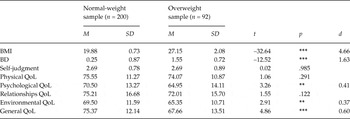
The means, standard deviations, and Student t-test results between the normal-weight sample (n = 200) and the overweight sample (n = 92) in all of the study variables, are reported in Table 1. Results showed that, consistently to what was expected, the two groups presented significant differences with a large effect size regarding body dissatisfaction, with overweight participants presenting higher body dissatisfaction. Also, the groups presented differences in general, psychological and environmental QoL with medium effect sizes. Overweight participants revealed lower levels of these QoL dimensions when compared to normal-weight participants. However, these two groups did not differ concerning the physical and social relationships QoL domains, and in the maladaptive emotion regulation process in study (self-judgment).
Differences between the two groups (normal-weightand overweight women)
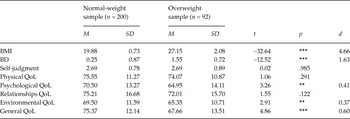
Note
** p < .010; ***p < .001;
BMI = Body Mass Index; BD = Body Image Dissatisfaction; Self-jugment = dimension of SCS; Physical QoL, Psychological QoL, Relationships QoL, Environmental QoL, General QoL = domains of the WHOQOL_BREF.
Correlations
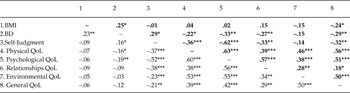
Pearson product-moment correlation coefficients (Table 2) indicated that BMI was positively associated with body image dissatisfaction (BD) for both samples. It is noteworthy to mention that BMI was significantly and negatively associated with general quality of life (QoL), but solely in the overweight sample. For both samples, BD was found to be correlated with self-judgment.
Correlations between study variables in the normal-weight (NW; n = 200) and overweight (OW; n = 92; in bold) groups

Note
* p < .050; **p < .010; ***p < .001;
BMI = Body Mass Index; BD = Body Image Dissatisfaction; Self-jugment = dimension of SCS; Physical QoL, Psychological QoL, Relationships QoL, Environmental QoL, General QoL = domains of the WHOQOL_BREF.
Additionally, in the overweight sample, BD showed negative and significant associations with general QoL and with the physical, psychological and social relationships QoL dimensions; although an exception was verified regarding the environmental dimension of QoL. In the normal-weight sample, BD only presented significant, although weak, negative correlations with physical and psychological QoL dimensions.
In both samples it were evidenced negative associations between self-judgment and all QoL domains and overall QoL. An exception was verified in the overweight sample regarding the environmental dimension of QoL, which revealed a non-significant association with this maladaptive emotional process.
Mediation analyses
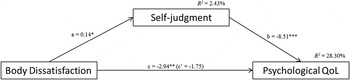
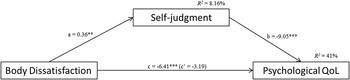
With the purpose of exploring the mediator role of self-judgment in the association between body image dissatisfaction (BD) and psychological QoL, two mediator analyses (Hayes, Reference Hayes2013) were conducted in the normal-weight female sample (Figure 1) and in the overweight female sample (Figure 2).
Normal-weight sample.
Note: Visual representation of the simple mediation in the normal-weight group (n = 200) exploring the effect of self-judgment on the association between body dissatisfaction and psychological QoL. The values on the arrows represent non-standardized regression coefficients. a = the effect of body dissatisfaction on self-judgment; b = the effect of self-judgment on psychological QoL; c = the total effect of body dissatisfaction on psychological QoL; c’ = the direct effect of body dissatisfaction on psychological QoL after the inclusion of the mediator variable (self-judgment).
*p < .05, **p < .01, ***p < .001.

Overweight sample.
Note: Visual representation of the simple mediation in the overweight group (n = 98) exploring the effect of self-judgment on the association between body dissatisfaction and psychological QoL. The values on the arrows represent non-standardized regression coefficients. a = the effect of body dissatisfaction on self-judgment; b = the effect of self-judgment on psychological QoL; c = the total effect of body dissatisfaction on psychological QoL; c’ = the direct effect of body dissatisfaction on psychological QoL after the inclusion of the mediator variable (self-judgment).
*p < .05, **p < .01, ***p < .001.

In the normal-weight sample, the individual analysis of the relationships between variables revealed that BD is significantly associated with self-judgment (b = 0.14; SE = 0.06; p = .028) in a significant model (F(1, 198) = 4.92; p = .028). Furthermore, psychological QoL was associated with self-judgment (b = –8.51; SE = 1.04; p < .001) but not with body dissatisfaction (b = –1.75; SE = 0.93; p = .060) in a model that explained 28.3% of psychological QoL (F(2, 197) = 38.87; p < .001).
Despite this non-significant direct effect, it was found an indirect effect in the relationship between body dissatisfaction and psychological QoL through self-judgment b = –1.19; SE = 0.59; 95% CI [–2.41 to –0.04]. Therefore, the negative effect of body dissatisfaction on the psychological QoL of normal-weight women seemed to act through the mechanisms of self-judgment.
Regarding the overweight sample, the same procedure was conducted. The individual analysis of the associations between variables demonstrated that BD is significantly associated with self-judgment (b = 0.36; SE = 0.13; p = .006) in a significant model (F(1, 90) = 8.00; p = .006). Moreover, in this group, psychological QoL was also associated with self-judgment (b = –9.05; SE = 1.35; p < .001) but not with body dissatisfaction (b = –3.19; SE = 1.68; p = .060) in a model that explains 41% of psychological QoL (F(2, 89) = 30.53; p < .001).
It was also found an indirect effect in the association between body dissatisfaction and psychological QoL through self-judgment (b = –3.22; SE = 1.39; 95% CI [–6.35 to –.89]. These results seem to indicate that the negative effect of body dissatisfaction on overweight women’s psychological QoL also seems to be mediated by self-judgment.
Discussion
Previous research suggested that the negative impact of body image dissatisfaction on women’s mental well-being is not linear (Mond et al., Reference Mond, Mitchison, Latner, Hay, Owen and Rodgers2013). Specifically, although it is reported that some levels of body dissatisfaction are unavoidable for the majority of women, it may be the way one replies to body dissatisfaction that can have a negative impact on one’s psychological health. Nonetheless, the maladaptive emotion regulation strategies implicated in this relationship remain unclear.
The main aim of this study was therefore to test the mediator effect of self-judgment on the relationship between the negative experience of one’s own body image and psychological QoL, in normal-weight and overweight female students. For this purpose, statistical analyses were performed in two independent samples: normal-weight group (18.5 ≤ BMI ≤ 24.9) and overweight group (BMI ≥ 25).
Comparisons analyses from the BMI groups showed, as expected, that overweight women presented higher levels of body image dissatisfaction, when compared to normal-weight participants. Additionally, and in accordance with previous research (e.g., Kearns et al., Reference Kearns, Ara, Young and Relton2013), female students with excess of weight or obesity, when compared to those with normal-weight presented lower levels of an overall perception of well-being. Also, overweight women reported lower levels in psychological and environmental QoL domains. However, these two groups did not present significant differences concerning physical and social relationships QoL domains, and also self-judgment.
In line with extant literature, this study showed that BMI was positively linked to body image dissatisfaction, in the normal-weight and the overweight groups (e.g., Puhl & Heuer, Reference Puhl and Heuer2009; Rozin, Bauer, & Catanese, Reference Rozin, Bauer and Catanese2003). Interestedly, BMI did not present significant associations with the dimensions of QoL, neither for normal and overweight female college students. An exception was verified in the overweight group, in which BMI was inversely correlated with general QoL. Regarding the relationship between body image dissatisfaction and QoL domains, the present results go in line with previous research (Kearns et al., Reference Kearns, Ara, Young and Relton2013). Specifically, results demonstrated that for overweight and obese female students a negative perception of body image was linked to low levels of overall well-being and to physical, psychological and social QoL. While in the normal-weight group body image dissatisfaction only presented significant, although weak, negative correlations with physical and psychological QoL dimensions.
Concerning the relationship between self-judgment and QoL, the present study extended previous research which has demonstrated the link between this emotion regulation process and psychopathology (Berry et al., Reference Berry, Kowalski, Ferguson and McHugh2010; Ferreira et al., Reference Ferreira, Pinto-Gouveia and Duarte2013; Magnus et al., Reference Magnus, Kowalski and McHugh2010; Pinto-Gouveia et al., Reference Pinto-Gouveia, Ferreira and Duarte2014). Specifically, results showed that women who presented harsher self-judgment about their failures or inadequacies, over-identifying themselves with thoughts and emotional states, and presenting feelings of isolation, tend to present lower levels in overall and all QoL domains. In fact, a harsh self-critical attitude was associated with poorer physical, psychological and social QoL indices in both groups. An exception was verified regarding the environmental dimension of QoL, which revealed a non-significant association with this maladaptive emotional process in the overweight sample. It seems important to note that, in the overweight sample, self-judgment showed a strong negative association with psychological QoL, which is considered a main aspect to define individuals’ overall level of health (Camfield & Skevington, Reference Camfield and Skevington2008; Hoffman & Driscoll, Reference Hoffman, Driscoll, Brown and Lent RW2000).
Additionally, to further understand the relationship between body image dissatisfaction, psychological QoL and self-judgment in normal-weight and overweight female college students, mediation analyses were conducted for each group. Results indicated that, in both BMI groups, body image dissatisfaction presented a negative effect on psychological QoL with a simultaneous indirect effect through the mechanism of self-judgment. This mediational model explained a total of 28.3% and 40.7% of the variance of psychological QoL in the normal-weight and overweight group, respectively.
These findings suggest that the experience of body dissatisfaction by normal-weight and overweight women is linked to a higher engagement in an emotion regulation process marked by criticism and judgment towards the self, which seems to explain lower psychological QoL. These findings may indicate that the extent to which negative body-related experiences impact on women’s well-being depends on the level of self-judgment, i.e., a critical self-to-self relationship which involves self-attribution of error and unsuccessful life events. It was interesting to verify that the same impact pattern was observed in normal-weight women and women with excess of weight. These data seem to show that the way one responds to body-related experiences significantly influence the impact of those experiences on psychological QoL, but. In other words, data suggests that the experience of physical appearance dissatisfaction, when mediated by judgmental and self-critical attitudes, results in worse psychological QoL indicators.
These findings cannot be considered without taking account some limitations. Firstly, the main limitation of the present study is its cross-sectional nature which does not allow causal interpretations. Therefore, future research should focus on longitudinal and experimental research of emotion regulation processes’ role on women’s QoL. Secondly, the tested mediational model is restrained since other emotion regulation processes are probably involved in the association between body image dissatisfaction and QoL (e.g., body image flexibility, rumination). In this study, the mediational model was intentionally limited to specifically explore the impact of self-judgment on QoL. Nevertheless, in future studies, different emotion processes should be tested. Finally, another possible limitation concerns the characteristics of the sample. The use of a convenience sample of female college students can limit the generalization of the data. Indeed, future studies should test our findings in more diversified samples, with different age ranges, different cultures, and gender.
Nevertheless, the present study seems to contribute to the growing literature concerning the role of self-judgment in the relationship between body image dissatisfaction and psychological QoL in normal-weight and overweight women. It was indeed interesting to note that body dissatisfaction might not directly impact women’s psychological health, which rather seems to depend upon the extent to which individuals present negative self-judgment and self-scrutiny when facing inadequacies or unwished characteristics about themselves. These findings may contribute to future research and may have important implications for the development of community-based interventions focused on the promotion of QoL in women. In particular, this study seems to emphasize that these interventions should target not only one’s experience related to body image, but mostly how one relates to such experience. That is, our findings suggest that rather than efforts being placed in targeting weight or body image dissatisfaction, interventions should focus on developing adaptive emotion regulation, opposed to harsh self-critical and judgmental attitudes, to deal with such negative experiences related to body image.