1 Introduction
Scottish Gaelic has been described as having a number of unusual phonological properties (Borgstrøm Reference Borgstrøm1940, Ladefoged et al. Reference Ladefoged, Ladefoged, Turk, Hind and Skilton1998). Among these is the phonological status of the inserted vowel.Footnote 1 Consider, for example, a word like balg ‘blister’, pronounced as [balak]. The apparent second vowel in the pronounced form is obligatory, and is claimed either to have been historically inserted in certain environments, some of which are now opaque (Borgstrøm Reference Borgstrøm1940), or to be synchronically inserted in those same environments (Clements Reference Clements, Bogers, Hulst and Mous1986, Bosch & de Jong Reference Bosch and de Jong1997). Compare this with ballag [balak] ‘skull’, where the second vowel is underlying.
There has been corresponding debate as to the inserted vowel's phonological status. Hall (Reference Hall2006), in particular, cites the Scottish Gaelic inserted vowel as an instance of an excrescent vowel. An excrescent vowel is defined as one that is phonologically invisible. As such, it is predicted not to affect the phonology of the rest of the word; for example, it should not count as a syllable, or be in the environment for a phonological alternation. In this paper, we report on a series of experiments, and argue that though the inserted vowel exhibits virtually all of the properties that define an excrescent vowel for Hall, it is not, in fact, phonologically invisible. That said, we also find that the inserted vowels are not visible to the phonology in the same way as underlying vowels.
We first review the distribution of the vowel. We go on to consider Hall's typology of inserted vowels, showing how the Scottish Gaelic case fits the typology. We then turn to our experiments. Our experiments establish the facts in (1) about the inserted vowel in Scottish Gaelic.
-
(1)


These results are important, because they provide empirical substance to the debate on the phonological status of inserted material. Once we have reviewed the properties of excrescent segments, we will show how these are incompatible with treating the Scottish Gaelic inserted vowel as excrescent.
2 Distributional regularities
In this section, we outline the distributional regularities governing the inserted vowel in Scottish Gaelic. Previous treatments of the relevant phonology include Clements (Reference Clements, Bogers, Hulst and Mous1986), Bosch (Reference Bosch1991), Bosch & de Jong (Reference Bosch and de Jong1997) and Smith (Reference Smith, Hulst and Ritter1999).
Certain consonant sequences are broken up with a vowel, as shown in (2).Footnote 2
-
(2)

In each pair in (2), the first word has an underlying second vowel and the second an inserted vowel; the inserted vowel does not appear in the orthographic representation. Borgstrøm (Reference Borgstrøm1940) maintains that, while an intervocalic consonant normally affiliates with the syllable to the left, before an inserted vowel the consonant affiliates to the right; we have marked this syllabification in (2).Footnote 3
The examples in (3) show that the inserted vowel is generally identical to the preceding vowel.
-
(3)

There are four conditions that must hold for vowel insertion: (i) the preceding consonant must be a sonorant liquid or nasal, (ii) the preceding vowel must be a short monophthong, (iii) the cluster may not be homorganic and (iv) the second consonant may not be a preaspirated stop. We go through all four cases here.
The consonant preceding the inserted vowel must be a sonorant liquid or nasal. The following are examples of clusters that don't exhibit the inserted vowel, because the first consonant of the cluster is not a sonorant.
-
(4)

The preceding vowel must be a short monophthong; a preceding long vowel or diphthong blocks insertion, as shown by the examples in (5).
-
(5)

Inserted vowels may not break up a homorganic cluster, as seen in (6).
-
(6)

Finally, the second consonant may not be a preaspirated stop. In medial position, the voicing contrast for stops is realised as a contrast between plain voiceless and preaspirated (Clayton Reference Clayton2010). The former correspond to initial voiced (or plain) stops, while the latter correspond to initial voiceless (or aspirated) stops.Footnote 4 After a sonorant, we transcribe the preaspiration as devoicing of the sonorant, as in (7).
-
(7)

Summarising, the inserted vowel is obligatory in the frame in (8). There must be a preceding short vowel. The first of the two consonants must be a sonorant and the second must not be preaspirated. Finally, the two consonants may not be homorganic.
-
(8)

Notice that there is no overt syllabification restriction on the nature of the cluster in (8); hence adding suffixes to relevant word-final clusters does not produce alternations.
Bosch (Reference Bosch1998) maintains that there are stress and syllabification differences in many dialects between inserted and underlying vowels. First, as already noted above, Borgstrøm (Reference Borgstrøm1940) holds that while, in general, intervocalic consonants are reported to affiliate to the left, a consonant preceding an inserted vowel affiliates to the right, implying the syllabifications in (9). This would, of course, go against the typical cross-linguistic pattern where onsets are maximised (e.g. Hooper Reference Hooper1972, Kahn Reference Kahn1976, Steriade Reference Steriade1982, Clements & Keyser Reference Clements and Keyser1983).
-
(9)

Second, while stress generally falls on the first syllable of a word, if the second vowel is an inserted vowel, stress is reported to fall there instead, as in (10) (Bosch & de Jong Reference Bosch and de Jong1997).
-
(10)

These prosodic restrictions are quite remarkable. First, we would not expect inserted vowels to attract an onset where underlying vowels do not. In addition, we would not expect inserted vowels to attract stress in an environment where underlying vowels do not. We do not treat the stress facts here, but our experiments directly address the syllabification facts.
3 Epenthesis vs. excrescence
Hall (Reference Hall2006) argues for a sharp distinction between what she refers to as epenthetic vowels (phonologically visible inserted vowels) and excrescent vowels (phonologically invisible inserted vowels), giving the properties in (11) for epenthetic vowels (2006: 391).
-
(11)

She describes excrescent vowels as in (12).
-
(12)

The inserted vowel in Scottish Gaelic exhibits many of the properties of excrescent vowels. First, the inserted vowel is a copy of the preceding vowel (12a).Footnote 5 The consonant intervening between the inserted vowel and the vowel it copies is a sonorant (12b). Third, the vowel occurs only in a heterorganic cluster (12c). Finally, the inserted vowel doesn't obviously repair an illicit structure (12e).Footnote 6 On the other hand, the inserted vowel is not optional or variable (12d).
Hall's proposal is to treat excrescent vowels in general, and Scottish Gaelic inserted vowels specifically, as the result of a non-phonological gestural operation. Since this operation takes place at a different level from the phonology, it follows that words like arm [aram], with an inserted vowel, are phonologically monosyllabic.
Hall gives a number of arguments that the Scottish Gaelic inserted vowel is not phonological. This is a difficult argument to make in principle, because there is no generally accepted diagnostic for what constitutes a phonological pattern vs. what constitutes a phonetic pattern. Several of Hall's arguments are of a derivational character: the argument is based on the observation that vowel insertion would seem to follow some other process.
For example, she cites glottal epenthesis in Argyllshire Gaelic as evidence (Smith Reference Smith, Hulst and Ritter1999). In this dialect, a glottal stop is inserted to close short stressed open syllables (13a). This does not occur after a long vowel or diphthong (13b), or before a cluster broken up by an inserted vowel (13c).
-
(13)

Hall concludes that clusters broken up by inserted vowels behave like coda consonants and that the inserted vowel is excrescent. Alternatively, from a derivational perspective, this can be characterised in terms of vowel insertion following glottal stop insertion in the phonology. Hall presents three additional sets of data that are of this sort: (i) first-syllable vowel restrictions apply to inserted vowels, (ii) vowel assimilation to palatalised (in traditional terms ‘slenderised’) consonants includes the vowel preceding the inserted vowel and (iii) vowel syncope creates an environment for vowel insertion. While these additional facts are consistent with an analysis where vowel insertion is not phonological, they are also consistent with an analysis where vowel insertion follows the relevant phonological process. Such relationships are handled differently in a framework such as Optimality Theory, but our point is not the precise theoretical characterisation, but rather that these arguments have a general character consistent with inserted vowels being phonological.
Hall also cites arguments from prosody. First, she cites Ladefoged et al. (Reference Ladefoged, Ladefoged, Turk, Hind and Skilton1998) as establishing that a monosyllable with an inserted vowel ‘has the same pitch pattern as monosyllables’ (2006: 401), but this is not our reading of that paper. Rather, Ladefoged et al. present preliminary results that would seem to show that words with inserted vowels, like balg [balak] ‘blister’ have different pitch properties from words with underlying (non-inserted) vowels, like ballag [balak] ‘skull’. They do not directly compare these words with monosyllables which do not have an inserted vowel. In fact, given that words like balg have two vocalic portions, it's not clear how their pitch could be the same as genuine monosyllables with one vocalic portion. That said, this line of argument is certainly interesting and merits further detailed investigation.
Hall also cites syllabification arguments in support of her position. For example, Borgstrøm (Reference Borgstrøm1940: 153) maintains that native speakers do not treat inserted vowels as a separate syllable:Footnote 7
Comparing the two words f
 Nak ‘a crow’ … and ʃ[
aLa
]
k ‘hunting’ … [a consultant] said: In f
Nak there is a ‘space’ between the two syllables, so that he could pronounce f
– Nak. In ʃ[
aLa
]
k the L and the following k are so ‘close together’ that such a separation is impossible; the word is ‘nearly monosyllabic, but not quite monosyllabic’.
If this is correct, inserted vowels do not change the syllable count of a word; a word like sealg [ʃalak] ‘hunting’, with an inserted second vowel, has one syllable.
Summarising, the phonological evidence is unclear on whether the inserted vowel in Scottish Gaelic is phonological. We saw in the previous section that the conditions under which the inserted vowel occurs are phonological in nature: they can be expressed in terms of configurations that can be expressed in phonological features and syllable structure. That said, the inserted vowel is not treated as a vowel by other phonological processes in the language. In addition, the syllabification facts that have been cited would also seem to support a view that the inserted vowel is not phonological.
Our experiments address precisely the syllabification claims. We consider first whether speakers can perceive these vowels at all, and then focus on the two specific syllabification claims: (i) do inserted vowels constitute a separate syllable, and (ii) do they affect the syllabic affiliation of adjacent consonants? We establish that speakers are aware of these vowels and can distinguish them from underlying vowels. In addition, we show that they do affect the number of syllables in a word and the syllabic affiliation of intervocalic consonants. The import of these results is that the inserted vowels of Scottish Gaelic are phonologically relevant. The precise contribution of these vowels is not categorical, however, and so it is fair to say that if the inserted vowels are phonological, they are not phonological in the same sense as underlying vowels. We return to this after we present our experimental results.
4 Experiment 1: partial word identification
The purpose of this experiment was to determine whether native listeners can identify whether a string contains an inserted or an underlying vowel on the basis of acoustic cues. These cues need not be localised in the vowel itself, but may be distributed throughout the string. However, if listeners heard the entire word containing the target vowel, they could use knowledge of the lexicon and orthography to determine the insertion status of the vowel. Therefore, in this experiment, we presented VC(V)C portions clipped from recordings of longer real words, where the second vowel was either inserted or non-inserted (underlying).Footnote 8 For example, the words bargan [barakan] ‘bargain’ and marag [marak] ‘blood pudding’ were recorded by a native speaker of Scottish Gaelic (the sixth author, our native speaker consultant, who was naive as to the purposes of the experiment at that time) and the [arak]/[arak] portions of each word were clipped out for use as stimuli. This manipulation ensured that the target vowels were pronounced naturally, as they were read in real words, but that the listeners could not hear enough of the word to recognise the lexical item. It is possible that coarticulation in the remaining segments could provide enough information for listeners to recognise some of the whole words. However, for most items, it was expected that the remaining part of the stimulus word presented would not provide enough cues to allow recognition of the full word. Furthermore, it was important to present the vowel before the target syllable if possible, because the duration ratio of the vowels might serve as a cue to their vowel-insertion status. This method was used rather than presenting whole words because there are very few minimal pairs in the language differing only in the insertion status of the vowel.
4.1 Participants
All of the experiments that we report on here were run in sequence, interspersed with a number of other perceptual and articulatory experiments not relevant to the topic of this paper. The sequence was not the sequence in which results are reported here, and varied by subject. These different orderings were largely a function of logistical concerns, maximising the participation of each subject across the experiments reported here and others that we conducted not relevant to this paper. There were some ordering constraints that we maintained so as not to bias subjects from one study to another, and these are cited below where relevant. We used only subjects for whom Scottish Gaelic was a first language. Given the endangered status of the language, this meant that subjects were hard to find and that many of our subjects were quite old and occasionally infirm. We were able to run our experiments on 18 native speakers of the language, all of whom had been monolingual until age 5. Because of their age, some of our subjects were not able to complete all the studies. In addition, one subject was not literate in Scottish Gaelic and had to be excluded from some of the studies. These exclusions are noted separately for each experiment.
For Experiment 1, participants were 18 native speakers of Scottish Gaelic. The participant who was ultimately discovered not to read Scottish Gaelic was excluded from this task. Another subject was excluded because of equipment failure during the experiment. Data from 16 subjects were thus available for analysis.
4.2 Methods
The experiment was run using E-prime software on a PC netbook. For each task, subjects were first given oral instructions in English about the nature of the task. Written instructions in English were also provided at the beginning of each E-prime experiment.
Target stimuli were extracted from the 14 real words of Scottish Gaelic in (14), seven of which contained an inserted vowel and seven an underlying vowel in an environment matching the environment of one of the words containing an inserted vowel. Stimuli were randomised with the stimuli for several experiments on perception of other distinctions not reported here, so that listeners were not responding repeatedly to tokens with inserted vowels.
-
(14)

The stimuli relevant to perception of other distinctions (which served as fillers for the current experiment) were similar to the current stimuli, in being strings of a few segments excised out of Gaelic words. The task for these fillers was the same as for the target items, except that for some distinctions the response alternatives were parts of words instead of whole words.
The word pairs were matched for the consonants surrounding the target vowel, and for five of the seven pairs also on the vowel of the preceding syllable. For one pair, the vowel of the previous syllable differed, and for one word of another pair, there was no preceding vowel.Footnote 9 The boundary between a preceding consonant and the first vowel of the stimulus was placed at the onset of a clear second formant frequency for the vowel. For consonant-initial stimuli, the boundary between a preceding vowel and the consonant was placed at the most sudden change in the spectrogram consistent with onset of the consonant (e.g. the sudden shift in frequency distribution at the onset of a nasal). For stimuli which had an additional vowel in the word after the last consonant of the stimulus, similar criteria were used.
Participants heard a partial word, and were simultaneously presented with two whole-word orthographic choices on the screen. One of the choices was the correct orthography of the word from which the stimulus was spliced; the other was the orthography of the other word of the pair. For example, when the stimulus [arak]/[arak], spliced from either bargan (inserted [a]) or marag (underlying [a]), was played, those two words were the response alternatives displayed on the screen, in Gaelic orthography. All stimuli were presented once.
Participants were encouraged to guess if they did not know the answer; if no response was detected, the program advanced automatically after six seconds. After a participant responded, there was a pause of 700 milliseconds before the next stimulus was presented. Participants responded on a PST Serial Response Box (subjects 1–11) or keyboard (subject 13 and above).Footnote 10 Only response, not response time, was analysed, so the keyboard was sufficient for recording responses. There were five practice items before the target items.
4.3 Results
In total, there were 221 data points. (There were 3 non-responses.) The data were analysed using mixed effects logistic regression (Jaeger Reference Jaeger2008).Footnote 11 In all of our analyses, we follow the recommendations of Barr et al. (Reference Barr, Levy, Scheepers and Tily2013), using maximal design-based models with random slopes as appropriate.
The data were analysed using vowel status (inserted or non-inserted) as the single factor. This is a repeated measure for both subjects and items, since the stimulus words were chosen in matched pairs (with at least the two consonants and any vowel before the C(V)C string matched, e.g. bar(V)gan was matched to marag). The data were analysed with the proportion of inserted vowel responses as the dependent variable, i.e. the proportion of items for which subjects chose the orthographic representation consistent with analysing the target vowel as inserted. Thus, if a subject chose …arg… rather than …arag…, this was an inserted response, regardless of whether the stimulus came from bargan (inserted) or marag (non-inserted). Analysing the proportion of inserted vowel responses rather than the proportion of correct responses removes the confound of bias with perceptibility.Footnote 12 In this particular analysis, we use random intercepts and slopes for both subjects and items.
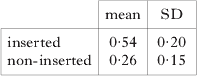
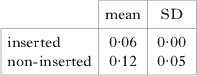
Means and standard deviations appear in Table I. Notice that the proportion of inserted responses is much higher for items with inserted vowels. It might seem surprising that listeners only identified inserted vowels as inserted on 54% of trials. This reflects a bias toward choosing an orthographic representation that is closer to the surface form. When listeners heard a stimulus with an inserted vowel, they could choose the underlying, non-inserted response, which was closer to the surface form which they heard. Choosing the (correct) inserted response required choosing a more abstract orthography. Thus listeners had an overall bias toward the underlying responses.
Proportion of inserted responses (e.g. choice of …arg… rather than …arag…) for Experiment 1, by insertion status of the stimulus word.

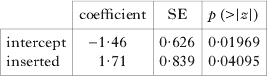
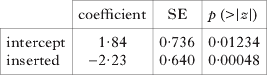
The effect of vowel insertion is significant, as shown in the bottom right-hand cell of Table II. The positive coefficient for insertion confirms the pattern in Table I.
Mixed effects logistic regression results for Experiment 1.

4.4 Discussion
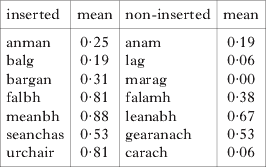
We see that subjects were generally able to distinguish forms with and without inserted vowels even, in the general case, without hearing enough of the word to recognise the lexical item. There must thus be acoustic differences between matched pairs. These differences do not stem from the quality of the preceding vowel or coarticulation with the surrounding consonants, since these were matched. This suggests that inserted vowels are phonological entities which are distinct from non-inserted vowels. Note that our result does not establish when in the signal the perceptual cues to vowel-insertion status occur. As noted by an anonymous reviewer, perceptual cues to vowel-insertion status may overlap into neighbouring segments or the preceding syllable, and our technique does not separate these out. Examination of means for each item pair (see the individual item-by-item response means in Table XII in the Appendix) shows that for six of the seven pairs, listeners are more likely to respond that a vowel is inserted if it actually is than if it is not. There is of course variation in the size of the effect, but the pairs with the smallest differences show 6% (anman [anaman] vs. anam [anam]) and 13% (balg [balak] vs. lag [lak]) differences. The item-pair means demonstrate that the perceptual effect is not carried by one or two items. Determining whether there are cues to vowel insertion in segments other than the vowel, and where these are located, is a question for future research. The current study establishes that sufficient cues are present within the vowel and surrounding segments for listeners to distinguish inserted from underlying vowels.
We examined several acoustic measures of the 14 stimulus sound files, to determine how likely it is that the vowel itself might contain perceptual cues to the inserted/underlying distinction. Because only a single token of each word was presented to listeners (because of the constraints of fieldwork with native speakers of a severely endangered language) this analysis has low statistical power. However, it reveals two potential acoustic characteristics listeners might use to hear the distinction, both realised within the vowel itself. Average vowel duration is 52 ms longer for inserted vowels than underlying ones, consistent with past literature on another dialect (Bosch & de Jong Reference Bosch and de Jong1997). Furthermore, the F0 peak is timed earlier in words with an underlying vowel, but near the onset of an inserted vowel (the average time of the F0 peak relative to the onset of the target vowel is 57 ms earlier for underlying vowels), which is also consistent with Bosch & de Jong's findings. Using within-items ANOVA, because these data have only one random factor, the vowel-duration difference is not significant (F(1,6)=3·63, p=0·106), but the F0 peak-timing difference is (F(1,6)=6·48, p<0·05). These analyses of the acoustic characteristics of the target vowel suggest that there may be perceptual cues to the vowel's insertion status even within the vowel itself. However, it was not the purpose of this experiment to determine when in the signal sufficient perceptual cues to the insertion distinction become available, and it is quite possible that listeners also use additional perceptual cues in surrounding segments. What this experiment shows is that there are perceptual cues located in the target vowel and/or the string of segments around it that are sufficient for listeners to perceive the distinction, and the acoustic analyses of the stimuli suggest that at least some of those perceptual cues are probably located within the vowel. Our result here does not establish that the inserted vowel is itself acoustically distinct from a non-inserted vowel.
Presenting the two orthographic response alternatives (representing inserted and non-inserted spellings of the sound string) on the computer monitor could draw subjects' attention to the issue of insertion status. It is also possible that some listeners could recognise what word some of the items came from, even though only a portion of the word was presented. In order to rule out possible effects from these sources, we conducted Experiment 2, using nonsense words and a task that would not draw listeners' attention to insertion status.
5 Experiment 2: nonsense-word task
In our second experiment, we created a set of nonsense items that varied in terms of inserted vowels. The goal was to see if subjects could reliably distinguish inserted from non-inserted items in an open-response orthographic transcription task, which did not direct their attention to insertion status or constrain their response alternatives.
5.1 Participants
Participants were the same as in Experiment 1. The subject who was not literate in Scottish Gaelic was again excluded, leaving 17 subjects.
5.2 Methods
33 nonce words were constructed. All nonsense words were spelled with a second-syllable vowel that would be read as unstressed (e.g. ralabh [ralav]), or were spelled without a second vowel, but had an environment for an inserted vowel (e.g. albh [alav]).
To create the tokens for the experiment, items were written down in Scottish Gaelic orthography. The items were then recorded by a native speaker (the sixth author, who was again naive as to the purpose of the experiment at the time of the recording). The speaker produced all of the stimulus items with an unstressed second vowel. For items spelled without a second vowel, such as albh, she inserted a vowel. For items spelled with a second vowel, such as ralabh, she produced the vowel as a non-inserted vowel. All items are given in (15).
-
(15)

Instructions were given orally in English. Subjects were told they would hear recorded nonsense words in Scottish Gaelic, and were asked to do their best to write the words down in Scottish Gaelic orthography. Items were presented in a single pseudo-randomised order.
5.3 Results
The data were analysed using a mixed effects logistic regression. Random intercepts were used for subjects and items, but random slopes were only used for subjects. Because the items are nonsense words, the insertion status of the vowel actually reflects whether the vowel was orthographically present in the non-word materials the speaker read the stimuli from. An item spelled albh in the stimulus recording list (and pronounced [alav]) is an insertion item, because the speaker had to pronounce it with a second vowel. An item spelled ralabh in the stimulus recording list (and pronounced [ralav]) is a non-insertion item, because the speaker treated the vowel as being underlyingly present.
Because the data use an orthographic open-response format, because the participants do not all have the opportunity to write in Scottish Gaelic frequently even if they can read it well and because Gaelic has a relatively opaque orthography where many spellings are possible for the same phonetic string, written responses were highly variable on features other than insertion status of the target vowel. Any response with an orthographic vowel between the second syllable consonants was counted as a non-insertion response. Any response without one was counted as an insertion response. For example, for a stimulus which the speaker read from the non-word ilim, responses included eilim, iolam (both non-inserted), iolm, eilm (both inserted), etc.Footnote 13 There were also misperceptions or mistranscriptions of consonants, as in the response birip for a stimulus read from beillip. Although the purpose of the experiment was to examine the insertion status of vowels, we also coded responses for the number and type of variations from the expected form (in addition to insertion status). These measures did not show any significant differences between inserted and non-inserted stimuli, and will not be discussed further here: whether the second vowel was pronounced as inserted or not did not affect how accurately listeners succeeded in transcribing consonants or the first vowel.
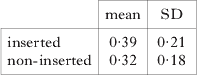
In total, there were 561 data points. Table III shows the proportion of items to which subjects responded with an inserted vowel.
Proportion of responses with no orthographic vowel between the second-syllable consonants (insertion responses) for Experiment 2, by insertion status of the stimulus (see text).

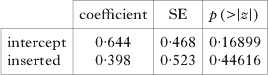
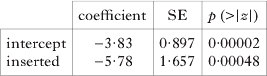
Notice that the percentage of inserted responses is higher for inserted items, but this effect is not significant, as shown in the final cell of Table IV. The positive coefficient shows the non-significant positive effect of insertion. The lack of fully matched pairs of items is likely to increase the variability in responses to specific items.
Mixed effects logistic regression results for Experiment 2.

Although the items are all nonsense words in Gaelic, it is possible that listeners would be influenced by how similar the items are to real words, or by what proportion of real words with the same consonant cluster as the non-word show insertion. The proportion of subjects responding to each item as if the second vowel were inserted (e.g. albh-type responses) was tested for correlation with the neighbourhood density of the nonsense item, and with the probability of an inserted vowel within the lexicon in the target consonant cluster.
For this analysis, neighbourhood density and probability of insertion in the lexicon were determined as follows. We calculated neighbourhood density with respect to the LER-BIML corpus.Footnote 14 Neighbourhood density was 0 for most items, owing to the complexity typical of Gaelic words, but there was some variation within this measure. This correlation was not significant (r(31)=−0·057, p=0·754), but it is difficult to conclude much, given the lexical data available.
We also coded items for how likely a vowel is at the relevant site. For example, we counted up the number of instances of lb and the number of instances of lVb. Items were then coded for how likely a vowel was in that environment compared to no vowel. This correlation was also not significant (r(31)=−0·308, p=0·081). Although it seems to approach significance, it is also in the opposite of the expected direction: words with a higher probability of insertion elicit fewer inserted vowel responses. We conclude that the likelihood of vowel insertion was not a factor in this experiment.
5.4 Discussion
This task was completely open-response, asking listeners simply to write down what they heard, and not directing their attention to the fact that some of the vowels were potentially inserted. Listeners were not instructed to choose whether the second vowel should be written or not, for example. Responses were quite variable on aspects unrelated to insertion status as well, indicating that encoding the phonemes of non-words in Gaelic orthography was not a straightforward task. (The lack of correlation with lexical measures suggests that this non-word transcription task did avoid lexical influence on responses.)
The overall proportion of responses indicating that listeners interpreted the vowel as inserted was slightly higher in Experiment 1 (phonetic identification of partial real words; averages of 0·26 and 0·54 insertion responses) than in Experiment 2 (open transcription of non-words; averages of 0·32 and 0·39 insertion responses). Thus Experiment 2 shows a stronger bias against insertion responses. This is probably a result of the open-response task in Experiment 2. Since listeners were not instructed to consider that some of the vowels might be inserted and therefore might not be spelled, the most straightforward response would be to write all the sounds they heard, regardless of potential phonological origin and subtle phonetic differences that might differentiate them, giving a surface representation of the stimulus (e.g. responding alabh rather than albh for [alav]/[alav]). Giving an insertion response (e.g. albh) requires realising that the sounds could be spelled in a way that is further from the surface form.Footnote 15
6 Experiment 3: counting syllables
In this experiment, subjects were asked to count the number of syllables in a word overtly. The goal was to see if or how inserted vowels contribute to the syllable count. This experiment bears directly on the question of whether an inserted vowel constitutes an independent syllable.
6.1 Participants
Participants were the same as in Experiments 1 and 2. One subject did not participate in this experiment, because of a hearing impairment and consequent difficulty in completing all the tasks. There were thus data from 17 subjects available for analysis.
6.2 Method
Participants were prompted verbally with an English word or phrase, and were instructed to give the Scottish Gaelic translation equivalent. Items were presented in a pseudo-randomised order. If a participant did not respond with the expected item, the experimenter prompted the participant with the desired item in Scottish Gaelic. If the participant indicated after prompting that they were not familiar with the item, it was discarded from the later parts of the experiment. In this and all of our experiments, the experimenter was always a speaker of English who had limited knowledge of Scottish Gaelic.
Participants were then asked to count the number of syllables in the Scottish Gaelic equivalents of the English stimuli. All responses, regardless of the nature of the prompt, were treated together. Non-whole number responses (e.g. ‘one and a half syllables’) were initially excluded from the analysis, as the experiment was designed for categorical responses. A subsequent separate post hoc analysis was done that included these responses, to ascertain if they affected the results.
Items were coded for how many non-inserted syllables were present. For example, a form like aran [aran], with no inserted vowels, would be coded as having two syllables. A form like arm [aram], with a single non-inserted vowel, would be coded as having only one syllable. Subject responses were coded in terms of how they departed from these. For example, if a subject responded that [aran] had two syllables, this would be coded as zero. If they responded that it had three syllables, this would be 1; a response of one syllable would be coded as −1. Similarly for a form like [aram]: if a subject said it had one syllable, this would be coded as zero, and if they said it had two syllables, this would be coded as 1. The general logic of the response coding is that zeros would indicate that subjects were not counting inserted vowels, and positive counts would indicate that they were.Footnote 16 The items used in the experiment are given in (16).
-
(16)

6.3 Results
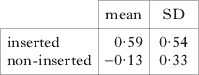
Out of 300 possible scores, there were 261 usable data points. There were significant effects of insertion status in the count data: we give the means and standard deviations in Table V. A positive number indicates that responses had an extra vowel compared to the count of non-inserted symbols; a negative number indicates that responses had fewer vowels than expected.
Degree of deviation from number of orthographic (non-inserted) syllables for the counting experiment, by whether the word contains an insertion environment or a matched non-inserted vowel. Positive numbers reflect addition of a syllable beyond the number that is written, such as a syllable for an inserted vowel. Negative numbers reflect the absence of an underlying syllable.

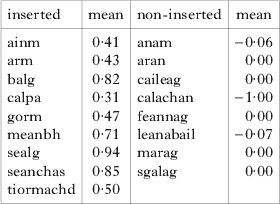
The means for each condition show that the words with inserted vowels sometimes, but not always, got an extra syllable; indeed, there was an extra syllable about 59% of the time. In contrast, words with non-inserted vowels on average did not get an extra syllable. The negative mean is due to subjects not always counting non-inserted vowels as syllables (hence the difference between expected number of syllables and observed number of syllables would be negative in those cases). Vowel type is significant by likelihood ratio test (χ2(1)=16·7, p<0·001).
As noted above, some subjects gave non-whole-number responses, e.g. ‘one and a half syllables’, etc. There were eight such responses, given by five different subjects. Vowel type is still significant by likelihood ratio test (χ2(1)=16·7, p<0·001) when these responses are included.
6.4 Discussion
Our results show that inserted vowels are not equivalent to non-inserted vowels, since subjects counted the former only 58% of the time. At the same time, inserted vowels were counted as a syllable more often than would be expected if they were indeed non-syllabic, as claimed by Hall. Indeed, at, 58%, they were counted more than half the time. Therefore these results would argue against treating Scottish Gaelic inserted vowels as excrescent.
Looking at the item-by-item values in Table XIII (in the Appendix), the means are quite consistent. The mean for calachan stands out, and it may be that this is actually an inserted-vowel item.
While our experiment was not set up to test the gradience of syllable count, it is interesting to note that some subjects would count words with inserted vowels as having an extra half syllable. Several subjects gave this type of response even though it wasn't an option given to them in the instructions. (These responses were therefore excluded from our initial analysis.) This response was never given for words without inserted vowels.
7 Experiment 4: knocking for syllable beats
We were concerned that subjects might not understand syllable counting correctly or that we might elicit some sort of prescriptive or orthographically determined syllable count. We therefore had a second task with the same items as Experiment 3, where subjects were asked to knock in time to each word. The reasoning is that this might provide a more natural opportunity for syllable count to be revealed.
7.1 Participants
Participants were the same as in Experiment 3. The same 17 subjects completed the task.
7.2 Method
As for Experiment 3, participants were asked to give the Scottish Gaelic translation equivalent of an English word or phrase. Following this, participants were asked to ‘knock’ on the table or a hardcover book for each ‘part’ of the word. Participants were encouraged to give an immediate response, rather than to count ‘parts’ consciously. This experiment took place prior to Experiment 3, so that participants would not be biased toward knocking the number of syllables that they later gave the count for. In addition, Experiments 3 and 4 were separated from one another by an unrelated articulatory task using ultrasound. Again, we received some responses where subjects indicated they wanted to give half a knock. As with the previous experiment, we analyse the data without these responses first and then with them.
7.3 Results
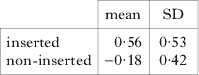
Out of 300 possible scores, there were 271 usable data points. There appear to be significant simple effects with the knocking data as well as the counting data. The means, calculated the same way as for the counting data, are given in Table VI. Notice that, just as with the counting data, subjects did not consistently add an entire syllable for inserted vowel words.
Degree of deviation from number of orthographic (non-inserted) syllables for the knocking experiment, by whether the word contains an insertion environment or a matched non-inserted vowel.

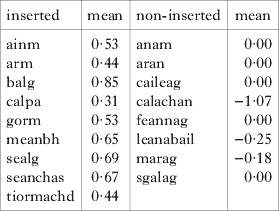
As with the counting experiment, a likelihood ratio test shows a significant effect of vowel insertion (χ2(1)=18·3, p<0·001). As with Experiment 3, inspection of the item-by-item values, in Table XIV in the Appendix, shows quite consistent behaviour, though again, calachan stands out, and may actually have an inserted vowel.
As with the previous experiment, some subjects said that they wanted to give a ‘half a knock’ to some syllables. There were eight such responses, given by six different subjects. Only one subject gave half responses for both tasks. Vowel type is still significant by likelihood ratio test (χ2(1)=18·9, p<0·001) when these responses are included.
7.4 Counting vs. knocking
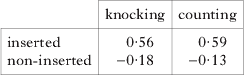
Is there a difference between counting and knocking? Recall that we used the knocking task in response to the possibility that counting might invoke more prescriptive judgements or might be unduly influenced by the orthography. Since the materials of the two experiments are the same and the methodologies are quite parallel, we can put response type into the analysis and ask whether there is a significant difference in the effect of vowel insertion in terms of response type: whether there is a significant interaction. First, Table VII shows the mean responses by response type. Note that the numbers here are slightly different, as we calculate means here only over items where subjects responded in both tasks.
Comparison of mean degree of deviation from number of non-inserted syllables by task and word type.

The interaction is not significant by likelihood ratio test (χ2(5)=6·62, p=0·251). There is no difference if ‘half’ responses are included; the interaction is still not significant by likelihood ratio test (χ2(1)=0·008, p=0·929). We conclude that putative orthographic or prescriptive effects do not distinguish the tasks.
7.5 Discussion
The results of Experiment 4 essentially replicated those from Experiment 3: in the aggregate, inserted vowels add less than a whole syllable, but more than nothing, to the number of knocks for a word.Footnote 17 There does not appear to be a significant difference between the knocking and counting tasks in terms of the effect of insertion, though counting resulted in numerically a slightly higher, but non-significant, reported number of syllables overall. The import, once again, is that inserted vowels are not invisible phonologically if we make the natural assumption that our tasks tap into phonological awareness.
8 Experiment 5: syllabification in the coda?
Recall from §2 that Bosch (Reference Bosch1998) maintains that a consonant preceding an inserted vowel is more likely to syllabify as the onset of the following vowel/syllable than as the coda of the preceding vowel/syllable. This is contrary to the normal syllabification of the language, as laid out by Borgstrøm (Reference Borgstrøm1940) and summarised in §2 above. In Experiments 5 and 6, we tested whether this is true by asking native speakers to give the first and last syllables of disyllabic words. If Bosch is correct, (i) the intervocalic consonant should be in the first syllable but not in the last syllable if the vowel of the second syllable is not an inserted vowel, and (ii) it should be in the last syllable but not in the first syllable if the second vowel in the word is an inserted vowel.
There are of course two other possibilities: the consonant could be in both syllables, or it could be in neither syllable. Accordingly, we treated first- and last-syllable responses separately, first asking whether the intervocalic consonant was more likely to be in the first syllable for inserted vowels or for non-inserted vowels, and then doing the same for the last syllable.
Syllable judgements of this sort have been used for some time to tap into subjects' intuitions about syllables (Treiman & Danis Reference Treiman and Danis1988, Treiman & Zukowski Reference Treiman and Zukowski1990). Following the same paradigm, Derwing (Reference Derwing1992) found further support for these factors (stress, vowel quality, orthography, etc.) affecting syllabification in English, and reported similar results in Korean, Arabic, Swiss German and Blackfoot, thus extending the pause-break paradigm to other languages. That judgements for adjacent syllables should be treated separately is argued by Content et al. (Reference Content, Kearns and Frauenfelder2001); see also LaCross (Reference LaCross2008).
The import of this question is that syllabification is a phonological variable. If inserted vowels are associated with different syllabification, this supports the notion that inserted vowels are phonologically visible and not excrescent.
8.1 Participants
This experiment had the same participants as the other experiments, except that two subjects did not participate in this one. Thus data from 16 subjects were available for analysis.
8.2 Method
As in Experiments 3 and 4, participants were prompted verbally with an English word or phrase and asked to give the Scottish Gaelic translation equivalent. If the participant did not respond with the expected item, the experimenter prompted the participant with the desired item in Scottish Gaelic. If the participant indicated that they were not familiar with the item after prompting, it was discarded from the further parts of the experiment. Participants were then asked what the first syllable of the word was. In this experiment and the next, we therefore explicitly used the term syllable.Footnote 18 Participants were told that the first and last syllables could be the same, in case they did not think that a word with one underlying vowel and one inserted vowel was two syllables long. We focused on words that have two syllables on the surface, where the second vowel is either inserted (ainm) or not (anam). We did this to avoid the complexities of dealing with words that are potentially longer, where some medial syllable might complicate the responses.
8.3 Results
There were 175 usable data points. We first analyse the first-syllable judgements, focusing on whether that syllable is closed by the intervocalic consonant or not. (In the next section, we treat separately the question of whether that consonant affiliates to the second syllable.) If the intervocalic consonant was part of the first syllable, we coded that as a ‘yes’ response.
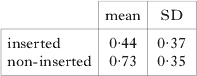
The mean proportion of ‘yes’ responses by insertion status is given in Table VIII. Notice that the proportion of ‘yes’ responses is much lower for inserted vowels. As before, we analyse this with a mixed effects logistic regression with random intercepts for subjects and items and random slopes for subjects.
Proportion of responses including the intervocalic consonant in the first syllable, by insertion status of the word.

There is a significant effect of vowel insertion, as shown in the final cell of Table IX. The negative coefficient reflects the negative effect of vowel insertion on the response variable.
Mixed effects logistic regression results for Experiment 5.

Both types of words (words with inserted vowels and words without) may have the intervocalic consonant in the coda of the first syllable, but words without the inserted vowel are significantly more likely to; on average, the intervocalic consonant is in the first syllable 73% of the time for words without inserted vowels, as opposed to only 44% of the time for words with inserted vowels.
It's possible that phonotactic restrictions played a role in this task. While items in both conditions contained the vowel [a] followed by [l], [n] or [r], there were two items in the inserted condition that contained the vowels [ε] and [ɔ], e.g. gorm [gɔrɔm] and meanbh [mεnεv]. These vowels can occur in open syllables in Scottish Gaelic, e.g. in e ‘he’ [ε] or seo ‘here is’ [ʃɔ], but their type frequency is quite low; there are very few words of this sort, though the ones that do occur are extremely high-frequency. It's possible that subjects may have been reluctant to supply closed syllable responses in such cases. If this were the case, however, notice that it would go in the opposite direction from the effect that we have found. We conclude that any phonotactic effect of this sort is not confounded with our effect.
8.4 Discussion
Results for Experiment 5 confirm Bosch's claim: syllabification of Scottish Gaelic normally places an intervocalic consonant at least partially in the coda. Further, the consonant is less likely to be such a coda when the following vowel is an inserted vowel. As with our syllable-counting and knocking experiments, however, this is not categorical.
At the same time, the consonant preceding the inserted vowel does sometimes (44% of the time) appear in the first syllable, in contrast to the claim that it should always be the onset of the inserted vowel. 44% does not approach 0%, which suggests that the syllabification of a consonant preceding an inserted vowel is gradient, ambiguous or ambisyllabic. What is very clear, however, is that the presence of the inserted vowel has consequences for syllabification. Hence it would be incorrect to view the inserted vowel as phonologically invisible.
9 Experiment 6: syllabification in the onset?
Whether the intervocalic consonant is in the last syllable is treated separately from whether or not it is in the first syllable, since, conceivably, the consonant could be in both syllables or neither syllable.
9.1 Participants
This experiment had the same 16 participants as Experiment 5.
9.2 Method
Following Experiment 5, there was a break during which participants participated in another, unrelated experiment, so that the responses they had given for the first syllable would not influence their responses for the last syllable. As with Experiments 3–5, participants were prompted with an English word or phrase, for which they were asked to give the Scottish Gaelic translation equivalent. Participants were then asked to give the final syllable of the Scottish Gaelic words. As with Experiment 5, only plausibly disyllabic items are relevant.
9.3 Results
In this section, we consider the syllabification of an intervocalic consonant into a following syllable depending on whether the vowel of that syllable is inserted (ainm) or not (anam). Table X shows the difference in the proportion of ‘yes’ responses across the two conditions. A ‘yes’ response means the subject judged the intervocalic consonant to be in the following syllable. Notice that the consonant is less likely to affiliate to the right in words with inserted vowels.Footnote 19
Proportion of responses including the intervocalic consonant in the following syllable, by insertion status of the word.

There were 175 usable data points. We analyse this with a mixed effects logistic regression with random intercepts for subjects and items, and random slopes for subjects. This difference is significant, as shown in the final cell of Table XI. The negative coefficient reflects the pattern in Table X. The difference is small, but the consonant syllabifies rightward with non-inserted vowels more readily than with inserted vowels. The literature reports no difference in syllabic affiliation in this direction.
Mixed effects logistic regression results for Experiment 6.

9.4 Discussion
The main result from Experiments 5 and 6 is that the consonant preceding an inserted vowel was less likely to be included in the preceding syllable, and was also less likely to be included in the following syllable. As already discussed, the former fact argues that inserted vowels in Scottish Gaelic are not phonologically invisible, since their presence has consequences for syllabification. The rightward-affiliation facts support this conclusion as well.
The results are somewhat anomalous, however. While we have found a clear effect in Experiments 5 and 6 for vowel insertion, the conclusion seems to be that subjects avoided including the consonant preceding an inserted vowel in either syllable. Neither effect is categorical, of course.
10 General discussion
The results from all experiments show some support for claims from the literature, but in each case require a more nuanced view of the status of the inserted vowel.
Experiment 1 showed that subjects can distinguish words with inserted vowels from words with underlying vowels. This suggests that there is indeed both a phonetic and a synchronic phonological distinction between the two classes of words. This experiment did not establish that the perceptual cues for that distinction are found during the vowel; they may very well be distributed over other segments in these words. However, the acoustic analyses we performed of the stimulus productions suggest that at least some perceptual cues are probably located in the vowels themselves, such as vowel duration and the shape and height of the F0 curve as affected by timing of the F0 peak. However, the timing of the perceptual cues is not at issue, and this experiment establishes that sufficient cues are available for listeners to hear the difference.
Experiment 2 was an open-response ‘write what you heard’ task, using nonsense words. The task did not draw listeners' attention to the insertion phenomenon, although one or two listeners with extensive metalinguistic knowledge about Scottish Gaelic did realise that this experiment was about these vowels. The effect of vowel-insertion status in this experiment was not significant, but this may stem from the small number of items, the fact that the items were not fully matched, and the expected variability of open-response data, all of which lower statistical power. The non-significant effect suggests that listeners may perceive some difference between inserted and underlying vowels even when their attention is not drawn to this distinction, and reflect that difference in choice of orthography.
We also saw in Experiments 3 and 4 that subjects had a different syllable count for words with and without inserted vowels: words with inserted vowels were judged as having more than the number of input vowels (see note 2 on our use of ‘input’). This argues that words with inserted vowels in their surface form have to be represented phonologically somehow as having more syllables than in their input. On the other hand, Experiments 3 and 4 also show that the count for words with inserted vowels is not simply a result of adding an additional syllable. Rather, in the aggregate, such words would seem to have something less than a syllable added.
Experiment 5 established that the affiliation of intervocalic consonants was different in the two classes of words. When the following vowel was in the input, the consonant affiliated to the left. When the following vowel was an inserted vowel, the consonant was significantly less likely to affiliate to the left. Finally, Experiment 6 showed that in the face of a general preference for not including the intervocalic consonant in the following syllable, this preference was significantly stronger when the following vowel was inserted. Since syllabification is an instance of phonology in Hall's sense, and inserted vowels have consequences for it, this suggests that inserted vowels are phonological.
Taken together, these results establish that the inserted vowel is not simply a retiming of phonetic gestures, irrelevant to the phonology. Rather, the inserted vowel makes a clear contribution to the syllable structure of Scottish Gaelic.
Thus, even though Scottish Gaelic inserted vowels meet some of Hall's criteria for excrescent (phonologically inactive) vowels, such as occurring in heterorganic clusters, having a schwa or copied quality, and not explicitly repairing illicit structures (see (12) above), the current results show that Scottish Gaelic inserted vowels are phonologically visible. This suggests at least that inserted vowels in the world's languages cannot be divided into phonologically visible epenthetic vowels vs. phonologically invisible excrescent vowels on the basis of any simple set of criteria. Hall's criteria are already quite elaborated, and she uses Scottish Gaelic inserted vowels extensively as an example of a phonologically invisible excrescent vowel. Thus the current results draw such classification criteria into question.
Warner et al. (Reference Warner, Jongman, Cutler and Mücke2001) argue on the basis of articulatory data that Dutch inserted vowels, which Hall (Reference Hall2006) also claims to be phonologically invisible, are in fact phonologically active, in that they trigger an allophonic alternation that depends on syllable structure. Warner et al. argue that the allophonic alternation (between light and dark /l/) cannot be achieved by changing the timing of the existing articulatory gestures in an Articulatory Phonology analysis (Browman & Goldstein Reference Browman and Goldstein1990), and instead requires insertion of a phonological unit (the inserted vowel). The current results, for Scottish Gaelic, also show that there is a phonologically visible insertion, but the current results show this on the basis of listeners' judgements rather than articulatory gestures, complementing these previous results. The fact that listeners variably judge words with inserted vowels to contain an extra syllable, or even volunteer that such tokens contain half an extra syllable (but not a whole one), strongly suggests that the gestures of the underlying form without the additional vowel have not just been retimed, but that a phonological unit of some sort has been inserted. Thus, Scottish Gaelic vowel insertion provides another case in which gestural retiming alone cannot explain the phenomenon.
That said, Scottish Gaelic inserted vowels are not like other vowels in the language. They ‘count’ less than non-inserted vowels in a very clear way. In addition, they contribute to a different syllable structure. Together, these results suggest that inserted vowels are indeed phonological elements, but elements that have a different phonological status than non-inserted vowels. Our results would seem to imply that any phonology–phonetics distinction for inserted vowels is probably more of a continuum, rather than a categorical split, or at least that there are more than two types of inserted vowels.
Appendix: Item-by-item means for Experiments 1, 3 and 4
Item-by-item means for Experiment 1, showing proportion of responses choosing the word with an inserted vowel (responses of ‘inserted’).

Item-by-item means for Experiment 3, showing degree of deviation from number of orthographic (non-inserted) syllables for the counting experiment, by whether the word contains an insertion environment or a matched noninserted vowel. Positive numbers reflect addition of a syllable beyond the number that are written, such as a syllable for an inserted vowel. Negative numbers reflect the absence of an underlying syllable.

Item-by-item means for Experiment 4, showing degree of deviation from number of orthographic (non-inserted) syllables for the knocking experiment, by whether the word contains an insertion environment or a matched non-inserted vowel.