Sŏng-il: “Ten years from now, our eldest here will be ten years old, the second will be eight, the youngest will be five, and …”
Chŏng-hŭi: “Gee, dunno. Think birth control!”
Sŏng-il: “Ha-ha, but we should have at least two boys and one girl. Then we will build our own nice house with a large yard.”
Chŏng-hŭi: “In our own car, we'll enjoy weekends touring all parts of our country on the completely paved expressways. It's like a dream!”
Sŏng-il: “It's not a dream. When we understand each other and work together, tomorrow will come with happiness.”
Chŏng-hŭi: “Alright. I will work hard. For you and me, and for our baby!”
Sŏng-il: “Thanks. Let's hang in there until the day will come!”
– A dialogue from P'aldogangsan of Our Own (1972)In a South Korean governmental propaganda film made in 1972, P'aldogangsan of Our Own, a young couple makes a promise about their future after ascertaining that the wife, Chŏng-hŭi, is pregnant. The husband, Sŏng-il, dreams of owning their own house, and Chŏng-hŭi responds with her dream of traveling around the country in their private car. Interestingly, the film ends with a montage of several scenes following this one, depicting their grandfather's speech encouraging diligence, handwriting on the wall by South Korean President Park Chung Hee emphasizing the spirit of Saemaŭl undong (New Village Movement), and an express bus cruising on the expressway (Kim Han Sang Reference Sang2008, 56–59). The young couple's hope for a bright future is embodied in the house and car they desire. The young bride's spoken wish to travel nationwide in their own car is connected visually with the scene of an open stretch of expressway. Between the spoken wish and the expressway, the writing of Park Chung Hee comes through to emphasize the appropriateness of his leadership for realizing these wishes.
In this way, the future goals of nuclear family units were promised in a mode of mobility that was made possible by a certain type of modernity that was organized around the automobile and automobile traffic. In a way, it would be appropriate to call this automobility, “a system that coerces people into an intense flexibility” or a system of “fluid interconnections” (Urry Reference Urry2004). Automobility is not just a system, but also signifies a specific “principal socio-technical institution through which modernity is organized,” an “ideological or discursive formation,” and a “way of experiencing the world” (Böhm et al. Reference Böhm, Jones, Land and Paterson2006, 3). However, Chŏng-hŭi's dream to possess a private family car and drive anywhere she would like to visit reflects something more than those dimensions that co-define automobility in general. Such a dream mirrors what drove the population towards certain slogans in postcolonial Korea. As narrated in the governmental propaganda film, it could obtain its reality based on the multiple transformations in South Korea at that time, such as the nuclearization of the family, the rise of the automobile industry, and the completion of expressway construction. The long-term U.S. military presence might be one of the factors that lubricated such transformations.
In this article, I contend that the transition in mobility and its perception was not merely a reflection of social transformation, but also one of the (un)intended cultural consequences of the U.S. military and nonmilitary presence in Korea, especially based on the influences of film propaganda activities. The U.S. Army and the U.S. Information Service (USIS) in Korea used film as a tool of propaganda that showed a sense of mobility different from that of the colonial period. The way they delivered such cinematic illusions to Koreans and the image of a modernized civilization represented in those films contributed to changing the cultural logic of mobilization in postcolonial Korea by promoting automobile-related future expectations. Such a sense of the new paradigm, which will be called “my car modernity” in this article, stimulated in the Korean people a sense of possession and a desire for privately owned, self-regulated units. As demonstrated by the fact that Koreans began to use the Korean transliteration of English words, maik'a (my car), to refer to a privately owned car as early as the late 1960s, there is a strong possibility that the automobile-related utopia was closely related to the American influence.
Into Capillaries: Organizing the Gaze through Flexibility in Motion
As Fujitani (Reference Fujitani1998, 24–28) demonstrated convincingly, in a modern state, how a ruler sets out on a trip to reach the people has been “central to the construction of a kind of ocular domination.” The “roaming ruler” in the great imperial pageants of the Meiji era made “his spectacles visible to all the people of the nation,” while simultaneously, “all the people of the empire” were made “visible to one dominating and all-seeing monarch.” A sense of mobility in a modern society is closely connected with how the power organizes the gaze of the governed, as well as how his or her gaze is distributed to them. In the case of the automobile utopia of my car modernity, the ruler's gaze moves rather floatingly, penetrates into his or her territories, and reaches people face to face.
The film P'aldogangsan (1967), which was the first in a series that ended with P'aldogangsan of Our Own in 1972, and its sequels show how an imagination of an automobile utopia was created through cinematic representations. It was the first commercial, full-length, feature film sponsored by the ROK Ministry of Public Information and its affiliate, the National Film Production Center. The film was promoted publicly along with the sixth presidential election about two months earlier, and its success led the ministry to make sequels (Kim Han Sang Reference Sang2008, 10–24).
One remarkable fact was that the star of the film, Kim Hŭi-kap, placed great importance on his experience in the exchange program in America with director Pae Sŏk-in, as the origin of the film project (Kim Hŭi-kap Reference Hŭi-kap1992, 215–54). From 1955 to 1958, Pae was affiliated with the USIS and made its newsreel series, Liberty News, and documentaries, such as Korean Editor (1958). Kim also had gained experience through collaboration with the USIS Film Production by appearing in an educational feature, Birds of a Feather (Chosŏn ilbo 1961). The association between these two film specialists and the USIS leads to an interesting interpretative connection, which suggests that this film reflects the influence of the twenty-year film propaganda activities conducted by the U.S. Army and the USIS.
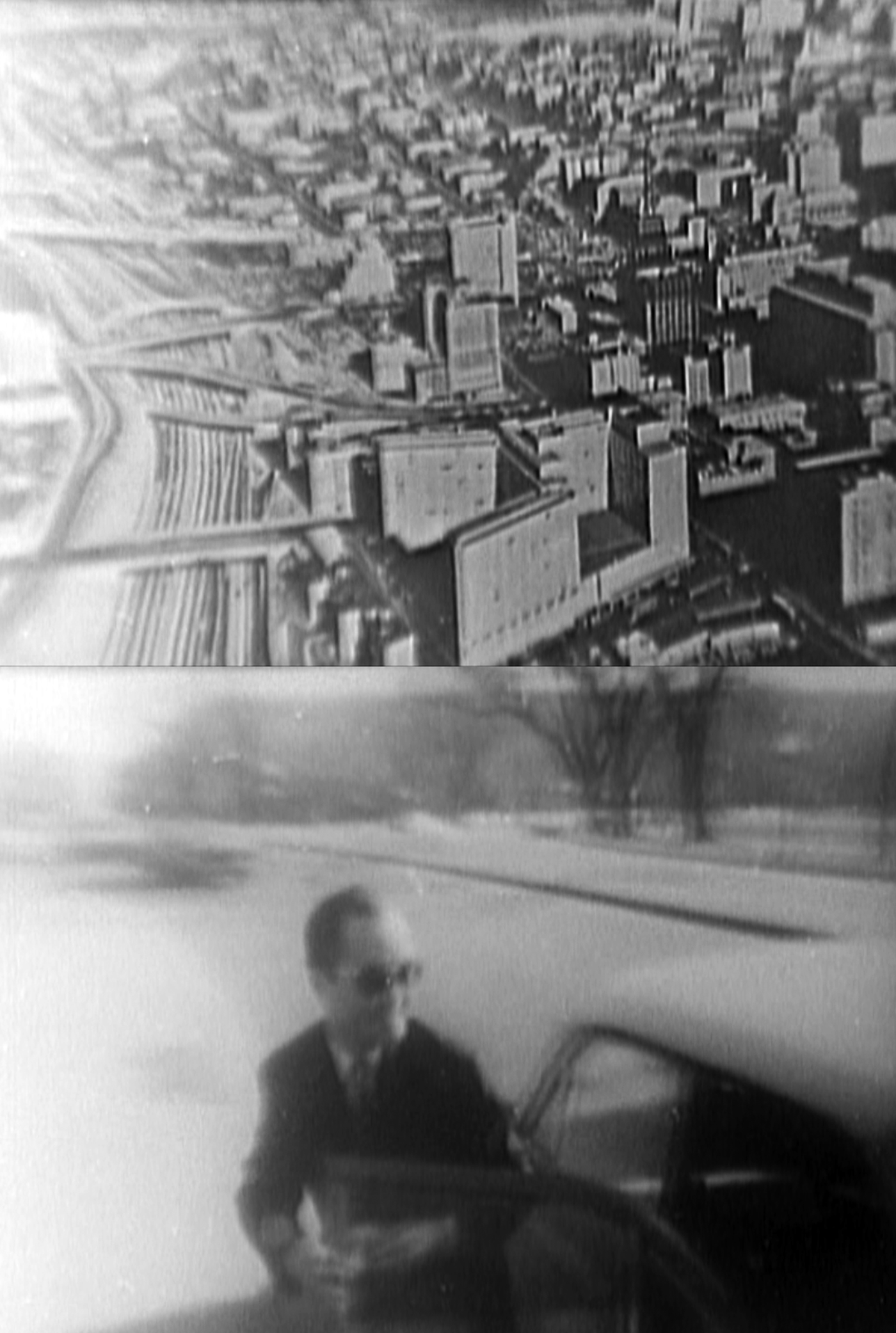
Both men were invited to participate in the film specialist exchange program offered by the U.S. State Department and visited American cities from September 1964 to January 1965. According to Kim, the idea to go sightseeing throughout South Korea in P'aldogangsan began while they were staying in New York following a nationwide tour of America (Kim Hŭi-kap Reference Hŭi-kap1992, 215–54). After touring nineteen representative cities in America, Kim appeared on a USIS television show, Korea-America Today (1965), and told of his experience with a slide show. The panoramic visual composition of American local attractions, which they could reach mostly by car, constructed an overall view of that nation. For Kim, Los Angeles was a tremendous sight with over five million cars (see figure 1).
A bird's-eye view of Los Angeles and a scene of Kim Hŭi-kap getting out of a car in Korea-America Today. Image captured from RG306-586, courtesy of the U.S. National Archives and Records Administration (NARA).

As Kim Hŭi-kap wrote about the film P'aldogangsan, the narrative of traveling around the country looks considerably similar to Kim and Pae's visit to America in terms of its structure. The film's main plot is about an old couple, Hŭi-kap and Chŏng-sun,Footnote 1 who travel around the country to visit their daughters and sons-in-law. In a similar way to Korea-America Today, Hŭi-kap and Chŏng-sun's tour in P'aldogangsan gathers typical images of local attractions and key industries as mosaic tiles that are then combined. After the long trip, the map of the nation is finally completed. The local color and dialect of each province appear as a convention when the parents visit each daughter's family. After the parents’ long, roundabout trip, the whole family gathers in Seoul to celebrate the father's sixtieth birthday.
Tourism with the purpose of sparking the national imaginary, however, was not entirely new, considering Emperor Sunjong's tour at the gate of colonization. On January 7, 1909, the Korean emperor boarded a southbound train at the Namdaemun Station in Seoul. It was the first nationwide tour ever made by a sovereign of the Korean peninsula in order to display his own body to the people (Lee Wang-moo Reference Wang-moo2007). The royal tour was planned by the Japanese Residency-General as a legitimacy strategy for the Japan-Korea Protectorate Treaty (Kim So-young Reference So-young2010). Because the Japanese emperor of the Meiji era had made a successful nationwide tour in 1872 (Lee Wang-moo Reference Wang-moo2007), such pageants seem to have been understood by the Japanese officials as an effective means to justify their own rule.Footnote 2 While the Meiji emperor's roaming had motivated a shared national identity, Sunjong's royal tour was accompanied by foreign authorities who were threatening national sovereignty. People witnessed the foreign officials of the Residency-General at the same time as their own emperor. Resident-General Itō Hirobumi delivered speeches emphasizing the importance of an alliance with Japan (C. Kim Reference Kim2009). Therefore, this was an event that constructed and reinforced a form of ocular domination by the colonial ruler. In accompanying Sunjong on their own organized trip, the Japanese officials would have expected certain effects on the visibility of the protectorate and its modern administration.
The tour was truly modern. It was made possible only by the presence of a modern transport system, a railroad.Footnote 3 On his royal train, Sunjong completed his first tour in seven days and his second in eight days, both of which were extremely short periods of time in which to cover the nation compared to the routings of other traditional means of transportation (Lee Wang-moo Reference Wang-moo2007, Reference Wang-moo2011). With this new mode of mobility, people could discipline themselves to settle in modern temporality while waiting for the emperor's scheduled arrival and learning the concept of time (Lee Wang-moo Reference Wang-moo2007). With the nationwide networks of railways that linked major cities and foreclosed the districts between them, a new sense of place, a “panoramic perception,” might have emerged (Schivelbusch Reference Schivelbusch1986, 52–69). This new sense of time and space constituted “a new sense of national simultaneity” (Fujitani Reference Fujitani1998, 24–28).
What differentiates the tour in the P'aldogangsan series and this royal tour is the flexibility of the “roaming ruler” (Fujitani Reference Fujitani1998, 24). While it is obvious that the father figure of Kim Hŭi-kap was constructed to metaphorically link the Park Chung Hee regime to the model of a harmonious family (Kim Han Sang Reference Sang2008, 45–48), the father as a ruler does not concentrate his offspring to certain centralized points of the collective transportation system, as Sunjong did on the railway system, but reaches their homes personally. Moreover, as the sequels develop, the father's flexibility increases. While Hŭi-kap and Chŏng-sun were on a train in the first film (1967), the second (1971), third (1971), and fourth (1972) sequels show their motor tours on expressways. In these films, Hŭi-kap is a gentle, humorous, and rational character of economic means who can move freely according to his own will.
Amid this transition, between Sunjong's centralization of the gaze and the allegorical father's flexible, mobile gaze, one can genealogically locate the role of American film propaganda practices and their use of Jeeps. While the Japanese colonial government had begun to use mobile projection as a propaganda tool as early as the 1910s, the U.S. Army changed the primary vehicle for such mobile exhibition from trains to automobiles, such as Jeeps and trucks.
In the early days of the occupation, Jeeps were used primarily for transporting U.S. authorities, but they seem to have gradually become tools for civic actions. One such action was mobile film propaganda. Beginning in early 1946, the U.S. Army Military Government in Korea (USAMGIK) removed the restriction imposed by the Japanese colonial administration regarding Hollywood films and began to import U.S. Army propaganda films. However, the U.S. film propaganda agencies did not eliminate the colonial legacy. Instead, they used a colonial practice swiftly when they considered it useful. Mobile film propaganda was one such practice that was employed once again.
Early U.S. mobile film propaganda activities also depended upon the railway system but, by degrees, Jeeps became important for their circulation. In 1946, the USAMGIK Department of Public Information established a tour plan of nationwide mobile propaganda by railway called the Mobile Education Train (U.S. Army Forces in Korea 1948a). However, in a report dated November 10, 1947, written by James L. Stewart, Director of the Office of Civil Information (OCI), after the public information function was transferred to the U.S. Army, it appears that Jeeps and trucks had begun to be transported on railway flatcars to be used in the mobile propaganda activities in July 1947. In such civil actions, more emphasis was placed on the provinces, which railways did not reach, than on urban areas. The report stated that OCI considered “decentralization in operation” as an essential aim and endeavored to “operate into the countryside” from “a smooth, impressive headquarters” located in Seoul (Stewart Reference Stewart1947).
While the itinerant exhibition of propaganda films showed continuity throughout both the Japanese and the U.S. occupations, the use of Jeeps enabled the maneuver of the projection units to be more flexible under USAMGIK than it had been before. Unlike urban areas that had been actively absorbing new culture and information from the outside world, the provinces suffered from a chronic information gap. Hence, the ruling powers judged that these locals could receive messages through verbal propagation, performances, and moving image exhibitions more easily than through the usual distribution of printed media. In such considerations, mobile film screening served as a form of maneuver warfare. With Jeeps and trucks, film units infiltrated and penetrated the provinces that trains could not reach. While city cinemas fulfilled the role of a strategic foothold to lure the urban audience, itinerant film exhibitions were active primarily in efforts to reach the everyday lives of people in the countryside directly and thus to mobilize the rural audience.Footnote 4
In the course of such propaganda activities, the Jeep itself was the embodiment of American state-of-the-art technologies that had to be shown through the films it delivered. It was a vehicle of high maneuverability, as well as a self-contained unit that was not interrupted by any preassigned timetables. From General Douglas MacArthur's statement to encourage the Japanese to develop and industrialize, “These people will soon make their own Jeep” (Ohtsuka Reference Yasuo1994, 136), it was clear that the Jeep was a symbol of both advanced technology and self-reliance in Korea, a former colony of Japan. In a February 1949 news article, it was reported that hundreds of Jeeps had been stolen between the liberation and the report date, which shows how the Koreans adored the newly imported vehicle (Kyŏnghyang sinmun 1949).
The outbreak of the Korean War occupied a considerable role in introducing the effectiveness of American motor vehicles to Korea. While as many as 80 percent of the existing automobiles were destroyed during wartime, the Korean War opened a new chapter in the South Korean auto industry by importing over six thousand Jeeps with the U.S. Army (Chŏn Reference Yŏng-sŏn2010, 246–51). The Korean conflict also provided opportunities to the Japanese automobile industry because the U.S. Army ordered companies such as Toyota to build war vehicles to bring to the Korean peninsula (Shimokawa Reference Koichi1994, 104–5; Toyota 2012). These Jeeps and trucks were recycled and served as a model for early South Korean–made cars after the war.
In terms of film propaganda, weapons carrier trucks now became an essential component to form a wartime mobile unit that replaced trains. Starting in October 1950, the U.S. Department of the Army initiated procurement actions for film equipment and resources to conduct psychological warfare (Department of the Army 1950). Ten mobile film units, equipped with 16 mm sound and 35 mm slide projection equipment, public address systems, recording and record playing equipment, and related supplies, were shipped from Japan, along with 300 sets of 16 mm projectors with screens and twenty-five prints of 16 mm films in the Korean language (Acheson 1951). Such equipment necessitated a vehicle for each mobile unit. Weapons carrier trucks with “a locally built aluminum body” were regarded as most feasible in the wartime situation (Conners Reference Conners1951).Footnote 5 Due to the high value of these vehicles and equipment, mobile screening operations were sometimes vulnerable to guerrilla actions. In November 1951, one vehicle was reportedly ambushed and lost to communist guerrillas. The guerrillas let the crew flee and took the vehicle (Conners Reference Conners1951).
Wartime audiences’ reactions to the propaganda films were “enthusiastic” (Muccio Reference Muccio1950a). U.S. Ambassador John Muccio stated in a telegram to the State Department that the wartime USIS newsreel series Segye nyusŭ received a fervent response from Korean audiences. According to the operations report on Taegu in September 1950, the USIS film President Truman's Speech and five Segye nyusŭ issues were shown in the Taegu USIS center with a total attendance of 75,960 persons, and in mobile screenings in rural villages around Taegu attended by 37,870 persons (Muccio Reference Muccio1950b).
The increasing use of Jeeps and trucks in U.S. film propaganda activities, which became standardized throughout the occupation and the war, signifies that the gaze of power, in Michel Foucault's (Reference Foucault1978, Reference Foucault2009) sense of surveillance and governmentality, gained more tactical agility and coverage. The automobile replaced the train because it was a compact, self-motivated unit, ideal for maneuvering in as yet unreached areas. Its flexibility in motion allowed better visibility, by visualizing yet-invisible rural areas for the foreign propaganda authorities. People in the rural areas could feel and watch the presence of the ruling power and its state-of-the-art technology embodied in the maneuvering vehicles, without being mobilized to welcome the monarch at the train station in bigger towns. They not only were observing the delivered spectacle, but also were observed by the delivery personnel who were the agents of a U.S. information agency.
Off the Track: Individual Flexibility for High Mobility
The flexibility in motion also began to change how people were gathered, organized, and mobilized. Contrary to the railway system, the brand new vision of automobile traffic and privately owned cars enabled people to imagine a self-regulating and untrammeled unit where they could choose their own destination, speed, and companions. In such a transition, the idealized type of individually flexible, self-regulated units was a nuclear family. As Chŏng-hŭi in P'aldogangsan of Our Own dreamed of “our own car,” the ideal of a privately owned car was naturally understood as a family-owned car driven by a young father.
Such an understanding of the nuclear family as a normative model also could be observed in other P'aldogangsan sequels. The films in the series were, in fact, visual textbooks that taught about a Korean version of the nuclear family. Despite the appearance of a large family, the old couple and their married daughters did not live together, and each household was economically independent of the other. In the analogy between the family ties and the nation state, the nuclear family is itself the basic labor unit that completes the internal reproduction procedure based on the gender division of labor as a norm (Kim Han Sang Reference Sang2008, 40–44; Moon Reference Moon2005, 2, 64–66).
As in P'aldogangsan of Our Own, the last sequel of the film series, the future goals of nuclear family units were promised in the forward movement on the expressway, which was not only a symbol of rapid economic growth through government-led mobilization, but also a reified system of free movement of goods and capital.
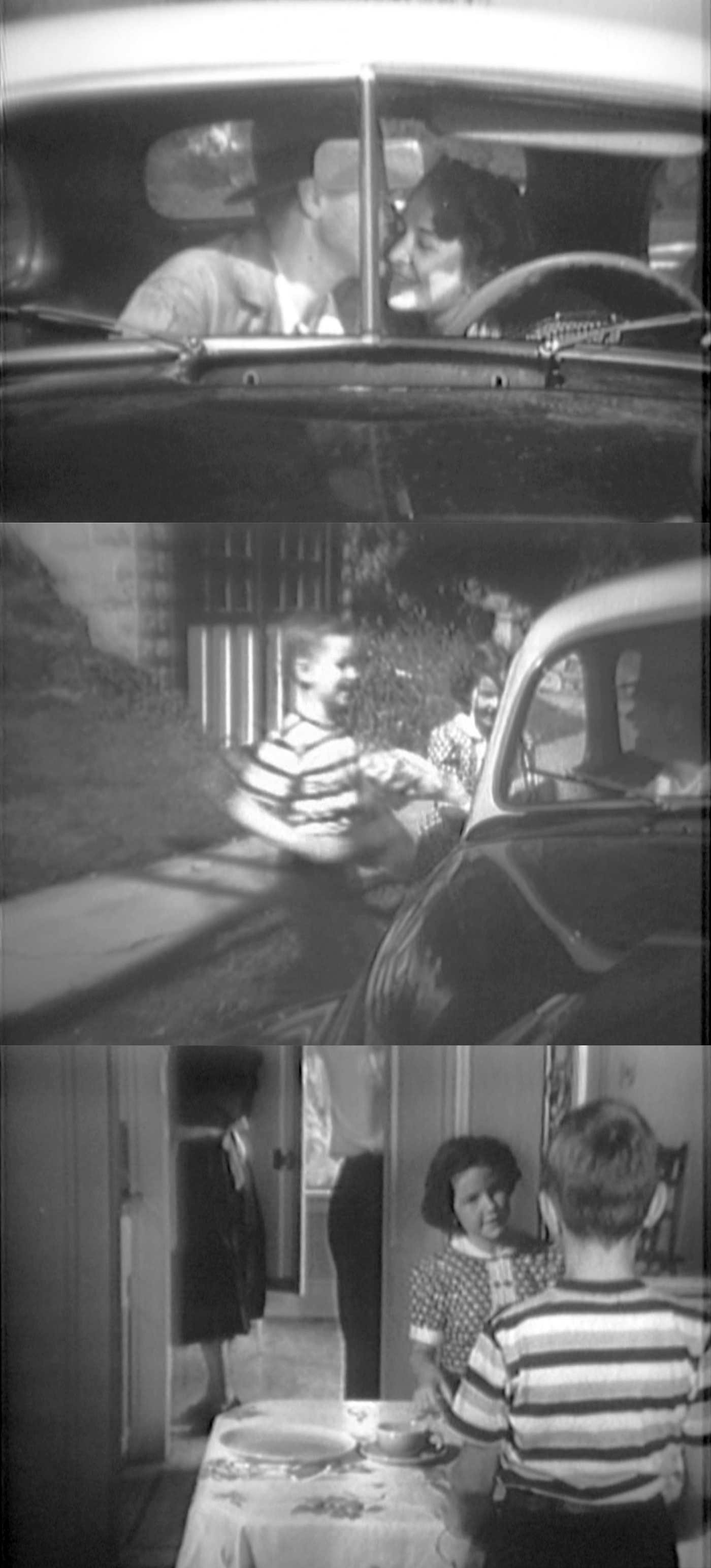
Modern everyday American life depicted in the USIS films was also based on nuclear family units. One such film, American Working Women (n.d.), was shown with additional Korean introductory footage in the mid-1950s and was housed in the USIS film library for rental purposes.Footnote 6 In this film, which was made to educate audiences on the ideal social role of women in contemporary America, one of the female protagonists commutes to work in her own car (see figure 2). On her way home from work, she picks up her husband at his factory and their children at the neighboring house of a babysitter. They display a harmonious family of four, preparing a meal together. Her car embodies her autonomy as an independent citizen, as well as the family as a self-contained unit of four people. Similar depictions of American automobiles and nuclear families are found commonly in the USIS films shown in Korea, such as The American Road (1953) and Country Editor (1954).
A nuclear family in American Working Women. Image captured from RG306-21, courtesy of NARA.
Another significant symbol of flexibility and individual mobility was the expressway. The construction of the Kyŏngbu Expressway was begun in 1968 and completed in 1970. It was the starting point of a series of grand-scale construction projects in South Korea that aimed to complete five major expressway lines in five years. In 1967, the Park Chung Hee government suggested the construction as a presidential election pledge for Park's reelection (Kim Han Sang Reference Sang and Chŏnggyu2010).
As the construction is construed to have changed the South Korean industry from railway- to automobile-based, it is noteworthy that Park's government struggled against opposition opinions that supported the railway system. In the face of Park's pledge of expressway construction, the opposition party criticized it for inefficiency, as they believed that the double tracking of the railway lines would cost less (Chosŏn ilbo 1968). Park lashed back against such criticism by deprecating the railway system. His campaign team insisted that the railroads in South Korea were too old and could not reach rural areas promptly with the existing lines. They imparted a meaning to the expressway system, claiming that it would be the fruit of the “sole national potential,” whereas the railway system was a vestige of Japanese colonialism (Kim Han Sang Reference Sang and Chŏnggyu2010). Such a comparison shows how the cultural logic of mobilization was reshuffled with the emergence of the expressway system and the dream of an automobile utopia.
It is also important to note that such an ideal of an automobile utopia was taken mainly from the existing images of the Western consumer culture, as portrayed primarily through Hollywood and American propaganda films, while the expressway construction and the auto industry were understood as a set of national projects. Park's counter-discourse on the railway system angled for the sentiment of anti-colonialism in South Korea, but at the same time leaned on admiration of a specific version of Western civilization.
In 1956, the Eisenhower administration completed the national expressway system by establishing the Dwight D. Eisenhower National System of Interstate and Defense Highways (Murphy Reference Murphy2009, 73–88). As investigated in several preceding studies, this interstate highway system was a firm foundation on which to reorganize an American national identity by combining Fordism and consumer culture.Footnote 7 The Korean War even contributed to the high growth of the automobile industry in America. During the war, the railway system turned out to be rather inefficient for defense purposes because it was “vulnerable to disruption through strategic bombing” (Sibul Reference Sibul2008, 227). This established the case for the motor transport lobbyists to persuade the Eisenhower administration to construct “a toll-free interstate highway system” (Sibul Reference Sibul2008, 227).
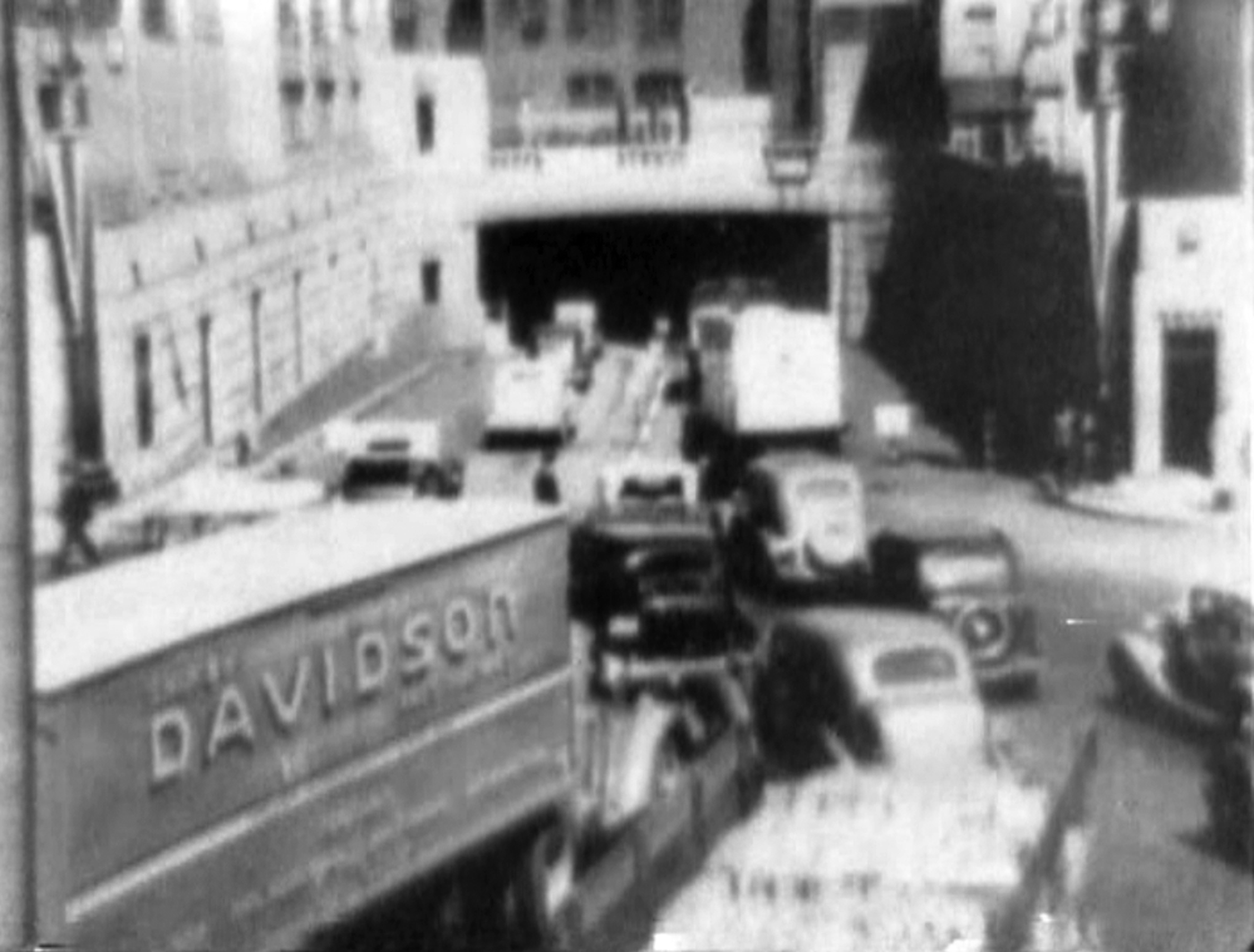
The American highway experience had been developed through global historical events such as the Great Depression and the two World Wars, thus its historical particularity was proposed as the universality to newly independent nations like South Korea. As early as 1947, when the OCI of the U.S. Army started to distribute and screen imported American propaganda films in South Korea to fight for hegemony against indigenous left-wing nationalist groups, films depicting American automobile culture were shown frequently to the Korean people. While the Jeep was an embodiment of high technology delivering American images to the newly liberated people, the private cars on the streets in those delivered U.S. Army films were rather a developed version of such embodiments, optimized to everyday life. The Story of Lincoln Tunnel (c. 1943), which was shown in Korea starting in January 1948 (U.S. Army Forces in Korea 1948b), begins with a scene of Manhattan that shows skyscrapers as attractions. In the following scene, a line of automobiles is seen entering the Lincoln Tunnel (see figure 3). Then the film narrates a brief history of the tunnel's construction, with some animated scenes illustrating the technological principles of the process. In the final scene, several private cars can be seen exiting the tunnel quickly, thus completing the picture of modern urban spaces.
A scene from the opening sequence of The Story of Lincoln Tunnel. Image captured from RG306-3086, courtesy of NARA.
A privately owned car in the representation of the American way of life was, however, not merely a means of attraction, but a signifier of American democracy. The paradigm of individual mobility gradually became understood as a principle of the modern democracy, tangled up with the American vision of democracy. In late 1947, the OCI started a nationwide project to educate Koreans in order to establish a separate government in South Korea and distributed films on elections and democracy. Tuesday in November (1945) was the American film shown most frequently during this project (Kim Han Sang Reference Sang2011). In this film, privately owned cars are depicted as an embodiment of the free will of voters. The film was produced by the Overseas Branch of the U.S. Army Office of War Information (OWI) to give a pictorial exposition of the American election system and government structure. Its main narrative structure is constructed to link a small local constituency—Riverton, California—with a federal-scale political event, the presidential election in 1944, thereby visualizing the basic principle of American federalism. Therefore, Riverton is not only a sample of American local constituencies, but also a miniature representation of the American constitutional structure.
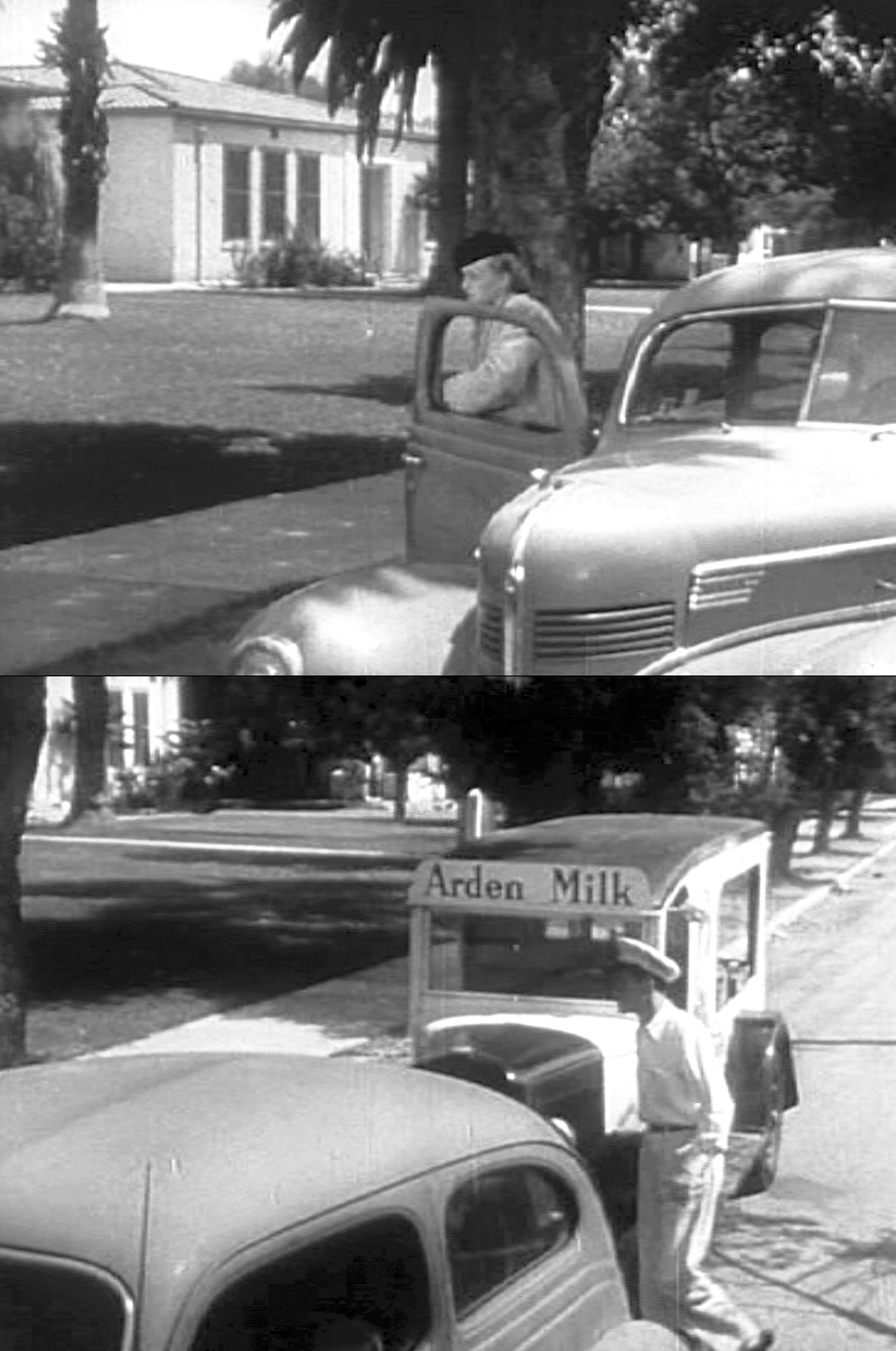
In the first sequence, the film depicts a woman who is the principal of the Riverton Public School and the chair of the election board for the presidential election. She arrives at the polling station in her own car. After getting out of the car, she opens the station, sets up the board table, and checks the voting booth and the ballot box. The first voter in Riverton arrives in the following scene, also in his car (see figure 4). While these two figures symbolize the election system and constituents, their cars connote the autonomy and free will of the constituents to elect their own delegates. Voters driving to the polling station in their own cars, along with the female chair of the election board, might be perceived by the Korean audience to be as entirely new and curious as the idea of universal suffrage.
The election board chair and the first voter getting out of their cars in Tuesday in November. Image captured from RG306-201, courtesy of NARA.

This shows how a political structure imagined through individual mobility represented in American propaganda films was distant from that of colonial propaganda films. The railway system was considered a basic infrastructure for colonization by the Great Powers, and its objective was to mobilize people in ways not only economic, military, and political, but also cultural and educational. The use of cinema by the colonial authorities as a means to make people recognize the gaze of the ruler and let them become visible was an indivisible technology of government to mobilize the colonial subjects; it shared a coessential logic with the railway system in order to construct the ocular domination of the colonial power. The railway system was a mechanism for “management of the population” (Foucault Reference Foucault2009, 42–44) that induced people to internalize and be disciplined under such ocular domination. I call the modernity under this type of biopower locomotive modernity.
To speak of locomotive modernity, the following features should be considered. First, it entails collectivity in motion and vision. The “train–cinema interface” (LaMarre Reference LaMarre2009, xiii) coerced people into sharing the same points of departure and destination with others. “The official timetabling of mobility that accompanied the railways” (Urry Reference Urry2004) brought a modern sense of temporality, which implied that everyone had to participate in the collective discipline in order to avoid falling behind. The same conditions applied to every individual who wanted to watch a film either at the theater or at an itinerant exhibition. Everyone had to be intermingled in a group of people and, once the movie started, the projector had to be run to the end of the final reel without pause. Such collectivity resonated eventually with the political settings in cinematic representations. In a spy film in colonial Korea, Military Train (1938), the train is depicted not only as a vehicle of military importance, but also as an allegorical apparatus of the Japanese empire. Communist spies try to discover the train's operating schedule, and the protagonist struggles to keep it secret for national security. A tourist cultural film, Tokyo-Peking: Through Tyosen and Manchoukuo (1939), adopts the view from a train that departed, ostensibly, from Tokyo and headed to northern China. The train routes illustrated on the map shape the spatial composition of the empire (Kim Han Sang Reference Sang, Yoo and Cha2013a). In such embodied pictures of the empire, the future was only seen to be possible through collective dreaming, as projected in a 1941 commercial Korean film, Spring of the Peninsula, with its protagonist couple riding on a train to Tokyo to bring expertise from the center of the empire to the Korean local film industry.
Collectivity in motion and vision connects spontaneously to the second feature of locomotive modernity, namely, the centralizing movement. Trains linked each location to another in a seemingly horizontalized network of routes; however, every movement on the railroads aimed at a certain center. Classification into the destination centers and the rest resulted in a hierarchical rearrangement of living spaces. Hierarchy also existed among the destination centers. The totality of the whole movement generated simultaneously both the centripetal force toward Tokyo and the centrifugal force to untapped territories. In this imperializing forward movement, cinema also centralized vision by positioning audiences in the place of an imperial subject behind the camera. Through the journeys in tourist cultural films, such as Tokyo-Peking, the train confirms the dominions of the empire and preoccupies its future territories over the borders visually (Kim Han Sang Reference Sang, Yoo and Cha2013a). In Volunteer (1941), a commercial film with a strong propagandistic nuance for the war volunteer system, a military train evokes the protagonist's agony in his search for a faultless national identity to overcome his limits as a colonial subject, and finally takes him to the center of the national sublime, that is, to the battleground. In that sense, the couple in Spring of the Peninsula who departs for Tokyo and the soldier in Volunteer who heads for the frontline share the same movement toward the center of the empire.
The timetabling constitutes another feature of locomotive modernity, which is stability. Train journeys and film screenings promised regularly scheduled actions. The forward movement of train and cinema was based upon the idea of progress, but it was rather conservative, as any occasional or derailed advances were not allowed. In Military Train, the driver of the train says in a speech that a five-minute delay of the train is fatal to everyone. In the regularized system of train and cinema, flexibility was considered unstable and hazardous. In a 1936 film, Sweet Dream, even though the film was sponsored by the Sŏn Man (Chosŏn-Manchuria) Traffic Times for the purpose of traffic guidance, the contrast between the railway system and automobile traffic is obvious and dichotomous. The heroine, a wanton woman, dreams of running away from home and hurries the taxi driver in order to catch a train. When the taxi hits her daughter by accident and her escape eventually proves to be a failure, the film reveals a striking contrast between trains and automobiles. The train for her is a hope for a better future, but she could not take it because she deviated from the desirable route. At the same time, in the film, the flexibility of automobiles causes some concerns about unexpected negative results.
Therefore, locomotive modernity implies a self-contained regime equipped with regularized systems for collective forward movements. In contrast, American-made propaganda films showed a liberated and unlimited mobility through privately owned cars. In such a sense of automobile mobility, certain expectations of collectivity and regularity were to be betrayed. As seen in American films, including American Working Women and Tuesday in November, privately owned cars allowed audiences to imagine each individual moving separately with his or her own will. Each one possessed a right to elect his or her own delegates, thus, allegorically and theoretically, each had a different destination from others. Such high flexibility, however, was not regarded as unstable or hazardous in those representations, but rather bright and promising.
In My Car: The Future of Private Ownership and the Modern Self
The bright images and assertive tones in such American propaganda films were of course linked with a utopian vision of the new mode of transportation, namely private car ownership. It was not merely the matter of private property, but also that of diverse future issues surrounding the modern self, such as physical mobility at one's own free will, social status and mobility, securement of private spaces, and self-realization in the automobile-based society.
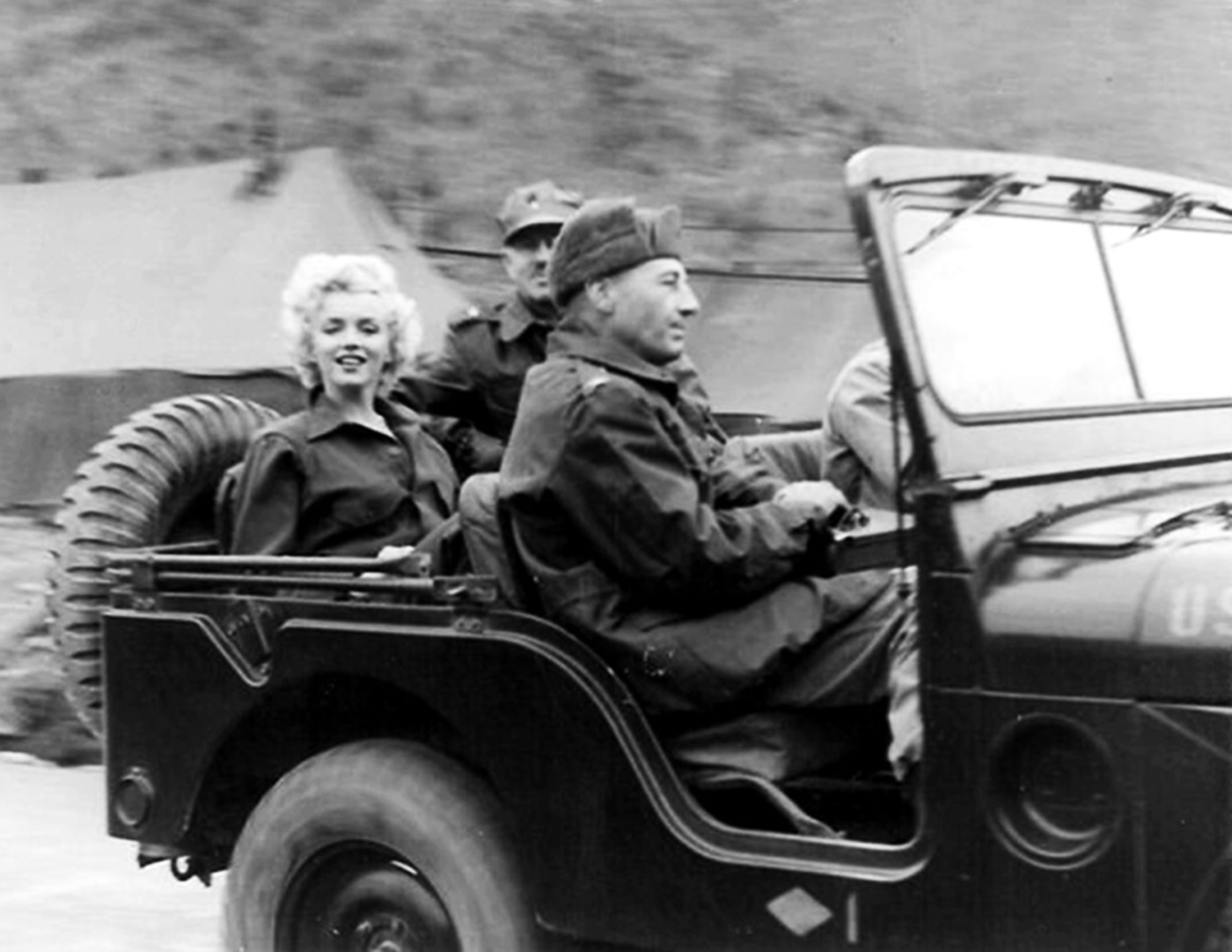
As seen in the statement of General Douglas MacArthur, “These people will soon make their own Jeep” (Ohtsuka Reference Yasuo1994, 136), the future image of automobile traffic was equated with private car ownership from the beginning. In September 1945, when the U.S. Army landed on the Korean peninsula as a liberator, U.S. troops paraded in Jeeps among the newly liberated people (P'yŏnjippu 1975, 16–17). For those who had rarely seen such vehicles, the parade of Jeeps would have been a magnificent spectacle (see figure 5).Footnote 8 Even in their former mainland, Japan, people admired the strange vehicles and dreamt to “own one someday” (Ohtsuka Reference Yasuo1994, 136). The new mode of transportation meant that a car could be owned personally even though no one knew when that would be.
Marilyn Monroe in a Jeep when she visited South Korea in February 1954. Image captured from RG111-LC-35128, courtesy of NARA.
The Jeep, which was originally the product of Willys-Overland, gained its reputation as a general-purpose vehicle during World War II. Beginning in 1942, Willys-Overland started to prepare “a market for a civilian version of the Jeep at the end of the war” (German Reference German, Haridakis, Hugenberg and Wearden2009, 95). Postwar American society had already become an automobile-based economy, and Jeeps were one of the products that any civilian could purchase and possess. The war had played a significant role in advertising Jeeps for future customers in civilian markets (German Reference German, Haridakis, Hugenberg and Wearden2009). Therefore, when U.S. Jeeps were shipped from occupied Japan to serve as military vehicles in the Korean War (Ohtsuka Reference Yasuo1994, 160), it triggered the idea of promoting and advertising private car ownership in South Korea.
Before the 1980s, Jeeps remained central to car ownership in South Korea and were greeted with “respect and admiration” (Nelson Reference Nelson2000, 93). During the vehicle recycling boom in the 1950s after the Korean War, South Koreans embraced, mimicked, and transformed the American automobile culture; Jeeps became a symbol of private car ownership. They were repainted black and used as private cars by “presidents, ministers, lawmakers, mayors, entrepreneurs, celebrities, and everybody” (Chŏn Reference Yŏng-sŏn2010, 246–51). The first Korean-made passenger car, the Sibal, was manufactured to look like a Jeep, and its core components were imitations of those from an American-made Jeep engine (Chŏn Reference Yŏng-sŏn2010, 251–57; Kyŏnghyang sinmun 1955).
The fact that those surplus Jeeps were understood to be icons of private car ownership reflects the humble stage of the South Korean auto industry. Privately owned cars became admired gradually as an ideal of economic success, but were still inaccessible to ordinary people, and the absolute rate of car ownership in South Korea remained low until the 1980s (Nelson Reference Nelson2000, 93–101), when the number of registered cars increased sharply (see table 1).
Number of registered automobiles in South Korea (Ch'oe Reference Un-sik1995, 254; Ministry of Transportation 1973, 102–5; Statistics Korea 2013).
However, on the discursive level, private car ownership became a source of admiration in the late 1960s. In a 1967 news article, a rosy future of “average life” was described with the newly coined term, maik'a (my car) (Kyŏnghyang sinmun 1967). The article predicted the future of a “consumer revolution” and the dawning of the my car age. The writer predicted that the my car age would arrive in South Korea in the 1970s (Maeilgyŏngje sinmun 1968).
This term appears to have been imported from Japan, where a maikā (my car) boom was already in effect around the time of the 1964 Tokyo Olympics (Ministry of the Environment 2002); however, the term had a different vernacular meaning in South Korea. While my car in Japan was a term to explain an existing phenomenon, in South Korea it was instead a slogan designed to mobilize people. Contrary to the optimistic forecasts in the late 1960s’ news articles, the my car age in South Korea did not arrive until the late 1980s. My car was a “dramatic symbol manipulation to urge people to actively engage in the economic development” of Korea (Kim Hyŏng-guk Reference Hyŏng-guk1989, 125).
P'aldogangsan of Tomorrow (1971), the second sequel of the P'aldogangsan series, was a significant medium for such symbol manipulation. In the film, Hŭi-kap appears on a television talk show as a guest and praises the opening of an era where the entire nation is entering a one-day commuting zone thanks to the construction of the expressways. To exemplify this “one-day life zone,” he explains that he can receive fresh fish within a quarter of a day from his son-in-law in Pusan. After watching the show, the son-in-law actually visits him with these fishes, driving his own car (Kim Han Sang Reference Sang2008, 63–64). In this scene, the expressway is not the only target used for emphasis. The fact that the son-in-law, a successful businessman, possesses an object of envy—a privately owned car—exposes the attractiveness of my car in such propaganda films.
In this wise way, the P'aldogangsan series promoted a my car utopia as a positive vision for the future. While the son-in-law's case shows a symptom of that desire for cars, another scene in the same film exposes the wish in a more obvious manner. The old couple's granddaughter Chŏng-hŭi starts to date Sŏng-il, who is the couple's boarder. In the scene that shows their dates, Sŏng-il drives a convertible car with Chŏng-hŭi as a passenger. Their car takes the overpass in downtown Seoul. In truth, this scene is entirely unrealistic, because such a car was too expensive to be owned by a young, working-class roomer. Therefore, the image of Seoul in this scene is not that of the present, but rather a dream of the future (Kim Han Sang Reference Sang2008, 78–79).
However, such admiration of my car should not be merely understood as a desire for possession. As evident in the transliteration of the possessive pronoun, “my,” the my car syndrome reflected the recognition of the first person. Acquiring high mobility through owning a car meant that the self gained a wider sphere of activity and became more capable of moving. It also signified that he or she obtained more freedom in deciding where to go.
One of the USIS Film Library holdings in Korea, The Autobiography of a Jeep (1943),Footnote 9 and a Korean-made USIS film, I Am a Truck (1955), both reveal a significant tendency of American propaganda films during the reconstruction period, in terms of the recognition of the modern self. The Autobiography of a Jeep was made for the OWI during World War II by an American documentary filmmaker, Irving Lerner. Like many trendy children's books in wartime America, this film uses the first-person point of view of a “talking Jeep” (Kim Han Sang Reference Sang2013b; National Film Preservation Foundation 2000: 119–20). I Am a Truck, directed by Kim Ki-yŏng in postwar South Korea, follows this style and uses a first-person narration by a military truck.
While these two talking automobiles are unlike each other with respect to their tones and characters (Kim Han Sang Reference Sang2013b), they share a certain attitude toward the world, namely confidence as an independent individual—the modern self. According to German (Reference German, Haridakis, Hugenberg and Wearden2009, 97–98), the Jeep in The Autobiography of a Jeep reflects three ideal traits of the “American soldier—optimism, comradeship, and loyalty.” However, regardless of the vehicle's military identity, its basic attitude mirrors the modern liberal individualism of American society. The Jeep talks in a cheerful voice, without reserve. Its rhythmical motion and powerful operation increase the reliability of this small, self-contained unit. The personification of the Jeep not only develops an intimacy between the audience and the vehicle, but also promotes the idea of an ideal individual possessing free will and mobility. Kim Ki-yŏng's personified truck looks rather gloomy, but internalizes a strong-willed individual engaging in the reconstruction of the war-damaged country. When the recycled American military truck narrates, “Now I abandoned the desire to return to my country, for I love Korea very much” and “I made up my mind to stay and help the reconstruction of Korea,” it testifies how such a sense of the free will in the modern self was adapted in the localized version of American propaganda in South Korea.
In addition, it should not be disregarded that the individual-oriented paradigm of new mobility in my car modernity was in fact a nuclear family–oriented one, as stated above. One of the earliest news articles that predicted the my car age defined it as the age of “at least one car in every house” (Maeilgyŏngje sinmun 1968). The imagined individual self with free will, in this sense, was the male breadwinner who might be imagined as the driver of the family-owned car.
Conclusion
When Virilio (Reference Virilio1989) stated that “the history of battle is primarily the history of radically changing fields of perception” and that “for once the cinema was able to create surprise, it effectively came under the category of weapons” (7–8), a large part of the mobility that accompanied cinema-weapons on the battle fields of perception might have been generated by the most diffused mode of transportation. In Korea, where there were ceaseless wars to win the hearts and minds of the colonial and postcolonial population, the main vehicles that carried the weapons of cinema were at first the train, and then the automobile. The shift from trains to automobiles indicated that there was a change in the perception of the world at the same time.
What is striking is the extent to which the transition was a cultural consequence of a long-term U.S. military presence in South Korea, especially its activities related to film propaganda production and distribution. The cultural logic of locomotive modernity, which had been characterized by collectivity and regularity in mobilizing the public, made way for my car modernity that recognized the modern self, which in fact was the male head of a nuclear family unit, moving flexibly with his own free will. The shift was stimulated by the blueprint of American auto culture, as well as the actual embodiment of such transportation technology that accompanied the propagandistic exhibitions.
In this sense, the television show Blooming P'aldogangsan (1974–75), which concluded the P'aldogangsan series, is noteworthy regarding the development of my car modernity. At that moment, the conveyor of the propagandistic vision was neither a train nor a Jeep. Now audiences did not have to gather in one place; they could simply stay at home. The advanced technology of satellites enabled the maximization of mobility, and propaganda pictures now reached people directly in their own homes. Similar to private car ownership, television also provided people in the nuclear family with a sense of possession, namely home theater at maihom (my home).Footnote 10
Given that my car modernity is one possible pathway of postcolonial nation-building on the Korean peninsula, the other option adopted by the rest of the peninsula has demonstrated a clear difference. As the slogan “chuch’ŏlchongdo” (railroads are primary, driveways are subordinate), shows, mobility in North Korean transportation has developed by adhering to the locomotive. The railroad is supported because it is believed to guarantee “extensive, scheduled, and stable” transport, as well as the ability of the system “to limit the free movement of people” (Ahn Reference Ahn2012, 12). The contrast between the two Koreas with respect to individual mobility suggests that the diffusion of the automobile culture under U.S. hegemony had a significant effect on the liberal technology of government after the dissolution of “railway imperialism” (Davis Reference Davis, Davis, Wilburn and Robinson1991).
However, such a utopian ideal of flexibility and private ownership in my car modernity in the south must be questioned in terms of its actual effects. While the automobile apparently allows people to decide their own destination according to their free will, the bigger picture of the automobile society is not exactly an autonomous utopia. Rather, it is a ceaseless circulation of products and labor, which rarely allows anything outside that circulation. In the rapid flow on expressways, each individual car cannot turn, reverse, or stop. All you can do is to maintain your speed so that you will not disturb the flow. Every possible accident and environmental disaster caused by automobile traffic is understood as an unavoidable side effect of the flexibilized utopia. Then, one might ask if there is an “actual” right of selection in the automobile utopia. My car modernity is, in that sense, a “dictatorship of movement exerted on the masses” (Virilio Reference Virilio2007, 83), whereas it leaves room for interpretation that a certain process of “construction of a voluntaristic subject” (Jin-kyung Lee Reference Lee2010, 33) has existed in it.
Acknowledgments
I would like to express my deepest gratitude to Seungsook Moon for her invitation to contribute to the cluster of thematically coherent articles and her valuable comments. I am also grateful to those who made helpful comments on this work, including Christina Klein, Steven Chung, Todd Henry, Jin-kyung Lee, Karl Gerth, Theodore Hughes, Suzy Kim, Seung-hee Jeon, Dima Mironenko, Yusung Kim, Hoduk Hwang, Youngjae Yi, and the anonymous readers for the Journal of Asian Studies. The paragraphs dealing with the P'aldogangsan series and the USIS mobile screening activities in this publication were excerpted and revised from my PhD dissertation.