Sustained foetal supraventricular tachycardia with heart rates in excess of 210 beats per minute may lead to congestive heart failure and hydrops. There is still no consensus on the most effective treatment option for intractable foetal supraventricular tachycardia. In recent years, some experts have shifted their approach to combination therapy instead of using initial monotherapy. Nevertheless, at times the only choice that remains is to resort to direct foetal treatment in cases when there is no response to different combination treatments.
Experience with using triple combination therapy in such resistant cases is poorly documented. Here, we present a baby who failed to respond to various combination treatments and developed a pericardial effusion. Restoration of sinus rhythm was successfully achieved with triple oral transplacental antiarrhythmic therapy.
Case presentation
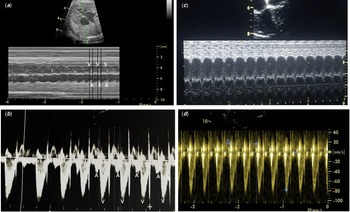
A 26-year-old pregnant woman was referred to our hospital for treatment of foetal tachycardia at 26 weeks of gestation. A foetal echocardiogram confirmed the diagnosis of intermittent atrioventricular re-entry tachycardia. It started and ended suddenly and recurred frequently during the examination. The heart rate was 269 beats per minute during the tachycardia. Every atrial contraction was followed by a ventricular contraction. Ventriculo-atrial time, atrioventricular time, and the ratio of them were measured as 81ms, 126ms, and 0.64, respectively (Fig 1). There were no structural heart anomalies, pleural/pericardial effusion, or ascites.
( a , b ) Before treatment, the M-mode and simultaneous superior vena cava and ascending aorta pulsed wave Doppler shows intermittent tachycardia with, every atrial contraction followed by a ventricular contraction with ventriculo-atrial time of 81ms. ( c , d ) M-mode and pulse wave Doppler shows sustained foetal atrioventricular re-entry tachycardia with heart rate 218 bpm.

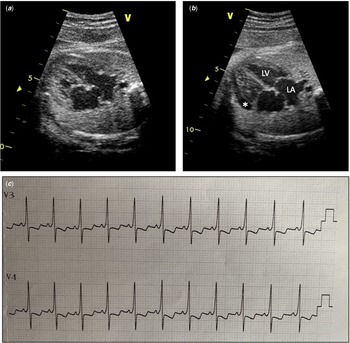
The patient was started on digoxin with a loading dose of 500 mcg followed by 250 mcg every 8 hours for 3 doses. Although adequate maternal serum digoxin level was obtained, sinus rhythm could not be achieved and the atrioventricular re-entry tachycardia became sustained. Thus, flecainide at 100 milligrams three times a day was added to the treatment on the 4th day. On the second day of the combination treatment, the foetus was found to be in sinus rhythm with heart rate of 140 beats per minute. On follow-up assessment, atrioventricular re-entry tachycardia was seen to have recurred after 5 days. The patient had taken the medications properly during this period. There were no signs of drug toxicity or any maternal complaint. Maternal ECG was normal. Maternal serum levels of the antiarrhythmic drugs were within therapeutic ranges. Nevertheless, the digoxin loading dose (500 mcg) was repeated and the flecainide dose was increased to 400 mg daily. Treatment was continued for three more days with altered doses, but the supraventricular tachycardia persisted. Pericardial effusion (3.5 mm) developed in the foetus but there were no other signs of hydrops. There was mild cardiomegaly (the ratio of circumference of heart and thorax was 0.56) and no atrioventricular valve regurgitation (Fig 2). Therefore, it was decided to add sotalol (80 mg two times a day) instead of intra-foetal treatment. Digoxin was decreased to 250 mcg two times a day; flecainide was continued at 100 mg three times a day. The sotalol dose was increased to 80 mg three times a day due to continued foetal supraventricular tachycardia. Within 3 days after the addition of sotalol, supraventricular tachycardia first became intermittent, and then, sinus rhythm was established. Daily ECGs and biochemical profile were assessed to monitor for maternal toxicity. The mother tolerated the triple drug treatment extremely well with no significant side effects. The digoxin was discontinued on the 10th day of the triple combination therapy. The flecainide and sotalol were continued until delivery. For the rest of the pregnancy, no episodes of foetal tachycardia or any signs of hydrops were observed at ultrasonographic evaluations.
( a , b ) Pericardial effusion(*) is seen adjacent to the right heart chambers before the triple therapy is initiated. ( c ) A post-natal ECG of the baby shows ventricular pre-excitation.

The patient delivered a male foetus via normal route at 38 weeks of gestation, weighing 3780 g with Apgars of 8 and 9 at 1 and 5 min, respectively.
The post-natal ECG demonstrated ventricular pre-excitation, which is consistent with Wolff–Parkinson–White syndrome (Fig 2), and the infant was started on propranolol prophylactically. No episodes of atrioventricular re-entry tachycardia were observed in the next 3-month period, and the baby remained in good condition with normal neuromotor development according to age.
Discussion
This report shows that intractable foetal supraventricular tachycardia can be treated successfully and safely with triple antiarrhythmic drugs, and it may also help clinicians avoid resorting to potentially risky intra-foetal injections of antiarrhythmic drugs in such resistant foetal supraventricular tachycardia cases.
In utero management of foetal arrhythmias is complicated because assessment and treatment are indirect. The optimal choice of antiarrhythmic therapy is controversial, but a number of commonly used different algorithms exist.
A growing body of literature has investigated several drugs and regimens in the treatment of foetal tachycardia. The most commonly used and successful drugs are digoxin, sotalol, flecainide, and amiodarone. Digoxin has been widely used in the treatment of foetal tachycardia as a first-line agent, but results are rather conflicting with varying success rates of 46–62%. Reference Simpson and Sharland1–Reference Lulić Jurjević, Podnar and Vesel4 However, the rate goes down to 15–25% in foetal supraventricular tachycardia complicated by hydrops foetalis or ventricular dysfunction. Reference Simpson and Sharland1–Reference Ebenroth, Cordes and Darragh3 Frequently, second-line drugs are required to restore and maintain sinus rhythm. Although digoxin is still used as the first-line drug by many centres, caution should be used in the treatment of foetal supraventricular tachycardia or atrial flutter. Because digoxin blocks atrioventricular nodal conduction, in the presence of an accessory pathway with atrial flutter or fibrillation, this might facilitate rapid antegrade conduction over the accessory pathway. Reference Jaeggi, Carvalho and De Groot5 The frequency of Wolff-Parkinson-White syndrome in foetal supraventricular tachycardia varies between 10 and 21%. Reference Hahurij, Blom and Lopriore6,Reference Uzun, Babaoglu, Sinha, Massias and Beattie7
Available evidence suggests that it would be safer and more effective if digoxin is used in conjunction with sotalol or flecainide. In recent years, successful results have been reported with digoxin and flecainide combination therapy. Uzun et al reported that 26 foetuses (96%) responded well to flecainide and digoxin combination, with restoration of sinus rhythm in 22 (81.4%) and rate control in the remaining four. Reference Uzun, Babaoglu, Sinha, Massias and Beattie7 Flecainide, a class IC antiarrhythmic agent, significantly depresses both antegrade and retrograde conduction of the accessory pathway and prevents such rapid conduction to the ventricles, even in the presence of digoxin. Reference Uzun, Babaoglu, Sinha, Massias and Beattie7 It has been proposed as an effective drug in the treatment of supraventricular tachycardia, especially in cases of supraventricular tachycardia associated with hydrops, either as a drug of first choice or in combination with digoxin.
Several investigators have also used sotalol and flecainide. Sotalol is a beta blocking agent with additional class III antiarrhythmic properties. Multiple studies published in past years have shown sotalol’s modest efficacy, and therefore, sotalol has been incorporated into most treatment protocols for foetal supraventricular tachycardia and atrial flutter. Shah et al noted that transplacental sotalol, alone or combined with digoxin, is effective for the treatment of foetal supraventricular tachycardia and atrial flutter, with an 85% complete or partial response rate. Reference Shah, Moon-Grady and Bhogal8 Some studies have found lower rates and even increased mortality of as high as 19% when sotalol was used alone. Reference Oudijk, Michon and Kleinman9 Jaeggi et al reported that digoxin and flecainide are more effective than sotalol in both foetal supraventricular tachycardia and atrial flutter. Reference Jaeggi, Carvalho and De Groot5 Due to its rapid and efficient transfer across the placenta, sotalol is a reasonable choice in the treatment of foetal arrhythmias.
The management of the present case resulted in complete resolution of the supraventricular tachycardia but required trials of multiple regimens, including digoxin alone, a combination of digoxin and flecainide, and finally a triple combination with digoxin, flecainide, and sotalol. Close monitoring of maternal symptoms, maternal electrocardiograms, and serum drug levels, in addition to frequent assessment of foetal heart rate and well-being, were carried out to avoid any antiarrhythmic drug-related complications. Administration of these three drugs together did not cause any complications in this case.
This case report shows that management of foetal supraventricular tachycardia can be challenging but with a successful multidisciplinary approach, foetal and neonatal outcomes are commonly favourable. This case was diagnosed with Wolff–Parkinson–White syndrome in the post-natal period which can explain the difficulties faced in controlling the supraventricular tachycardia. Moreover, it was interesting that the supraventricular tachycardia recurred a week after conversion to sinus rhythm in spite of treatment with digoxin and flecainide therapy and could only be suppressed with the addition of sotalol.
Conclusion
Management of foetal supraventricular tachycardia is a dynamic process and can be challenging. It should be kept in mind that transplacental triple combination therapy with digoxin, flecainide, and sotalol can be tried before employing direct intra-foetal treatment in cases with refractory supraventricular tachycardia.
Financial support
This research received no specific grant from any funding agency, commercial, or not-for-profit sectors.
Conflicts of interest
None.
Ethical standards
The authors assert that all procedures contributing to this work comply with the ethical standards of the relevant national guidelines and Helsinki Declaration of 1975, as revised in 2008.
Patient consent
Obtained.