The Municipal Corporations Act of 1835 in many ways marked the birth of modern municipal government. According to the triumphal narrative espoused by Sidney and Beatrice Webb, the cathartic structural transformations engineered by the act touched virtually every corporation across the nation, ridding them of their oligarchic tendencies and reforming them into organs of inclusive, capable local governance. The validity of this Webbian viewpoint, coloured as it is by their political agenda, is open to debate.Footnote 1 Yet, as the Webbs themselves acknowledge, the largest corporation in the country, the City of London, took a rather different trajectory from oligarchy to democracy. It was one of the few corporations to escape the attentions of the Reform Act as by the mid-eighteenth century the Corporation of London had already decisively shifted its modus operandi from oligarchic governance to a more representative form of self-rule. In the context of the City of London, it was the period between the Restoration and the 1750s when ‘many of the characteristic features of today's London governance emerged or became significant’.Footnote 2
Yet, despite this fundamentally important transformation in the governance of the largest and most powerful corporation in the land, a lacuna exists in our understanding of how and why this occurred. This is primarily because historians charting the Corporation's progress from seventeenth-century oligarchy to eighteenth-century democracy have generally approached their topic from a party political angle that takes its cue from the national battle between Tories and Whigs. Such research is implicitly concerned with elucidating how and why in the era after the Revolution – the period that witnessed the birth of party politics – the Whigs managed to control the most powerful body within the Corporation, the twenty-four strong, highly oligarchic, Court of Aldermen.Footnote 3
The Whigs achieved this ‘defence’ of their oligarchy by only admitting fellow Whigs to the Court and parrying efforts by the more inclusive and Tory-controlled 236 strong Common Council to remove a number of the Court's powers, in particular the aldermanic veto: the right of the Court to overturn any decision made by the Council.Footnote 4 The party politically motivated battles between the Court and Council reached a crescendo in the 1720s and 1730s, over issues such as the City Elections Act and the Excise Crisis. By the 1740s, the balance of power had shifted decisively towards the Council, the Whigs’ grip on the Court had been broken and the anti-ministerial Tory and therefore democratic element within the Corporation had been crowned victors in this conflict. The abolition of the veto in 1746 has been cited as symbolic of the death of aldermanic oligarchy within the Corporation, as it ensured that the Tory-controlled Council became the ultimate authority within the City, and that party political considerations could no longer dictate the composition of the aldermanic bench.Footnote 5 Such an account, again reflecting the national picture, is couched in terms such as ‘struggle’ against and ‘resistance’ to oligarchy, and suggests a rather revolutionary path from oligarchy to democracy, characterized by internecine battles as aldermen fought to maintain their exclusive grip on power.Footnote 6 However, this thesis must be questioned for a number of important reasons, all derived from the definition of oligarchy its proponents employ.
Understanding oligarchy
In terms of early modern corporations we must be wary of conceptualizing oligarchy as just an isolated element of governance, confined to the high politics of a corporation. It is more appropriate to ‘branch out from this narrowly political view of urban oligarchy’ and recognize it as a system of government that structures the entire corporate body from its administrative base upwards.Footnote 7 As Evans notes: ‘Oligarchy may be defined as the possession and exercise of power by a few individuals either directly, as a consequence of holding the important political offices, or indirectly, as a consequence of controlling recruitment of officeholders and influencing their decisions.’Footnote 8
The two defining aspects of oligarchy therefore are: the possession of power by a small clique, and the exercising of that power usually for the clique's benefit. The crucial point is that an oligarchy will invariably wield profound influence over the administration of a corporation. The pre-Revolution Corporation of London, intimate in scale and dominated across every level by the small cadre of aldermen, was a fine example of this.Footnote 9 Yet, the literature on party political oligarchy rarely offers insights into the administrative operations of the City. With the notable exception of Gauci's work, a similar critique can be made of the scholarship on oligarchy in provincial towns and cities, as by adopting a prosopographical approach such research restricts the analysis of oligarchy to a discussion of the composition of corporate bodies, who was included in the clique and who was excluded.Footnote 10 In addition, we cannot assume that the party political story was reflected in the administrative reality, as there is little evidence that party political concerns influenced the more routine administrative activities of corporations.Footnote 11
Therefore, to fully appreciate developments within early modern oligarchic governance, and, in the case of this article, chart the demise of oligarchy within the context of the City of London, far greater attention needs to be paid to the routine activities of corporate bodies. With regards to the metropolis, the fragmentary research that does focus on the administrative minutiae of the City offers evidence of a less confrontational path from aldermanic oligarchy to shopkeeper's democracy.
Rogers argues that as the Court became more exclusive in its social composition after the Restoration, and therefore oligarchic in this sense, its increasingly elite and elitist members gravitated towards the more attractive aspects of aldermanic office, such as involvement in national politics, high finance and polite society.Footnote 12 Indeed, it was such interests that led a number of the City's wealthier citizens to avoid the office of alderman altogether. The pace and depth of this aldermanic gentrification has been open to debate,Footnote 13 but nevertheless as the volume of administrative business undertaken by the Corporation expanded in the first half of the eighteenth century, so the aldermen progressively shied away from the mundane, bureaucratic aspects of aldermanic office.Footnote 14 This process has been documented by Beattie in relation to the legal system as the aldermen began to neglect their duties as magistrates. He notes that they were ‘increasingly reluctant . . . to attend court sessions in sufficient numbers to guarantee a quorum’ resulting in frequent delays of the sessions.Footnote 15 As a consequence of this type of individual aldermanic retrocession, the Court's administrative influence began to wane.Footnote 16 Indeed as Doolittle points out, in practical administrative terms the Court's most potent weapon, the veto, was largely redundant by the 1720s. It was invoked only a handful of times after its confirmation in 1725, with the aldermen reluctant to employ such a controversial power, fearful of the ‘bitter hostilities’ its use would arouse between Court and Council.Footnote 17
Consequently, we are left with a paradox. One historiographical strand claims the Court was becoming more oligarchic in the sense of its exclusivity based on party political affiliation, implying a whiggish transition from oligarchy to democracy. Yet, conversely, the historiography on the administrative activities of the City after the Revolution suggests that the aldermen themselves were voluntarily ceding power to the Common Council, and the Court was evolving into a ceremonial, rather than functional, body.
This contradictory picture is exemplified by the Webbs, who on the one hand suggest that the repeal of the aldermanic veto in 1746 was a fundamental turning point, a rupture, by stating that ‘between 1746 and 1835’ the Common Council was transformed ‘into a supreme organ of administration’.Footnote 18 They argue that the ‘administrative business of the Common Council itself was, for the first half of the eighteenth century, insignificant in amount’.Footnote 19 Such statements suggest a rather abrupt transition around the mid-century. Yet, elsewhere in their work, they appear to suggest a more protracted, linear transition by arguing that from the Revolution onwards the alderman would find ‘his work as a member of the Common Council was steadily increasing in importance, as his functions as a member of the Court of Aldermen were becoming, slowly but surely, of less importance’.Footnote 20 Rudé adheres to a similarly confused narrative, whilst Jones states that ‘the functions of the Court . . . may be said to have contracted as those of the Common Council developed, each being complementary to each other’.Footnote 21 Such inconsistencies highlight our limited understanding of how and why this transition from aldermanic oligarchy to commoner democracy occurred in the context of the daily governance of the City. So although historians agree that by the 1750s the City of London had thrown off its old oligarchic clothes and was taking its first tentative steps towards a ‘rate payer's democracy’, the question of whether it had undergone evolutionary or revolutionary change to get to this point is open to debate.
This article will engage in this debate by arguing that the Corporation's progress from oligarchy to democracy was evolutionary in nature. It will posit that the democratization of the City was the product of a gradual, yet inexorable shift in its administrative landscape between the 1680s and 1750s. This process was propelled by, and no doubt helped shape, broader changes in the culture of early modern urban governance, whereby in response to their expanding administrative workloads urban authorities developed away from an ad hoc, idiosyncratic, paternalistic organizational culture that was both a symptom and cause of oligarchy, to an increasingly bureaucratic model of professionalization, standardization and accountability that underpinned more participatory forms of governance.Footnote 22
To construct this argument, this article will adopt a simple yet fresh methodological approach by conducting a systematic investigation of the routine administration of the Corporation between the Glorious Revolution and the mid-eighteenth century. Such an examination across the whole of the Corporation's activities would require the attentions of a monograph, but a case-study of one of the Corporation's powerful committees offers a more manageable, yet still meaningful, object of analysis. A micro-history of this nature enables us to trace in detail, and for an extended period, aspects such as the composition of the committee, changes in the nature of office holding and the behaviour of the committee in relation to its duties.
One of the most important City committees undertook the administration and management of the Bridge House, the ancient quasi-trust responsible for the maintenance and financing of arguably the single most significant piece of infrastructure within the City: London Bridge.
The Bridge House
To undertake the maintenance of London Bridge, a large workforce developed from the late twelfth century onwards, headed by the Bridge Masters – two citizens elected by the Common Council. This organization became known as the Bridge House and is often described as a trust, although it was closer in nature to a modern-day quango. In order to fund the maintenance of the Bridge, the Bridge House utilized the rental revenues derived from a large landed estate. Although initially the Bridge Masters leased this estate and managed the Bridge House, by the mid-sixteenth century, it was the aldermen who performed both these duties, first through the Court of Aldermen, who collectively took decisions regarding the Bridge, and secondly through their absolute control of the Bridge House Lands Committee (BHLC), the City committee that was by then responsible for leasing the Bridge House estate. Because the Bridge House was created in the period ‘before the doctrine of trusts was fully developed’,Footnote 23 it was never subject to the essential legal protection and rules of operation that define a true trust. It occupied a strangely liminal position, never an ‘integral element’ of the Corporation, yet nor was it a truly distinct body.Footnote 24 Due to these characteristics, it had historically always been under the control of the body that wielded the greatest influence within the City, and as such is a good barometer of where the centre of power within the Corporation lay.Footnote 25
Prior to 1688, the Court was by far the most active body within the context of the routine Bridge House administration. It dealt directly with everything from the financial and legal matters of the Bridge House to repairs and public order issues relating to the Bridge itself. In order to arrive at an informed decision the Court created small temporary sub-committees to investigate matters. These bodies consisted of a handful of aldermen, along with any required specialists such as a surveyor, or mason. The often highly detailed and thorough reports of these sub-committees indicate that these were onerous and laborious duties.Footnote 26
Similarly, it is clear that prior to the 1680s the aldermen and their deputies dominated the composition of the 18 man strong BHLC, and were highly active in undertaking the various duties of the committee. The BHLC consisted of 6 aldermen and 12 commoners, with a third of that number required to ensure a quorum. The aldermen who sat on the committee were certainly amongst the elite of their number. Similarly, the commoner members were invariably deputy aldermen, and many went on to attain the rank of aldermen. Such commoners were effectively part of a proto-aldermanic group that existed within the Common Council. This rarefied membership reflected the importance and kudos attached to the work of the BHLC. Finally, the offices of the master workmen of the Bridge House, along with the main clerk – the comptroller – were in the gift of the lord mayor, and therefore their appointment was entirely at the whim of an alderman.Footnote 27
Aldermanic dominance over the Bridge House was therefore total. It was simply part of the aldermanic fiefdom. The Common Council was almost completely absent in the running of the Bridge House prior to the Revolution, either directly as a body, or through individual commoner attendance on the BHLC. Because of this, the Bridge House's indeterminate legal status, and its prestige and importance, it offers a perfect case-study for the types of changes we are attempting to chart.
The following sections will highlight that by the late seventeenth century, as the business of the BHLC increased, so aldermanic involvement in the daily management of the Bridge House began to decline markedly. As a result, the bureaucratic machinery of the committee expanded, and authority over the Bridge House was progressively, and in a rather piecemeal ad hoc manner, devolved from the Court to the Council. From the 1740s onwards, however, the Council sought to instigate more permanent structural reforms in the relationship between the Bridge House and the Corporation. This process culminated in 1756 London Bridge Improvement Act, a piece of parliamentary legislation that effectively placed the Council's control over the Bridge House on a legal footing. This process was largely consensual, and there is only limited evidence of the internecine battles between Court and Council that seem to characterize the party political narrative charting the Corporation's transition from oligarchy to democracy.
Transfer of power from court to BHLC
Despite dominating the affairs of the Bridge House prior to the Revolution, it is evident that post-1688 the Court's involvement in the routine affairs of the Bridge House entered a period of steep and terminal decline, and by the 1720s was perfunctory.
In the twenty-year period prior to the Improvement Act the business of the Bridge made a total of 66 appearances in the Court of Aldermen repertories. Of these, 47 entries recorded the Court simply rubber stamping decisions taken by the BHLC or Common Council, such as the confirmation of a gratuity paid to the poor by the Bridge House, or the resignation or swearing in of Bridge House officers. The rest of the business brought before the Court consisted of rather trivial affairs such as ordering the Bridge Masters to pay the lord mayor £40 towards the repair of his house, and £50 for his feasts.Footnote 28 The Court's withdrawal is further exemplified by the fact that from the late seventeenth century onwards it ceased to order its own sub-committees, a crucial mechanism in the administration of the Bridge House and the Corporation in general during this period. By the early eighteenth century, the Court's duties regarding the Bridge House were token, no directives relating to the financial affairs or daily running of the organization emanated from the aldermanic forum.
Such a development is perhaps no surprise. Closer management of the City's landed estates, the implementation of infrastructure projects and the advent of collective civic services ensured that the business of the Corporation gradually increased. As this expansion occurred, so the Court, as an administrative mechanism, became evermore marginalized and replaced by the powerful committees of the Corporation.Footnote 29 This dynamic is in evidence for the Bridge House as the BHLC progressively began to occupy the place of the Court of Aldermen in the everyday operations of the Bridge. The BHLC began issuing directives regarding the maintenance of the structure, it saw to the resolution of disputes between the Bridge House and its lessees and ordered reports regarding a range of issues. Virtually every aspect of Bridge House administration that had previously been undertaken by the Court was now undertaken solely by the BHLC. The expansion of the committees’ duties is best illustrated by the physical size of the Bridge House Journals, which begin our period as small volumes with a handful of entries for each year. By the later part of our period, a researcher has to wrestle with weighty tomes, with entries for a single meeting often running to a dozen pages. This increased workload is evidenced by the rising number of meetings from the 1690s onwards (Figure 1).Footnote 30
Average commoner and aldermanic BHLC attendance per meeting: 1670s–1750s
Source: London Metropolitan Archives, Bridge House Journals, COL/CC/BHC/01/02–11. Sample of alternate years from 1671 to 1755.

Yet, the withdrawal of the Court cannot be taken as concrete evidence of the dilution of aldermanic power, and therefore the dissipation of oligarchy. Oligarchic cliques had the ability to evolve, mutate and shift their locus of power and means of control,Footnote 31 and as we have seen, the BHLC was, in the pre-Revolution period, simply an adjunct of the Court. Does this devolution of duties from the Court to the BHLC simply mean that aldermanic oligarchy wore new clothes? Was aldermanic power channelled through new avenues, such as the committees of the Corporation? We can begin to address this question by – analysing the composition of the BHLC.
The composition of the BHLC, 1680s–1750s
As Beattie has shown in relation to the legal system, individual aldermanic participation in the daily business of the Corporation was in decline from the late seventeenth century. In addition to their withdrawal from their duties as magistrates, the aldermen exhibited a growing reluctance to attend City committees, including those dealing with the street lights and the watch. By the mid-1730s, such committees ‘consisted almost entirely of common councillors.’Footnote 32 In other words, Beattie has uncovered increased absenteeism and a distinct pattern of seemingly voluntary disengagement by the aldermen in City business, and a concomitant rising engagement by the commoners to fill the vacuum. So was this dynamic in evidence in relation to the BHLC?
Figure 1 shows the decadal averages of the number of BHLC meetings, aldermen's attendance and common councillors’ attendance. It is clear that aldermanic attendance remained remarkably constant throughout our period. Given that at least two aldermen were required to constitute a quorum, an average of over two per meeting is to be expected, but as Beattie has shown in relation to the magistrates’ sessions, this rule was no guarantee that the requisite number of aldermen would indeed turn up for duty. The Bridge House Journals record no comparable instances of aldermanic absenteeism leading to the abandonment of a BHLC meeting, suggesting a genuine willingness on the part of the aldermen to sit on the committee. This postulation is reinforced by further analysis of the attendance lists.
These lists show that for virtually every year of our sample, the six aldermen elected to the committee attended at least one meeting. This is not to say that attendance was distributed evenly amongst the six men, for example in 1737 Daniel Lambert attended all nine meetings whereas John Barnard appeared at just one. The other four aldermen – Francis Child (five) John Barber (three) Robert Godschall (four) Robert Willmot (four) – all managed multiple attendances.Footnote 33 Even in years when aldermanic attendance was relatively low, such as 1743 (2.1 per meeting), each alderman managed to appear for at least one of the nine meetings that year, including a certain Daniel Lambert.Footnote 34 Lambert's appearance in both 1737 and 1743 brings us on to a point regarding the phenomenon of multiple aldermanic re-elections to the BHLC. Such repeated stints in office were commonplace for aldermen in the pre-Revolution period, and were clearly still almost de rigueur in the eighteenth century. Thomas Stampe appears in 1693, 1701 and 1707, Francis Child appeared five times between 1723 and 1739, Robert Ladbrooke five times between 1741 and 1751, and there are plenty more examples to indicate that a majority of the aldermen served multiple terms.Footnote 35
It is clear that aldermanic attendance at the BHLC was relatively healthy, with individuals willing to share the burden of attending meetings. Their proclivity to serve multiple terms could almost be taken as evidence of aldermen actively seeking to sit on the committee – a stark contrast to their reluctance to involve themselves with other committees of the Corporation and their duties as magistrates.
There could be many reasons for the aldermen's continued commitment and desire to serve on the BHLC. The BHLC met on average once a month and its duties would have been far less taxing than magistrates’ work. Furthermore, from the mid-1690s onwards, meetings were never held in January and February and rarely in March. This hiatus in activity coincided with the height of the London ‘season’, the annual social gathering of genteel high society that was becoming increasingly important for aldermen in order to ‘facilitate their entry into polite society’.Footnote 36 Therefore, membership of the BHLC would fit into the aldermen's changing priories regarding their involvement in the administration of the Corporation. Attending the committee meetings and the responsibility for the leasing of the City's estates offered these men the power, prestige and influence they desired, as opposed to their work as magistrates, which offered little in the way of such benefits.
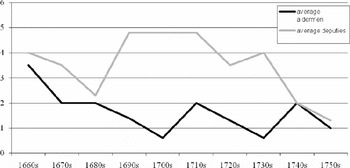
Clearly then, in terms of aldermanic attendance, the BHLC exhibited the same profile across our period. However, where the composition of the BHLC did start to deviate was in the attendance of commoners. Figure 1 highlights that attendance by the common councillors increased markedly between the 1670s and the 1750s. Even more revealing data can be gained from an analysis of the composition of this cohort. Many of the common councillors that had populated the BHLC in the pre-Revolution period were from an aldermanic subset of commoners, who had either been, or would go on to reach, the aldermanic bench. In particular, aldermanic deputies figure highly in the composition of the BHLC.Footnote 37 The office of deputy is a good indicator of social status as it was often a stepping stone towards becoming an alderman. The deputy was usually the most senior commoner of the ward, chosen by the ward's alderman, and it was the aldermen who ‘held control over their conduct’.Footnote 38 Deputies therefore were part of the group of elite commoners that acted as a feeder pool to the Court of Aldermen: they were essentially proto-aldermen. As Figure 2 shows post-1680s, deputies and proto-aldermen were still in evidence amongst the commoner members of the committee but there was clearly a downward trend in this profile from the 1720s onwards.
Average number of aldermen and deputy aldermen attending BHLC meeting: 1660s–1750s
Source: London Metropolitan Archives, Bridge House Journals, COL/CC/BHC/01/02–11BHJ. Sample of alternate years from 1667 to 1755.

In part, this is to be expected, given the increasing rarity of vacancies for aldermanic posts and the fact that the office of alderman was becoming even more elite over this period, thanks to a higher property qualification.Footnote 39 Even so, the data clearly shows that the profile of the commoners on the committee was changing. Although they were still likely to come from the elite end of the commoner spectrum, they were also less and less likely to have had any direct connection with the Court or the post of alderman – they were career commoners.
Overall, this analysis demonstrates that despite the expanding workload of the BHLC, the aldermen were not reluctant to attend its meetings, and there continued to be an imposing aldermanic presence on the committee across the period. However, their willingness to attend, in contrast to their reluctance to involve themselves in other facets of city administration, is particularly instructive. It illustrates that the aldermen, in their role on the BHLC, were not expected to perform the type of ground level administration they seemingly disliked, and that their predecessors had performed for the pre-Revolution BHLC. But the phenomenon that Beattie has noted of rising commoner engagement in the affairs of the City is also evident in relation to the BHLC, as the number of commoner members attending committee meetings rose markedly over the period, and the profile of these commoners was less and less aldermanic. This pattern of greater commoner activity can be seen in other aspects of the daily business of Bridge House administration, in particular the use of sub-committees.
The rise of the sub-committee
The importance of sub-committees to the BHLC and indeed the Corporation in general cannot be understated. During the eighteenth century the workload of the BHLC expanded, driven by improvements in the exploitation of the Bridge House estates and the devolution of decisions on expenditure from the Court of Aldermen to the BHLC. For example, the BHLC began to encourage completion for leases, which in turn required them to scrutinize the various bids. Similarly, they were required to take decisions on how money should be spent on Bridge maintenance and repair.
This expanding workload meant that the BHLC needed to delegate duties, and as Figure 3 shows, the number of sub-committees increased. Prior to the 1730s, the number of sub-committees was limited. The peaks of activity in 1668 and 1713 were exceptional and related to the views and valuations conducted at the expiration of large numbers of leases. But by the 1730s, the number of sub-committees per year was consistently in double figures. This was because the breadth of business they dealt with began to expand in the second quarter of the eighteenth century. This development had the effect of greatly increasing the importance of sub-committees in relation to the Bridge House administration. They remained for the most part small, with only three men required to constitute a quorum, but they became ever more vital cogs in the functioning of the Bridge House. For example, in 1713, when a glut of Bridge House leases was about to expire, sub-committees undertook 28 views of properties within the City. These viewings, upon which the BHLC would base its valuation of a lease, were crucial given the reliance of the Bridge House on rental income to fund the maintenance of the Bridge.Footnote 40
Number of BHLC sub-committee meetings: a sample for 1668–1753
Source: London Metropolitan Archives, Bridge House Journals, COL/CC/BHC/01/02–11. Sample at five-year intervals.

But the sub-committees seemed to grow in stature in other areas. By the 1740s, they were auditing workmen's bills in order to keep ‘fraudulent bills’ to a minimum. They also investigated and made recommendations on the working practices of workmen, and occasionally oversaw the work carried out.Footnote 41 Sub-committees investigated arrears of rent and were therefore instrumental in attempts to boost the income of the Bridge House.Footnote 42 They reported on the physical state of the Bridge, and they provided the research upon which the committee based its decisions to undertake large-scale alterations to the Bridge in 1728 and 1743.Footnote 43 Prior to the Revolution, these assessments had been carried out exclusively by the sub-committees of the Court of Aldermen. The aldermanic attendance on these bodies remained negligible, as it had always done; indeed, in the period between 1747 and 1755 not a single alderman appeared as a member of a BHLC sub-committee.Footnote 44 Yet, the rising number of such committees ensured that the contribution of common councillors to the administration of the Bridge House naturally increased. The profound influence of these little administrative mechanisms was accentuated by the fact that, not only did they gather the information upon which the committee itself made decisions, but crucially, in the course of reviewing nearly 300 sub-committee reports for this article, in only a handful of occasions was a recommendation made by a sub-committee contested or amended by the full committee. In other words, the BHLC simply rubber stamped the decisions made by its sub-committees, committees exclusively composed of commoners.
In addition to this expansion of the role of the sub-committee, the broader remit of the BHLC and the rise in the number of meetings was accompanied by other administrative developments. For example, by the 1720s, the committee had settled into a regular routine of meetings at roughly monthly intervals.Footnote 45 Such scheduling indicates a more organized approach on the part of the BHLC, as opposed to the pre-Revolution period, when the committee seemed to meet as and when required. The meetings themselves became more systematic, with the business relating to the general administration or maintenance of the Bridge House being dealt with first and the process of issuing leases being dealt with in the second half of the session. The reason these changes are evident is that there was a marked improvement in the record keeping of the committee. Whereas in the late seventeenth century entries were scribbled in the journals with no standardization in the information they contained, by the early eighteenth century, the journals had been transformed into accessible and detailed chronicles of each meeting of the committee. Finally, the committee instigated changes in the recording of information, for example attempts were made to set down on paper the duties of the various Bridge House officers so that the committee had a job specification for future reference.Footnote 46 Such efforts exemplify the shift towards the professionalization, bureaucratization and accountability associated with more participatory forms of governance.Footnote 47
Therefore, as the BHLC progressively took over the duties once undertaken by the Court of Aldermen, and the workload of the committee grew, so the involvement of commoners in the administration of the Bridge House became more profound, primarily thanks to the increase in commoner man hours spent on Bridge House business. It is clear that this was a largely consensual arrangement, the aldermen were apparently happy to occupy a more exclusively executive role, with commoners undertaking the routine administrative duties. But what is significant is that this expansion of commoner involvement did not entail any real alterations to the structure of Bridge House administration or the Corporation; it was an evolutionary development within the existing bureaucratic framework. Crucially, this ensured that aldermanic authority was never explicitly denuded. However, as the following section will show, by the 1740s, more pronounced modifications began to embed the Bridge Houses more firmly into the central bureaucratic apparatus of the Corporation.
Direct involvement by the Common Council
The increasingly direct intervention by the Common Council in Bridge House business can be seen in a number of areas. For example, in the first quarter of the eighteenth century, the Council replaced the Court as the arbiter in lease disputes between tenants and the Bridge House. Similarly, around the same period, the Council started to authorize the BHLC to request cash from the City chamber, a responsibility that had previously rested with the Court.Footnote 48
Aldermanic influence was further eroded in the 1730s and 1740s, when in response to numerous allegations of severe corruption, various Bridge House offices in the gift of the lord mayor were abolished, and replaced with Council appointed sub-contractors or salaried officials. The abolition of these offices is interesting as it does seem that, initially at least, attempts by the Council to remove them met with resistance from the Court.
In order to offset the costs he incurred during his term of office, the lord mayor was allowed to sell various City offices, including virtually all posts associated with the Bridge House such as the comptroller, and the master workmen. The prices paid for these offices were often substantial, running to many hundreds of pounds, yet the salaries associated with them were paltry. Instead, the men who had purchased the offices earned their money through billing the Bridge House for the work they had undertaken. Therefore, not only were the men keen to recoup their payment for the office, but the more work they undertook, the higher their profits. In addition, because they had not been appointed by the Common Council, the accountability of these men was at best limited, and crucially there was no formal procedure for checking the veracity of the bills they submitted. Historians have long been aware of the deficiencies associated with such ‘offices of profit’, particularly as they seemed actively to encourage corruption and jobbery.Footnote 49 Yet, as Doolittle notes, the City of London did little to remedy its system, as these offices were viewed as sources of income for the lord mayor, rather than essential components of the City's administration.Footnote 50
Accusations of corruption made against Bridge House workmen are scattered throughout the Bridge House Journals but the Corporation's response to them changed dramatically over our period. Accusations against various workmen made in the 1670s resulted in almost complete inertia on the part of the aldermen. Yet, there was a much stronger response to accusations made in 1708 by a Bridge House workman against his colleagues, and this episode provides evidence of disputes between the aldermen and the commoners over the retention of several offices.
A committee instigated by the Court of Aldermen was ordered to investigate these accusations of ‘frauds and abuses’ in 1708, but the committee never met.Footnote 51 A separate BHLC sub-committee also conducted their own investigations into the allegations and their ensuing report concluded that serious consideration should be given to abolishing a number of sold offices and sub-contracting the work as and when necessary.Footnote 52 The offending officers at the centre of the corruption allegations, the two master carpenters, were dismissed by the Council. However, the carpenters petitioned the Court which subsequently overrode the Council's decision and re-instated them. It is not clear whether the Court had explicitly deployed its veto, but it is clear that it had re-asserted its supremacy.Footnote 53
However, whereas in 1708 reform was apparently stymied by the aldermen, similar accusations of corruption in the 1730s and 1740s did result in concrete action.Footnote 54 The Council, finding the officers accused of corruption guilty, abolished various sold offices, replacing them with posts directly accountable to the Council or sub-contractors accountable to the BHLC.Footnote 55 As opposed to the events of 1708, the abolition of these sold offices did not raise objections from either the Court or the lord mayor. Indeed, in 1749, the entire system of sold offices within the Corporation and Bridge House was swept away by an act of Common Council.Footnote 56
The abolition of the Bridge House's ‘offices for profit’ was probably partly due to an increasing realization on the part of the Corporation of the detrimental effect sold offices were having on the financial health of the City.Footnote 57 Yet, these actions also exemplify the broader changes in the mentality towards office holding in the early modern period, as notions of probity, honesty and professionalization in public office began to take hold.Footnote 58 Their abolition was significant because they were in many ways the most visible symbol of the oligarchic, paternal governance exercised by the aldermen. Their replacement by Council-appointed sub-contractors or officers ensured that the posts responsible for the administration and maintenance of the Bridge were now directly accountable to the Council or the BHLC – a body increasingly dominated by commoners.
Collectively, such developments illustrate the Council's tightening control over the daily operations of the Bridge House, but crucially they were evolutionary and, barring a handful of disputes, largely consensual changes. Therefore, whereas in the first quarter of the eighteenth century the consolidation of the Common Council's control over the Bridge House was achieved through changes within the context of the existing Bridge House administrative framework, such as the increased use of sub-committees, by the 1730s, subtle, yet transformative, structural alterations to the relationship between the Bridge House and the Common Council were occurring.
The London Bridge Improvement Act
Perhaps the best example of such piecemeal but structural administrative changes coincided with the mid-eighteenth-century renovation of the Bridge. This renovation, which included removing the houses on the Bridge which had lined the structure since the thirteenth century, was one of the most important events in the Bridge's history and the role the Common Council played in instigating this project has been explored elsewhere.Footnote 59 But the manner in which this project was undertaken, and the mechanism used to achieve it, suited additional purposes and exemplifies the types of processes that this article has discussed.
In order to implement the project, the Council petitioned parliament for an improvement act, and the London Bridge Improvement Act was duly granted on 25 June 1756.Footnote 60 Such improvement acts created bodies called improvement commissions. These bodies were charged with the responsibility to undertake one specific task, and the powers vested in them were highly specific.Footnote 61 However, the real attraction of these acts and the improvement commissions they created was that as they were products of private bill legislation they derived their power from statute, which meant that ‘no alteration was made to the general law’.Footnote 62 Therefore, improvement commissions lay outside the existing corporate power structures. As a result of their origins, improvement acts and improvement commissions possessed a flexibility that allowed Corporations to put them to a number of uses, financially, administratively and politically.Footnote 63
The London Bridge Act first enacted a number of powers, and charged the ‘common council assembled’ with appointing a committee in which those powers would rest. The body subsequently created – the London Bridge Improvement Commission – consisted of 12 aldermen and 24 commoners, although in reality, attendance was rarely even a quarter of that number. The powers held by the commission related to both the implementation and funding of the project.
With regards to implementation, the powers granted to the commission were powers that the BHLC or the Corporation itself already possessed in one form or another. The commission's main duties revolved around ordering compensatory payments to the handful of Bridge residents who had been compulsorily bought out of their leases, supervising the toll collector for the bridge and rubber stamping payments for the construction of a temporary wooden bridge. The commission was scheduled to meet weekly; however, by early 1757, the meetings had become increasingly sporadic and dealt with a decreasing volume of business.Footnote 64 In truth, the commission had a peripheral role in undertaking the project with all work carried out by sub-contractors managed by the recently appointed George Dance, the clerk of the city works, and the city surveyor Robert Taylor.Footnote 65 Dance and Taylor were not only appointed directly by the Common Council, but as architect planners and salaried technocrats they were men who personified the concept of the professionalization of office.Footnote 66 Essentially, the commission was a shell body, a point made clear right from its inception when the Common Council asserted that the commission's members were ‘subject to the control of this Court’.Footnote 67
The real reason for the creation of the act was related to the funding of the project. The act granted the commission the power to charge tolls from vehicles passing over and under the bridge. This tollage was to create a stable revenue stream which the commission could use as security against credit, credit to fund the renovations. But crucially, the act also placed the responsibility for receiving and distributing all the monies associated with the project in the hands of the City's chamberlain; the money was to pass through the City chamber and never appeared in the Bridge House account books.Footnote 68 Over the course of the project the Council became increasingly active in administering the broader Bridge House finances, as evidenced by their role in determining how to invest the substantial surplus of that was accruing from the rental income from the Bridge House estate.Footnote 69
In summary, the improvement commission was a superfluous by-product of an act designed simply as a vehicle to fund the renovations of the Bridge. But the act was also an opportune way for the Council not only to directly control the renovations, but also to legally place the management of the Bridge House finances in the hands of the Corporation. Indeed, by the time the project had run into financial difficulties in the early 1760s, largely due to the inability of the toll collector (whom the commission supervised) to collect tolls efficiently, the commission was effectively disbanded.Footnote 70
Therefore, both practically and symbolically, in the case of the Bridge House it was the London Bridge Improvement Act rather than the abolition of the aldermanic veto that marked the point when the burgeoning bureaucratization, professionalization and accountability of the ‘rate-payers democracy’ finally laid to rest any vestiges of aldermanic oligarchy.
Conclusion
In the context of the Bridge House, from the late seventeenth century onwards, a process was underway whereby as the Court of Aldermen's power began to wilt, so the individual aldermen themselves became more interested in the prestigious aspects of their roles. Thus, the Common Council became more active, both in terms of personnel and direct intervention, in the daily business and administration of the Bridge House. This commoner involvement served to ensure an incremental and evolutionary absorption of the Bridge House into the central apparatus of the corporate bureaucracy, an assimilation which became more profound from the 1740s onwards. Yet, it is important to note that this was a piecemeal process, whereby assorted measures over several decades slowly began to consolidate the Common Council's hold on the Bridge House. The use of the Improvement Act, ostensibly to facilitate the renovations of the Bridge, but in reality to extend corporate control over the finances of the Bridge House, can be seen as exemplifying the absorption of the Bridge House by the centralized authority of the Corporation.
By adopting a methodology that surveys the routine administrative life of the Bridge House, this article has shed new light on the Corporation's path from the oligarchic governance of the aldermen, to the ‘rate payer's democracy’ of the Common Council. In suggesting that this transition was more evolutionary and consensual than the revolutionary narrative espoused by those researching party politics, this article reminds us of a crucial point articulated by Doolittle that the tumultuousness of party politics within the square mile was often in stark contrast to the fundamental underlying stability of its governance. This inherent stability ensured that the Corporation was able to reorganize itself and ultimately avoid the attentions of the Victorian reformers. This article has also argued that what was driving this process was the changing attitude towards the business of governance and office holding. For the Corporation in the post-Revolution period, increased administrative professionalization begat increased democratization.
This process continued into the nineteenth century, as the increasingly artisanal council – the ‘parliament of shopkeepers’ – instigated a plethora of private bills to improve the City's services and infrastructure. This typically piecemeal, fragmented approach fuelled bureaucratic growth and, despite its democratic basis, critics have argued that these changes primarily served the rather narrow interests of the City shopkeepers. It was not until the mid-1800s, when various ‘metropolitan authorities’ of elected members were created, that London's administration was conducted on a city-wide scale and began to resemble the type of democratic governance that we are familiar with today.Footnote 71
Finally, in more broad terms, this article has shown that when seeking to understand oligarchy within the context of pre-modern towns and cities we must be attentive to how power was or was not expressed on a routine administrative basis within such a system of urban governance. To ignore this base of the oligarchic edifice, and focus primarily on analysing its executive aspects, is to risk a partial reading of what is a complex and holistic topic.