Antimicrobial-resistant infections such as methicillin-resistant Staphylococcus aureus (MRSA) infections pose great patient safety challenges. Healthcare-associated MRSA infections lead to increased healthcare costs by extending patient length of stay (LOS) and requiring alternative treatments beyond common first-line antibiotics. 1 More importantly, higher mortality rates have been reported among patients infected with MRSA than in patients infected with methicillin-susceptible strains of Staphylococcus aureus. 1 , Reference Yoon, Choi, Kim, Kim and Song 2
Infection surveillance systems have been developed in Canada to monitor and reduce the incidence of MRSA infections in healthcare settings, typically by active prospective case detection. Guidelines for active surveillance recommend laboratory screening of patients at risk or manual review of medical records 3 – 6 ; hence, active surveillance is often costly and labor intensive. Efforts to publicly report hospital-acquired MRSA infections in Canada have been undertaken by the Public Health Agency of Canada and provincial governments. 7 In 2014, an estimated all-cause mortality rate of 25% was reported for MRSA bloodstream infections (BSIs) among 58 sentinel, participating, acute-care Canadian hospitals. 7 However, the incidence and mortality rates of MRSA infections from these 58 hospitals represent only 10% of all acute-care hospitals in Canada, and most were teaching facilites. 7 The complete and representative estimate of MRSA infections for the country, as well as the estimate variations across hospitals, remains unknown.
In Canada, administrative data are routinely collected from all acute-care hospitals, and demographic and clinical information are captured. In all hospitals, clinical information is collected according to a mandatory national coding standard, the International Statistical Classification of Diseases and Related Health Problems, Tenth Revision, Canada (ICD-10-CA), which is used for diagnoses. The Canadian Classification of Intervention is used for interventions. As a complement to the surveillance systems, administrative data can therefore provide a standardized approach to reporting and monitoring antimicrobial-resistant infections across all Canadian hospitals. Administrative data can also facilitate interfacility comparability of risk-adjusted rates across Canada and can provide a cost-effective alternative for under-resourced hospitals lacking a surveillance system.
The primary objective of this study was to assess the feasibility of using administrative data to monitor in-hospital MRSA BSIs and all-body-site MRSA infections. The secondary objective was to determine whether there was a correlation between MRSA BSIs and all-body-site MRSA infections within the administrative data only.
METHODS
Study Design
We conducted a retrospective study of all patients discharged from acute-care hospitals in Ontario and Alberta between April 1, 2012, and March 31, 2013, and we compared the total number of adult and pediatric cases of hospital-level MRSA infections in an administrative database to corresponding mandatory-reporting surveillance datasets. We also measured the correlation between Ontario cases of MRSA BSIs and all-body-site MRSA infections within the administrative database. In this study, we focused only on hospital-acquired MRSA infections associated with the reporting facilities.
Case Definitions and Data Sources
Publicly reported data for Ontario
The mandatory-reporting surveillance program dataset from Ontario containing quarterly results for new hospital-acquired MRSA BSIs was obtained from the Ontario Ministry of Health and Long-Term Care, and we analyzed the data collected during the study period. 8
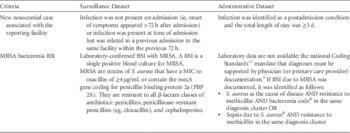
Aggregated hospital-level MRSA BSIs from the publicly reported surveillance program were provided based on the 3 reportable standard case definitions (Table 1). 9 Only cases associated with the facility are publicly reported in the program, and these cases were the focus of this study. In Ontario, hospital-acquired cases are identified as infections not present at the time of admission with symptom onset at least 72 hours after hospital admission or infections present at the time of admission but related to a previous admission to the same facility within 72 hours. 9
MRSA Infection Definitions by ICD-10-CA Code 12 Used in Surveillance and Administrative Datasets in Ontario, Canada, 2012–2013

MRSA, methicillin-resistant Staphylococcus aureus; BSI, bloodstream infection; MIC, minimum inhibitory concentration; ICD-10-CA, International Statistical Classification of Diseases and Related Health Problems. Tenth Revision, Canada (2012).
a Nurses’ notes, pathology reports, and other investigations were used to identify specificity in assigning the diagnosis code for documented conditions.
b As postadmission category (type 2: a condition that arises post admission). A postadmission category for a comorbidity was assigned if one of the following criteria was met: (1) required treatment beyond maintenance of the pre-existing condition; (2) increased the LOS by at least 24 h; or (3) significantly affected the treatment received and affected the management of the patient in hospital. 11
Surveillance data for Alberta
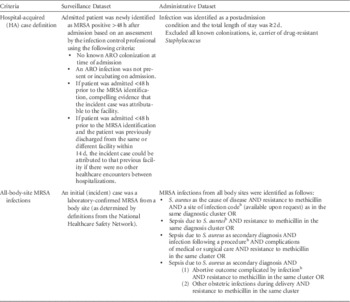
A similar mandatory, provincial, surveillance-reporting dataset was obtained from Alberta Health Services for data collected during the same period. 10 In contrast to Ontario, the Alberta surveillance dataset included new hospital-acquired MRSA infections of all body sites. The case definition included laboratory-confirmed cases from a body site identified at the time of admission or during hospitalization (Table 2). 10
MRSA Infection Definitions by ICD-10-CA Codes 12 Used in Surveillance and Administrative Datasets in Alberta, Canada, 2012–2013Footnote a

NOTE. MRSA, methicillin-resistant Staphylococcus aureus; ARO, antimicrobial-resistant organism; ICD-10-CA, International Statistical Classification of Diseases and Related Health Problems. Tenth Revision, Canada (2012).
a The first positive MRSA result was considered as the surveillance case, whether a screening specimen or a clinical specimen. If both specimen types were taken within 24 h, the most important specimen were considered.
b As postadmission category (type 2: a condition that arises post admission). A postadmission category for a comorbidity was assigned if 1 of the following was met: (1) required treatment beyond maintenance of the preexisting condition; (2) increased the LOS by at least 24 h; or (3) significantly affected the treatment received and affected the management of the patient in hospital. 11
Administrative database
The Canadian Institute for Health Information (CIHI) Discharge Abstract Database (DAD) was the administrative dataset used to collect information regarding hospital-acquired MRSA infections during a hospital stay during the study period. Definitions from both surveillance programs were used to match definitions in the administrative data and thereby to perform the comparison between each surveillance program and the respective administrative data. In the CIHI administrative database, only postadmission active infections were included. To capture active BSIs for Ontario, case selection for MRSA bacteremia and sepsis was developed following the Canadian Coding Standards using the ICD-10-CA classifications system (Table 1). 11 , 12
To capture all-body-site MRSA infections for Alberta, case criteria were expanded to also include a site of infection (Table 2).
For Ontario, hospital discharges with in-hospital MRSA BSIs and a LOS>3 days were retained from the administrative data. For Alberta, in-hospital MRSA infections with a LOS >2 days were identified. Diagnostic codes for Staphylococcus aureus colonization or carriage (eg, ICD-10-CA: Z22.300 Drug-resistant Staphylococcus) were not included because we sought to detect clinical infections. 11 , 12 Hospital-level cumulative LOS was calculated for all acute inpatients by summing the number of days from admission to discharge. Rehabiliation and mental health stays were not included because this information was captured via other administrative databases.
For the secondary study objective, in-hospital MRSA infections from all body sites in the Ontario administrative dataset were also identified using a method similar to that described for Alberta; thus, Ontario hospital-level MRSA BSIs could be correlated to all-body-site MRSA infections across those same institutions.
Statistical Analyses
Primary objective
The numbers of in-hospital MRSA BSIs identified from the Ontario administrative dataset during the study period were plotted against hospital-acquired cases from surveillance data for each of the 124 Ontario hospitals. Similarly, the numbers of in-hospital all-body-site MRSA infections identified in the Alberta administrative dataset were compared against hospital-associated cases from surveillance data for each of the 93 hospitals in Alberta. Scatter plots and Pearson correlation coefficients were used to compare the numbers of hospital-level MRSA infections within administrative versus surveillance datasets.
Secondary objective
In Ontario, administrative data only were also used to assess the correlation of hospital-level MRSA BSIs and all-body-site MRSA infections. Pearson correlation coefficients were calculated between in-hospital MRSA BSIs and all-body-site MRSA infections from the administrative dataset for the same 124 Ontario hospitals and the same period of study. All Pearson correlation coefficients were weighted for hospital-level cumulative LOS and were calculated using SAS Enterprise Guide, version 4.3 software (SAS Institute, Cary, NC).
RESULTS
The surveillance datasets included hospital-level results for all hospitals (including rehabilitation and psychiatric facilities) in Ontario and Alberta, resulting in the inclusion of 235 hospitals in Ontario and 102 hospitals in Alberta. The administrative dataset compiled by CIHI included information on acute-care hospitals only. Discharges from these acute-care hospitals in Ontario and Alberta were identified from the administrative dataset for the same period. In total, 124 and 93 hospitals in Ontario and Alberta, respectively, were matched from provincial surveillance and administrative databases. Of the 124 hospitals in Ontario, 15 (12%) were teaching hospitals, 27 (22%) were large community hospitals, 33 (27%) were medium-size community hospitals, and 49 (39%) were small community hospitals. In Alberta, 8 (9%) were teaching hospitals, 5 (5%) were large community hospitals, 5 (5%) were medium-size community hospitals, 74 (80%) were small community hospitals, and 1 (1%) did not have an associated peer group. 13 The remaining unmatched hospitals from the surveillance data included non–acute-care facilities (eg, rehabilitation and psychiatric facilities): 111 from Ontario and 7 from Alberta. However, 2 acute-care hospitals in Alberta with missing MRSA results from the surveillance data were excluded from our analyses.
Overall Rate of In-Hospital MRSA Infections in Administrative Data
During the study period, there were 1,132,834 discharges from the 124 hospitals in Ontario, for a cumulative total LOS of 6,597,641 patient days. Furthermore, 168 MRSA BSIs were identified as conditions that arose after hospital admission. The overall in-hospital MRSA BSI rate for the 124 Ontario hospitals was 0.25 cases per 10,000 patient days during the study period. At the hospital level, rates varied from 0 to 2.6 per 10,000 patient days.
There were 383,746 discharges from the 93 hospitals in Alberta, with a total cumulative LOS of 2,619,211 patient days, during which 113 all-body-site MRSA infections were identified as in-hospital infections. The overall in-hospital all-body-site MRSA infection rate for the 93 Alberta hospitals was 0.43 per 10,000 patient days during the study period. At the hospital level, rates varied between 0 and 5 per 10,000 patient days.
Overall Rate of Hospital-Associated MRSA Infections in the Surveillance Data
The mandatory surveillance program revealed a total of 181 hospital-associated MRSA BSIs reported from the 124 Ontario hospitals during the same period; thus, an additional 13 MRSA BSIs were reported in the surveillance program. The total patient days reported to the Ontario program were also higher than in the administrative data (ie, 8,492,215 vs 6,597,641, respectively). This difference can be attributed to the fact that the surveillance data included rehabilitation and mental health stays within the acute-care facilities, while the DAD only included acute-care stays in these same facilities. It is also possible that the 13 additional cases from the surveillance program were related to the types of hospital stay not included in the administrative data. The overall rate was similar to that obtained using administrative data: 0.21 MRSA BSIs per 10,000 patient days. More cases were also identified in the Alberta surveillance program, where a total of 229 hospital-acquired, all-body-site MRSA infections were reported during the same period. Unlike the large difference in total patient days observed for Ontario; the total patient days in the Alberta surveillance data were relatively similar to those calculated from administrative data (2,558,537 vs 2,619,211, respectively). The overall rate was 0.90 all-body-site MRSA infections per 10,000 patient days.
Correlation of Hospital-Level In-Hospital MRSA Infections in the Administrative and Surveillance Data
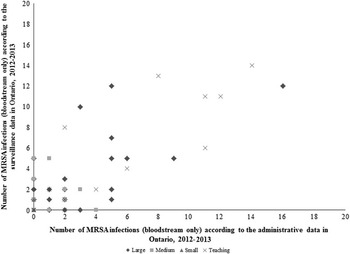
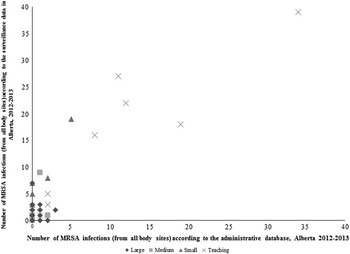
We identified a strong correlation between the hospital-level MRSA BSIs in Ontario administrative and surveillance databases (r=0.79; P<.0001; 95% CI, 0.72–0.85) (Figure 1a). An even stronger correlation was observed between all-body-site MRSA infections in the administrative and surveillance data from Alberta (r=0.92; P<.0001; 95% CI, 0.88–0.94) (Figure 1b).
Correlation between in-hospital MRSA infections (bloodstream only) from administrative data and hospital-associated MRSA infections (bloodstream only) from surveillance data in Ontario hospital (n=124). Each data point represents a different type of acute-care hospital from Ontario data. The administrative data for each hospital did not include rehabilitation, chronic care, or mental health stays in those hospitals.

Correlation between in-hospital MRSA infection cases (all body sites) from administrative data and hospital-associated MRSA infection cases (all body sites) from surveillance data in Alberta hospitals (n=93). Each data point represents a different type of acute-care hospital from Alberta data. The administrative data for each hospital did not include rehabilitation, chronic care, or mental health stays in those hospitals.

Correlation of In-Hospital MRSA Bloodstream and All-Body-Site MRSA Infections in Ontario Administrative Data
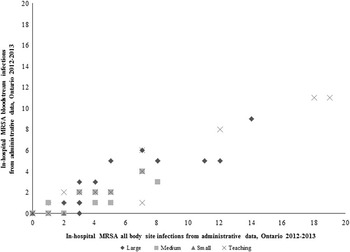
A total of 334 all-body-site MRSA infections were identified from the Ontario administrative data; this represents an additional 166 infections (ie, roughly twice the number) when compared to MRSA BSIs only. We reviewed the correlation between MRSA BSIs and all-body-site MRSA infections that were identified as in-hospital conditions using the Ontario administrative data (Figure 2). A strong correlation (r=0.95; P<.0001; 95% CI, 0.93–0.96) was observed between in-hospital MRSA BSIs and all-body-site MRSA infections for the 124 Ontario hospitals.
Correlation between in-hospital MRSA bloodstream infections from administrative data and MRSA infection of all body-sites from administrative data in Ontario hospitals (n=124). Each data point represents a different type of acute-care hospital from Ontario data.

DISCUSSION
To our knowledge, this is the first study to examine the comparability between hospital-level MRSA infections derived from surveillance and administrative databases based on a national coding standard and the ICD-10-CA classification system. Using administrative data case-selection criteria tailored to match the definitions from each provincial surveillance program, we found a strong correlation between in-hospital MRSA infection counts in administrative and surveillance datasets across 2 large, independent provincial healthcare systems: Ontario and Alberta. This finding suggests that administrative data can be used to obtain accurate estimates of MRSA BSI and all-body-site MRSA infection rates. In addition, the strong hospital-level correlation of MRSA BSIs versus all-body-site MRSA infections in Ontario suggests that either could be used as a hospital-level metric.
A similar analysis showed an excellent correlation (r=0.91) for hospital-acquired Clostridium difficile cases using the same administrative and surveillance databases from Ontario.Reference Daneman, Stukel, Ma, Vermeulen and Guttmann 14 Previous studies on MRSA infections in administrative databases have focused on the validity of the ICD-9 or ICD-9-CM classification systemsReference Kreppel 15 , Reference Schweizer, Eber and Laxminarayan 16 ; the ICD-10-CA system is superior to the ICD-9 system because it allows the use of a combination of codes to identify the microorganism, as specified by the national coding standards regarding the site of the infection and the antibiotic resistance profile. Furthermore, the CIHI administrative database distinguishes conditions arising after admission. 11 Methodologies for using a combination of codes to identify the etiology and manifestation of MRSA infection have been suggested to improve data reliability.Reference Kreppel 15 Additionally, in contrast to the ICD-10-CA system, earlier versions of the ICD-9 did not facilitate differentiation between colonization and infection.Reference Schweizer, Eber and Laxminarayan 16
In Canada, standard surveillance definitions and minimum requirements for MRSA reporting were developed in 2008; however, definitions are not mandatory, and each administrative region or hospital in Canada determines their own surveillance protocols based on local epidemiology and/or resources. 17 Although administrative databases cannot replace surveillance systems because of the different purposes of these datasets, administrative databases may be used as a tool to ensure that a consistent methodology is applied to estimate risk-adjusted rates of in-hospital MRSA infections across Canadian hospitals. In turn, public reporting on these indicators will be feasible, efficient, and practical and will support quality-of-care improvement efforts. Additionally, it will allow for the development and reportage of risk-adjusted rates so that hospitals can compare their data against that of their peers, thereby creating further opportunities for interhospital learning.
Overall, both surveillance programs identified more MRSA infections than the administrative database. Some of the differences observed may be attributed to the fact that laboratory results are not available in administrative data; thus, the accuracy of administrative data relies on the charting accuracy of the primary care provider (ie, physician or nurse practitioner 11 ). Furthermore, the surveillance programs in most Canadian hospitals are independent of the administrative coding programs, possibly leading to variation in the numbers of infections reported. In addition, other differences observed may be attributed to the inability to fully align the administrative definition criteria with those of the surveillance protocols. First, the surveillance programs excluded relapses using different time windows, ie, a 6-week end of treatment in Ontario and a 10-day end of treatment in Alberta. 9 , 10 , 17 Date of end of treatment and date of negative culture data are not collected in administrative data. However, we identified fewer than 5 patients with a MRSA BSI who had a previous hospital admissions within 6 weeks in Ontario; therefore, the likelihood of including relapses in the administrative database was low. The difference between a 4-week and a 12-month review period for classifying MRSA cases was investigated in a previous study, and only 2% of cases were reclassified from community associated to healthcare associated.Reference Leung, Lloyd-Smith and Romney 18 Second, results from administrative data in Ontario did not include cases attributed to a previous hospitalization, whereas the Alberta program did. 10 Although this information was not available in the administrative data, we searched for MRSA infections within 48 hours of admission and found 1 case in Ontario and no cases in Alberta. Third, the surveillance program data for Ontario included rehabilitation and mental health stays, whereas the administrative data did not capture these stays.
Our study also demonstrates that the number of MRSA infections doubled after expanding the criteria definition to include all-body-site MRSA infections compared to MRSA BSIs only in Ontario; others have reported that only 25% of MRSA infections are related to septicemia in the United States.Reference Kuehnert, Hill, Kupronis, Tokars, Solomon and Jernigan 19 Importantly, our data demonstrate a strong correlation between hospital-level MRSA BSI counts as well as all-body-site MRSA infection counts. Although both levels of reporting are likely reasonable, focusing on MRSA BSIs limits the precision of estimates compared with the approach used in Alberta, which further included all-body-site MRSA infections.
A limitation of this study was our inability to examine patient-level data from surveillance data. Despite the excellent correlation at the hospital level, some discrepancies may exist across databases at the patient level. Also, some differences may be related to case definitions for MRSA. Finally, it may be hard to generalize our conclusions given that each province uses different protocols for identification of hospital-acquired infections for surveillance.
The comparison of administrative datasets to a reference standard of surveillance data is limited by the potential inaccuracies of surveillance data.Reference Forrester, Collet and Mitchell 20 However, the strong correlation observed suggests that both are likely accurate estimates of hospital-associated MRSA rates. A re-abstraction study on the administrative database used in our analyses revealed that 74% of in-hospital MRSA infections had been coded with drug-resistance codes, as confirmed from patient charts. 21 Similarly, a 24% discordant classification between community- and hospital-acquired MRSA infections was identified in a re-abstraction study using Canadian surveillance data.Reference Forrester, Collet and Mitchell 20 Lastly, the findings of this study may not apply to other countries due to differences in surveillance systems, administrative data collection, national coding standards, and prevalence of MRSA infections.
An important role of active surveillance systems, which cannot be replaced by the administrative data measures, is the identification of cases in real time to guide isolation and prevention of infection transmission. However, another role of surveillance is to track rates for intra- and interfacility comparisons. Administrative databases offer a cost-effective alternative that may be especially helpful for underfunded hospitals; therefore, they may be useful as a tool to ensure that consistent methodology is applied to estimate rates of in-hospital MRSA infections across Canadian hospitals.
In conclusion, administrative and surveillance datasets identify comparable hospital-level counts of MRSA infections. Although it was not designed for surveillance purposes, this study demonstrates the feasibility and accuracy of using administrative databases to report on antimicrobial-resistant infections across Canadian regions and hospitals. By using administrative data, all Canadian hospitals would have a standard definition for measuring these infection rates; therefore, comparisons among hospitals across the country would be possible. Furthermore, with the evolution of reporting tools, more timely and comparable results would be possible using administrative data and would therefore enhance data quality.
ACKNOWLEDGMENTS
The authors would like to acknowledge Dr. E. Henderson of Alberta Health Services Infection Prevention and Control and D. Gibson of Health Analytics Branch, Ministry of Health and Long-Term Care (MOHLTC) for voluntarily providing the hospital-level results from their provincial surveillance programs and for their constructive comments. Without their participation, the analysis and reporting of this data would not have been possible. We thank our colleagues from the Canadian Institute for Health Information, Alana Lane and Janet Manuel, for providing their expertise on Canadian Coding Standards. We also thank Chen Wu and Yue You for assisting with database design.
Financial support: This research was supported and conducted at the Canadian Institute for Health Information. The opinions, results, and conclusions in this paper are solely those of the authors.
Potential conflicts of interest: All authors report no conflicts of interest relevant to this article.