Nomenclature
- UAV
-
unmanned aerial vehicle
- UCAV
-
unmanned combat aerial vehicle
- IPA
-
immune plasma algorithm
- gintIPA
-
greedy initialiser immune plasma algorithm
1.0 Introduction
Unmanned aerial vehicles (UAVs; also called the unmanned combat aerial vehicles or UCAVs) and similar equipment capable of carrying sophisticated weapon systems as well as monitoring and tracking equipment, revolutionised the world [Reference Bushnell1–Reference Yesilbas, Özgür, Ozen and Oktay3]. Well-known military doctrines and complex numerical strategies are designed by considering the advantageous sides of these unmanned vehicles in the production cost and maintenance, and increasing amounts of budgets are allocated for developing new forms or solving critical problems related to them. Path planning is among the most critical problems for the UAV or UCAV systems, and an optimal or near optimal solution according to some minimisation objectives of the enemy threats, fuel or battery consumption,and manoeuvres has a direct influence on the flight safety and task success [Reference Gutierrez-Martinez, Rojo-Rodriguez, Cabriales-Ramirez, Estabridis and Garcia-Salazar4–Reference Rostami, Bardin, Neufeld and Chung6].
In recent years, different graph-based path planning techniques such as Dijkstra, A*, and D* lite, sample-based methods including rapidly-exploring random trees (RRTs), and probabilistic roadmaps (PRMs), popular field-based approaches like virtual force (VF) and artificial potential field (APF) have been explored successfully. Although all these path planners come with a set of unique solving characteristics, they generally have difficulties when addressing the bottlenecks stemming from the relatively high computational burdens, requirements of detailed battlefield maps and extra storage spaces for them. Meta-heuristic algorithms that are in the subgroup of artificial intelligence were also used for solving the UAV or UCAV path planning problem, and promising results compared to the results of the classical planners were obtained.
The number of meta-heuristic algorithms that are employed with their standard workflows or after a substantial number of changes on various stages demonstrates the importance of the UAV or UCAV path planning problem and the urgent demands to more versatile and stable path planners designed by bringing strong search characteristics of a modern meta-heuristic and genuine procedures together. Immune Plasma algorithm (IP algorithm or IPA) is a recent meta-heuristic that is inspired by the fundamental steps of a medical method that gained popularity again with the COVID-19 pandemic and called immune or convalescent plasma treatment [Reference Aslan and Demirci7]. The standard IPA or its modernisations have been used efficiently as a noise minimiser [Reference Aslan and Demirci8], neural network trainer [Reference Ajay and Nesasudha9], time series predictor [Reference Arslan10], radio channel assigner [Reference Kisa, Demirci, Arslan and Aslan11], wireless sensor distributor [Reference Tasdemir, Demirci and Aslan12] and UAV or UCAV path planner [Reference Aslan and Erkin13]. In this study:
-
• A greedy heuristic approach that guarantees the maximum safety while keeping the length of line segment and turning angle at minimum if possible for generating a UAV or UCAV path by evaluating the geometric description of the battlefield is utilised.
-
• The quality of the path discovered by the greedy approach gives inspiration to initialise the population of a meta-heuristic algorithm and IPA is chosen as the reference meta-heuristic.
-
• Additionally, the plasma collection and transfer procedures of the IP algorithm are completely remodeled to gain advantages from the qualified individuals of the initialised population more and an efficient search is maintained, eliminating the need for control parameters that set the number of donors and receivers.
The performance of the IPA-based path planner or greedy initialiser IPA (gintIPA) was investigated in detail over three different battlefield scenarios and their 12 test cases. A set of comparative studies between the gintIPA and other 14 path planners including IPA, Genetic algorithm (GA), a modified version of GA named GAPSO, Moth-Flame Optimisation (MFO), Salp Swarm algorithm (SSA), Pathfinder algorithm (PFA), Stain Bowerbird Optimisation (SBO), Sine Cosine algorithm (SCA), a variant of the Teaching Learning Based Optimisation (TLBO) called ECTLBO, Grey Wolf Optimiser (GWO), a hybridisation of GWO and Symbiotic Organism Search (SOS) or HSGWO-MSOS, an implementation of the Particle Swarm Optimisation (PSO)- a substantially enhanced Particle Swarm Optimisation (PSO) implementation for short CIPSO-, Artificial Ecosystem Optimiser (AEO), and neighbourhood-based search enhanced AEO (NSEAEO) was carried out. Comparative studies between gintIPA and other mentioned meta-heuristic-based path planners informed that gintIPA outperforms them for almost all test cases. The population generated by the proposed greedy initialiser contains candidates whose qualities are generally better than the qualities of the candidates generated by the common randomise initialisation method and allows gintIPA to start ptimisation in a search space narrowed subtly. Also, the newly designed treatment schema that differentiates the plasma collection and its transfer carefully enhances the exploitation performance of the gintIPA and assists it in finding safer and more efficient paths than other tested algorithms. The remainder parts of the manuscript are organised as follows: In Section 2, the mathematical properties of the path planning problem are given. While the fundamental steps of the IPA are summarised in Section 3, details of the greedy initialiser and treatment schema and how they integrate into the workflow of IPA are presented in Section 4. Section 5 is devoted to the experiments and comparative studies. Finally, in Section 6, some concluding remarks and proposals for future work are provided.
1.1 Related works
Zhang et al. proposed the Fitness Scaling Adaptive Chaotic PSO (FAC-PSO), which enhances the traditional PSO by adapting the parameters managing particle velocity and position using chaotic random numbers to improve the performance [Reference Zhang, Wu and Wang14]. Duan and Qiao developed Pigeon-Inspired Optimisation (PIO) by leveraging the natural navigation abilities of pigeons as a point of inspiration [Reference Duan and Qiao15]. The path planning problem for UAVs was addressed with the Artificial Bee Colony (ABC) algorithm combined with balance evolution (BE-ABC) [Reference Li, Gong and Yang16]. In a comparative study on three different scenarios, BE-ABC outperformed standard ABC and two variants of ABC, those being I-ABC and IF-ABC [Reference Li, Gong and Yang16]. In another study, Tang and Zhou hybridised Glowworm Swarm Optimisation (GSO) with PSO and called as PGSO [Reference Tang and Zhou17]. Zhang et al. further developed their study by considering path planning for UAVs as a three-dimensional optimisation problem [Reference Zhang and Duan18]. They also evaluated the new constraints that the variables of climbing and turning angles, in addition to fuel consumption and enemy threats, for the determination of the optimal path [Reference Zhang and Duan18]. This comprehensive study was completed with a new variant of DE (differential evolution) designated as the DE algorithm with Level Comparison (DELC) [Reference Zhang and Duan18]. An innovative study integrating the Wolf Colony algorithm (WCA) with the complex method to improve navigation in challenging optimisation environments was carried out by Zhou et al. with the discovery of the Complex Method-based WCA (CWCA) [Reference Zhou, Zhou and Chen19].
Zhang et al. considered the path planning problem under dynamic conditions in a three-dimensional environment and introduced a new method by reinforcing the PIO with predator-prey (PPPIO) [Reference Zhang and Duan20]. In another study, Chen et al. introduced Modified CFO (MCFO) by updating Central Force Optimisation (CFO) with PSO and GA to plan paths for vertical take-off and landing (VTOL) vehicles [Reference Chen, Yu, Mei, Wang and Su21]. A novel algorithm called Quantum Wind Driven Optimisation (QWDO) was designed for the problem by Zhou et al. [Reference Zhou, Bao, Wang, Qiao and Zhou22]. Experimental results demonstrated that QWDO outperforms several existing algorithms, including Quantum BA (QBA) and PSO, in terms of efficiency and effectiveness in finding optimal flight paths while avoiding threats [Reference Zhou, Bao, Wang, Qiao and Zhou22]. Wang et al. introduced the Improved Bat algorithm (IBA) by incorporating the mutation operator from the DE to enhance the diversity of solutions in the Bat algorithm (BA) [Reference Wang, Chu and Mirjalili23]. The performance of the GWO in solving the problem was investigated by Zhang et al. [Reference Zhang, Zhou, Li and Pan24]. In a separate study using the PSO algorithm as a reference, the adaptive decision operator was utilised, which eliminated the problem of trapping into local minima and improved the quality of the results [Reference Liu, Zhang, Guan and Delahaye25]. In a further study, Liu et al. contributed to the existing literature by investigating the four-dimensional (4D) problem for multiple UAVs, in which time is also considered [Reference Liu, Zhang, Zhang and Guan26]. A novel approach, Quantum Encoding BA (QBA), which is built on quantum, NOT gate and quantum rotation methods, has been demonstrated by Luo et al. to obtain suitable paths for UAVs [Reference Luo, Li and Zhou27]. To overcome the premature convergence problem of the Collective Decision Optimisation algorithm (CDOA), Zhang et al. devised the Extended CDOA (ECDOA), which draws on an external archive and employs an operator that increases diversity in the generation of new agents [Reference Zhang, Wang, Yang, Ding, Li and Hu28].
Alihodzic et al. adapted Elephant Herding Optimisation (EHO) to solve the path planning problem and demonstrated it as Adjusted EHO (AEHO) [Reference Alihodzic, Tuba, Capor-Hrosik, Dolicanin and Tuba29]. Miao et al. carried out a series of experiments including GWO, ABC and BA, to investigate the potential of Modified SOS Algorithm Based on the Simplex (SMSOS) in path planning for UAVs, and the results proved the superiority of SMSOS [Reference Miao, Zhou and Luo30]. In further study, the utilisation of Directional Drive-Rotation Invariant Quadratic Interpolation White Shark Optimisation algorithm (DD-RQIWSO) in planning of paths for UAVs has been investigated by Miao et al. [Reference Miao, Li, Yan, Mei, Wu, Zhao, Liu and Zhang31]. Dolicanin et al. developed the Brain Storming Optimisation (BSO) algorithm to produce more appropriate solutions [Reference Dolicanin, Fetahovic, Tuba, Capor-Hrosik and Tuba32]. Lin et al. employed the APF method to increase the convergence speed of the BA integrating a success rate strategy and chaos theory to avoid local optimums and ensure solution diversity [Reference Lin, Tang, Li and Zhao33]. Pan et al. contributed to the field by creating CIJADE, a hybrid algorithm that integrates the strengths of CIPDE and JADE, two DE variants [Reference Pan, Liu and Chu34]. CIJADE has been put to 28 different tests with 11 different well-known DE variants before the path planning problem and proved its superiority [Reference Pan, Liu and Chu34]. Reinforcement Learning-based GWO (RLGWO) was introduced by Qu et al. to improve the balance between exploitation and exploration, enhancing overall solution quality, while also smoothing the generated paths with B-spline curves to ensure better flight compatibility [Reference Qu, Gai, Zhong and Zhang35]. In a similar study, Qu et al. considered the path planning problem with the HSGWO-MSOS, which was created by bringing together the Simplified GWO (SGWO) and Modified SOS (MSOS) [Reference Qu, Gai, Zhang and Zhong36]. Yi et al. presented the Quantum Monarch Butterfly Optimisation (QMBO), utilising a quantum approach to refine poor solutions and enabling the algorithm to achieve global optimum results more effectively [Reference Yi, Lu and Zhao37].
Neighbourhood Global Learning Based Flower Pollination algorithm (NGFPA) was used successfully in obtaining optimal routes for UAVs [Reference Chen, Pi and Xu38]. Zhu et al. conducted a survey of algorithms designed for the path planning problem, complemented by the contribution of the Spider Monkey Optimisation (SMO) algorithm to the literature [Reference Zhu, Wang, Ma and Li39]. Following this pioneering work, SMO was enhanced with the help of Cooperative Co-Evolution (CE) and demonstrated the superior performance of the newly developed CE-SMO algorithm in various scenarios compared to SMO, GWO, PSO and ABC [Reference Zhu, Wang and Li40]. The BA was updated by incorporating an advanced search step, leading to the development of the Improved BA (IBA) [Reference Zhou, Gao, Fang and Lan41]. The novel method demonstrated a solution speed twice as fast as that of the standard BA, along with a 14% improvement in solution quality [Reference Zhou, Gao, Fang and Lan41]. Mixed strategy-based GSA (MSGSA) was proposed by reinforcing the GSA algorithm with
 $\alpha $
coefficient and Cauchy approximation [Reference Xu, Jiang and Zhang42]. Jiang et al. conducted a study on navigating UAVs through complex landscapes including radar, missile and defence systems, employing the Partially Observable Markov Decision Process (POMDP) and Monte Carlo Tree Search (MCTS) methods along with the GWO [Reference Jiang, Lyu, Li, Guo and Zhang43]. Jarray et al. developed a new approach by parallelising the GWO algorithm to provide better solutions in a shorter time and announced it as Parallel Cooperative Coevolutionary GWO (PCCGWO) [Reference Jarray, Al-Dhaifallah, Rezk and Bouallègue44]. The Chimp Optimisation algorithm (ChOA) was enhanced with a dynamic technique for updating the foraging phase, leading to the Improved ChOA (IChOA), which significantly enhances solution quality and avoids local optima [Reference Du, Zhou, Deng and Luo45]. Wang et al. improved the MA by employing an adaptive Cauchy mutation for velocity adjustments and an exponentially decreasing inertia weight to balance exploration and exploitation [Reference Wang, Pan, Yang, Kong, Snášel and Chu46]. Niu et al. modified the AEO algorithm to increase search capability and avoid local optimum solutions [Reference Niu, Yan, Wang and Niu47]. They also focused on possible ways to advance this work and conducted a new experiment in a three-dimensional environment with the newly proposed Modified AEO (MAEO) [Reference Niu, Yan, Wang and Niu48].
Jia, Qu and Li improved the consistency of the results by unequally dividing the line between the UAV start and target points using PSO and rotation-based approaches augmented with Double Layer Coding (DLCRPSO) [Reference Jia, Qu and Li49]. Moreover, Jia et al. published an innovative study in which fitness distance correlation (FDC), adaptive K-neighbourhood-based learning strategy and differential hunger-hunting strategy methods were used besides the DLC to further improve the performance of GWO with DLC (DLC-K-FDGWO) [Reference Jia, Qu and Li50]. Zhang et al. adapted the Search and Rescue (SAR) algorithm to the problem by combining it with Heuristic Crossing (HC-SAR) for the first time and performed real-time path planning for the UAV [Reference Zhang, Zhou, Qin and Tang51]. Aquila Optimisation (AO) was chaoticised using the chaotic map method (CAO) in combination with Simulated Annealing (SA), leading to the invention of CAOSA [Reference Ait-Saadi, Meraihi, Soukane, Ramdane-Cherif and Gabis52]. Also, Saadi et al. designed a new approach to the African Vulture Optimisation algorithm (AVOA) with the Chaotic Cauchy Opposition method (CCO-AVOA) [Reference Ait-Saadi, Meraihi, Soukane, Yahia, Ramdane-Cherif and Gabis53]. GWO was hybridised with DE and the Hybrid GWODE (HGWODE) algorithm was employed in the CEC2014 benchmark functions as well as the path planning problem and the results indicated that HGWODE achieved noticeably more robust solutions [Reference Xiaobing, Jiang, Wang and Li54]. A different approach from other studies, Chen attempted to plan the path by considering the UAV dynamics with the Truncated Mean Stable Strategy-Based Bat Optimisation (TMS-SBA) algorithm in the spherical coordinate system instead of the Cartesian coordinate system [Reference Chen, Jin, Zhang and Yang55]. Huang et al. used Adaptive Cylindrical Vector (ACV) to constrain the search space based on the UAV dynamics and also enhanced the PSO algorithm by using the DE operator to avoid local optima and introduced ACVDEPSO to the literature [Reference Huang, Zhou, Ran, Wang, Chen and Deng56]. Experimental results using Real Digital Elevation Model (DEM) maps with different PSO variations validated ACVDEPSO supremacy, demonstrating the performance of the method [Reference Huang, Zhou, Ran, Wang, Chen and Deng56].
The idea of evolving the Firework algorithm (FWA) by utilising the advantageous sides of DE was suggested by Zhang et al. and the Hybrid FA with DE (HDEFWA) approach was applied to path planning for multiple UAVs [Reference Zhang, Zhang and Miao57]. Another study on hybridising algorithms has been carried out by Yu et al., and they introduced the Reinforcement Learning-based Multi-Strategy CS (RLMSCS) [Reference Yu and Luo58]. They also considered the turning angle and collision avoidance when planning a path for UAV in three-dimensional environment [Reference Yu and Luo58]. Hu et al. tried to tackle the path planning problem for UAVs efficiently with a new algorithm called SaCHBA_PDN, which was created by leveraging the Honey Badger algorithm (HBA) with Bernoulli shift map, piecewise optimal decreasing neighbourhood, and horizontal crossing with strategy adaptation [Reference Hu, Zhong and Wei59]. In addition to this research, Hu et al. introduced the Enhanced Multi-Strategy Bottlenose Dolphin Optimiser (MBDO), integrating a fish aggregating device strategy, random mixed mutation and chaotic opposition-based learning [Reference Hu, Huang, Seyyedabbasi and Wei60]. This approach effectively enhances the balance between exploration and exploitation phases, particularly in solving constrained optimisation problems [Reference Hu, Huang, Seyyedabbasi and Wei60]. The concept of hybridising PSO and Enhanced SSA algorithms (PESSA), along with the idea of operating them in parallel to achieve better solution was put forward by Wang et al. [Reference Wang, Sun, Zhou and Zhu61]. A comparison was drawn with 12 different meta-heuristics on ten different tests to verify its success, and PESSA was always the best on average [Reference Wang, Sun, Zhou and Zhu61]. In another novelty, the mutation and crossover steps of GA are improved with sigmoid function, the selection strategy is revised and combined with PSO and introduced as a path planner in three-dimensional environment by Deng et al. [Reference Deng, Chen, Zhang and Liu62].
Aslan developed the IP algorithm or IPA followed by the introduction of the hospital IPA (hospIPA) and Q-learning IPA (Q-LIPA) algorithms on the path planning problem for UAVs [Reference Aslan63, Reference Aslan and Demirci64]. Fu et al. implemented Red-billed Blue Magpie Optimiser (RBMO) approach for five different engineering problems, including the UAV path planning problem [Reference Fu, Li, Huang, Ma, Fan and Zhu65]. Yang et al. enhanced the Sparrow Search algorithm (SSA) by incorporating an adaptive weight jumping mechanism alongside suicide mutation perturbation techniques, resulting in the Multi-Mechanism Balanced Advanced Sparrow Search (BALSSA) method, which demonstrated improved performance [Reference Yang, Yang, Zhu, Hu, Zhang, Ma and Zhang66]. Haris et al. developed the Cognitive and Social Information-Based Hyperbolic Tangent PSO (HT-PSO) to improve convergence speed, demonstrating remarkable performance in tests conducted across three distinct environments [Reference Haris, Bhatti and Nam67]. Qu et al. addressed the path planning problem as two-stage that horizontal and vertical and they also presented a new method called Improved Elephant Clan Optimisation (IECO) for an efficient solution [Reference Qu, Jia, Li and Fan68]. Another contribution to the literature was made by Chen et al. with Improved Dung Beetle Optimiser (IBDO) [Reference Chen, Wang and Sun69]. They utilised novel methods including Cauchy mutation method to augment the performance of IBDO [Reference Chen, Wang and Sun69].
2.0 Formulation of the Geometrical Path Planning Problem
Critical details of an enemy threat about how it detects or senses a UAV or UCAV, how the detection or sensing range and danger level are appointed, and how a path from the start point to the target point is represented are all related to the mathematical model of the path planning problem. A common mathematical model that can also be called the geometrical model for the UAV or UCAV path planning problem represents an enemy threat by a circle for which the centre coordinate and radius showing the sensing range are known in advance. Moreover, for representing a UAV or UCAV path, a set of points whose members are chosen subtly after considering the minimisation requirements to do with the enemy threats, fuel or battery consumption, flight length and turning manoeuvres is employed.
The path planning operations for the geometrical description of the problem are started by drawing a reference line from the start point or
 ${p_s} = \{ {{x_s},{y_s}} \}$
to the target point or
 ${p_t} = \left\{ {{x_t},{y_t}} \right\}$
and dividing it into
 $D + 1$
line segments with the help of
 $D$
segmentation points. When the segmentation of the reference line is concluded, a line named as the
 ${L_1}$
passing through the first segmentation point and intersecting the reference line vertically, a line named as the
 ${L_2}$
passing through the second segmentation point and intersecting the reference line vertically and so on are drawn and then a line set
 $L = \left\{ {{L_1},{L_2}, \ldots ,{L_{D - 1}},{L_D}} \right\}$
is obtained. The set
 $L$
becomes a beacon for the subsequent operations of the path planning problem. If each line in the set
 $L$
is used in a manner that the point
 ${p_1}$
from the line
 ${L_1}$
, the point
 ${p_2}$
from the line
 ${L_2}$
and so on are chosen and then combined with the
 ${p_s}$
and
 ${p_t}$
appropriately, a point set
 $P = \left\{ {{p_s},{p_1},{p_2}, \ldots ,{p_{D - 1}},{p_D},{p_t}} \right\}$
can be organised. The set
 $P$
is capable of intrinsically describing a UAV or UCAV path. When the neighbour point pairs of the set
 $P$
are connected with a line segment, a path from the point
 ${p_s}$
to the point
 ${p_t}$
is generated [Reference Niu, Yan, Wang and Niu47].
Some calculations required to find the members of the set
 $L$
and set
 $P$
should be supported with a strong geometrical background. Each line in the set
 $L$
must vertically intersect the reference line by only passing through the matched segmentation point. Furthermore, the points of the set
 $P$
ranging from the
 ${p_1}$
to
 ${p_D}$
must satisfy the equation of the corresponding line in the set
 $L$
. For reducing the calculation difficulties about the members of set
 $L$
and set
 $P$
, a new coordinate system that accepts the reference line between the
 ${p_s}$
and
 ${p_t}$
as the horizontal axis can be utilised. To transform the point
 ${p_k}$
in the original coordinate system into the new coordinate system, Equation (1) can be referenced. While the
 ${x_k}$
and
 ${y_k}$
show the horizontal or
 $x$
-axis value and vertical or
 $y$
-axis value of the point
 ${p_k}$
, the
 ${\dot x_k}$
and
 ${\dot x_y}$
represent the
 $\dot x$
-axis and
 $\dot y$
-axis values of the transformed point
 ${p_k}$
or
 ${\dot p_k}$
in Equation (1) [Reference Niu, Yan, Wang and Niu47]. Also, the angle between the
 $x$
-axis and reference line is symbolised with the
 $\theta $
term and
 $arctan(({y_t} - {y_s})/( {{x_t} - {x_s}} ))$
trigonometric operation yields its value.
 \begin{align}\left[ {\begin{array}{l}{{{\dot x}_k}}\\{{{\dot y}_k}}\end{array}} \right] = \left[ {\begin{array}{l@{\quad}l}{cos( \theta )} & {}{sin( \theta )}\\{ - sin( \theta )} & {}{cos( \theta )}\end{array}} \right] \times \left[ {\begin{array}{l}{{x_k} - {x_s}}\\{{y_k} - {y_s}}\end{array}} \right]\end{align}
The major effect of the coordinate system exchange is seen on the calculation of point
 ${\dot p_i}$
that is the transformed counterpart of the point
 ${p_i}$
found on the line
 ${L_i}$
of the set
 $L$
. Because of the lines in the set
 $L$
are vertical to the reference line, and they pass through the segmentation points equally dividing the reference line, the
 $\dot x$
-axis value of the point
 ${\dot p_i}$
becomes also the same as the
 $\dot x$
-axis value of the transformed counterpart of the
 $ith$
segmentation point, and it is simply found as the result of
 $i| {{P_s}{P_t}} |/( {D + 1} )$
operation. If only
 $\dot y$
-axis values of the points are predicted and stored in a set such as
 $\left\{ {{{\dot y}_s},{{\dot y}_1},{{\dot y}_2}, \ldots ,{{\dot y}_{D - 1}},{{\dot y}_D},{{\dot y}_t}} \right\}$
, a path can be defined by using the previously calculated
 $\dot x$
-axis values and the guessed
 $\dot y$
-axis values of the points. A visual inspection of how the coordinate system transformation changes the obtainment procedure of the set
 $P$
can be carried out with Fig. 1.
Original coordinate system for a battlefield with four enemy threats (a), its conversion to the new coordinate system (b), different paths in the new coordinate system (c) and their equivalences in the original coordinate system (d).

The points being selected from the lines of the set
 $L$
are in the continuous search space, and ignorable changes on the decisions can trigger tremendous modifications on the corresponding path. For making a discrimination between the paths and deciding which one is more appropriate, a cost or score requiring minimisation should be assigned to each path. When calculating the cost or quality score to a path, Equation (2) can be guided. In Equation (2), the cost stemming from the fuel consumption is represented with the
 ${C_f}$
, the
 ${C_t}$
and
 ${C_s}$
are used on behalf of the costs stemming from being sensed by the enemy threats and violations of the turning manoeuvres. While the weight of the
 ${C_f}$
on the overall path cost or
 $C$
is adjusted with the
 ${\lambda _f}$
coefficient, the weight of the
 ${C_t}$
and the weight of the
 ${C_s}$
are calibrated with the
 ${\lambda _f}$
and
 ${\lambda _s}$
coefficients. Finally, the sum of all three coefficients must be equal to
 $1$
.
 \begin{align}C = {\lambda _f}{C_f} + {\lambda _t}{C_t} + {\lambda _s}{C_s} = {\lambda _f}\mathop \smallint \nolimits_0^\ell \,{w_f}d\ell + {\lambda _t}\mathop \smallint \nolimits_0^\ell {w_t}d\ell + {\lambda _s}\mathop \sum \limits_{j = 1}^D {\emptyset _j}\end{align}
The integration of the
 ${w_f}$
term from
 $0$
to the
 $\ell $
showing the length of the path can be purified while keeping the calculation accuracy at the desired level. If the
 ${w_f}$
term is replaced with a positive integer constant such as
 $1$
, the value of the
 ${C_f}$
becomes equal to the
 $\ell $
and increases proportionally to the length of the path. Another purification can also be made for the integration of the
 ${w_t}$
term. Given that
 ${p_i}$
and
 ${p_j}$
are two consecutive points in the set
 $P$
and
 ${L_{ij}}$
is the length of line segment between them. Furthermore, the line segment of length
 ${L_{ij}}$
is divided equally into ten partitions and the first, third, fifth, seventh and ninth partition points are marked for a subsequent usage. If the line segment between the
 ${p_i}$
and
 ${p_j}$
is in the effect or sensing range of the
 $kth$
enemy threat, the cost of being sensed by the
 $kth$
enemy threat or
 ${C_{t,\left( {ij} \right),k}}$
is determined with Equation (3) [Reference Niu, Yan, Wang and Niu47]. In Equation (3),
 ${t_k}$
shows the threat grade or danger level. The Euclidean distances between the marked partition points and the centre of the
 $kth$
enemy threat are represented as the
 $d_{0.1,i,k}^4$
,
 $d_{0.3,i,k}^4$
,
 $d_{0.5,i,k}^4$
,
 $d_{0.7,i,k}^4$
and
 $d_{0.9,i,k}^4$
terms. After checking each line segment for all the enemy threats and summing their partial costs, the value of the
 ${C_t}$
is estimated.
 \begin{align}{C_{t,\left( {ij} \right),k}} = \frac{{{L_{ij}}{t_k}}}{5}\left( {\frac{1}{{d_{0.1,i,k}^4}} + \frac{1}{{d_{0.3,i,k}^4}} + \frac{1}{{d_{0.5,i,k}^4}} + \frac{1}{{d_{0.7,i,k}^4}} + \frac{1}{{d_{0.9,i,k}^4}}} \right)\end{align}
A path being tracked by a UAV or UCAV system necessitates a set of turning manoeuvres successfully [Reference Oktay, Arik, Turkmen, Uzun and Celik70, Reference Oktay and Coban71]. However, a UAV or UCAV has obvious kinematic limitations and some of the turning manoeuvres to track the path thoroughly can not be handled [Reference Arik, Turkmen and Oktay72]. Assume that
 ${p_j}$
,
 ${p_{j + 1}}$
and
 ${p_{j + 2}}$
are three successive points in the set
 $P$
and
 $\overleftarrow {{p_j}{p_{j + 1}}} $
and
 $\overleftarrow {{p_{j + 1}}{p_{j + 2}}} $
are two vectors drawn by referencing these points. If the first three points are considered,
 ${p_j}$
,
 ${p_{j + 1}}$
and
 ${p_{j + 2}}$
correspond to the
 ${p_s}$
,
 ${p_1}$
and
 ${p_2}$
elements. Similarly, if the last three points are considered,
 ${p_j}$
,
 ${p_{j + 1}}$
and
 ${p_{j + 2}}$
correspond to the
 ${p_{D - 1}}$
,
 ${p_D}$
and
 ${p_t}$
, respectively. When the absolute value of the turning angle
 ${A_j}$
or
 $\left| {{A_j}} \right|$
found as in Equation (4) is less than the maximum turning angle or
 ${\emptyset _{max}}$
, it is accepted that the turning manoeuvre with the
 ${A_j}$
degrees is within the limitations of the UAV system. Otherwise, the cost stemming from the turning with the
 ${A_j}$
degrees is added to the existing value of the
 ${C_s}$
[Reference Niu, Yan, Wang and Niu47].
 \begin{align}{A_j} = arctan\left( {\frac{{\parallel \overleftarrow {{p_j}{p_{j + 1}}} \times \overleftarrow {{p_{j + 1}}{p_{j + 2}}} \parallel }}{{\overleftarrow {{p_j}{p_{j + 1}}} \cdot \overleftarrow {{p_{j + 1}}{p_{j + 2}}} }}} \right)and{\rm{\;\;}}{\emptyset _j} = \left| {{A_j}} \right|,\left| {{A_j}} \right| \gt {\emptyset _{max}}0,otherwise\end{align}
3.0 Immune Plasma Algorithm
The COVID-19 pandemic taught the whole world that a medical method called immune or convalescent plasma treatment is still influential for helping critical patients. Even though the first practical usage of the immune or convalescent plasma treatment dates back more than a century ago and is associated with the 1918 Great Influenza, patients infected with MERS, Ebola, SARS and H1N1 have also tried to be cured by applying the plasma treatment. The idea biologically strong and ahead of its time lying behind the immune plasma treatment is transferring antibodies from a person recovered shortly before to a patient. Antibodies that are actually protein structures specifically synthesised by the immune system cells can float in the blood for binding to the invaders triggering the infection and healing a critical patient can be supported with the transfer of the donated blood or antibody-rich part of the blood, also known as plasma.
The fundamental steps of the plasma treatment perfectly conform to two main stages namely exploration and exploitation of a meta-heuristic. Aslan and Demirci analysed the mentioned conformation and IP algorithm or IPA that brought intelligent optimisation techniques to the literature [Reference Aslan and Demirci7, Reference Aslan and Demirci8]. IP algorithm sets an analogy between a solution of the problem and an individual or member of its population. The objective function of the problem is used to determine the immune response or antibody level of an individual. When the IPA decides to treat an individual labelled as a receiver because of poor quality or weak immune response, it first selects one of the top-qualified individuals from the population as a donor and then the plasma transfer from the donor to the receiver individual is conducted by guiding a mathematical model. Detailed explanations of IPA about the distribution of infection between the population members, selection of receivers and donors, implementation of plasma treatment and modification of donor individuals are given in the following subsections.
3.1 Generating individuals of population
An individual of population in IP algorithm is represented with a
 $D$
-dimensional vector. Each element of the
 $D$
-dimensional vector corresponds to a decision parameter of the optimisation problem with
 $D$
different decision parameters. When the first value of the
 $jth$
parameter for the
 $ith$
individual in the population of size
 $PS$
or
 ${x_{ij}}$
is determined, a simple calculation process described with Equation (5) is driven [Reference Aslan and Demirci7]. In Equation (5),
 $x_j^{min}$
and
 $x_j^{max}$
are the lower and upper bounds of the
 $jth$
parameter and
 $rand\left( {0,1} \right)$
is replaced with a random fractional number generated between
 $0$
and
 $1$
.
 \begin{align}{x_{kj}} = x_j^{min} + rand( {0,1} )\left( {x_j^{max} - x_j^{min}} \right)\end{align}
3.2 Infecting individuals of population
A pathogen causing an infection can spread from one individual to another. For modelling the spreading or distribution of infection, IP algorithm selects two individuals. While one of them is infected, the other is accepted as susceptible [Reference Aslan and Demirci7]. Given that
 ${x_k}$
is the
 $kth$
individual of the population and
 ${x_m}$
is another individual chosen randomly from the same population. For infecting the
 ${x_k}$
individual due to the sudden encounter with the
 ${x_m}$
, IPA offers the usage of Equation (6) [Reference Aslan and Demirci7]. While
 $x_{kj}^{inf}$
represents the randomly determined
 $jth$
parameter of
 $x_k^{inf}$
and
 $x_k^{inf}$
is matched with the infectious counterpart of
 ${x_k}$
,
 ${x_{kj}}$
and
 ${x_{mj}}$
represent the
 $jth$
parameters of
 ${x_k}$
and
 ${x_m}$
individuals, respectively. Finally,
 $rand( { - 1,1} )$
is a random fractional number between
 $ - 1$
and
 $1$
. As easily understood from the mentioned equation, IPA models the distribution of infection by changing only one parameter of the
 ${x_k}$
individual and
 $x_k^{inf}$
actually same as
 ${x_k}$
except the newly calculated
 $jth$
parameter.
 \begin{align}x_{kj}^{inf} = {x_{kj}} + rand( { - 1,1} )( {{x_{kj}} - {x_{mj}}} )\end{align}
When the
 ${x_k}$
individual meets with the infection, its immune system gives a response by synthesising antibodies. For measuring how strong the immune response of the
 ${x_k}$
individual is, IPA utilises from the objective function
 $f$
of the optimisation problem and the immune response of the
 ${x_k}$
individual to the infection or synthesised antibody amount is measured as
 $f\big( {x_k^{inf}} \big)$
[Reference Aslan and Demirci7]. If the immune response of the
 ${x_k}$
individual against to the infection is better than the immune response of the same individual before the infection calculated as
 $f\left( {{x_k}} \right)$
, the immune memory of
 ${x_k}$
individual is powered by changing
 ${x_{kj}}$
with
 $x_{kj}^{inf}$
. Otherwise,
 ${x_k}$
individual protects the value of
 $jth$
parameter as easily seen from Equation (7) for a minimisation problem [Reference Aslan and Demirci7].
 \begin{align}{x_{kj}} = x_{kj}^{inf},if{\rm{\;\;}}f( {x_k^{inf}} ) \lt f( {{x_k}} ){x_{kj}},otherwise\end{align}
3.3 Treating critical individuals
IP algorithm continues to distribute infection until all of
 $PS$
individuals are affected. While some of the individuals are capable of handling the infection because of their strong immune systems, some of them require intense care or even the help of other individuals who recovered shortly before. For deciding who are capable of handling the infection and who requires a treatment, IPA introduces two control parameters called
 $NoD$
and
 $NoR$
[Reference Aslan and Demirci7]. The
 $NoD$
parameter gets its name from the word group number of donors, and the best
 $NoD$
individuals are assumed to have already recovered and are ready to become donors [Reference Aslan and Demirci7]. On the other hand, the
 $NoR$
parameter gets its name from the word group number of receivers and the worst
 $NoR$
individuals are labelled as receivers and tried to be treated with the plasma donations [Reference Aslan and Demirci7].
Given that
 $x_k^{rcv}$
is the
 $kth$
receiver from the set of receivers containing
 $NoR$
individuals and
 $x_m^{dnr}$
is the randomly selected
 $mth$
donor from the set of donors containing
 $NoD$
individuals. In order to represent the transfer of the first plasma dose from the
 $x_m^{dnr}$
to the
 $x_k^{rcv}$
, IPA executes Equation (8) where
 $j$
is chosen sequentially from the set
 $\{ {1,2, \ldots ,D} \}$
[Reference Aslan and Demirci7]. In Equation (8),
 $x_{kj}^{rcv - p}$
shows the
 $jth$
parameter of
 $x_k^{rcv - p}$
and
 $x_k^{rcv - p}$
is used on behalf of the plasma transferred counterpart of the
 $x_k^{rcv}$
individual. Also,
 $x_{kj}^{rcv}$
and
 $x_{mj}^{dnr}$
are matched with the
 $jth$
parameters of the
 $x_k^{rcv}$
and
 $x_m^{dnr}$
individuals. If the immune response of the
 $x_k^{rcv}$
immediately after the first dose of plasma also measured as
 $f\left( {x_k^{rcv - p}} \right)$
is better than the immune response of donor individual measured as
 $f\left( {x_m^{dnr}} \right)$
,
 $x_k^{rcv}$
is updated with the parameters of
 $x_k^{rcv - p}$
appropriately. Moreover, the preparation for the transfer of second dose begins. Otherwise,
 $x_k^{rcv}$
is updated with the parameters of
 $x_m^{dnr}$
and treatment is simply concluded [Reference Aslan and Demirci7].
 \begin{align}x_{kj}^{rcv - p} = x_{kj}^{rcv} + rand( { - 1,1} )( {x_{kj}^{rcv} - x_{mj}^{dnr}} )\end{align}
The second dose of plasma from the
 $x_m^{dnr}$
is transferred to the
 $x_k^{rcv}$
as described in Equation (8). However, the decision about whether the treatment will be continued with the third dose of plasma or not is made in a different manner when compared to the previous case. If the immune response of the
 $x_k^{rcv}$
after the second dose of plasma is better than the immune response of the current
 $x_k^{rcv}$
, a procedure modifying the parameters of
 $x_k^{rcv}$
with the parameters of
 $x_k^{rcv - p}$
is executed and then the treatment is maintained with the third dose of plasma [Reference Aslan and Demirci7]. Otherwise, the treatment is completed for the
 $x_k^{rcv}$
, and next receiver if it exists is taken to start similar plasma transfer operations.
3.4 Modification of donor individuals
If an individual who recovered previously encounters the same infection frequently as time goes by, their immune memory can be specialised more to recognise the pathogen causing infection. As an expected result of this type of specialisation, the required amount of antibodies is synthesised immediately. In contrast, recognising the pathogen and synthesising the required amount of antibodies by the immune system of the considered individual takes longer. In the IP algorithm, only the individuals chosen as donors are assumed as recovered and their immune memories are specialised fully or partially according to a probabilistic mechanism. The probabilistic mechanism responsible for deciding which type of specialisation procedure is applied compares the ratio of
 ${t_{cr}}$
and
 ${t_{max}}$
with a random number between
 $0$
and
 $1$
[Reference Aslan and Demirci7]. While the
 ${t_{cr}}$
shows the current evaluation number, the
 ${t_{max}}$
represents the maximum evaluation number. If the ratio of
 ${t_{cr}}$
and
 ${t_{max}}$
is less than the random number, the donor individual is regenerated by using Equation (5). Otherwise, each parameter of the donor individual is changed somewhat as formulated in Equation (9) [Reference Aslan and Demirci7].
 \begin{align}x_{mj}^{dnr} = x_{mj}^{dnr} + rand( { - 1,1} )x_{mj}^{dnr}\end{align}
When the details about the model for specialising the immune memories of the donors are investigated, it is seen that the probability of updating immune memories partially with Equation (9) increases, while the run of the IPA reaches termination [Reference Aslan and Demirci7]. Because the ratio of
 ${t_{cr}}$
and
 ${t_{max}}$
gets close and then becomes equal to
 $1$
at the end of a run, the probability of generating a random number less than
 ${t_{cr}}/{t_{max}}$
and applying a partial update with Equation (9) also increases and immune memories of the donors are preserved more.
4.0 Greedy Initialiser Immune Plasma Algorithm
The geometric description of the path planning problem requires intense calculations to do with the lines of the set
 $L$
and their counterparts for the transformed coordinate system. However, all of these lines provide critical information about the battlefield and can be further referenced for generating an initial path or paths being used by a population-based meta-heuristic algorithm. Given that
 ${\dot L_i}$
is the
 $ith$
line from the set
 $\dot L$
and it is divided equally into
 $D + 1$
line segments with
 $D$
different points similar to the segmentation of the reference line [Reference Aslan73]. The points dividing the line
 ${\dot L_i}$
are also combined into a set such as
 ${\dot P^i} = \left\{ {\dot p_1^i,\dot p_2^i, \ldots ,\dot p_{D - 1}^i,\dot p_D^i} \right\}$
. If the first line is taken into account and a point from the point set
 ${\dot P^1}$
will be selected for a UAV or UCAV path, a greedy heuristic in which a point that is the nearest one to the
 ${\dot p_s}$
and outside the effect range of all enemy threats will be selected is employed [Reference Aslan73]. When the line
 ${\dot L_i}$
where
 $i$
is greater than
 $1$
is considered and a point from the point set
 ${\dot P^i}$
will be selected for a path, the mentioned greedy approach in which a point that is nearest to the taken point in the set
 ${\dot P^{i - 1}}$
of line
 ${\dot L_{i - 1}}$
and outside the effect range of all enemy threats is chosen again [Reference Aslan73]. The formulations for the selection of the first and other points by the heuristic method are given in Equations (10) and (11), respectively.
 \begin{align}{\dot p_1} = \dot p_j^1,\mathop {d( {t,\dot p_j^1} )}\limits_{\forall t \in T} \gt {r_t} \wedge d\left( {{{\dot p}_s},\dot p_j^1} \right) \lt \mathop {d( {{{\dot p}_s},\dot p_m^1} )}\limits_{\forall \dot p_m^1 \ne \dot p_j^1 \in {{\dot P}^1}} \dot p_1^1,otherwise\end{align}
 \begin{align}{\dot p_i} = \dot p_j^i,\mathop {d( {t,\dot p_j^i} )}\limits_{\forall t \in T} \gt {r_t}\dot p_k^i,\mathop {d\left( {t,\dot p_k^i} \right)}\limits_{\forall t \in T} \gt {r_t} \wedge d\left( {{{\dot p}_{i - 1}},\dot p_k^i} \right) \lt \mathop {d\left( {{{\dot p}_{i - 1}},\dot p_m^i} \right)}\limits_{\forall \dot p_m^i \ne \dot p_k^i \in {{\dot P}^i} - \left\{ {\dot p_j^i} \right\}} first{\rm{\;}}of{\dot P^i} - \left\{ {\dot p_j^i} \right\},otherwise\\[10pt]\nonumber \end{align}
The fundamental idea lying behind the introduced greedy approach is keeping the distance between the subsequent points and manoeuvre costs related to the turnings at minimum. Also, while the path safety is guaranteed partially when the line segment between two selected points intersects with the circles representing the enemy threats even though the selected points are outside the circles or fully when the line segment between two selected points does not intersect with any circles [Reference Aslan73]. Because of this reason, the first point being controlled from the set
 ${\dot P^i}$
should be
 $\dot p_j^i$
, if the point
 $\dot p_j^{i - 1}$
in the set
 ${\dot P^{i - 1}}$
where
 $i$
is greater than
 $1$
is chosen. If the point
 $\dot p_j^i$
is outside the effect range of all enemy threats, it is taken quickly without controlling other segmentation points in the set
 ${\dot P^i}$
of line
 ${\dot L_i}$
. In Fig. 2, a graphical example of how the points are selected by the heuristic method is given. When the selection of the point from the line
 ${\dot L_i}$
concludes with the point
 $\dot p_j^i$
, it should be noted that the length of line segment between
 $\dot p_j^{i - 1}$
and
 $\dot p_j^i$
is minimised and safety of UAV or UCAV for this line segment is ensured. In addition to this, a turning manoeuvre is not carried out by considering that the point
 $\dot p_j^{i - 2}$
from the line
 ${\dot L_{i - 2}}$
is chosen. Otherwise, the remaining points in the set
 ${\dot P^i}$
are investigated for finding a point that is closest to the
 $\dot p_j^{i - 1}$
and outside the effect range of all enemy threats.
Selecting the points from the lines
 ${\dot L_1}$
(a),
 ${\dot L_2}$
(b),
 ${\dot L_3}$
(c) and
 ${\dot L_{D - 1}}$
(d) according to the greedy heuristic.

A path generated by the greedy heuristic can be referenced to populate individuals of the IP algorithm. For maintaining the information provided by the greedy approach and satisfying the required population diversity, the individuals of IPA is created in a manner that a randomly determined one is equalised to the path of greedy heuristic and each remaining member of the population is created by adding randomly produced number between
 $ - 1$
and
 $1$
to each parameter of the path inherited from the greedy heuristic. By slightly modifying the inherited path when generating the
 $PS - 1$
members of the population, the new path candidates without executing compute intensive operations are discovered. Subsequently, an initial population that contains the promising solutions is passed to the IP algorithm for the following phases or stages.
The population generated as detailed above and passed to the IP algorithm should be exploited more carefully for converging to the optimum solution or solutions. When the properties of the IP algorithm are investigated, it is seen that the fundamental phase related to the plasma treatment maintains the exploitation dominant operations. However, IPA uses a generalised model for providing an algorithmic simplicity by skipping some subtle parts about the acquisition of plasma. If the IP algorithm is supported with an extra mechanism that models the acquisition of the plasma and its transfer to a receiver, the vicinity of the promising solutions in the population is searched particularly. Given that
 ${x^b}$
is the best solution found by the algorithm until the current evaluation and
 $x_1^{dnr}$
and
 $x_2^{dnr}$
are two donors chosen from the existing population. For modeling the acquisition or collection of the plasma that is represented as
 ${x^p}$
and initialised with the
 ${x^b}$
, Equation (12) given below can be served. In Equation (12),
 $x_j^{p - t}$
is the newly calculated
 $jth$
parameter of
 ${x^p}$
with the help of
 $jth$
parameters of
 $x_1^{dnr}$
and
 $x_2^{dnr}$
. When the newly calculated
 $jth$
parameter of
 ${x^p}$
improves the solution quality, a replacement between
 $x_j^p$
and
 $x_j^{p - t}$
is approved. After controlling all the
 $D$
parameters and updating them if required,
 ${x^p}$
becomes ready for the transfer.
 \begin{align}x_{j}^{p - t} = x_1^{dnr} + rand( { - 1,1} )\left( {x_1^{dnr} - x_2^{dnr}} \right)\end{align}
The quality of the solution represented with the
 ${x^p}$
is equal to or most likely better than the quality of the solution represented with the
 ${x^b}$
and its transfer to a receiver should be carried out by considering the conservation of
 ${x^p}$
or a better candidate for utilising it in future cycles. Assume that
 ${x^{rcv}}$
is the most critical individual of the population. The transfer of plasma or
 ${x^p}$
to the
 ${x^{rcv}}$
individual can be described as in Equation (13). In Equation (13),
 $x_j^{rcv - p}$
is used on behalf of the
 $jth$
parameter of
 ${x^{rcv - p}}$
and
 ${x^{rcv - p}}$
shows the plasma transferred counterpart of the
 ${x^{rcv}}$
individual. While
 $x_j^{rcv}$
and
 $x_j^p$
are the
 $jth$
parameters of
 ${x^{rcv}}$
and
 ${x^p}$
,
 ${j_r}$
is a random integer between
 $1$
and
 $D$
. Since only one parameter index will be equal to the
 ${j_r}$
,
 ${x^{rcv - p}}$
directly configures its
 $D - 1$
different parameters with the corresponding parameter values of
 ${x^p}$
. If the objective function value of
 ${x^{rcv}}$
immediately after the treatment or
 $f\left( {{x^{rcv - p}}} \right)$
is better than the objective function value of the same individual before the treatment or
 $f\left( {{x^{rcv}}} \right)$
,
 ${x^{rcv}}$
is updated with the
 ${x^{rcv - p}}$
and treatment is ended. Otherwise,
 ${x^{rcv}}$
is updated with the
 ${x^p}$
and then treatment is concluded.
 \begin{align}x_j^{rcv - p} = {\rm{\;}}x_j^p,if{\rm{\;\;}}j \ne {j_r}\;x_j^{rcv} + rand( { - 1,1} )\left( {x_j^{rcv} - x_j^p} \right),otherwise\end{align}
The details of the proposed treatment schema that models how the plasma is collected and then transferred also give some clues about the changed requirement trend of the
 $NoR$
and
 $NoD$
control parameters of the IPA. As stated previously, the proposed treatment schema selects two donors from the population and transfers the collected plasma to the most critical individual. By considering this preset for the donors and receivers, there is no further need to the
 $NoR$
and
 $NoD$
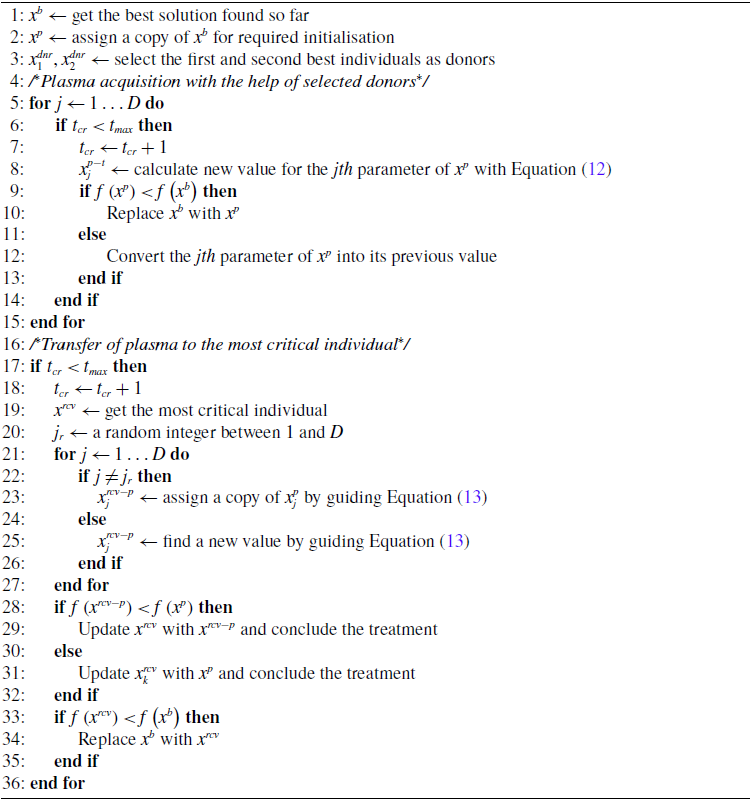
control parameters and their sensitive configurations according to the population size, number of parameters and specific properties of the problem being solved optimally. The operational steps about how the plasma is collected first and transferred in the renovated treatment schema can be examined by guiding Algorithm 1. The IP algorithm, where the greedy heuristic is used to initially generate the population and the proposed treatment scheme is responsible for the collection and transfer of plasma, is called greedy initialisation IPA for short gintIPAFootnote 1.
Details of the treatment schema in gintIPA

5.0 Experimental Studies
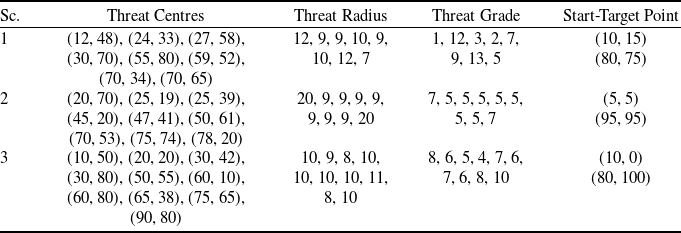
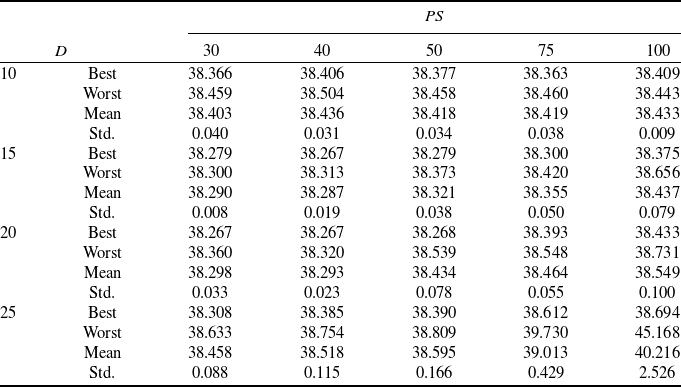
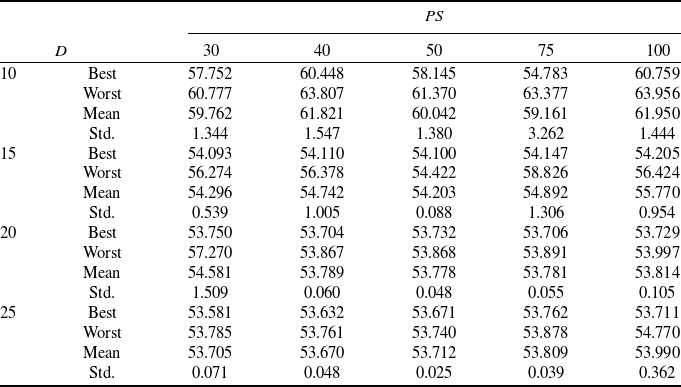
The performance of the gintIPA can vary with the properties of the battlefield in terms of number of enemy threats, their centre locations, sensing or detecting ranges determined by radius, danger levels or grades. For evaluating how the performance of gintIPA varies, three battlefield scenarios detailed in Table 1 were used [Reference Niu, Yan, Wang and Niu47]. Each battlefield contains four test cases generated by configuring the number of segmentation points or
 $D$
as
 $10$
,
 $15$
,
 $20$
and
 $25$
. The gintIPA was experimented with
 $30$
times for each test case with the different
 $PS$
values including
 $30$
,
 $40$
,
 $50$
,
 $75$
and
 $100$
. When completing a run or test after consuming
 $6000$
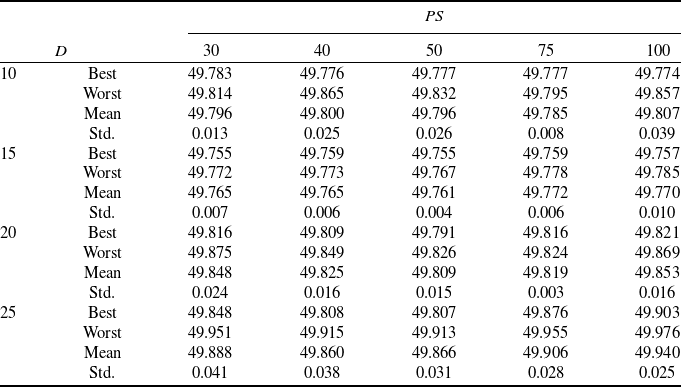
evaluations, the best solution was found and its objective function value was recorded. The best, worst, mean best objective function values and standard deviations calculated over
 $30$
records were presented in Table 2 for the cases of Scenario-
 $1$
, Table 3 for the cases of Scenario-
 $2$
and finally Table 4 for the cases of Scenario-
 $3$
.
Information about the battlefields used in the experiments

Results of gintIPA with varying
 $PS$
values for Scenario-
 $1$

Results of gintIPA with varying
 $PS$
values for Scenario-
 $2$

Results of gintIPA with varying
 $PS$
values for Scenario-
 $3$

The best and worst paths found by gintIPA for
 $10$
(a),
 $15$
(b),
 $20$
(c) and
 $25$
-dimensional (d) cases of Scenario-
 $1$
.

The best and worst paths found by gintIPA for
 $10$
(a),
 $15$
(b),
 $20$
(c) and
 $25$
-dimensional (d) cases of Scenario-
 $2$
.

The best and worst paths found by gintIPA for
 $10$
(a),
 $15$
(b),
 $20$
(c) and
 $25$
-dimensional (d) cases of Scenario-
 $3$
.

The results given in Tables 2, 3 and 4 provide critical information about the relatively consistent solving capabilities of the gintIPA. The population or colony size of a meta-heuristic algorithm can impact the quality of the final solutions. If the population or colony size is chosen high, the solution space is sampled more and the algorithm gets a chance of starting the subsequent operations with a set of qualified candidates. However, it should be noticed that the number of evaluations per cycle or iteration increases and a run of the algorithm terminates without executing specially designed operations enough. On the other hand, if the population or colony size is chosen small, the probability of starting a run of a meta-heuristic with a set of qualified initial candidates decreases. Even though the probability of initialising the population with qualified candidates decreases, the considered algorithm iterates more compared to the previously mentioned configuration about population or colony size. From the mean best objective function values in Tables 2, 3 and 4, it is seen that gintIPA protects the qualities of final solutions while the different values are assigned to the
 $PS$
parameter. One of the main reasons behind the stable performance of gintIPA is related to the employed greedy initialisation method that works by guiding only number of segmentation points. When the greedy initialiser determines its path, one of the individuals in the gintIPA is configured with the determined path, and the remaining members of the population are also produced randomly in a narrow neighbourhood of the path of the greedy initialiser. By generating the population of gintIPA with the help of a greedy initialiser, algorithm starts its phases about the distribution of infection, plasma treatment and modification of the donor or donors with the promising population members. Moreover, it is important to declare that if the
 $PS$
parameter of gintIPA is set to a higher value, an intrinsic advantage about the searching the neighbourhood of the qualified path determined by greedy initialiser is gained and gintIPA can protect the qualities of its solutions for the running configurations causing the huge amount of evaluation consumption per cycle.
The stable performance of gintIPA for different values assigned to the
 $PS$
parameter is also related to the modernised treatment schema that combines both newly introduced plasma collection mechanism and transfer approach and removes the necessity of the inherited control parameters from IPA called
 $NoR$
and
 $NoD$
. When the gintIPA decides to treat the most critical individual of the population, it first collects the plasma. The plasma is actually a new solution generated by guaranteeing its objective function value is at least equal to or less than the objective function value of the best solution found so far. Also, the transfer approach used for the plasma performs an extra search and tries to find a solution better than the solution represented by the plasma. As an expected result of the detailed exploitation of the eligible solutions in the population for the collection of plasma and subtle search when transferring it, gintIPA handles some problems originating from the quick termination without executing treatment operations adequately. The small differences between the best and worst paths found by gintIPA with
 $30$
individuals can be visually investigated over Fig. 3 for Scenario-
 $1$
, Fig. 4 for Scenario-
 $2$
and Fig. 5 for Scenario-
 $3$
.
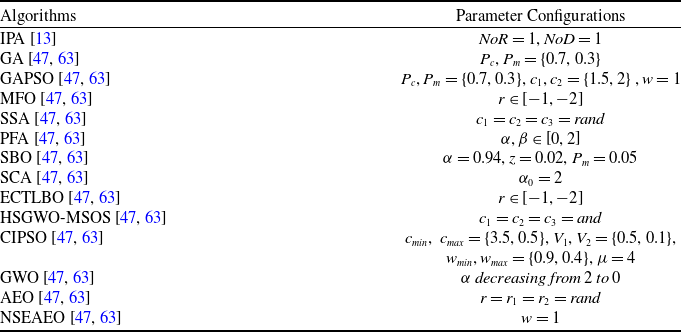
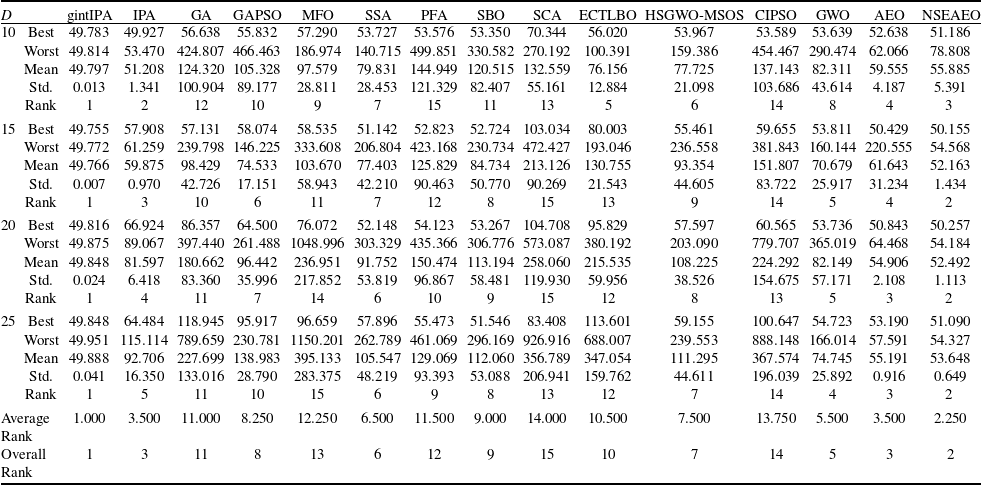
In order to understand how successful the gintIPA is as a path planner and how eligible the calculated paths by gintIPA are, a set of comparative studies should be carried out. For this purpose, the paths found by the gintIPA were compared with the paths of fourteen different meta-heuristic techniques including IPA, GA, GAPSO, MFO, SSA, PFA, SBO, SCA, ECTLBO, HSGWO-MSOS, CIPSO, GWO, AEO and NSEAEO whose control parameters are set as in Table 5. Each test case belonging to the Scenario-
 $1$
, Scenario-
 $2$
and Scenario-
 $3$
was solved
 $30$
times after equalising the running conditions by setting the population or colony size to
 $30$
and maximum evaluation number to
 $6000$
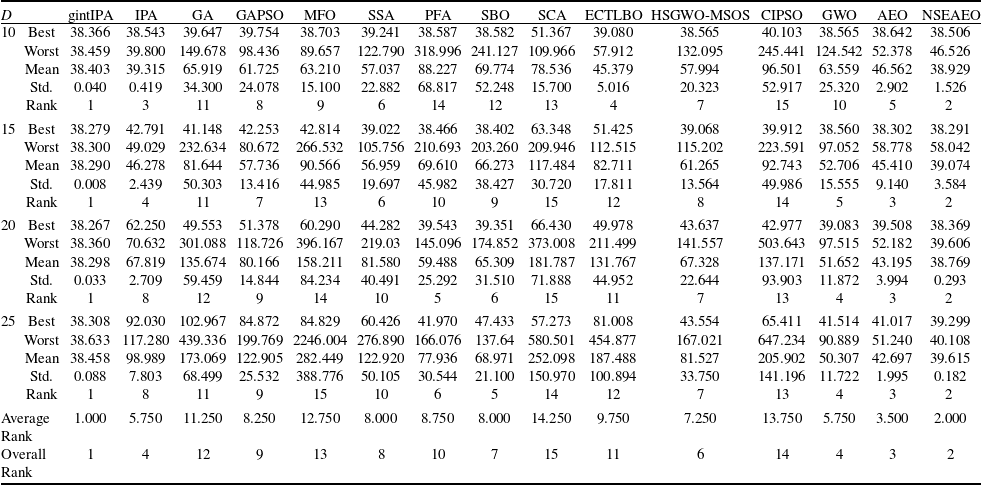
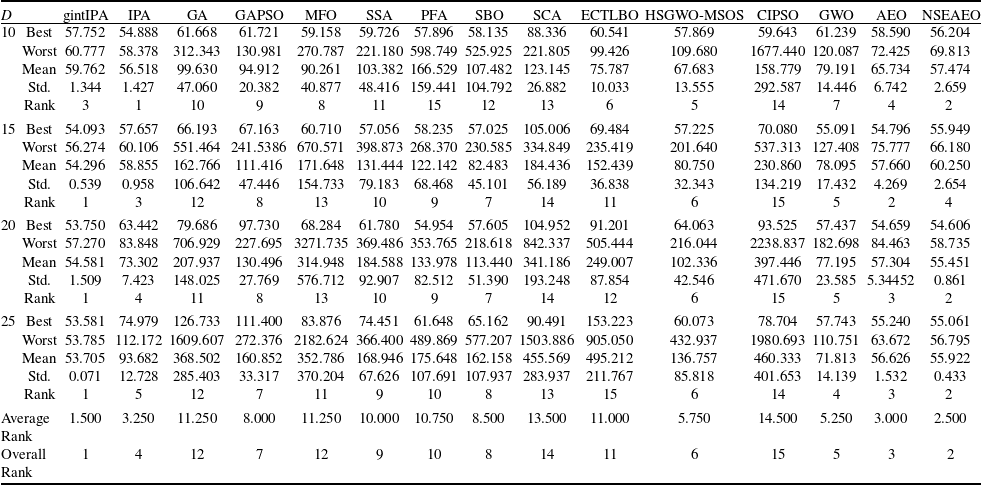
for the gintIPA and other mentioned algorithms [Reference Niu, Yan, Wang and Niu47, Reference Aslan63]. When the results given in Tables 6, 7 and 8 are investigated, the competitive performance of gintIPA against other path planners can be seen clearly. While the gintIPA outperforms all of other techniques for 11 of 12 test cases and gets ranked as the best path planner, it lags behind IPA and NSEAEO only for one test case belonging to the Scenario-
 $2$
and gets ranked as the third best path planner and allows to state that gintIPA is still capable of obtaining better solutions than remaining 12 algorithms. The visually apparent contribution of the greedy initialiser as validated from Figs 3, 4 and 5 and improved exploitation performance with the newly designed treatment schema allow gintIPA to perform better than the considered algorithms in
 $91.6{\rm{\% }}$
of all test cases. The comparative studies between gintIPA and other path planners also provide important information about the advantageous sides of gintIPA becoming more evident with the increasing number of segmentation points. When the number of segmentation points and difficulty of the path planning problem are increased, the greedy initialiser of gintIPA can determine more points on the path reducing the cost of enemy threats, fuel or battery consumption or turning manoeuvres. In addition to this, when the number of segmentation points is increased, the chance of collecting more qualified plasma is also increased intrinsically due to the sequential control of all parameters with the help of the selected donors. As an expected result of the self-configurable searching characteristics according to the number of segmentation points, gintIPA handles the difficulties of the path planning problem more robustly and calculates better paths than its competitors.
Compared algorithms with gintIPA and their parameter adjustments

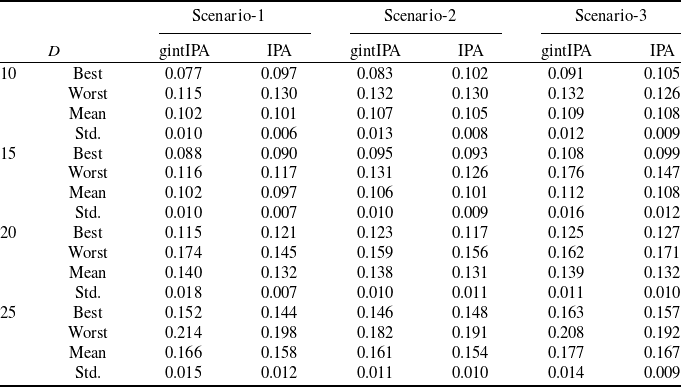
The greedy initialiser used with the gintIPA brings an extra computational burden. Also, the modernised treatment schema changes the number of evaluations spent per infection cycle and gintIPA can iterate less than the standard implementation of the IPA even though the termination criteria and other running configurations are the same. In order to analyse that how the modifications change the execution time, gintIPA and IPA were experimented with
 $30$
times by setting the population size to
 $30$
and maximum evaluation number to
 $6000$
for each test case of Scenario-
 $1$
, Scenario-
 $2$
and Scenario-
 $3$
and the time passed until the end of a run was recorded. Both gintIPA and IPA were coded in C programming language and a computer equipped with an Intel i5-
 $10500$
processor and managed by Fedora-
 $34$
operating system was used. The best, worst, mean elapsed times in terms of seconds and standard deviations were determined by using the records and then summarised in Table 9. When the mean execution times in Table 9 are investigated, it is understood that gintIPA requires more time compared to the IPA. While the differences between the mean execution times of the gintIPA and IPA are
 $0.002$
and
 $0.006$
seconds at most for
 $10$
and
 $15$
-dimensional cases, the differences between the mean execution times of the gintIPA and IPA are
 $0.008$
and
 $0.010$
seconds at most for
 $20$
and
 $25$
-dimensional cases and indicate the direct relationship with the computational complexity of the greedy initialiser and number of segmentation points.
Comparison between gintIPA and other path planners for Scenario-
 $1$

Comparison between gintIPA and other path planners for Scenario-
 $2$

Comparison between gintIPA and other path planners for Scenario-
 $3$

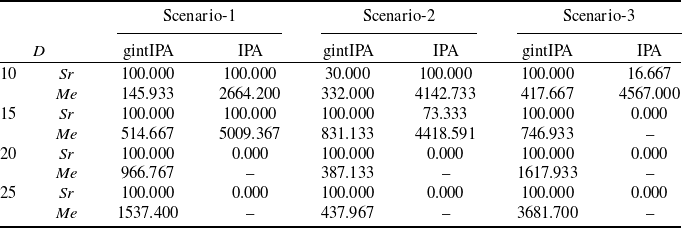
The proposed greedy initialiser and treatment schema can also affect the convergence performance of the algorithm. For evaluating the convergence performance of a meta-heuristic algorithm, the success rate abbreviated as
 $Sr$
and mean evaluations abbreviated as
 $Me$
are referenced frequently [Reference Aslan63]. If a run of the considered meta-heuristic concludes with a solution whose objective function value is better than the previously determined threshold, this run is accepted as successful and the ratio between the number of successful runs and the total number of runs corresponds to the
 $Sr$
metric. If a run is determined as successful, the minimum number of evaluations required to find a solution whose objective function value is less than the threshold is stored. The average of the stored values represents the value of the
 $Me$
metric. The
 $Sr$
and
 $Me$
metrics belonging to the gintIPA and IPA by setting the threshold to
 $50$
for the Scenario-
 $1$
and Scenario-
 $3$
and
 $60$
for the Scenario-
 $2$
were calculated and presented in Table 10. The
 $Sr$
and
 $Me$
metric values given in Table 10 prove the superior convergence performance of gintIPA against the IP algorithm. While the
 $Sr$
metric of gintIPA is better than the
 $Sr$
metric of IPA for 9 of 12 test cases, the
 $Me$
metric of gintIPA is better than the metric of IPA for all test cases. However, it should be noted that even though the
 $Me$
metric value of gintIPA is better than the
 $Me$
metric value of IPA for
 $10$
-dimensional test case of Scenario-
 $2$
, gintIPA obtains final solutions whose objective function values are less than the threshold for only 10 of 30 runs.
Comparison between the execution times of gintIPA and IPA

 $Sr$
and
 $Me$
metrics of gintIPA and IPA

Results of the Wilcoxon signed rank test for gintIPA and IPA

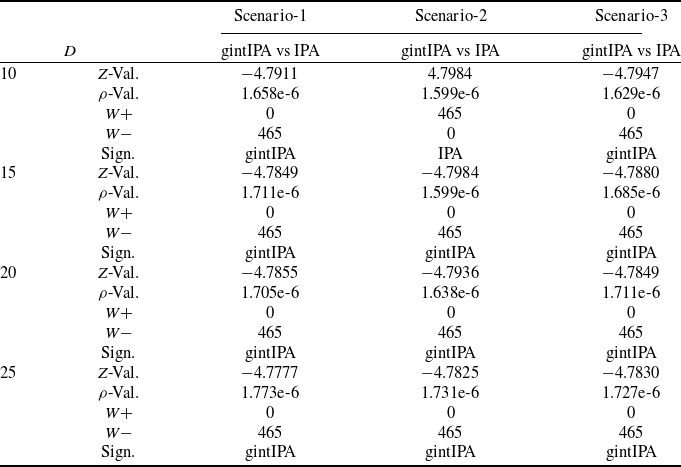
The comparative studies between the gintIPA and IPA indicate that gintIPA is capable of planning more qualified paths than IPA by bringing negligible amount of computational burden. However, demonstrating the effectiveness of the gintIPA against IPA with an appropriate statistical test is important to prove the critical assistance of the modifications. Wilcoxon signed rank test is a well-known non-parametric statistical test and has a widespread usage for the comparison of meta-heuristics [Reference Aslan63]. If the significance level (
 $\rho $
) of Wilcoxon signed rank test is found less than a constant usually fixed to
 $0.05$
, the difference between the compared algorithms is enough to state that one of the competitors is statistically better [Reference Aslan63]. The test results of the comparison between the gintIPA and IPA were given in Table 11 where
 $Z$
represents the test statistics and
 $W + $
and
 $W - $
show the sum of ranks for which gintIPA lags behind IPA and the sum of ranks for which gintIPA outperforms IPA. As easily seen from the
 $\rho $
values in Table 11, gintIPA is statistically better than IPA for all cases of Scenario-
 $1$
and Scenario-
 $3$
. Moreover, the Wilcoxon signed rank test validates that the difference between the qualities of the paths found by gintIPA and IPA is enough to generate a statistical significance in favour of the gintIPA for
 $15$
,
 $20$
and
 $25$
-dimensional cases of Scenario-
 $2$
. Utilising from the properties of the geometrical model as in the introduced greedy initialiser and redesigning the exploitation dominant operations by considering the gains related to the initialisation boosts the planning capabilities of the gintIPA and assist it to obtain solutions whose superiorities are statistically prominent compared to the solutions found by the standard IPA.
6.0 Conclusion
The technological advancements changed the design approaches and usage purposes of UAVs and various countries started to reorganise their air forces and defence systems according to the existence of UAVs or weaponised variants of them called UCAVs. In this study, the IPA was supported with a newly designed greedy initialiser and fine-tuned treatment schema and then a recent UAV or UCAV path planner named as gintIPA was proposed. The performance of the gintIPA was investigated by planning paths for three different battlefields and 12 test cases generated by adjusting the number of segmentation points and obtained results were compared with the results of other meta-heuristic-based techniques including IPA, GA, GAPSO, MFO, SSA, PFA, SBO, SCA, ECTLBO, HSGWO-MSOS, CIPSO, GWO, AEO and NSEAEO. Comparative studies allowed us to state that gintIPA handles challenging objectives about the enemy threats, fuel or battery consumption and turning manoeuvres more robustly and calculates better paths than all of 14 techniques for the
 $91.6{\rm{\% }}$
of the test cases.
The greedy initialiser generates a population containing individuals corresponding to the promising path candidates by adding acceptable amount of computational burden and helps gintIPA to start its operations with the solutions in the effectively narrowed search space. Moreover, the modernised treatment schema in which two separate procedures, on managing the collection of the plasma and, of the transferring the collected plasma to the receiver, significantly improves the exploitation characteristics of gintIPA and removes the further requirement to the
 $NoD$
and
 $NoR$
control parameters. In the future, the greedy initialiser can be redesigned by using a repair module for determining whether a line segment between two selected points intersects with a circle while keeping the computational complexity still polynomial and integrated into the workflow of the IPA or other meta-heuristic algorithms. Also, parallel implementations of the IPA-based path planners for which each core or node of a cluster uses a unique initialiser and treatment schema can be developed and tested for two and three-dimensional battlefield environments containing dynamic enemy threats and non-flight zones.
Acknowledgment
We would like to thank the Proofreading & Editing Office of the Dean for Research at Erciyes University for the copyediting and proofreading service for this manuscript.
Funding
This study was not funded by any organisation.
Competing interests
The author declares that he has no conflict of interest.
Ethical approval
This article does not contain any studies with human participants or animals performed by any of the authors.