INTRODUCTION
According to Price (Reference Price and Hendrickx2004), about 110 species of Mysida have been recorded from the Pacific coast of America (Alaska to Chile). Records are twice as numerous for species occurring in the northern part than in the southern part of this region (Price, Reference Price and Hendrickx2004). Deep-water species are particularly rare and many have been recorded only once or a few times.
The genus Ceratomysis (Petalophthalmidae) was proposed by Faxon (Reference Faxon1893) to accommodate a single female specimen of Ceratomysis spinosa (the type species) collected off Panama at 782 fathoms (‘Albatross’ St. 3357) (Faxon, Reference Faxon1893, Reference Faxon1895). At present, the genus contains five species. The most recent discovery was by Fukuoka (Reference Fukuoka2009) who described two new species from Japan.
During an exploratory survey off the west coast of the Baja California Peninsula, Mexico, aboard the R/V ‘El Puma’ of the Universidad Nacional Autónoma de México (UNAM), six specimens of C. spinosa were collected, among other crustaceans, using a benthic sledge. This material is reported herein and represents the first records for the Mexican Pacific. It is deposited in the Regional Collection of Marine Invertebrates (EMU) at UNAM in Mazatlán, Mexico.
SYSTEMATICS
Order MYSIDA Boas, 1883
Family PETALOPHTHALMIDAE Czerniasvky, 1882
Genus Ceratomysis Faxon, Reference Faxon1893
Ceratomysis spinosa Faxon, Reference Faxon1893
Figures 1–3
Ceratomysis spinosa Faxon, Reference Faxon1893, male, dorsal view, 27.5 mm TL (EMU-10501).

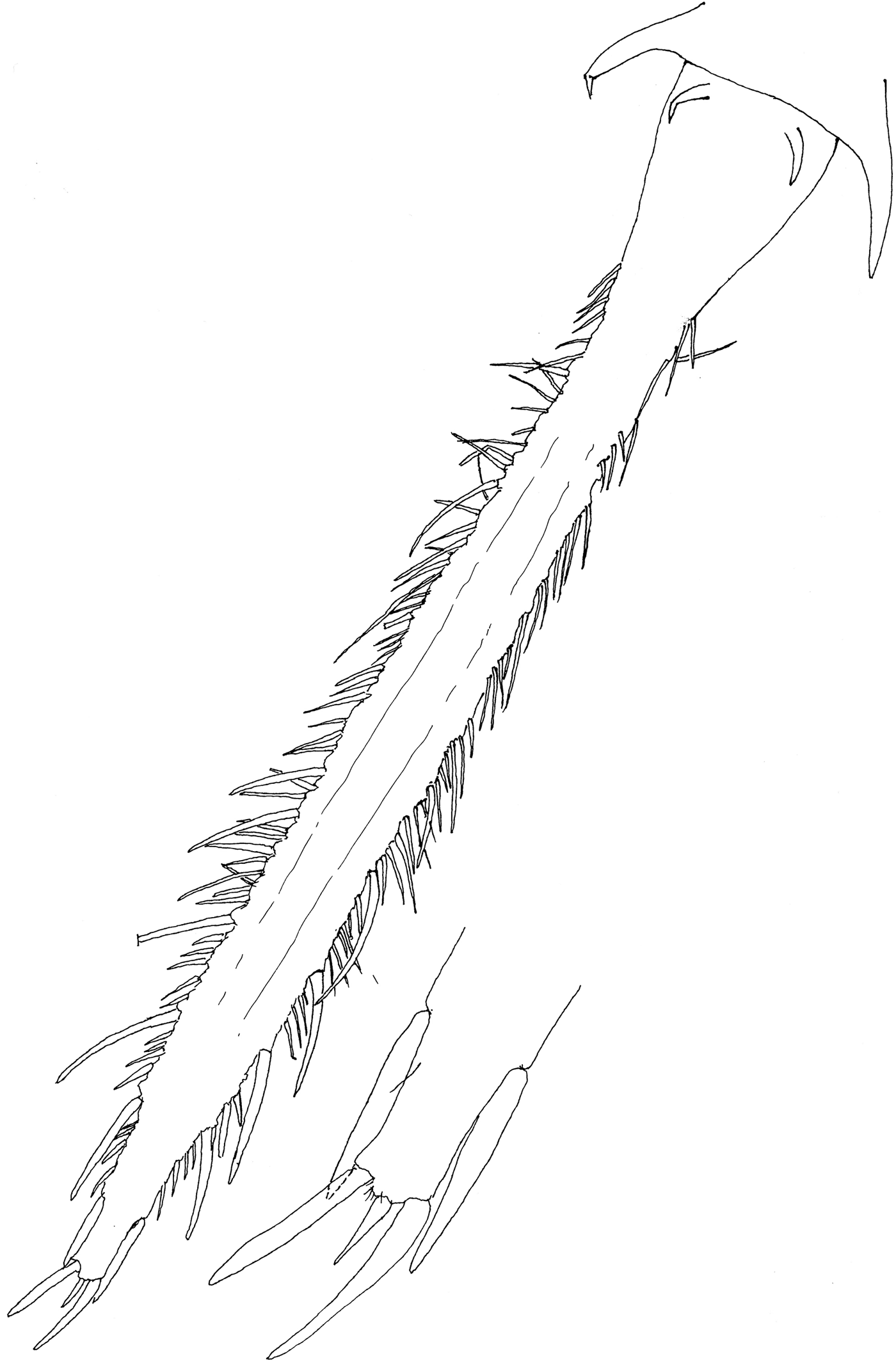
Ceratomysis spinosa Faxon, Reference Faxon1893, male, 27.5 mm TL (EMU-10501). Dorsal view of telson and telson tip (enlarged).
Ceratomysis spinosa Faxon, Reference Faxon1893, male, 27.5 mm TL (EMU-10501). (A) Cephalon (dorsal); (B) Buccal appendages and labrum (ventral); (C) Proximal part of telson (dorsal); (D) Tip of right uropodal exopod (dorsal).
Ceratomysis spinosa Faxon, Reference Faxon1893, Reference Faxon1895; Hansen, Reference Hansen1910; Tattersall, Reference Tattersall1951; Birstein & Tchindonova, Reference Birstein and Tchindonova1958; Ledoyer, Reference Ledoyer1977; Mauchline & Murano, Reference Mauchline and Murano1977; Kathman et al., Reference Kathman, Austin, Saltman and Fulton1986; Müller, Reference Müller1993; Petryashov, Reference Petryashov2005; Fukuoka, Reference Fukuoka2009.
MATERIAL EXAMINED
TALUD XVI-B, Station 22 (30°49′47″N 116°35′54″W), 28 May 2014, five females, 28.5–34.5 mm total length (TL), benthic sledge, 1480–1560 m (EMU-10539); Station 23 (30°56.04′N 116°40.92′W), 28 May 2014, one male, total length 27.5 mm, benthic sledge, 1296–1340 m (EMU-10501).
DISTRIBUTION
Off Coiba Island, Panama (‘Albatross’ St. 3357, type locality, surface tow to 782 fathoms = 1449 m); Japan, Sea of Okhotsk, Bering Sea, Alaska, USA (Faxon, Reference Faxon1893; Tattersall, Reference Tattersall1951; Kathman et al., Reference Kathman, Austin, Saltman and Fulton1986; Müller, Reference Müller1993; Price, Reference Price and Hendrickx2004; Fukuoka, Reference Fukuoka2009). In their long world list of species of Mysidacea, Mauchline & Murano (Reference Mauchline and Murano1977) included this species in three zones corresponding to records for Japan, the north Pacific and the eastern Pacific. It has also been reported from the entire North Pacific by Petryashov (Reference Petryashov2005) who listed it as a ‘Pacific tropical-boreal’ species.
ECOLOGY
Mauchline & Murano (Reference Mauchline and Murano1977) and Müller (Reference Müller1993) considered Ceratomysis spinosa as a mesopelagic species, and the later author indicates a depth range of 1070–3400 m. Kathman et al. (Reference Kathman, Austin, Saltman and Fulton1986) provide a depth range of 1050–3400 m. Petryashov (Reference Petryashov2005) reported it in depths from 414 to 3400 m. The specimens examined herein were obtained from two benthic sledge samples taken at 1480–1460 m and 1296–1340 m in depth, but the net remained open during the entire haul and the specimens might have been captured during its ascent. Ceratomysis spinosa, however, is a rather robust species, with a strong, heavy, spiny carapace and it might actually live closer to the bottom than thought. Bottom environmental conditions at sampling localities were as follows: dissolved oxygen 0.76–0.96 ml/l; temperature 3.05–3.15°C; sediment composition (clay-lime-sand) 5.6–60–34.4% at St. 22 and 11–79.5–9.5% at St. 23.
REMARKS
Specimens of Ceratomysis spinosa previously reported include: the type material (one female; ‘Albatross’ St. 3357) from Panama; material from off the USA (between 47°36′N and 48°36′N; six specimens, California Academy of Sciences), British Columbia (‘Albatross’ St. 2859, one male; and probably another specimen) and Japan (‘Albatross’ St. 4915, St. 5050, St. 5082; one male and two females) (Faxon, Reference Faxon1895; Hansen, Reference Hansen1910; Tattersall, Reference Tattersall1951). Kathman et al. (Reference Kathman, Austin, Saltman and Fulton1986) report a female of 38 mm TL. The specimens collected during the TALUD XVI-B cruise (Figure 1) are, therefore, the 14th–19th on record.
The telson of the female holotype lacks most of its lateral spinose setae (Faxon, Reference Faxon1895: pl. LVI, Figure 1). While comparing Ceratomysis egregia Hansen, Reference Hansen1910 to Ceratomysis spinosa, Hansen (Reference Hansen1910, p. 23) noted that ‘Faxon describes the lateral margins of the telson in C. spinosa “setose”, …, but in C. egregia a number of long and strong spines and numerous small spines but no setae are found’. Telson spines (or spiniform setae) are easily lost during sampling, as seen, for example, in the Figure 1 of Ledoyer (Reference Ledoyer1977) and the Figures 1I and 4I of Fukuoka (Reference Fukuoka2009). The specimen examined, however, allows for the observation of numerous, relatively long, lateral spiniform setae on the telson, including a series of eight very robust setae in the distal third (Figure 2). The tip of the telson presents a clear emargination with a stout, subterminal spiniform setae on each side, a pair or terminal spiniform setae and a shorter, stout, median setae on the distal margin (Figure 2).
Kathman et al. (Reference Kathman, Austin, Saltman and Fulton1986) provide illustrations of the dorsal and lateral views of a female specimen, and of its telson, noting the presence of robust spiniform setae on the outer margin of the exopod. They also note the presence of two large spines (proximally) on the telson and of a rounded apex with a pair of terminal spiniform setae separated by a single shorter seta. All these characters coincide with the specimen from the TALUD cruise, although the illustration of the pair of proximal spines on the telson provided by Kathman et al. (Reference Kathman, Austin, Saltman and Fulton1986: Figure C) suggests that these spines are mobile, which is not the case (see Figure 3C).
Fukuoka (Reference Fukuoka2009) provided a comparative analysis of the five species of Ceratomysis described at this time (number unchanged since), including two new species proposed by this author. His comparison is essentially based on the presence or absence of dorsal spines on the body, the shape of these spines and the presence or absence of dorsal suture on the uropod exopod. Ceratomysis spinosa is the only species that presents a combination of the following three characters: apex of dorsal spines of carapace and thoracic somites 7–8 pointed (Figure 1); uropodal exopod without suture (Figure 3D); and spines present near base of telson (Figures 2 and 3C). The six specimens examined fit well with these three characters. The distribution and shape of the other dorsal and lateral spines also fit with the description and illustrations provided by Faxon (Reference Faxon1895).
According to Fukuoka (Reference Fukuoka2009), the total size of the species of Ceratomysis varies from 24 to 36 mm TL, with a maximum known size for Ceratomysis spinosa of 36 mm, which is close to the maximum size of the examined specimens (27.5–34.5 mm) (Figure 1).
ACKNOWLEDGEMENTS
The author thanks all scientists, students and crew members who took an active part in the TALUD XVI-B cruise. This study was supported by CONACyT-Mexico (Project No. 179467). Ship time of the research cruise TALUD XVI-B carried out onboard the R/V ‘El Puma’ was funded by the Universidad Nacional Autónoma de México and by CONACyT (Project No. 179467). Thanks to Kenneth Meland for providing copies of literature on Ceratomysis. Mercedes Cordero Ruiz is acknowledged for preparing the figures and editing the final version of the manuscript and José Salgado for taking the photographs of the specimen examined.