Introduction
The attributes of the planet Earth are of critical importance to the existence and survival of life upon it. In fact, it may be so finely tuned that few planets in the Galaxy share its life-friendly characteristics. From this premise, it is almost inevitable to reach the conclusion that intelligent life (at least any that is predicated on evolution from complex metazoans) is also rare – perhaps unique to the planet Earth.
These ideas have been encapsulated in what is known as the Rare Earth Hypothesis (Ward & Brownlee Reference Ward and Brownlee2000). It can be summarized as follows.
1. Simple life may be commonplace in the Universe. The existence of extremophilic organisms in what were originally considered to be inhospitable regions (hydrothermal vents, acidic pools, toxic waste, deep in the Earth's crust) has shown the hardiness of simple life (Cavicchioli Reference Cavicchioli2002; Diaz & Schulze-Makuch Reference Diaz and Schulze-Makuch2006). Indeed, these habitats are believed to be duplicated elsewhere in the Solar System, e.g. Mars (Formisano et al. Reference Formisano, Atreya, Encrenaz, Ignatiev and Giuranna2004; Krasnopolsky et al. Reference Krasnopolsky, Maillard and Owen2004), Europa (Carr et al. Reference Carr1998), Titan (Stofan et al. Reference Stofan2007) and Enceladus (Parkinson et al. Reference Parkinson, Liang, Hartman, Hansen, Tinetti, Meadows, Kirschvink and Yung2007; Spencer & Grinspoon Reference Spencer and Grinspoon2007), so it is still possible that ‘alien’ life may be closer to home than once thought.
2. However, although simple life is resilient and adaptable, the evolution of complex animal life is extremely difficult. For this to be achieved, there are certain criteria (hereafter referred to as the Earth Criteria) that must be satisfied, in order for animals to thrive.
The following is a (non-exhaustive) list of the Earth Criteria.
• A planet within a critical range of orbital radii – the ‘stellar habitable zone’ (Hart Reference Hart1979; Kasting et al. Reference Kasting, Whitmire and Reynolds1993).
• A star within a critical mass range (large enough to push the habitable zone outside the planet tidal locking radius, and small enough to provide sufficient energy while avoiding UV exposure).
• A star located in a critical region of the Galaxy – the ‘galactic habitable zone’ (GHZ) (Lineweaver et al. Reference Lineweaver, Fenner and Gibson2004).
• A planet within a critical mass range to maintain a suitable atmosphere.
• A planet with a stable low eccentricity orbit (to avoid extreme temperature changes). This also requires a relatively large moon to provide axial stability (Waltham Reference Waltham2004).
• A planet with sufficient raw materials to generate amino acids and proteins.
• A planet with suitable atmospheric composition, in particular the production of atmospheric oxygen – initially produced by cyanobacteria in Earth's early history (Canfield Reference Canfield2005).
• A planet with plate tectonic activity to regulate atmospheric composition and the balance of carbon (Bounamam et al. Reference Bounamam, von Bloh and Franck2007).
• The presence of Jupiter to control the rate of comet and asteroid impacts – although this is now in question (Horner & Jones Reference Horner and Jones2008, Reference Horner and Jones2009; Horner et al. Reference Horner, Jones and Chambers2010).
The weakness of this hypothesis rests in the (usually implicit) assumption that all of the Earth Criteria are independent of each other. Taking Jupiter as an example: asking whether Jupiter exists or otherwise in the Solar System is not meaningful, as planet formation is a complex, non-linear process: every planet in the Solar System owes its formation to its surrounding environment, and therefore its planetary neighbours, through the dynamics of migration (Raymond et al. Reference Raymond, Mandell and Sigurdsson2006; Paardekooper & Papaloizou Reference Paardekooper and Papaloizou2008) planet–planet scattering (Ford & Rasio Reference Ford and Rasio2008; Raymond et al. Reference Raymond, Armitage and Gorelick2009), resonances (Cresswell & Nelson Reference Cresswell and Nelson2006), and other secular phenomena (e.g. Batygin & Laughlin Reference Batygin and Laughlin2008). Without Jupiter, the Earth as it is today may not have formed at all.
This paper investigates the influence of a subset of the Earth Criteria on the resulting distribution of inhabited planets, using Monte Carlo realization techniques (Vukotic & Cirkovic Reference Vukotic and Cirkovic2007, Reference Vukotic and Cirkovic2008; Forgan Reference Forgan2009). The paper is structured as follows: in the Method section we outline the methods used to simulate the distribution of life in the Galaxy; in the Inputs section we define the input parameters for the simulations run; the results are displayed in the Results and discussion section and summarized in the Conclusions section.
Method
The numerical simulations are carried out using the Monte Carlo realization techniques outlined in Forgan (Reference Forgan2009), hereafter referred to as Paper I. A brief summary of the method follows for completeness.
In essence, the method generates a Galaxy of N * stars, each with their own stellar properties (mass, luminosity, location in the Galaxy, etc.) randomly selected from observed statistical distributions. Planetary systems are then generated for these stars in a similar manner, and life is allowed to evolve in these planets according to some hypothesis of origin. The end result is a mock Galaxy which is statistically representative of the Milky Way. To quantify random sampling errors, this process is repeated many times: this allows an estimation of the sample mean and sample standard deviation of the output variables obtained.
The inputs used to define the mock Galaxy (e.g. the Galaxy's surface density profile, the initial stellar mass function (IMF), the star formation history (SFH), etc.) are of critical importance. Paper I focused on using current empirical data (especially for the simulation of exoplanets) to define the mock Galaxy. In this paper we attempt to improve on the inputs of Paper I: these improvements are discussed in the following.
Improvements on the model
The simulation of the Galaxy
In Paper I, the Milky Way was simulated in two dimensions only (in polar coordinates (r, φ)). As a first improvement, the Galaxy is given vertical structure, incorporating both the thick and thin stellar discs (Ostlie & Carroll Reference Ostlie and Carroll1996):

Secondly, the metallicity gradient of the Milky Way was previously simulated using only one curve:
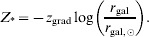
In truth, there are many differing measurements of the abundance gradient in the Galaxy (Rolleston et al. Reference Rolleston, Smartt, Dufton and Ryans2000), dependent on the metals studied. This reflects the different synthesis processes at work for differing elements. This can be (crudely) reproduced by allowing z grad to have a distribution of values – in this case, a Gaussian distribution, with sample mean and sample standard deviation defined by the measurements of Rolleston et al. (Reference Rolleston, Smartt, Dufton and Ryans2000).
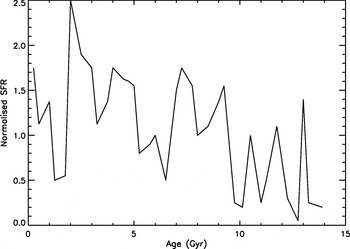
Finally, measures have been taken to correlate the age and metallicity of the stars. The Age Metallicity Relation (AMR) of Rocha-Pinto et al. (Reference Rocha-Pinto, Maciel, Scalo and Flynn2000a) (with its errors) defines upper and lower bounds to the age of a star (given its metallicity). The SFH has also been improved, allowing better time resolution Rocha-Pinto et al. (Reference Rocha-Pinto, Scalo, Maciel and Flynn2000b) (see Fig. 1).
The star formation history used in this work (Rocha-Pinto et al. Reference Rocha-Pinto, Scalo, Maciel and Flynn2000b).

The simulation of stars
An important change to this work is the simulation of stellar luminosity evolution. As stars evolve along the main sequence, their luminosity increases (Schröder & Connon Smith Reference Schröder and Connon Smith2008). As the luminosity increases, the location of the stellar habitable zone must move further away from the star (Hart Reference Hart1979; Kasting et al. Reference Kasting, Whitmire and Reynolds1993). This implies that any planets with biospheres initially in the habitable zone can leave the habitable zone on a timescale τHZ, which is a function of the host star's initial luminosity and the planet's distance from it. Together with the main sequence lifetime τMS, it defines a maximum lifetime for any biosphere:

where τMS is given by
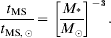
For more information, see Prialnik (Reference Prialnik2000) (note that quantities referring to the Sun have the subscript ⊙). The luminosity evolution of the stars are approximated by extrapolating the simulated Solar luminosity data of Schröder & Connon Smith (Reference Schröder and Connon Smith2008) to all main sequence starsFootnote 1:

The simulation of planets
Current exoplanet data, while impressive, is still incomplete. This introduces significant bias into the results of any simulation (Forgan Reference Forgan2009), and precludes the discussion of the Rare Earth Hypothesis if using observations alone (as statistical analyses cannot currently simulate Earths with any robustness). To bypass this problem, the empirical data is replaced by theoretical relations: this allows the simulation of planetary objects down to Lunar masses.
The probability of a star hosting planets is a function of its metallicity – this code uses the distribution as described by Wyatt et al. (Reference Wyatt, Clarke and Greaves2007):
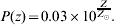
The Planetary Initial Mass Function (PIMF) is approximated by a simple power law:

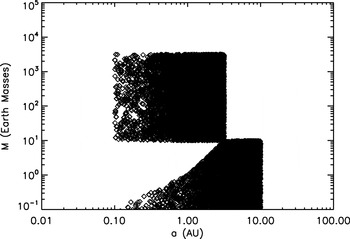
which operates over the mass range of [M moon, 25 M Jup]. To correctly reproduce the distribution of planetary radii, two different radii distribution functions are used. Jovian planets reproduce the data of Armitage (Reference Armitage2007), which accounts for the effects of Type II planetary migration. For terrestrial planets, the data of Ida & Lin (Reference Ida and Lin2008, fig. 1c) is emulated: a simple parametrization allows the trend for low-mass objects to be recovered (see Fig. 2). It should be noted that in essence this is swapping one weakness for another: while the bias of empirical data is lost, the uncertainty of current planet formation models is gained.
The mass–radius relation for a sample of planets.

Also, as the mass function can simulate Moon-mass objects, any object with a mass less than Pluto's that resides within another planet's Hill sphere (that is, it resides within the gravitational influence of said planet) is considered a moon of that planetFootnote 2. This property will become important for the simulation of the Rare Earth Hypothesis.
The simulation of life
The simulation of life proceeds in much the same manner as Paper I: life must achieve several difficult goals, each goal requiring a time τi to be achieved, in order to evolve into a technologically capable sentient species (Carter Reference Carter2008). During this process, resetting events can occur (e.g. cometary impacts, supernovae, gamma ray bursts, see Annis (Reference Annis1999)), which cause large-scale extinctions, and reset the evolution of life to an earlier stage (or, in the worst case, sterilize the planet entirely). The reader is referred to Paper I for a more in depth discussion of how this is achieved in the code. A significant change to the model is the mechanism for resetting events becoming sterilization events. This was described by a probability of annihilation p annihilate, which was created in order to define the Galactic Habitable Zone (Lineweaver et al. Reference Lineweaver, Fenner and Gibson2004). This simplified approach has been replaced with an attempt to simulate the loss of biodiversity incurred as the result of a reset. The effect of a reset is to reduce biodiversity by a fraction x: if x is greater than 1, the planet is sterilized. Appealing to the Central Limit Theorem, x is selected from a Gaussian distribution with mean 0.5, and standard deviation 0.25. This means that, on average, 5% of resets will result in annihilation. The average number of resets increases with proximity to the Galactic centre – this is now parametrized by

where μEarth=5 (Raup & Sepkoski Reference Raup and Sepkoski1982). This provides the mean of a Gaussian distribution from which N resets is sampled. The habitation index of Paper I (which is assigned to all planets in the simulation) is modified to account for the potential existence of microbial life:
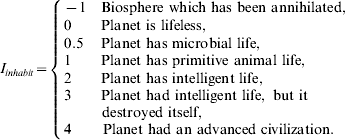
Note that interplanetary colonization is not modelled in this work.
New outputs – civilization interaction
As the code produces data pertaining to each individual civilization, it is possible to study the entire dataset for each run, and identify the potential for communication between all possible pairs of civilizations. For N galactic civilizations, there are N(N–1)/2 pairs of civilizations. For each intelligent civilization pair (ICP), the following outputs can be calculated.
1. Their physical separation in kiloparsecs (dx).
2. The available window of communication dt (that is, the maximum time interval where both civilizations exist and are able to communicate).
3. The space–time interval ds 2=c 2dt 2−dx 2. This quantity determines whether a signal travelling at lightspeed can traverse the distance between two civilizations within the communication window (assuming the intervening space to be Minkowskian). If ds 2<0, then the signal will fail to reach its destination before the window closes. If ds 2=0, then the signal will reach its destination at the same instant the window closes. If ds 2>0, then the signal will reach its destination within the window, and it is therefore possible for communication between the two civilizations to be established.
4. The ‘contact factor’ f contact=(2c dt)/dx, which counts how many ‘conversations’ (pairs of signals) can travel between the two civilizations.
These outputs give extra information on the distribution of civilizations in the Galaxy, and their potential connectedness by signals travelling at lightspeed.
Inputs
Two separate hypotheses were tested with this model. Each was subjected to 30 Monte Carlo realizations, with each realization containing N stars=109. This is of course two orders of magnitude short of the Milky Way's stellar content, but computational constraints prevented increasing N stars further. The interested reader can multiply subsequent results by 100 to obtain an estimate of Milky Way figures. In any case, absolute numbers are less relevant to the issue at hand: this study focuses on comparing two hypotheses, and comparing relative trends (which is a more reliable route in studies of this nature).
The baseline hypothesis
This basic hypothesis requires only that a planet must be in the stellar habitable zone for life to form upon it. If the planet's surface temperature lies between [0°C, 100°C], then microbial life can form upon it. Complex animal life will only form if the planet's surface temperature lies between [4°C, 50°C] (Ward & Brownlee Reference Ward and Brownlee2000). This hypothesis was tested to provide a comparison with the results of the Rare Earth Hypothesis.
The Rare Earth Hypothesis
This hypothesis builds on the baseline hypothesis by also requiring that animal life will only form on a planet if the following four conditions are met:
1. the planet's mass is between [0.5M ⊕, 2.0M ⊕];
2. the star's mass is between [0.5M ⊙, 1.5M ⊙];
3. the planet has at least one moon (for axial stability and tides);
4. the star system has at least one planet with mass >10M ⊕ in an outer orbit (for shepherding asteroids).
Results and discussion
The distributions of life and intelligence
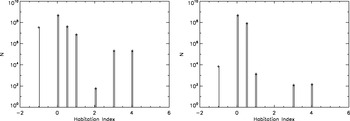
The properties of the Rare Earth Hypothesis galaxy can now be compared against those of the Baseline Hypothesis. Comparing the habitation index for both hypotheses (Fig. 3), it can be seen that (by construction) microbial life (I inhabit=0.5) is unaffected by the Rare Earth Hypothesis, whereas the prevalence of animal life (I inhabit=1) is reduced by a factor of 104 against the baseline. This reduction is thus propagated into the intelligent biospheres (I inhabit>2). However, despite some quite stringent conditions on the planetary system architecture (conditions 3 and 4 in the previous section) the number of intelligent biospheres numbers in the hundreds: the implications for SETI are discussed in the next section.
The habitation index for the Baseline Hypothesis (left) and the Rare Earth Hypothesis (right).

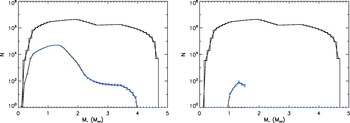
As stellar mass is a key condition to the Rare Earth Hypothesis, it should be expected that the two hypotheses' distributions diverge, and this is indeed the case: Fig. 4 shows the distribution of stellar mass for both hypotheses. The IMF is modified by the effects of the habitable zone (and the distribution of exoplanet semi-major axis) to give the characteristic bump between 1 and 2 Solar masses. Comparing the hypotheses shows that although the Baseline Hypothesis favours lower mass stars for intelligent biospheres (for their increased longevity), the Rare Earth Hypothesis must discard the substantial number of stars that are less than 0.5M ⊙.
Stellar mass for the Baseline Hypothesis (left) and the Rare Earth Hypothesis (right). The black lines indicate all biospheres, the blue lines indicate all intelligent biospheres.

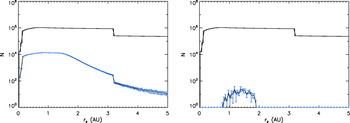
This bias towards lower mass should be reflected in the distribution in semi-major axis (as lower mass stars have closer, more stationary habitable zones). Figure 5 shows that this is true for the Baseline Hypothesis (with intelligent biospheres dropping off as R>1.5 AU), and doubly true for the Rare Earth Hypothesis, selecting a narrow radial range between [0.8 AU, 1.9 AU].
Planet semi-major axis for the Baseline Hypothesis (left) and the Rare Earth Hypothesis (right). The black lines indicate all biospheres, the blue lines indicate all intelligent biospheres.

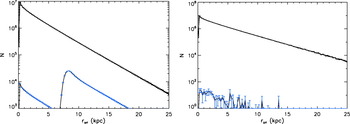
The most striking difference can be seen in the distribution of galactocentric radius (Fig. 6). While the GHZ can be identified in the Baseline Hypothesis (with a small contingent at lower radii, which presumably exists due to the lack of modelling of the central supermassive black hole (SMBH) and hypervelocity stars in the inner regions), the Rare Earth Hypothesis appears to have no GHZ. This is unexpected: the four conditions of the Rare Earth Hypothesis tested here do not affect where intelligent systems should lie; why then does the GHZ not appear (with reduced numbers)?
Galactocentric radius for the Baseline Hypothesis (left) and the Rare Earth Hypothesis (right). The black lines indicate all biospheres, the blue lines indicate all intelligent biospheres.

Communication and connectivity
The prima facie conclusion (having studied the results of the previous section), is that if the Rare Earth Hypothesis is correct, and intelligent civilizations are infrequent, then the potential for communication is also low. This expectation can be tested by calculating the interaction variables discussed previously. As the focus has now shifted from individual intelligent civilizations to ICPs, the numbers duly increase from N to N(N−1)/2. Figure 7 shows the distribution of ICP separation dx for both hypotheses. The baseline hypothesis exhibits a sharp peak at around 8 kpc (the location of the GHZ), accompanied by a long decay. This distribution is reminiscent of the log-normal distribution expected if the tools of the statistical Drake equation were applied (Maccone Reference Maccone2009). The distribution reaches its mode in steps: these steps are sensitive to the local galactic spiral structure. The Rare Earth Hypothesis has no apparent GHZ, so the distribution (though reduced in magnitude) peaks at a much lower 3 kpc.
Separations of ICPs for the Baseline Hypothesis (left) and the Rare Earth Hypothesis (right).

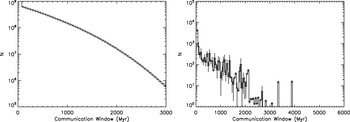
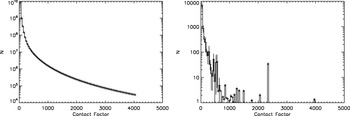
Does this reduced separation imply increased connectivity? The answer depends on the communication window for the ICP. The longer the window (i.e. the larger overlap in history where both civilizations exist), the longer the separation can be while allowing the ICP to be connected. The Baseline Hypothesis favours shorter communication windows (Fig. 8), which reduces the connectivity. Apart from small fluctuations at larger values, the Rare Earth Hypothesis agrees. When considering the space–time interval ds 2 (Fig. 9), the reduced connectivity becomes apparent. ICPs that are unconnected (negative values) are much more frequent than connected civilizations (positive or zero values). This does not spell the end for SETI, however, when the contact factor (i.e. the number of conversations) is considered: although few ICPs enjoy the privilege of contacting each other, those that do can expect a great deal of conversation (Fig. 10), where each hypothesis agrees that a select few will enjoy potentially thousands of exchanges with other civilizations.
Communications window (maximum time interval for communication) for ICPs for the Baseline Hypothesis (left) and the Rare Earth Hypothesis (right).

Space–time interval (ds 2) of ICPs for the Baseline Hypothesis (left) and the Rare Earth Hypothesis (right). Unconnected ICPs have ds 2<0, connected civilizations have ds 2⩾0.

Contact factor (number of exchanged signal pairs) for ICPs for the Baseline Hypothesis (left) and the Rare Earth Hypothesis (right).

Future improvements to the model
Numerical modelling of this type is generally a shadow of the entity it attempts to model, in this case the Milky Way and its constituent stars, planets and other objects. While a substantial improvement over the work of Paper I, there is still potential for future work. Several suggestions are listed here.
1. A more accurate Galactic model, better taking into account its chemical diversity, stellar clustering and the inner regions (specifically the central SMBH and the hypervelocity stars orbiting it).
2. An improved planetary architecture model, better equipped to deal with moons and the planet mass–semi-major axis distribution. Also missing is the modelling of orbital eccentricity and inclination, potentially of great importance in issues of habitability (e.g. Williams & Pollard Reference Williams and Pollard2002; Spiegel et al. Reference Spiegel, Menou and Scharf2008).
3. Improved modelling of the connectivity of civilizations (potentially extending to the modelling of interstellar colonization and face-to-face contact).
Conclusions
In this paper we have tested the Rare Earth Hypothesis (Ward & Brownlee Reference Ward and Brownlee2000) using the Monte Carlo Realization techniques outlined in Forgan (Reference Forgan2009). By comparing the results with a Baseline Hypothesis, the influences of the criteria for a planet to be officially designated as ‘an Earth-like planet’ can be studied. In this work, the criteria were limited to planet mass, star mass, the presence of a moon and the presence of a Jupiter-type object in a more distant orbit. It is shown that these criteria alone greatly reduce the number of intelligent civilizations in the Galaxy (compared with the baseline). As expected, the stellar mass criterion results in a narrow range of planet semi-major axes where intelligent biospheres exist. Interestingly, the GHZ, apparent in the Baseline Hypothesis, was not visible in the Rare Earth Hypothesis.
This result is important for civilization connectivity: reducing the civilization separation means that, for a given time interval of communication, civilizations under the Rare Earth Hypothesis are able to exchange more signals than civilizations under more contact-optimistic hypotheses. The implications for SETI are somewhat mixed: while Earth may be much more likely to be a disconnected than connected civilization, if it is connected, it can expect substantial conversation from other civilizations (while the Sun remains in the main sequence). Therefore, the Rare Earth Hypothesis (in the formulation described in this work) is a ‘soft’ or ‘exclusive’ hypothesis (using the nomenclature of Brin (Reference Brin1983) and Cirkovic (Reference Cirkovic2009)), in that it is not a completely contact-pessimistic hypothesis, but one that is contact optimistic for a small subset of civilizations in the Galaxy.
Acknowledgements
This work has made use of the resources provided by the Edinburgh Compute and Data Facility (ECDF, http://www.ecdf.ed.ac.uk/). The ECDF is partially supported by the eDIKT initiative (http://www.edikt.org.uk).