INTRODUCTION
Attention-deficit/hyperactivity disorder (ADHD) confers well-established impairment in children (Hinshaw, 2002) and adults (Barkley et al., 2002). Children with ADHD also appear to have deficits in a class of cognitive abilities known as executive functions (EF) (Barkley, 1997; Hervey et al., 2004; Nigg et al., 2005; Pennington & Ozonoff, 1996), although this conclusion is less well-established for adults. In children, co-occurring problems in executive functions appear to contribute to greater impairment in at least some domains (Biederman et al., 2004). However, it is unclear how real-world impairments in adults with ADHD are related to laboratory-based executive function weakness, and whether particular symptom domains are related to impairment. Clarifying this question is of great theoretical importance in understanding the etiology of impairment, as well as in considering newer interventions that address EF in ADHD (Wasserstein & Lynn, 2001).
Impairments in adults with ADHD are substantial. Interpersonally, they are more likely than non-ADHD individuals to report high levels of relationship problems, multiple marriages, and difficulties making friends (Murphy & Barkley, 1996). Academically, they are more likely to have been placed in special classes, repeated grades, dropped out of high school or college, or obtained lower grades, and less likely to have attended college (Barkley, 2002; Barkley et al., 1990; Biederman et al., 1993; Murphy & Barkley, 1996). Occupationally, they report employment instability, with shorter employment duration (Barkley et al., 1996), frequent job changes from increased likelihoods to impulsively quit their jobs and be terminated involuntarily (Murphy & Barkley, 1996), and lower overall employer ratings of work performance (Barkley, 2002). Other problems include poor planning, messiness, inability to organize their homes, and difficulty managing their children (Weiss & Murray, 2003), and interviewing clinicians tend to give significantly lower Global Assessment of Functioning scores to adults with ADHD (Biederman et al., 1993).
Several of these problems are potentially related to executive dysfunction, yet key considerations complicate this conclusion. For one thing, individuals with ADHD have higher lifetime rates of comorbid disorders (Biederman et al., 1993, 1996) that might account for some or all of these functional impairments. However, in the present sample, a companion report found that comorbid disorders (antisocial personality disorder, major depressive disorder, anxiety disorders, and substance use disorders) failed to account for the strong relationship between ADHD symptoms and functional impairments (Miller & Nigg, under review).
Another key issue is that ADHD involves two partially distinct symptom domains: inattention–disorganization and hyperactivity–impulsivity. Recent theories suggest that these two domains may have partially distinct determinants, with EF thought to be more closely related to the inattentive–disorganized domain (Nigg et al., 2005; Sonuga-Barke, 2002, 2005). Furthermore, we would expect that, developmentally, hyperactive–impulsive symptoms would become less salient sources of impairment as children mature into adulthood, because those symptoms tend to remit with age (Hart et al., 1995). In contrast, problems with inattention–disorganization tend to persist and, therefore, might become more salient with age. Hence, in adulthood, weakness in EF and consequent impairment may be related to the inattentive–disorganized symptom dimension, rather than the hyperactive–impulsive domain.
EF represents a class of higher-order cognitive abilities that are associated with the structural and functional integrity of the frontal lobes and underlying frontostriatal neural circuits (Pennington & Ozonoff, 1996). Overall, EF refers to the “ability to maintain an appropriate problem-solving set for attainment of a future goal” (Welsh & Pennington, 1988, p. 201). EF component processes may involve response inhibition, planning of action sequences, complex attentional processes, and the ability to retain mental representations of a task and desired outcome over time (Pennington & Ozonoff, 1996).
Although the linkage of laboratory measures to real-world functioning has been a topic of investigation in its own right (Burgess et al., 1998), evidence suggests that executive abilities as assessed through neuropsychological testing have implications for behavior within various contexts outside of the laboratory. Lezak et al. (2004) described executive functions as “necessary for appropriate, socially responsible, and effectively self-serving adult conduct” (p. 611). Performance on tests assessing EF has been related to functional outcome in individuals with traumatic brain injury (Crépeau & Scherzer, 1993; LeBlanc et al., 2000), alcoholism (Moriyama et al., 2002), and schizophrenia (Bilder et al., 2000). Inconsistent findings and controversy have marked studies of EF in adults with ADHD (Holdnack et al., 1995; Riccio et al., 2004, 2005; Walker et al., 2000; Weyandt et al., 1998). However, the two largest studies to date found reliable EF deficits (Murphy et al., 2001; Nigg et al., 2005). Specific examination of the relationship between EF and functional impairments in adults with ADHD has been lacking, although one line of work suggests that EF deficits may be associated with driving impairments in this population (Barkley et al., 2002).
Appropriate measurement of EF in the laboratory is a matter of some debate. Some researchers have argued that EF is inherently a multicomponential process (Duncan et al., 1997; Lowe & Rabbitt, 1998; Miyake et al., 2000; Pennington & Ozonoff, 1996). Others have supported a more unitary factor underlying at least some of these measures (Delis et al., 2001; Duncan et al., 1997; Hanes et al., 1996). Task impurity likely contributes to diversity between tasks (Miyake et al., 2000), in that tasks that measure EF vary widely and include nonexecutive components (Lezak et al., 2004; Stuss et al., 2000). This heterogeneity of EF measures complicates interpretation in that it is difficult to identify the process underlying poor performance when multiple processes are required to perform a task. In response to this issue, latent modeling techniques have utility in studying EF by allowing us to pool the shared variance from several measures of EF to maximize construct-relevant variance (a “purer” composite EF index), exclude variance unique to any single measure, and maximize reliability (Miyake et al., 2000) relative to examination of individual tests.
The present study used a latent variable approach to evaluate how EF and adaptive functioning related to ADHD symptom dimensions. It was expected that EF and inattentive–disorganized symptoms would independently predict adaptive impairment.
METHOD
All research methods and procedures were in compliance with institutional standards and the Helsinki Declaration. Written informed consent was obtained.
Participants
Recruitment
Prospective participants were recruited from the community by means of public advertisements and then evaluated in a standard multistage screening and diagnostic evaluation procedure. Separate advertisements were used to recruit possible ADHD and non-ADHD participants. In the multistage screening procedure, prospective participants contacted the project office at which point key rule-outs were checked by telephone (age was restricted to 18–37 to maintain some homogeneity with regard to cognitive development and change, no sensory–motor handicap, no neurological illness, and native English-speaking). Eligible participants were then scheduled for the diagnostic visit wherein they completed semistructured clinical interviews and questionnaires.
Assessment of ADHD symptoms by self- and informant reports
Assessment of ADHD in adults requires retrospective assessment of their childhood ADHD status to establish childhood onset and inclusion of informant interviews to verify symptoms and impairment (Wender et al., 2001). A retrospective Kiddie Schedule for Affective Disorders and Schizophrenia (K-SADS; Puig-Antich & Ryan, 1986) was administered by a masters-level clinician after extensive training, following previously published procedures (Biederman et al., 1990, 1992), to assess childhood ADHD, conduct disorder (CD), and oppositional defiant disorder (ODD) symptoms and impairment. The same semistructured modules were administered to the participant and an informant who had known them as a child (usually a parent) to ensure cross-informant convergence. The informant reported on the participant's childhood behaviors by means of an ADHD Rating Scale and a retrospective informant-based K-SADS ADHD module.
Current (adult) ADHD symptoms were assessed by self-report and by interview with a second informant, who knew the participant well currently (Wender et al., 2001). We again used K-SADS ADHD questions worded appropriately for current adult symptoms following Biederman et al. (1992). This interview was supplemented with the Barkley and Murphy (1998) Current ADHD Symptoms Rating Scale. To ensure that ADHD participants exceeded normative cutoffs for level of ADHD symptoms, participants also completed the Conners et al. (1999) Adult ADHD Rating Scale, Achenbach (1997) Young Adult Self-Report Scale, and Brown (1996) Adult Attention-Deficit Disorder Scale. The informant (usually a spouse or friend) also completed the same ratings in peer format on adult symptoms and a brief screen of antisocial behavior and drug and alcohol use about the participant. A structured interview about the participant's current ADHD symptoms, using the modified K-SADS for current symptoms, was also completed with informants.
Comorbid Axis I disorders were assessed with the Structured Clinical Interview for DSM-IV Axis I Disorders (SCID-I; First et al., 1997) by a trained masters-level clinician. Personality disorders were assessed with the SCID-II.
Establishment of best estimate diagnosis for ADHD
A diagnostic team (licensed clinical psychologist and a board-certified psychiatrist) then arrived at a “best estimate” diagnosis (Faraone, 2000) as follows. The psychologist and psychiatrist independently reviewed all available information from SCID, K-SADS, and rating scales to arrive at a clinical judgment about ADHD present or absent, ADHD subtype, and comorbid disorders. Their rates of agreement were computed for all cases that they reviewed and were satisfactory (for ADHD any type, k > .80), and disagreements were then discussed to arrive at a consensus diagnosis.
Because no consensus published criteria exist for ADHD in adults, the team followed Diagnostic and Statistical Manual of Mental Disorders, Fourth Edition (DSM-IV) criteria for children by requiring the same symptoms in adults, but allowed the adult “ADHD-residual” category as well because it was allowed in earlier editions of the DSM. To control against extreme levels of comorbidity, DSM-IV guidelines were carefully followed, so that ADHD was not diagnosed if clinicians judged that symptoms were better explained by a co-occurring mood or other major disorder (American Psychiatric Association, 1994). Childhood onset of ADHD by age 12 or younger, confirmed by two reporters, was required. Sixty-five percent of the ADHD sample reported that they had been previously diagnosed with or treated for ADHD as children or adolescents (agreement between self- and reporter, k = .91).
Exclusionary criteria
Potential participants were excluded from the ADHD and non-ADHD groups if they were in a current major depressive or manic/hypomanic episode, acutely substance dependent so as to preventing sober testing, history of psychosis, autism, full-scale IQ (FSIQ) < 75, history of head injury with loss of consciousness, sensory–motor handicap, neurological illness, native language not English, or currently prescribed antipsychotic, antidepressant, or anticonvulsant medications. For the non-ADHD group only, additional exclusions were antisocial or borderline personality disorder, past bipolar disorder, or a previously diagnosed learning disorder. Other psychiatric disorders were free to vary. Primary reasons for rule-out after the initial screen were failure of self-informant convergence on symptoms, current major depression, or taking long-acting psychoactive medications that would affect neuropsychological test performance.
Final sample
A total of 424 individuals passed the initial screen and completed the screening rating scale and diagnostic visit. The final diagnostic procedures qualified 195 individuals (46%) between the ages of 18 and 37 for the study, grouped into an ADHD group and a non-ADHD control group as detailed later.
Medication washout
Participants prescribed psychostimulant medications (20% of the ADHD group; Adderall, Ritalin, Concerta, and Focalin in this sample) were tested after a medication washout averaging 63.5 hr (SD = 40.5; range, 18.02 to 184.6 hr).
Measures of Adaptive Impairment
Adaptive impairment was defined as problems in major life activities in three realms: social, occupational, and educational. Adults with ADHD have demonstrated deficits in each of these areas (Barkley, 2002; Barkley et al., 1990, 1996; Biederman et al., 1993; Murphy & Barkley, 1996; Weiss & Murray, 2003). We chose global assessments covering these three domains of functioning.
Young Adult Self-Report (YASR)
The YASR (Achenbach, 1997) is a self-report questionnaire assessing multiple behavioral domains. It provided an overall adaptive functioning score derived from participant reports in five areas: education, employment, friends, spouse, and family. High scores indicate better adaptive function.
Global Assessment of Functioning
The interviewing clinician made a rating using the Global Assessment of Functioning (GAF) scale (Luborsky, 1962), provided in the DSM-IV. On this 0–100 scale, high scores indicate better function. This score was intended to represent general functional impairment.
Self-reported ADHD symptom impairment
During a semistructured clinical interview, participants were asked to gauge their current impairment from symptoms of ADHD (“Impair” variable) using the question, “Currently, are these problems with paying attention or hyperactivity minimally, moderately, or severely impairing to your overall functioning, or not impairing at all?” Follow-up questions were used to confirm the participant's self-reported level of impairment to the clinician's satisfaction. The clinician then assigned a rating on a scale of 0–3, with 0 = none, 1 = minimal, 2 = moderate, and 3 = severe (score was later reversed to correlate with other measures).
Executive Functioning
Participants completed a battery of neuropsychological tests, selected to assess the component processes of EF defined by Pennington and Ozonoff (1996): response inhibition, planning of action sequences, cognitive flexibility, set-shifting, and the ability to retain mental representations of a task and desired outcome over time. To enhance clinical application of the results and assess higher-level integrative processes, we emphasized multifactorial EF tests that are commonly used in clinical assessment.
Trail Making Test (TMT)
The TMT consists of two parts (Reitan, 1958). Part A depends largely upon psychomotor speed and visual search abilities. Part B places additional demands upon working memory and cognitive flexibility (Crowe, 1998). To isolate the ability to shift mental set, we created a “Trails” residual score by regressing TMT Part A time on TMT Part B time; residual scores were saved to represent the variance associated with Part B that could not be explained by speed on Part A.
The Stroop Color–Word Test (Stroop)
The Stroop test measures the ability to shift attention and inhibit prepotent responses by naming the ink of incongruently-colored color words (e.g., “red,” “blue,” or “green”; Golden, 1978). To isolate interference control from general naming speed, we created a residual “Stroop interference” score by regressing incongruent color–word reading time on the individual word and color reading trials, and saving the residual. This score was reversed so higher scores reflect weaker control.
Wisconsin Card Sorting Test (WCST)
A 64-card, computerized version of the WCST was administered to assess abstract reasoning, concept formation, working memory, and set-shifting (Heaton et al., 1993; Kongs et al., 2000). In this task, participants must deduce changing principles for sorting cards by using only the computer's feedback (“correct” or “incorrect”) for each trial. Due to their high correlation (r = .60), total number of categories completed (reversed) and number of perseverative errors were standardized and averaged (“WCST”).
Logan Stop Task (Stop)
The tracking version of the Logan Stop Task was administered as described by Logan et al. (1997). Participants pressed designated buttons as quickly as possible when they saw an X or an O on the screen but had to inhibit responding when they heard a warning tone (25% of the trials). Four blocks of 48 trials were administered following two practice trials. Stop Signal Reaction Time (SSRT), assessing response inhibition, was calculated by averaging performances across the last three blocks (high scores indicate worse control).
Tower of London: Colorado version (TOL)
The TOL is a computer-administered task (Davis & Keller, 2002) that assesses planning ability. Using the computer mouse, participants moved colored balls on pegs, one at a time, from a starting position to match a final goal position in the fewest number of moves. Total number of moves made served as the “TOL” variable in this study.
Full Scale IQ (FSIQ)
FSIQ was estimated with a five-subtest short form of the Wechsler Adult Intelligence Scales, Third Edition (WAIS-III; Wechsler, 1997; Sattler, 2001): Picture Completion, Vocabulary, Similarities, Arithmetic, and Matrix Reasoning. Reliability and validity for this short form are good (Sattler, 2001).
Statistical Analyses
Data preparation and analysis
As recommended in recent methodological texts, extreme outliers (z > 4.0 and more than .5 SD from next score) were truncated to within .5 SD of the next nearest score to prevent undue influence of single scores on linear models and reduce type I and type II error (see Wilcox et al., 1998). Two scores were adjusted: one for TMT Part B (from z = 4.9 to z = 3.5) and one for SSRT (from z = 5.8 to z = 3.6). The expectation maximization method was used to impute missing data (1.7% of the cognitive variables; 1.3% of behavioral variables).
Analyses
The AMOS 5.0 (2003) statistical package, using the Maximum Likelihood method, was used for all latent variable and structural analyses. Composite variables for (a) inattentive–disorganized and (b) hyperactive–impulsive symptoms were created by averaging the number of symptoms endorsed by participants and two informants in the K-SADS interview, scaled so that 1 = no symptom, 2 = symptom sometimes present, and 3 = symptom present. Informants and probands by definition had some agreement on symptoms, so reliability of these composites was acceptable (inattention α = .93, hyperactivity α = .89). We focused upon current (i.e., adult) symptoms of ADHD to understand how these symptoms affected adaptive functioning in adulthood. However, because ADHD requires symptom onset in childhood for diagnosis, and impairment may be cumulative across time, results for child symptoms are briefly noted.
For analyses relying on structural equation modeling (SEM), we report multiple fit indices and interpret them as outlined by Kline (2004): (1) Pearson χ2 for which nonsignificant values signify good fit, and a χ2/df ratio < 3 is acceptable; (2) Goodness of Fit Index (GFI; Joreskog & Sorbom, 1981) for which a value > .90 signifies good fit; (3) Comparative Fit Index (CFI; Bentler, 1990) for which a value > .90 signifies good fit; and (4) Root Mean Square Error of Approximation (RMSEA; Steiger, 1990) for which a value of .08 is considered acceptable and .05 is considered good (lower is better). The current sample size is considered “medium” by Kline's (2004) standard for SEM analyses.
RESULTS
Sample Description
Demographic information for the sample is provided in Table 1. Ratings data all showed marked clinical elevations in the ADHD sample, indicating validity of ADHD assignments regardless of instrument or model used. Ethnic variation was closely similar to the surrounding community. Parental household incomes were nearly identical in the two groups (p > .8), indicating that they came from similar socioeconomic backgrounds. Although both groups had slightly above-average IQ, IQ did not differ between the groups. Consistent with prior reports (Murphy & Barkley, 1996), ADHD individuals had fewer years of education (Table 1) and were more likely to be in the workforce or seeking work (67% vs. 56%) or attending community or technical college (16% vs.7%). Non-ADHD individuals were more likely to be attending full-time university (32% vs. 16%; p < .05) and when doing so had higher grade point averages [M = 3.21 (.45) vs. 2.71 (.58); p < .001]. The ADHD group thus had lower educational attainment overall. Also consistent with the literature, personal incomes tended to be lower for the ADHD than non-ADHD individuals (nonstudents, M = $21,300 vs. $29,400; p < .01), despite equivalent parental incomes. The gender difference, with a greater proportion of males with ADHD (see Table 1), is common in studies of ADHD and in part may reflect the male preponderance of ADHD in the population. Gender was covaried later.
Description of ADHD and non-ADHD groups on demographic and diagnostic variables

Taken together, results suggest that participants with and without ADHD were similar on basic demographic and intellectual characteristics. The sample was representative of the local population where the study was conducted, although participants were likely somewhat better educated than the general U.S. population. All findings below were preserved after covarying IQ, education, or gender (see the Checks on Data and Models section).
Confirmatory Factor Analysis of Latent EF and Adaptive Impairment Variables
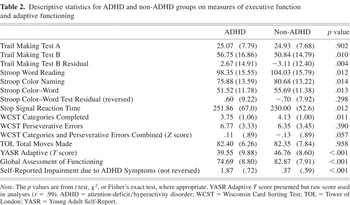
Table 2 shows the means and standard deviations for all variables in the analyses. We conducted confirmatory factor analyses to evaluate the latent structure of dependent and independent variables. With regard to EF, we first attempted to fit a model that included all EF variables [Stroop interference, Trails B residual, SSRT, TOL, and WCST; overall model fit: χ2(5) = 10.70; p = .06; CFI = .87, RMSEA = .08]. This fit was marginal; Stroop had the weakest factor loading and was dropped. The resultant model had fit that was significantly improved [Δχ2(3) = 9.87; p = .02] and acceptable [χ2(2) = .83; p > .05; GFI = 1.00, CFI = 1.00, RMSEA = .00]; all factor loadings were significant. We, therefore, adopted this model. Confirmatory factor analysis was not possible for a three-indicator adaptive functioning factor because the number of indicators made this model just-identified. However, when included within full measurement and structural models, fit was good and all loadings for adaptive functioning indicators were significant.
Descriptive statistics for ADHD and non-ADHD groups on measures of executive function and adaptive functioning

In the measurement model that included EF and adaptive functioning, the zero-order correlation between latent EF and adaptive functioning factors was significant and in the expected direction [r = −.30; p < .05; χ2(13) = 19.87; p > .05; GFI = .97; CFI = .95; RMSEA = .05], indicating that weaker executive function was associated with poorer adaptive functioning.
Structural Model of EF and ADHD Symptoms Predicting Adaptive Functioning
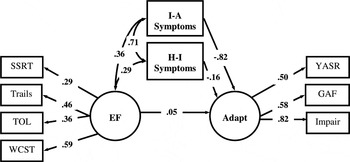
We used SEM to address the basic hypotheses, examining the multivariate relationships between the latent EF and adaptive functioning variables and the composite manifest variables for symptoms of inattention–disorganization and hyperactivity–impulsivity. The path model was constructed such that EF, inattentive–disorganized, and hyperactive–impulsive symptoms were permitted to correlate (i.e., no assumed direction of causality between ADHD symptoms and EF), and each directly predicted adaptive functioning (see Figure 1). This model was appropriate in view of (a) these were cross-sectional data, and causality between ADHD symptoms and EF could not be definitively proven; and (b) alternative models, with EF predicting ADHD symptoms and ADHD symptoms predicting EF, yielded similar results.

Structural model of executive functions (EF), current inattentive symptoms, and current hyperactive symptoms predicting adaptive functioning. SSRT, Stop Signal Reaction Time from Stop Signal Task; Trails, Trail Making Test B regressed on Trail Making Test A time; TOL, Tower of London; WCST, Wisconsin Card Sorting Test; EF, Executive Functions; I-A, Inattentive–Disorganized; H-I, Hyperactive–Impulsive; Adapt, Adaptive Functioning; YASR, Adaptive Score from the Young Adult Self-Report; GAF, Global Assessment of Functioning from DSM-IV; Impair, Self-reported impairment. Squares represent manifest variables; circles represent latent factors; straight lines represent standardized regression weights (weights ≥ .16 are significant); residual (error) terms not shown; fit statistics are provided in text.
As shown in Figure 1, current inattentive–disorganized and hyperactive–impulsive symptom domains were highly correlated with one another and both were correlated with weaker EF. The model yielded acceptable overall fit [χ2(23) = 41.11, p < .05; GFI = .96, CFI = .96, RMSEA = .06]. Although both symptom domains predicted poorer adaptive functioning, inattentive–disorganized symptoms accounted for a much greater amount of the variance in adaptive functioning than hyperactive–impulsive symptoms (67.2% vs. 3.6%, respectively). This finding is consistent with our hypothesis that inattentive symptoms would be most salient for impairment in adults with ADHD. With the addition of the symptom variables, EF no longer independently predicted adaptive functioning.
ADHD is most often diagnosed in childhood and requires a childhood onset. Therefore, we also ran our main structural model using only past symptoms of ADHD, as well as past and current symptoms combined. Full results were very similar to those reported for current symptoms. Briefly, differences were that hyperactive–impulsive symptoms failed to predict adaptive functioning [β = −.06 (past symptoms) and −.09 (past + current)] and were not related to EF in the past symptoms model (β = .18, p = .09). Inattentive–disorganized symptoms had a strong relationship with adaptive functioning [β = −.84 (past) and −.86 (past + current)]. These results were consistent with the findings that relied on current (adult) symptoms.
Checks on Data and Models
All data checks were performed upon our main model with current symptoms of ADHD. To rule out the possibility that component EF processes (as opposed to the composite latent variable) were related to adaptive functioning, we analyzed each individual EF test as a manifest variable in the structural model; none independently predicted adaptive functioning when symptoms were included. We checked all results after covarying years of education, IQ, and gender. None of these variables produced any appreciable changes in the pattern of relationships reported for the structural model.
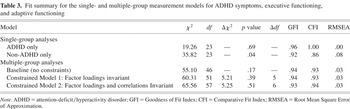
We conducted single- and multiple-group confirmatory factor analyses to evaluate the legitimacy of interpreting model fit in the two different samples combined (Kline, 2004). All data related to these analyses are presented in Table 3. First, we performed single-group analyses in which the baseline measurement model (i.e., same model as Figure 1, but with correlations between all factors) was analyzed separately in the ADHD and the non-ADHD groups. Model fit was acceptable for each group (Table 3). Second, multiple-group analyses were used to evaluate the measurement model in both groups simultaneously with varying levels of cross-group equality constraints. If there is no significant difference in fit (determined by the difference in χ2) of an unconstrained model to those with equality-constrained loadings, then the indicators are judged to assess the factors comparably in each group; significant loss of fit would suggest group membership moderated the relations specified in the model (Kline, 2004). The fit statistics for the multiple-group measurement model without equality constraints were compared with those from two follow-up multiple-group analyses that constrained (1) factor loadings to be equal across groups (Constrained Model 1), and (2) factor loadings and correlations between factors to be equal across groups (Constrained Model 2). Results indicated that the changes in overall χ2 for both constrained models were nonsignificant (see Table 3), suggesting that the factor structures and correlations were comparable across the ADHD and non-ADHD samples. We, therefore, concluded that it was appropriate to interpret results from the model involving all participants.
Fit summary for the single- and multiple-group measurement models for ADHD symptoms, executive functioning, and adaptive functioning

DISCUSSION
Results corroborate that symptoms of ADHD in young adults are associated with impairments in adaptive functioning. In this study, we used measures of several areas of adaptive function and EF to define latent variables capturing their shared variance. Although previous studies have noted impairments in adults with ADHD (Barkley, 2002; Barkley et al., 1990, 1996; Biederman et al., 1993; Murphy & Barkley, 1996; Weiss & Murray, 2003), the present study extends those findings by showing that adaptive impairments were primarily accounted for by symptoms of inattention–disorganization (whether identified in adulthood or restrospectively in childhood), whereas symptoms of hyperactivity–impulsivity accounted for very little unique variance in adaptive impairment. Furthermore, whereas EF was related to adaptive impairment, it failed to predict impairment when ADHD symptoms were added to the model.
These findings are noteworthy, because a key question has been the relative importance of the two ADHD symptom domains to impairment, especially in adults. These results suggest that inattentive–disorganized symptoms have lasting and long-term effects upon adaptive functioning in adults with ADHD and may be the primary pathway through which EF is related to adaptive functioning. It is possible that EF deficits underlie the adaptive impairment associated with ADHD, and primarily exert their effects through surface behaviors that are labeled as inattentive–disorganized symptomatology. These results are consistent with a cognitive model of ADHD in which key symptoms of the disorder are due to EF deficits (Pennington & Ozonoff, 1996) and with a dual pathway conception in which concomitants of inattentive–disorganized symptoms are distinct from hyperactive–impulsive symptoms (Sonuga-Barke, 2005). That conclusion is tempered, however, by the fact that a full mediational model (i.e., one in which EF predicted ADHD symptoms) did not better explain the data than the correlated default model that we presented. This question of direction of effects remains of keen interest but will require prospective longitudinal studies following these results.
It was notable that EF did not predict impairment independently of ADHD. This finding may call into question the clinical utility of assessing EF in ADHD. On the other hand, it may be that EF is a more particularized way of assessing the types of problems that lead to impairment in this population, in conjunction with symptoms of inattention–disorganization. Debate is ongoing about the applicability of clinical EF tests to “real world” executive processes and functioning (Burgess et al., 1998; Denckla, 1996; Eslinger & Damasio, 1985; Rabbitt, 1997). Yet certain limitations to the assessment of EF here must be noted. Other components of EF (e.g., working memory) could be considered; also, more specific cognitive tasks could be examined. In addition, the use of the latent variable for EF was not meant to suggest that all EFs can be reduced to a single latent variable. Certain components may still remain of particular importance when a larger set of measures is obtained.
Another caution is that the measurement of adaptive functioning, while strengthened by the use of multiple measures from different observers combined into a single latent variable, also was necessarily incomplete. The present results apply to adaptive functioning as it was defined in this study but did not include such context-specific effects as driving impairment (Barkley, 2002). Certain types of functioning may be differentially affected by EF and ADHD symptoms. Furthermore, some aspects of our adaptive construct were closely related to ADHD (in particular, the measure of ADHD-related impairment); this finding may have inflated the magnitude of relationship of this impairment index with ADHD versus other kinds of impairment. However, results for inattentive–disorganized symptoms held even when that measure was excluded.
It was necessary to exclude individuals in a current major depressive or manic episode or actively substance dependent so as to obtain valid test scores. Although individuals with past depression or substance dependence were not excluded, the necessary exclusion of these acute cases could still restrict the external validity of our findings to some degree because these acute problems are associated with ADHD (Biederman et al., 1993, 1996).
To balance these cautions, the results were supported by key strengths of this study, including a well-characterized sample of adults with ADHD not better explained by other conditions, a relatively large sample (indeed, this is one of the largest samples of adult ADHD in the literature), and the fact that the structural and measurement models were empirically well-supported in this sample and survived multiple types of controls for potential confounds.
These data highlight that ADHD is an impairing condition for adults that should be taken seriously. In particular, inattentive symptoms, while less obviously disruptive, should not be dismissed by clinicians, because they may contribute to long-term impairment in real-world functioning. This finding provides support for the continued development of cognitive rehabilitative techniques to address attention difficulties early on and possibly counteract these negative effects (Sohlberg & Mateer, 2001; Wasserstein & Lynn, 2001).
In conclusion, our findings are consistent with the idea that the isolation of specific symptom domains in ADHD is useful in understanding the impairment associated with ADHD in adults. In particular, inattentive–disorganized symptoms appear to primarily contribute to key aspects of poorer adaptive function by adulthood and may be the route through which executive functioning problems lead to adaptive impairment.
ACKNOWLEDGMENTS
Work on this grant was supported by National Institute of Mental Health Grant R01-MH63146 to Joel Nigg, John Henderson, and Fernanda Ferreira. Parts of this manuscript were presented at the annual meeting of the American Psychological Association in Washington, DC, August 2005. The authors thank the participants who made this study possible: Colleen Schmitt, Andrew Homa, Timothy Goth-Owens, and Linna Leslie for invaluable assistance in carrying out this work; and David Hambrick for helpful discussions about this study.