Introduction
Prenatal alcohol exposure has been implicated in a wide range of effects that adversely influence the cognitive, behavioral, and physical development of affected individuals. Individuals whose neurobehavioral functioning has been significantly affected by the organic brain damage resulting from intrauterine alcohol exposure may be clinically identified as having a fetal alcohol spectrum disorder (FASD). With an estimated prevalence of 2–5 per 100 children in North America (May et al., Reference Miller and Cohen2009), FASD is a leading cause of developmental disability and a significant public health concern.
The term FASD is not a diagnostic label, but rather an umbrella term for a set of more specific diagnoses [e.g., fetal alcohol syndrome (FAS), partial FAS, alcohol-related neurobehavioral disorder (ARND), etc)] (Chudley et al., Reference Chudley, Conry, Cook, Loock, Rosales and LeBlanc2005). Members of all diagnostic subgroups experience neurobehavioral impairments such as deficits in learning, memory, intelligence, language, visual-spatial ability, motor-function, academics, adaptive behavior, attention, and executive function (EF) (for a review, see Mattson, Crocker, & Nguyen, Reference May, Gossage, Kalberg, Robinson, Buckley, Manning and Hoyme2011) as a result of brain damage caused by prenatal alcohol exposure. Alcohol affects the developing brain through several mechanisms including neuronal proliferation and migration errors, decreased myelination, and cell death (Niccols, Reference Prencipe, Kesek, Cohen, Lamm, Lewis and Zelazo2007). Advances in brain imaging have revealed abnormalities in brain structure, function, and metabolism (for a review, see Roussotte, Soderberg, & Sowell, Reference Lehto and Elorinne2010). Of particular importance to this study, abnormalities observed in the frontal lobes and basal ganglia in FASD are of particular interest given their putative role in decision-making and EF (Miller & Cohen, Reference Niccols2001).
Deficits in EF [higher-order, consciously controlled cognitive processes necessary for goal-directed activity (Zelazo & Müller, Reference Zelazo and Müller2002)] are prominent in FASD (for review, see Rasmussen, Reference Rasmussen and Bisanz2005). EF includes attention, planning, set-shifting, inhibition, strategy employment, flexible thinking, and working memory and can be conceptualized along a continuum of “cool” and “hot” EF (Zelazo & Muller, 2002). This model provides a useful functional framework for recognizing the differences in EF as it ties to behavior. Cool or cognition-based EF behaviors are thought to be elicited heavily in situations that require abstract manipulation of information such as problem solving, in which reward or punishment is not explicitly tied to the task (Kodituwakku, May, Clericuzio, & Weers, Reference Kodituwakku, May, Clericuzio and Weers2001). In comparison, hot or affective EF behaviors are believed to prevail in situations that require regulation of emotion and motivation, and actions are based on reward and punishment. Everyday decision-making involves aspects of cool EF, such as the ability to inhibit impulses, respond flexibly and adaptively, and generate cognitive strategies and shift between them. However, rarely are decisions made without affective or motivational influences, which may interfere with the deployment of cool EF abilities (Prencipe et al., Reference Rasmussen2011). In most situations, especially contexts likely to elicit maladaptive responses, failure to use both hot and cool aspects of executive control can result in lapses of judgment. This is certainly an issue in the FASD population, where difficulties with sound decision-making and avoiding impulsive acts of poor judgment are common (for a review, see Rasmussen & Wyper, Reference Roussotte, Soderberg and Sowell2007). Despite the fact that both cool and hot EF are required to operate cohesively to produce optimal function, research in children with FASD has focused almost exclusively on examining tasks that emphasize cool EF. More research needs to include assessments of hot EF, especially because hot EF may be a particularly salient factor underlying the host of emotional and behavioral difficulties experienced by individuals with FASD.
In one of the few studies addressing hot EF in children with FASD, Kodituwakku and colleagues (2001) found that children with FASD (7–19 years) exhibited difficulty with affective learning (e.g., reversal learning, extinction of reward-response patterns) as well as cool EF tasks (e.g., conceptual set-shifting, intellectual ability). Deficits in hot EF persisted even after controlling for intelligence and cool EF, suggesting an important dissociation between hot and cool executive abilities in children with FASD. Although the study by Kodituwakku et al. (Reference Kodituwakku, May, Clericuzio and Weers2001) revealed difficulty with classic affective learning and provided a valuable first step to identifying hot EF deficits in FASD, it did not investigate decision-making and risk-taking. Therefore, the current study seeks to build upon the early work of Kodituwakku et al. by investigating decision-making using the Iowa Gambling Task (IGT) in FASD.
The IGT is a widely used measure of hot EF that was originally designed to detect real-life deficits in affective learning, decision-making, and risk-taking in patients with ventromedial prefrontal cortex (vmPFC) and/or medial orbitofrontal cortex (mOFC) lesions (Bechara, Damasio, Damasio, & Anderson, Reference Bechara, Damasio, Damasio and Anderson1994). Developmentally, the rate of contingency learning tends to increase with age and peaks in mid to late adolescence (Hooper, Luciana, Conklin, & Yarger, Reference Hooper, Luciana, Conklin and Yarger2004). This increase in ability does not appear to be mediated by age-related changes in other cognitive abilities such as working memory or inhibition (Crone & van der Molen, Reference Crone and van der Molen2004; Hooper et al., Reference Hooper, Luciana, Conklin and Yarger2004). By contrast, patients with damage to the PFC do not tend to exhibit a learning curve. That is, they make poor choices that result in negative consequences and do not seem to learn from mistakes over time (Bechara et al., Reference Bechara, Damasio, Damasio and Anderson1994). IGT performance does not appear to be significantly related to measures of cool EF or intelligence in children or adults (for a review, see Toplak, Sorge, Benoit, West, & Stanovich, Reference Toplak, Sorge, Benoit, West and Stanovich2010). The IGT has also been found to differentiate children and adolescents with ADHD (e.g., Masunami, Okazaki, & Maekawa, Reference Mattson, Crocker and Nguyen2009), disruptive behavior disorder (e.g., Ernst et al., Reference Ernst, Grant, London, Contoreggi, Kimes and Spurgeon2003), psychopathy (e.g., Blair, Colledge, & Mitchell, Reference Blair, Colledge and Mitchell2001), and alcohol abuse issues (e.g., Johnson et al., Reference Johnson, Xiao, Palmer, Sun, Wang and Wei2008) from typically developing controls. However, the IGT has not been studied in FASD, even though individuals with FASD experience high rates of secondary disabilities which are presumed to at least partially result from primary neurobehavioral deficits such as EF impairments (Streissguth et al., Reference Streissguth, Bookstein, Barr, Sampson, O'Malley and Young2004).
Thus, the goal of the present study was to determine whether children with FASD would show deficits on the IGT relative to controls, and how decision-making abilities would differ with age across these two groups. We sought to extend the findings of Kodituwakku et al. (Reference Kodituwakku, May, Clericuzio and Weers2001), who, using a model of a continuum of cool and hot EF abilities, reported evidence of dissociated cool and hot EF impairment in this population. However, Kodituwakku et al. did not use a measure of “hot” decision-making. Based on the previous neuropsychological findings by Kodituwakku et al. of hot EF impairment as well as behavioral reports of decision-making issues, we hypothesized that children with FASD would be impaired on the IGT relative to controls and would not exhibit a learning curve on the task. Additionally, we hypothesized that IGT performance in children with FASD would not improve across increasing age (unlike controls), as some previous cross-sectional research suggests that performance on some cool EF tasks decreases (relative to the norm) with age among those with FASD (Rasmussen & Bisanz, Reference Rasmussen and Wyper2009). Further understanding and characterization of hot executive function deficits in this population will allow better identification of all aspects of function. This will serve to improve assessment, intervention, and remediation, such as better supports for individuals with FASD.
Method
Participants
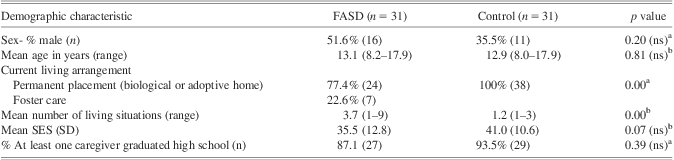
Sixty-two children aged 8–17 years participated in the present study: 31 children with FASD and 31 control children (see Table 1). Children with FASD were recruited through a hospital FASD clinic; those with comorbid genetic disorders (e.g., Down's syndrome), severe neurodevelopmental disorders (e.g., autism spectrum disorder), or severe motor/sensory impairments (e.g., cerebral palsy) were excluded. All FASD participants had been diagnosed by a multidisciplinary team of professionals (i.e., psychologist, speech-language pathologist, occupational therapist, social worker, and developmental pediatrician). All participants with FASD had received a diagnosis according to the Canadian guidelines for FASD (Chudley et al., Reference Chudley, Conry, Cook, Loock, Rosales and LeBlanc2005) using the four-digit diagnostic code (Astley, Reference Astley2004). This system objectively ranks diagnostic information using a 4-point Likert scale in four key areas: growth deficiency, facial features, brain dysfunction, and alcohol exposure. For example, a brain dysfunction code of 1 indicates no evidence of brain damage, 2 indicates mild to moderate delay of dysfunction, and 3 indicates significant dysfunction. A brain code of 4 is assigned to patients with definite brain damage as evidenced by structural markers (e.g., microcephaly or structural abnormalities on magnetic resonance imaging scans). To be assigned a brain code of 3, the patient must be significantly impaired across 3 or more neurobehavioral domains (sensory/motor, communication, attention, intellectual, academic achievement, EF, memory, adaptive functioning). A brain code of 2 would be given when current data did not support a ranking of 3 or 4, despite a strong history of significant cognitive and/or behavioral problems. All of the participants with FASD in the present sample were coded as Brain 2 or 3. Alcohol exposure was confirmed through birth records, children and youth services documentation, birth mother report, or other reliable sources before clinic acceptance. Sixty-seven individuals with FASD met the inclusion criteria for the study and were contacted by phone and by mail. Three declined to participate and 29 could not be reached. Information about characteristics of non-participants was not available. Thirty-five individuals agreed to participate, and four were excluded when specific diagnostic information could not be obtained after testing. Of the 31 FASD participants, 18 (58.1%) were diagnosed with Static Encephalopathy, Alcohol Exposed; 10 (32.3%) with Neurobehavioral Disorder, Alcohol Exposed; 2 (6.5%) with Partial FAS; and 1 (3.2%) with FAS according to the four-digit diagnostic code (Astley, Reference Astley2004). Full-scale IQ (FSIQ) was obtained for 27 of the FASD participants, and averaged 82 (range, 70–109).
Participant characteristics
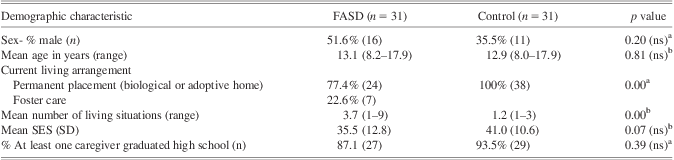
Note. SES determined by Hollingshead's Four-Factor Index of Social Status. SES, education, and income information obtained from current caregivers; ns, not significant.
aAnalyzed by chi-square analysis.
bAnalyzed by analysis of variance.
The control group was recruited through advertisements placed in local elementary and secondary schools. As such, we cannot determine the precise number of participants who viewed the advertisements or their personal characteristics. Forty-two individuals expressed interest in the study. Potential controls were screened through a parental-report questionnaire and excluded if they reported (a) a neurological/mental health condition and/or brain injury; (b) any maternal drinking during pregnancy; or (c) serious complication(s) during pregnancy and/or childbirth. Eleven participants were excluded based on these criteria. The control group was not significantly different from the FASD group in age, sex, or socioeconomic status (SES), but they did differ in current living arrangement and mean number of living arrangements (for demographic information, see Table 1).
Informed consent was obtained from caregivers, and all children provided assent before the testing session. All data collected for this study were obtained in compliance with regulations of an institutional review board.
Materials
The Iowa Gambling Task
The IGT (Bechara et al., Reference Bechara, Damasio, Damasio and Anderson1994) was developed and normed for adult populations (18 years and older), but it has been used successfully in developmental populations as young as age eight (e.g., Lehto & Elorinne, Reference Masunami, Okazaki and Maekawa2003). Developmental analogues of the IGT have also been developed, such as the Hungry Donkey Task (Crone & Van der Molen, 2004) and the Children's Gambling Task (Kerr & Zelazo, Reference Kerr and Zelazo2004). The present study used a computerized version of the full IGT. Participants were instructed to select from four decks of cards labeled A, B, C, D. They were not told how long the task would take (100 trials; approximately 10 min). Each card selected revealed a combination of gains and losses measured in pretend money, accompanied a happy face for a win, and a sad face for a loss. For example, a participant may be told they “won” 50 dollars but “lost” 100. Participants were given a “loan” of $2000 and were instructed to earn as much money as possible and avoid losing money by choosing from any of the decks, one card at a time. They were also told that some decks were worse than others, but that they would have to figure out which. Indeed, intermittent penalties are arranged within the decks so that decks A and B, although initially associated with large rewards (average of $100), yield large subsequent losses and are ultimately disadvantageous. In contrast, decks C and D, which have small immediate gains (average of $50) and small eventual losses, are considered advantageous. The decks also differed from each other in punishment frequency: Decks A and C delivered more frequent losses (50% of cards), whereas B and D yielded less frequent losses (10% of cards).
Participants could track how much money they had won or lost based on an image of a green bar, which increased or decreased on the screen accordingly. The green bar was located above a red “borrow” bar, which represented the $2000 lent to the participant. Participants were told that if their green bar exceeded the red bar in length, that meant they were winning; if the green bar was shorter than the red bar, they were losing. They were also told to treat the play money as “real” money, and to create a tangible incentive they were told that if they “won” they would be given five real dollars. All participants were given five dollars regardless of actual performance. A trained research assistant sat with each participant and ensured they understood the task before task initiation. After each block, the research assistant reminded the child of the central premise of the game (e.g., “Remember, some decks are worse than others, so try to stay away from the worst decks.”) The task continued until participants had completed 100 trials. All participants completed the task.
Statistical Analyses
To test IGT performance differences between participants with FASD and controls, we operationalized IGT scores in several different ways. Group differences in overall performance (IGT total net score) were analyzed using one-way analysis of variance (ANOVA). We then tested whether performance of children with FASD and controls would differ over the course of the task using a 2 (group) × 5 (block) ANOVA with repeated measures on the last variable. Additionally, we examined group differences in the total number of cards selected using one-way ANOVAs. To examine whether IGT performance differed with age, we analyzed a custom general linear model univariate ANOVA. This model included IGT net total score as a dependent variable and an age by group interaction term, which allowed for examination of age effects as a continuous variable.
Results
IGT Total Net Score
Mean total net score was calculated by subtracting the number of disadvantageous selections from the number of advantageous selections, [(C+D) – (A+B)] over 100 trials. A positive net score indicates advantageous performance on the IGT and a negative score indicates poor decision-making performance. Children with FASD exhibited a significantly lower total net score (M = −7.94; SD = 20.08) than controls (M = 8.84; SD = 21.91); F(1, 61) = 9.87; p < .01.
IGT Block Net Scores
The 100 trials are divided into 5 blocks of 20 cards each, and net score for each block is calculated using the formula [(C+D) – (A+B)] to create 5 “block net scores.” Again, negative scores indicate disadvantageous performance, and positive scores indicate advantageous performance. Block net scores yield a profile of decision-making and affective learning behavior over time. All types of participants are expected to begin by choosing randomly, or possibly more from disadvantageous decks. As the task progresses, neurologically intact individuals generally transition to choosing more from advantageous decks, exhibiting a positive learning curve. Random performance across trials is generally suggested to indicate diffuse brain damage, and a negative learning curve has been associated with more localized brain damage (i.e., vmPFC) (Bechara, Reference Bechara2007).
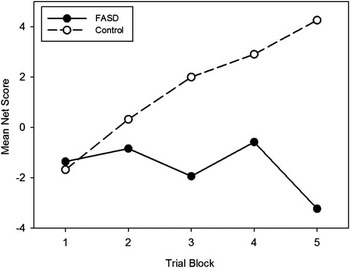
A 2 (group) × 5 (block) ANOVA with repeated measures on the last variable showed a main effect for block, F(4, 240) = 1.87, p < .05. There was a significant main effect for group, F(1, 60) = 8.61, p < .01, with the control group outperforming participants with FASD. There was also a significant block by group interaction, F(4, 240) = 4.18, p < .01 (see Figure 1). To identify the source of the interaction, additional repeated-measures ANOVAs were conducted separately for each group. There was no effect of block among the FASD group, F(4, 120) = 1.49, p > .05; however there was a significant effect of block among the control group, F(4, 120) = 3.86, p < .01, suggesting that typically developing children exhibit a positively sloped learning curve whereas the learning curve of participants with FASD is relatively flat. To account for gender effects, which are occasionally observed in aspects of IGT performance (e.g., Hooper et al., Reference Hooper, Luciana, Conklin and Yarger2004), we re-ran the repeated-measures ANOVA with gender as a covariate. The effect of gender was not significant, F(4, 236) = 0.51, p >.05.
Mean block net scores by group. Performance of participants with fetal alcohol spectrum disorders (FASD) and control participants by trial block (5 blocks of 20 trials each). Mean net score per block can range from −20 to 20.

Total Number of Cards Selected From Each Deck
Although decks A and B are considered disadvantageous, a high number of cards selected from deck A is highly suggestive of decision-making impairments whereas a high number of cards selected from deck B is less conclusive, as neurologically intact individuals can also tend to choose frequently from this deck (Bechara, Reference Bechara2007). For the advantageous decks, a low number of cards selected from deck D is highly indicative of poor decision-making capacity, whereas a low number of cards selected from deck C can be inconclusive. Compared to controls, children with FASD selected significantly more cards from deck A and significantly fewer cards from deck D, but the two groups did not differ in number of cards chosen from deck B or C (see Table 2).
Mean IGT scores by group

Note. IGT = Iowa Gambling Task; FASD = fetal alcohol spectrum disorders.
*p < .05 analyzed by analysis of variance.
** Partial eta-squared.
We also examined group differences in total number of advantageous (C+D) and disadvantageous (A+B) cards chosen (see Table 2). Children with FASD chose significantly more disadvantageous cards, and therefore significantly fewer advantageous cards, than control children.
Relation of IGT Performance to Age
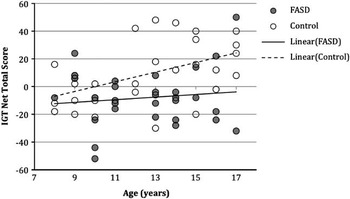
A custom univariate ANOVA model revealed a significant interaction between group and age, F(2,61) = 10.41, p < .001. To further clarify the nature of the interaction, we conducted correlations between IGT total net score and age within each group. IGT total net score was not correlated with age within the FASD group, r(30) = 0.16, p = .52, but was highly correlated with age in the control group, r(30) = 0.50, p < .01, indicating improvement on the IGT with age in the control group but not in the FASD group (see Figure 2).
Total net score by age in FASD and control participants. Net total Iowa Gambling Task (IGT) score of participants with fetal alcohol spectrum disorders (FASD) and control participants from age 8 to 17. Total net score can range from −100 to 100.

Relation of Other Variables to Scores in the FASD Group
In the FASD group, IGT total net score was not correlated with IQ scores, r(30) = 0.05, p = .82, current living arrangement (permanent placement vs. foster care), r(30) = −0.07, p = .71, or with FASD diagnostic scores (p > .27 for all correlations). IGT total net score was not significantly related to SES in the FASD group, r(30) = 0.30, p = .10, or in the control group, r(30) = 0.32, p = .08. IGT total net score was also not correlated with mean number of living situations in the FASD group, r(30) = −0.10, p = .58, or in the control group, r(30) = −0.04, p = .84.
Discussion
FASD Versus Control IGT Performance
The primary aim of this study was to investigate whether the IGT could detect differences between participants with FASD and controls. True to our predictions, we found that children with FASD performed significantly worse overall (as evidenced by significantly lower total net scores), as well as over time throughout the task (shown by significantly poorer performance across block net scores) compared to controls. Consistent with previous research with typical populations, control children exhibited a positive learning curve over the course of the trial. In contrast, children with FASD exhibited a fairly flat and overall random learning curve. These results might suggest that control children appeared to learn from previous experience with the negative consequences of the disadvantageous decks. They were able to flexibly appraise the situation in the face of motivationally significant stimuli, inhibit the prepotent response for immediate reward, reflect on long-term consequences, and eventually shift to selecting the much-less immediately attractive, but the much more eventually advantageous decks. The experience of children with FASD is much less clear. Although alcohol-exposed children seemed to be more predisposed to making disadvantageous choices than controls, the somewhat random, but overall negative pattern of performance suggests that children with FASD may not have a uniquely heightened sensitivity to reward or insensitivity to punishment and future consequences. Instead, their poor performance could reflect many factors, including an overall lack of learning, difficulty in learning reward/punishment contingencies (inability to learn and predict which decks are disadvantageous), or an overall motivational or emotional insensitivity to negative consequences. Poor performance could also represent an inability to interpret the salience of losses in this task (i.e., an inability to recognize their impact on the overall outcome), or lack of capacity to truly understand what is going on (e.g., the task itself, cause-and-effect relationships, etc). Complex tasks such as the IGT exert demands on both cool and hot EF. Impairments in cool EF (e.g., poor working memory, attentional inflexibility) are common deficits in FASD, and thus could also be related to their poor performance.
Age-Related IGT Performance
Our second main interest was to examine age-related performance between and within groups. We found a significant interaction between age and group, indicating that control participants became more adept decision-makers with increasing age but the FASD group did not (Hooper et al., Reference Hooper, Luciana, Conklin and Yarger2004; Prencipe et al., Reference Rasmussen2011). With increasing age, control children did not only tend to select more from the advantageous decks, but they also learned to shift from playing disadvantageous decks to advantageous ones more quickly. In contrast, within the FASD group, adolescent performance could not be differentiated from that of the youngest FASD participants. Clearly, children with FASD are not developing their decision-making abilities at rates on-par with their typical peers. These age-related findings add to previous FASD literature suggesting that individuals with FASD often present with deficits that are consistently poor across age-ranges and may even become more pronounced with age (relative to typical peers), such as impairments in cool EF (Rasmussen & Bisanz, Reference Rasmussen and Wyper2009), social skills (Kully-Martens, Denys, Treit, Tamana, & Rasmussen, Reference Kully-Martens, Denys, Treit, Tamana and Rasmussen2012), and aspects of achievement (Tamana, Pei, Massey, Massey, & Rasmussen, Reference Tamana, Pei, Massey, Massey and Rasmussenin review). However, further longitudinal research is critical to determined true age changes over time. Nevertheless, the increasing functional gap between children with FASD and their typical peers presents a significant concern. As children with FASD move through adolescence, they may not be able to meet typical expectations, such as increased independence, self-sufficiency, and positive-decision-making. Adolescents are faced with complex and demanding social contexts (including increased opportunity for risky behavior), which require elevated competency in social navigation and decision-making, as well as new and challenging emotional experiences, which can pose significant regulatory burden on decision-making processes. Thus, it appears that adolescence is a period of increased vulnerability among individuals with FASD where decision-making skills may deviate the most from the norm. Supporting individuals with FASD through this transition period by being cognizant of underlying neuropsychological impairments is critical.
Implications
Our results provide new insight into the breadth of EF and general neuropsychological impairments experienced by individuals with FASD. In any clinical population, it is essential to understand the profile of neurobehavioral strengths and weaknesses to determine appropriate assessment approaches and intervention strategies. Currently, clinical FASD assessments weigh heavily on examining cool EF abilities at the expense of hot EF measures, which are rarely included in an assessment battery. Although further research is needed to determine the diagnostic utility of hot EF tests such as the IGT, information provided by a measure like the IGT could still reasonably be applied to the implementation of optimal supports for alcohol-exposed individuals. For example, being able to identify individuals with poor decision-making scores may allow prescient and more focused intervention strategies, such as scaffolded decision-making.
These findings also provide insight into best practices with alcohol-exposed children. Children with FASD may be more vulnerable to negative influences through adolescence and may make repeated mistakes, especially in affective contexts. Children with FASD have hot EF deficits, which may impact their ability to respond adaptively or flexibly in situations with significant emotional or motivational interplay, thus contributing to maladaptive or impulsive behaviors. Children with FASD may not learn from their experiences as we expect them to. Therefore, poor decisions may not necessarily reflect defiance, conduct issues, or an intentional lack of concern or motivation. Furthermore, it appears that hot EF in children with FASD may not be developing at the rate we might expect, and therefore, the functional gap between them and their typical peers may grow. Thus, it is important to consider interventions that may help offset tendencies toward disadvantageous decision-making. This could include encouraging the individual to slow down their decision-making process, role-playing, and role-modeling deliberately considering future alternatives before making a decision, and teaching them to intentionally seek support. These strategies may encourage individuals to better use skill sets they already have and allow them options other than impulsively responding. However, efforts to build decision-making abilities in this population should consider the difference between cognitively constructing and articulating multiple choices in a decision-making context (cool EF) and actually being able to implement a choice in the heat of the situation, which will likely be fraught with strong motivational and affective forces (hot EF). Strategies toward building this affective “intelligence” may include consideration of peer and social context pressures, and mood regulation (see Xiao et al., Reference Xiao, Bechara, Cen, Grenard, Stacy, Gallaher and Anderson Johnson2008).
Limitations and Future Directions
First, although we interpreted significant age-related differences from our cross-sectional design, without longitudinal research, true developmental trajectory of hot EF abilities in this population cannot be inferred. Second, our preliminary study did not include current correlative behavioral or cognitive measures or parental reports of decision-making capacity, although requisite cognitive testing at diagnosis would have established such deficiencies.
Future studies may want to include the IGT as a part of a larger hot EF battery alongside measures of cool EF, as well as investigate the possible connection between IGT performance and behavioral measures. Furthermore, it should be recognized that the IGT was not originally designed for developmental use. Although a developmental analogue has been created for preschool children (Kerr & Zelazo, Reference Kerr and Zelazo2004), the IGT has not yet been adapted for use in school-aged youth. Another limitation to our study is we were not able to tease apart the etiology of poor IGT performance by participants with FASD, which, as mentioned previously, could be influenced by different factors (e.g., learning, memory, comprehension, emotional salience of consequences). However, the current findings do not suggest that impaired IGT performance related to below-average IQ in the FASD group. Future studies could explore modifications to the IGT to determine which factors are underlying IGT performance in FASD. Finally, future work should aim to combine hot EF tasks (including the IGT) and neuroimaging to further elucidate the biological underpinning of performance deficits in FASD.
Conclusions
Despite these limitations, this study provides the first evidence that individuals with FASD are impaired on a neuropsychological measure of affective decision-making and risk-taking, which forms a base for important future research and clinical endeavors in the area of hot EF. This impairment may contribute to behavioral and adaptive dysfunction often observed in individuals with FASD, especially as they mature into adolescence and adulthood and functionally begin to deviate further from their typical peers.
Acknowledgments
Funding for this research was provided by the Glenrose Rehabilitation Hospital Clinical Research Fund. The authors thank Dr. Ying Cui and the Centre for Research in Applied Measurement and Evaluation (CRAME) at the University of Alberta. The authors have no conflicts of interest to report.