Introduction to the problem
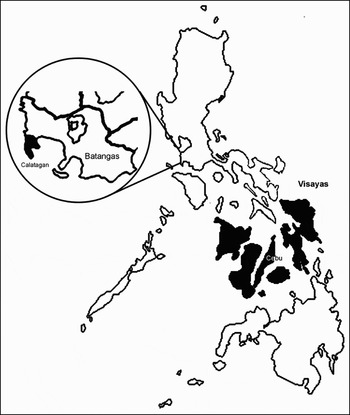
It has been almost 50 years since the Calatagan pot, a unique artifact with an inscription around its shoulder, was allegedly discovered in conjunction with comprehensive archaeological excavations of burial complexes in Calatagan, Batangas (Figure 1). Criselda Yabes tells the story of Alfred Evangelista, a member of the National Museum team headed by Robert B. Fox, who was the first archaeologist to see the find:
Mang Fred [Evangelista] got himself embroiled in a controversy that will probably bother his peace of mind to his remaining days. He is now 70 years old, still unable to put to rest an event that took place before I was born more than thirty years ago …. In July, 1961, he was part of a digging expedition in the town of Calatagan in Batangas province south of Manila. There had been images of Spanish religious icons recovered, and soon enough, replicas of them began to spread widely. Private companies financing the diggings were about to give up when no new artifacts had surfaced. As it was his routine schedule, Mang Fred went home to Manila on weekends. He thought luck had struck him when, returning to Calatagan first thing one Monday morning, the sugar cane farmer on whose land he was digging gave him an earthenware pot which the farmer said he himself had discovered.
Until today, many have casted doubt on the pot's authenticity, that the farmer may have fooled him, but Mang Fred still believes it is real. And if it is, it would be the first known archeological evidence with an inscription of the ancient script.Footnote 1
The Calatagan pot inscription (CPI) has remained a puzzle for decades despite numerous attempts to decipher it palaeographically by the comparative analysis of its symbols. Because of the sheer difficulty of deciphering the CPI, its questionable origin, and the lack of a verifiable tradition of writing on clay pots in Southeast Asia, many scholars have raised probable suspicions of forgery. On the other hand, several experts are convinced of its authenticity. For example, writing in 1973, more than a decade before the discovery of the Laguna copperplate inscription (LCI) in 1989 and its decipherment by Antoon Postma in 1990,Footnote 2 the palaeographer and Sanskrit expert Juan Francisco wrote that, ‘pending discovery of further proofs, let it be considered that this inscription carries the burden of archaeological proof of ancient Philippine writing’.Footnote 3 The archaeologist Eusebio Dizon reports that an expert on Indonesian palaeography, Johannes de Casparis, upon examining the pot closely, expressed the belief ‘that it was not a fake as evidenced by the inscription itself. He maintained that it would be very difficult to fake such an inscription’.Footnote 4
Map of Calatagan, Batangas and the Visayan islands

Regarding the problem of dating, Francisco wrote:
All the associations of this single artifact has been with these Chinese and Siamese wares which may be dated as falling into the period between the late 14th century and the end of the 15th century or the early part of the 16th century …. In spite of its associations which would make more or less the Fourteenth Century as its terminus a quo, it can still be assumed that the script itself may have been introduced far earlier than that date, since writing in the Southeast Asian region was already widely used from the early centuries of the Christian Era.Footnote 5
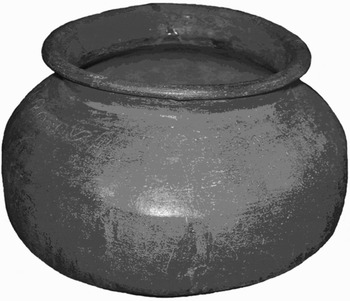
Given that it was not actually found in in situ in archaeologically controlled conditions, Francisco's presumed approximate dating should be viewed with the appropriate caution. Grace Barretto-Tesoro, author of a comprehensive study on the Calatagan earthenwares,Footnote 6 says that the pot's make and material seem typical of the locally made earthenware pottery found in gravesites in that area (Figure 2).Footnote 7 However, the pot, which measures 12.0 cm tall, 20.2 cm wide and weighs 872 g, has resisted attempts at more accurate dating because of contamination with a petroleum-based cleaning solution which had mistakenly been used by the National Museum staff.Footnote 8 Dating by accelerated mass spectroscopy (AMS) in 1993 resulted in erroneous dates of 6,000 BCE outside the pot and 2,000 BCE inside the pot.Footnote 9
The Calatagan pot with inscriptions around the shoulder

Among the scholars who have systematically analysed the symbols of the CPI are Francisco, Jean-Paul Potet, Postma, Harold Conklin and de Casparis. Among these, only Francisco and Potet have made public a more or less complete set of symbol equivalences.Footnote 10 Francisco accomplished his preliminary series of equivalences by means of rigorous palaeographic analysis with reference to known syllabic scripts or syllabaries (known as baybayin or surat in the Philippines). However, he pointed out, ‘I can offer no possible transliteration of the inscription owing to the difficulty of identifying some of the symbols, as indicated in the above attempt to identify them’.Footnote 11 More recently, a certain Quintin Oropilla produced a complete Pangasinan language decipherment of the CPI using a combination of palaeography and a wide stretch of the imagination.Footnote 12 (This latter case shall be discussed in more detail below.) Francisco underlined the importance of deciphering the CPI:
The successful decipherment of the inscription would open many ‘dark rooms’ in Philippine pre-and proto-history. For instance, the symbols will thus have been fully identified and it would thus show the various forms of the letters as they were known and used in prehistoric times. After this is successfully done, perhaps paleographists would then be able to give a better typological analysis of Philippine scripts generally. Furthermore, the decipherment of this inscription would also open to linguistic scientists a new field of study in terms of the structure of the Tagalog or Mangyan languages in Pre-Hispanic times. Indeed, this inscription is truly significant in the attempt to understand the many vague aspects of Philippine cultural history.Footnote 13
Spanish records on Philippine syllabaries suggests that these were once widely used throughout the archipelago and that, despite quite fundamental commonalities, they were also quite diverse in their distinctive traits. These writing systems were referred to as baybayin or surat. Some syllabaries in Southeast Asia are called Surat Mangyan, Surat Tagabanuwa Surat Bugis, Surat Batak, Surat Ulu, etc. According to Robert Blust, the nomenclature surat is particularly interesting because it seems to be an indigenous term for writing, which he conjectures as pointing to the existence of lost practices of literacy predating those of Indian origin:
Since all reported ‘indigenous’ scripts in Indonesia and the Philippines appear to be based on Indian originals, there is no known physical reason to suppose a pre-Indian tradition of ‘bamboo literacy’. Surat is not a Sanskrit loanword, however, invariably and exclusively refers to writing, and must have existed in western Indonesia only slightly later than the earliest inscriptions in an Indian-based script. It therefore seems unlikely that writing was introduced to Indonesia entirely as a result of direct or stimulus diffusion from India.Footnote 14
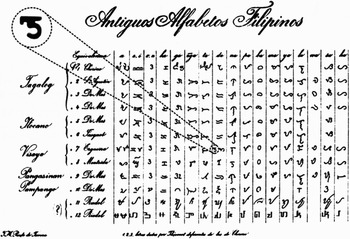
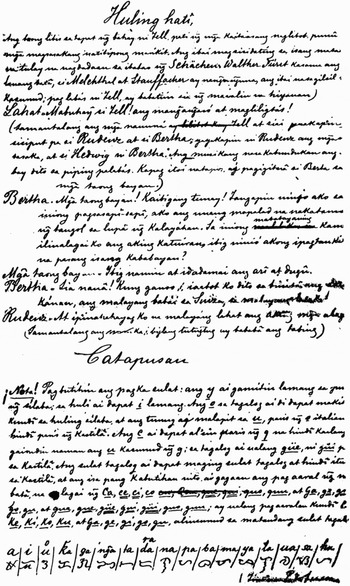
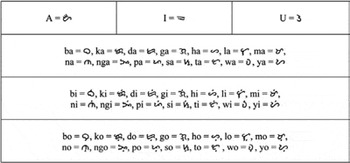
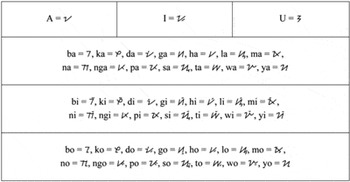
Filipino scholars and nationalists of the nineteenth century were particularly interested in these writing systems. Trinidad Pardo de Tavera consolidated a comparative table of Philippine scripts in 1884 (Figure 3). José Rizal was inspired to explicitly model a new Tagalog orthography after the baybayin system in 1887 (Figure 4); and the revolutionary Kataastaasang Kagalanggalangang Katipunan ng mga anak ng Bayan (The Highest and most Venerable Association of the Sons and Daughters of the People) of the 1896 Philippine Revolution famously used the symbol  (ka) on its flags and uniforms.Footnote 15 However, very few written samples of these syllabaries from the whole period of Spanish colonial rule have been preserved. Though some syllabaries continue to be used, particularly among the Mangyans on the island of Mindoro and the Tagbanuwa of Palawan, these are now steadily dying out due to the inroads of ‘modern’ education and culture and a lack of interest on the part of the authorities to preserve them. A distinctive synthesis of external stimulus and local genius, these scripts attest to the vibrant cultural contacts which the Philippine archipelago had maintained historically with mainland and insular Southeast Asia. These syllabaries generally possessed three symbols for vowels and 14 for consonants. Consonantal symbols were accompanied by a diacritical mark (called kudlit in the baybayin system) above if the following vowel was ‘i’/‘e’ while the mark would be placed below if followed by ‘o’/‘u’. If there are no accompanying kudlit then these are followed by the vowel ‘a’ (Tables 1 and 2).
Comparative table of Philippine scripts (from Pardo de Tavera, 1884) (note the encircled Visayan symbol for da)

Final page of José Rizal's Tagalog translation (1887) of Friedrich Schiller's Wilhelm Tell with Tagalog baybayin at the bottom and explanation of a new proposed Tagalog orthography

The Tagalog baybayin writing system

The Surat Mangyan writing system

Like the Surat Bugis of Sulawesi, to which they do not seem closely related in any other way, the baybayin or surat systems in the Philippines do not possess any so-called virama (‘vowel killer’) which could have allowed for the representation of ending or closing consonants after a consonant–vowel cluster. Independent consonants therefore had to be filled in by the reader by means of context clues and adherence to formulaic utterances. The Tagalog symbol sequence  (pa-pa) could therefore be read variously as pakpak (‘wing’), palpak (‘failure’), paspas (‘faster’), padpad (‘drift’), pagpag (‘to dust off’), pampang (‘shore’), patpat (‘stick’), paypay (‘fan’) and so forth. The script is also written in such a way that spaces or other indicators between words are not observed. This may present little difficulty to those who were immersed daily in its use such as the Mangyan poets or the Filipino literates of ancient times but is exceedingly difficult for outsiders to master.
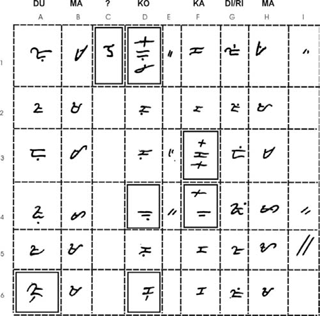
Some interesting samples of baybayin writing were provided by Potet who deciphered a series of signatures by two individuals, Don Marcos Karima and Doña Francisca Tala-i, written down on a Spanish document in the years 1646, 1647 and 1648.Footnote 16 The signatures by Don Marcos Karima are most interesting because the first among a series of six of his signatures contains a symbol (Table 3 at position C-1) which Potet remarked as being similar to the palaeograph  on the CPI. Various oddities can also be observed such as the five variations on the symbol ka (which is of interest in itself) at positions D-1, F-3, D-4 and F-4. It shall be noticed that the ka which appears at position D-4 is identical to the ka symbols in the Philippine syllabaries of Pangasinan and Pampanga. The ka at positions D-1 and F-4 are combinations of the Pangasinan/Pampanga and the Mangyan and Tagbanua forms. Lastly, the ka at position F-3 likewise represents a combination of the Tagalog baybayin with the Mangyan and Tagbanua forms. Another oddity is the irregular use of end-word symbols at columns E and I. The titles of ‘Don’ and ‘Doña’ have been borrowed to signify that these individuals belong to the maginoo or noble class of people. The first names ‘Marcos’ and ‘Francisca’ are also of Spanish origin and therefore posed difficulties in their adaptation to the early Philippine writing system. Don Marcos' first attempt to write down his given name encountered the difficulty of having to write a consonant without a succeeding vowel (r) in the middle of a word. He responded to this problem by writing down the symbol which presumably sounded similar to ‘r’. The Tagalog baybayin system, as with most of the Philippine scripts, has no symbol for ra and oftentimes uses da for this purpose, as Don Marcos did with his last name ‘Karima’ using di,
 to represent ri. The palaeograph might also be da/ra. (This point shall be discussed in more detail below.) Don Marcos' initial effort at writing his first name therefore came out literally as ma-da/ra-ko(s). His five other succeeding attempts at writing his signature eliminated this inconsistency by writing only ma-ko or Ma(r)ko(s).
Baybáyin signatures dated 1646–48 (from Potet, 1999)

Though the question of the origin and history of the Philippine scripts shall not be delved into here, it should be remarked that there are at least four major theories on the putative origin of these writing systems: (1) direct introduction from India; (2) development from the Buginese scripts and Javanese alphabets; (3) descent from Sumatran writing systems; (4) derivation from scripts of mainland Southeast Asia, in particular from Cham.Footnote 17 The third thesis, advanced by Francisco, and the fourth and most recent one, proposed by Geoff Wade, both present substantial palaeographic evidence and deserve serious scientific consideration towards a possible consensus.
Setting aside the issue of the actual authenticity of the pot, it can be seen that anyone attempting the transliteration, meaning the determination of the symbol equivalences (let alone the actual decipherment of the CPI), would encounter at least three seemingly insuperable problems:
(1) The equivalents of most of the symbols cannot be determined with certainty. The multifarious possibilities for many of the symbols render most decisions equivocal;
(2) The language(s) composing the CPI is/are unknown;
(3) Even if the symbols were successfully identified, the complications intrinsic to reading baybayin text in determining the start and end of words and the determination of final consonants would be exceedingly difficult to overcome.
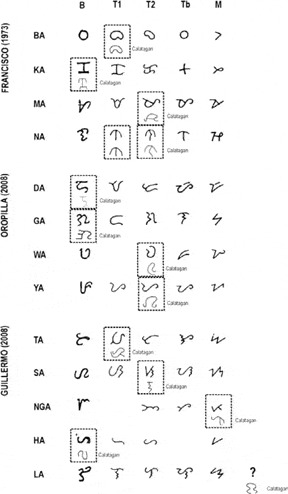
Equivalences from Francisco, Oropilla and Guillermo. B1 = Bisaya, Alcina 1668; B2 = Bisaya, Ezguerra 1747; T1 = Tagalog, Chirino 1604; T2 = Tagalog, the Doctrina Christiana 1593; Tb = Tagbanuwa; M = Mangyan

Two minimal assumptions shall be proposed here:
(1) The CPI is in a syllabary which is fundamentally similar to the known Philippine syllabaries;
(2) That the language(s) it is in is potentially readable and not completely unknown to the authors of this study.
Given the palaeographic deadlock surrounding the CPI that has spanned five decades, the present experimental effort at decipherment will try to move forward by combining palaeographic and cryptographic techniques in order to arrive at a complete decipherment. The above-mentioned obstacles, however, work against any definitive and final reading and always entail what may be a rather large margin of error. With respect to the CPI, the relative plausibility of the transliteration, or set of symbol equivalences, is therefore more significant than its definitiveness. Extreme caution should therefore be observed regarding any claims to finality. It should be emphasised that this study only proposes a new approach and some tentative conclusions premised on the as-yet unproven veracity of the CPI and the pot itself.
The transcription of the inscription
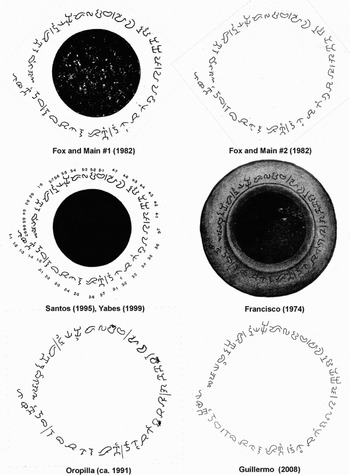
The accuracy of the existing transcriptions of the symbols comprising the CPI is still a major issue. Four main sources have served as bases of comparison for the current analysis (Figure 5). The first is made up of the two transcriptions by Fox and Dorothy Main.Footnote 18 The second is the artistic rendition of the CPI in Francisco's pioneering study.Footnote 19 The third is the corrected version by Hector Santos which added a missing symbol to Francisco's version.Footnote 20 Efforts at transliterating the CPI by Francisco and others were hampered by this error in transcription originating from the National Museum, in which only 39 of the 40 symbols of the CPI were represented.Footnote 21 The last point of reference is the somewhat idiosyncratic rendition by Oropilla.Footnote 22 The first three sources all agree with one another to a very great extent while Oropilla's transcription of 1991 probably reflects certain predilections of his regarding the nature and origin of the script in question.
Six transcriptions of the Calatagan pot inscription

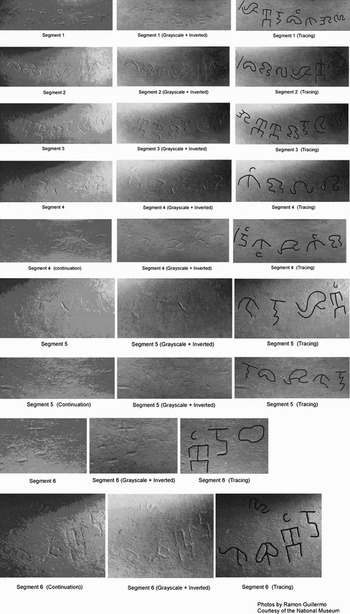
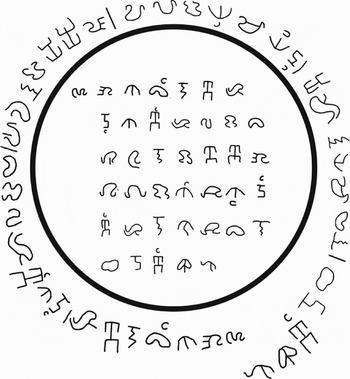
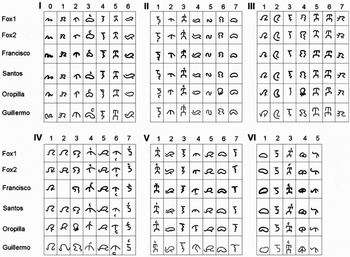
A series of photographs was taken to bring out the symbols in greater relief by using different angles of lighting. The results are shown in Figure 6. The tracings of the symbols in the photographs were then lifted and patched together in order to construct the latest transcription of the CPI (Figure 5, bottom right, and Figure 7). This transcription is unique among the rest because of the fact that it is not an artistic rendition of the CPI but is an effort at ‘lifting’ the images directly from the pot's surface. Admittedly, errors and wrong decisions in the interpretation of the marks in the process of tracing cannot be ruled out. The markings on the pot are extremely shallow in some areas and it is sometimes hard to differentiate genuinely meaningful markings from surface scratches. Distortions in size and character formation are also evident because of the different angles that were used in taking the photographs. The use of more sensitive equipment and better techniques could probably resolve certain grey areas in the current transcription. An easier layout for the comparison of all the transcriptions can be seen in Figure 8.
Photographs and tracings of the Calatagan pot inscription

Transcription lifted from the pot's surface in the original circular arrangement and in a horizontal format (centre)

Horizontal arrangement of transcriptions for comparison. Note the missing symbol in Francisco IV

Oropilla's latest transcription (Figure 5, bottom left)Footnote 23 replaced a symbol  with a symbol which is clearly
 (Figure 8, line V), while a symbol
 with clearly no diacritical mark below it was read by him as
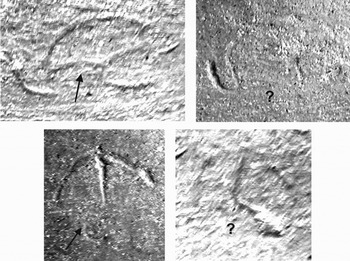
 (Figure 8, line IV). All these errors in transcription can be verified by a closer inspection of the photographs of the actual inscription (Figure 9). In fact, line V in Figure 8 shows that Oropilla's original inscription of 1991 did not incorrectly read this as . It can also be seen in line IV that while Fox (version 2) and Oropilla concur on the reading of as , Santos' highly accurate corrected version, Fox (version 1) and the present authors do not agree with this reading.
Oropilla's errors in transcription. Upper left: note the distinct horizontal line connecting the verticals. Upper right: Oropilla thinks that there is a horizontal line here connecting the verticals but there is none. Lower left: note the diacritical mark which is a half-circular indentation below the symbol. Lower right: Oropilla asserts that there is a diacritical mark below this symbol which has been ‘chipped off’.

Grouping of symbols and preliminary equivalences
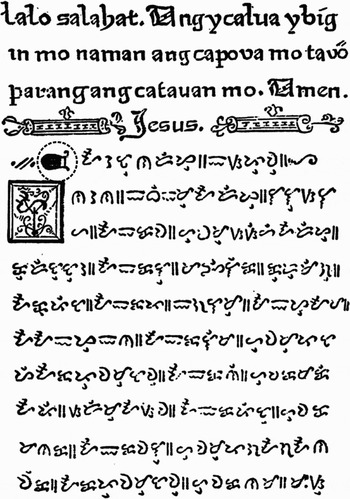
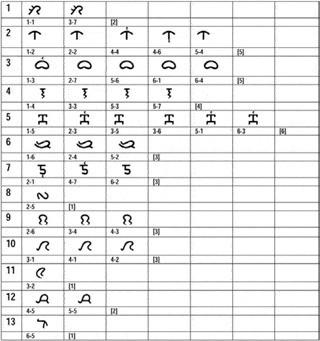
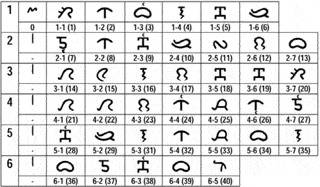
It can be observed in Table 5 that the symbols have been grouped into 13 different types. Aside from arranging the symbols differently from Francisco, who puzzlingly groups and together, another difference was that he considered the symbol  (position 0) to have a sound value, though he could not identify what this was.Footnote 24 It has already been mentioned above that this symbol shall here be considered a starting marker. This is a controversial move, since, if the CPI, which has seven symbols in the first six segments/lines and five in the last, were a metered form composed of seven-syllable or heptasyllabic lines in conformity with ancient Philippine poetic forms, the tendency would indeed be to maintain the symbol as having a sound value. Only segment six with its five symbols would not have to follow the meter. But the CPI could just as well be a poem as not. The current assignment of = ‘starting marker’ is only a hypothetical step and may be judged by the results it produces. It may be reversed or cancelled in order to arrive at better results. Indeed, this value assignment would not even have been proposed at all if there had been any obvious candidates for this symbol evident from the palaeographic record. The Doctrina Christiana of 1593 itself does seem to have a starting marker (Figure 10). The vertical line | separating the six sections of the text are interpreted here as indicating the endings of sentences, lines or phrases. This is also present in the Doctrina Christiana in the form ||. Lacking spaces between words, such markers are valuable indicators in the CPI of at least where some words start and end.
Page from the Doctrina Christiana (1593). Note the encircled symbol which is present at the beginning of the baybayin sections. The diacritical marks are identical with the Calatagan pot inscription but face in the opposite direction

Grouping and frequency of symbols (in order of appearance)

Five symbols out of the total 13 in the CPI can be ascertained to be consonantal syllables since these have been written with diacritical marks positioned above or below them. It bears repeating that a diacritical mark or kudlit above the symbol means that the consonant will be followed by the vowel ‘e’/'i' while one below the symbol means that it will be followed by the vowel ‘o’/'u'. Four of these five known consonants in the CPI have already been adequately identified palaeographically by Francisco. Following Francisco,  will here be equated with ba in the Tagalog baybayin
 , the symbol
 will be assumed to be equal to ka and as equal to
 na. Despite Francisco's misgivings because of its inverted orientation, in the CPI will here be equated to the Tagalog
 ma. The net result of this preliminary set of equivalences is that the analysis can begin with four symbols having assigned values and nine with unknown values.
Permuting the fifth line of the inscription
If the equivalences from Francisco are correct, it will be noticed that out of the six individual or unique symbols comprising the fifth line (of a total of seven since the symbol  in position 5-3 repeats in 5-7), there are now assigned values for four symbols. Only two symbols,
 at position 5-2 and at positions 5-3 at 5-7 have no definite equivalents (the boxes corresponding to those symbols with assigned values have been shaded).

A simple formula can be used to calculate for permutations wherein two symbols may each have 14 different possible values (but not at the same time): P = 14!/(14-2)!.
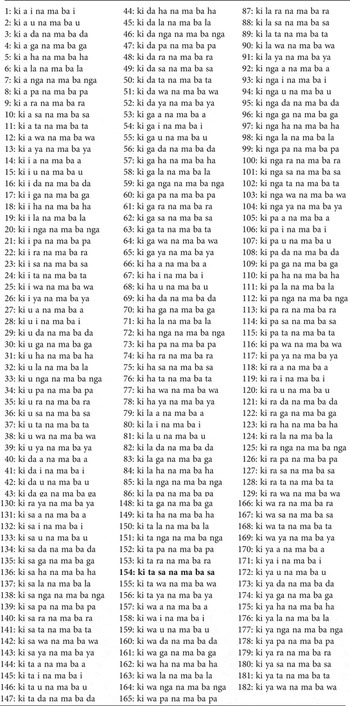
The result is 182 possible permutations for line 5. The computer program below generated all possible permutations for the symbols at position 5-2 and at positions 5-3 and 5-7:Footnote 25
L = open (‘calatagan5.txt’, ‘w’)
ctr = 1
CHR1 = “b”
CHR2 = “k”
CHR3 = “n”
CHR4 = “m”
for x5 in [“a”, “i”, “o”, “da”, “ga”, “ha”, “la”, “nga”, “pa”, “ra”, “sa”, “ta”, “wa”, “ya”]:
CHR5 = x5
for x6 in [“a”, “i”, “o”, “da”, “ga”, “ha”, “la”, “nga”, “pa”, “ra”, “sa”, “ta”, “wa”, “ya”]:
CHR6 = x6
if CHR5 == CHR6: continue
print str(ctr) + ‘: ‘ + CHR1 + ‘ ‘ + CHR2 + ‘ ‘ + CHR3 + ‘ ‘ + CHR5 + ‘ ‘ + CHR6 + ‘ ‘ + CHR4
print
L.write (str(ctr) + ‘: ‘ + CHR1 + ‘ ‘ + CHR2 + ‘ ‘ + CHR3 + ‘ ‘ + CHR5 + ‘ ‘ + CHR6 + ‘ ‘ + CHR4 + ‘\n’ + ‘\n’)
L.write (CHR2 + ‘i’ + ‘ ‘ + CHR5 + ‘ ‘ + CHR6 + ‘ ‘ + CHR3 + ‘a’ + ‘ ‘ + CHR4 + ‘a’ + ‘ ‘ + CHR1 + ‘a’ + ‘ ‘ + CHR6 + ‘\n’+ ‘\n’)
ctr = ctr + 1
The permutations generated can be analysed for any promising meanings or word shapes they may produce by referring to a permutation table (Table 6). In this particular case, permutation no. 154 seems to offer one of the most interesting possibilities for interpretation. This is the following:

List of permutations of line 5 (right to left)

Unlike all the other permutations produced, this is apparently the only one which from the beginning is a seemingly meaningful phrase for someone who reads Tagalog, although there is still a great chance that this is still a chance construction and that the language may not even be Tagalog. The straightforward Tagalog reading of line 5 could therefore be ‘hopefully we read’. For a person hoping to actually read the CPI, this seems to be a message coming from a time long past. The appearance of the word kita (‘we’, ‘the two of us’) at positions 5-1 and 5-2 is also very significant because if the CPI text is looked at as a whole, the word kita appears once more at positions 2-3 and 2-4. This is a very valuable piece of information, not least because it may indicate the locations where at least some words start and end in the CPI, before and after kita. Kita generally translates as the first person plural pronoun ‘we’, which includes the person(s) spoken to (tayo in Tagalog).
From the palaeographic point of view, it may be noticed here how the symbol in the CPI seems to be more closely related to the Tagalog  la than
 sa. Francisco observes that, ‘The nearest identifiable form with which this symbol can be compared is the Mangyan
 la, without the top horizontal (or side vertical) stroke, compare this also with Mangyan
 sa, which has a half-horizontal (or side half-vertical) stroke of the Pot letter.’ He goes on to speculate that the top-strokes of the la in Tagalog and Tagbanuwa are ‘curvilinear developments of the top horizontal (or side-vertical) stroke of the Pot letter’.Footnote 26 However, as Francisco notices, the sa and la form a distinctive subset in the majority of Philippine scripts even though the Tagalog sa and la are not as self-evidently related as the Hanunoo Mangyan variants (sa and la;
 sa and
 la) and the Tagbanuwa variants (
 sa and
 la;
 sa and
 la). The proposed Calatagan sa in fact shares a close resemblance to the Buhid Mangyan palaeographs for sa (
 ;
 ). This symbol will therefore be equated here with sa in conformity with permutation no. 154. On the other hand, the symbol in the CPI shares evident similarities (though seemingly in mirror-image) with the ta
 in the Tagalog baybayin, which is said to ultimately derive from ta of the Pallava system of south India.Footnote 27 If other possibilities such as = nga or = la are taken into account for the fifth line, then these would produce the right-to-left permutation number 98: ki-nga-la-na-ma-ba-la or, read in left-to-right sequence: la-ba-ma-na-la-nga-ki. Other scholars may be able to make some sense out of these syllable sequences, but the real challenge would be for the whole inscription to make sense, starting from these assignments, rather than just producing meaning for this single line alone. Developing a coherent sense and grammatically consistent expression for the whole text is a frustrating and almost impossible task, as anyone who has ever tried to do this can attest.
At this point, six symbols now have assigned values while seven are still unassigned. In order to take full advantage of these, the first line of the inscription can be considered in the analysis. It will be immediately noticed that when the results of permutation no. 154 are plugged into the first line, all the symbols except one  at position 1-1 in line number 1 shall already have assigned equivalents.

The assignment of the value sa for the symbol in the CPI as proposed from the reading of line 5 produces the Tagalog (from Javanese) word bisa ‘ability’ at positions 1-3 and 1-4. While the assignment of ta for the symbol in the CPI produces kata (‘word’/‘to say’). The whole of line 1, excluding the first two characters, can therefore read straightforwardly (as it would be, for example, in Bahasa Indonesia) as bisa kata or ‘can say’. The question thus arises of whom this subject ‘who can say’ actually is? And what does he or she actually say? The fact that the selected permutation produced meaning in two different lines of the CPI and produced a frequently repeating function word (kita) adds plausibility to the above-mentioned character assignments.
A palaeographic advance: DA
The four palaeographs from Francisco and the two hypothetical equivalences produced by permutation analysis mean that there are now six known symbols. It is here where Oropilla's crucial contributions come into the picture.Footnote 28 These can be summed up in his identification of four symbols through incisive palaeographical analysis: = ga, = da,  = wa, = ya. These identifications, accomplished by a close comparison of the Calatagan script with the Tagalog Doctrina Christiana script (1593) are undoubtedly correct. Oropilla's criticism, which he voiced in a forum on the CPI decipherment sponsored by the University of the Philippines Archaeological Studies Program (ASP) on 1 October 2008, that one of the authors (R.G.G.) had underestimated the value of the palaeographic approach in favour of a highly uncertain cryptographic adventure was completely correct.Footnote 29 Needless to say, since Oropilla has already proposed his own values for all the symbols in his Pangasinan language reading, only four of his new proposals based on solid palaeographic insights have been accepted in the current interpretation. Different values are here being proposed for the remaining six symbols where Oropilla's equivalences have seemed shaky or excessively speculative, especially in those cases where he made direct comparisons between the Bengali script and the Calatagan script. Oropilla's four identifications shall therefore be added to the six knowns from Francisco and our permutation analysis of line 5 which therefore add up to ten knowns. In addition the equivalents
 = nga,
 = ha and
 = la are further proposed. Except for mysterious palaeograph la, we now believe that these further additions (taking into account various character inversions and rotations) can be adequately supported by the existing palaeographic data (Table 4). The symbol is indeed a mystery. Francisco wrote, ‘this [symbol] seems devoid of any possible comparable from in the syllabaries now known’.Footnote 30 Barring the availability of any further palaeographic evidence, hypothetical substitution is indeed the only possible recourse (the only other remaining options given the previous assignments are a, e/i, o/u, la and pa). De Casparis himself did not completely rule out this method:
In many cases precise knowledge of palaeography may not by itself enable the palaeographist to identify a particular aksara but it may narrow the possibilities down to such a limited number that the correct choice can be made on other grounds …. A much more frequently applied method, which carries however certain dangers, is that of excluding certain possibilities on account of the context and opting for one that makes sense. It is true that in actual practice most epigraphists unconsciously work in this manner and usually start scrutinizing the minute details only if there is more than one possibility. Despite the obvious hazards it would be unrealistic to condemn such a method, especially on account of the stereotyped nature of some parts of the inscriptions. Caution and self-discipline must determine the limit to which one is allowed to go.Footnote 31
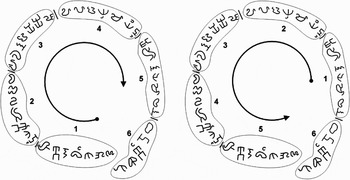
The 14 symbol identifications by Francisco, Oropilla, Potet and the present authors complete all the symbol equivalences necessary for deciphering the CPI. Aside from these differences in symbol equivalences and the above-mentioned problems with Oropilla's transcription, another main difference with Oropilla's decipherment is that this reading proceeds in a clockwise fashion starting from the symbol . through the six segments of the text, while Oropilla read in a counterclockwise direction beginning with the second occurring segment rather than the first one. He then placed what should more properly be considered the first segment (according to his direction of reading) after the last segment ending with the symbol. We do not believe this to be a legitimate step since it damages the sequence of the textual segments (Figure 11). His illustration of the CPI completely misrepresents if not deliberately falsifies the sequence of the writing of the segments by giving the impression of an illogical ‘bunching-up’ pattern.Footnote 32
Direction of reading, grouping of symbols and reading sequence (left: Guillermo, right: Oropilla)

Our own reasons for deciding on an extremely controversial clockwise or right-to-left reading direction starting from the symbol require further elaboration given that Francisco himself settled for the counter-clockwise direction.Footnote 33 Our motivations are as follows:
(1) It is evident that the actual writing almost certainly started from the symbol . because the inscription overshot the circumference of the pot's rim and had to end below the original starting point at the symbol
 . Despite his contrary position on this matter, Francisco admits that:
It appears … that the left end [
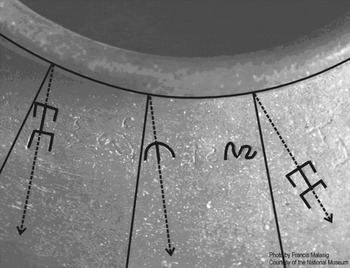
] is the beginning because it is parallel to the rim of the Pot's mouth, and the right [] assumes the end of the line. This is because there is no further space for the rest of the inscription and the inscriber had to extend the ‘line’ to a point in which it had to deviate from the normal course of writing. Significantly, it is usual in writing in any manner that when space has been exhausted and a few more words need to be written, one tends to write on any available space not necessarily along the same direction. And this is just what may have occurred in this particular inscription.Footnote 34(2) Careful examination of the photographs of the CPI (and, of course, of the pot itself) would show that the characters become increasingly shallow, more sloppily written and less defined towards the symbol
. This may either be due to writing fatigue or, more probably, due to the gradual hardening of the writing surface;(3) The verticals of the characters at the proposed beginning of the writing lean to the left, away from the writer, and pulls towards her or him which makes it more logical as a starting point than as an ending point (Figure 12);
(4) The Doctrina Christiana of 1593, a document written in Tagalog syllabary from left to right, has a diacritical mark which looks like a ‘c’ with its mouth open to the left. The diacritical mark of the CPI is written in reverse and looks almost exactly like a ‘c’. This may indicate a reversal in writing direction (Figure 10).
(5) The early Spanish chronicler Antonio de Morga observed in 1609 that among the Tagalogs, ‘The direction of writing before on bamboo and now on paper, starts from the right to the left, in the Arabic fashion’ (El orden de escribir era en cañas, y ya en papel, comenzando los reglones, de la mano derecha á la izquierda, á la usanza arábiga).Footnote 35 This observation, given de Morga's relatively accurate accounts on several other matters bearing on Philippine culture and history of that time, has probably not been given the serious consideration it deserves. The Frenchman Paul de Gironière (1855) even makes the same observation as de Morga regarding the direction of writing.Footnote 36 Taking into account the striking diversity of opinions and observations on the matter of writing direction of Philippine writing systems, it would be unwise to assume that a ‘standard’ direction had already prevailed in ancient times.Footnote 37
(6) It is assumed that the writing and reading directions are the same and do not go in opposite directions.
Leftward slant of verticals. Photo by Francis Malasig, courtesy of the National Museum

Finally, another major difference with Oropilla is that it is here proposed that the language of the CPI is neither Pangasinan nor Tagalog but, broadly speaking, Visayan. Why Visayan? This idea hinges around the assignment, = da. According to Francisco,
It may be da, and its nearest form may be found in the 1747 Bisaya (Esguerra) da – - which may have developed into various forms, i.e. Tagalog  (1593), Tagbanuwa and Samar-Leyte which follow the same principle of incision. The Tagbanuwa seems to the nearest relative of this symbol, although the Tagalog may be postulated to be a rather stylized form.Footnote 38
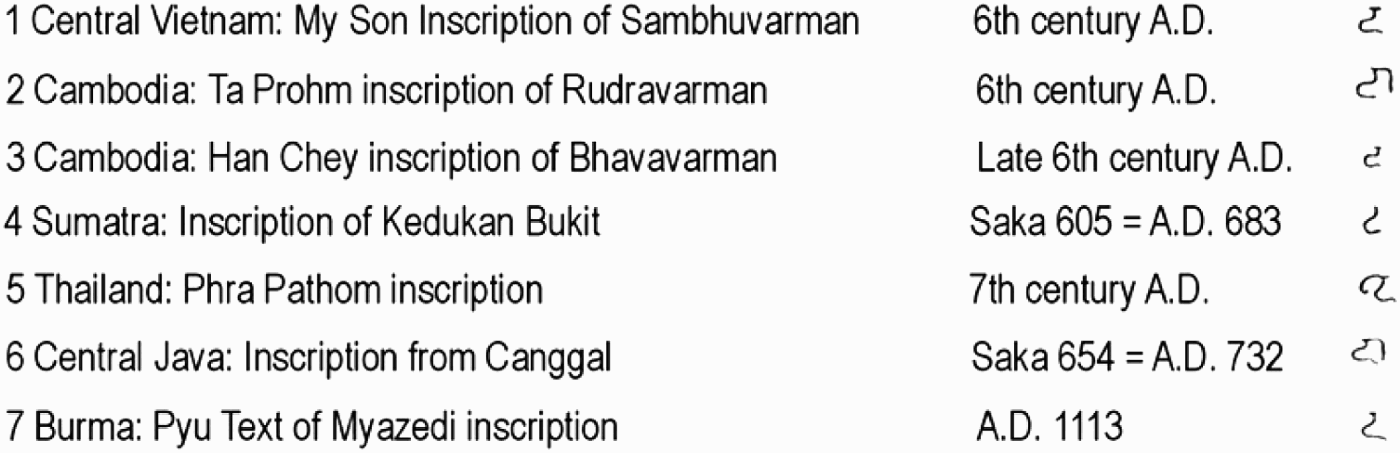
The symbol if it is indeed da can be considered a clue regarding the language of the CPI. For example, if one were to see a text written in Thai script, one would immediately conclude that it was most probably not written in Russian but in the Siamese language. A cursory analysis of the da symbol in the known Philippine scripts as seen in the comparative tables of Philippine syllabaries by FranciscoFootnote 39 (Table 4) and Pardo de Tavera (Figure 3) shows that only Visayan syllabaries possessed this form of da. Further inspection of the comparative tables of Indian scripts by Ahmad Hasan Dani also shows that this form of da traces its antecedents to as far back as the inscription of Ayodhya in the early first century CE and continued its diffusion to Southeast Asia in numerous examples which include the My Son inscription of Sambhuvarman in the sixth century CE and the important inscription of Kedukan Bukit, Sumatra 683 CE, while all throughout displaying remarkable formal stability (Figure 13).Footnote 40 Dani describes this da as the ‘round da with its mouth open to the right’.Footnote 41 The Calatagan symbol da can be seen as a variant with its mouth open to the left. (See also how the Calatagan palaeographs ma, wa, ha and ta are all inverted, mirror-imaged or rotated forms of the Tagalog syllabary with reference to Chirino (1604) and the Doctrina Christiana (1593) (Table 4).) The notion that the Visayans developed their writing system by belatedly copying the Tagalog system seems to be questionable.Footnote 42 However, Francisco's notion that the Visayan da from Esguerra developed through an autochthonous process towards the Tagalog stylised variant does not seem to hold water, since this latter form is that which already appears in the LCI as da in the tenth-century Kawi script. Karel Frederik Holle's tables shows that the Visayan da in this particular form may have antecedents in the retroflex ‘d’ of the devanāgarī script or be a variant of the palaeograph for ‘r’ in some variants of the Kawi script from the same period as the LCI.Footnote 43 Despite the fact that further analysis of various early transcriptions of Visayan scripts as collected by Cantius J. Kobak shows that Pardo de Tavera's transcription may have been inaccurate in several respects, these fine details cannot be entered into here.Footnote 44
Symbols for d/da in various Southeast Asian inscriptions (after Dani, 1963)

Based on the presumed provenance of da, one could test if the hypothesis that the language of the CPI is Visayan is indeed a plausible one. One should take note that ‘Visayan’, a language family with more than 30 members today, is taken here in its broadest sense.
Substitution of symbols
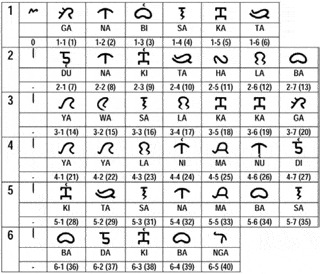
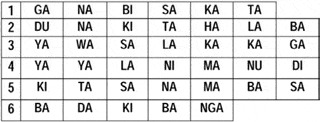
Table 7 shows the 40 symbols and 14 unique characters comprising the inscription read in a clockwise direction starting from and divided into six segments by highly legible vertical markers. The symbols with their assigned equivalents from Francisco, Potet, Oropilla and the authors are shown in Table 8. The Calatagan symbols have been removed in Table 9, leaving only their Roman alphabet equivalents.
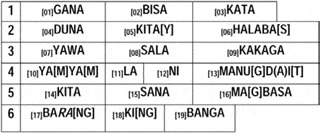
Hypothetical groupings of the syllables and addition of consonants (in brackets) are attempted in Table 10. This is one of the most sensitive and potentially intrusive stages of this process of decipherment. The reader should take note of the fact that in the case of line 6 at word-form [17], ra is considered the equivalent of da which holds for the majority of Philippine syllabaries including the Tagalog and Visayan. Word-form [13] also has a hypothetical added ‘a’ which may have been elided either in pronunciation or in writing.
Observe in Table 10 that there are only nine instances in lines 2, 4, 5 and 6 where stand-alone consonants have been added. Ten out of the 19 hypothetical words are completely made up of open syllables with no closing consonants added. It need not be stressed here that the less intervention into the text, the better.
Arrangement of symbols in six lines (read from right to left on the pot starting from )

The Calatagan symbols with corresponding equivalents

Transliteration of the symbols

Hypothetical groupings and addition of independent consonants

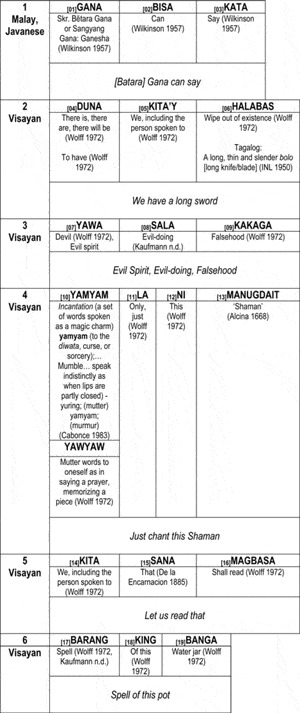
Hypothetical word-forms and their literal translations
Table 11 shows the dictionary meanings of the hypothetical word forms produced in Table 10 and the literal translations of the resulting lines. Most of the words are recorded in John Wolff's massive Dictionary of Cebuano Visayan (1972).Footnote 45 Here is the proposed Visayan reading (with interpretive revisions incorporated in the text) and its free-translation in English:
[01]Gana [02]Bisa [03]Kata
[04]Duna [05]kita'y [06]halabas
[07]Yawa, [08]sala, [09]kakaga
[10]Yamyama [11]la [12]ni (mga) [13]Manugdait:
[14]Kita [15]sana [16]magbasa
[17]Barang [18]king [19]banga
Gana Bisa Kata [Powerful is Gana's Word]
We have a sword
Evil, faults, falsehood
Just chant this, Shaman(s)
Let us read the signs
Spell/power of this pot!
Observe that [17] could refer better to voice-plus-letter ‘power’ than simply refer to a ‘spell’. Likewise, in the magico-religious context pointed here, [16] to ‘read’ could better be rendered as ‘to read signs’. Lines 4 and 5 seem to form a repeating couplet (‘reading’ and ‘chanting’) which is extremely common, for example, in the chants (linda) of the shaman of the Mandaya and also in Mangyan poetry carved on bamboo (ambahan).Footnote 46
Dictionary meanings and proposed line-by-line translation

An interesting theory was suggested by William Collins.Footnote 47 He proposed that the lines would make more sense if read in the opposite order with the last line being: [Batara] gana bisa kata. According to him, this line reminds him of the following ‘extremely common’ conclusion to the Sumatran jampi (‘spell’): ‘Ghot! Batara Guru Sakti!’ Collins notes that the first syllable Ghot! is a powerful or forced expulsion of breath which seems to push the spell outwards. Batara Guru Sakti alludes to Siva, the master of all magic power. Furthermore, he emphasised that these jampi are frequently concealed, at least to his knowledge, in Sumatra because of their imputed powerful magical properties which should not be accessible to just anyone. This intriguing possibility should be kept in mind even though this study shall keep to the original sequence.
Minimal tests for the proposed reading
Descriptively, two important characteristics of the proposed decipherment should be emphasised. First, while predominantly Visayan, it is actually of dual language. The six-segment text contains five Visayan lines and one Old Malay and Javanese (or Balinese?) line, a kind of mantra-like kernel (Gana bisa kata) of the text. This structure is easily comparable with many oracion verses that mix local language (Bisaya or Tagalog) with a ‘core’Footnote 48 foreign element (usually bastardised Latin). Bisa, which according to Hendrik Kern comes from Sanskrit visá ‘poison’ (vergif), primarily denotes ‘to be possible’, ‘can, be able to do something’ in Javanese and ‘poison’ in Malay.Footnote 49 In Tagalog, bisa can mean ‘power’ (virtud), ‘potency’ (potencia), ‘activity’ (actividad), ‘efficacy’ (eficacia) and also ‘snake venom’ (la ponzoña de la culebra).Footnote 50 Kern explains this complex dual meaning of bisa by means of an analogy with the Javanese term ampuh, which reveals approximately the same series of concepts from ‘power’ to ‘poison’. According to Kern, the fact that Tagalog bisa possesses roughly the same semantic field as the Javanese bisa logically points to the influence of the latter rather than Malay proper.Footnote 51 The word kata, which is likewise Sanskrit in origin, means ‘word’ or ‘says’/‘said’ in Malay. Kata in Malay is related to the Tagalog words makata (‘poet’) and katha (‘fiction’ or ‘story’). One could also look into the possibility that the kernel in this prehispanic case could be Balinese (which is culturally linked to Old Java). It is interesting to note that gana, bisa and kata are present in Balinese language, as respectively: ‘Dewa Ganesha’ (‘power’ and ‘word’). Also, the CPI symbol here interpreted as a ‘start-symbol’ functions similarly in the Balinese simbar writing system.Footnote 52
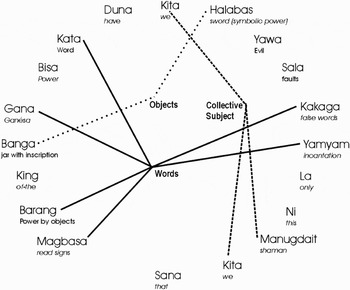
Secondly, it shows cross-referenced elements (an echoing of senses within the text) among the 19 words. The lexical coherence diagram (Figure 14) reveals a strong degree of internal textual coherence gravitating around the lexical domains of ‘words’, ‘objects’ and a ‘collective subject’. The repeating first person plural pronoun kita (inclusive-we) partly helps to establish the consistency of the text, especially since it repeats more frequently like all common function words. These observable internal structures of semantic coherence between lexical elements (aside from their sound grammatical formation) partly reduce but perhaps do not eliminate the chance that the experimental reading is merely a random construction.
Lexical coherence diagram

The contextual plausibility of the inscription-reading presented above appears to satisfy three demands or tests that we think are crucial for any proposed reading of the CPI (both the inscription and the pot-object itself): (1) lexical coherence and simplicity (the elements of the text hang together, as already illustrated above); (2) historical emplotment (the text can be inserted, unproblematically, into a known temporal series); and (3) sociological mapping or embeddedness (it can be inserted, unproblematically, into a known structure of social network). Given these, it seems to us that the present package of decipherment, reading and contextualisation has enough tightness to merit endorsement.
Looked at from the point of view of the anthropology of the text, the key conceptual elements of the text resonate well with the presumed spatio-temporal context of the CPI (historical emplotment). The following points should highlight how this second test is met by the text:
(1) Dewa Ganesha, Batara Gana, Sang Gana, Ganapati or Ganésa is a Hindu deity well known in Southeast Asia and the Malay world, most often represented as an elephant-headed god. The allusion to Gana/Dewa Ganesha in the text's mantra kernel fits with the historical popularity of Gana/Dewa Ganesha throughout Indonesia in the eighth–fifteenth century CE, which, needless to say, also fits with the presumed date of the CPI (eleventh–fifteenth century CE). The Balinese archaeologist I. Wayan Redig, in a comparative study of Ganésa images from India and Indonesia, observed that, ‘The deity is popular not only in India, but in Indonesia also. The discovery of numerous images of Ganésa indicates that his cult was very strong in Indonesia during the classical and post-classical period (i.e. eight–fifteenth century CE).’Footnote 53 According to Robert Brown, the first Ganésa image in Indonesia has been dated back to the eighth century and that:
Ganesa was extremely popular in Indonesia, and he took a number of innovative forms. He adopted a demonic form as Tantric practices became important. His function as a threshold guardian or obstacle remover however, appears to have remained his primary role …. It is, in fact, this role that best explains Ganésa's ready adaptability throughout Southeast Asia. Ganésa is the god whose aid is enlisted before any task is undertaken, including the worship of other deities.Footnote 54
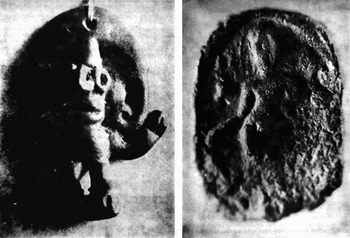
T. Rengarajan also observed that ‘he is invoked at the commencement of books. He is said to have written down the Mahābhārata from the dictation of Vyāsa’.Footnote 55 Furthermore, Ganésa's name is ‘found inscribed at the beginning of all literary works by the devout’.Footnote 56 It is therefore significant that he is mentioned in the only known sample of ancient writing using a Philippine script. It should also be pointed out that a copper Ganésa medallion dating to the twelfth century was found in the Visayas, more specifically in Mactan, Cebu, in 1843, while a clay image of the boddhisatva Avalokitesvara-Padmapani was found in Calatagan itself in 1961 (Figure 15). Felipe L. Jocano writes that the archaeologists date the Calatagan finds to the fourteenth century and that these may be, together with the Ganésa medallion, local copies of images of Hindu-Indonesian and Buddho-Siamese origin.Footnote 57
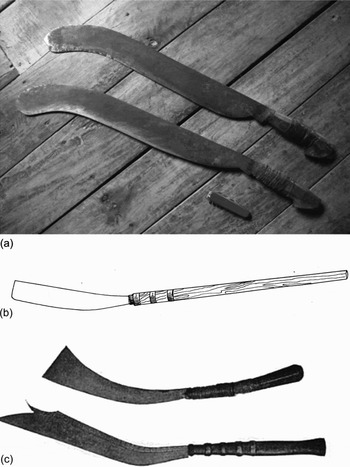
(2) Halabas (hagbas in contemporary Visayan) is related to the cutting (or the tool used) of weeds and brambles in the process of clearing a field or opening a path in the wilds (Figure 16). According to Wolff's Cebuano dictionary,Footnote 58 it means to ‘cut down s.t. tall with a long swing of a blade’ or ‘wipe [something] out of existence’. (See his sample sentences: Habasun ko ning mga sagbut, I'll cut down these weeds; Habásun sa Diyus ang tanang dautan sa kalibútan, God will wipe out all evil on earth.) Halabas as a weapon or tool denoting a ‘long blade’ or as a type of ‘scythe’ is more well known in the Tagalog-speaking areas, such as present-day Batangas or Quezon province, which make up the surrounding area of Calatagan.Footnote 59Halabas blends well with the association of Gana with a weapon (‘battle axe’), as a ‘remover of obstacles’, among practitioners of ‘witchcraft’. Dewa Ganesha has also been represented as a ‘remover of obstacles and destroyer of the enemies of gods’. In addition, Honey Achanzar, writing on the ritual function of swords, observes that, ‘The Itnegs of Patoc, Abra, tell the story of Silag and Sayen. The legend tells of two brothers of great physical stature, and how one of them drove away evil elements using a mystical sword . … The Itneg sword and the Indonesian kris were weapons used against malefactors and malignant spirits as well as in war.’Footnote 60 Isabelo De los Reyes also recorded the use of blades to ward off malignant spirits in his book on El Folklore Filipino.Footnote 61 The halabas, hagbas as a tool/act for (metaphorically) clearing wild spaces suggests the contending dichotomy between cleared and wild spaces of the banwa/world. The following is again a quote from the study of Redig:
How the god is treated as the remover of obstacles, tradition surviving in Bali may explain, for the name of the god still appears in the ceremony called rsigana which is performed whenever a disaster like floods, mountain eruption, earthquake etc. occurs in the region …. The white flag with Ganesa motif is also used in the ceremony called nangluk-merana, which is regularly performed twice a year, for killing plant diseases. […] Another tradition coming from Bali is that in few cases, the god is worshipped by those whose profession is witchcraft.Footnote 62
Miguel Covarrubias, for example, mentioned Gana as ‘the elephant-headed god, once worshipped in Bali, but now remaining only as a protective magic amulet’.Footnote 63
(3) Dait or daitan as alternative pre-hispanic Visayan terms for baylan (‘shaman’) and diwatahan (‘people who followed, or were guided by, the diwata’) is described in Francisco Alcina's Historia de las islas e indios de Bisayas (1668):
Now, therefore, as far as their priests or petty sacrificers, who were of two different classes and who in ancient times had two names, I have discovered with very little doubt that they were commonly women and not men. If there was some man who might have been one [i.e. priest], he was called asug, as they put it ….
To these women they called in their language daitan or baylan; they were known thus by both names. They called them daitan because the word dait means ‘friendship and peace’; they gave them this name because some persons close to God had to be his friends and enjoy his friendship in order to mediate between god and people.Footnote 64
The reading of the symbol sequence
ma-nu-di as ma-nu(g)-d(a)i-(t), which transforms the vowel ‘i’ in the syllable di into the dipthong (a)i/ay, calls for some explanation. According to the linguist Ricardo Nolasco,Footnote 65 the transformation of the dipthong ‘ay’ or ‘ai’ into ‘e’ or ‘i’ is a phonologically attested phenomenon. For instance, what is pronounced in the southern Tagalog region as ‘ay’ is pronounced in Manila as ‘e’. Aywan (‘I don't know’) becomes ewan and baiki (‘mumps’) becomes beke. Jaime Tiongson also brings up the following numerous examples: taynga (‘ear’) becomes tenga, baywang (‘waist’) becomes bewang, kailan (‘when’) becomes kelan, kaysa (‘rather’) becomes kesa, mayroon (‘there is’) becomes meron and so on.Footnote 66 Furthermore, according to Rizal's work on Tagalog versification (1887), ‘e and o only appear in dialects, more precisely as shortened forms of the dipthongs ai and au’.Footnote 67 Written examples in baybayin of this spelling variation can be found in some old documents from the University of Santo Tomas Archives, particularly in the bound volume entitled Archibo de Colegio de Santissima Rosario, Escritura de Guertas y Tierras de Gagalangin, Cavayanan, Quinamata, Isla de de Malabon, Bacouor, Botabotavos, Tierras de Somagdal, pertenientes del Colegio, Tomo 17 Caxon 26 which contains two long deeds of sale in Tagalog baybayin.Footnote 68 The first example from a document dated 1613 contains the baybayin text: , which can be transliterated as ipina(g)bili ko ka(y) Do(n) A(n)dali(s) Kapii(t) ‘I sold [it] to Don Andalis Kapiit’. The word ka(y) (‘to’) is here written simply as k ka. A second document dated 1625 contains the baybayin text: , which can be transliterated as ako nagbili na(ng) lupa ki Do(n)ya Para(n)si(s)ka (‘I have sold land to Doña Francisca’). Differently from the first document, which writes the word ka(y) (‘to’) simply as , it is consistently written in the second document as ki or ke. In the same document ma(y) (‘there is’) is also spelled as mi or me. This may explain why dai/day could have been written simply as di on the CPI.(4) Kita and the communal rituals presided by the daitan. This is again documented by Alcina in the seventeenth-century Visayas, ‘The most important paganitu and the most popular that I have found practiced by these Bisayans in antiquity is one which they called pagtigman, which means “the gathering of many”.’Footnote 69 It is also interesting to note here that Alicia Magos' study of the ma-aram/babaylanes tradition of the Visayas areas (centring on Antique) cited the records of the Augustinian friars assigned to Panay mentioning the bangos-banwa community in reference to the ancient religion of Panay. The high degree of institutionalisation of the daitan practices is highlighted by that term and given ethnographic description in Magos' bangot-banwa healers.Footnote 70
(5) Magbasa, yamyam and the prehistoric roots of this oracion/libreto series: The use of secret, written formularies (oracion, libreto as part of ‘alphabet mysticism’Footnote 71) that are passed on to succeeding generations of ‘healers’ are also well documented in various ethnographies as part of an enduring tradition. One New Israel (Makilala, North CotabatoFootnote 72) Moncadista priest-healer (a Waray), for example, mentions the practice of sabak (‘mentoring a prospective healer’) and the yearly collective sacrifice-celebration attended by his network of healers. This priest, although from Samar, is associated with healers residing in Bohol and has married a Bol-anon and resided in a Bohol village for some time. He makes a regular yearly visit to Bohol where collective offerings are made to the abyan (‘unseen friend’). The proposed reading of the CPI (mentioning a collective subject of daitan), an inscription in what might be taken as a ritual pot (perhaps a regular offering vessel), would make sense as a central vessel in the context of yearly communal rituals and the magico-religious practice of ‘alphabet mysticism’.
 ma-nu-di as ma-nu(g)-d(a)i-(t), which transforms the vowel ‘i’ in the syllable di into the dipthong (a)i/ay, calls for some explanation. According to the linguist Ricardo Nolasco,
 , which can be transliterated as ipina(g)bili ko ka(y) Do(n) A(n)dali(s) Kapii(t) ‘I sold [it] to Don Andalis Kapiit’. The word ka(y) (‘to’) is here written simply as k ka. A second document dated 1625 contains the baybayin text:
 , which can be transliterated as ako nagbili na(ng) lupa ki Do(n)ya Para(n)si(s)ka (‘I have sold land to Doña Francisca’). Differently from the first document, which writes the word ka(y) (‘to’) simply as
 ki or ke. In the same document ma(y) (‘there is’) is also spelled as
 mi or me. This may explain why dai/day could have been written simply as di on the CPI.
Twelfth century Batara Gana (Ganésa) Medallion found 1843 in Mactan, Cebu (left), twelfth–thirteenth century image of Avalokitesvara-Padmapani found 1961 in Calatagan, Batangas (right) (Jocano, 1975)

(a) Lagaraw blade for hagbas; (b) halabas (Diaz, 1961); (c) panabas, a weapon from the Southern Philippines (Stone, 1999)

We arrive now at the third part of what we set out as tests for the reading given here. We have already stated above the necessity of providing a supplementary scenario (a kind of ‘thin narrative’) to frame the CPI within a plausible ‘story’. Now the question is the frequency in the kind of object such as the CPI, namely, a pot with an inscription. Upon checking the report on the number of archaeologically dug potteries and shards within Calatagan area alone,Footnote 73 our spontaneous reaction was: ‘Isn't it strange that of the hundreds of pots uncovered, not one bears an inscription? If the CPI is not a fake, how do we account for its rarity in a socio-historical sense?’
Any contextualising narrative must factor in this hard datum: that the CPI, otherwise a quite common type of pot usually associated with burials, archaeologically ‘sticks out’ from the rest of pot-shard finds because it carries baybayin symbols. The problem now is the inscription on the-pot as such, regardless of its undecipherability. Bypassing the possibility of the pot being a fake (with its sui generis nature), we think that its rarity should itself be accounted for. Needless to say, the proposed reading should fit well into this explanation.
The non-mapping of the CPI pot-object in the archaeological pot-burial records (the overwhelming majority of which do not have inscriptions) has two alternative implications: (a) we have to dig more; (b) we already have a probabilistic basis to say that the CPI-pot object was not originally intended to be in the context of burial. Because we tend to favour this last argument, the next thing to ask is: what is the CPI-pot object's original function? As already given above, the CPI makes sense in the context of communal rituals. The parsimonious nature of this interpretation should immediately be apparent when one sees that this interpretation itself also explains the CPI's rarity. It is archaeologically rare because objects such as this, possibly originally owned by a primus daitan/bailana, are not usually duplicated, but merely passed on to generations that practised the communal ritual-offerings. Although a systematic study of this practice is yet to be conducted, the initial information is that ‘alpha-object’ amulets in the Philippine ethnographic context are usually passed on to others when the owner dies, unlike ordinary amulets. In some rare instances, alpha-objects do accompany the dead and are thus interred, but only in cases where no living hands are worthy of inheriting it. If this is the correct analogical context, the CPI is then a rare alpha-object of a primus daitan. But what if the account of Feliciano Bugtong, the farmer who allegedly found the pot, is true?Footnote 74 His account mentioned that it was found on the shoulder-level, right side of a skeleton that was facing east. The position of the skeleton is notable. If true, and combined with a healthy dose of imagination, the following account of Alcina would boost further our interpretation. It points to the probable fate of an old diasporic (from Visayas to Luzon) Visayan bailana ‘a woman prime priest’, who died far from her homeplace and without having a worthy hand to receive the alpha-object that is the CPI:
The burial of the daitan or the baylana was different. When burying one of these or the asog, who held the same office, if she were a katuuran (we have already said that it means ‘a prophetess of gloom’ and who was one who had intimate relationships with the diwata, and therefore, esteemed and held in high honor) they built such ones a tomb near the sea, facing the rising sun ….Footnote 75
Some conclusions
The preliminary reading put forth here, which preliminarily satisfies the three parameters, namely, (1) lexical coherence and simplicity; (2) historical emplotment; and (3) sociological mapping, does not mean that the problem of deciphering the CPI has been definitely solved for all time. Such a reading only means that a provisional degree of plausibility has been attained given the current extremely limited knowledge about the object in question. Despite its admittedly tentative nature, we believe that it has achieved a certain degree of plausibility with reference to the proposed criteria.
Other current and future readings of the CPI can and should be measured or tested against similar criteria. However, our experience with this proposed solution to the decipherment of the CPI shows that each possible solution brings together general principles of inquiry and very specific paths of investigation arising from a very close and concrete acquaintance with the object of study. Each attempted solution is therefore a narrative in itself which may internally generate new criteria for determining plausibility. Both the solution and the measures of its plausibility should be considered as factors inextricably evolving together. Given the complexities involved in reconstructing meaning from any baybayin inscription, the intervention of subjectivity at all stages of decipherment is inescapable. Subjectivity is, however, not a problem in itself. What the researcher should strive for as much as possible is to try to make each decision taken, at all of the stages involved, perceptible to other researchers so that these can be subjected to rigorous and scientific critique.
The discovery of other similar pots with inscriptions or other corroborating archaeological, ethnographic and historical data would also serve to strengthen conjectures about the authenticity of the object itself. One pot with alphabetic inscriptions (unfortunately, not baybayin) around its shoulder has recently been found by a National Museum team in situ at the San Ignacio church archaeological site in Intramuros, Manila. Further information regarding the content of the inscription, dating and associated materials is not yet available at the present time.Footnote 76
It should, however, be emphasised that a plausible interpretation of the CPI does not in itself solve the problem of its authenticity. Such a plausible interpretation may in fact harm scientific inquiry by reducing the required vigilance regarding the object itself. Resolving the issue of authenticity becomes thus more urgent.
If the current reading is found to be generally correct, that is to say, able to withstand sustained scientific criticism and prove more acceptable than other competing readings for an appreciable amount of time, and if the authenticity of the CPI is borne out by further researches, this would mean, first of all, that the first written inscription known today in a Philippine language and script is in a Visayan language and that it is apparently a magical incantation. It could also serve as a basis for the following research directions: (1) to deepen current knowledge regarding the characteristics and history of Philippine writing systems; (2) to lend additional ethnographic and historical insights into an extremely little known aspect of Philippine ritual and social practices in ancient times; (3) to help situate the Philippine writing systems and the above-mentioned ritual practices and beliefs within the broader Southeast Asian context.
As a further defence of the current approach to interpreting the CPI, it should be said that there are hard features in the CPI datum that impose strong limits even on the possibility of imagining a non-equivocal resolution to the whole package of CPI-decipherment (transcription, transliteration, translation): (1) abstraction of the object from its (claimed) archaeological burial context; (2) chemical contamination; and (3) surface scratches on some inscription-mark areas. These conditions cut from the very beginning the standard avenues for establishing authenticity, easy (non-interpretive) generation of transcription, and direct-context determination of meaning.
A kind of methodological dead end, therefore, emerges if an investigator confines oneself with resolving first, in a strictly inductive manner, this problem of authenticity and transcription before moving on to proposing possible translations or readings. It is precisely out of the apparent deadlock in the previous decipherment attempts over half a century that we undertook the present study: taking a deductive approach and maximising not only palaeographic but also cryptographic and ethno-historical analogies. The logic invoked here is similar to ways in which noisy input and hardware failure are handled in some cognitive-system models (the so-called ‘graceful degradation’ in neural network models): in the absence of a perfect datum, auto-associators that give us a preponderance of mutually consistent pieces of information could sometimes override an ambivalent piece in order to guess correctly the original (but non-accessible) state.
It is in this perspective that we claim importance for the empirical bits and the contextualising narrative given here: in view of the hard limits of the CPI, they should be taken as part of the necessary methodological steps in resolving the ambivalences inherent in the datum. Given the CPI's ‘input noise’, the tight association of a translation (or more accurately, the degree of such asymptotic ‘tightness’) to other empirical pieces of socio-historical information is as much part of the criteria for discriminating competing readings as that coming traditionally from palaeography. Needless to say, the last word in the CPI's decipherment would always be in the form of probability instead of non-equivocal certainty.