Introduction
Advance directives (ADs) are documents expressing an individual's wishes about future medical care, to ensure that these wishes are met in the event that they become unable to articulate these desires or unable to make important decisions for themselves (Dadalto, Reference Dadalto2020). ADs related to the end-of-life can be understood as documents where people can specify their choices regarding the future healthcare treatment and options they would like to receive in the event that they become unable to communicate their choices (Luck et al., Reference Luck, Eggenberger and Newman2017). This document, therefore, helps to protect people's autonomy (Peicius et al., Reference Peicius, Blazeviciene and Kaminskas2017). According to the literature, ADs are seen as a means to promote spiritual peace for their authors (generally people who suffer from serious, life-threatening health problems); it is also a document that allows caretakers to honor the desire of patients, and stimulates communication among the patients, their families, and the healthcare team (Thompson et al., Reference Thompson, Barbour and Schwartz2003). This can also be useful to achieve better communication and satisfaction regarding the end of the life decision-making process (Pautex et al., Reference Pautex, Herrmann and Zulian2008).
The legal status of ADs began in the USA in 1990. Currently, countries like Germany, Spain, Italy, and Portugal already have specific legislation on the subject, with abundant consideration toward end-of-life care (United States of America, 1990; Spain, 2002; Germany, 2009; Portugal, 2012; Italy, 2018). Despite the importance of this document, the prevalence of ADs among the general population is low. Currently, this prevalence varies from 0.5% to 30% in the world (Yadav et al., Reference Yadav, Gabler and Cooney2017; Portugal, 2019). In Brazil, there is no specific law on ADs; there is only Resolution number 1995 of the Federal Council of Medicine published in 2012, which regulates the living will from the perspective of the physician–patient relationship (Brazil, 2012). In Brazil, as far as we know, there are no studies on population uptake of ADs, how ADs are made available and implemented, role of surrogate decision-makers, and dissemination of this document. According to healthcare providers’ perceptions of ADs in Brazil, substantial issues are identified ranging from disregard of its use to the conclusion that the physician and family members still retain decision-making power over the fate of the terminal patient (Cassol et al., Reference Cassol, Quintana and Velho2015). Fears linked to legal implications appear as a determinant factor and limiting the practice of ADs by nurses, physicians, and family caregivers in the hospital. As there is still no specific legislation or support for ADs is up to the Federal Council of Medicine Resolution, which still raises doubts about its applicability (Cogo et al., Reference Cogo, Lunardi and Quintana2016). According to studies conducted in Brazil, fear of legal implications, as the concerns about possible legal questions regarding nonintervention conducts, is what most interferes with medical actions related to end-of-life issues (Forte et al., Reference Forte, Vincent and Velasco2012; Bussinguer and Barcellos, Reference Bussinguer and Barcellos2013). Apparently, physicians seem more afraid to invest little than to do too much for patients (Cogo et al., Reference Cogo, Lunardi and Quintana2016).
Healthcare professionals working in palliative care (PC) have the opportunity to witness how ADs help assure that patients’ wishes are carried out (Luck et al., Reference Luck, Eggenberger and Newman2017). These professionals also witness the damaging consequences suffered by patients, their families, and the healthcare team when those patients do not register their end-of-life wishes, especially those regarding medical treatments (Luck et al., Reference Luck, Eggenberger and Newman2017).
It is accepted that the education of healthcare professionals working in PC is vital in order to achieve higher quality support, including the development of competencies such as the assessment and discussion of strategies and challenges related to the definition of the medical care objectives, aligned with the prognosis, treatment options, and patients’ wishes (Paal et al., Reference Paal, Brandstötter and Lorenzl2019). However, it is currently unclear whether or not such professional characteristics influence the prevalence of ADs among the healthcare professionals who work in PC. This is an important question to answer as professionals who have their own ADs may feel more comfortable discussing end-of-life matters with their patients (Lazenby et al., Reference Lazenby, Ercolano and Schulman-Green2012). To our knowledge, there are no data that can currently answer this question.
Therefore, the aim of this study was to investigate the association between professional characteristics (profession, post-graduate qualifications, and length of time working within PC) and the prevalence of ADs among PC professionals.
Methods
Study design
This is a descriptive, cross-sectional survey, which has been reported according to STrengthening the Reporting of OBservational studies in Epidemiology (STROBE) (von Elm et al., Reference von Elm, Altman and Egger2008). The data presented here are part of a study on the assessment of the educational needs of end-of-life health professionals.
Sampling and recruitment
A convenience sample was composed of healthcare professionals working within PC. These professionals came from different regions of Brazil and were currently working for private or public health institutions.
The recruitment phase started by announcing the study in groups of PC healthcare professionals in social networks: WhatsApp, Facebook, and Telegram. These groups were selected based on their administrators, who are health professionals recognized nationally for their performance in PC. After authorization from the administrators of these groups, the members were contacted through private messages, inviting them to participate in this study. Then, the link to the online questionnaire was sent.
Eligibility criteria
The inclusion criteria were (1) to be currently working within PC (at primary, secondary, or tertiary levels of health care), during the data collection period and (2) to have graduated from one of the professional qualification courses eligible for this study (Nursing, Pharmacy, Physiotherapy, Phonoaudiology, Medicine, Nutrition, Dentistry, Psychology, Social Service, and Occupational Therapy) (Haugen et al., Reference Haugen, Nauck, Caraceni, Cherny, Fallon and Kaasa2015; Wiseman, Reference Wiseman2017). Participants who did not respond to all items on the online survey were excluded from the study.
Questionnaire and data collection
The LimeSurvey platform was used to develop this online survey. For the data collection, which took place from January to May of 2018, a questionnaire was developed by the authors themselves based on a previous study that explored the prevalence and factors influencing AD completion rates in a survey of hospice healthcare providers (Luck et al., Reference Luck, Eggenberger and Newman2017). The questions were multiple choice, and the questionnaire took approximately 10 min to be completed. The survey included demographic questions assessing the age, gender, post-graduate (specialization, Master in Business Administration – MBA, master or doctorate degree), profession of the participant, as well as questions assessing the length of time working within PC, specific post-graduate course in PC, and the writing of the participants’ own ADs. In Brazil, post-graduate courses for concerning clinical practice on PC are carried out mainly through lato sensu courses: specialization with a minimum workload of 360 h or specific medical/multi professional residency programs in PC. Post-graduate courses stricto sensu are research focused aiming a master or doctorate degrees.
Statistical analyses
Descriptive analyses were used to describe the variables. Based on the verification of data normality and homoscedasticity, the Kruskal–Wallis test was used to compare the groups according to age, level of education, and work experience.
The chi-square test was used for the qualitative variables (gender, post-graduate qualification in PC, and profession). The “profession” variable was grouped in the following categories: Nursing, Medicine, Psychology, and other professions (Social Service, Phonoaudiology, Dentistry, Physiotherapy, Pharmacy, Occupational Therapy, and Nutrition). The grouping of these health care professions was performed due to the reduced number of the “other professions” since they could compromise the analyses.
At last, Logistic Regression was used to investigate the association between having an AD, and the other factors, all of which were selected following the stepwise procedure, with the aim of enabling the Odds Ratio adjusted prediction. All the tests were carried out using a 5% significance level and were analyzed using the IBM SPSS Statistics v.20 software.
Ethical considerations
This study was approved by the Committee of Ethics in Research of the Botucatu Medical School – UNESP (CAAE 79408117.0.0000.5411; report number: 2.421.530), December 2017. Consent to participate in this study was obtained online from all participants.
Results
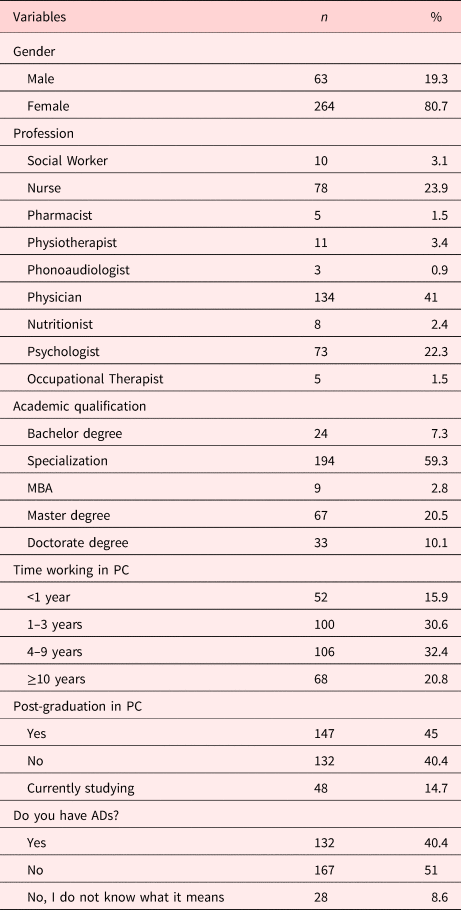
429 participants were recruited initially. The final sample was composed of 327 professionals with an average of 38.38 years of age [±8.06; (24–69)]. Among the participants in this study, 59.6% stated that they had not written their ADs. All the other data related to the characterization of the participants are presented in Table 1.
Sample characteristics

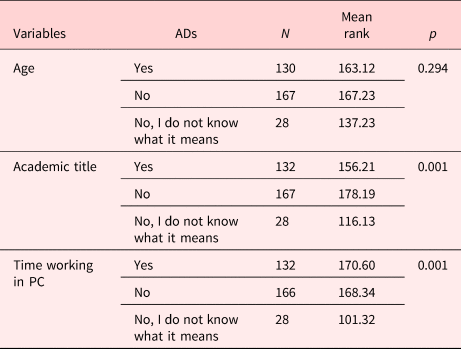
According to the Kruskal–Wallis test results, the age variable had no relation to whether participants had their own ADs, unlike the variables “academic qualification” and “time working in PC” (Table 2). Individuals with higher levels of academic qualification, that is, with more years of study were more likely to have their own ADs, as were those who reported a longer time working in this area. Furthermore, individuals with fewer years of study were more likely to not know what ADs are (Table 2).
Results of the Kruskal–Wallis test for the comparison of ADs according to age, scholarship, and work experience

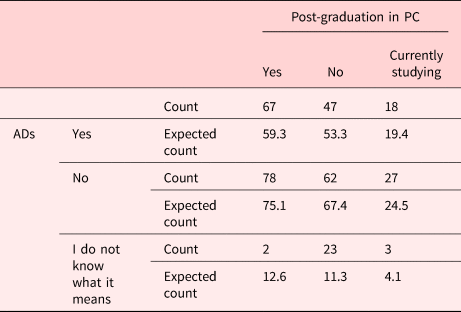
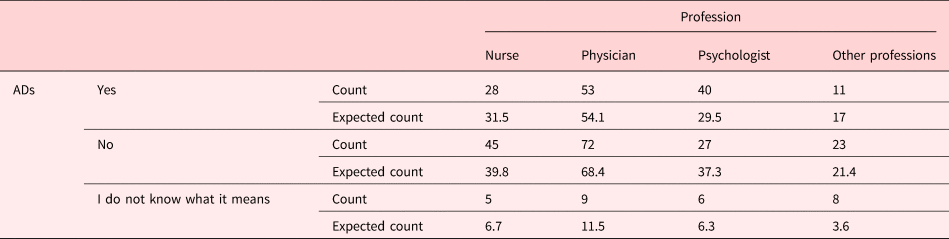
The possession of an AD was not found to be related to gender (p = 0.182), but it was related to having a post-graduate qualification in PC (p < 0.001) (Table 3). A relationship was also found between having an AD, and the type of healthcare profession the participant reported (p = 0.012) (Table 4). Those without a post-graduate qualification in PC had an answer rate that was higher than expected for the item “I do not know what it means” in relation to ADs (Table 3).
Results of the chi-square test for the comparison of ADs according to the post-graduation in PC

Results of the chi-square test for the comparison of ADs according to the profession

Psychologists were the only professionals who stood out in the item “Have their own ADs” (Table 4). According to the Logistic Regression result, out of all the variables studied, only the profession variable was significantly associated with participants having their own AD, whereby psychologists were more likely to possess this document [OR = 2.254; CI 95% (1.295; 3.925)].
Discussion
In this study, only 40.4% of the participants have own ADs. A previous study that explored the healthcare professionals’ understanding of ADs pointed out that even though they agreed that this document helps the decision-making process for the end-of-life scenario, the professionals displayed a low level of knowledge of the subject (Peicius et al., Reference Peicius, Blazeviciene and Kaminskas2017). However, the perception that ADs are useful tools for planning in advance for the loss of decision-making capacity, does not necessarily result in the creation of an ADs (Fagerlin and Schneider, Reference Fagerlin and Schneider2004). It is also possible that healthcare professionals are not familiar with the topic and have scarce knowledge on the legal dimension of this topic (Duke and Thompson, Reference Duke and Thompson2007; Peicius et al., Reference Peicius, Blazeviciene and Kaminskas2017; Gimeno et al., Reference Gimeno, Escribano and Fernández2018); in fact, a small proportion of the participants (8.6%) did not know what ADs are. Despite more than 50 years of existence of ADs, discussions in Brazil on the subject are still recent (Nunes and Trovo, Reference Nunes and Trovo2018), which may explain the low rate of this document among health professionals. Only from 2012, with Resolution number 1995 of the Federal Council of Medicine on ADs, this topic started to be more discussed among Brazilian health professionals (Nunes and Trovo, Reference Nunes and Trovo2018). Thus, the adoption of strategies to expand the dissemination of ADs can be important for the propagation of the topic among health professionals and society in general. It is also worth mentioning that health professionals in Brazil are afraid of the legality of ADs since there is no jurisprudential legislation on the subject (Bussinguer and Barcellos, Reference Bussinguer and Barcellos2013). The recommendations contemplated in Resolution number 1995 on ADs seem generalizable, without highlighting operational particularities of conduct, as occurs in the laws of some other countries (Cogo and Lunardi, Reference Cogo and Lunardi2018).
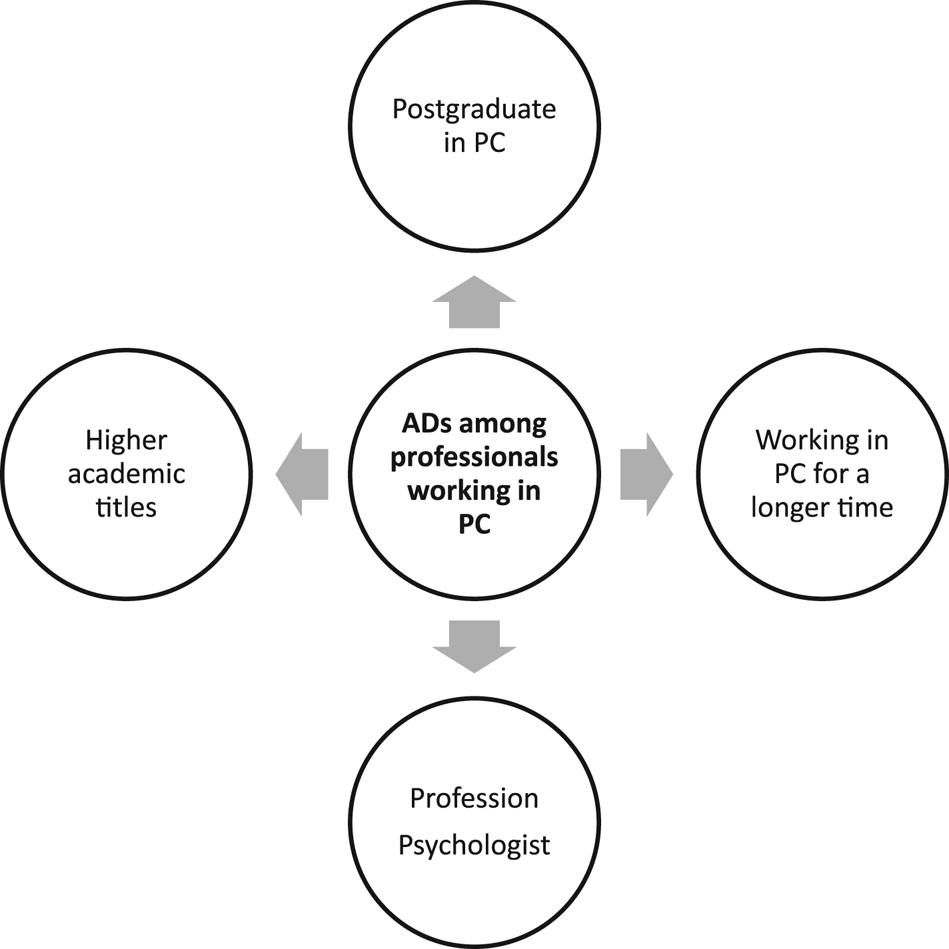
The results suggest that the prevalence of ADs among professionals working in PC is associated with factors such as higher academic qualifications, having post-graduate qualifications in PC, and working in PC for a longer time. Furthermore, psychologists appear to be more likely to have registered their own ADs, compared with other healthcare professionals (Figure 1).
Factors associated with the prevalence of Advance Directives among palliative care professionals.

According to our results, a deeper theoretical (possessing post-graduate qualification in PC and higher academic titles) and practical knowledge (having worked for a longer time in the area) are each related to a higher prevalence of ADs among PC professionals. A similar result was previously found among health professionals who worked with cancer patients, whereby more years of professional experience with this population were associated with the staff having their own ADs (Go et al., Reference Go, Hammes and Lee2007). According to the scientific literature, hospice healthcare providers who reported being “very knowledgeable” about ADs were 3.9 times more likely to have an advance directive (Luck et al., Reference Luck, Eggenberger and Newman2017). However, it is worth mentioning that, in studies carried out with the general population, other factors were associated with the presence of ADs: ethnicity, health care utilization, age, religious affiliation, number of children, marital status, number of comorbidities, admission with a chronic disease, having made end-of-life decisions for someone else, and who asked the patient about ADs (Van Scoy et al., Reference Van Scoy, Howrylak and Nguyen2014; White et al., Reference White, Tilse and Wilson2014; Luck et al., Reference Luck, Eggenberger and Newman2017).
The current study found that psychologists were more likely to have registered their own ADs. We believe that a potential for this fact is related to the competencies of these professionals in the PC care plan. The psychologists, who are PC specialists, are expected to be self-aware of their own existential questions, and the impact of such questions on counter-transference and self-care (Ryan et al., Reference Ryan, Connolly and Charnley2014). Self-awareness on own reactions toward patients and their relatives is a foundational competency for all professionals in PC (Simon et al., Reference Simon, Ramsenthaler and Bausewein2009), considering that dying and death is a universal experience that evokes complex feelings in patients, families, and professionals (Kasl-Godley et al., Reference Kasl-Godley, King and Quill2014). Self-reflection and self-awareness have been described as extremely important competencies for PC psychologists (Jünger and Payne, Reference Jünger and Payne2011). These professionals must reflect on their own needs and feelings, their own concepts of life and death, becoming fully aware of the existential issues in their own lives, including personal preferences for advanced care planning (Jünger and Payne, Reference Jünger and Payne2011). We speculate that this self-awareness may influence professionals’ reflection upon their own mortality, leading psychologists to develop their own ADs. We believe that in order to deal with mortality, values, and what makes sense in the life of others, it is necessary to carry out this exercise with oneself.
Conclusions
This research aimed to investigate the association between professional characteristics, and the prevalence of ADs among PC professionals. Results suggest that professionals with a post-graduate qualification in PC, who have studied for a longer time (post-graduation in PC and higher academic titles) and who have more experience in this area, are more likely to have written down their own ADs. The prevalence of ADs was highest among psychologists. However, our study also suggests that being involved in or familiar with the context of palliative and end-of-life care does not guarantee that health professionals register their ADs.
This study was carried out using a cross-sectional design; therefore, it is not possible to establish causal evidence regarding the factors related to possession of ADs among healthcare professionals in PC. Further qualitative studies should be developed to get deeper knowledge on the perceptions and experiences of healthcare professionals who work within PC regarding the writing of their own ADs. Furthermore, the data for the current study were collected in Brazil, and the results should be considered on this cultural context. As so, studying this subject in other countries, where the context may be different from low- and medium-income countries, would improve the evidence on similarities and differences.
Finally, from the results of this study, we suggest that health professionals in the process of training in PC have the proper support and guidance to deal with issues related to their own finitude. From this, we believe that, possibly, they maybe are more able, and feel more comfortable and confident to assist patients and families in the planning of ADs.
Conflict of interest
There are no conflicts of interest.