

1 INTRODUCTION
The impact of English on French is of interest to linguists and non-linguists alike. The 1975 Bas-Lauriol Law and the 1994 Toubon Law regulate the use of foreign words in commercial advertisements and public announcements, with the latter further stipulating that French be used in the workplace and mandating French as the language of instruction.Footnote 1 It is widely thought that these measures aim to protect French against English (Piller, Reference Piller2003:174). The regularly updated Dictionnaire des termes officiels de la langue française (Délégation générale à la langue française 1994) lists new English lexical borrowings (Anglicisms), and only Anglicisms, and their recommended replacements.
General-audience works by linguists on this topic tend to be highly charged. The influential 1964 polemic Parlez-vous franglais? decries English-influenced language use by the French as a result of ‘l'impérialisme yanqui’ (Etiemble, Reference Etiemble1964:267). More recently, Hagège (Reference Hagège2006: 42, 75) calls the permeation of English words into French trendy and snobbish and claims that the integrity of a language is only maintained when borrowings do not exceed 15% of the lexicon. The choice of this percentage is not motivated.
It is not surprising that the influence of English on French is of such interest to the general public; the number of lexical borrowings from one language to another is a statistic that can gauge the interaction of two cultures. The rate of borrowing is often asymmetric; the language of a culturally and economically dominant group tends to be the predominant donor language from which the recipient language borrows (Coulmas, Reference Coulmas1992:268).
In going beyond a catalogue of lexical borrowings, we can discover more about the influence of one culture on another. For all of the claims about the reasons for and effects of Anglicisms in French, most research (Rey-Debove, Reference Rey-Debove1987; Pergnier, Reference Pergnier1989; Picone, Reference Picone1996; etc.) examines only Anglicisms and not lexical borrowings from other languages. Such approaches do not examine whether the reasons for borrowing from English are different from borrowing from other languages. Asking this question can help determine the role of Anglicisms in greater depth. In turn, having this information could help a future study describe the relationship between francophone and anglophone cultures more accurately.
The current study examines Anglicisms in the context of lexical borrowings in general in order to address the underlying patterns of Anglicisms in the Metropolitan French lexicon. Borrowings are both linguistic and cultural phenomena, so the claims of this paper do not extend beyond Metropolitan French. For example, the same kind of study on Québécois French could well give different results.
Are Anglicisms a subset of lexical borrowings – do they constitute essentially the same phenomenon as borrowings from other languages, despite their higher frequencies? Or do they represent a separate phenomenon in French? This paper tests the following hypothesis about the nature of Anglicisms in French:
Above and beyond their predicted higher frequencies, Anglicisms constitute a different phenomenon from borrowings from other languages.
Similar linguistic phenomena will show similar statistical patterns in empirical data. The scale of the pattern may be different, but the general trend will remain the same. Yet if the above hypothesis is the case, we should expect Anglicisms and non-English borrowings to have different distributions in a corpus.
The following section lays out in greater detail the definitions and classifications used in the study. In section 3 I report on all occurrences of new lexical borrowings in a corpus of 21,560 sentences from the French newspaper Le Monde from 1989 to 1992 (Abeillé et al., Reference Abeillé, Clément, Toussenel and Abeillé2003). To determine which low-frequency borrowings are productive, all occurrences of borrowed words found in the Le Monde corpus are cross-checked against the online archives of another full-coverage French newspaper, Le Figaro, from later dates (section 3.2). Additionally, the qualitative differences in lexical borrowings are investigated using criteria aimed at teasing out the range of denotata to which the lexical borrowings can refer. It is found that Anglicisms are different from non-English borrowings in these respects, and that the differences are not limited to differences in frequencies (section 4). Section 5 addresses the representativeness of the study as well as the concern that the language of the original wire feeds could affect the number of borrowings in the newspaper articles.
2 LEXICAL BORROWINGS: DEFINITIONS AND CLASSIFICATIONS
Lexical borrowings from English constitute approximately 1.7% of vocabulary types in French (Bogaards, Reference Bogaards2008:69,79).Footnote 2 In spoken French, Anglicisms not adapting to French morphophonological conventions make up 2.6% of French vocabulary types (Blanche-Benveniste and Sabio, Reference Blanche-Benveniste, Rouget and Sabio2002; cited in Hagège, Reference Hagège2006:41). Borrowings can be from numerous domains, as Picone (Reference Picone1996) notes.
This study is concerned with the patterns of lexical borrowings from various donor languages, languages from which lexical borrowings stem, into French, the recipient language in question. This use of the term borrowing is consistent with that of Thomason and Kaufman (Reference Thomason and Kaufman1988), who stipulate that a word is a borrowing only when native or quasi-native speakers of the recipient language adopt the lexical item from the donor language. This is opposed to interference as a result of L2 speakers’ influence on the recipient language.
This study further narrows down the definition of a lexical borrowing so as to target neologisms. As we shall see, a narrow definition of the phenomenon to be studied makes for easier identification in the corpus. Calques and graphically adapted words are not examined due to the difficulty of discovering these items in the data. A lexical borrowing is defined here as a lexical item (lemma) from a donor language satisfying the following criteria:
1. the (approximate) form and meaning are copied from donor to recipient language, without adaptation to French morphological and graphical conventions;
2. the borrowing is not yet found in a particular French dictionary.
The first criterion allows for the proper amount of imprecision with which to take into account speakers’ probable perceptions of lexical borrowings. For example, Thogmartin (Reference Thogmartin1988) notes that his respondents offer week-end and parking as examples of Anglicisms in French. Yet the form of week-end is not exactly the same in the donor language, since in English there is no hyphen. The meaning of parking is not exactly the same in French and English: French parking is equivalent to English parking lot. Since the goal of the current work is to capture speakers’ knowledge about their language's lexicon, it seems appropriate to disregard these minor differences in form-meaning transfers.
The second criterion justifies using a term other than loanword, for which typically only the first criterion applies. It also follows the initial requirements for neologisms of Baayen and Renouf (Reference Baayen and Renouf1996). While a dictionary is not a perfect representation of speakers’ lexical knowledge, verifying the presence of a word in a dictionary does represent a concrete way to measure integration of a word into a language. Many related studies (e.g. Cannon, Reference Cannon1988; Baayen and Renouf, Reference Baayen and Renouf1996; and Bogaards, Reference Bogaards2008) examine dictionary entries, and in so doing they also use dictionaries to measure the integration of new lexical items. The dictionary used in this study is the Trésor de la langue française informatisé, or TLFi (Dendien and Pierrel, Reference Dendien, Pierrel and 2003) available online at http://atilf.atilf.fr/tlf.htm, since it is one of the more exhaustive French dictionaries. Additionally, the format of this dictionary allows for automatic querying of lexical entries, whereas others, especially others from the original time period (1989–92) do not. The convenience this dictionary offers likely overrides any possible precision lost from not using a dictionary from the exact time period as the Le Monde corpus. Furthermore, the TLFi is somewhat conservative in adding new words. If anything, this is convenient for the purposes of this study: it offers the possibility of a larger dataset.
Under the first criterion, the written form of the lemma must have been adopted more or less ‘as is’. For example, dérégulation does not constitute an Anglicism according to this definition: the written form changed from English deregulation to dérégulation. Although the French form is approximately the same as the English, the French form follows French morphological and graphical conventions, and French speakers most likely do not know that this word is a calque from English. Transliterations into the Roman alphabet, where no apparent adaptation to French morphology occurs, also count as lexical borrowings under this definition. For example, Russian glasnost is obviously Romanized. Yet glasnost does not exist in a French dictionary, and it is a transliteration of a Russian term, as opposed to a translation (transparence) or a written Gallicization such as glasnoste. Under this definition, an anglicism is simply a lexical borrowing from English. Lexical items are not limited to words and include idiomatic and multi-word expressions such as last but not least and Latin res nullius ‘unowned property’.
Proper nouns such as names of places or entities, titles of address, movie and book titles, and product names were excluded from the study. Also excluded from the study are any morphologically inflected or derived realizations of lexical items already existing in the TLFi. For example, I eliminated an attestation of self-made men from the data, since it is the plural form of self-made man, which does exist in the TLFi. Since these forms are quite rare, querying and examining the morphological patterns of all the donor languages in this study would have proved too time-consuming given the small additional return it would yield.
Qualitatively, the extent of a donor language's impact on the French lexicon was investigated in two respects: (1) the sense pattern of the borrowings from that language, and (2) the cultural context of these borrowings. These two features both have to do with the range of denotata to which a lexical borrowing can refer. The sense pattern of a borrowing reflects the monosemy or polysemy of the borrowed lexical item. We can suppose that it is easier to assign a new, related meaning to an extant lexical entry than to create an entirely new entry with a meaning similar to that of an existing lexical entry. The polysemous borrowing thus has a wider range of denotata than a monosemous borrowing. For these reasons, borrowings that are polysemous should be more likely to be integrated into the recipient language than monosemous borrowings.
To see if this hypothesis is supported empirically, I carried out a Spearman correlation test between the sense pattern of the borrowings in the earlier Le Monde newspaper and the frequencies of these borrowings in the later Le Figaro data. The correlation was significantly positive (rs = 0.19, p < 0.01) in that polysemous borrowings, regardless of donor language, have higher frequencies in the Le Figaro data than monosemous borrowings. In other words, this empirical evidence argues that polysemous borrowings are more likely to be integrated into the language than monosemous borrowings. The current work examines whether Anglicisms are more likely to be polysemous than non-English borrowings. If this is so, we can conclude that Anglicisms are more likely to be integrated into the French lexicon than non-English borrowings.
A lexical borrowing is determined to be polysemous if it has at least one other sense elsewhere in the recipient language, not necessarily in the corpus. If a borrowing is not polysemous, then it is monosemous. For the purpose of this paper, a sense is defined as a first-level sub-entry of a lexical entry in the TLFi. This relatively narrow definition can effectively capture the changes in meaning patterns of borrowed words. For example, a pack is one entry with two immediate sub-entries: it is both a ‘a number of individual units packaged as a unit’ or ‘a group of eight forwards in a rugby game’, and not simply ‘a group of things or people’, which is the approximate English definition. This definition also includes items that are only in the dictionary as fixed expressions but that are used in a free context. The only example of this type of polysemy in my findings is the word cash, where the TLFi lists this item only in the expression payer cash, yet it exists freely in my findings (‘...30 % du prix devant être versé en cash’Footnote 3).
The cultural context of the borrowing specifies the relationship between language and culture of the denotatum. An instance of a lexical borrowing can be either restricted to a culture that typically corresponds to that language (e.g., a Russian borrowing like perestroika for topics related solely to the U.S.S.R./Russia or Soviet/Russian culture), or it can be unrestricted if it does not correspond to that particular culture (e.g., the same borrowing when discussing China). Flaitz (Reference Flaitz1988:87) touches upon the notion of cultural context when she notes that
The words success story, for example, appear... in an article about the life and career of Lee Iacocca, the American head of Chrysler Corporation. Had the article been focussed on the life and career of François Mitterrand, the anglophone phrase success story would have incited much well-deserved criticism.
It would seem that the range of possible cultural contexts is a salient feature of a lexical borrowing. The current study translates this intuitive concept into a criterion for measuring the degree of integration of a lexical borrowing in the recipient language. It is reasonable to assume that borrowings occurring in culturally unrestricted contexts are more likely to be integrated than culturally restricted borrowings.Footnote 4 This work examines whether Anglicisms have the same range of cultural contexts as borrowings from other languages.
Determining the cultural context of a borrowing was fairly straightforward. Use of a borrowing in direct connection with a culture in which that language is spoken was considered a restricted cultural context, while use of it outside of that context was considered an unrestricted context. However, some classification difficulties arose when discussing international contexts. If the context concerned multi-national bodies such as the European Union, I classified these contexts as unrestricted. I judged likewise when seeing Anglicisms in the context of international agreements between France and other, non-anglophone countries. At present, it is an open question whether these contexts correspond to the definition of a culture typically associated with a particular language. If on the other hand the context was an international agreement between France and an anglophone country, I judged this a restricted cultural context, since any mention of an anglophone country could elicit more Anglicisms.
3 METHOD
To study the distribution of lexical borrowings in French, I examined foreign words in the Le Monde corpus from 1989–92 (Abeillé et al., Reference Abeillé, Clément, Toussenel and Abeillé2003). However, since lexical borrowings as defined above are rare, examining only one source can lead to confusion between nonce (one-time) and productive borrowings only attested once in the corpus. For this reason, the lexical borrowings found in the Le Monde corpus were cross-checked in the online archives of Le Figaro, another full-coverage French newspaper.
Since neologisms and foreign borrowings often have unstable written forms, all written variations of what were obviously the same lexical item into one token form were collapsed into one type. Most written variations were at the level of capital letters, hyphens, or diacritics (for example, both perestroika and perestroïka exist in the corpus). On the other hand, a distinction between singular and plural forms of the same lemma was made. For example, Land ‘German administrative region’ and its plural Länder are considered separate types. This distinction is purely practical: we shall see in section 3.2 that some forms are ambiguous in querying the Le Figaro archives, and in maintaining this distinction we can target the desired sense in at least one of the forms (singular or plural).
3.1 Initial corpus: Le Monde
Foreign words are labeled as such in the Le Monde corpus, but often, the part-of-speech tags in the corpus did not correspond to the definition of a lexical borrowing given above. The labelling of foreign words was non-systematic. For example, some proper nouns, such as Aston-Martin, were labeled as foreign words, and some words labeled as foreign words were in fact in the TLFi, such as manu militari ‘with the help of the military’, Latin. To estimate the rate of lexical borrowings not labeled as foreign words in the corpus, I manually examined 431 random sentences (4% of the corpus). According to the above definition, three out of 14 lexical borrowings in this sample were labeled as foreign words in the corpus. I determined that a second pass through the corpus was necessary to find more borrowings.
This second pass to capture the borrowings not labeled as such was done in a series of three steps. The first and principal step of the procedure consisted in examining letter combinations of low frequency in ‘native’ French words and of relatively higher frequency in other languages. For example, I looked at all words with the letters <w> or <qi> in them. These letters or letter combinations are not common in French words, and they often tell of recent foreign origins. In addition, letters with certain diacritics, such as <ö>, do not exist in French, so any words with these written forms are certainly foreign. The derivational and inflectional morphological paradigms of other languages not taken into account by the above letters or letter combinations, such as Spanish -ismo ‘-ism’, were also examined. Second, the context around these borrowings was examined, on the assumption that borrowings might occur in clusters. Lastly, if step 2 led to any new borrowed words, I added the relevant written forms of these borrowed words to the list of infrequent written forms in French and began a new search. In total, 94 letter combinations comprised of letters or letter combinations of low frequency in native French words were queried (see appendix B).
3.2 Follow-up corpus: Le Figaro
No doubt there is a direct correlation between the frequency of a lexical borrowing in a corpus and the degree of its integration into the language. In order to quantitatively grasp, then, the impact of a donor language on the recipient language's lexicon, we can obtain frequency information of lexical borrowings from a particular language and extrapolate information about the foreign language's effects on French. Yet with low-frequency items like the borrowings in the Le Monde corpus, borrowings seen once could either occur only once in the corpus, and nowhere else in French, or only once in the corpus, but elsewhere in French. To distinguish between nonce and productive borrowings, I queried the online archives of Le Figaro from January of 1996 to December of 2006 to see how many occurrences of the borrowings were present. Through this diachronic follow-up study, we can get a glimpse of the borrowings with limited contexts, e.g. current events. These borrowings are more likely to be nonce borrowings.
The Le Figaro archives give up to 1000 responses for a given word, and, crucially, the context of the queried word.Footnote 5 Here only exact matches were counted, and near matches, such as self government when searching for simply government, were excluded. Differing senses were controlled for in the Le Figaro data. Up to 200 Le Figaro occurrences of a borrowing were examined manually for sense. If there were over 200 occurrences, I estimated the total number of borrowings with the same sense by manually examining a subset of the data. The subset size was determined by dividing the total number of occurrences by a divisor between two and five, in order to get the closest number of occurrences to 200 as possible. The estimated number of total borrowings was then found by multiplying the number of borrowings found in the subset by the original divisor. For example, if there were 865 occurrences of a borrowing, 173 occurrences were examined, because 865/5 = 173. If 112 of these borrowings corresponded to the sense seen in the original corpus, then the estimated number of borrowings is 112*5, or 560. If there were 1000 borrowings, the maximum number of occurrences returned by Le Figaro, the same technique for estimating was used.
If the overwhelming majority of the occurrences were for a different sense, the borrowing was excluded from the follow-up study. Take the case of bush with the sense of ‘Australian outback’: I looked for attestations with this sense but only found hits relevant to the former American presidents. The Le Figaro query interface does not differentiate between capital and lower-case letters, nor between accented and unaccented characters. Hence a query for deregulation also yields results for dérégulation. These results had to be discarded as well. Fortunately excluding words for such reasons led to discarding only seven types from the follow-up study.
The follow-up Le Figaro study was primarily done to see if the borrowings are productive. Therefore, all results are reported for the initial Le Monde corpus only unless explicitly mentioned otherwise.
4 RESULTS
The combination of initial corpus labelings and the method outlined in section 3 gave 281 borrowed tokens and 138 borrowed types in the Le Monde corpus. Borrowed types and their frequencies are given in appendix A. Two types, deutschemark ‘Deutschmark’Footnote 6 and its plural deutschemarks, were extremely frequent, with 25 and 24 attestations, respectively. These types are actually one lemma – recall that the singular and plural forms are only kept distinct so as to target the word in the Le Figaro archives. This means that one lemma comprises 17.5% of the borrowings found. From both quantitative and qualitative perspectives, then, it could make sense to exclude this potential outlier from the findings. Hence subsequent results reporting token counts are given with and without the lemma deutschemark.
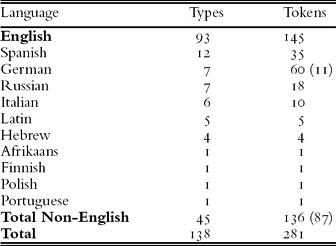
Table 1 shows a breakdown of tokens and types by language. These results show us to what extent English dwarfs all other languages with respect to number of borrowings. They also quantitatively justify dividing the data between Anglicisms and non-English borrowings.
A breakdown of tokens and types according to languages, with figures excluding the lemma deutschemark in parentheses.
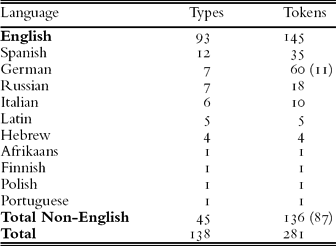
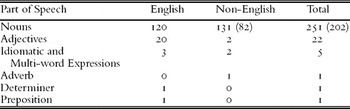
Table 2 gives a breakdown of borrowed tokens according to part of speech. With respect to parts of speech, the data in this study break down similarly to another study on borrowings, that of Haugen (Reference Haugen1950). Interestingly, I found no borrowed verbs in the Le Monde corpus. This finding is corroborated by many authors who note that verbal inflection in French impedes borrowability (Meillet Reference Meillet1921; cited in Thomason and Kaufman, Reference Thomason and Kaufman1988 and Haspelmath, Reference Haspelmath, Stolz, Bakker and Palomo2008). English contributes more varied parts of speech than other languages, but there is not enough data to find out whether this finding is significant.
A breakdown of part of speech tokens according to languages. Figures excluding the lemma deutschemark in parentheses.

4.1 Evaluation
The method proposed in section 3 finds 281 borrowings in the Le Monde corpus, but we would like to know how many borrowings there actually are in the corpus. Having this information allows us to evaluate the method's sensitivity, i.e., the proportion of borrowings detected to the total number of borrowings in the corpus. By manually examining a subsection of the corpus for borrowings, we can estimate the sensitivity of the method proposed as well as the number of borrowings in the corpus.
The method used for detecting borrowings, in combination with the initial labeling of the corpus, found nine of the 14 borrowings in the 431 sentences that were manually examined for borrowings (see section 3.1). This gives a sensitivity of 9/14 = 64.29%. Undetected tokens in this sample were dirham, dirhams, nairas, majors, and eurobag. The first three of these are foreign currencies; it is possible that several of the undetected tokens are similarly restricted in meaning. This is a substantial improvement over the initial labeling alone (sensitivity of 3/14 = 21.43%). We should conclude that the method for finding additional borrowings proposed above is effective.
We can construct a confidence interval for the method's sensitivity, and from this we can estimate how many borrowings are in the corpus. Using score confidence intervals, we can say that the true sensitivity of the method has a 95% likelihood of being between 38.76% and 83.66%. This corresponds to saying with 95% confidence that the true number of borrowed tokens in the corpus is between 334 and 722.Footnote 7
4.2 Follow-up study
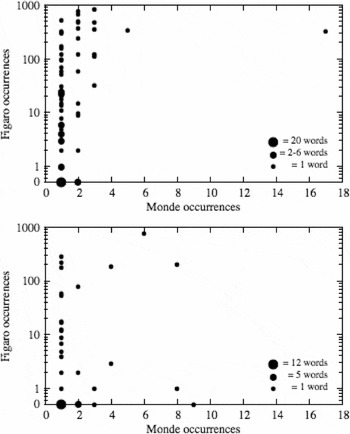
The cross-corpus analysis of lexical borrowings between the Le Monde and Le Figaro data shows that the frequency of an Anglicism in the Le Monde corpus is a stronger predictor of its frequency in the Le Figaro data than for a non-English borrowing. In figure 1, we see a clear correlation for English between the number of occurrences in the Le Monde corpus and the Le Figaro data. In general, as the number of occurrences of Anglicisms in Le Monde increases, so does the number of Le Figaro occurrences (rs = 0.625, p < 0.001). Excluding the lemma deutschemark, this correlation is not significant for the non-English borrowings (rs = 0.10, p > 0.10). For example, there are eight occurrences of ejido ‘communal agricultural land’, Spanish, in Le Monde, but only one in the Le Figaro data. No trend in the cross-corpus data is visually apparent for non-English borrowings. In other words, if the frequency in the initial Le Monde corpus is the same for an Anglicism and for a non-English borrowing, the Anglicism is more likely to occur – and with a greater frequency – in the Le Figaro data.
Cross-distribution of English lexical borrowings (top) and non-English lexical borrowings (bottom) in the Le Monde corpus and the Le Figaro data.

4.3 Sense pattern
The sense pattern data indicate that Anglicisms are more likely to be polysemous than are borrowings from non-English languages. There are 10 polysemous Anglicism types corresponding to 22 tokens in the data; in contrast, no polysemous non-English borrowings were found. One borrowing was eliminated from the results due to an unclear sense. Table 3 gives a breakdown of the sense pattern data according to language.
Number of sense pattern tokens according to language. Figures excluding the lemma deutschemark in parentheses.

A χ2 test even when excluding the lemma deutschemark shows these results to be highly significant (χ2(1) = 12.71, p < 0.001); if we were to include all occurrences of this lemma, these results would be even more significant. The context for the Anglicism pack, in quotation marks in the original text, here simply meaning ‘a group of people’, is given in (1).
(1) Face à la plus gigantesque agression dont une monnaie ait jamais été l'objet ces dernières années, l'alliance franco-allemande vient d'être scellée...A Washington, où, après deux jours de dures négociations, le ‘pack’ français a réussi à convaincre les argentiers germaniques. Au-dessus de l'Atlantique, les trois généraux vont préparer l'exécution de la contre-attaque.
In French, pack has at least three other senses, the most closely related to this sense being ‘a number of individual items packaged as a unit’ or ‘a group of eight forwards in a rugby game’. The sense of pack in (1) could either be a direct translation of the larger sense of the English pack or a metaphorical extension of the rugby sense. Yet the metaphor for this political situation is not a sporting event but rather a war. In brief, pack is highly polysemous in French.
The results in table 3 show us that Anglicisms in the corpus are more likely than their non-English counterparts to be polysemous. What if these results are because of the fact that there are more borrowed forms from English than from non-English languages? As a reviewer notes, if a language only furnishes a small number of borrowings, the chance that another borrowing has the same form as an extant borrowing is quite small. Suppose there are 100 borrowed Anglicism types and 10 borrowed non-English types in the data, but that the percentage of polysemous lexical items is a constant 30%. Then we would expect 30 Anglicisms and only 3 non-English borrowings to be polysemous, and the difference in number of polysemous borrowings would be due solely to the overall frequencies of Anglicisms and non-English borrowings.
Table 4 differs from Table 3 in that it gives the number of types (unique forms) seen. The percentage of polysemous Anglicism types is 10.8% (10/93). For non-English borrowed types, this percentage is 0% (0/45). Already at these low sample sizes, the difference between polysemous Anglicisms and non-English borrowings are marginally significant (χ2(1) = 3.74, p = 0.053). With cells having values of 0 and 10, it is difficult to obtain significance, but it is quite possible that this difference between Anglicisms and non-English borrowings would be amplified with a larger sample size. Hence we can tentatively conclude that the increased polysemy of Anglicisms is not due solely to the fact that there are more lexical borrowings from English than from other borrowings.
Number of sense pattern types according to language.

4.4 Cultural context
Results from the examination of cultural context show that Anglicisms are more likely than non-English borrowings to be used in unrestricted cultural contexts. Table 5 compares cultural contexts according to language, with three borrowings eliminated from the results due to unclear cultural contexts. The results in table 5 are highly significant (χ2(1) = 23.48, p < 0.001) even when excluding the lemma deutschemark: while almost half of all Anglicisms are found in unrestricted cultural contexts, non-English borrowings are almost always found in restricted contexts. Again, including the occurrences of the lemma deutschemark would reinforce this finding.
A breakdown of cultural context according to language. Figures excluding the lemma deutschemark in parentheses.

There were several occurrences of Anglicisms in contexts which were specifically intra-national French, or extra-national but non-anglophone, such as Mauritania, Greece, and Brazil. Sentence (2) is an example of an international context discussing Morocco and Tunisia in which the Anglicism offshore occurs.
(2) L'enjeu pour le Maroc et la Tunisie est de renforcer l'attrait qu'ils présentent pour les investisseurs européens. . . Le Maroc a créé en février dernier à Tanger une place financière offshore dont il attend de meilleures conditions d'accès aux capitaux internationaux.
Borrowings from non-English languages were used in 75 restricted contexts and 11 unrestricted contexts. Of these 11 non-English unrestricted contexts, five were Latinisms that pertained to French contexts. Although Latin is the precursor to French, I decided to treat Latinisms not in the dictionary as borrowings since (1) they are not in the TLFi, and (2) they are often set off by italics, which indicates a degree of foreignness.
Five of the remaining six borrowings were Russian terms associated with communism (nomenklatura) or post-communism (perestroïka) that were applied in Eastern European contexts (Romania and Albania), or China. An example of two unrestricted uses of nomenklatura is given in (3). Here this word is used to discuss a Chinese context:
(3) Parce que la jeunesse de Pékin a trop évolué et que les dirigeants chinois sont trop âgés, l'évolution serait irréversible. D'aucuns, en revanche, ne sont pas loin de penser qu'on n'a jamais vu une nomenklatura communiste engendrer une nomenklatura démocratique...
The results concerning restricted vs. unrestricted uses of lexical borrowings show that the use of Anglicisms is different from that of borrowings of other languages. Non-English borrowings are used primarily in contexts directly concerned with the countries in which the language is spoken. In the data, the ‘unrestricted’ uses of lexical borrowings of living non-English languages are in fact limited to a specific political ideology (communism) and the nations practicing or formerly practicing it. English borrowings display no such restraints, covering a range of topics as well as cultural contexts.
5 DISCUSSION
The hypothesis posited about the nature of Anglicisms in French is repeated here:
• Above and beyond their predicted higher frequencies, Anglicisms constitute a different phenomenon from borrowings from other languages.
The current results indicate that this hypothesis is likely to be true. The distribution of Anglicisms in the data shows that they do not behave in the same way as lexical borrowings from other languages. Quantitatively, there are far more Anglicisms than non-English borrowings. More importantly, though, the Anglicisms are significantly more likely than their non-English counterparts to recur in the French newspaper data. Although there may be similarly low frequencies of English and non-English borrowings in the initial corpus, the follow-up Le Figaro data show that Anglicisms are more productive than non-English borrowings.
Qualitatively, this paper explores two methods of classifying how likely the borrowings are to be integrated into the French lexicon. I examined the sense pattern of a borrowing with the assumption that a polysemous lexical item is more likely to be integrated into the recipient language. The current findings indicate that Anglicisms are sometimes polysemous, whereas none of the non-English borrowings are polysemous. This paper also looks at the cultural context in which the borrowings occur, on the assumption that unrestricted borrowings will be more integrated into the recipient-language lexicon. It is found that Anglicisms occur in culturally unrestricted contexts far more often than non-English borrowings. In addition, most unrestricted contexts of non-English, non-Latin borrowings in my findings are in fact limited to a particular context; i.e. communism. Anglicisms show no such contextual restrictions.
Furthermore, two Anglicisms in my findings, the and because, are closed-class items; as such, they already have frequent French counterparts. This closed-class evidence supports the idea that Anglicisms might not be like other neologistic phenomena insofar as they are used for different reasons in different contexts. Yet with so few examples, it is impossible to say this with certainty.
5.1 Causes
The reasons for which Anglicisms in French are used differently than other lexical borrowings are no doubt complex and merit a separate study. It would be interesting to see if obtaining more exact causes of the findings presented here is possible, and if so, what the specific causes of the differences between Anglicisms and non-English borrowings are. However, doing so would most likely require coding the discourse for factors like degree of irony, technical expertise, etc.
One possible cause is the original language of the newswire feeds. Pergnier (Reference Pergnier1989:131) notes that ‘journalists... work primarily on international news that comes to them more than 80% of the time in English’ (translation mine). This statement could be a caveat to the results presented here. That is, if it is the case that the corpus makes use of this proportion of English news feeds, this fact could play a large part in the distribution of Anglicisms in the current findings. This finding would be less interesting than other possible explanations, such as specific contexts in which Anglicisms are used where other borrowings are not.
The Le Monde corpus does not systematically include bylines, so examining the corpus is a not reliable method for determining the source of the articles.Footnote 8 So to estimate how much news comes from news feeds not originally in French, I looked at the authorship of all the articles in the February 1, 1990 edition of Le Monde. This date was chosen at random among the dates included in the corpus. An article was determined to be any writing with a headline or any writing set off from other text so as to be independent of other articles. Of the 126 articles for that day, 59 gave author bylines and 11 gave correspondent bylines. Only 23 were from newswires, and all of these 23 were either from Agence France Press (17) or AFP and another newswire, which was originally in English, e.g. Reuters (6). The newswires from AFP were presumably written in French, and the articles from newswires tended to be short blurbs. Thirty-four articles did not credit any source. Most of these articles were also blurbs about events in France, e.g. a road accident close to Biarritz, or agendas such as television listings. It is unlikely that such events were received from foreign news wires. Based on these results, it is highly likely that the proportion of this issue that was originally written in a language other than French is extremely small. We should conclude that the vast majority of text in the corpus came from sources originally written in French and that the original language of the articles does not explain the above findings.
5.2 Claims of representativeness
The issue of whether these results are representative of the lexical borrowings in the corpus and in the French journalistic genre in general are complex. There are three levels of representativeness that this study touches on:
1. Domain level: is the distribution of lexical borrowings with respect to domain, or topic, in the corpus representative of the distribution in the French journalistic genre as a whole?
2. Language level: is the distribution of lexical borrowings with respect to donor language in the corpus representative of the distribution in the French journalistic genre as a whole?
3. Lexical level: are the lexical borrowings found in the Le Monde corpus the same that occur in the entire French journalistic genre and French in general, or are the borrowings found simply one-time borrowings?
Unfortunately, this study cannot make any claims about representativeness with respect to domain, since a breakdown of the corpus by domain is not given in the literature on the corpus (Abeillé et al., Reference Abeillé, Clément, Toussenel and Abeillé2003). We can say, for example, that x% of Anglicisms concern financial topics, but without the corresponding percentage of how much of the corpus covers financial topics, such a percentage is meaningless.
I would like to claim relative representativeness at the language level, however. The number of Spanish borrowings is probably inflated due to one article with several borrowings in it, and the number of German tokens is no doubt inflated due to frequent borrowing of the single lemma deutschemark. Current events are time-sensitive and represent the only other caveat to this claim of representativeness. The Le Monde corpus is a collection of articles from 1989 to 1992, when issues of German reunification and the post-Cold War Soviet Union, etc. were prominent. Hence Russian tokens might also be slightly over-represented in the corpus. Post-9/11 terrorism issues were not on the horizon, and correspondingly, neither were the Anglicisms and Arabicisms associated with them. The word djihad ‘jihad’, for example, did not occur in the corpus, but it probably would have if the corpus dated from 2002–06. These examples appear to be the only exceptions to over- and under-representation of languages in the borrowings.
The follow-up Le Figaro study aims to discover whether the individual borrowings are regularly used in French or whether the borrowings are one-time borrowings. Section 4.2 addresses the extent to which Anglicisms in the initial corpus are more representative than non-English borrowings. Of the 274 initial borrowings examined in the Le Figaro corpus, 212, or 77.3%, were seen again at this later date. On the lexical level, it appears the borrowings in the Le Monde corpus are fairly representative of the borrowings in the French journalistic genre as a whole.
Finally, we can discuss to what extent borrowings in newspapers are representative of borrowings in Metropolitan French in general. There is no doubt that the frequency of these borrowings in spoken language is quite different than in written journalistic French. For example, there are no borrowings from Arabic in the corpus, yet there are many in spoken French, such as toubib ‘doctor’ and bled ‘middle of nowhere’. Written French and spoken French are highly divergent, and borrowings are no exception to this generalization.
6 CONCLUSIONS
This paper presents results from a corpus study of new lexical borrowings in French newspaper articles to see if English lexical borrowings, or Anglicisms, are different from lexical borrowings of other languages, and if so, how. The study of lexical borrowings is restricted to new lexical borrowings that are not in the dictionary and that do not have a Gallicized written form. In order to find out whether the borrowings found are productive, I queried the online archives of the Le Figaro newspaper for each of the borrowed types in the initial Le Monde newspaper corpus. I propose two qualitative methods of classifying the lexical borrowings in terms of their integration into the French lexicon, the sense pattern of the borrowing (monosemous/polysemous) and the cultural context of the borrowing (restricted/unrestricted to a culture in which the language is typically spoken). I assume that polysemous borrowings and borrowings that occur in unrestricted cultural contexts are more likely to be integrated into the recipient language, since these borrowings have fewer limitations on what they can refer to.
In both quantitative and qualitative respects, Anglicisms differ from non-English borrowings. Anglicisms are both far more frequent than borrowings from other languages and also more likely to re-occur in other French newspaper articles from later dates. This means they are more likely to be productive than other borrowings. Since they are more likely to be polysemous than their non-English counterparts, Anglicisms are also more likely to be integrated into French, even while controlling for frequency. Furthermore, Anglicisms are more likely to be used in unrestricted cultural contexts, which could also imply greater integration.
This study produces quantifiable methods of measuring the degree of influence of English on French. Indeed, these methods could likely be employed when examining the impact of any donor language on any recipient language. From a cultural perspective, the results presented here can be used to approximate the influence of anglophone societies on French culture. However, this study does not explore ways in which Anglicisms are different from non-English borrowings outside of the notions of sense pattern and cultural context. Proposing and testing new features that further describe the impact of a donor language on a recipient language would be promising avenues of research.
ANNEXE A: LEXICAL BORROWINGS FOUND IN LE MONDE
Borrowings are given as they appear in the corpus.

ANNEXE B: LETTER COMBINATIONS QUERIED IN THE CORPUS
xxx- = prefix
-xxx = suffix