1. Introduction
Peer learning practices are acknowledged as ways of learning promoted for theoretical, empirical and policy reasons (Reise, Samara & Lillejord, Reference REISE, SAMARA and LILLEJORD2012) and which can mean ‘many things across a range of different contexts’ (Reid & Duke, Reference REID and DUKE2015, p. 223). Within this range of understandings and experiences, Reise, Samara and Lillejord (Reference REISE, SAMARA and LILLEJORD2012) recognise ‘the need for including the development of generic skills related to future employment [which] can be promoted by learning practices where students work together’ (p. 601). For higher education student composers and performers, development of generic skills is crucial for future artistic employment and opportunities for peer learning between these two groups potentially lay the groundwork for lifelong artistic partnerships. Peer learning opportunities here are often desirable; our research questions to what extent in the learning of contemporary music practice they are necessary. Our study asked two conservatoire student composers to each write a piano piece, and three student pianists at the same institution, to rehearse and perform each of these pieces in a public concert. The study did not ask the student groups to collaborate – a more common peer learning approach – instead it took a step back and, by giving the pianists the completed scores, sought to identify information on the generic and specific technical challenges and opportunities which arose during rehearsal and subsequent performance in the absence of any personal communication with the composer or further contextual background to the score. In particular, the study sought to explore how contemporary classical music notation requires decision-making on the part of the student composer, and new interpretive strategies on the part of the student performer. In doing so, it responded to Reid and Duke's (Reference REID and DUKE2015) description of peer learning as ‘a way of describing the process of becoming acculturated into a specific discipline’ (p. 222), in our case, the discipline of writing and interpreting contemporary classical notation. Focusing on the detailed experiences of a small number of student composers and performers in a European conservatoire setting, this study aimed to provide a deep account of the challenges faced in the absence of any composer-performer peer learning so that future interventions may be guided in their focus on specific aspects, particularly of communication via notated score.
The paper responds to the questions:
RQ1. What technical challenges and opportunities arise for student composers in having student performers perform their newly written scores?
RQ2. What technical challenges and opportunities arise for student performers approaching newly composed scores by student composers?
While writing exists on the professional composer and performer relationship, very little has focused on peer learning opportunities that can arise between student composers and student performers working together within an institution. The relationship between the professional composer and the professional performer has often been one-sided, especially for some 20th-century composers who expected score obedience and ‘correct’ playing from the performer. Yet in the 19th century, and increasingly in the development of recent new classical music, a collaborative working relationship between composer and performer is encouraged and often adopted (Clarke & Doffman, Reference CLARKE, DOFFMAN, Fabian, Schubert and Timmers2014). In describing the context of our current research, this paper first outlines the current literature on peer learning in higher music education, before taking a look at the more frequently documented professional composer-performer relationship. As our particular study takes for an example the interpretation of notated scores, we outline the general stages of learning a notated score, and the issues that arise specifically from newly composed scores.
1.1 Peer learning in higher music education
Peer learning is becoming a more frequently used approach in the higher education music classroom. In the higher education conservatorium, Reid and Duke (Reference REID and DUKE2015) noted that peer learning can be both formal and also informal (e.g. through coffee shop discussion). By asking student peers performing on the same instrument for their views on learning from each other, a type of community of practice developed with peer mentoring and active involvement in student engagement activities on-going into the following year. Examining peer learning in the conservatoire master-apprentice environment, Hanken (Reference HANKEN2016) identified specific strategies teachers adopted to actively encourage peer learning amongst their students, e.g. the teacher not giving an opinion first, specific questioning-responding techniques by and to student performers encouraging deeper discussion, and the teacher physically moving away from the student group to encourage peer interaction.
Several studies draw out the assessment challenges and opportunities for students in mixed repertoire (Blom & Poole, Reference BLOM and POOLE2004) and popular music programs (Lebler, Reference LEBLER, Gaunt and Westerlund2013) through peer or collaborative learning within groups of student performers in the recording/composition environment. Little if any research has been undertaken into peer learning in the composer-performer relationship. Collaborative learning is a broad term, which includes peer learning, and Clauhs and Newell (Reference CLAUHS, NEWELL, Gaunt and Westerlund2013) mention music students working collaboratively on the recording and notating of compositions and arrangements, plus partnered songwriting. They also note the value of small group improvisation where, musically and socially, students constantly learn from their peers. Their study is in Gaunt and Westerlund's (Reference GAUNT and WESTERLUND2013) publication, Collaborative Learning in Higher Music Education, which despite the breadth of its title, has no articles exploring the composer-performer collaborative environment in the conservatoire.
1.2 Composer-performer peer learning in other teaching contexts
There are enterprising music teachers who are placing student composers and student performers together, although with few if any research outcomes to date. Italian pianist and teacher, Antonietta Loffredo (Reference LOFFREDO2010), has written of her experience introducing middle school students (aged 9–11) to around 20 specially commissioned pieces by experienced composers for small instrumental ensemblesFootnote 1. Her own interest in the performance of new notation practices aimed to see students introduced to these ideas. With pieces which did ‘depart radically from “tradition” . . . to explore harmony, timbre and gesture, no particular resistance was noted from the pupils’ (fourth page).
UK schools enjoyed relationships with professional composer-educators John Paynter, Peter Maxwell Davies, Brian Dennis and George Self in the late 1950s (Burke, Reference BURKE2014), and the Music for Young Players series published by Universal Edition in the late 1960s–1970 featured compositions by David Bedford, George Self, Brian Dennis, Christopher Small and Bernard Rands. In Canada, composer-educator R. Murray Schafer engaged students in exploring sound. Maxwell Davies’ visit to Australia in 1965 to talk about his UK teaching of creative music stimulated the introduction of creative music education in schools in Victoria, Australia. And in the early 1960s Australian composer, Keith Humble, with a small number of classroom music teachers, pioneered creative music education in the state of Victoria (Burke, Reference BURKE2014). New Zealand's composer-in-schools program has been in place since 1976, actively engaging composers in the classroom (Blom, Reference BLOM2001). Literature has engaged with the workings of some of these professional composers in the classroom, finding that there is much to learn from students’ responses. Composer Harry Somers (Kuzmich, Reference KUZMICH1987) brought his modes of compositional thinking into the classroom and used the student responses as the basis for more explorations. Linjama (Reference LINJAMA1999) has written of Finnish composer Einojuhani Rautavaara realising that working with children had taught him many things. Linjama noted that, when learning a new work, children might ‘develop an urge to sing a particular bar twice over . . . [and this might] teach the composer something more profound about the way the music naturally breathes, about its inherent time perspective, so that in the end he might well decide to revise his work at that point’ (p. 6). Makoto Nomura (Reference NOMURA1996), composer and improvising musician, agrees. He asked students to play extracts from one of his incomplete compositions but didn't correct their mistakes and misunderstandings because they ‘often show surprising ideas’ (p. 207). In doing so, he found that he learned composition from the students ‘hints of new musical possibilities’ (p. 203). These insights involved both notated and non-notated compositional strategies.
1.3 The professional composer and performer relationship
The majority of literature documenting the collaboration between composer and performer is centred on the relationship between professionals. From the first half of the twentieth century an emphasis is often seen placed on the composer and the score as the primary focus, with the performer as secondary. Cook (Reference COOK2001) offers three examples from this period. Firstly, Arnold Schoenberg, who is purported to have said, ‘The performer . . . for all his intolerable arrogance, is totally unnecessary except as his interpretations make the music understandable to an audience unfortunate enough not to be able to read it in print’. Secondly, Leonard Bernstein who required the conductor to ‘never interpose himself between the music and the audience; that all his efforts, however strenuous or glamorous, be made in the service of the composer's meaning’. Thirdly, Stravinsky, who found ‘The secret of perfection lies above all in [the performer's] consciousness of the law imposed on him by the work he is performing’. Here, the performer is servant of the composer. Some 20th-century composers may go even further and self-represent themselves as independent and autonomous, with no allegiances to stylistic schools or aesthetic commonalities with the work of other composers (Wilson, Reference WILSON2004). Yet Wilson finds that an artist is never truly alone. Often composer and performer work closely together. This can occur at a macro-level e.g. in the case of soprano, Denise Duval, who asked Poulenc to delete an opera scene, which he did, or at a micro-level, e.g. violinist Joseph Joachim, who advised Brahms on technical issues in a concerto. For the contemporary performer and composer in the 21st century, this collaborative process is often a natural way of working (Clarke & Doffman, Reference CLARKE, DOFFMAN, Fabian, Schubert and Timmers2014) and can encompass a wide variety between performers and composers in terms of the amount of creative input possible (Kanga, Reference KANGA2014).
From a performer's perspective, Finnish cellist, Anssi Karttunen (Reference KARTTUNEN1999), finds relationships he develops with composers are very important to him: ‘I try to place myself in their worlds, each completely different’ (p. 18). Here the performer is taking on the responsibility of understanding what sound the composer is trying to achieve and to make it even more effective. When composers write for the instrument they play, it may result in music which is less interesting ‘in a technical sense, for he will tend to write something that is comfortable to perform or to over-exploit certain personal facilities’ (p. 16). A non-performing composer, however, may produce ‘ideas that will force the player to look for new solutions on the instrument’ (p. 16). Karttunen uses composer Kaiija Saariaho as an example, in particular her use of the tone gradually becoming noise because of extreme bow pressure. While a conservatorium might teach the student not to make that sound, he finds ‘it is not a note that is destroyed but a beautiful sound in itself’ (p. 19). Here exploration of timbre, beyond the traditional way of playing the cello, is recognised by the performer and appreciated.
Casting a composer's eye on workshop interactions between new composers paired with professional performers, composer Elliott Gyger (Reference GYGER and Barrett2014) documented interaction focused around the notated score. Over several months, performer feedback and collaboration was invited at different stages in the creative process (from first drafts to final rehearsals). Seven categories of revisions were suggested by performers, placed by Gyger into increasing order of significance:
1. Practicalities and corrections
2. Notation issues
3. Missed opportunities – ‘making the music go further’
4. Tempo and pacing
5. Mood and character
6. Theatrical impact in performance
7. Aesthetic choices
The results from this workshop suggest that certainly for new composers preparing notated scores, there are several concerns that can be addressed through collaborative learning. The majority of these concerns generally address the effective communication of information through the notation.
1.4 The notated score
Although music notation has offered itself as the medium for more than four centuries through which western composers communicate with performers, a notated score may only be considered as a partially successful attempt to reduce the complexity of a compositional idea to its symbolic representation. A musical score, in trying to specify events as occurring simultaneously and involving different parameters, is subject to the performer's will and ability to decipher, understand and interpret it. This task becomes more challenging if one considers the number of additional pieces of information (convention-related and instrument-specific) which, if missing, may result in a breakdown of communication between the composer and performer.
Conflicts between professional composers’ intentions and professional performers’ interpretations in this regard are often due to issues of unclear notation but also, in fact, issues of personal taste on the part of the composer (Thomas, Reference THOMAS2007). A case in point is represented by Luciano Berio's Sequenza I for flute solo, first published in 1958. Although it was not his initial intention, Berio decided to use proportional notation, in which the horizontal spacing of each note is equivalent to its duration (Folio & Brinkman, Reference FOLIO, BRINKMAN and Halfyard2007). However, the composer found the results most unsatisfactory and argued that ‘this notation has allowed many players . . . to perpetuate adaptations that were little short of piratical.’ (Berio, cited from 1981 interview in Perlove, Reference PERLOVE1998. p. 47). The problem lay in the manner in which flutists either tended to misunderstand the proportions, regardless of the chosen speed, or took them almost as a pretext for improvisation (Muller, Reference MULLER1997). Berio, feeling obliged to impose his will more assertively, decided to rewrite the piece, this time adopting a precise time signature (2/8) and traditional note values. The second version was published in 1992 but never succeeded in establishing itself as the reference version over the first. For composer, Brian Ferneyhough, ‘notation is always relative to intention, whereby it is up to the composer to adequately suggest appropriate forms of response’ (Ferneyhough in Gaudeamus Foundation et al., 1990, p. 19).
These issues become far more intricate if one considers that a largely shared notion of performance style in recently composed music takes time to be established among performers. In fact, the limited number of performances prevents the creation of that substantive body of repeated interpretive gestures and habits which represent the foundation of the notion of style itself (Leech–Wilkinson, Reference LEECH−WILKINSON2010). Prescriptive notation has become a more distinctive feature of contemporary music than descriptive notation (Kanno, Reference KANNO2007). But, while in descriptive notation a long-established tradition codifies and underpins the relationship between the written sign and the expected sound, in prescriptive notation the composer rather specifies the method of producing the sound, leaving the aural effect open to a range of possibilities. Contemporary music scores then may often include legends that attempt to describe in detail those body gestures, movements and tools necessary to achieve the expected result.
This balance between choosing precise notation to determine the performance and allowing the performer full interpretive freedom is characterised by Hayden and Windsor's (Reference HAYDEN and WINDSOR2007) examples of directive and interactive collaboration. The latter involves a more discursive and reflective process between the two parties that covers more than simply practical issues in realising the piece, but establishes that the composer remains the sole author. The stage in the composition process at which this collaboration takes place (pre-draft, rehearsals through to final performances) can influence its very nature (Gyger, Reference GYGER and Barrett2014). However, at any stage, we note that a creative collaboration process presents opportunities for peer learning for student composers and performers in educational institutions.
1.5 Stages of learning newly-composed scores
In learning traditionally notated scores, the performer segments their practice into stages, addressing the overall picture of the piece, perfecting smaller segments and re-integrating them into the overall narrative (Chaffin & Imreh, Reference CHAFFIN, IMREH, Chaffin, Imreh and Crawford2002; Hastings, Reference HASTINGS, Williamon, Edwards and Bartel2011; Williamon, Valentine & Valentine, Reference WILLIAMON, VALENTINE and VALENTINE2002). Chaffin and Imreh (Reference CHAFFIN, IMREH, Chaffin, Imreh and Crawford2002) note the stages of practice for classical compositions as follows:
1. Scouting it out: Identifying the main structure via an initial read-through
2. Section by section: Resolving basic and technical difficulties in each section
3. The gray stage: Further work on technical difficulties to make the performance automatic, linking short sections into longer passages, first work on phrasing and dynamics
4. Putting it together
5. Polishing
6. Maintenance
However, in preparing an unfamiliar contemporary classical piece for performance, Viney and Blom (Reference VINEY and BLOM2014) find that an interpretational platform needs to be established before an understanding of the score elements can be properly achieved in stages 1–3 (scouting it out – the gray stage). This platform involves: 1) getting to know the composer, 2) reading the score, 3) engaging with musical parameters, 4) anchoring and 5) discussing the issues which involve actions such as researching biographical information and previous works, listening to recordings, finding non-musical information on the score that can help with interpretation such as the title, and making sense of the notation in being able to perform what is directed. Professional performers also often experience the need to develop their technique, in ways that haven't been addressed in their formal education, in order to address the technical challenges in each new piece. Often, ‘thinking outside the box’ is required in order to solve these challenges (Redgate, Reference REDGATE2007).
Investigating how student performers take meaning from music notation in sections or entire pieces of Western tonal music (works by Mozart, Scriabin, Schumann, Chopin), Hultberg (Reference HULTBERG2002) identified two main approaches. In a ‘reproductive approach’ the score is ‘found to be that of an explicitly normative document in which the composer's intention is correctly decoded’ (p. 193). She noted a prescriptive and a controlling aspect to this approach, likening it at times to the musicians appearing to act on behalf of ‘a superior interpreter, the editor, whose interpretation they tried to reproduce’ (p. 189). This type of approach in fact relies on the performer's conception (or in some cases misconception) of both the instrument-specific and convention-related practices associated with the type of work in question. In an ’explorative approach’, ‘music notation serves the primary function of a document providing incomplete, coded information on the composer's possible musical intention within a normative frame settled by the discourse in music . . . [with the printed score] a source of exploration based on the musician's individual familiarity with conventions of expression’ (p. 193). While Hultberg's study is reporting on tonal music of established pre-20th-century composers using traditional music notation, the two approaches relate to other notions of composer-performer relationships discussed above – reproductive with directive collaboration and descriptive notation; explorative with interactive collaboration and to some extent, with prescriptive notation – and all might be relevant for approaching newly-composed music by live student composers, as the challenges involved in writing, and student performers in interpreting, a musical score become all the more evident if contemporary music is taken into consideration.
Pianist Philip Thomas (Reference THOMAS2007) suggests that performers of contemporary music must approach individual works as truly individual, with standardised approaches limiting the creativity that performers can bring to new works. However, performers still seem to share some common learning strategies in that they usually search for landmarks or patterns to guide them through their reading of the piece (Thomas, Reference THOMAS1999). Although some experienced performers report focussing on smaller moments in contemporary pieces with less of a focus on overall structure, as they often feel this is evident in the notes themselves (Clarke et al., Reference CLARKE, COOK, HARRISON and THOMAS2005), performers trained in the classical tradition find it difficult to suppress the urge to seek out structural units and try to phrase or shape them (Heaton, Reference HEATON2012).
In summary, the literature identifies several challenges and opportunities for students and teachers. Peer learning can be formal or informal, building into a community of practice with teachers adopting specific strategies to encourage students. In more recent years, collaboration has been acknowledged as a natural way of working for many professional composers and performers. The impetus for composer-performer peer learning may come from the performing teacher's own interest in new notation practices, identifying harmony, timbre and gesture for exploration. From student and professional performers, composers learn more about: the way music naturally breathes; inherent time perspectives; new musical possibilities; and instrument-related technicalities. From the composer, performers learn to take responsibility for understanding what sound the composer is trying to achieve; making it even more effective; and looking for new solutions through exploration of timbre, on one's instrument. Composers should know that performers learn new scores in different ways and that the musical score is subject to the performer's will and ability to decipher, understand and interpret it. Therefore, it is up to the composer to adequately suggest appropriate forms of response. On the other hand, the performer cannot and does not apply the same approach to each new work, (and across performers this approach is also modified by their personal way of approaching a score – reproductive/explorative) and so needs to have the will and ability to understand what is in the score and what is not. Performers are to take responsibility for understanding what sound the composer is trying to achieve, make it even more effective and look for new solutions on the instrument. Because of insufficient performances of new scores, a performance practice has not become firmly established, however, there are common learning strategies between existing and new repertoire. When learning a newly composed score, a scouting it out read-through is not enough. Rather, an interpretational platform needs to be established from which to interpret the work. Both composers and performers need to understand that some prefer descriptive notation (e.g. proportional notation) to prescriptive notation (e.g. precisely metered notation); at the same time different individuals may prefer different ways of collaborating.
Heaton (Reference HEATON2012) asks, whether a contemporary score alone is sufficient enough to develop an interpretation. This question is particularly pertinent in the absence of an established performance practice, and limited knowledge of new/extended instrumental techniques. Although it is acknowledged that in this context within a higher education institution, peer learning is certainly desirable, to what extent is it absolutely necessary? When deprived of such opportunities, what are the challenges that arise for students approaching newly-composed scores, and what skills are required in order to compose and interpret a piece of new music? What are the possible shortcomings if composer and performer communicate only via the notated score? This article will address these questions by describing a study undertaken at a music conservatory involving student composers and performers.
2. Method
2.1 Participants
This project involved two student composers and three performers all studying at the Conservatorio della Svizzera Italiana (Lugano, Switzerland). The small number of participants was chosen in order to serve as case studies that would draw attention to the specific types of challenges encountered in composing and interpreting new scores. All students were at master's level in order to secure a high level of skill and confidence within their own composing/performing abilities. Participation was also limited to those who could incorporate such detailed work into the composition/recital requirements of their degree coursework.
Student composers and performers at the Conservatorio are directed in a practice-based approach to learning how to compose and/or interpret contemporary music. There are no formalized learning patterns; instead students are encouraged to consult with each other in order to verify a range of composing or performing decisions. Student composers are generally encouraged to work collaboratively with their colleagues from other departments and explore together new compositional strategies. This may include extended techniques, computer-assisted composition and mixed approaches, with results ranging from small pieces for solo instruments to larger compositions involving complex installations and big ensembles. In particular, student composers are asked to verify with their performer colleagues whether the technique of their choice is feasible for the chosen instrument. Student performers are required to include contemporary repertoire in their recital programmes and as such are confronted with contemporary music scores on the basis of the particular pieces they are given or that they choose for these occasions. Throughout their training, they are offered elective seminars concerning contemporary music that are instrument-specific and explore a certain composer/repertoire. Students have opportunities at the Conservatorio to be involved in concert productions of thematic programs that involve the preparation, rehearsal and public performance of contemporary works. In sum, the context of this study is such that the student performers and composers are exposed to contemporary notation in a number of practice-based scenarios.
2.2 Compositions and Recorded Compositional Intentions
The two student composers were tasked with composing a short solo piano piece, three to four minutes in length. For this experiment no specific instructions regarding style or type of score notation were provided. The final products from these two composers differed, as one used standard piano notation (descriptive) and focused mainly on notes that were played on the keyboard (Un’ Eco a Waldau), whereas the other (Schegge) used a more graphic form of notation which asked the performer to create many different types of sound on the keyboard, and play the strings inside the piano (prescriptive).
2.2.1 Schegge (Chippings)
This piece uses four distinct motifs (a–d) shown in Figures 1–4. Each motif differs in terms of the physical gesture needed to play the notes, as well as the pitch register of the piano. The composer expressed his compositional intentions by describing each section as a fragment or ‘chipping’ of a natural piano sound, as suggested by the title, with a juxtaposition of different sounds that together form one overall arch from beginning to end. Each successive fragment is in a higher register than the previous one, and finally these all interact with each other, ending again at the lowest register of the piano. The composer described the tension in the piece manifesting in different states (or levels) throughout the various fragments, i.e. each chipping embodied a different state of tension. However, he had also noted that there was one particular point of tension in the passage leading towards a climax on page 9 at the fff marking (the end of section d after it is repeated, see Figure 4).
Motif a from Schegge. This motif uses harmonics played with chords

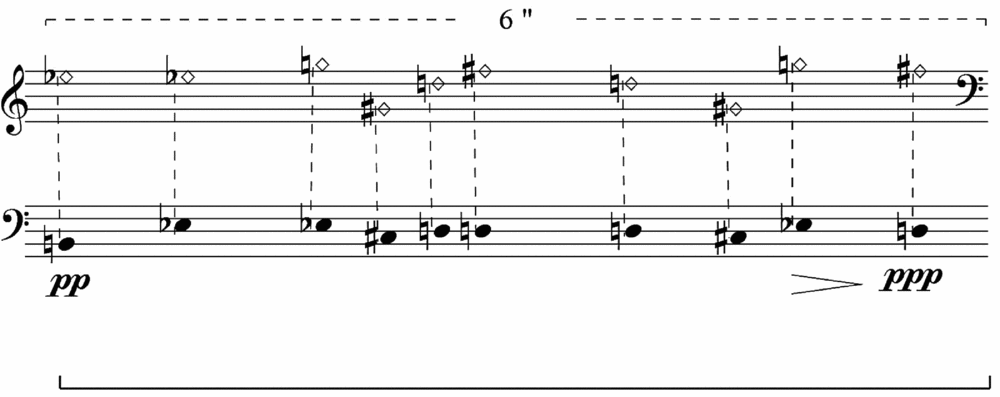
Motif b from Schegge. This motif uses harmonics of various pitches, and is specified to be played in the duration of 6 seconds

Motif c from Schegge. This gesture requires the pianist to pluck the strings inside the piano. The metronome marking was determined by the composer to fall at an inverse exponential rate

Motif d from Schegge. This motif requires the pianist to play several harmonics at once with fluctuating dynamics

2.2.2 Un’ Eco a Waldau (An echo at Waldau)
The composer took his inspiration from an unspecified painting by the artist Adolf Wölfli, who spent most of his life at the Waldau psychiatric clinic in Bern, Switzerland. The piece uses material derived from two distinct motifs, each of which is subject to motivic development in the course of the composition. The first two-bar motif (Figure 5) consists of a pianissimo melody in the lowest register of the piano, written with the purpose to create more a change of colour in the perceivable sounds than an actual melody. This initial motif is then repeated in various locations in the score, and interpolated with a quick rhythmic pattern which represents the second musical idea (Figure 6). The composer stated that Un’ Eco presents ideas of sounds instead of scales or harmonics, and expected the performers to create these sounds within the motifs through the use of dynamics and the pedal, but in unconventional settings, such as a melody marked pianissimo in the lowest register of the piano. The composer provided written directions for performing the opening and closing note clusters (see Appendix 2) and few comments concerning tension within the piece, instead emphasizing the importance of sound contrasts. However, one particular location at bar 35 was marked as the beginning of a build-up in tension that culminates with a climax at bar 43.
Introduction and first motif from Un'Eco a Waldau

Second motif from Un'Eco a Waldau. Performers are instructed to use alternating hands for each note/chord

2.3 Procedure
2.3.1 Performances
Three student pianists at the Conservatorio della Svizzera Italiana (identified in the results using the initials AF, AG and FP) were given six weeks to prepare their own interpretation of each piece (Schegge and Un’ Eco) within a concert programme of self-chosen solo repertoire. The composers remained anonymous to ensure all communication took place via the score only.Footnote 2 The cycle of three solo concerts took place over one week and was advertised publicly to attract a live audience. Each concert was video recorded (using a Panasonic HDC-SD90 camcorder) with audio recorded separately from two Neumann U87 condenser microphones in a stereo pair setup.
2.3.2 Post-Performance Interviews
Individual semi-structured interviews were conducted with all performers to obtain their final interpretive views on each piece and also with both composers to obtain a full description of their intentions for the piece, and their reactions to each performance. Each interview lasted 60 minutes and was conducted in Italian.Footnote 3 The interview was structured to address three issues: requirements of performance technique (technical elements), overall structure, and expressive concerns throughout the piece (see Appendices 4 and 5).
2.4 Analysis
Thematic analysis was conducted for composers’ and performers’ statements. For composers, Gyger's (Reference GYGER and Barrett2014) categories of performer revisions were used to classify the challenges experienced and their potential solutions. A new type of collaboration arising from this research, and not identified in previous studies, was labelled ‘creative collaboration’ in order to reflect opportunities where performers and composers could work together to come up with a collaborative solution. For performers, Chaffin and Imreh's (Reference CHAFFIN, IMREH, Chaffin, Imreh and Crawford2002) stages of learning a piece of music were used, including the extensions from Viney and Blom (Reference VINEY and BLOM2014) in considering newly-composed pieces. Performers’ approaches to solving these challenges were classified in terms of Hultberg's definition of reproductive and explorative approaches (Reference HULTBERG2002), concerning whether the performer had attempted to follow the composer's intentions to the letter, or whether they had found a different solution.
3. Results
3.1 Schegge
3.1.1 Technical elements
Although the opportunities are present in this particular conservatoire context for performers to be exposed to new types of notation, it is well documented that each new piece can present a new set of challenges. The student performers had had relatively little experience with this type of notation and the gestures described; therefore, they spent a long time attempting to follow the instructions to produce an accurate representation of the timbre intended. When notation was unclear, performers would change the physical gesture in order to achieve the sound they believed to be required. The composer had aimed to give his performers a sense of freedom through the notation, and although for the most part, the performers were dedicated to accurately producing his timbral intentions, this freedom also meant that the pianists sometimes ended up doing something completely unexpected. A particular disagreement regarding the gestural production of the sounds in motif c (Figure 3) was noted when pianists produced percussive sounds from hitting the strings with their fingertips, instead of the intended pizzicato-like sound. However, the composer's description of which part of the finger to use to achieve the desired effect present in the legend (see Appendix 1) fails to mention in clear terms the desired pizzicato-like effect. Thus the performers, being more concerned with achieving the intended dynamics, tended to alternate between using the pad of the finger and the fingernail. More practical issues prompted similar changes: the construction of struts in the Steinway used in the performances prevented performers from playing motif d (Figure 4) in the intended register so they solved this by transposing the motif down an octave. Performers also had to invest a large amount of time preparing the piano in order to achieve the correct harmonics. Further issues arose from the composer's false assumption that all pianos would have harmonics in the same positions (AF) as well as in achieving ‘clean’ and correctly pitched harmonics when under a tempo constraint (AG, FP). The range of consecutive gestures required often made it difficult to respect the notated tempo markings (AG, FP). Other technical issues prompted more creative solutions from the performers, for example, AF constructed a small hammer so that she could press several strings at the same time when playing harmonics in the occurrences of motif d (Figure 4).
3.1.2 Structural elements
Having each motif written in a different gestural format, visually it was clear to every performer where one motif ended and another began, and when the repetition of each motif occurred. The fermatas in the score were understood as explicit direction on where to pause between sections; AG also took cues from the pedal markings in terms of which motifs should be linked together and which should remain separated. The structural boundaries indicated by the composer do not always coincide with the written fermatas. Although the interviews with the pianists indicated that agreement with the composer's ideas was at its strongest on the segmentation of the piece at the lowest structural level i.e. the recognition of each separate motif, performers provided differing views on how the different motifs fit together. The coda section in particular was the location of large divergence between performers.
Performer AG understood each fragment as a new section, admitting to not understanding the general idea of the piece. She instead focused on the juxtaposition of various features, much like the composer had described in the legend. Performer AF interpreted the role of the different fragments within the piece as different parts of an overall picture which retained a fluid structure, and in doing so, made less of a separation between the different fragments than Performer AG. Similarly, performer FP aimed to differentiate the sections as much as possible, although these were already marked out in the score in terms of timbral and dynamic differences of the different gestures required. However, he then fitted each fragment into larger structures that spanned one to two pages. All performers responded to one location in particular as a global climax of the piece. This appeared at the end of motif d after it had been repeated the first time. Between performers, the build-up towards these high points of tension varied.
3.1.3 Expressive elements
The title of the piece for two performers (FP, AG) suggested that there was no general idea for the piece, with focus to be directed on distinguishing each section from the other. FP stated that the differences in intended timbre and dynamics between the ‘chippings’ were clear from how they were notated. AG stated that she liked the idea that the piece was reassembled from parts of different works. In this way, the fragments were part of a discussion and not completely separate.
The expressive concerns of the performers mainly addressed how they should reconcile the intended timbre with seemingly contrasting demands made by the tempo and dynamic markings. Despite AF finding the indication of length in seconds in motif b difficult to implement whilst also retaining a steady tempo, and FP reporting difficulty in understanding the numerous tempo markings and changes in metronome, the composer felt that the proportional notation in motif b had been completely disregarded. In terms of dynamic markings, performers tended not to respect the notation if they thought the result may have been inaudible (FP, AG), for instance when playing the soft harmonics. Performers would also change the gesture if they felt the notated one could not achieve the dynamics intended. These decisions demonstrated a balance between the creativity afforded by the notation, along with a dedication to producing the timbres and dynamics required.
Performers reported different states (levels) of energy in the piece and interpreted feelings of chaos (AG) or nervousness (FP). These were enabled by the different harmonies and dynamics of the different sections.
3.2 Un’ Eco
3.2.1 Technical Elements
The composer commented positively on the contrast in sounds for the two musical ideas (some percussive and some pianistic) achieved by pianist FP, matching his initial interview comments. On the other hand, he felt that, while pianists AG and AF had successfully captured the sound of the first idea along the lines he had intended, the second faster material was misunderstood and lacked a certain percussive quality. This particular timbral contrast was not notated explicitly in the score, and instead was meant to be understood simply from the different material in the two motifs.
Although most of the intended gestures in this piece were well understood from the notation, their realisation was more difficult. The use of the pedal throughout the piece was difficult to achieve (FP, AG) which prompted AF to use another object (a small wine cork wedged on the pedal) to realise this gesture. For motif b the notated fingering was difficult to respect because of the required changes in hand (see Figure 6) and the apparent lack of a consistent pattern in the notes (FP, AG). For this particular motif, all performers made compromises with the tempo in order to achieve note accuracy.
FP stated at several points that the notation did not seem to be technically well-written for the pianist, with tempo indications difficult to respect due to the physical movements and jumps required. Having little experience with these types of gestures, including playing on the wood of the piano and the initial chord clusters, AG also found the different types of gesture disorientating. Although these elements may make the piece difficult to memorise (FP), the performers thought that the piece should be memorised to be performed more effectively (FP, AG).
FP thought that the intended sound of the chord clusters beginning and ending this piece had been fairly simple to understand and as such, these had been over-prescribed by the provided directions (see Appendix 2). However, AF's particular gesture used to perform these clusters was different than directed: she used her hands to hit against the underside of the keyboard to produce a similar effect to the original instructions, as she had not been able to obtain an audible sound in the manner notated (by using the pedals). This solution, although it may be considered as an example of creative thinking, was viewed as inappropriate by the composer who felt that the timbral effect had been altered.
3.2.2 Structural elements
All three performers shared a similar interpretation of the material in terms of structure and form. This coincided with the composer's ideas and is perhaps due to the more traditional type of notation he used. AG stated that the pause at bar 27 acted like a mirror. A major difference in interpretation concerned where the coda began.
Tension was described mainly in terms of local climaxes that were initiated at earlier points in the score. The composer marked out the con fuoco section (b1) as leading to the main point of tension in the piece at bar 43. All performers interpreted this final point of tension in the same place; the main difference in the interpretations was that their journey towards this point in the score often differed. Four locations were commonly identified as points of tension in the piece across all performers: two of these occurred at the end of a section, the other two mid-section. The performers’ interpretations differed in terms of how these points of tension functioned within the piece, particularly one location at bar 22, where one performer saw it as a climax, another as the beginning of a line of tension leading off to a climax further on, and the third marking it as a change in the level of tension of the piece. Again, the micro differences in interpretation, particularly on the function of certain sections, demonstrates the creative freedom that has been left by the notation, even though where there were few instances of new or unknown symbols, the performers were likely to conform to more traditional performance views.
3.2.3 Expressive elements
Performers experienced problems with Un’ Eco similar to those encountered when interpreting Schegge, particularly in respecting the notated dynamic markings. For instance, the pianissimo marking of the melody in the bass register (motif a, see Figure 5) was difficult to achieve (FP), as was playing the consecutive accents in the motif b (Figure 6) without anticipating an ff dynamic (AG). The dynamics in general were difficult to understand (FP).
The pianists aimed to discern the broader meaning of single gestures (AF, FP) in an attempt to fit these into the overall meaning of the piece (FP). Without a further explanation on the background of this piece, the pianists searched the internet for the meaning of the title finding Waldau linked to the name of a psychiatric institution in Bern. However, they could not make the connection to the specific artist the composer had in mind. Taking their cue from this information, they conceptualized the piece in terms of the various states of nervousness, and the schizophrenic nature of the two interacting motifs (AG, FP). The relentless rhythms (AG) and use of accents (FP, AG) and repetition (AG, AF) helped to build a sense of growing urgency (AG), chaos (FP) and anxiousness (AF).
4. Discussion
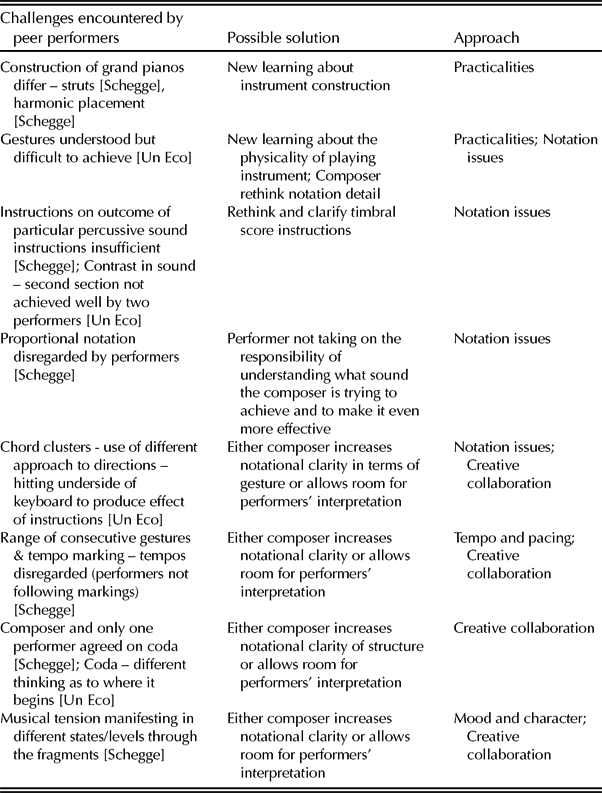
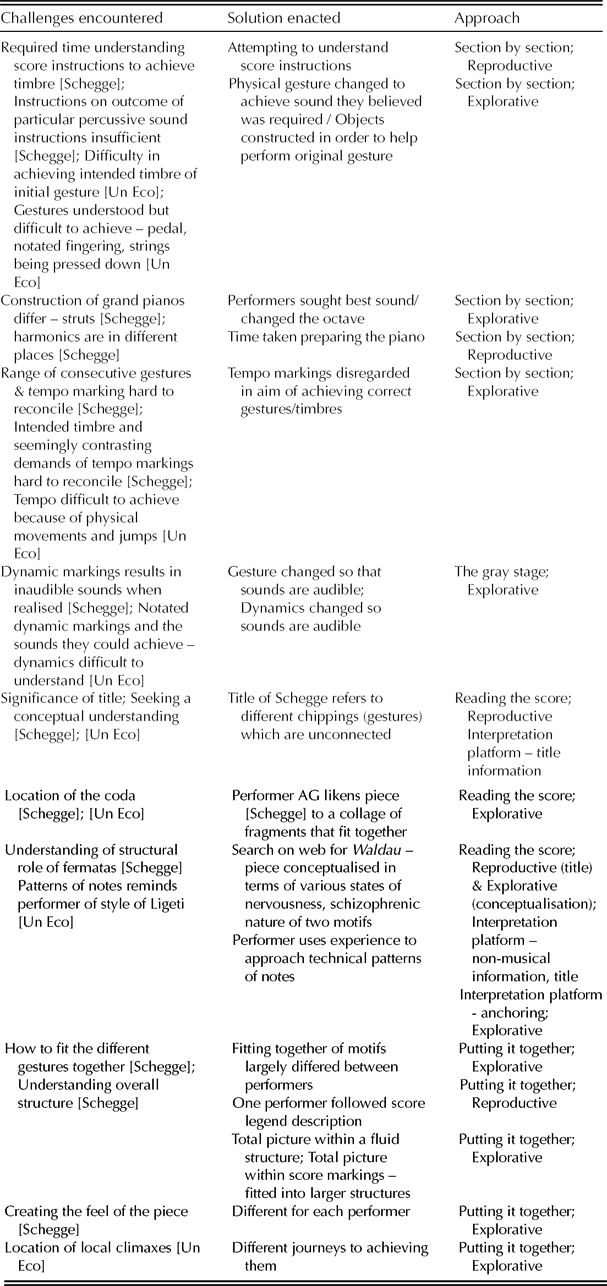
The results of the interviews were arranged into two tables reflecting both the composers’ and the performers’ experiences and identifying creative collaboration opportunities.
4.1 Composer challenges and outcomes
Table 1 shows the majority of challenges are classified in terms of practicalities and notation issues. The student composers’ lack of knowledge regarding both the instrument (such as incorrect assumptions about standardisation of piano strut placement) and the performance of the instrument (such as underestimating the physicality of different gestures) contributed to a large number of technical challenges faced by the performers. Notation issues involved the realisation of notated gestures or the communication of certain timbres reflecting gaps in what the score could communicate. These challenges present opportunities for peer learning: composers may find it beneficial to work with instrumentalists when exploring the viability of extended piano techniques and determining the best notation to express a particular intention. The composers faced challenges where performers had realised the music in an unexpected manner. Here, the resolution can either be to provide more detail and to restrict performance variations (prescriptive notation) or relinquish control to the performers to explore the various interpretive possibilities (interactive collaboration). These junctures provide opportunities for creative collaboration, where student performers and composers could work together in resolving interpretive issues, being partners in the creative process, and building on existing shared understandings.
Composer challenges (and possible solutions) arranged by Gyger's revision categories (Reference GYGER and Barrett2014)

4.2 Performer challenges and resolutions
Table 2 shows that although performers tended to be faithful to the composer's instructions, instances of non-traditional techniques and/or notation as well as perceived gaps in the notation encouraged the use of more explorative approaches. That the performers spent a large part of rehearsal time trying to understand the particular aural effect the composer had in mind, even in cases of seemingly insufficient information, reflects this inbuilt desire still often found in contemporary performances to have respect for the composer's intentions (Clarke & Doffman, Reference CLARKE, DOFFMAN, Fabian, Schubert and Timmers2014). When performers encountered challenges in realising particular gestures, this often prompted creative solutions as a result of lateral thinking (for example, the use of other objects to help pluck the strings inside the piano, or help with pedalling) which coincides with Redgate's experiences of ‘thinking outside the box’ (Reference REDGATE2007). Challenges in terms of extended techniques and types of notation represent opportunities for peer learning: performers may find it beneficial to work with composers in exploring new gestures, building shared understandings which will benefit all. In terms of the challenges encountered in interpreting how the pieces fit together, these junctures again present opportunities for creative collaboration.
Challenges faced by student performers and solutions enacted when approaching newly-composed scores

5. Conclusions
Results from studying student composers’ and performers’ approaches to writing and performing newly-composed scores suggest that not only is peer learning in educational institutions desirable but also necessary, especially if prescriptive music notation on the one hand, and extended techniques on the other, are involved in the creative process. In fact, the majority of challenges faced by student composers and performers were in regard to the practicalities of playing the instrument and the use of extended techniques plus issues surrounding how to interpret specific aspects of notation, realising the music. These are all potentially resolvable through student creative collaboration between composer and performer, an approach which can collectively re-imagine sections or whole scores together, covering a range of practical and interpretive issues as well as coming up with creative solutions to problems encountered through notation. Here, there may not be a sole author, but, at the other extreme, neither are decisions made collectively ‘live’ in performance (see Hayden and Windsor's ‘collaborative’ definition above). There were shared understandings, largely concerning structure, as existing literature predicted (Thomas, Reference THOMAS1999; Heaton, Reference HEATON2012) and these form a good basis for building further information sharing. There were also instances of personal taste taking precedence, on the part of both performers and composers. Like Loffredo's experience, none of the student performers responded with resistance to the new works, instead taking on challenges and finding solutions. In a spectrum of ways of working, this study therefore has identified opportunities for building creative collaboration where student performers and composers can work together to creatively resolve issues in the writing and interpretation of newly-composed scores.
Of course, due to the nature and size of our research project, the exact benefits of composer-performer peer learning processes in higher education institutions are still speculative. Further research into these types of collaborations are therefore pivotal in order to determine the best practices for including peer learning opportunities. These may be either formally as part of conservatoire training, or informally by raising awareness as to the benefits of these types of relationships whilst developing as an artist. This in turn, potentially, lays the groundwork for establishing lifelong artistic partnerships with, as the literature noted, ongoing peer learning. In sum, given the constraints and ambiguities of contemporary classical music notation, learning a new piece is not likely to work well if peer learning or collaborative composition strategies are not involved.
Supplementary material
To view supplementary material for this article, please visit https://doi.org/10.1017/S0265051717000304