

INTRODUCTION
Fear of crime has been the subject of an increasing scientific output in recent decades (Gabriel and Greve Reference Gabriel and Greve2003; Hale Reference Hale1996; Whitzman Reference Whitzman2007) and research has shown that women report higher levels of fear of crime, although they have a lower risk of victimization for street crimes (Garofalo Reference Garofalo1979; Hale Reference Hale1996; LaGrange and Ferraro Reference LaGrange and Ferraro1989; Smith, Torstensson, and Johansson Reference Smith, Torstensson and Johansson2001; Tjaden and Thoennes Reference Tjaden and Thoennes1998). The disproportion between the women’s fear and their lower risk of victimization became known as the fear–victimization paradox (Skogan and Maxfield Reference Skogan and Maxfield1981; Warr Reference Warr1984). Over time many theories have been trying to explain the reasons underlying this insecurity reported by women (see, for example, Ferraro and Nuriddin Reference Ferraro and Nuriddin2006; Sutton and Farrall Reference Sutton and Farrall2005). Due to an apparent dichotomy between public and private spaces, empirical evidence has been ignoring the effects of domestic violence and its variations on women’s fear of crime (Broll Reference Broll2014; Madriz Reference Madriz1997; Pain and Scottish Women’s Aid Reference Pain2012).
The present study aims to understand how fear of crime, specifically the fear of violence in the context of intimate relationships, impacts itself in women’s lives, considering both individual and contextual factors. In recent years, the Global South has been widely pointed out by the international scientific community as an important context for research in the criminological field (Carrington, Hogg, and Sozzo Reference Carrington, Hogg, Sozzo, DeKeseredy and Dragiewicz2018). In this regard, Brazil stands out as a country that has many social and economic problems and those issues seem to be reflected in permanent escalating violence. Therefore, the concepts used throughout this paper, as well as the description of the chosen theoretical model will be presented briefly, following a methodology description. Finally, the main results will be presented and discussed in light of previous scientific research.
Intimate Partner Violence (IPV) Against Women
Violence against women is a complex and multidimensional phenomenon (Fulu and Miedema Reference Fulu and Miedema2015). It is a severe human rights violation (Bott et al. Reference Bott, Guedes, Goodwin and Mendoza2014; Fulu and Miedema Reference Fulu and Miedema2015; Johnson, Ollus, and Nevala Reference Johnson, Ollus and Nevala2007; Roggeband Reference Roggeband2016) as well as a public health issue (García-Moreno et al. Reference García-Moreno, Jansen, Ellsberg, Heise and Watts2006; Gracia and Herrero Reference Gracia and Herrero2007). Violence against women is one of the most tolerated forms of violence that crosses many contexts and cultures, reinforcing gender inequalities and affecting all areas of its victims’ lives (Johnson et al. Reference Johnson, Ollus and Nevala2007). In this study, violence against women will be addressed in a strict sense, only referring to IPV (García-Moreno et al. Reference García-Moreno, Jansen, Ellsberg, Heise and Watts2006; Heise and Kotsadam Reference Heise and Kotsadam2015; Ismayilova Reference Ismayilova2015; McCloskey Reference McCloskey2007).
According to Capaldi et al. (Reference Capaldi, Knoble, Shortt and Kim2012), the concept of IPV includes different forms of physical, psychological and sexual abuse which can be perpetrated by both men and women against their romantic partners. More accurately, Dixon and Graham-Kevan (Reference Dixon and Graham-Kevan2011) refer that IPV can be understood as any form of aggression or controlling behaviours inflicted on a current or ex-partner regardless of their sex or relationship status. The World Health Organization (2012) states that “Intimate partner violence refers to behaviour by an intimate partner or ex-partner that causes physical, sexual or psychological harm, including physical aggression, sexual coercion, psychological abuse and controlling behaviours” (World Health Organization 2012:1). Several terms have been used over time to refer to the violence perpetrated by men over women in the context of intimate relations, such as “domestic violence, domestic abuse, intra-family violence, wife abuse, spousal abuse, wife battering, courtship violence, battering, violence against women, and intimate partner abuse” (Ali and Naylor Reference Ali and Naylor2013:612). Despite some conceptual differences, all those expressions reflect the disproportionality of female victimization. Recent data suggest that one in three women in the world aged 15 years or older experienced physical and/or sexual violence by a current or ex-partner at some point in their life (Devries et al. Reference Devries, Mak, García-Moreno, Petzold, Child, Falder, Lim, Bacchus, Engell, Rosenfeld, Pallitto, Vos, Abrahams and Watts2013). Approximately 38 % of registered femicides worldwide between 1982 and 2011 were committed in the context of domestic violence and perpetrated by current or ex-partners (García-Moreno et al. Reference García-Moreno, Pallitto, Devries, Stöckl, Watts, Abrahams and Howes2013). Some authors have considered IPV as a form of terrorism, due to the high numbers of female victimization as well as the severe consequences of the violence, which extend beyond the victim–aggressor relationship (Pain and Scottish Women’s Aid Reference Pain2012; Pain Reference Pain2014). A study conducted in Brazil (DataSenado 2017), in which 1116 women participated, 324 reported having experienced some form of domestic or family violence perpetrated by a man. About 75 % of this total also reported that the abuser was a current or ex-partner (husband, partner or boyfriend). These figures are rooted in the social acceptance of violence in Brazil, as suggests the results of the research on social tolerance of violence against women (Institute of Applied Economic Research (IPEA) 2014). According to the survey, more than half of the respondents expressed total or partial agreement with the phrase “if women knew how to behave there would be less rape”. An even more significant percentage of respondents (63 %) also agreed (totally or partially) that family violence is a “private” issue. Women participating in this study almost unanimously agreed that “dirty clothes should be washed in house” (89 %) and “we should not interfere in husband and wife quarrel” (82 %). Therefore, social acceptability around the issue of the daily violence against women in societies increases (Gracia and Herrero Reference Gracia and Herrero2007), suggesting and supporting their blame even in extreme situations, as in cases of sexual abuse. The victim-blaming attitudes (Gracia and Herrero Reference Gracia and Herrero2006; Ivert, Merlo, and Gracia Reference Ivert, Merlo and Gracia2017; Walklate Reference Walklate1997) are based on that idea that there is a “culpable victim” who failed to protect herself against the aggressor. The culpable victim is, therefore, liable for the offence suffered, does not deserve empathy, and, even, attention (Jarrett-Luck Reference Jarrett-Luck2015). This person is someone who does not fit in the label of “ideal victim” (Christie 1986, cited in Walklate Reference Walklate2011:183) since she is blamed for her victimization. Through a more critical approach, Ryan (Reference Ryan2010) warns that the shift of responsibilities underlying the victim-blaming construct is not restricted to crime-victimization situations. Instead, it permeates the everyday debates both in the public and social spheres.
Women’s Fear of Crime
Fear of crime is an emotional reaction characterized by feelings of danger and anxiety (Garofalo Reference Garofalo1981), a set of individual negative emotional responses related to crime or symbols associated with it (LaGrange and Ferraro Reference LaGrange and Ferraro1987). Fear of crime is multifaceted and dynamic (Hale Reference Hale1996; Koskela and Pain Reference Koskela and Pain2000). It consists of a reaction to the perceived environment, and it is an emotional condition, a sense of alarm caused by consciousness or expectation of danger (Warr Reference Warr2000). Thus, fear of crime can be triggered by an immediate threat or by the anticipation of future events. According to Warr (Reference Warr2000), the anxiety about future victimization is what we most commonly see externalized in victimization surveys. An accurate review suggests that women are more fearful than men (see more in Hale Reference Hale1996). The quantitative research points that although women reported high levels of fear of crime, they have less risk of becoming victims of street crimes. The disproportion between fear and risk related to the women’s case gave rise to what has become known as the “fear–victimisation paradox” (Skogan and Maxfield Reference Skogan and Maxfield1981; Warr Reference Warr1984). Several theories have been put forward over time to explain this paradox. When studying female fear, it is essential to note that perhaps part of the disproportion between genders is explained by the “absence” of fear reported by men over time. As pointed by Pain (Reference Pain2000), men’s fear may have been seriously underestimated since genders are affected in different ways by social pressure to minimize their feelings. The stereotypes underlying hegemonic masculinity do not give rise to the externalization of vulnerability and emotions by men (Goodey Reference Goodey, Ditton and Farrall1997; Sutton and Farrall Reference Sutton and Farrall2005). Thus, the social pressures associated with gender roles tend to restrain men from reporting their fear of crime, and they are led to choose the most socially desirable response on the surveys (Sutton and Farrall Reference Sutton and Farrall2005; Sutton, Robinson, and Farrall Reference Sutton, Robinson and Farrall2011).
Also, it is essential to note that “for various reasons, both official statistics and victimisation surveys fail to capture the full nature and extent of women’s victimisation” (Hale Reference Hale1996:19). As pointed out by Madriz (Reference Madriz1997, cited in Broll Reference Broll2014), the higher levels of fear reported by women reinforce the image of women as potential victims of crimes and also reinforce the social control by men over women, increasing gender inequalities and keeping patriarchal power in evidence. In turn, this self-image does not allow women to see themselves as full citizens. It also takes effect in their way of life, increasing both avoidance behaviours and feelings of insecurity. In this way, the hypothesis of the shadow of the sexual assault (Ferraro Reference Ferraro1996) was quite widespread. According to that theory, women’s fear of crime is based on their fear that any aggression suffered may necessarily escalate to sexual assault. Indeed, the threat of sexual abuse has shown to be a strong predictor of women’s fear of crime over time (Fisher and Sloan III Reference Fisher and Sloan2003; Hilinski Reference Hilinski2009; Lane and Fox Reference Lane and Fox2013; Özascilar Reference Özascilar2013). However, if the occurrence of that crime could be mapped out, there would be highlighted far more rooms than public areas (Pain Reference Pain1997a). In fact, contrary to what the general studies may suggest, women are more likely to experience victimization from an acquaintance than from a stranger (Drakulich Reference Drakulich2015). The spatial patterns of women’s victimization require a broader study that takes into account the incidence of various crimes committed in private and semi-private spaces (Pain Reference Pain1997b; Whitzman Reference Whitzman2007).
As stated in the introduction, IPV and fear of crime are distant subjects in the criminological field, so empirical evidence is rather scarce. However, there are some studies which ought to be emphasized.
During decades, fear of crime was seen as a partial product of victimization (Farrall, Gray, and Jackson Reference Farrall, Gray and Jackson2007). However, some research suggests that sometimes the causal link between victimization and fear of crime cannot be confirmed (see, for example, Garofalo Reference Garofalo1979; Guedes Reference Guedes2012; Hale Reference Hale1996; Walklate Reference Walklate1997).
Using data from the Australian Women’s Safety Survey, Carcach and Mukherjee (Reference Carcach and Mukherjee1999) found that women who have experienced IPV were twice as likely to admit fear of crime when compared with non-victimized women or those who were victimized by strangers. According to the authors, their results support the feminist argument that female victims of domestic violence may be at increased risk – that is, outside and inside their own homes and this significantly increases their levels of fear of crime in communities (Carcach and Mukherjee Reference Carcach and Mukherjee1999). More recently, analysing data from the General Social Survey of Canada (GSS), Broll (Reference Broll2014) found that almost 60 % of the women interviewed in the national survey had experienced intimate partner abuse. More specifically, one in five women reported having suffered physical abuse in the past year, while approximately one in 20 had suffered one or more types of intimate partner abuse in the past five years. Crossing victimization and fear of crime, women who have experienced some IPV were much more likely to report high rates of fear of crime compared with other women. The physical and emotional abuse was positively and significantly associated with women’s fear of crime. On the other hand, women who were sexually abused by an intimate partner were only moderately likely to reveal a greater fear of crime (Broll Reference Broll2014).
Ecological Approach of IPV
The perspective of understanding human behaviour considering its contextual environment was definitively introduced in the social sciences in the 1960s and 1970s. As pointed out by Bronfenbrenner (Reference Bronfenbrenner1977), human development is influenced mainly by contextualization processes and interactions, and these processes occur in the most diverse levels of social life. The levels represent an artificial division of the social environment. From the closest (microsystem) to the larger (macrosystem), those levels are interconnected and express some influences on the individual (Bronfenbrenner Reference Bronfenbrenner1977; Koller Reference Koller2004; Llorens Aguado Reference Llorens Aguado2014). Thus, each level is responsible for exerting cumulative effects, impacting the various stages of human development, as well as bringing pressure on the social behaviours.
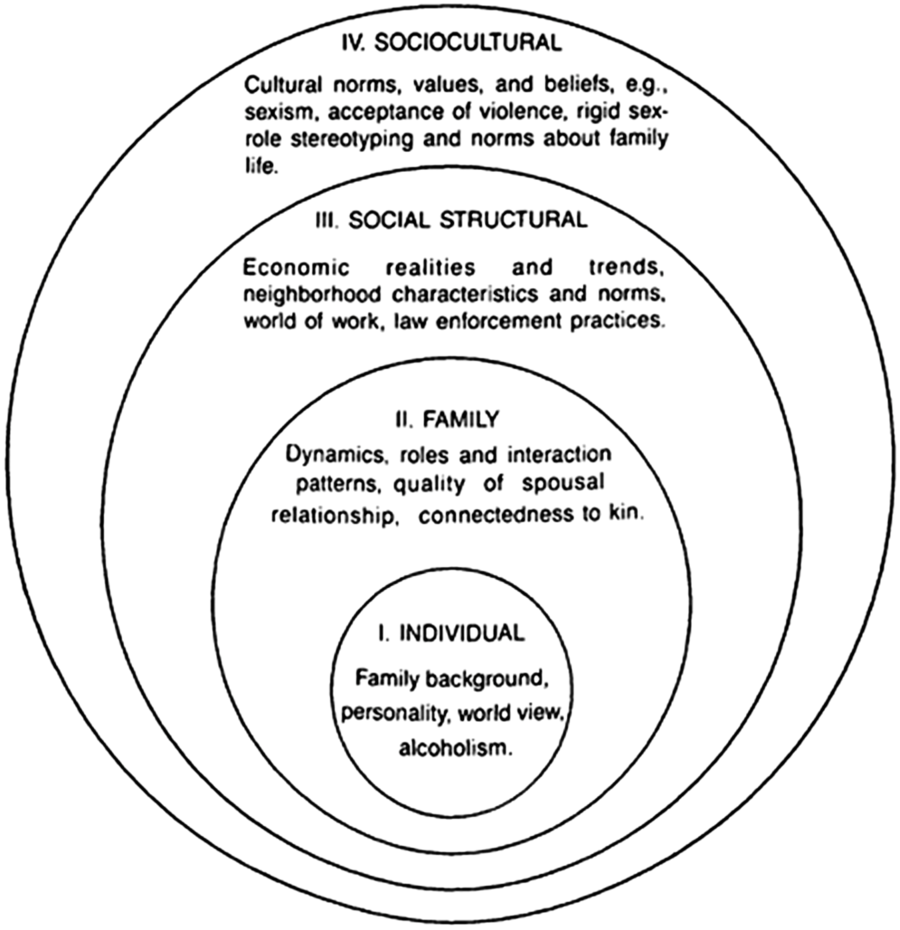
Carlson (Reference Carlson1984) was the first author to propose an ecological analysis of domestic violence. Based on the propositions of Bronfenbrenner (Reference Bronfenbrenner1977), Carlson (Reference Carlson1984) outlined his ecological model for understanding domestic violence. The structure is divided into four levels which are nominated as individual, family, social structural and sociocultural (Figure 1).
Ecological Model for Understanding Domestic Violence (Carlson Reference Carlson1984:571).

While the first and second levels refer to internal factors and proximal relations, the third and fourth levels are linked to the social dimension of the violence, referring to social and economic factors as well as to social and cultural values. The individual level corresponds to those personal behaviours brought to the relationship by the intimate partners that can be decisive in triggering or maintaining violence inside the intimate relationship. The second level refers to the family dynamics and the interactions among its members, notably, based on the existence of gendered role divisions. The social structural level refers to the economic reality, income and resource distribution among social groups. This dimension encompasses the construct of structural inequality, which means that resources are not distributed equally to all people, causing tensions that increase family violence. Finally, the sociocultural level, as the name implies, focuses on socially established rules and values that could emphasize gender inequalities, reinforcing stereotypes and acceptance of violence.
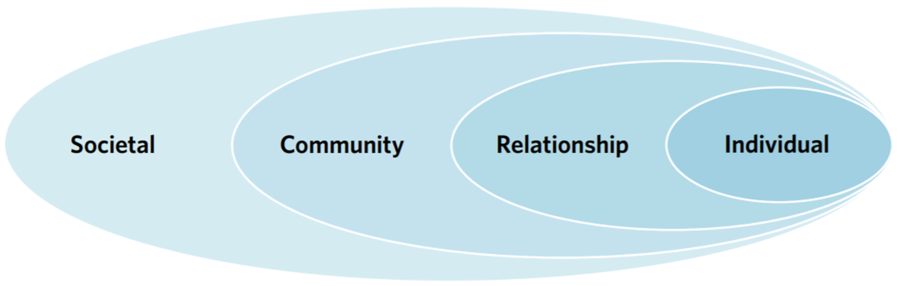
In the field of IPV, the research developed by Lori Heise stands out. In 1998, she developed her recognized and still used ecological model for understanding IPV, whose structure guides the studies related to the subject throughout the world and has been adopted as a reference by the World Health Organization (Ismayilova Reference Ismayilova2015). According to Heise (Reference Heise1998), a better understanding of IPV emerges from concentric circles that represent levels which reflect the occurrence of this violence in the several dimensions of the social structure. This multidimensional or multilevel approach originates, according to García-Moreno (2000, cited in Llorens Aguado Reference Llorens Aguado2014), in four main levels of the social ecology: individual, relationship, community and society (Figure 2). This theory emphasizes the interaction between factors at different levels and suggests that the behaviour of individuals is shaped by this interaction between the individual person and the social environment (Ali and Naylor Reference Ali and Naylor2013).
Ecological Model for Understanding Violence (World Health Organization and London School of Hygiene and Tropical Medicine 2010:18).

In a recent systematic review, Beyer, Wallis, and Hamberger (Reference Beyer, Wallis and Hamberger2015) detailed the factors that compose each of the levels of social ecology proposed by Heise, as shown in Figure 3.
Ecological Model for Understanding Intimate Partner Violence (Beyer et al. Reference Beyer, Wallis and Hamberger2015:17).

Most studies on both IPV and fear of crime have been carried out ignoring the influence of the macro-level predictors. This gap is based on the distance between the level in which such violence and fear are manifested (individual level) and the macrosystem. Nevertheless, being a complex conceptual path, sometimes with little theoretical clarity, it is necessary to further understand this type of violence (Heise Reference Heise2012). The macrosystem consists of a broad set of cultural values and beliefs that influence people’s development and behaviour (Ali and Naylor Reference Ali and Naylor2013; Dutton Reference Dutton1985). The macrosystem fundamentally differs from the other dimensions that surround individuals (i.e. micro-, meso- and exosystemic) since it does not reflect the proximal contexts that involve a specific person; instead, it reflects a general picture related to the structural pattern of societies (Bronfenbrenner Reference Bronfenbrenner1977). Regarding these factors, Heise and Kotsadam (Reference Heise and Kotsadam2015) recently carried out a multilevel analysis in 44 European countries, and the results empirically reinforce the importance of the macrosystem in the incidence of IPV, suggesting that a macro-level process affects the individual risk for IPV.
Heise (Reference Heise2012) suggests a classification of these macro-factors into three categories:
(1) Gender norms (or women’s empowerment measures), that refer to power imbalances between men and women in society, ranging from the social, legislative and institutional aspects of a country to the levels of tolerance to gender violence. All these factors guide the social system functioning and may or may not accentuate gender inequalities, determining the incidence of violence against women, particularly IPV;
(2) Macroeconomic factors, which are related to the levels of modernization, globalization and economic development of the countries. They refer, for example, to the measures associated with labour market access, economic inequalities and social inequalities. The positive combination of all these factors would make it possible to promote a more prosperous and equal social environment, inhibiting violence;
(3) Other cultural factors related to the construction of collective life, that is, factors that refer to the social, religious and cultural beliefs shared as to the moral roles to be played by men and women in a given society. A careful analysis of the phenomenon of violence requires some precautions, in order to avoid what the authors call the ecological fallacy (Beyer et al. Reference Beyer, Wallis and Hamberger2015; Courgeau and Baccaini Reference Courgeau and Baccaini1998; Kawachi, Kennedy, and Wilkinson Reference Kawachi, Kennedy and Wilkinson1999). The use of aggregate measures imposes special attention to the data interpretation, taking precautions regarding unauthorized inferences about individual behaviours (Courgeau and Baccaini Reference Courgeau and Baccaini1998:40).
Global South as a Criminological Context for Research
The Global South has been used by the scientific community to refer to those nations that lie outside the boundaries of the developed countries of North America and Western Europe. More specifically, this north/south dichotomy could also be translated, and without prejudice, into the rich/poor binomial, in which “the rich comprise the old imperial states of Europe and certain of their wealthy settler spin-offs like the USA, Canada, Australia and New Zealand (…). The poor are the rest” (Carrington et al. Reference Carrington, Hogg, Sozzo, DeKeseredy and Dragiewicz2018:5). This division is not simply about the geographical location. Instead, it is related to the manifestation of differences at the economic, social and cultural levels, accentuating the dichotomies between the north and the south, rich and poor, developed and underdeveloped. Zaffaroni (Reference Zaffaroni1988) also deals with this distancing under a binomial that he calls “centre and margin”. According to the author, the criminology of the margin – especially in South America – is a field of study that still seeks answers to the questions that emerge from the complexity and social tragedies that permeate the continent, and these questions proliferate more and more rapidly (Zaffaroni Reference Zaffaroni1988). While questions at the margin remain unanswered, responses at the centre are produced as more investment is made in scientific activities. For example, nearly half of all homicides in the world are concentrated in 20 countries in Latin America and sub-Saharan Africa. In contrast, almost 95 % of all knowledge about effective violence prevention is produced and relates directly to the realities of the USA and prosperous European countries (Eisner Reference Eisner2015). The escalating violence in the Global South has brought an increase in the feeling of insecurity of the population, and this insecurity has strong sociocultural roots (Dammert Reference Dammert2012; Lupton Reference Lupton1999; Mendoza Reference Mendoza2014). Fear of crime would be a “scapegoat”, a sentiment that would encompass all other concerns that gradually widen and permeate social life (Dammert and Malone Reference Dammert and Malone2006). Sebastian Roché (Reference Roché1993) leads to this same reasoning by pointing out that the issue of (in)security has continuously been subject to discussions because of its conceptual elasticity which allows encompassing a myriad of concerns.
The Brazilian context suggests that the escalating violence is driven by a combination of factors that share its explanation, and this set of elements cannot be ignored when trying to develop a broad understanding regarding the phenomenon. With a population of approximately 210 million people and a total area of roughly 8.5 million square kilometres (Brazilian Institute of Geography and Statistics (IBGE) 2019), Brazil is a country whose continental dimensions seem to reflect the size and complexity of its inequalities and economic and social problems. After experiencing more than 20 years of military dictatorship (1964–1985), democracy returned to the country when the Federal Constitution was promulgated in 1988. This transitional period between regimes was marked by instabilities from several orders in social, political and economic fields so that the Brazilian re-democratization seems to walk “hand in hand” with escalating violence (González Reference González2012:2). Currently, Brazil is ranked among the world’s most violent countries, due to the national average of more than 31 homicides per 100,000 inhabitants (Brazilian Forum on Public Safety 2019). In recent years, violence has become the country’s most significant health problem (Minayo Reference Minayo2006; Murray, de Castro Cerqueira, and Kahn Reference Murray, de Castro Cerqueira and Kahn2013). Violence is also a political issue that demands public investment. According to the Brazilian Forum on Public Safety (2017), in 2017, federal entities (Union, States and Municipalities) jointly invested approximately 81 billion reais (16 billion euros; $17.8 billion) in public policies against violence. In contradiction, according to the same report, the amount invested was 2.6 % lower than the one spent for the same purpose in the previous year (Brazilian Forum on Public Safety 2017).
Furthermore, Brazil is a place whose social structures are precarious, and extreme social inequality is also a reality (Beato and Reis Reference Beato and Reis2000). A study on income concentration in Brazil between the years 2006 and 2014 concluded that the levels of income inequality in the country point to a concentration of resources in the hands of the richest, who represent only 1 % of the population (De Souza and Medeiros Reference De Souza and Medeiros2017). In a very appropriate way, Wacquant (Reference Wacquant2003) notes that “Brazilian society remains characterized by vertiginous social disparities and mass poverty, which together feed the inexorable growth of criminal violence that has become the main scourge of the big cities” (Wacquant Reference Wacquant2003:199). A study conducted in the city of Salvador da Bahia highlights a strong association between violence and social inequality since those higher homicide rates were recorded in the most deprived areas of the city (Macedo et al. Reference Macedo, Paim, Silva and Costa2001). In the same way, de Resende and Andrade (Reference De Resende and Andrade2011) also suggest a strong and positive correlation between inequality and crime, especially property-related crimes.
Likewise, rates of violence against women in Brazil are also very high. In 2018, 1133 femicides and 61,032 rapes were recorded (Brazilian Forum on Public Safety 2018), which means that in Brazil, 167 women are raped daily, an average of seven victims per hour. As is well-known, rape is a crime that holds high rates of under-reporting and therefore many “black figures” so that the real dimension of female victimization is still unknown by social researchers (Lawoko et al. Reference Lawoko, Dalal, Jiayou and Jansson2007). The escalating violence is driven by a combination of factors that shares its roots, and this set of elements cannot be ignored when intending to develop a broad understanding regarding the phenomenon.
EMPIRICAL STUDY
Objective
The purpose of the present study was to understand which individual and contextual variables (macro-level) are associated with the fear of IPV (FIPV) reported by women in Brazil, through a multilevel approach.
METHODS
First, it is essential to clarify that the expression “multilevel” refers both to the theoretical framework and to the statistical analysis that were adopted. IPV has its explanations at various levels of the social ecology, and for the present study, the emphasis will be on individual-level and macro-contextual variables. Multilevel modelling is particularly appropriate to this kind of research since it accommodates more properly the hierarchical data structure, correcting the estimated standard errors to allow analysis by clustering (Koenig et al. Reference Koenig, Stephenson, Ahmed, Jejeebhoy and Campbell2006; Santos et al. Reference Santos, Ferreira, Oliveira, Dourado and Barreto2000). This exploratory study has a quantitative research design and belongs to the scope of the correlational or association analyses since it is intended to identify potential predictors of women’s FIPV both at the individual and at the macro-contextual level. Establishing the link between the macrosystem, fear of crime and IPV is a complex task because theory places these topics at far levels of the social ecology. This distance sets up obstacles to a theoretical clarification since there are several possible paths for argumentation and a significant number of variables could be studied in this complex structure.
However, some research relates the objective aspect of IPV and macro-contextual variables, and it is possible to highlight some recent studies: Ackerson and Subramanian (Reference Ackerson and Subramanian2008), Heise (Reference Heise2012), Heise and Kotsadam (Reference Heise and Kotsadam2015), Ismayilova (Reference Ismayilova2015) and Miller-Graff and Graham-Bermann (Reference Miller-Graff and Graham-Bermann2016) regarding the prevalence of IPV and macro-factors; Hayes and Boyd (Reference Hayes and Boyd2017) regarding the link between these factors and attitudes towards intimate violence.
Data Source
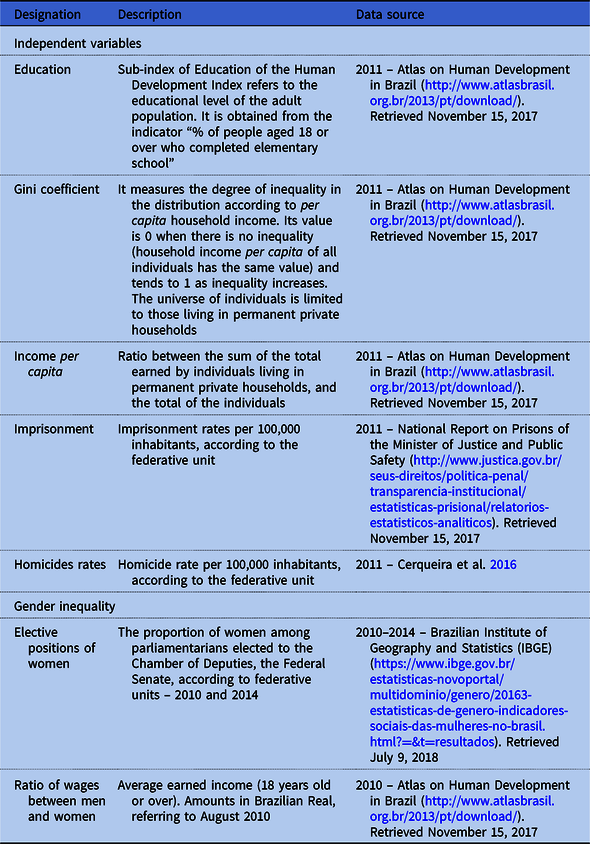
Official databases of the Brazilian Government, as well as from national research institutions, were used. Both the dependent variable and individual-level variables were retrieved from the Brazilian National Victimization Survey (BNVS) database. The other variables were obtained from four different sources as further described in Table 1. All macro-variables reflect the country reality regarding all 27 federative units and refer to the years 2010 and 2011.
Macro-Variables: Description and Data Source

Data were compiled and a set of statistical data-screening procedures was carried out as Appendix A summarizes. All individual variables were extracted from the BNVS database and relate to the period from 2010 to 2012, including the outcome variable – “fear of intimate partner violence” (FIPV). The statistical analyses were performed by using the Statistical Package for the Social Sciences (IBM SPSS software version 25).
Sample
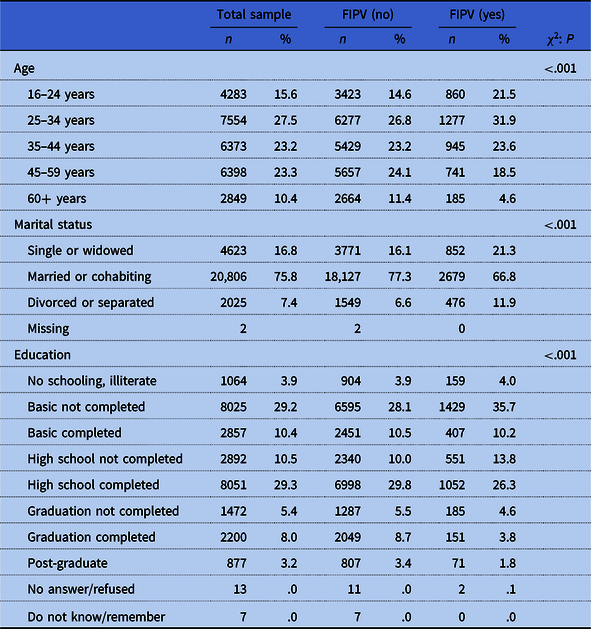
The BNVS database contains information on 78,008 respondents (37,186 men and 40,822 women). A filter was created for selecting only heterosexual women who answered “yes” or “no” to the dependent variable question (FIPV). Considering the universe of individuals belonging to the 27 federative units, there were 27,457 valid cases. Table 2 provides a sociodemographic characterization of the sample. A sample characterization, as well as a frequency table that summarizes responses gathered to the dependent variable, are presented in Table 3 and Table 4, respectively.
Sociodemographic Characterization of the Sample (n = 27,457)

FIPV, fear of intimate partner violence.
Sample Characterization According to Outcome Variable Answers (n = 27,457)

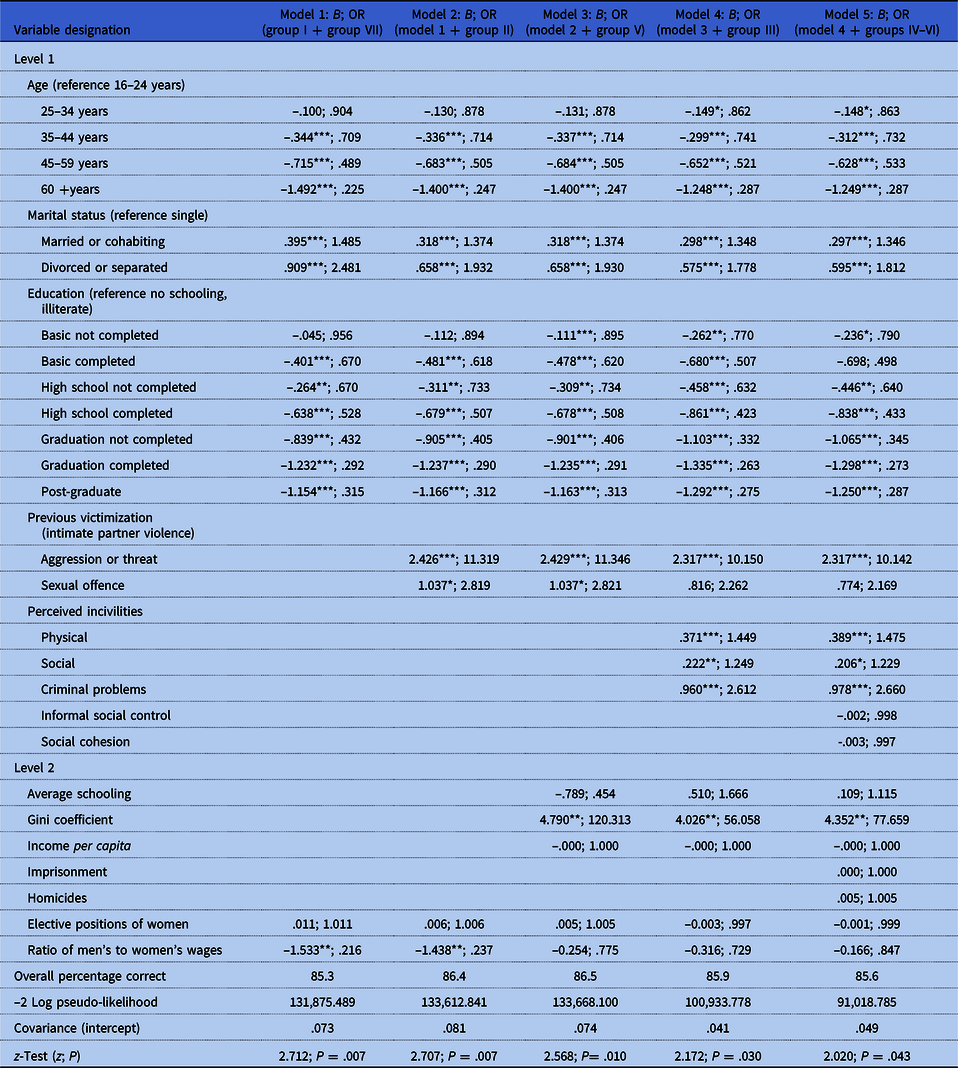
Multilevel Analysis (Outcome: Fear of Intimate Partner Violence)

OR, odds ratio.
* P <.05, ** P<.01, *** P <.001.
Variables
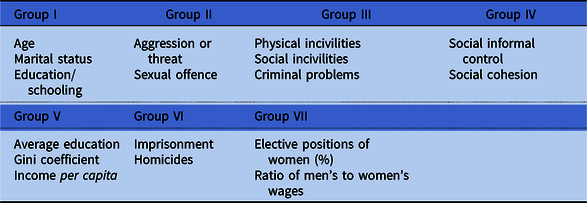
Seven groups of variables were defined according to the similar characteristics that these variables reflect. The first four groups (group I, sociodemographic profile; group II, IPV victimization; group III, perceived incivilities; group IV, collective efficacy) refer to individual variables and the other groups (group V, inequality and human development; group VI, criminal reality; group VII, gender inequality) refer to macro-contextual variables (see Table 5).
Variable Groupings

Statistical Analysis
Some preliminary analyses were performed, and data structure recommends using a multilevel statistical model since individuals included in the sample are grouped according to their federative units (states) and, hence, they present the same values for contextual variables. The null model revealed that the estimated independent term had a significant variance (z = 3.076, P = .002), so it is possible to assume a sufficiently significant variability between the independent terms of the logistic equations that correspond to the different federative units.
RESULTS
Logistic regressions were performed by groups, as Table 4 summarizes. Each column represents a regression model, and they all reflect the association between the outcome variable (FIPV), and individual and macro-contextual variables. These logistic regressions by groups are especially useful to understand the outcomes’ behaviour while other variables are included in the statistical analysis. Since this research focuses on the gender disproportion on IPV victimization and the fear reported by women, model 1 tested only the association between both groups I and VII. In this first step, results suggest a strong association between all individual-level predictors and FIPV. The range between 35 and 45 years old is the most “fearful” age for women (see odds ratio (OR) values); being separated/divorced is strongly associated with more fear than being married/cohabiting, and low levels of schooling are almost linked to higher levels of fear. Regarding group VII, just the ratio between men’s and women’s wages is negatively associated with FIPV (OR = .216; p = .001). According to model 2, having experienced physical aggression, threat and sexual violence by (ex)partner leads to higher levels of FIPV. In model 3, we introduced some other contextual variables that reflect inequality and human development at the macro-level, and from that point onwards, the ratio between men’s and women’s wages lost its statistical significance. In model 4, all variables related to the perception of incivilities and criminal problems in home areas proved to be associated to FIPV. Among them, we highlight the variable criminal problems (OR = 2.612, p < .005). Also, another important effect was observed for the Gini coefficient, which in the previous model presented a value of OR = 120.313 (p = .009) and, after having included this set of variables, OR increased to 56.058 (p = .008). Finally, among all macro-level variables that were tested (model 5), inequality (Gini coefficient) was the only one that appeared to be associated with FIPV in the final model (OR = 77.659, p = .008).
DISCUSSION
This research aims to build a theoretical and empirical bridge between the concepts of fear of crime and IPV against women, through an approach that considers both individual and macro-contextual factors which are linked to the “fear of intimate partner violence” (FIPV) felt by Brazilian women. The starting assumption is based on Heise’s (Reference Heise1998) ecological approach for IPV, which posits that this type of violence, triggered by many factors scattered throughout the various levels of social life and their interaction, jointly with other aspects of people’s lives, may lead to victimization experiences. It is important to note that so far no study has been found that explored “fear of intimate partner violence” (FIPV) as the outcome variable. Preliminary searches in online databases of scientific journals and institutional repositories were performed using groups of keywords of interest, such as “fear of crime + IPV”, “fear of crime + domestic violence”, “fear of crime + partner + violence” and “fear of crime + violence against women”. All searches were also repeated with the same keywords in both Portuguese and Spanish, but no studies were found. This lack of previous studies turns this into an exploratory research and limits its possible discussion taking into account previous studies. Therefore, the discussion integrates results from similar scientific works published (both theoretically as well as methodologically) on fear of crime and IPV.
Individual-Level Predictors
Our research suggests that women who have experienced aggression or threats of aggression are more likely to report FIPV. This result is consistent with that found in Broll (Reference Broll2014) who studied the relationship between IPV and fear of crime in a sample of Canadian women and concluded that those who had experienced physical and emotional abuse and severe physical abuse by male partners reported higher levels of fear of crime compared with women who were not victimized. Similarly, Carcach and Mukherjee (Reference Carcach and Mukherjee1999), in the Australian context, found that women who had experienced violence were more likely to report higher levels of fear of crime, and this propensity was even more evident when they reported domestic violence. This result suggests that the risk factors linked to IPV are also reflected in the outcome variable since the previous victimization was the most consistent individual predictor for FIPV.
Regarding age, this research shows that the odds of a woman reporting FIPV increases as age decreases. However, the majority of the empirical evidence related to the general fear of crime states that, in most cases, the relationship between those variables is positive (see Hale Reference Hale1996). In this study, we are facing the fear of a specific crime, which is the FIPV. Specificities of IPV allow the conclusion that this association with fear is higher among younger women since they are more exposed to the victimization risk (Peterman, Bleck, and Palermo Reference Peterman, Bleck and Palermo2015), especially those that are in reproductive age. According to Devries et al. (Reference Devries, Kishor, Johnson, Stöckl, Bacchus, Garcia-Moreno and Watts2010), the prevalence of IPV is higher among women aged 15–35 years old.
The lower the level of women’s schooling, the higher their chances of reporting FIPV, as well as victimization and fear of crime (for example, Guedes Reference Guedes2012; Kaya and Cook Reference Kaya and Cook2010; Villarreal Reference Villarreal2007). Besides, being separated or divorced also increases the odds of women reporting FIPV, which is opposite to the results obtained by Carcach and Mukherjee (Reference Carcach and Mukherjee1999) who have found that fear of crime is greater among those women who were effectively involved in an intimate relationship.
The association between perceived physical and social incivilities, criminal problems and the fear of crime has already been widely explored by the scientific community (Wilson and Kelling Reference Wilson and Kelling1982). Studies reinforce that this set of variables precipitates the feeling of insecurity in communities, mainly as these problems represents an inevitable loss of control for citizens over their home areas (Lewis Reference Lewis2017). The current study also confirms the association between these variables and the FIPV.
Collective efficacy was not associated with FIPV. This result is contrary to some traditional studies on fear of crime (for example, Sampson, Raudenbush, and Earls Reference Sampson, Raudenbush and Earls1997). The negative association between collective efficacy and IPV was also studied by Browning (Reference Browning2002), and their results suggest that both social cohesion and informal social control were negatively associated with numbers of intimate homicide and non-lethal IPV. Besides, these authors also found that higher levels of collective efficacy create a more socially supportive environment by making women victims of IPV find support. Like Browning (Reference Browning2002), Wright and Benson (Reference Wright and Benson2011) also found a negative association between collective efficacy and IPV within Chicago neighbourhoods.
Macro-Level Predictors
The Gini coefficient was the most consistent macro-variable in the prediction of FIPV in all models. This result suggests that social inequalities are an important explanatory factor for violence, including violence in intimate relationships. Therefore, fear of crime cannot be seen isolated from other insecurities in local and national contexts (Dammert Reference Dammert2012; Pantazis Reference Pantazis2000; Roché Reference Roché1993). As well pointed out by Wilkinson and Pickett (Reference Wilkinson and Pickett2009), unequal societies are fertile ground for growing social problems, especially violence and also insecurity.
On the other hand, after having included other macro-variables into the statistical model (especially the Gini coefficient), gender inequalities lost their association with FIPV. This result is contrary to what the empirical evidence has shown regarding the association between these indicators and IPV (for example, Ackerson and Subramanian Reference Ackerson and Subramanian2008; Heise and Kotsadam Reference Heise and Kotsadam2015). Perhaps, other indicators already mentioned in previous research, such as, for example, those used by Heise and Kotsadam (Reference Heise and Kotsadam2015) concerning women’s access to the labour market, acceptance of gender violence and prevalence of control behaviours in the relationship, would lead to different results. However, there are few options on disaggregated data available in Brazil for the period covered by this research.
All other macro-variables added to model 5 (average schooling, Gini coefficient, income per capita, imprisonment and homicides rates) were not associated with FIPV. Thus, insecurity or fear of crime – represented by our variable outcome (FIPV) – seems to be embedded in roots of deep social inequalities (as referred to by Stanko Reference Stanko, Hope and Sparks2000, cited in Kristjánsson Reference Kristjánsson2007). Although IPV and fear of crime are critical and cross-cutting issues, their incidence remains linked to a set of social motivations. Unequal societies tend to be more violent, mainly because of the quality of social relations, which tend to be weaker (Wilkinson Reference Wilkinson2004). Sanz-Barbero et al. (Reference Sanz-Barbero, Vives-Cases, Otero-García, Muntaner, Torrubiano-Domínguez and O’Campo2015), through multilevel regressions, addressed the association between social inequality and IPV in the Spanish context and found that inequality increases the chances of reporting IPV by women. In the same way, the association between social inequality (Gini coefficient) and fear of crime has also recently been studied at the European level by Vauclair and Bratanova (Reference Vauclair and Bratanova2017), and their findings point out that individuals living in locations with higher levels of social inequality are also those that report the greatest fear of crime.
CONCLUSION AND LIMITATIONS
Fear of crime is a symptom. This symptom reflects many insecurities experienced in social life, especially in Brazil. Our findings suggest that this symptom has both individual and social roots. The previous victimization by IPV and social inequality potentiate this feeling in the lives of Brazilian women, and from the present work, it is possible to assert that the reduction of social inequalities, as well as the investment in public policies to combat IPV, are ways which lead to the reduction of this fear. This study was carried out following recommendations that have been raised by researchers about the need to integrate fear of crime into the so-called “new crimes”, including IPV (Carcach and Mukherjee Reference Carcach and Mukherjee1999; Jarrett-Luck Reference Jarrett-Luck2015).
Finally, no scientific research is intended to be perfect or immune to some limitations and this study is no exception. The absence of previous studies on this topic strongly restricted the discussion of our results. Among the main limitations is the fact that there is no specific section on intimate violence in the database used. Also, methodological triangulation would be an asset since the fear of crime is an emotion that falls within the scope of subjective experiences, which can be better understood through qualitative methods. Nevertheless, this study fills one of the great gaps regarding the studies about the fear of crime.
Acknowledgements
We want to thank you the International Society of Criminology and the United Nations Office on Drugs and Crime for promoting the research paper competition in 2019, which has made possible this publication.
Appendix A. Individual-Level Variables (Brazilian National Victimization Survey Database): Metrics and Operationalization

Camila Iglesias is a PhD student in Criminology at the School of Criminology, Faculty of Law of the University of Porto, Portugal.
Carla Cardoso, PhD, is an Assistant Professor at the School of Criminology, Faculty of Law of the University of Porto, Portugal.
Pedro Sousa has a PhD in Economics, and is an Assistant Professor and Director of the Master’s Programme in Criminology at the School of Criminology, Faculty of Law of the University of Porto, Portugal.