Introduction
Allergic rhinitis (AR) represents an inflammatory disorder of the nasal mucosa that begins with an immune response mediated by IgE antibodies against inhaled allergens (e.g., dust mites, molds, and animal dander) in sensitized individuals. This disease is characterized by the presence of rhinorrhea, nasal congestion, and sneezing (Reference Greiner, Hellings, Rotiroti and Scadding1). AR is a common disease in children, affecting approximately 13 percent of children aged 6 and 7 years in South America. Children with AR can suffer from impaired school performance, anxiety, and social dysfunction (Reference Barr, Al-Reefy, Fox and Hopkins2).
AR has been classified traditionally as seasonal, when symptoms occur only during certain periods of the year (caused mostly by pollen or allergens outside the home), and perennial, when symptoms occur permanently throughout the year (caused by indoor allergens such as dust mites and animal dander). Besides, according to the frequency of symptoms, AR is classified into intermittent AR, when symptoms occur for less than 4 days a week or for less than four consecutive weeks, and persistent AR, when symptoms occur for more than 4 days a week or for more than four consecutive weeks. In addition, according to the severity of the symptoms and their impact on the quality of life (QoL) of patients, AR is classified as mild, when the symptoms do not interfere with the patients’ lives, and moderate/severe, when the symptoms they alter the QoL of the patient, this includes, the alteration of sleep and school activities (Reference Bousquet, Khaltaev and Cruz3).
The management of AR in children includes avoidance of allergens, nasal irrigation, and pharmacotherapy, the last recommended for persistent, moderate, or severe cases. There are different types of medications for the treatment of AR, including oral or intranasal antihistamines, intranasal corticosteroids (INCS), and leukotriene receptor antagonists (LTRAs). Currently, INCS are the mainstay of pharmacotherapy for AR in children (Reference Barr, Al-Reefy, Fox and Hopkins2;Reference Bousquet, Khaltaev and Cruz3), as they have shown superior efficacy in controlling nasal symptoms compared to antihistamines and LTRAs. No clear evidence conveys that one INCS is more effective than another (Reference Wise, Damask and Roland4;5).
Fluticasone furoate is a second generation INCS used to treat the symptoms of AR in adults and children. It is indicated in a dose of 55 or 110 μg once daily. Although the results of a systematic review has shown that fluticasone furoate nasal spray (FFNS) is statistically superior to placebo in reducing nasal and ocular symptoms in adolescents and adults with AR (Reference Rodrigo and Neffen6), there is still uncertainty about its clinical effectiveness in the pediatric population. Thus, a comprehensive review was conducted to investigate the clinical effectiveness of FFNS in children with perennial AR. More specifically, this review aimed to answer to the following question: Is FFNS more effective than placebo in reducing symptoms in children with perennial AR?
Methods
This review was carried out following the recommendations of Preferred Reporting Items for Systematic reviews and Meta-Analyzes (PRISMA) (Reference Moher, Liberati and Tetzlaff7) and the Cochrane Handbook for Systematic Reviews of Interventions (8). The PRISMA checklist is provided in Supplementary Table 1. The protocol is provided in Supplementary Table 2. Neither ethics approval nor patient consent was required for this analysis.
Selection criteria and outcomes
The population of interest was patients aged 2–11 years with perennial AR. The selection was limited to randomized controlled trials (RCTs), comparing FFNS with placebo. RCTs were the study design selected for inclusion in this review as they provide much stronger evidence than observational studies. This is because the randomization process can minimize differences in group characteristics that may influence outcome; and thus, providing the most definitive evidence on the impact of the intervention on the outcome.
Primary outcomes were reflective and instantaneous total nasal symptoms scores (rTNSS and iTNSS) and reflective and instantaneous total ocular symptom scores (rTOSS and iTOSS). The TNSS is defined as the sum of the patient scores of four individual nasal symptoms (rhinorrhea, nasal congestion, sneezing, and nasal itching) on a scale of severity categorized from 0 to 3 (0 = absent, 1 = mild, 2 = moderate, 3 = severe; twelve-point scale). The TOSS is defined as the sum of the patient scores of three individual ocular symptoms (itching, tearing, and redness) on a scale of severity categorized from 0 to 3 (0 = absent, 1 = mild, 2 = moderate, 3 = severe; nine-point scale). The rTNSS and rTOSS are the average of the morning and evening assessments. The iTNSS and iTOSS are measured in the morning immediately before taking the next dose. Secondary outcomes were QoL and adverse events. There was no minimum duration of follow-up.
Search strategy
Searches were performed in two databases (PubMed and Embase) twice; the primary search was done on 26 January 2021, and then updated on 21 April 2023. Search terms were related to fluticasone furoate and allergic rhinitis. Complementary manual searches were performed in the reference lists of the full texts evaluated. The search was limited to articles written in English and/or Spanish and full papers only. Search strategies are shown in Supplementary Table 3.
After conducting the search in the selected databases, all references retrieved were downloaded, combined, and prepared for the screening process. Merging of search results and elimination of duplicates were performed using reference management software (Mendeley).
Study selection
One reviewer screened the retrieved titles and abstracts for potential inclusion, and reviewed the full text of potential studies. The selection of articles was performed using a web-based application (Rayyan).
Data extraction
One reviewer extracted the data of studies that met the inclusion criteria. Data were extracted using a Microsoft Excel Spreadsheet. The following data were extracted: general information (e.g., author, year of publication, study objective, and source of funding), interventions data (e.g., intervention group, control group, intervention site, duration of intervention, and length of follow-up), study’s characteristics (e.g., method of randomization, allocation concealment, blinding, and numbers included in the study), population characteristics (e.g., target population, inclusion criteria, characteristics of participants at baseline, age, and percent male), outcomes (i.e., definitions), analysis (e.g., statistical techniques, intention to treat analysis, power calculation, attrition rates, compliance with study treatment, adherence to study treatment, and co-interventions), effectiveness results, and safety results. If the outcomes of interest were not reported in the manuscripts, data from the GSK Study Register website was extracted.
Quality assessment
A quality assessment of the selected RCTs was carried out using the Cochrane’s risk of bias tool available in the Cochrane’s Review Manager software (RevMan 5.4). The tool consisted of seven domains: random sequence generation (selection bias), allocation concealment (selection bias), blinding of participants and personnel (performance bias), blinding of outcome assessment (detection bias), incomplete outcome data (attrition bias), selective reporting (reporting bias), and other possible sources of bias. Each domain was assessed as one of the following levels: “low risk” of bias, “unclear risk” of bias, and “high risk” of bias (Reference Higgins and Sterne9). Quality assessment was performed in parallel with data extraction by the same researcher. “Risk of bias graph” and “Risk of bias summary” figures were generated using RevMan 5.4. The overall quality of evidence was assessed using the Grading of Recommendations, Assessment, Development and Evaluation (GRADE) approach (Reference Guyatt, Oxman and Vist10).
Strategy for data synthesis
A meta-analysis was carried out to combine the results of the effect of fluticasone furoate from clinical trials that met the eligibility criteria. Meta-analyses were performed using RevMan 5.4. A random-effects model was used to pool study results. A sensitivity analysis using a fixed-effects model was also conducted when there was low statistical heterogeneity. For continuous outcomes, the standardized mean difference (SMD) with the 95 percent confidence intervals (CIs) was calculated. A sensitivity analysis using the mean difference (MD) was also performed. Binary outcomes were pooled using common relative risks (RRs) and 95 percent CIs. I square (I 2) statistic was calculated to estimate statistical heterogeneity across studies. The level of heterogeneity was defined as low (<25 percent), moderate (25–50 percent), or high (≥50 percent) (Reference Higgins, Thompson, Deeks and Altman11). Separate analyses were performed both for short-term (≤6 weeks) and long-term (>6 weeks) treatment studies, for the effectiveness outcomes. P-values ≤0.05 were considered statistically significant. Since fewer than ten studies were identified, funnel plots were not constructed to assess publication bias.
Minimum clinically important difference (MCID).
In the absence of a gold-standard MCID for symptom rating scales in PAR patients, effects were considered clinically important if the pooled SMD and 95 percent CI exceeded the threshold of −0.20, which represents a small treatment effect according to the Cohen’s criteria. In addition, the anchor-based MCID proposed by Barnes et al. (Reference Barnes, Vaidyanathan, Williamson and Lipworth12) was used. Accordingly, effects on TNSS (twelve-point scale) were considered clinically important if the pooled MD and 95 percent CI exceeded the threshold of −0.28 (Reference Barnes, Vaidyanathan, Williamson and Lipworth12). The MCID was only examined if the mean reduction in symptoms was statistically significant.
Results
Selection of studies
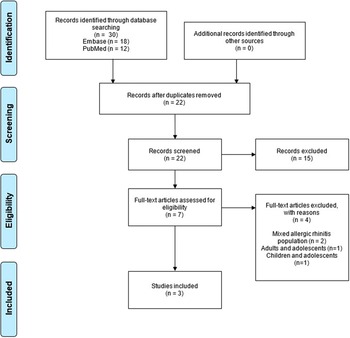
Overall, thirty records were retrieved, and twenty-two records remain after removing duplicates. Based on title and abstract screening, fifteen articles were excluded, and seven articles were retrieved and assessed for eligibility. Of these, four were excluded for not corresponding to the target population: mixed allergic rhinitis population (n = 2) (Reference Meltzer, Tripathy, Máspero, Wu and Philpot13;Reference Zhang, Wei and Chen14), adults and adolescents older than 12 years, n = 1 (Reference Wu, Walters, Nadeau, Botnick and Broughton15), and children and adolescents older than 12 years (n = 1) (Reference Okubo, Okamasa, Honma and Komatsubara16). The remaining three articles were included in this review (Reference Tripathy, Levy, Ratner, Clements, Wu and Philpot17–Reference Lee, Sterling, Máspero, Clements, Ellsworth and Pedersen19) (Figure 1).
PRISMA flow diagram of study inclusion.

Study characteristics
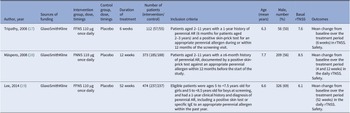
The characteristics of the included studies are shown in Table 1. All studies were sponsored by GlaxoSmithKline and evaluated FFNS at a dose of 110 μg once daily. In addition, one study also evaluated FFNS at a dose of 55 μg once daily (Reference Máspero, Rosenblut, Finn, Lim, Wu and Philpot18). For the purpose of this analysis, the dose of 110 μg once daily (included in all studies) was selected for comparison with placebo. The trials were published between 2008 and 2014. All trials had a double-blind, parallel group design, and their median follow-up ranged from 6 weeks to 52 weeks. Baseline rTNSS ranged from 6.1 to 8.5, but was similar between groups (drug vs. placebo) within the same trial. The studied populations ranged in size from 112 to 474 and were of similar age (range: 6.3–7.7 years). All trials included pediatric patients with perennial AR and a positive skin-prick test against an appropriate perennial allergen within 12 months before the start of the study. All studies evaluated safety and mean change from baseline over the treatment period in rTNSS as secondary outcomes. None evaluated the iTNSS, ocular symptoms, and QoL.
Baseline characteristics of randomized controlled trials

Abbreviations: AR, allergic rhinitis; FFNS, fluticasone furoate nasal spray; rTNSS, reflective total nasal symptom score.
Risk of bias within studies
The summary and overall assessment of risk of bias for the three included studies is shown in Supplementary Figures 1 and 2, respectively. All studies reported unclear risk of bias in the random sequence generation, allocation concealment, and blinding of outcome assessment, and low risk of bias in the blinding of participants and personnel and selective reporting. One study had a high risk of attrition bias due to incomplete outcome data (more than 40 percent of participants withdrew from the study, mainly due to withdrawal of consent and protocol deviation) (Reference Lee, Sterling, Máspero, Clements, Ellsworth and Pedersen19). Risk of bias due to industry sponsorship was rated high in all studies. The overall quality of evidence was rated low for both nasal symptoms and safety outcomes mainly due to risk of bias and imprecision (wide confidence intervals and/or few events).
Nasal symptoms
Two trials provided information on the short-term effect of FFNS 100 μg on nasal symptoms (rTNSS) (Reference Tripathy, Levy, Ratner, Clements, Wu and Philpot17;Reference Máspero, Rosenblut, Finn, Lim, Wu and Philpot18). The results showed no difference in effect between FFNS and placebo during a follow-up period of 4–6 weeks (p = 0.25) (Supplementary Table 4 and Figure 2). The meta-analysis showed a moderate grade of heterogeneity (I 2 = 35 percent). Similar results were obtained using the MD (Supplementary Table 5 and Supplementary Figure 3).
Reflective total nasal symptoms scores at 4–6 weeks: meta-analysis of two trials comparing FFNS with placebo. Effect measure: standardized mean difference.

Two trials evaluated the long-term effect of FFNS 110 μg on rTNSS (Reference Máspero, Rosenblut, Finn, Lim, Wu and Philpot18;Reference Lee, Sterling, Máspero, Clements, Ellsworth and Pedersen19). Pediatric patients treated with FFNS, compared to those treated with placebo, showed a significant mean reduction in rTNSS score of −0.18 (95 percent CI, −0.35 to −0.01, p = 0.03) during a follow-up period of 12–52 weeks (Supplementary Table 6 and Figure 3). However, given that the mean reduction did not reach the value of the MCID according to the Cohen’s methodology (SMD −0.20), these results were considered as clinically nonrelevant. Besides, the meta-analysis showed moderate heterogeneity (I 2 = 36 percent). When the MD was used instead of the SMD, there was no significant mean reduction in rTNSS score (Supplementary Table 7 and Supplementary Figure 4).
Reflective total nasal symptoms scores at 12–52 weeks: meta-analysis of two trials comparing FFNS with placebo. Effect measure: standardized mean difference.

Safety
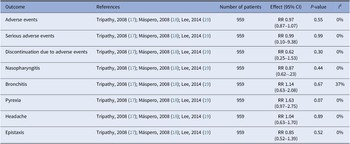
The results of the safety outcomes are shown in Table 2. No significant differences were found between FFNS and placebo in the rate of total adverse events (56.6 vs. 58.3 percent) (Supplementary Figure 5), serious adverse events (0.2 vs. 0.2 percent) (Supplementary Figure 6), and discontinuation due to adverse events (1.8 vs. 2.9 percent) (Supplementary Figure 7). The most frequent adverse events were nasopharyngitis (11.1 vs. 12.7 percent) (Supplementary Figure 8), bronchitis (8.8 vs. 7.3 percent) (Supplementary Figure 9), pyrexia (7.3 vs. 4.4 percent) (Supplementary Figure 10), headache (6.1 vs. 5.8 percent) (Supplementary Figure 11), and epistaxis (5.9 vs. 6.9 percent) (Supplementary Figure 12), with no significant differences between groups. Regarding consistency, the meta-analyses of safety outcomes showed very low heterogeneity, except for bronchitis (I 2 = 37 percent). Identical RRs (95 percent CI) were found using the random- or fixed-effects models.
Analysis of safety outcomes: FFNS versus placebo

Abbreviations: 95% CI, 95% confidence interval; RR, relative risk.
Discussion
To the best of author’s knowledge, this is the first comprehensive review to investigate the clinical effectiveness of FFNS 110 μg once daily against placebo in children with perennial AR. Three RCTs met the inclusion criteria. The findings showed a statistically significant, but not clinical significant, improvement in nasal symptoms with long-term use of FFNS. No statistically significant effects were found on nasal symptoms with short-term use of FFNS. Safety outcomes with FFNS were similar to placebo. None of the studies evaluated ocular symptoms and QoL.
A previous systematic review comparing the effectiveness of FFNS with placebo on symptoms in patients with perennial AR concluded that the evidence was limited for children and that the overall results for adults and adolescents could not be extrapolated to the pediatric population (Reference Rodrigo and Neffen6). Although this systematic review was conducted a decade ago, to date there is still limited evidence regarding the clinical effectiveness of FFNS in children with perennial AR. Of note, the effects of FFNS in adults and adolescents appear to be of greater magnitude than those observed in children. Indeed, a recent systematic review, published as a conference abstract, reported that the effect of FFNS 110 μg over placebo on rTNSS in adults and adolescents with perennial AR was SMD −0.390 (95 percent CI −0.476 to −0.303, p < 0.001) in the short term and that similar results were observed in the long term (Reference Rivera Ramirez and Fiestas Saldarriaga20). Taking into account Cohen’s methodology and the MCID value of −0.20, the effects of FFNS would be clinically relevant in adults and adolescents but not in children 2–12 years of age.
The three RCTs included in this comprehensive review had several limitations. First, all studies had an unclear risk of detection bias because blinding of outcome assessments was not specified. Second, all the studies were at high risk of industry bias because they were funded by the company that produces FFNS. Third, the study with the largest sample and longest follow-up had a high risk of attrition bias due to the incomplete data outcome. Fourth, all studies were underpowered to assess rare and long-term adverse events. Thus, the overall quality of evidence was rated low for both nasal symptoms and safety outcomes mainly due to risk of bias and/or serious imprecision.
Concerns with long-term use of FFNS include its possible systemic effects on growth retardation in children. One of the studies included in this review evaluated the effects of FFNS on growth velocity as the main outcome (Reference Lee, Sterling, Máspero, Clements, Ellsworth and Pedersen19). This study reported a reduction in growth rate after 52 weeks of treatment with FFNS 110 μg once daily compared with placebo. The authors concluded that clinicians must weigh the benefits and harms before recommending FFNS in children. This uncertainty regarding long-term growth suppression is not unique to FFNS but to all INCS (Reference Wise, Damask and Roland4), since to date no comparative studies (RCTs or observational studies) with follow-ups longer than 52 weeks have been published (Reference Wise, Damask and Roland4;Reference Donaldson, Choby, Kim, Marks and Lal21). In addition, other INCS, such as the first-generation agents triamcinolone acetonide and beclomethasone dipropionate, have also been shown to reduce growth in children in 52-week follow-up RCTs (Reference Donaldson, Choby, Kim, Marks and Lal21). Consequently, some guidelines recommend administering the lowest effective dose of INCS to avoid negative effects on growth, in addition to periodically monitoring growth in children who use these drugs in the long term (Reference Wise, Damask and Roland4). Others suggest to use the intranasal steroid preparations that have not been shown to have any negative impact on growth in children, such as the second-generation agents fluticasone propionate and mometasone furoate (Reference Seidman, Gurgel and Lin22). Overall, further studies are still needed to investigate the effects of FFNS and, in general, INCS, on long-term safety.
The findings of this review are not consistent with the guideline recommendations for the management of AR in children ≥2 years and adults. In fact, the American Academy of Otolaryngology – Head and Neck Surgery Foundation (AAO-HNSF), the International Consensus Statement on Allergy and Rhinology (ICAR), and the British Society of Allergy and Clinical Immunology (BSACI) recommend the use of INCS as first-line treatment in patients with AR (Reference Wise, Damask and Roland4;Reference Seidman, Gurgel and Lin22;Reference Scadding, Kariyawasam and Scadding23). However, it should be noted that this recommendation is very general and does not consider possible differences in relevant characteristics such as the type of INCS, the clinical condition (seasonal/perennial AR), and the patient population (adults/children). In accordance with the guidelines, the INCS recommendation is based on their efficacy, superiority over other therapies, and good safety record (Reference Wise, Damask and Roland4;Reference Seidman, Gurgel and Lin22;Reference Scadding, Kariyawasam and Scadding23). However, it should be noted that comparative trials have, for the most part, been limited to adults and adolescents, so extrapolation to the pediatric population should be done with caution (Reference Brożek, Bousquet and Agache24). In this regard, the Allergic Rhinitis and its Impact on Asthma (ARIA) guidelines mention that although one can assume that the relative effects of AR treatment are probably similar between adults and children, adverse effect may be more or less frequent, and their perception and importance may be different (Reference Brożek, Bousquet and Agache24). With respect to therapy approaches, the ARIA guidelines recommend either a combination of an INCS with an intranasal antihistamine or an INCS alone in patients with perennial AR, although it states that combination therapy might act faster than an INCS alone (Reference Brożek, Bousquet and Agache24). On the other hand, the AAO-HNSF, ICAR, and BSACI only recommend combination therapy in patients with AR who have inadequate response to INCS alone (Reference Wise, Damask and Roland4;Reference Seidman, Gurgel and Lin22;Reference Scadding, Kariyawasam and Scadding23). In addition, some guidelines recommend the use of saline irrigation as an adjunctive treatment in children with AR, as it has been shown to be safe and effective in reducing symptoms and may reduce the amount of drug therapy needed (Reference Wise, Damask and Roland4;Reference Scadding, Kariyawasam and Scadding23). Although not mentioned in a clinical guideline, a systematic review concluded that saline irrigation may be an alternative therapy for children with AR as no difference was found between saline irrigation and INCS in children (Reference Wang, Jin, Liu, Fan, Qin and Yu25). In contrast, in adults, INCS were superior to saline irrigation (Reference Wang, Jin, Liu, Fan, Qin and Yu25), supporting the previously mentioned hypothesis that INCS (FFNS) may be less effective in children than in adults and adolescents. However, more high-quality and adequately powered research is warranted in this area. In general, until more robust evidence is available, decisions about the use of INCS in pediatric AR should be guided by the physician’s clinical experience and individual patient circumstances and preferences.
Limitations of this comprehensive review includes that data selection and extraction were not performed in duplicate and analyzes were based on few studies. In addition, the efficacy analyzes were statistically heterogeneous, indicating variability in treatment effects. This variability could be due to clinical and/or methodological diversity, biases, or chances. On the other hand, although the analyzes were based only on a 110 μg dose of FFNS, the long-term results (12 weeks) with the 55 μg dose suggest that the effects on nasal symptoms are similar to those obtained with the 110 μg dose in children with perennial AR (Reference Máspero, Rosenblut, Finn, Lim, Wu and Philpot18). Despite limitations, this review shows the lack of sound evidence on the clinical effectiveness of FFNS in children to inform decision making in clinical practice and drug financing. No ongoing trials of FFNS in children with AR have been identified in ClinicalTrials.gov.
Conclusion
The currently available evidence suggests that FFNS, compared to placebo, does not produce a meaningful clinical effect on nasal symptom in children with perennial AR. This conclusion was based on three studies that provided weak evidence on the short-term and long-term use of FFNS. Future RCTs are needed to clarify the uncertainty of the effect of FFNS on symptoms, QoL, and safety in children with perennial AR.
Supplementary material
The supplementary material for this article can be found at https://doi.org/10.1017/S026646232300034X.
Author contribution
P.A.R.: Conceptualization, methodology, formal analysis, investigation, writing – original draft, and project administration.
Funding statement
This research received no specific grant from any funding agency, commercial or not-for-profit sectors.
Competing interest
The author declare that she has no known competing financial interests or personal relationships that could have appeared to influence the work reported in this paper.