




No CrossRef data available.
Article contents
Anicius Auchenius Bassus, African Red Slip Ware, and the Church
Published online by Cambridge University Press: 20 September 2005
Extract
Some years ago a rectangular ceramic panel appeared at auction in London and made its way to Boston (fig. 1). The object was purchased by Cornelius C. Vermeule III, who placed it on loan to the Museum of Fine Arts in Boston. The technical term in English to describe the fabric of this kind of ceramic is “African Red Slip” ware—abbreviated ARS. The term was coined by John Hayes, a scholar who has done important work in classifying these wares. In Italian, the name that is used is “terra sigillata chiara” or “light terra sigillata,” to distinguish it from “terra sigillata,” its counterpart in Italy and Gaul. The latter has a deep-red color and a high-gloss surface, while the African variety is less shiny and light orange in color.
Information
- Type
- ARTICLES
- Information
- Copyright
- © 2005 Cambridge University Press
The Object
Some years ago a rectangular ceramic panel appeared at auction in London and made its way to Boston (fig. 1).1
See Bonhams, Antiquities, Auction 7 November 2002, lot 413. According to the auction house it came from El Djem (ancient Thysdrus), Tunisia, where it had been acquired in the late 1970s.
For an introduction see John J. Herrmann, Jr. and Annewies van den Hoek, Light From the Age of Augustine: Late Antique Ceramics from North Africa (1st ed., Cambridge, Mass.: Harvard Divinity School, 2002; 2d ed., Austin: Institute for the Study of Antiquity and Christian Origins of the University of Texas at Austin, 2003); see also the website of the Institute for the Study of Antiquity and Christian Origins at the University of Texas at Austin, http://www.utexas.edu/research/isac/light.
John W. Hayes, Late Roman Pottery (London: British School at Rome, 1972); “Ceramica africana,” in Ceramica fi ne romana nel bacino Mediterraneo, vol. 1 of Enciclopedia dell'arte antica classica e orientale: Atlante delle forme ceramiche (ed. A. Carandini, S. Saguí, S. Tortorella, and I. Tortorici; Roma: Istituto della Enciclopedia italiana, 1981) 9–227, pls. 13–109.

African Red Slip Ware cover, Tunisia, c. 408 C.E. Collection of Cornelius C. Vermeule III, on loan to the Museum of Fine Arts, Boston (photo: author).
The object has the rectilinear shape of a lanx, which is a large-size rectangular platter commonly produced in ARS, but this object does not show other characteristics of a lanx: a deep floor, elevated borders, and a low foot. At first glance the unusual object, whose dimensions are 43.5 × 31.5 × 7.5 cm, looks like a large tile. It is mold-made and shows three figures on its upper surface. In the center stands a Roman consul, identifi ed by his senatorial costume (toga worn over a tunic and boots tied with long straps) and his consular attributes (the mappa and the scepter). The mappa was a piece of cloth wrapped into a ball. The emperor or magistrate would drop the cloth as a signal to start the games, and in late Roman iconography it became one of the principal consular attributes. The consul appears in a rectangular frame, in whose upper part are curtains that have been pulled aside. He is flanked by the apostles Peter and Paul, who are seated on thrones or high-backed chairs with footstools. The apostles wear the mantle (pallium and tunic of Greek philosophers and sandals rather than boots. Peter has a short beard and holds a book. Paul is balding and has a long beard. Both gesture with their right hands in a manner suggesting speech. A rectangular frame of vine tendrils encloses the three figures. These images were made from stamps impressed into the mold used to cast the rectangular object. Rectangular indentations around the figures probably reflect the outer contour of the stamps. The figures were then touched up with a pointed tool such as a knife or stick.
The clay of the object (henceforth “cover”) has the typical red orange color of ARS ware but is rather coarse and loose in structure. The lower right side shows a crack and substantial restoration. A picture taken before this restoration shows that two sections are missing: the lower right corner, including the left leg and the right foot of the apostle Paul, and a small section of the upper right corner (fig. 2). In spite of its matte texture, the cover should be considered African Red Slip ware, since all three figures and the vine frame are known from other works in ARS.4
See Jan Willem Salomonson, “Late-Roman Earthenware with Relief Decoration Found in Northern Africa and Egypt,” OMRL 43 (1962) 53–95, esp. 62 and pls. XVII–XVIII. See also idem, “Spätrömische rote Tonware mit Reliefverzierung aus nordafrikanischen Werkstätten. Entwicklungsgeschichtliche Untersuchungen zur Reliefgeschmückten Terra Sigillata Chiara ‘C,’ ” BABesch 44 (1969) 4–109. Idem, “Römische Tonformen mit Inschriften, ein Beitrag zum Problem der sogenannten ‘Kuchenformen’ aus Ostia,” BABesch 47 (1972) 88–113. Idem, “Kunstgeschichtliche und ikonographische Untersuchungen zu einem Tonfragment der Sammlung Benaki in Athen,” BABesch 48 (1973) 5–82.

African Red Slip Ware cover, Tunisia, c. 408 C.E., before restoration. (photo: courtesy of J. W. Salomonson).
The underside of the object is closed on three sides by broad flanges (fig. 3). One side is left open—that above the heads of the figures—but a pair of low ridges separated by a groove runs along this edge. A part of the ridges at the right has been broken away. At the left there is an indentation in the flange that corresponds to the groove between the ridges. The flanges and the ridges suggest a practical function for the object. It could have been employed to cover another rectangular object, such as a box. The flanges would have overlapped the sides of the box. The ridges on the open side suggest a kind of hinge arrangement so that the lid could have been rotated open: a wooden dowel could have been placed in the groove between the ridges and anchored in the indentation on the left side. Rectangular boxes of this general size were used since the early Roman Empire to store documents and eventually precious items such as relics.5
See Helmut Buschhausen, Die spätrömischen Metallscrinia und frühchristlichen Reliquiare (Vienna: Böhlau in Komm, 1971).

Underside of African Red Slip Ware cover, Tunisia, c. 408 C.E. Collection of Cornelius C. Vermeule III, on loan to the Museum of Fine Arts, Boston (photo: author).
While the figures may be known individually, this particular composition, two apostles flanking a consul, has not been recognized until now.6
Hardly any image in ARS exists that is not duplicated in one way or another.
The usual composition with a cross in the middle is called the “guarding of the cross,” after the German Kreuzwache. For the reconstruction, see Salomonson, “Sammlung Benaki,” 19, fig. 11. Salomonson discusses the possible origins of such plates as covers of small boxes; their original models could have been made of ivory or silver, such as the Pola casket now in Venice (ibid., n. 53). Salomonson also reviews the iconography of the juxtaposition of Peter and Paul (ibid., 21 nn. 57–58). He points out that the Concordia Apostolorum reflects the polemical situation of that time between Catholics and Donatists. The Catholics underwrote the idea of the universality of the (Roman) church, represented here by the images of the two apostles. Thus the iconography of Peter and Paul would have served as a propagandistic tool for the Catholics against their Donatist adversaries. In a similar way, other reminiscences of the city of Rome were present on ARS lanxes. For example, high officials presiding over the games are shown in their official boxes. Ivory panels with similar representations circulated in Italy, but the production of such images in ARS was primarily an African affair, destined for the local markets. Salomonson also points out the strong connections between some senatorial families, for instance, the Anicii, Valerii, Symmachi, and Ceionii, and the African provinces because of their landholdings (ibid., 17 n. 50).
See, for example, a lamp in the Benaki Museum in Athens, inv. 11864. An unpublished bowl (Hayes form 53A) with the two apostles is on view in the Römisch-Germanisches Zentral Museum in Mainz, inv. O 41460. In this instance the bowl, which is reconstructed from large fragments, shows the two apostles without a cross in the center.

Reconstruction of an African Red Slip Ware lanx with seated Peter and Paul (line drawing: courtesy of J. W. Salomonson).
Less well known on ARS than the princes of the apostles is the portrait of the consul on the Vermeule cover. Two identical images of this consul occur on ARS fragments in collections in Carthage (fig. 5a–b)9
See Salomonson, “Late-Roman Earthenware” 65–66, figs. 19, 3a–b; idem, “Spätrömische rote Tonware,” 9, fig. 7; idem, “Sammlung Benaki,” 11 and 13, fig. 2; Jochen Garbsch, “Spätantike Sigillata-Tabletts,” BVBl 45 (1980) 182 and fig. 25.
The present location of this object is unknown; see Het verhaal bij het materiaal. Een kennismaking met de archeologische studieverzameling van de Utrechtse universiteit (ed. J. W. Salomonson; Utrecht: Rijksuniversiteit Utrecht, 1980) 30, fig. 5b.
I am grateful to the director and conservator of the Carthage Museum for opening the storage area during construction at the museum in January 2004.
In a letter dated 29 March 2005, Jan Willem Salomonson writes that in his recollection both the Dutch and the Carthaginian fragments were of very fine quality.

a–b African Red Slip Ware fragment with consul and ivy vine. Carthage Museum, Carthage, inv. 47.31 (photo: courtesy of J. W. Salomonson).

African Red Slip Ware fragment with consul and ivy vine. Dutch private collection, present location unknown (photo: courtesy of J. W. Salomonson).
Recently, another fragment showing the vine border and the lower part of the throne of Peter turned up on the art market in Germany (fig. 7a). Details of the throne, such as the form of the panther legs and the drawing of folds of cloth, as well as the different distances between St. Peter and the border, make it clear that the fragment comes from a mold similar but not identical to that of the Vermeule cover. Since the object's cross section (fig. 7b) does not show a foot, it is clear that again in this case the fragment was not part of a lanx. The texture of the clay is coarser than that of ARS bowls and thus compares well with the Vermeule cover.13
Another fragment in the Carthage Museum (without inventory number) shows the lower part of the chair of Peter and part of the elevated vine border; see Salomonson, “Sammlung Benaki,” 18, fig. 10d. Upon inspection this fragment, which appeared to be made of rather coarse material, does not have traces of a foot. It too must have been part of a cover. The distances between figure and borders again are different and indicate that the piece stems from yet another mold.

a–b African Red Slip Ware fragment with part of Peter's seat and ivy vine. Numisart GmbH Munich (photo: courtesy of Christian Niederhuber and Oliver Habel). Unpublished.
Identifying the Consul
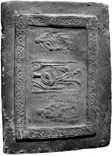
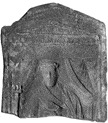
The consul on the ARS cover seems to represent the same person shown on a consular mold and plaque recently published by Jeffrey Spier (figs. 8 and 9).14
Jeffrey Spier, “A lost consular diptych of Anicius Auchenius Bassus (A.D. 408) on the mould for an ARS plaque,” JRA 16 (2003) 251–54.
See Jochen Garbsch, “Zwei Model und eine Patrize für Mittelfelder spätantiker nordafrikanischer Tontabletts,” BVBl 54 (1989) 243–49, figs. 21–24. Additional research and clay analysis by Michael Mackensen and Gerwulf Schneider have shown that the fragment originally came from a production center in Central Tunisia, known by the modern name of Sidi Marzouk Tounsi. It can be postulated that all other pieces with this imagery were produced at the same site. See Michael Mackensen and Gerwulf Schneider, “Production centres of African red slip ware (3rd–7th c.) in northern and central Tunisia: Archaeological provenance and reference groups based on chemical analysis,” JRA 15 (2002) 121–58.

African Red Slip Ware fragment of the mold of a consular plaque. Collection of Cornelius C. Vermeule III, on loan to the Museum of Fine Arts, Boston (photo: author).

African Red Slip Ware fragment of a consular plaque. Collection of Cornelius C. Vermeule III, on loan to the Museum of Fine Arts, Boston (photo: author).

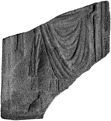
African Red Slip Ware fragment of a consular plaque. Archäologische Staatssammlung, Munich, PStslg. inv. 1988, 3002 (photo: courtesy of the Archäologische Staatssammlung).
Although the image of the consul in the mold is visibly the same as on the Vermeule cover, there are differences in execution as well as size. The workmanship of the mold and plaque is of high quality and the material consists of very fine clay. Spier argued, as Salomonson before him in other cases, that the original consular plaque, presumably made of ivory or bone, was directly impressed in the clay to create a mold.16
Spier, “A lost consular diptych,” 251–53.
See, for example, Peter La Baume and Jan Willem Salomonson, Römische Kleinkunst: Sammlung Karl Löffl er (Wissenschaftliche Kataloge des römisch-germanischen Museums Köln, Bd. III; Köln: Römisch-Germanisches Museum, 1976) no. 608, fig. 62, 1.
The more refined ARS pieces (figs. 8–10) show the consul in an architectural setting, a feature that has been largely eliminated on the cover. In the mold, the lintel above the consul's head shows an inscription, which Spier reads as “Anici(us) Aucheni(us) Bassus, v(ir) c(larissisimus).”18
Spier, “A lost consular diptych,” 253.
See David M. Novak, “A Late Roman Aristocratic Family: The Anicii in the Third and Fourth Centuries” (Ph.D. diss., University of Chicago, 1976).
Spier, “A lost consular diptych,” 253 and n. 14.
As noted above, the consular image on the Vermeule cover is very similar to that in the high-quality mold, but it is smaller and more roughly executed. The fabric of the cover may have contributed to the coarser effect. The detail of the three busts on the scepter, however, appears on both pieces but is more blurred on the cover. Salomonson only distinguished two busts of emperors when he published the fragment in Carthage (fig. 5a–b),21
See Salomonson, “Late-Roman Earthenware,” 66.
To investigate the hypothesis that the difference in size between the consular images reflects shrinkage of the clay in the process of recasting and remolding the same image, a comparison was made between the measurements of various details of the figures on the mold (fig. 8), the Munich plaque (fig. 10), and the cover (fig. 1). First, the consul on the mold was compared to the consul on the cover. A total of twelve measurements were taken from the same points on the two objects: from the left to the right side of the outer border, from the two sides within the filets, from the emperors’ heads to the curtain, from curtain to curtain, from the top of the consul's head to his chin, from the consul's head to his shoulder, and so on. The measurements showed that the dimensions of the two images are consistent on both objects, but that the cover has the most shrinkage. The second comparison between the mold and the plaque shows much less, and the third comparison between the plaque and the cover reveals the least amount of shrinkage.

As discussed above, the images on the cover lack the precision of detail seen in the consular plaques, which also supports the idea that the cover was the result of a second (or third) generation of molding. Shrinkage and loss of detail occurred in every phase (fig. 11).

Comparison of consular mold and impressions. Left to right: mold (fig. 8, detail, reversed horizontally), Munich plaque (fig. 10, detail), and Vermeule cover (fig. 1, detail).
Dating the Cover
While it can be established that the consular plaque was issued in the first months of Bassus's consulship in 408, it is more difficult to determine the exact date of the Vermeule cover. It is conceivable that the molds could have lingered in the workshop for several years. There is another argument, however, that can be used for dating the cover, which is linked to the specific composition of the three figures. As pointed out above, ARS images of Peter and Paul tend to flank a monogrammatic cross. Placing the consul in a central position between the two major saints of Rome and Christianity is a remarkable intertwining of religious and secular imagery.22
Salomonson made the argument that the imagery of Peter and Paul flanking the cross could be viewed as a polemical tool; see n. 7, above, and Salomonson, “Sammlung Benaki,” 21 n. 58. The Vermeule cover only strengthens this argument since the consul replaces the cross and a fortiori represents the Roman authority. For a longer study of the political and theological implications of the imagery, see my “Peter, Paul, and a Consul,” Zeitschrift für Antikes Christentum, forthcoming.
From the early fourth century onward, the Roman provinces of Africa had been involved in a violent conflict between two Christian factions: the Catholics and Donatists.23
William H. C. Frend, The Donatist Church: A Movement of Protest in Roman North Africa (3d ed.; New York: Oxford University Press, 1985) 60–75. For a comprehensive survey of the schism, a chronological appendix, and additional bibliography, see the very helpful article by Anthony R. Birley, “Some notes on the Donatist Schism,” Libyan Studies 18 (1987) 29–41.
It is estimated that for most of the fourth century the Donatists, who considered themselves the legitimate church of the martyrs, outnumbered the Catholics. This situation began to change in the late 390s, largely through the activities of Augustine and his circle. In spite of being outnumbered, they were able to coordinate the Catholic cause effectively. Moreover the political situation in North Africa had become more alarming from a Roman point of view, and the Catholics were capable of taking advantage of the crisis. Local militia commanders had revolted against Roman rule and received support from peasants allied with the Donatist cause and from some of the Donatist leaders. Gildo, a rich landowner with vast estates and military forces at his disposition, led a particularly dangerous uprising in 397/98, which, if successful, could have led to the secession of North Africa from the western Empire. His revolt managed to obstruct the annona, the grain shipments to Rome, in that year.24
See Frend, The Donatist Church, 224–25; 245.
A program of mediation and intervention culminated in the formation of an imperial commission, which summoned a conference (collatio) at Carthage in 411 to establish religious unity. As a result the Donatist cause was condemned and the subsequent laws were more strictly enforced. These policies broke the powerful movement and brought the schism to a virtual end. The outcome of the conference was a personal victory for Augustine and his friends.
Augustine may have had a personal connection with Anicius Auchenius Bassus, the consul of 408. The latter wrote an epitaph for the tomb of Monica, Augustine's mother who died in Ostia, where the Anicii had estates.25
Augustine stayed at Ostia in 387, but as it appears from his account in Conf. 9.12.31, he and his mother did not stay at an inn. Meiggs speculated that they may have stayed with senatorial friends with African connections, such as the Anicii; see R. Meiggs, Roman Ostia (Oxford: Clarendon Press, 1960) 213. The text of Monica's epitaph has long been known through a number of medieval manuscripts; see Anthologia latina sive poesis latinae supplementum (ed. F. Bücheler and A. Riese; Leipzig: Teubner, 1894–1926) part I, fasc. 2, p. 140, C. 670. See also De Rossi in ICUR (1888) II/1 252–53. In 1945 a physical part of the Bassus epitaph was found. See AE 44 (1948); A. Cantamassa, “Ritrovamento di parte dell'elogio di S. Monica,” RPAA 27 (1952–1954) 271–73.
Cod. Theod. XVI 5, 42 (Nov. 14, 408); Cod. Theod. XVI 5, 43 (Nov. 15, 408); Cod. Theod. XVI 5, 44 (Nov. 24, 408); Cod. Theod. XVI 5, 45 (Nov. 27, 408).
The composition of the Vermeule scrinium cover, blending so visibly Roman ecclesiastical and secular authority, reflects this intervention by high officials of the state in the affairs of the African churches. The cover is a vivid piece of propaganda in which the apostles Peter and Paul appear as magistrates, upholding contemporary Roman order just as Anicius Auchenius Bassus does. Although the specific function of the Vermeule cover is unknown, its imagery has an evident historical and political con-text. Whether or not the Vermeule cover dates from precisely the year 408, it is clear that it could not be much later than the year 411, when the Donatist conflict, which had divided the African churches for almost a century, fell into the background.27
Donatists continued to surface, probably as late as the eighth century; as refugees in Gaul and Italy, they were of particular concern to the church authorities. See the appendix in Birley, “Some Notes on the Donatist Schism,” 40.
I am grateful to Cornelius C. Vermeule III for his generosity in letting me publish these objects and for keeping them in the public domain through display at the Museum of Fine Arts, Boston. Thanks go to Jan Willem Salomonson for sharing his experience with me and providing photographs from his archive. I am grateful to John J. Herrmann and Anthony R. Birley for their advice on many details of this project. Rebecca Reed provided crucial assistance at a late stage in publication. A final thanks goes to the anonymous reviewer at HTR for his or her comments and to Tracy Thorpe for her valuable observations.
Footnotes
Note the following abbreviations: BABesch, Bulletin Antieke Beschaving; BVBl, Bayerische Vorgeschichtsblätter; and OMRL, Oudheidkundige Mededelingen uit het Rijksmuseum van Oudheden te Leiden.
African Red Slip Ware cover, Tunisia, c. 408 C.E. Collection of Cornelius C. Vermeule III, on loan to the Museum of Fine Arts, Boston (photo: author).

African Red Slip Ware cover, Tunisia, c. 408 C.E., before restoration. (photo: courtesy of J. W. Salomonson).

Underside of African Red Slip Ware cover, Tunisia, c. 408 C.E. Collection of Cornelius C. Vermeule III, on loan to the Museum of Fine Arts, Boston (photo: author).

Reconstruction of an African Red Slip Ware lanx with seated Peter and Paul (line drawing: courtesy of J. W. Salomonson).

a–b African Red Slip Ware fragment with consul and ivy vine. Carthage Museum, Carthage, inv. 47.31 (photo: courtesy of J. W. Salomonson).

African Red Slip Ware fragment with consul and ivy vine. Dutch private collection, present location unknown (photo: courtesy of J. W. Salomonson).

a–b African Red Slip Ware fragment with part of Peter's seat and ivy vine. Numisart GmbH Munich (photo: courtesy of Christian Niederhuber and Oliver Habel). Unpublished.
African Red Slip Ware fragment of the mold of a consular plaque. Collection of Cornelius C. Vermeule III, on loan to the Museum of Fine Arts, Boston (photo: author).
African Red Slip Ware fragment of a consular plaque. Collection of Cornelius C. Vermeule III, on loan to the Museum of Fine Arts, Boston (photo: author).
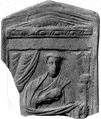
African Red Slip Ware fragment of a consular plaque. Archäologische Staatssammlung, Munich, PStslg. inv. 1988, 3002 (photo: courtesy of the Archäologische Staatssammlung).
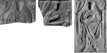
Comparison of consular mold and impressions. Left to right: mold (fig. 8, detail, reversed horizontally), Munich plaque (fig. 10, detail), and Vermeule cover (fig. 1, detail).
 You have
Access
- 2
- Cited by