


Introduction
Cognitive models of obsessive compulsive disorder (OCD) posit that specific dysfunctional, obsessive beliefs including over-estimation of threat and inflated responsibility, importance and control of thoughts, and perfectionism and intolerance of uncertainty lead to negative interpretations of intrusive thoughts and a desire to neutralize the thoughts (Obsessive Compulsive Cognitions Working Group, 1997). Given evidence for the link between dysfunctional beliefs and OCD, researchers have attempted to understand how these beliefs develop. Arguing that beliefs of inflated responsibility were the most consistently linked to OCD, Salkovskis et al. (Reference Salkovskis, Shafran, Rachman and Freeston1999) proposed multiple ‘pathways’ by which inflated responsibility beliefs could develop. According to the authors, these pathways include (1) heightened responsibility as a child, (2) rigid or extreme codes of conduct, (3) parental overprotection, (4) causing a negative life event, and (5) influencing a negative life event.
One method for assessing the experiences discussed by Salkovskis et al. (Reference Salkovskis, Shafran, Rachman and Freeston1999) is the self-report Pathways to Inflated Responsibility Beliefs Scale (PIRBS; Coles et al., Reference Coles, Schofield and Nota2015). Supporting the model by Salkovskis et al. (Reference Salkovskis, Shafran, Rachman and Freeston1999), the adult PIRBS correlates with self-reported beliefs of inflated responsibility in adults with OCD (Coles et al., Reference Coles, Schofield and Nota2015) and non-clinical adolescents (Halvaiepour and Nosratabadi, Reference Halvaiepour and Nosratabadi2015). Coles et al. (Reference Coles, Schofield and Nota2015) found that the PIRBS total score, and the ‘overprotection’ and ‘actions that influenced or caused a negative life event’ subscales correlated with self-reported beliefs regarding inflated responsibility and over-estimation of threat. In a study on 547 randomly selected adolescents (age 15‒18 years), small positive correlations were found between the adult PIRBS total and self-reported beliefs of heightened responsibility (Halvaiepour and Nosratabadi, Reference Halvaiepour and Nosratabadi2015). These results suggest that the cognitive theory by Salkovskis et al. (Reference Salkovskis, Shafran, Rachman and Freeston1999) could also apply to youth. Furthermore, examining pathways to inflated responsibility beliefs in youth might be more valid than examining them in adults, because they have occurred more recently and are therefore less prone to memory biases than retrospective reports of experiences. The relation between experiences proposed by Salkovskis et al. (Reference Salkovskis, Shafran, Rachman and Freeston1999) and beliefs regarding responsibility have not to our knowledge been investigated in youth with a current diagnosis of OCD.
Here, we provided an initial test of the theory for the development of inflated responsibility beliefs (Salkovskis et al., Reference Salkovskis, Shafran, Rachman and Freeston1999) in youth (both children and adolescents) meeting criteria for a diagnosis of OCD. First, we predicted that childhood experiences corresponding to each pathway hypothesized by Salkovskis et al. (Reference Salkovskis, Shafran, Rachman and Freeston1999) and their combined total would be positively associated with beliefs regarding responsibility and harm. Our second and third hypotheses were that each pathway and their total would correlate positively to a lesser degree with other obsessive beliefs and OCD symptom severity. Fourth, we hypothesized that the total score of pathways assessing repeated experiences (heightened responsibility, rigid rules, and overprotection) would also correlate positively with responsibility beliefs and OCD symptoms. To test our hypotheses, we adapted the adult version of the PIRBS scale for use with children in consideration of developmental norms.
Method
Participants
Participants were 20 youth, aged 9‒16 years (mean 12.10, SD 2.51) diagnosed with primary OCD. Just over half (55%) of the sample was female. Nineteen of the patients were identified as Caucasian by their parents. Age 9 years was set as the lower limit given that the obsessive beliefs questionnaire (OBQ) has been not validated in younger children (Coles et al., Reference Coles, Wolters, Sochting, De Haan, Pietrefesa and Whiteside2010). Diagnostic information was gathered from separate child and parent interviews and combined to assign composite diagnoses. OCD had to represent the most distressing/interfering problem. All interviews were conducted by advanced level graduate students or higher, and all interviewers were trained to reliability. For a principal diagnosis of OCD, inter-rater agreement was excellent (к = 0.85). Out of all patients, 70% had at least one comorbid diagnosis (n = 14), and 40% had more than one comorbid diagnosis (n = 8).
Measures
The Obsessive Beliefs Questionnaire-44, Child Version (OBQ-44-CV) is a 44-item self-report measure of obsessive beliefs in youth (Coles et al., Reference Coles, Wolters, Sochting, De Haan, Pietrefesa and Whiteside2010). Beliefs reflect three domains: responsibility and harm (OBQ-RH); perfectionism and intolerance of uncertainty (OBQ-PC); and importance and control of thoughts (OBQ-IT). The OBQ-CV total and subscale scores have demonstrated convergent validity in clinical samples (Coles et al., Reference Coles, Wolters, Sochting, De Haan, Pietrefesa and Whiteside2010) and had good reliability in this study (total α = .94, subscales α = .81‒.93).
The Obsessive Compulsive Inventory-Child Version (OCI-CV) is a 21-item self-report measure of OCD symptom severity for youth (Foa et al., Reference Foa, Coles, Huppert, Pasupuleti, Franklin and March2010). The OCI-CV correlates moderately with clinician-rated OCD severity (Foa et al., Reference Foa, Coles, Huppert, Pasupuleti, Franklin and March2010). In the current sample, the OCI-CV total score demonstrated strong internal consistency (α = .99).
The PIRBS-CV is a 23-item child self-report measure of the pathways to inflated responsibility beliefs proposed by Salkovskis et al. (Reference Salkovskis, Shafran, Rachman and Freeston1999). The PIRBS-CV was adapted from the adult PIRBS (Coles et al., Reference Coles, Schofield and Nota2015) to be developmentally appropriate for children and adolescents. Herein, the PIRBS-CV total (α=.83) and subscales of heighted responsibility (α = .82), rigid rules (α = .83), and actions that influenced or caused a negative event (α = .82) demonstrated strong internal consistency. The overprotection subscale did not have adequate internal consistency (α = .48). However, upon further review, it was noted that items 7, 9 and 12 ask about overprotective parental beliefs (e.g. My parents think I can't handle things) whereas items 5 and 13 ask about parental behaviour (e.g. My parents often do things to protect me). A revised overprotection subscale containing items 7, 9 and 12 had adequate internal consistency and was therefore used in the analyses.
Procedure
Information was gathered from patients assessed at an anxiety clinic. Patients completed the Obsessive Compulsive Inventory-Child Version (OCI-CV; Foa et al., Reference Foa, Coles, Huppert, Pasupuleti, Franklin and March2010), Obsessive Beliefs Questionnaire-44, Child Version (OBQ-CV; Coles et al., Reference Coles, Wolters, Sochting, De Haan, Pietrefesa and Whiteside2010), and the newly created Pathways to Inflated Responsibility Beliefs Scale-Child Version (PIRBS-CV). Given modest sample size, and directional hypotheses, we used one-tailed significance tests.
Results
Childhood experiences and beliefs regarding responsibility and harm
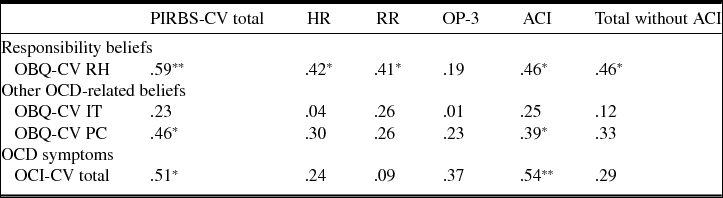
First, we examined the correlation between childhood experiences and inflated beliefs of responsibility and harm. Consistent with expectations, total scores on the PIRBS-CV strongly and significantly related to OBQ-CV Responsibility and Harm beliefs (see Table 1). Furthermore, the PIRBS-CV subscales assessing heightened responsibility, rigid rules, and Actions Caused/Influenced were all moderately and significantly correlated with OBQ-CV Responsibility and Harm beliefs.
Correlations between youth-reported PIRB experiences, obsessive beliefs and OCD symptoms

OBQ-CV RH, youth-reported responsibility and harm estimation beliefs; OBQ-CV IT, youth-reported importance and control of thoughts beliefs; OBQ-CV PC, youth-reported perfectionism and intolerance of uncertainty beliefs; OCI-CV, youth-reported OCD symptoms; PIRBS-CV, pathways to inflated responsibility beliefs: child version; HR, heightened responsibility; RR, rigid rules; OP-3, revised overprotection scale (items 7, 9 and 12); ACI, actions caused/influenced; Total-ACI, total score excluding ACI subscale; *p < .05 (one-tailed), **p < .01 (one-tailed).
Childhood experiences and other domains of OCD-related beliefs
Next, we examined whether the PIRBS-CV scores would be more modestly correlated with other OCD-relevant belief domains. The PIRBS-CV total was significantly correlated with OBQ-CV Perfectionism/Intolerance of Uncertainty, but not with OBQ-CV Importance/Control of Thoughts. Turning to the domains of childhood experiences, the PIRBS-CV Actions Caused/Influenced subscale was the only PIRBS-CV subscale significantly correlated with OBQ-CV Perfectionism/Intolerance of Uncertainty.
Childhood experiences and OCD symptom severity
Next, we tested the relations between childhood experiences and OCD severity. PIRBS-CV total was significantly correlated with OCI-CV total (see Table 1). Turning to specific pathways, PIRBS-CV Actions Caused/Influenced was significantly related to OCI-CV. However, PIRBS-CV Heightened Responsibility, Rigid Rules, and the revised Overprotection subscale were not significantly related to OCI-CV total.
Total experiences of Heightened Responsibility, Rigid Rules, and Overprotection and Beliefs Regarding Responsibility and Harm
Finally, given that the pathways proposed by Salkovskis et al. (Reference Salkovskis, Shafran, Rachman and Freeston1999) regarding the occurrence of a bad event are different in nature from the other three pathways, we tested whether a total PIRBS-CV without the Actions Caused/Influenced subscale would be associated with increased responsibility beliefs. In support of our hypothesis, this revised total was significantly related to OBQ-CV Responsibility and Harm.
Discussion
The results found herein are consistent with the prediction put forth by Salkovskis et al. (Reference Salkovskis, Shafran, Rachman and Freeston1999) that specific types of experiences during childhood are associated with OCD symptoms. Youth who reported more of these experiences across the five pathways also reported stronger beliefs of heightened responsibility. Reported exposure to heightened responsibility, rigid rules, and experiences in which the youth felt as if they had influenced or caused a negative life event were significantly correlated with beliefs regarding responsibility and harm but not OCD symptoms. Finally, the total of the first three pathways (PIRBS-CV Total minus ACI) was significantly correlated with beliefs regarding responsibility and harm, but not OCD symptoms. These results are similar to findings in adolescents (Halvaiepour and Nosratabadi, Reference Halvaiepour and Nosratabadi2015). Finally, the PIRBS-CV total and three of the four subscale scores demonstrated good internal consistency, but future studies are needed to further evaluate the psychometric properties of the scale.
Reports of heightened responsibility and rigid rules were moderately correlated with beliefs regarding responsibility and harm in this sample, but not in a prior adult sample (Coles et al. (Reference Coles, Schofield and Nota2015). Salkovskis et al. (Reference Salkovskis, Shafran, Rachman and Freeston1999) hypothesized that rigid rules and heightened responsibility can lead to beliefs regarding responsibility as early as childhood. Therefore, these experiences might be more strongly related to responsibility beliefs in our younger sample, because they have had fewer alternative experiences to buffer the development of obsessive beliefs. Future studies comparing these relations across the lifespan are needed to further understand these and other potential influences on the development of responsibility beliefs.
The current work is preliminary in nature, and thus has some limitations. First, the sample size was relatively small, thereby limiting our ability to detect statistically significant effects. Second, the internal consistency of the overprotection subscale was moderately low in our sample, but our small sample size also limited our ability to definitively establish the internal consistency and validity of the PIRBS-CV. Future studies should aim to replicate the present investigation in larger samples. Third, our investigation of the aetiological model by Salkovskis et al. (Reference Salkovskis, Shafran, Rachman and Freeston1999) was limited given the cross-sectional nature of the analyses and lack of a comparison group. Future studies could utilize longitudinal designs, compare children with and without current OCD, and investigate moderators of this relationship (e.g. age and gender).
In conclusion, results of this study are consistent with models of OCD which propose an association between specific childhood experiences and levels of OCD symptoms. However, this study does not test the aetiological role of these experiences which would require a prospective design. As we develop an increased understanding of the experiences that lead to potential cognitive vulnerabilities for OCD, prevention efforts can be targeted at modifying these experiences and/or responses to them.
Acknowledgements
We would like to thank all the families that contributed to this project.
Ethical statements: The study was approved by the human subjects committee of a midsized public university and all procedures followed American Psychological Association ethical standards.
Conflicts of interest: The authors of this publication have no conflicts of interest with respect to this publication.
Financial support: This research received no specific grant from any funding agency, commercial or not-for-profit organization.
Supplementary material
To view supplementary material for this article, please visit https://doi.org/10.1017/S1352465817000844.




Comments
No Comments have been published for this article.