Introduction
An important problem associated with the use of filter beds in water treatment works (WTW) is that they create ideal habitats capable of sustaining large larval populations of dipteran flies (Learner, Reference Learner2000). Investigations by Price et al. (Reference Price, Gigg and Lewin1997) identified granular activated carbon (GAC) adsorbers as being particularly prone to infestations of chironomid larvae. GAC adsorbers are used in many WTW to remove taste and odour compounds, trace organics and reduce assimilable organic carbon. GAC adsorption commonly takes place at the end of the treatment chain, prior to chlorine disinfection, and if chironomid larvae survive disinfection then they are free to proliferate within the distribution system and contaminate potable water supplies (Buchmann, Reference Buchmann1932; AWWA, 1995).
Microbial biofilm that develops on the surface of GAC within adsorbers supports food webs that are ideal for the growth and development of chironomid larvae. Once an adsorber becomes infested, there is a risk of long-term serial breakthroughs of larvae into the distribution system. The existing method for managing chironomid larval populations within GAC adsorbers is termed ‘anaerobic treatment’ and involves shutting down and isolating individual adsorbers for 72 h. Micro-organisms within the adsorber consume the available oxygen, creating an anoxic environment, which reduces the number of susceptible chironomid species. However, this method is temperature dependent and causes an increase in nitrite concentrations and chlorine demand (Price et al., Reference Price, Gigg and Lewin1997).
One of the most common chironomids to infest GAC adsorbers is Paratanytarsus grimmii Schneider. This species has a relatively homogeneous morphology at all stages of its life-cycle, with only minor variations throughout its almost worldwide geographic range (Langton et al., Reference Langton, Cranston and Armitage1988). In nature, it inhabits shallow standing water and sediments of oxygen-rich lakes (Augenfeld, Reference Augenfeld1967). Reproduction is always by parthenogenesis (Langton, Reference Langton, Armitage, Cranston and Pinder1995) and, because it can breed in water distribution systems, it has become notorious as a pest. Comprehensive descriptions of the biology of P. grimmii have been given by von Grimm (Reference Von Grimm1871) and Langton et al. (Reference Langton, Cranston and Armitage1988). Females lay their eggs either as the adult fly or as a pharate adult (still enclosed within the pupal case), although it is not known whether oviposition as an aerial or pharate adult is dictated by being confined to an enclosed system. The egg mass is laid within two hours of eclosion (if eclosion takes place); repeated oviposition occurs in P. grimmii, which is unusual for most Chironomidae (Pinder, Reference Pinder, Armitage, Cranston and Pinder1995). A second, smaller egg mass may be laid within the next 24 h (Langton et al., Reference Langton, Cranston and Armitage1988). Duration of the larval stage is dependent on water temperature and food availability. Langton et al. (Reference Langton, Cranston and Armitage1988) reported 17 days as the shortest period between hatching and pupation. However, at 22–28°C, larval development can be completed in 12–14 days (Anderson & Shubat, Reference Anderson and Shubat1983); and reproduction, albeit at a reduced rate, may take place as low as 12.5°C (Edward, Reference Edward1963). Overwintering of chironomids occurs during the larval stage (Thienemann, Reference Thienemann1954); and, in temperate regions, the onset of chironomid emergence in spring appears to require a minimum threshold temperature ranging from 6.5 to 8.0°C (Morgan, Reference Morgan1958; Carrillo, Reference Carrillo1974). The ability to become dormant (quiescence or diapause) occurs widely in Chironomidae (Tokeshi, Reference Tokeshi, Armitage, Cranston and Pinder1995a) and constitutes an important phase in the life cycle. In temperate regions, low temperatures during winter are a particular adverse condition for growth and development faced by chironomids (Tokeshi, Reference Tokeshi, Armitage, Cranston and Pinder1995a).
Because emergence of the adult from the water column serves as a pre-requisite for dispersal and reproduction of most chironomid species, emergence traps have been widely used to study aquatic insect communities (Davies, Reference Davies, Downing and Rigler1984). Valuable information can be obtained on the identification, quantification of numbers emerging from a given area, estimation of sex ratios, phenology of emergence and voltinism of different species (Lindeberg, Reference Lindeberg1958). In addition, benthic samples collected throughout the year add to our knowledge of the population dynamics of chironomids within a habitat. Both of these methods have been applied to study populations of Paratanytarsus grimmii in the context of GAC adsorbers.
The aim of this study was to examine mechanisms by which individuals of P. grimmii arrive, colonise and propagate in GAC adsorbers. Specifically, it was necessary to determine whether infestations originate from external sources or within the GAC adsorber building. Results presented here form part of a wider study to gain an understanding of the biology, physiology and ecology of chironomid infestations within WTW. The information gathered will be used as a means of informing specific management strategies for controlling chironomids within GAC adsorbers.
Materials and methods
The work reported here was carried out between April 2000 and June 2001. The GAC adsorber building at the study site consists of 16 bi-flow adsorbers. Each adsorber consists of two cells 4-m wide×16-m long, containing a 2-m layer of activated carbon (Chemviron TL830) covered by water to a depth of one metre. Water enters an adsorber through the up-flow cell, passes across a central channel and leaves through the down-flow cell. For the final stage of treatment prior to distribution, water passes from GAC adsorbers to a contact tank where it is chlorinated. When the adsorption capacity of GAC in an adsorber is exhausted, it is removed for regeneration (the organics are burnt off in a controlled manner), approximately every 5–6 years.
Dissolved oxygen, as percentage saturation, was recorded every two hours with four Solomat WP4007 probes located at the top and bottom of the up-flow and down-flow cells, respectively, of one adsorber (GAC 12). Water temperatures were recorded at two-hour intervals using a Digitron monolog™ data logger ML42 (Sifam Ltd). The water temperature logger was located at the macro-invertebrate sampling point connected to the down-flow cell outlet pipe of GAC adsorber 16 (GAC 16). Outlet sample points of all 16 GAC adsorbers consist of a 25-mm pipe (1 m long), which branches off the main outlet pipe. Flow rate is recorded by a flow meter, and a sample net is connected to the open end of each effluent pipe.
All equipment used to sample GAC adsorbers was sterilised with a solution of chloros (sodium hypochlorite) (Instachlor P1000, Palintest Ltd) made up according to the manufacturer's instruction. Sampling of the GAC adsorber column to identify the spatial distribution of chironomid larvae was undertaken in one randomly chosen GAC adsorber (GAC 4). Thirteen samples were taken from the top, middle and bottom of the up-flow and down-flow cells using a flap gouge auger (Eijkelkamp, Netherlands). The auger was extended into the GAC adsorber to the appropriate depth, rotated clockwise and extracted to give a semi-core of GAC 500 mm in length and 0.3 l in volume. Each sample was placed into a labelled 300×250-mm plastic bag with 100 ml of GAC influent water, sealed and returned to the laboratory for sorting.
Surface samples of GAC were taken from four adsorbers (GAC 11, 12, 15 and 16) at two-week intervals using a 0.5-l Van Veen grab. Three samples were taken from each of the up-flow and down-flow cells of each adsorber. Each sample was placed in a 2-l plastic container with some interstitial water. Prior to leaving site, 10 l of GAC influent water were collected for sorting and storage of carbon samples.
On return to the laboratory, each sample was placed into a sorting tray (275 mm×220 mm). Approximately 250 ml of GAC influent water was added to fluidise the carbon, and all invertebrates were removed and placed into a Petri dish. Individual chironomids were identified with the aid of a binocular microscope and preserved with a 9:1 (70% ethanol 30% distilled water:glycerol) solution. Carbon samples were returned to their respective containers and another 250 ml of GAC influent water was added. A lid and aeration line were attached to each container, which was stored at 20°C (±0.5°C) and continuously aerated. All samples were searched at seven-day intervals as previously described and samples were discarded after four searches.
A new trap for sampling insect emergence was designed to overcome public health regulations that prevent the use of conventional submerged or floating traps. This trap was designed and constructed to fit the basic criteria described by Mundie (Reference Mundie1956) and Davies (Reference Davies, Downing and Rigler1984) for collection of emerging insects. The trap consisted of a square (0.5 m×0.5 m) brass frame inserted into the base of a pyramid-shaped, fine net (height=0.9 m). At the top of the netting, a 32-mm, 90° knuckle bend (Osma Ltd), with a wire eye attached (1-mm-coated garden wire), was used to suspend the entire emergence trap. The suspending eye was held in place by a cable tie which prevented slipping. The trap was suspended from the fixed eye by a 2-mm nylon rope attached to a detachable cleat. The bottle trap consisted of a 250-ml wide neck square polypropylene Nalgene® bottle into which half a 32-mm double socket (Osma Ltd) was glued with gripfil (Laybond Products Ltd). This allowed for easy removal and replacement. Six of these emergence traps were suspended above a GAC adsorber, three above the up-flow cell and three above the down-flow cell. Six traps were suspended approximately 25 mm above the water surface at intervals along a length of 6-mm nylon rope attached to the dividing walls of the adsorber. Cable ties were used to keep a distance of one metre between the centre of each trap.
Flies collected in emergence traps were preserved in bottle traps with a 9:1 (70% ethanol 30% distilled water:glycerol) solution. Bottle traps were replaced at weekly intervals; the contents of collected bottles were used for counting and identification of trapped flies. Slides of adult flies, larvae and pupae from GAC adsorbers were prepared using methods described by Cranston (Reference Cranston1982) and subsequently sent to Dr S.J. Brooks (Natural History Museum, London) and Dr P.H. Langton (Coleraine, N. Ireland) for species identification. Confirmation of genus was performed using Wiederholm (Reference Wiederholm1983).
To monitor movement of larvae entering GAC adsorbers, sample nets (120×200 mm, 53-μm mesh size) were located on the anthracite/sand/gravel (ASG) filters and at the post-ozonation tank sampling points, the two processes prior to GAC adsorption. Sample points consisted of a 25-mm pipe connected to a flow meter. Sample nets were attached to the open end of the 25-mm pipe. Nets were changed at weekly intervals, placed into a 250-ml wide neck square polypropylene Nalgene® bottle, filled with GAC influent water and taken immediately to the laboratory. Each sample net was emptied into a sorting tray to which 500 ml of GAC influent water was added. Chironomid larvae were removed and preserved for later identification.
Statistical analyses
Spatial distribution of larvae was determined by testing data against the model for the Poisson distribution. Differences between larval densities in the top, middle and bottom of the GAC adsorber column were assessed with one-way ANOVA. Comparisons between larval densities in the down-flow and up-flow cells were analysed with separate variance t-tests. All statistical analyses were carried out using UNISTAT® 4.5 (UNISTAT Ltd, London).
Results
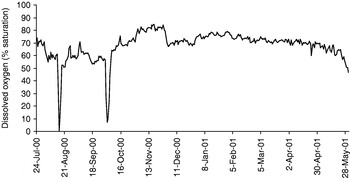
The four adsorbers investigated (GAC 11, 12, 15 and 16) were fully operational at the beginning of the study in April 2000. Average DO saturation in GAC 12 is illustrated in fig. 1 as an example; the sharp decreases (August and October) indicate the effect of anaerobic treatment. Average DO saturation throughout the adsorber never dropped below 50%, except when anaerobic treatment was applied. Mean daily water temperature passing through the GAC adsorber building was monitored throughout the year (fig. 2e). A maximum mean water temperature of 19.8°C was recorded on 17 August 2000, and the lowest mean daily water temperature was 2.3°C on 20 January 2001.
Average dissolved oxygen (percentage saturation) in GAC 12 during 2000–2001.

Adult emergence (regular line) and larval densities (bold line) of Paratanytarsus grimmii sampled throughout 2000–2001 in four GAC adsorbers (a–d). Bars indicate standard errors and timing of anaerobic treatments is indicated by ▪. Corresponding water temperature is illustrated in the bottom graph (e).

Only three chironomid species were found to inhabit the GAC adsorbers at the WTW studied (Olsen, Reference Olsen2004). These three species were present in all four adsorbers studied, but larval and emerging fly densities differed between adsorbers. Paratanytarsus grimmii was the most abundant chironomid, accounting for 96.5% of the total annual emergence and 51.1% of larvae sampled. The other two species trapped were Corynoneura scutellata and Limnophyes asquamatus.
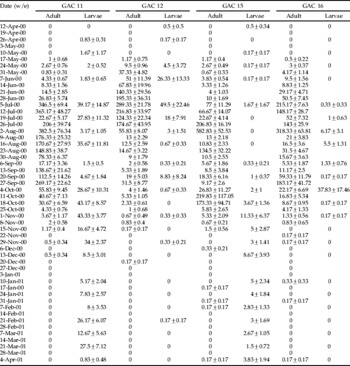
Emergence of P. grimmii first occurred when mean daily water temperature (WT) reached 14.1°C during the week ending (w/e) 17 May 2000 in all four adsorbers and continued until the middle/end of November 2000 (WT=7.0°C). Throughout the winter period, infrequent emergence was observed but did not completely cease (table 1).
Mean emergence of Paratanytarsus grimmii adults (flies m−2±SE) and larvae (larvae per 0.5 l of GAC±SE) collected from four GAC adsorbers during April 2000 to April 2001.

Paratanytarsus grimmii adults in GAC 11 reached a peak emergence on w/e 2 August 2000. High emergence was also observed for the w/e 5 and 12 July 2000. Anaerobic treatment applied in mid-July 2000 led to a small decrease in larval densities; adult emergence peaked the previous week (fig. 2a). The population quickly re-established and, by the beginning of August 2000, the second emergence peak was observed. Fluctuating larval densities were observed in GAC 11 with a maximum mean density during the w/e 1 November 2000 (table 1). Larvae remained present throughout the year and were sampled during the coldest period (<3°C).
In GAC 12, an almost exponential increase in emerging flies was observed from the beginning of the emergence period, culminating in a peak emergence and maximum larval density for the w/e 5 July 2000 (table 1). Larval numbers declined from this date onwards but a residual population remained. Anaerobic treatment applied in early August 2000 (fig. 2b) did not reduce numbers of emerging flies, but larval densities declined and a small larval population remained.
From the period 13 June 2000 to 4 October 2000, GAC 15 was taken out of service and completely drained. This resulted in a distance of one metre between the dry carbon surface and the opening of emergence traps. For w/e 2 August 2000, the highest adult densities overall were trapped over this adsorber, but larval densities remained at zero (table 1). Larval densities reached a maximum for w/e 1 November 2000 (mean temp>10°C). The bed was refilled on 20 September 2000 and, immediately after returning to service, another emergence peak was observed (fig. 2c). Sampling of GAC 15 throughout winter revealed sporadic emergence and the presence of a small overwintering population of P. grimmii larvae until 29 March 2001, when the GAC from the up-flow cell was regenerated.
Emerging flies of P. grimmii in GAC 16 also exhibited three major peaks: at the beginning of July 2000, one month later on the 2 August 2000 and a final emergence at the end of September 2000 (fig. 2d). Larvae were not found in samples until the beginning of July 2000, and the highest larval densities were observed during w/e 4 October 2000. However, this larval peak did not lead to another peak in emergence, and larval numbers declined rapidly; this was followed by successive anaerobic treatments at the beginning of November 2000 and January 2001. Unlike the other adsorbers, no larvae were found throughout the entire winter period in carbon samples taken, although infrequent flies were sampled in emergence traps (table 1).
Spatial distribution
The spatial distribution of P. grimmii in the carbon column of GAC 4 was found not to be significantly different from a uniform distribution in the down-flow cell (χ2=16.75, df=9, P>0.05) and the up-flow cell (χ2=15.28, df=10, P>0.05). No significant difference in the number of larvae found in the top, middle and bottom of the down-flow cell (F=0.151, df=2, P>0.05) and the up-flow cell (F=0.475, df=2, P>0.05) of GAC 4 was identified. However, larval densities in the down-flow cell and up-flow cell were significantly different (t=24.47, df=55, P<0.001). A mean number of 61 larvae per 0.3 l of carbon was found in the down-flow cell compared with a mean of 14 larvae per 0.3 l of carbon in the up-flow cell.
Routes of colonisation
Investigations into dispersal of chironomid larvae before GAC adsorption revealed no larvae trapped in sample nets on the post-ozonation tank, the final process before water enters the GAC adsorber building. However, a total of six larvae were trapped in sample nets attached to the post-ASG filtration (prior to post-ozonation) sample point on five different occasions (two larvae on 5 July, one larva on 25 October, one larva on 29 November 2000 and one larva on 14 and 21 March 2001).
Discussion
The chironomids Paratanytarsus grimmii and Corynoneura scutellata, both notorious for infesting distribution systems, were found to have colonised the four sampled GAC adsorbers. A third species, Limnophyes asquamatus, was identified for the first time as a coloniser of the GAC habitat. Low species diversity observed in GAC adsorbers is probably a consequence of the simple habitat structure as the substrate is homogeneous and lacking in complexity. Many factors may be responsible for determining the presence or absence of chironomids in GAC adsorbers. However, there is little evidence that intraspecific competition for food ever occurs in natural populations of Chironomidae, and evidence for interspecific competition is also sparse (Pinder, Reference Pinder1986). Chironomid larvae have been shown to have a large dietary overlap and partitioning of food is unlikely (Tokeshi, Reference Tokeshi, Armitage, Cranston and Pinder1995b). Density-dependent effects have been described by Ristola et al. (Reference Ristola, Pekkubeb, Ruokolainen, Kostamo and Kukkonen1999) where, at high larval densities, food and space may limit the rate of growth and development in chironomids.
Other important factors, such as photoperiod, pollution and predation, would certainly be considered in structuring community composition in wild populations, but they do not contribute to chironomid community structure in GAC adsorbers. Photoperiod is absent as adsorbers are enclosed within a building, pollution is not present in potable water at the stage of GAC treatment, and there is no evidence of invertebrate or vertebrate predators. Studies by Small & Greaves (Reference Small and Greaves1968) on infestations concluded that the population of invertebrates will depend on: (i) recruitment of individuals of a given species via the treatment plant and service reservoirs; (ii) maintenance of sufficient food supplies; (iii) suitability or adaptability of the species to the new environment; and (iv) the reproductive capacity of the species. Addressing each of these aspects in turn helps to explain why these species are present in GAC adsorbers.
Firstly, the main recruitment of individuals comes from overwintering populations that are constantly present in GAC adsorbers, resulting in self-perpetuating infestations. However, additional recruitment from the reservoir via the treatment chain should not be discounted. Studies by Flynn & Bolas (Reference Flynn and Bolas1985) concluded that, although raw water may have been the original source, it is not the primary source of persistent infestations at WTW. Secondly, food is unlikely to be a limiting factor in GAC adsorbers as biofilm growth is encouraged, algae are constantly moving through treatment processes and it is known that the carrying capacity of the GAC habitat is significantly higher than densities observed since the introduction of anaerobic treatment (Olsen, Reference Olsen2004). A plentiful supply of food will result in less time spent foraging, which translates into less wasted energy and, therefore, faster development. Thirdly, suitability and adaptability of the species in the new environment is difficult to determine, although several studies have identified the nature of the substratum as an important factor limiting distribution of chironomid larvae (McLachlan, Reference McLachlan1969). Particle sizes in sediments may also play an important role in determining the distribution of larvae (Wiley, Reference Wiley1981). Finally, a common phenomenon shared by all three chironomid species is parthenogenetic reproduction, and this may be one explanation as to why these species can exploit this habitat, although with varying degrees of success. Chironomids are considered opportunistic, generalist species by many authors (Rae, Reference Rae1985), and this enables them to rapidly exploit new habitats. Cranston (Reference Cranston1987) describes how parthenogenesis occurs widely in the Chironomidae, particularly amongst pest species. This is because this form of reproduction can facilitate the development of pest status by the exclusion of male mating swarms due to unsuitable conditions for swarm formation in restricted environments. There are many advantages to parthenogenetic reproduction, namely the speed with which the population can increase its numbers, because all adults of the population are egg-layers (Chapman, Reference Chapman1972); and, in some cases, the normal reproductive rate can be accelerated (Green et al., Reference Green, Stout and Taylor1993). From a genetic perspective, this mode of reproduction is associated with greater genetic stability in comparison to sexual reproduction (Suomalainen et al., Reference Suomalainen, Saura and Lokki1976). However, these advantages are offset by the absence of genetic recombination. Suomalainen (Reference Suomalainen1962) stated that the long-term effect of thelytoky (females only produced) in many cases would prevent a species from adapting to environmental changes so that they are destined to die out or to return to bisexuality. There is no evidence to support this theory in P. grimmii, where no males have been reported since the species was first described in 1871. One explanation as to why parthenogenetic reproduction is common in the GAC adsorber building could be due to prevention of swarming above other treatment processes in the WTW. Previously exposed treatment processes (ASG filters and clarifiers) are now covered, while other treatment processes are sealed (pre- and post-ozonation). The GAC adsorbers are located at the end of the treatment chain, and before larvae can enter this treatment process they have to travel through the entire enclosed treatment works. If, for example, larvae settle in the ASG filters, swarming of adults is prevented and sexual reproduction cannot take place.
The general pattern observed in P. grimmii was approximately three emergence peaks in all four adsorbers during July, August and October 2000 although there were differences in the number of flies emerging between individual adsorbers. Laboratory studies on development of P. grimmii (Olsen et al., Reference Olsen, Bale, Leadbeater, Callow and Holden2003) show that development from egg to adult at the average water temperatures between July and August 2000 (18°C) would take approximately four weeks, indicating that the second generation had emerged within one month of the first. Development of the third generation is identified by the emergence peak at the beginning of October 2000. The longer time period before the emergence of the third generation is a consequence of the decrease in water temperature to approximately 15°C.
Due to unplanned operational procedures, GAC 15 was taken ‘off line’ and drained down from mid-June 2000 until the beginning of October 2000. For this reason, it is difficult to draw any conclusions about chironomid population dynamics within this adsorber. A gap of one metre existed between the bottom of emergence traps and the carbon surface after the water was removed. Whether larvae were still living within the adsorber is difficult to determine; although the water was removed, the majority of carbon remained wet, except for the surface where samples were taken. Throughout this drained-down period, one viable larva was found in samples routinely taken, indicating that survival is possible.
During the time this adsorber was without overlying water, the highest number of flies was caught in emergence traps. This could be a reflection of what was occurring within the GAC adsorber building as a whole, because this emergence peak coincided with emergence peaks observed in other GAC adsorbers under study (GAC 11 and 16). Therefore, the flies trapped above GAC 15 during this period have probably emerged from neighbouring adsorbers.
Larval densities were highly variable between the four GAC adsorbers investigated. For example, larval densities in GAC 11 showed large fluctuations throughout the year and the application of anaerobic treatment was only partly responsible for the decline in larval densities. Although the sampling interval (two weeks) may make population trends difficult to interpret, the technique used here, whereby samples were sorted at weekly intervals and stored, helps to overcome problems with the sample sorting method. Therefore, underestimation of larval densities, due to first and second instar larvae passing through sorting sieves, can be avoided. The nature of operating processes, GAC age, random use of anaerobic treatment and biofilm formation coupled with complex biological processes are all contributing factors that may explain some of the variation seen between individual adsorbers.
A steady decline in larval densities was observed in GAC 15 through the winter; and this follows Lindegaard & Mortensen's (Reference Lindegaard and Mortensen1988) study of chironomids, which showed the density of overwintering populations remained steady through winter with numbers declining towards the time of adult emergence in spring and summer. The longer larvae overwinter, the more of a decline in numbers would be expected due to mortality with no compensatory recruitment. However, this pattern was not observed in the other three adsorbers investigated. Most importantly, overwintering larvae were present in all four adsorbers studied, and active larvae were sampled during the coldest period (<3°C). It is these individuals that overwinter and pupate in spring that will produce the first emergence and first generation of the following year.
Larval densities in GAC 16 remained low even preceding two mass emergences during the summer. Anaerobic treatment was not applied throughout this period; therefore, control measures were not responsible for the low population observed. Three possible explanations exist: (i) females did not oviposit in GAC 16; (ii) mortality of larvae was extremely high; or (iii) the eggs laid were not viable. Iwakuma (Reference Iwakuma1986) produced a life table for the chironomid Tokunagayusurika akamusi and observed 98% mortality from egg to first instar. Predation and fungal attack accounted for this high value, but no evidence of either of these factors was observed in GAC 16. It is unknown why the population remained low when high larval densities were recorded in other adsorbers under study, but this highlights the variability in chironomid densities between GAC adsorbers.
Anaerobic treatment is effective at reducing larval populations, but it is dependent on water temperature. For example, GAC 11 was anaerobically treated in July 2000, which reduced the larval population but had little long term effect. This is because continual recruitment occurs from flies, which have emerged prior to the application of anaerobic treatment, combined with ovipositing females within the GAC adsorber building having access to all GAC adsorbers. Two successive anaerobic treatments (August and October 2000) were applied to GAC 12 and possibly accounted for the decline in larval densities, which never recovered. Applying anaerobic treatment when water temperatures are declining may have a greater impact as dispersal from surrounding adsorbers will be reduced or even absent as temperatures may not be high enough for wing development. Therefore, the only recruitment would come from within the adsorber itself.
Regeneration of the up-flow cell of GAC 15 was carried out, which resulted in the adsorber being removed from service at the end of March 2001 for one month. Although this resulted in the elimination of all organic material in the regenerated carbon, this does not remove all chironomids from the adsorber. A residual population remains in the carbon that is left in the bottom of the cell being regenerated, as well as the population in the associated adsorber cell (down-flow) which remains, because only one of the two cells is regenerated at any one time. Carbon from the down-flow cell is then transferred into the up-flow cell and the regenerated carbon is placed into the down-flow cell. The regenerated carbon is immediately inoculated by the residual population in the bottom of the down-flow cell or attached to hard surfaces, such as the dividing walls and backwash launders.
Spatial distribution
The spatial distribution of P. grimmii showed that this species is uniformly distributed throughout the carbon column. This may be explained by the homogeneous nature of the substrate, having a large grain size that allows easy movement through three dimensions. Regular backwashing will also disturb or disrupt any tendency to aggregate in sedentary (tubicolous) species such as P. grimmii. The uniform distribution of larvae is advantageous when applying a control tactic because the control method should be equally efficient over the entire control area. Pest control frequently assumes that the pest population is uniformly distributed (Barclay, Reference Barclay1992) but this is seldom true in nature. Control is approximately four times as difficult for a highly aggregated population compared to one that is uniformly distributed (Barclay, Reference Barclay1992).
Passive movement of larvae and egg masses (before sinking) may explain some of the differences in densities between the down-flow cells and up-flow cells. Egg masses have a specific gravity greater than 1.0 and, therefore, will drift and sink slowly (Pinder, Reference Pinder, Armitage, Cranston and Pinder1995) as water moves from the up-flow to the down-flow cell. The down-flow cell is also more compact and similar to natural sediments, compared to the up-flow cell which is more fluid in its physical characteristics.
Routes of colonisation
Oviposition from external sources cannot be completely ruled out, although steps have been taken to mitigate this possibility. These include fitting mesh screens over all vents and ‘closers’ to all doors into the GAC adsorber building. However, opening of doors by operating staff may allow adult flies to penetrate the physical barriers in place and gain access to water overlying the GAC adsorbers.
Net samples set up post-ASG filtration and post-ozonation, prior to water entering the GAC adsorber building, indicate that some larvae are leaving the ASG filters. No larvae were ever sampled from the post-ozonation tank, which feeds directly into the GAC adsorbers, and it is possible that larvae were killed off at this stage. Wroath & Sims (Reference Wroath and Sims1997) describe how ozone is effective at reducing chironomid larval densities, e.g. 4 mgl−1 ozone for 5 min exposure will kill 50% of Corynoneura larvae. In the post-ozonation process, prior to GAC adsorption, a contact time of 10 min (4 mgl−1) is applied which will significantly reduce the number of larvae entering through the treatment chain.
Conclusion
The investigation of seasonal and inter-annual dynamics of P. grimmii implies that these populations are influenced by a combination of biotic and abiotic factors. Variations in temperature, oxygen levels, disturbance and food availability will result in complex population dynamics. Furthermore, chironomids are well known for their ability to tolerate a wide range of environmental conditions (Beck, Reference Beck1977).
Adsorbers within the GAC adsorber building exhibited considerable variation in larval densities and emerging adults. This investigation has demonstrated that the main source of infestations and increased population growth during summer months arises from overwintering populations. All four adsorbers studied showed overwintering larvae to be present; and it is probable, therefore, that other, if not all, adsorbers contain overwintering larvae.
Acknowledgements
We would like to thank the Biotechnology and Biological Sciences Research Council and Anglian Water Services for funding this research. The opinions and interpretations expressed in this paper are those of the authors and are not in any way attributable to Anglian Water Services Ltd.