Both the United States and Canada enacted sharp increases in tariffs in 1930 as the Great Depression was beginning. The failure of high tariffs to lead to economic recovery in the following years helped to undermine political support for protectionism. Although the conversion to free trade in the United States during the 1930s has been studied, the similar movement in Canada has been relatively neglected.Footnote 1 McDonald et al. find that R. B. Bennett’s surprising victory in 1930 was due to Canadian voters’ resentment over the Smoot-Hawley Tariff.Footnote 2 As promised during his campaign, Bennett quickly enacted tariff increases on U.S. goods and took steps to make Canada independent of the United States and to strengthen its ties to the United Kingdom. Beginning with Bennett’s election, we chronicle his deliberations during the period 1930–35 as he reformulated his views about the appropriate role of the tariff as a policy tool. We find that Bennett’s dramatic about-face on trade policy was largely driven by forces beyond his control: the establishment of a “new order,” brought about by changes in the trade policies of Canada’s two major trading partners, the United States and Britain, very much restricted Bennett’s policy choices.
This period warrants careful examination for three reasons. First, for Bennett personally, not being able to follow through on his campaign pledges on trade policy helped to seal his fate with the electorate. Of course, he also had the misfortune of serving as prime minister during Canada’s most severe economic downturn. Bennett’s focus on expanding trade with the United Kingdom (and the other Dominions) rather than the United States was entirely consistent with his U.K.-centric approach, despite being both infeasible and undesirable from an economic-policy perspective. Thus, his personal failure can be seen as a success for the Canadian economy as the U.S. market dominated Canadian export demand to such an extent that U.K. demand could not possibly have compensated for lost access to the U.S. market.
Second, this period marked a watershed moment for Canada-U.S. trade relations, as Canada’s Empire ties started to fray. These years mark the beginning of the slow but steady progress toward trade-policy realignment for Canada—away from Britain and toward the United States; thus, unraveling the myriad reasons for this realignment is important for a full understanding of why Canada would see its future as tied to the U.S. market. This episode also solidified Canadian-U.S. economic interdependence because all Canadian Prime Ministers since Bennett ultimately had to accept (some more resignedly than others) the inevitability of U.S.-Canada trade ties. As Hart says about John Diefenbaker’s rather bumbling attempts to redirect trade away from the United States in 1957, “It is only with the benefit of hindsight that we can appreciate the extent to which commercial ties with U.K. customers and suppliers had been severed and new ones with the United States put in place.”Footnote 3
Finally, although, unfortunately, many countries are even now attracted by the appeal of protectionist policies during tough times, Smoot-Hawley–induced tariff increases are still brought forth as important examples of the “folly of protectionism.” Thus, it can be argued that this episode did indeed help to alter policymakers’ attitudes toward protectionism generally. Although “punitive” tariffs and other restrictive trade measures are still used today as blunt instruments of foreign policy, most policymakers now recognize the economic benefits of freer trade.Footnote 4 However, it was during the 1920s and 1930s that the costs and benefits of protection were not just debated but also experienced first-hand in many countries, including the United States, Britain, and Canada. As Hart puts it, it was “the misery of a full-scale global depression [that] finally turn[ed] the tide” against protectionism.Footnote 5 If one wants to understand how freer trade came to be largely accepted as good economic policy, a careful examination of the circumstances leading to this free-trade conversion in Canada is especially important as not only did Canada probably suffer a greater reversal in fortunes than any other country during the depression, but it also “had gone further than almost any other country in developing the administration of the tariff as a protective device.”Footnote 6
It should be noted that our focus on Bennett’s trade policy reflects the economic reality of his policy choices: given the limitations of fiscal and monetary policy during this period, trade policy was the only available policy tool that could be used to promote economic recovery.Footnote 7
THE CANADIAN ELECTION OF JULY 1930
The July 1930 Canadian federal elections resulted in a solid parliamentary majority for the Conservative Party. This was the only parliamentary majority the Conservatives were to win between 1917 and 1958, and it was won in good measure as a result of the promises of their leader, Richard Bedford Bennett, to use tariff increases to restore economic prosperity. Bennett promised not only to increase tariffs on manufactured goods but also to use these tariff increases as bargaining chips to secure more extensive export markets for Canadian agricultural and natural resource production. In a speech in Winnipeg kicking off the election campaign, Bennett asserted: “You have been taught to mock at tariffs and applaud free trade. Tell me, when did free trade fight for you? You say our tariffs are only for the manufacturers; I will make them fight for you as well. I will use them to blast a way into the markets that have been closed to you.”Footnote 8
In the approving words of the Montreal Gazette: “[B]ennett proposes to so revise the Canadian tariff as to provide employment for all those in Canada who are in need of it. In the long run this is the sound and natural remedy.”Footnote 9 Once in office, Bennett convened a special session of Parliament in September to substantially increase tariffs. In March 1931 further increases were enacted that raised Canadian tariffs to the highest level in history.Footnote 10 When less than two years later Bennett informed the House of Commons that he was willing to enter into negotiations to bring about reciprocal tariff reductions with the United States, it was widely interpreted as a concession that his initial plan to restore the health of the Canadian economy through tariff policy had failed.Footnote 11 Why did Bennett begin his term with a strongly protectionist policy and an apparent indifference toward Canada’s trading relations with the United States and end his term seeing the conclusion of a reciprocal trade agreement with the United States as his only real hope of remaining in office?
The explanation we offer in this article is that Bennett’s initial tariff policy depended upon the willingness of Britain and its Dominions to reduce their trade with non–British Empire countries—as Canada had been forced to do with respect to the United States by the Smoot-Hawley Tariff—and increase their trade within the empire. Bennett hoped that this redirection of trade would greatly expand the markets for Canadian exports. Although this redirection of trade was central to the success of Bennett’s plan, it had gone almost unmentioned during the 1930 election campaign.
In the end Bennett’s policy failed because Britain and its Dominions were unwilling—for reasons discussed at length below—to redirect their trade within the empire to the extent that would have been necessary to significantly increase the demand for Canadian exports. Even if Bennett had managed to greatly expand empire demand for Canadian goods, the contractionary impact of the Depression would only have been, at best, partially offset. The thrust of Bennett’s strategy was directed at export expansion, rather than import substitution, although even a careful reader of his 1930 campaign speeches would have gotten the opposite impression. In concrete political terms, this means that Bennett ended up putting much of his political capital behind attempting to mollify groups, particularly exporters, who had not been reliable Conservative voters at the expense of protectionists, who were reliable Conservative voters.
BENNETT’S IDEAS ON TRADE AND PROTECTIONISM
Although Bennett represented a Calgary constituency, he had spent the first three decades of his life in New Brunswick. The Maritime Provinces were strongly pro-empire and Bennett had probably been influenced in his youth by the speeches and writings of Sir George Parkin, a New Brunswicker and one of the most forceful proponents of empire unity on either side of the Atlantic.Footnote 12 Strengthening the internal cohesion of the British Empire became a central theme of Bennett’s political career. From the time of his election to Parliament in 1911, Bennett expressed the belief that Canada would benefit from closer political and economic ties to Britain and to the other Dominions. He set out his ideas in an early speech in Parliament:
I preach a new Parliament, an Imperial Parliament where Canadians, Australians, South Africans and New Zealanders, shall sit side by side with the English, Welsh, Scotch and Irish and legislate for this great Imperial Empire. … I hold out to this House the vision of a wider hope, the hope that one day this Dominion will be the dominant factor in that great federation, when we may be able as the dominant partner to protect the destinies of the race and breed to which we belong and the destinies of the civilization of which we are so proud and of the Empire of which we will then form the predominant part.Footnote 13
He continued to make similar statements up to the time of his assuming the leadership of the Conservative Party in 1927: “I should like to think it is possible that the combined wisdom and genius for statecraft of the eminent men who guide the destiny of the British Empire are equal to the task of bringing about an economic union of the states of the British Empire that will more than compare with the United States of America.”Footnote 14
Once Bennett became leader, he appears to have felt obliged for political reasons to soft-pedal his ideas on greater integration of Canada into the empire. This was true for at least two reasons: first, there was lingering resentment against the Conservative Party among French-speaking voters in Quebec over the party’s support for conscription during World War I. Playing up closer ties with Britain was likely to exacerbate tensions on that issue. Second, manufacturing interests were closely tied to the Conservative Party, in significant measure because of the party’s support for the protective tariff. Anything approaching an economic union with Britain would be a threat to a number of Canadian manufacturing industries, most notably steel and textiles. For reasons of political expediency, Bennett was obliged to balance the needs of special interests against the higher principle of imperial federation.
As the campaign of 1930 approached, Bennett was caught in another political dilemma. The Liberal government of W. L. Mackenzie King was under pressure to make some response to the imminent passage of the Smoot-Hawley Tariff in the United States. On 1 May, King’s budget for 1930 was announced. It contained countervailing duties on 16 products imported from the United States and reductions in duties on 270 products imported from within the British Empire. This increase in so-called imperial preferences would appear to have been in line with Bennett’s hope to increase intra-empire trade and he might, under other circumstances, have been expected to support it. In fact, Mackenzie King wrote in his diary: “What will Bennett have left to talk on when trade with Great Britain [is] being increased by our proposals and trade with U.S. is being decreased?”Footnote 15 But the exigencies of the campaign obliged Bennett to oppose King’s proposals. He gave his reasons in a campaign speech:
What does [King] mean by [an increase in imperial preference]? Have you looked at the tariff schedules? They make strange reading. If it means that our offer to England and to the other Dominions of the Empire is intended to be an empty one—and it applies only for that purpose I suggest—then in common decency to the Empire, I oppose it. You who love the Empire must do so too. If it means that we are to admit free into our markets Empire goods in competition with our own, without securing a real benefit for ourselves, and without obtaining a preferred place in their markets for our products, then I oppose it as did Macdonald, for it is not good for Canada.Footnote 16
The upshot was that when Bennett took office he was in the awkward and, ultimately, politically and economically untenable position of trying to bring the Canadian economy out of recession by a substantial increase in exports to other empire countries, while at the same time having pledged to increase protection for domestic Canadian manufacturing. Pushing for anything like an empire-wide free-trade zone—without which it is difficult to see how it would have been possible to bring about his dream of a British Empire as economically integrated as the United States—would hardly have been politically feasible for a leader of the Conservative Party in the best of times, and had been largely foreclosed by the nature of the campaign Bennett had run in 1930.
THE IMPERIAL CONFERENCE OF OCTOBER 1930
Bennett had been in office only a few months when he left for England to attend a previously scheduled Imperial Conference. At this conference Bennett attempted to begin the process of expanding intra-empire trade. In Bennett’s view, it was only by imposing tariffs on non-empire imports into Britain that the British could provide the preference that he hoped to secure for Canadian products. This is exactly what Bennett proposed at the second plenary session of the conference. He declared: “I offer to the Mother country and to all the other parts of the Empire, a preference in the Canadian market in exchange for a like preference in theirs, based upon the addition of a ten percentum increase in prevailing general tariffs or in tariffs yet to be created. In the universal acceptance of this offer, and in like proposals and acceptances by all the other parts of Empire, we attain to the ideal of Empire preference.”Footnote 17
At the time of Bennett’s appearance at the Imperial Conference in late 1930, the positions of the British political parties on protectionism were rather unsettled.Footnote 18 The May 1929 British election had brought into office a minority Labour government headed by Ramsay MacDonald and dependent on support from the Liberal Party. It might have been expected that a Labour government in office at a time of high unemployment would have been inclined to break with orthodox economic policies, but, in fact, MacDonald’s government was reluctant to do so. Britain had taken some small steps away from free trade beginning in 1914, but in 1930 it remained by far the most open major economy in the world. In fact, Philip Snowden, Chancellor of the Exchequer, was a confirmed free trader. Moreover, Labour was committed to attempting to revive exports of coal, textiles, and iron and steel, and Snowden and MacDonald believed that for Britain to raise tariffs would undermine what hopes they had for bringing this about.
Textiles and iron and steel were industries for which Bennett had increased protection and acquiescing to policies likely to increase British exports of these products to Canada was unacceptable to him politically. The main support for protectionism in the British Labour Party came from its left wing, where the most coherent views on the issue were those put forward by Oswald Mosley—although by the time of Bennett’s arrival in Britain, Mosley had resigned from the MacDonald government. Mosley advocated setting up a free-trade area within the empire, which he believed would lead to a revival of Britain’s traditional industries, but only under the assumption that the growth of these industries in the Dominions would somehow be curtailed. In a speech to Parliament, Mosley claimed: “It is a recognized fact that the Dominions for many years to come must be largely agricultural producers, and we must be largely industrial producers. In this natural exchange we have a natural balance of trade.”Footnote 19 To Bennett, of course, such views were not acceptable.
Following the defeat of the British Conservative Party in the May 1929 election, support within the party for a move away from free trade increased. Lord Beaverbrook used the platform provided by his extensive newspaper holdings to argue for complete free trade within the empire coupled with substantial tariffs on non-empire imports. Beaverbrook argued: “There is only one reply to the rich free trade unit within the borders of the United States—that is of a far more vast and a far more powerful free trade unit within the borders of the British Empire.”Footnote 20 Beaverbrook had been born William Max Aitken in New Brunswick and as a young man had worked for Bennett’s law firm and had become good friends with him. Beaverbrook’s proposal was seen as a major challenge to the Conservative Leader, Stanley Baldwin.
There were those in the Conservative Party, notably Neville Chamberlain, the party chairman, who saw Bennett’s offer as an opportunity to develop a new position on trade, which would be independent of Beaverbrook’s, but still capable of gaining the political benefits of protection as an employment-increasing measure. Chamberlain composed a statement that was released under Baldwin’s signature and printed in the London Times. In the statement, Baldwin declared: “The striking offer made by the Prime Minister of Canada cannot fail to create a profound impression throughout the country and the Empire, and speaking on behalf of the Conservative Party, I say, without hesitation, that the great principle of Imperial Preference embodied in that offer is one to which we must and do subscribe. … Further, the Conservative Party, guided by the views expressed at this Conference, will formulate its own proposals for carrying that principle into effect, and will submit them to the people at the next election for their final and definite approval.”Footnote 21 In a subsequent speech to Parliament in early November, Chamberlain further endorsed the idea of imperial preference and argued that it might well lead to imperial self-sufficiency in a relatively short period of time.
The difficulty from Bennett’s point of view was that although Chamberlain and Snowden had accepted his proposal “in principle,” in practice their objective was to protect British industry, with concessions to the Dominions being offered only in exchange for reciprocal reductions in Dominion tariffs on British manufactured goods. Still, there was some potential for negotiation if the Conservatives were able to return to office relatively soon. Bennett believed that a more immediate problem was to distance himself from Beaverbrook’s empire free-trade proposal. A pamphlet in favor of empire free trade by Hugo Cunliffe-Owen, the chairman of the British-American Tobacco Company, entitled “Industry and the Empire Crusade: A Statement to Manufacturers,” had been widely circulated in Canada to a strongly adverse reaction.Footnote 22 Bennett felt obliged to make clear that his own proposal entailed the maintenance of protection for Canadian industry: “The [tariff] rate I have mentioned cannot be uniformly applied. The basis of the proposal is the adequate protection to industries now existent, or yet to be established. Because of this, we must ensure a certain flexibility in the preferential tariff. … It follows, therefore, that this proposed preference should not be considered as a step toward Empire free trade.”Footnote 23 At a dinner at the Federation of Chambers of Commerce of the British Empire, Bennett was quoted by the London Times as stating: “There was no likelihood that the great Colonies and Dominions Overseas would ever again be content to have their raw materials shipped to these islands to be fabricated and sent back to them in manufactured goods.”Footnote 24
Bennett’s attempt to walk the fine line of encouraging empire trade while rejecting empire free trade ended up alternately baffling and enraging British politicians. This remained the case throughout Bennett’s term in office. Beaverbrook wrote of his reaction to Bennett’s speech: “I was crushed. It was impossible at that moment to assess accurately the damage this declaration would do to our cause of Empire Free Trade.”Footnote 25 Beaverbrook was at such a loss to account for Bennett’s seemingly contradictory position that he ended up concluding it must have been meant as a personal affront to him: “My spirits revived slightly when on reflection I argued: Bennett of course did not believe in his denunciation of Empire Free Trade. He was punishing me because he considered I had failed to support his campaign at the General Election in Canada.”Footnote 26 In the end it became evident that Bennett’s proposal would be unable to generate any significant support among leading British politicians and his grating demeanor offended even potential allies. J. H. Thomas, the Secretary of State for the Dominions, had originally favored increasing British purchases of Canadian and Australian wheat by setting up a quota system.Footnote 27 But Bennett’s intransigence led Thomas in a speech to Parliament to refer to Bennett’s proposal as “humbug.” Although Thomas’s remark caused an uproar and he was obliged to apologize, Bennett came away from the conference in November 1930 with little more than a very mild promise by the British government to promote empire trade by means other than preferential tariffs: “His Majesty’s Government in the United Kingdom, believing that the development of inter-Empire markets is of the utmost importance to the Commonwealth, have declared that the interests of the United Kingdom preclude an economic policy which would injure its foreign trade or add to the burdens of the people; but that their fiscal policy does not preclude marketing propaganda and organisation which will secure valuable opportunities for the consumption of Dominion products in the United Kingdom.Footnote 28
Bennett did receive a commitment for another conference, this time to be held in Ottawa, which would be devoted exclusively to economic issues. Although the Ottawa Conference was supposed to have been convened within six months of the end of the Imperial Conference, it was postponed and did not finally begin until 21 July 1932, two years after Bennett had first taken office. The Ottawa conference represented Bennett’s last important opportunity to attain support for his plan to revive the Canadian economy by instituting a system of imperial preferences.
BENNETT’S POLITICAL AND ECONOMIC OPTIONS AT THE CLOSE OF THE IMPERIAL CONFERENCE
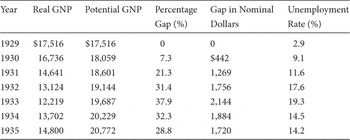
The economic situation Bennett faced at the close of the Imperial Conference was one of continuing economic contraction. Table 1 presents some key macroeconomic statistics for the 1929–35 period. The standard expansionary macroeconomic policies were, of course, not well understood in 1930. John Maynard Keynes’s General Theory of Interest, Employment, and Money did not appear until 1936, after Bennett had left office. In fact, Barry Eichengreen has argued that expansionary monetary and fiscal policies went largely unused during the 1930s: “I argue … that there was no Keynesian revolution in the 1930s. Arguments related to the General Theory had little impact on the actual policies of central banks and governments. Fiscal policy in particular made a very limited contribution to recovery from the Depression. Governments ran large budget deficits only where necessary to underwrite substantial increases in military spending that were impossible to finance by other means.”Footnote 29
Macroeconomic Conditions in Canada, 1929–1935

Notes and Sources:
Values for Real GNP and Potential GNP are in millions of 1971 Canadian dollars. Values for GNP Gap are in millions of nominal Canadian dollars. Real GNP is series F55 from Statistics Canada, Historical Statistics of Canada adjusted for comparability to Malcolm C. Urquhart, Gross National Product, Canada, 1870–1926: The Derivation of the Estimates (Kingston, Ontario, 1993). Potential GNP was calculated as a simple logarithmic trend between the real GNP values for 1929 and 1941. The unemployment rate is series C54 (“persons without job and seeking work”) divided by series C50 (“civilian labour force”) from Malcolm C. Urquhart and K. A. H. Buckley, eds., Historical Statistics of Canada (Toronto, 1965).
There is no indication that Bennett (who served as his own finance minister) considered a policy of expanding production and employment through increases in government expenditures financed by bond issue. Bennett had inherited a substantial public debt, interest payments on which would make up more than 25 percent of government expenditures in the fiscal year ending March 1931. He was not inclined to add to this burden. Total federal government expenditures for the fiscal year ending March 1931 were $442 million. This total rose only to $478 million for the fiscal year ending March 1935. Increases in relief payments, which rose from $10 million in fiscal 1931 to $76 million in fiscal 1935, more than account for the increase in total government expenditures. Bennett’s only significant change in fiscal policy during his first two years in office was actually contractionary as he raised income tax rates in an attempt to offset falling government revenue from tariffs and sales taxes.Footnote 30
Attempting an expansionary monetary policy was hindered by several factors.Footnote 31 Canada lacked a central bank until the Bank of Canada was established in 1935. Perhaps more important, Bennett felt constrained by the need to defend the value of the Canadian dollar. Canada had technically left the gold standard in January 1929, when Mackenzie King suspended gold exports. Although in principle the Canadian dollar was floating, it did not depreciate against the U.S. dollar or the British pound until after Britain left the gold standard in 1931. Bennett was committed to defending the value of the dollar and doubted the favorable effects of depreciation. Responding to a question in Parliament, Bennett argued: “If I thought for a single moment that to add, beyond $71 million of the present outstanding unsecured paper money of this country another 25 or 30 or 40 millions of dollars would cure unemployment, would lift the Depression and would end all of our troubles, I would have no more hesitancy in asking the House for it than I have in asking the House to pass any estimate that is submitted to it.”Footnote 32
The general interpretation of the British North America Act was that the power to enact legislation regulating businesses and labor markets was reserved for the Provinces. Although near the end of his term in 1935 Bennett proposed, and Parliament enacted, a number of pieces of regulatory legislation as part of his “New Deal” reforms, during the early years of his term Bennett and his advisers hewed to the orthodox view that such legislation was not constitutional.
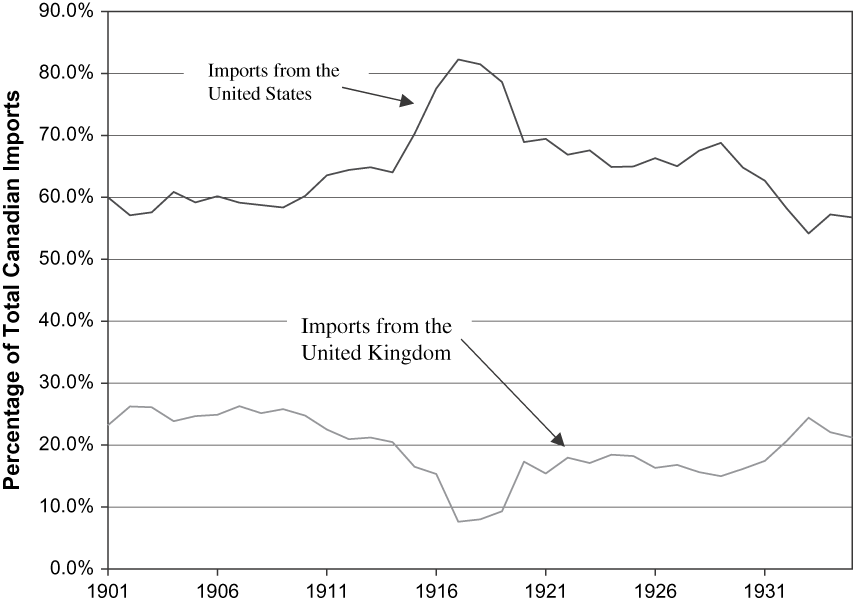
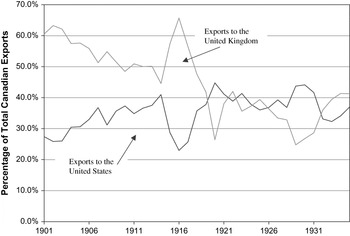
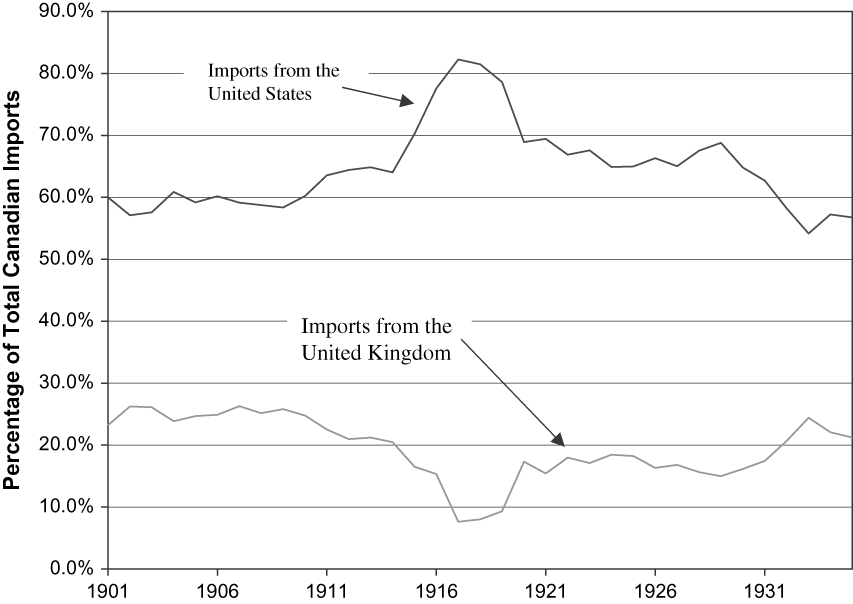
For Bennett, trade policy was the main hope for economic recovery. The United Kingdom and the United States were by far Canada’s largest trading partners. Although it would have been hard to tell from Bennett’s rhetoric, at the time he assumed the premiership in 1930 the United States was a larger source of Canadian imports and a much larger market for Canadian goods than was the United Kingdom. Figure 1 shows that in 1930, Canada was importing three times as much from the United States as from the United Kingdom. Figure 2 shows the share of Canadian exports bound for the United Kingdom had declined between 1901 and 1930, whereas the share bound for the United States had gradually risen.
Canadian imports from the United States and the United Kingdom, 1901–1935
Source: Canada, Dominion Bureau of Statistics, Canada Year Book 1939, 506–7.
Canadian exports to the United States and the United Kingdom, 1901–1935
Source: Canada, Dominion Bureau of Statistics, Canada Year Book 1939, 506–7.

The United States had also become the largest investor in Canada. Whereas British capital investment in Canada was hardly any greater in 1930 than it had been in 1914, American capital investment had increased more than fourfold. American capital investment had been less than one-third of British capital investment in 1914, but was more than 45 percent greater in 1930.Footnote 33
Export markets were of increasing importance for key Canadian products. By the late 1920s more than three-quarters of the Canadian wheat crop was sold abroad.Footnote 34 In these circumstances, the progressive increases in the U.S. tariff on wheat—which had been on the free list under the Underwood Tariff of 1913, but on which a tariff of 42 cents per bushel was being levied by 1930—had resulted in tremendous resentment in the Prairie Provinces. Bennett had adeptly exploited this resentment during the 1930 campaign. The Prairies had historically not been very receptive to the Conservative’s protectionist philosophy; in fact, Bennett’s seat in Calgary had been the only Prairie riding won by the Conservatives in the 1926 election. By 1930 popular sentiment on the Prairies was very different, and the Conservatives gained twenty-two seats in these provinces. Clearly, Prairie voters did not support Bennett’s proposed tariff increases because they desired protection from imports of foreign wheat (which were negligible). They were expecting Bennett to find additional export markets.
Bennett was in a similar situation with respect to another vitally important Canadian export, wood and wood products. In 1929, Canada produced almost $200 million worth of paper, 80 percent of which was exported. In the same year, about $115 million worth of lumber was produced, nearly half of which was exported, and $130 million worth of pulp, more than one-third of which was exported.Footnote 35 Wood products were of particular importance in British Columbia, which was a political sore spot for Bennett. Although at one time British Columbia had been the Conservative’s strongest province, the party had fared poorly there in the 1930 election. Their share of the vote declined by almost five percentage points compared with the 1926 election and they lost five seats. British Columbia was, in fact, the province most dependent on foreign markets. In 1930 it had per capita exports of $255, which was nearly 75 percent greater than for any other province.Footnote 36 Shortly after the election, Mackenzie King discussed the results with Bennett and wrote in his diary that Bennett believed that “I [King] had got them to believe the future of the port [of Vancouver] depended on Liberal policies.”Footnote 37 Hence, finding additional markets for wood products was an important priority for Bennett as he tried to allay skepticism among voters in British Columbia over his strategy of using tariff increases to pry open foreign markets.
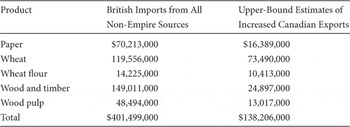
In the end, Bennett’s efforts for ameliorating the impact of the Depression on Canada were concentrated on striking a deal that would expand the market for Canadian exports in Britain. Table 2 provides a rough estimate of the extent to which exports of key Canadian products to Britain might have been expanded, based on conditions in late 1930 and early 1931 as Bennett looked ahead to the Ottawa conference. As column 2 indicates, Britain imported substantial amounts of Canada’s five most important export goods from non–British Empire countries. Under the most optimistic view of the potential impact of a policy of imperial preference, most of what Britain was importing from non-empire sources might have been switched to being imported from the Dominions. Column 3 provides an upper-bound estimate of the extent to which Canada might benefit from a redirection of inter-empire trade. For paper, paper and pulp, and wood products, we assume that Canada would be able to increase its exports to Britain by an amount equal to the difference between the highest level of total exports of the goods to all countries that Canada achieved during the 1920s and the actual amount exported in 1930. For wheat and wheat flour, Britain was importing substantial quantities from Australia. The values for these products in column 3 assume that Canada would have received its proportionate share of the British market under the assumption that all non-empire imports were redirected to the Dominions.
Potential Increase in Canadian Exports to the United Kingdom, 1930–1931

Notes and Sources:
Data are in Canadian dollars. For column 2: Canada, Department of Trade and Commerce Bureau of Statistics, External Trade Branch, Statistical Abstract of Trade of British Empire Countries (Empire and Foreign) 1930 (Ottawa, 1932), 32–51; for column 3: see text.
Clearly the estimates in column 3 represent upper bounds. They assume that all non-empire imports of these products to Britain would be eliminated. This would have required a substantial increase in tariffs, which was unlikely given the adamant opposition of most Labour and Liberal MPs to such tariffs as constituting a “food tax” and given the desire of the British government to expand non-empire markets for its manufactured goods. The estimates also ignore the impact on imports of declining incomes in Britain. Nevertheless, even these upper-bound estimates only result in a total increase in Canadian exports to Britain of less than $150 million. As Table 1 showed, the gap (in nominal dollars) between actual GNP and potential GNP was over $1 billion in 1931. Even with the assumption of a generous expenditure multiplier of two or three, this gain in exports would not have come close to offsetting the decline in spending from other sources.
POLITICAL AND ECONOMIC DEVELOPMENTS LEADING UP TO THE OTTAWA CONFERENCE
By early 1932, as Bennett looked forward to the opening of the Imperial Economic Conference in Ottawa, the political situation in Britain had changed in a way that was potentially favorable toward his plans, although this was overshadowed by the continuing deterioration in the Canadian economy. In Britain, the deepening economic crisis had led to a split between Ramsay MacDonald and most of the leadership of the Labour Party; in August 1931 he had formed a National Government, which included the Liberal and Conservative Parties. The National Government was returned to office by an overwhelming majority in the general election of October 1931; the Conservatives won 470 seats, MacDonald’s newly formed National Labour party won 13 seats, the Liberals won 73 seats, while the opposition Labour Party won only 52 seats.Footnote 38 Ramsay MacDonald, now formally expelled from the Labour Party, remained as prime minister, but Stanley Baldwin, as Leader of the Conservative Party, appeared to be the dominant figure in the government. By this time, Britain’s abandonment of free trade had become all but certain. The initial proposal by Neville Chamberlain, now Chancellor of the Exchequer, was for an across-the-board 10 percent tariff on nearly all products, to be applied to all imports, including those from the Dominions. Most raw materials and food products, including wheat, were to be exempted from the tariff.Footnote 39
Bennett was surprised and disappointed to learn that the new tariff would be levied on products from the Dominions. He attempted to rally support within Britain for exempting the Dominions. In early February 1932, he telegraphed Lord Beaverbrook: “We are greatly perturbed. Undoubtedly effect of suggested action will be to create an atmosphere that will render successful conference difficult if not impossible.”Footnote 40
Bennett’s efforts were successful and Chamberlain announced that no tariffs would be levied on Dominion products pending the outcome of the Ottawa conference. There was disagreement on this point within the British cabinet, and some members clearly believed that the exemption for the Dominions should only be maintained if the Dominions were willing to make tariff concessions on exports to them from Britain. In May, J. H. Thomas, British Secretary of State for the Dominions and a member of the British delegation to the conference, sent a telegram to Bennett:
His Majesty’s Government in the United Kingdom desire that no misunderstanding should exist as to their position in this respect. Their view throughout has been that continuance of concessions within the framework of the Import Duties Act after the 15th of November could not be justified to public opinion and affected interests here unless balanced by reciprocal concessions. … They are somewhat concerned that, though time is running short, there has so far been no real indication of the attitude of the Dominion Governments as regards concessions which the latter might be prepared to give in return for continuance of concessions under Imports Act.Footnote 41
In June, Stanley Baldwin issued a similar warning: “Let no Dominion think for a moment that we are not grateful for what they have done for years without any reciprocity from us, but let them for their part not fail to realize what a tremendous thing free entry is.”Footnote 42 From Bennett’s point of view, however, a necessary precondition for the success of his policy had been fulfilled: Britain had abandoned free trade. It had become at least possible that with hard bargaining he might be able to use the Ottawa Conference as a vehicle for greatly increasing Canadian exports to Britain.
The urgency of attaining this outcome had been increased by the continuing deterioration in the economic situation in Canada. Employment in Canada, which in 1930 had been down only about 5 percent from its 1929 peak, was down more than 25 percent by 1932. Relief and other public welfare expenditures had increased from about 1.2 percent of national income in 1929 to 6.0 percent in 1932.Footnote 43 Bennett’s promises during the 1930 campaign to bring about a quick end to unemployment were coming back to haunt him politically. Speaking in the House of Commons in early February, Mackenzie King quoted from a number of those speeches and then observed:
My right hon. friend [i.e., Bennett] is telling the country to-day that he is seeking to redeem his promises, and he points to the way he has raised the tariff and, as some of his followers did to-day, to the millions of dollars he is expending from the public treasury. But may I point out to him and to others that those were not his promises, that he would raise the tariff, that he would spend millions of dollars of public money for unemployment relief, and so on. The promises were that he would end unemployment, and that he would find markets; these other things the tariffs and the expenditures, were the means to that end.Footnote 44
Bennett’s response to such chiding was that the poor economic conditions in Canada were the result of a worldwide depression that was beyond his control. This observation was of little help politically. The future of Bennett’s government had become strongly dependent on his ability to extract concessions from Britain that would significantly increase the British market for Canadian exports, while at the same time resisting the demands the British delegation was sure to make for Canada to lower its tariffs on British manufactured products, particularly textiles and steel.
THE 1932 OTTAWA IMPERIAL ECONOMIC CONFERENCE
Bennett was cautious in his public pronouncements leading up to the conference. Mackenzie King had attempted to highlight the contradictions in Bennett’s plan to increase Canadian exports to Britain while protecting Canadian industry from British competition, by calling for what was, in all but name, free trade between Canada and Britain: “The Prime Minister and the government would be well advised to drop altogether this idea of seeking to bargain with the old country in any arrangements that they make at the conference. They would be well advised to take a generous attitude in the matter of trade which will enable British commodities[,] subject to the provisions of a revenue tariff, to come into this country and be of service to our consumers and to those engaged in the great basic industries, and thus in turn enable our commodities to find a place in the markets of Great Britain and elsewhere throughout the world.”Footnote 45
For Bennett, this was not a serious consideration. He believed anything approaching free trade would be destructive of Canadian manufacturing, particularly textiles and steel. As he wrote in a private letter: “I cannot conceive of any Canadian suggesting at this time the destruction of the industrial fabric which has been built up in Canada at so terrific a cost. … There are some things one can face, but one cannot with equanimity contemplate the results of the adoption of such a policy.”Footnote 46 His closest advisers agreed with this. In a postmortem on the conference, William Herridge, the Canadian ambassador to the United States and Bennett’s brother-in-law and close adviser, noted in a letter to him: “But to a Canadian, there is very little merit at all [in a proposal of free trade within the Empire], unless we are prepared to go back to a primitive state, to abandon our highly complex and costly social and economic system, and to throw to the wolves of Birmingham and Nottingham and Leeds the Canadian industrialists, to sustain life in whom we have always laboured so valiantly.”Footnote 47
In the end, Bennett decided to go forward with a strategy of attempting to get the British to agree to extend their tariff to raw materials and food products (or at least to wheat and wood products, the commodities most important to Canada) and to make permanent the Dominion exemption from the tariff. In exchange, Canada would be willing to reduce or eliminate tariffs on certain British manufactured goods. In his opening statement, Bennett indicated that the list of these goods would extend beyond those that Canada was incapable of producing or was currently importing from non-empire sources. Canadian industries that were in principle capable of competing with British industries would also have their tariff protection reduced: “Those Canadian industries which now have reached maturity under protective tariffs and are now competing in World Markets must support this proposal because of the great advantages that are to be obtained for the exporters of natural products.”Footnote 48
Bennett had difficulty in identifying such industries, in part because in setting tariff policy he continued to rely on advice from the Canadian Manufacturers’ Association, as he had from his first days in office. He had begun meeting with them in December 1931 in an attempt to work out tariff concessions that might be offered to Britain at the conference. He became increasingly dissatisfied with their apparent unwillingness to countenance any tariff concessions on products currently being manufactured in Canada. In a letter to J. K. Walsh, manager of the Canadian Manufacturers’ Association, written on the eve of the Conference, Bennett complained: “I think you will agree that the list of items not produced in Canada, comprising several thousand in number, which you forwarded, is not a practical answer to the question that I submitted to your Association last December. … I have given some little study to the list, and it is rather disheartening to think that such a list should be submitted to intelligent men as indicating the extent to which Canada might be able to improve trade and commerce with the United Kingdom by the admission, free or at a lower rate of duty, to our markets of the products of Empire countries.”Footnote 49
Even as the conference began, Bennett had no clear idea of what concessions he might offer the British. He was also very late in deciding which concessions he would ask from the British. He finally sent a telegram to the British delegation just as they were about to sail for Canada. The telegram did not specify the details of the Canadian request, but just listed the products—notably wheat, wood products, meat, and dairy products—on which Canada intended to negotiate for preferences in the British market.Footnote 50 In the end, Bennett had decided that rather than offering to lower tariffs on British imports, he would offer to raise further the tariffs on non-empire products with which British imports would compete. This was not a proposal with which the British were likely to agree because the markets they wished to enter were those, particularly in steel and textiles, where existing tariffs were so high that imports were negligible and high-cost Canadian firms predominated. In other words, the British delegation was expecting a reduction in existing tariffs on British exports to Canada rather than further increases in Canadian tariffs on imports from non-empire sources, which in practice would be of little use to them.
Stanley Baldwin headed the British delegation and noted in his opening remarks: “There are two ways in which increased preference can be given[:] either by lowering barriers among ourselves, or by raising them against others.”Footnote 51 He made it clear that the British delegation was in favor of the first of these alternatives. Although two years before Neville Chamberlain had spoken of making the empire economically self-sufficient, the realities of Britain’s trade situation had by 1932 made it evident that such a policy was not possible. More than half of Britain’s trade was with countries outside the empire and the British delegation was very reluctant to be party to an agreement that would oblige them to raise tariffs, which they believed was likely to provoke retaliatory increases by other countries.
The conference dragged on for a month, making little progress. The key sticking points were Bennett’s extreme reluctance to reduce the degree of effective protection enjoyed by Canadian industry and the British delegation’s reluctance to increase tariffs on non-empire imports into Britain. During the negotiations, Bennett attempted several times actually to expand the extent of the protection Canadian manufacturing received from British competition. For instance, even though previous discussions had led to a tentative agreement that rolled steel plate of greater than 60 inches in width would remain on the free list for at least five years, Bennett was successfully lobbied by representatives of the iron and steel industry to impose the tariff on plates of up to 66 inches in width—even though plates of that width could not currently be produced by Canadian companies.Footnote 52 Once again, Bennett’s hopes to increase Canada’s integration with the British Empire and find markets to replace those lost in the United States were hindered by his need to propitiate the special interests on whose political support he relied.
A complete breakdown of the conference was ultimately avoided and a limited agreement was reached. The fact that any agreement was reached at all was largely due to the political embarrassment that would have resulted for both the Canadian and British delegations if the conference had concluded without one. Although representatives of Australia, New Zealand, India, Southern Rhodesia, Newfoundland, and the Irish Free State attended the conference, no general empire-wide agreement was possible. The negotiations between Canada and Britain resolved themselves into what was in effect a bilateral trade agreement. The key to the agreement was Bennett’s willingness to accept a proposal by Neville Chamberlain for tariffs on manufactured products to be set according to the principle of “domestic competition.” The idea was that the Canadian tariff would be set so as to equal the difference in production cost between Canadian and British producers.Footnote 53 The determination of what this level might be was to be left to a Tariff Board that was to issue judgments arrived at in an impartial manner and before which British manufacturers were to be allowed to appear on an equal footing with Canadian manufacturers. In exchange for this concession, Canada would continue to be exempted from the British general 10 percent tariff and Britain would end its trade agreement with Russia, which, according to Bennett, had resulted in lumber and wheat being dumped on the British market at below production cost.Footnote 54
The agreement at the conference was not without benefit to the Canadian economy. Canadian merchandise exports to the United Kingdom increased from about $178 million (or about 37 percent of total Canadian exports) in 1932 to about $270 million (or about 42 percent of total exports) in 1934 and to about $303 million (or about 42 percent of total exports) in 1935.Footnote 55 But there could be no doubt that Bennett had not brought off the far-reaching reordering of Canada’s international trading relations that the Canadian public had been led to expect might result from the conference. Moreover, it had become quite clear that further expansion of Canadian exports to the United Kingdom would require additional tariff concessions with respect to manufacturing for which there was negligible support within the Conservative party.
MOVEMENT TOWARD A RECIPROCAL TRADE AGREEMENT WITH THE UNITED STATES
In the face of the weak recovery of the Canadian economy and the limited results to be expected from the Ottawa agreements with Britain, Bennett reluctantly turned toward attempting to revive Canadian exports to the United States. During the 1932 U.S. election campaign, Franklin Roosevelt had been forthright in criticizing the Smoot-Hawley Tariff increases, but he was much more circumspect in providing specifics of possible reductions he might contemplate once in office. Toward the end of the campaign, under attack from Hoover, Roosevelt felt obliged to pledge not to reduce tariffs on agricultural products.
Canadian observers were uncertain what to make of Roosevelt’s conflicting statements. Shortly after the election, Herridge wrote to Bennett: “When the polemics against the Republican record are eliminated from the campaign literature and speeches, not a great deal is left. In the later stages of the campaign Mr. Roosevelt grew more and more cautious in his references to the tariff.”Footnote 56 But Herridge also passed on to Bennett a report that Roosevelt was interested in exploring the possibility of a reciprocal trade agreement with Canada. In fact, shortly thereafter, Roosevelt dispatched Henry Morgenthau to Ottawa to see if the basis for negotiation existed.Footnote 57 As a result of Morgenthau’s visit, Bennett arranged to meet with Roosevelt in Washington during April 1933.
Entering into trade negotiations with the United States was not without political risk for Bennett. Although he could make the argument that one of his purposes in raising tariffs in 1930 and 1931 was to use the higher rates as bargaining chips in negotiations with the United States aimed at reducing the Smoot-Hawley increases, he had shown no interest in such negotiations until after his attempts to expand Canadian exports to Britain had failed to have the expected results. By early 1933, he had begun through his public statements to prepare Canadian opinion for trade negotiations with the United States by emphasizing the economic consequences of geographical proximity. In a speech to the Toronto Board of Trade in January 1933, Bennett declared: “Gentlemen, may I point this out to you: geographically, we are part of the North American continent. Who by taking thought can add a cubit to his stature? Who by taking thought can change Canada from being a part of North America to being a part of Europe? Gentlemen, I invite you to remember that fundamental fact, that the Dominion of Canada geographically is part of the North American Continent. And it gives me no joy to remind you also that financially it is in the same position.”Footnote 58
Bennett’s first public indication that he was interested in negotiating a reciprocal trade agreement with the United States came in the House of Commons on 20 February 1933. Bennett stated that he wanted to limit the agreement to trade in natural products and he argued at length that his position was not new, but was consistent with the stance of Canadian governments, Liberal and Conservative, for many years. But it was evident to most that a change in policy had taken place. Mackenzie King was quick to note the point:
I listened with much interest this afternoon to the Prime Minister (Mr. Bennett) in his remarks. … [T]he Liberal attitude in this parliament had always been favorable to a reciprocal trade agreement with the United States, if such could be obtained on terms mutually advantageous. I noticed that in speaking the Prime Minister enlarged the Liberal attitude somewhat and termed it the attitude of this parliament. Now, I regret to say that review of the debates of this parliament would not disclose any such acquiescence by hon. gentleman opposite in the Liberal point of view. … [M]y right hon. friend, if he believes what he says at this moment, has experienced a change alike of heart and of mind as a consequence of the changed conditions that have come about of recent years.Footnote 59
As the process of negotiating with the United States unfolded, King was even more caustic in comments in his private diary: “Again it is a wholesale theft of our policy of “reciprocity,” just at the moment that we would have been able to give it full effect. Bennett talking against “nationalistic” policies—when he more than anyone else in the world has been responsible for fastening them on to British countries & through British countries upon others.—Could there have been a comparable theft of a party’s entire program … than Bennett is guilty of.”Footnote 60
All that came out of Bennett’s April meeting with Roosevelt, however, was a joint statement indicating in general terms that negotiations on a reciprocal trade agreement had begun: “We have agreed to begin a search for means to increase the exchange of commodities between our two countries, and thereby promote not only economic betterment on the North American continent but also general improvement of world conditions.”Footnote 61
In fact, serious negotiations were very slow to begin. There was a stark division of opinion among Roosevelt’s advisers on the advisability of liberalizing trade. Secretary of State Cordell Hull favored the rapid dismantling of tariff barriers, but George N. Peek, who was head of the Office of Special Adviser on Foreign Trade, harbored strong protectionist sentiments. Peek was particularly skeptical of negotiating with Canada.Footnote 62 A second stumbling block was that control of tariff policy in the United States still lay with Congress. There had been a general expectation that Roosevelt would push to be granted the authority to arrive at agreements with other countries for joint tariff reductions without congressional approval, but Roosevelt was reluctant to provoke a political fight that might distract from his domestic agenda.Footnote 63 As a result, it was only in March 1934 that Roosevelt sent to Congress the Reciprocal Trade Agreement Act, which Congress passed in June 1934.
On the Canadian side, Bennett remained largely passive, apparently content to wait until the Roosevelt administration presented him with a concrete proposal. Among Bennett’s advisers, Herridge had become particularly impatient with the delays. In a letter to Bennett on 7 April 1934, he urged that the Canadian government make an immediate proposal:
If any agreement is to be made, it will be as a result of a definite proposal immediately this Tariff Bill becomes law. Clearly, long negotiations will lead us nowhere. … I say the Administration … will move only under stimulus from us. And that stimulus, in my opinion, should be a definite and concrete and comprehensive trade proposal. We have already discussed in a casual way certain possible major items. My own view clearly is that … the time is not far distant when we will be compelled to radically reduce the tariffs upon certain things with the price of which are involved cheap production and cheap transportation. These items … I should therefore use (with others we know of) in this proposed deal, and, I say, I would make the proposal concrete, comprehensive, and final.Footnote 64
Bennett, however, preferred to wait for the United States to make the first detailed proposal. A key sticking point for Bennett appears to have been the conflict between British preference rates written into Canadian tariff law and the provision of U.S. tariff law requiring that it receive “most-favored nation” status. Dana Wilgress, who had been party to the preliminary negotiations, reported that when he told Bennett of this problem, he “hit the roof. He literally shouted at the top of his voice at me about how this most-favoured-nation clause was most ridiculous.”Footnote 65 For Bennett, a good part of whose career was based on the attempt to disentangle Canada from its trading relations with the United States and to strengthen Canada’s role within the British Empire, putting Britain on a par with the United States with respect to trade was apparently too much to take. He also believed himself on firm ground in resisting extending most-favored-nation status to the United States because Britain and the Dominions had always held the position that for purposes of foreign trade agreements they were, in effect, a single unit whose internal relations were not subject to most-favored-nation considerations.Footnote 66
According to the account of R. K. Finlayson, Bennett’s private secretary from 1932 to 1935, it was only in November 1934 that Bennett finally agreed to allow Finlayson to draft a note for the government to dispatch to Washington proposing that detailed and serious negotiations begin.Footnote 67 Herridge personally handed the note to Hull on 15 November. In Herridge’s account, Hull’s reaction was mixed: “He favoured me with two or three brief extracts from his standard oration, and took some pains to impress upon me that precipitate action was dangerous because of the entrenched and powerful tariff interests which he had as yet been unable wholly to dislodge.”Footnote 68 It was not until 27 December that Hull made a formal reply. In his reply, Hull stated the willingness of the U.S. government to enter into serious negotiations within the limitations imposed by U.S. law. He made it clear that no commitment in advance of negotiations could be made as to reductions in the tariffs on particular products. Herridge was instructed to respond on 4 January 1935 that the Canadian government was ready to begin negotiations immediately. On 21 January 1935, the U.S. government made a public announcement of an intention to negotiate with Canada (which was required under the Reciprocal Trade Agreement Act).
When serious bargaining finally began in August 1935, Bennett considered the opening American position to be inadequate because it appeared unlikely to result in a significant increase in Canadian exports to the United States of a number of important products. In part, this was the result of the limitation written into the Reciprocal Trade Agreement Act, which capped at 50 percent the reductions in tariffs that U.S. negotiators could offer. Given how high the Smoot-Hawley rates were, even a reduction of 50 percent would have left many tariffs at prohibitive levels. A second round of negotiations was planned, but Bennett was obliged to set the next federal election for October and it was decided to suspend the talks pending the outcome of the election.
CANADIAN TRADE DURING THE DEPRESSION
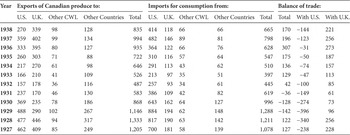
Table 3A presents Canada’s exports and imports over the period 1927–38, three years before Bennett’s election and three years following his defeat to Mackenzie King. Although falling incomes and rising and high unemployment (see Table 1) of course help explain the fall in imports shown in this table, tariff policy played a critical role.Footnote 69 Many observers at the time emphasized the tariff’s importance. For example, H. A. Innis claimed that “the effects of reliance on a single method of control have been evident during the depression in the dominance of the tariff as a means of providing unemployment relief, protection, and control of exchange.”Footnote 70 More recently, Michael Hart noted: “Canadian economic expansion in the 1920s had been built on precarious foundations and when … the world went into depression, dependence on exports of grain, forestry, and mineral products made Canada particularly vulnerable to the protectionist response.”Footnote 71 Canada’s Trade, 1927–1938 Notes and Sources: Data are in millions of Canadian dollars; gold is excluded. CWL stands for commonwealth countries. Series G389-G393 for exports and G396-G400 for imports. Available from http://www.statcan.gc.ca/pub/11-516-x/sectiong/4147439-eng.htm#4/. Accessed 30 January 2009. The balance-of-trade columns are the authors’ calculations. Canada’s Trade with the United States and the United Kingdom, 1928–1936

As O. J. McDiarmid stated: “In Canada, the two principal objectives of the tariff, revenue and protection, though often mutually inconsistent, have usually been sought simultaneously within the same edition of the customs act.”Footnote 72 He goes on to say that “very few countries indeed, used their tariffs more energetically or showed more ingenuity in developing supplementary controls in the same field.”Footnote 73 Hart provides a long list of “artful” protective devices, including made-in-Canada provisions, seasonal rates, and content requirements.Footnote 74 H. R. Kemp goes even further about the critical role the tariff played, claiming that in 1934, “of forty leading Canadian industries, at least twenty-four depended upon the protective tariff for their existence … and it might be argued that there was perhaps not a single Canadian industry which could not be undersold by some foreign competitor. The artificial nature of the Canadian economy appeared to be obvious.”Footnote 75
During 1930, both parties—the Liberals’ Dunning budget and, more important, the Conservatives’ postelection special session of parliament—raised duties, which led to a dramatic fall (about 50 percent) in total imports: from $1,288 million in 1929 to $619 million in 1931 (see Table 3A). As W. A. Mackintosh put it: “With the incoming of a Conservative government in 1930, tariff revisions were set on foot which represented the most clear-cut protectionist legislation proposed since the National Policy was adopted in 1879. … The new government proposed sweeping increases in customs duties which lifted Canada immediately from the ranks of the moderately protectionist countries into those of the highly protected.”Footnote 76
According to Mackintosh, even more significant than the increases in actual rates were the sweeping new powers assumed by the Bennett government. By amending the Customs Act in 1930, the Conservatives had broad powers to impose not only arbitrary valuations on goods to which the ordinary dumping legislation did not apply satisfactorily, but also drastic antidumping duties and what were in effect almost prohibitive duties on imports from countries with depreciated currencies.Footnote 77 As McDiarmid stated, “The sharpest teeth were inserted in this restrictive trade policy when the Conservative government raised maximum dumping duties from 15% to 50% and elaborated and refined the Liberal-sponsored dumping clause … to forge a most effective weapon against competitive imports.”Footnote 78 These special powers were freely used between 1930 and 1933, especially after sterling depreciated in 1931. Writing in 1933, Mackintosh described Canada as a country “not only of relatively high tariffs but [it] has in the past three years become a country of unstable tariffs … which constitutes a barrier to trade much greater than would stable rates of duty even though equally high.”Footnote 79
The additional duties following the Ottawa Agreements of 1932 contributed to the nadir of total imports during 1933 shown in Table 3A. These protectionist policies succeeded in drastically reducing imports and prevented “distress sales” of U.S. and other goods in Canada: not only did imports fall more rapidly than exports, but imports also hit a more than two-decade low in 1933, being only about 31 percent of what they had been in 1929.Footnote 80
Also shown in Table 3A, total exports reached a low in 1932 when they were about 36 percent of what they had been in 1928, which explains why Bennett was so determined at the 1932 Imperial Economic Conference to reorient Canada’s trade with the United Kingdom in an attempt to replace the lost U.S. market. Falling incomes around the world and other countries’ protective measures were the most important reasons for the steady decline in Canada’s exports from 1928 to 1932.Footnote 81 Because export prices fell more than import prices did over the period 1929–33, the terms of trade also fell, turning against Canada.
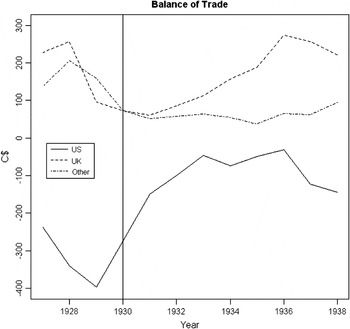
The total balance-of-trade column in Table 3A shows how Canadian trade dried up during the depression, the low point being a deficit of $36 million during 1931. Interestingly, Canada’s total trade balance was in deficit over the period 1929–31 as although imports fell more than exports did, imports still exceeded exports during this period. However, Bennett did succeed, in 1932, in attaining his goal of a “favourable” (albeit modest) balance of trade.Footnote 82 Despite significant shrinkage during the depression years, the last two columns of Table 3A and Figure 3 show that although Canada ran trade-balance surpluses with the United Kingdom (and all other countries), it ran trade-balance deficits with the United States annually throughout the entire period 1927–38.
Canada’s balance of trade with the United States, United Kingdom, and all other countries, 1927–1938
Source: Table 3A.

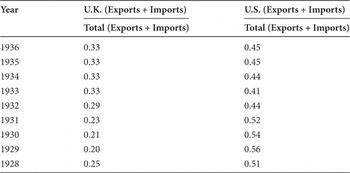
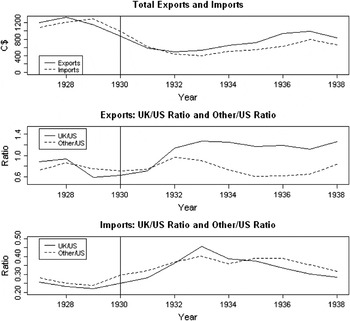
Figure 4 provides another way of seeing how Canada’s trade relationship with the United Kingdom was fundamentally different from its relationship with the United States and how Bennett did actually succeed somewhat in his goals of redirecting trade toward the United Kingdom. During 1930–33, not only did the ratios of U.K. to U.S. exports and U.K. to U.S. imports both rise, but they rose more sharply than did the comparable ratios of other countries to the United States. Table 3B shows that Bennett’s policies reduced the importance of Canada’s trade with the United States (as measured by U.S. exports and imports as a percentage of total exports and imports) from a high of 0.56 in 1929 to 0.41 in 1933, whereas the United Kingdom became relatively more important as its imports and exports (as a percentage of Canada’s total) grew from 0.20 in 1929 to a high of 0.33 in 1933.
Canada’s total exports and imports; U.K./U.S. and other countries/U.S. export and import ratios, 1927–1938
Source: Table 3A.

CONCLUSION
As we have argued above, at the time he took office Bennett had few policy options for fighting the depression. Understanding of expansionary monetary and fiscal policies was limited and, in any event, Bennett believed himself to have little leeway to undertake major increases in government expenditure or substantial new money creation. Higher tariffs did have the potential to expand production and employment in the short run, but this effect was swamped by the size of the contractionary forces buffeting the Canadian economy in the early 1930s. Ultimately, Bennett’s hope of strengthening Canada’s position within the British Empire both politically and economically by redirecting a greater share of Canada’s exports to Britain foundered on two key difficulties. The first was that in the end British negotiators expected reciprocity that would involve significant reductions in Canadian tariffs on manufactured goods. Such reductions were politically impossible for Bennett. The second difficulty was that the long-run trend in Canada’s trade was clearly toward increasing reliance on the United States and decreasing reliance on Britain. No feasible policy measures were likely to result in more than a temporary deflection of this trend.
Mackenzie King scored an easy victory in the October 1935 election, capturing 173 seats to 40 for the Conservatives and 32 for third parties. At the time of the election, Bennett was of course in an extraordinarily difficult political position. Unemployment remained high and production was well below its pre-depression peak. Nevertheless, the election was interpreted at the time as a clear repudiation of Bennett’s policies by Canadian voters.
The Canadian movement away from protectionism can be contrasted with the similar movement in the United States. In the United States, from the Civil War onward, the Republicans typically had been the party of high tariffs, and the Democrats typically had reduced tariffs during their infrequent periods in power. When the Democrats assumed control of Congress and the presidency following the 1932 election, they did not enact a unilateral reduction in tariff rates, as they had done in the past. Douglas Irwin argues that Roosevelt’s advisers concluded that only negotiated mutual reductions in tariffs could increase U.S. exports because of the increase in tariff rates enacted by most trading partners of the United States between 1929 and 1932. Without the possibility of increased exports, sufficient support did not exist in Congress for reducing tariffs, given the severity of the economic downturn.Footnote 83 Although, as we have seen, Democrats, including some in Roosevelt’s administration, were divided over the economic or political wisdom of tariff reduction, Roosevelt was able to push the Reciprocal Trade Agreement Act through Congress in 1934.
In Canada, Bennett and the Conservatives were led to accept a policy of negotiated tariff reductions as early as 1933, but Republicans in the United States took much longer to undergo a similar conversion. Irwin notes that, of the Republicans who had voted for Smoot-Hawley, only two members of the House of Representatives and one senator also voted for the Reciprocal Trade Agreement Act. The Republicans called for the repeal of the Reciprocal Trade Agreement Act during the 1936 presidential election campaign and most Republicans voted against the renewal of the Act in 1937. Only after World War II were a majority of congressional Republicans converted to free trade, as America’s postwar economic predominance led many business and labor groups to favor multilateral tariff reduction under the General Agreement on Tariffs and Trade (GATT), and increasing trade with Western Europe and Japan became identified with promoting national security as the Cold War took hold.Footnote 84
Bennett remained as Leader of the Opposition until 1938, when he retired from politics. He moved to England in 1939 and in 1941 he was created Viscount Bennett of Mickleham, Calgary, and Hopewell. He died on 27 June 1947. Somewhat like Herbert Hoover, Bennett was unable to recover politically from the perception that his policies had done little to ameliorate the problems of the depression. Indeed, P. B. Waite has argued that Bennett continues to “enjoy” the worst reputation of any Canadian prime minister, although Norman Hillmer and J. L. Granatstein have a less harsh assessment, ranking Bennett’s performance as average.Footnote 85