INTRODUCTION
Temperature is one of the main factors affecting embryo development of marine invertebrate species. Many works have shown that temperature determines developmental rate, growth rate, and survival of embryos (see Hoegh-Guldberg & Pearse, Reference Hoegh-Guldberg and Pearse1995 for a review). Together with temperature, oxygen may play an important role for the normal development of embryos in marine invertebrate species showing egg aggregation in the way of egg (jelly) masses or encapsulation (Strathmann & Strathmann, Reference Strathmann, Strathmann, Ryland and Tyler1989; Cohen & Strathmann, Reference Cohen and Strathmann1996; Lee & Strathmann, Reference Lee and Strathmann1998; Brante et al., Reference Brante, Viard and Fernández2008). The low solubility and diffusion rate of O2 in water, and the barrier that capsule wall and/or gelatinous matrix impose for oxygen diffusion seem to be major constraints for embryo packing (Strathmann & Strathmann, Reference Strathmann and Strathmann1995; Brante, Reference Brante2005). Thus, temperature and oxygen are two critical factors for the normal development of embryos within egg aggregations and at least, shaping important fitness traits such as reproductive success and clutch size in marine invertebrate species with embryo packing (Lardies & Fernández, Reference Lardies and Fernández2002; Fernández et al., Reference Fernández, Calderón, Cancino and Jeno2007; Brante et al., Reference Brante, Viard and Fernández2008). Studying the joint effect of both factors on physical conditions inside aggregations and on embryo performance may help us to advance in the understanding of the main mechanisms that constrain embryo packing in the sea and may shed light on the evolution of this strategy. In the present work, we focused on the role of the capsule wall as a barrier for oxygen diffusion and the effect of temperature on oxygen availability and embryos development of a marine gastropod which aggregated its offspring in the way of encapsulation.
A positive relationship between temperature and embryonic developmental rate has been described for many marine gastropods in general and in gastropod species with encapsulation, in particular (Pechenik & Lima, Reference Pechenik and Lima1984; Lima & Pechenik, Reference Lima and Pechenik1985; Roller & Stickle, Reference Roller and Stickle1989; Cancino et al., Reference Cancino, Gallardo and Torres2003). For example, time to hatch increased between 9.5 and 16.3 days for each Celsius degree decrease in capsules of Nucella emarginata from southern North America (Palmer Reference Palmer, Wilson, Stricker and Shinn1994). Similarly, Cancino et al. (Reference Cancino, Gallardo and Torres2003) showed that the average time required for hatching was reduced by 15 days when water temperature increased from 12 to 18°C in Chorus giganteus (Lesson 1830). The fastening of embryo development at higher temperatures is explained by the increase in the velocity of metabolic process which is translated into higher metabolic rates of individuals. Survival of embryos inside capsules may also be affected by temperature condition. A negative effect of temperature on embryo survival was observed in Thais haemastoma canaliculata (Roller & Stickle, Reference Roller and Stickle1989). This may be explained because of the high energetic demand by embryos exposed to high temperatures, and the concomitant rise in the oxygen demand (metabolic rate), is not sustained longer producing a systemic failure in the organism (Pörtner, Reference Pörtner2002).
Encapsulation would protect embryos against predation, desiccation and UV, among others (for a review see Przeslawski, Reference Przeslawski2004). However, the capsule imposes important restrictions on the diffusion of oxygen production so that embryos inside capsules experience low levels of oxygen (Lardies & Fernández, Reference Lardies and Fernández2002; Brante, Reference Brante2005; Moran & Woods, Reference Moran and Woods2007; Brante et al., Reference Brante, Viard and Fernández2008). Extreme anoxia has been observed in capsules of the sea slug Tritonia diomedea (Moran & Woods, Reference Moran and Woods2007) and the slipper limpet Crepidula fornicata (Brante et al., Reference Brante, Viard and Fernández2008). Experimental studies demonstrated that low levels of oxygen during encapsulated development affect embryonic development, embryo size, survival and hatching time (Cancino et al., Reference Cancino, Gallardo, Torres, Leiva and Navarro2000; Lardies & Fernández, Reference Lardies and Fernández2002; Fernández et al., Reference Fernández, Calderón, Cancino and Jeno2007; Moran & Woods, Reference Moran and Woods2007; Brante et al., Reference Brante, Viard and Fernández2008, Reference Brante, Viard and Fernández2009). Embryo developmental rate in three species of opisthobranch gastropods was retarded when exposed for 10 to 24 hours to oxygen tension below 10% air saturation (Strathmann & Strathmann, Reference Strathmann and Strathmann1995). Cancino et al. (Reference Cancino, Gallardo and Torres2003) showed that hypoxic conditions (oxygen at 50% of air saturation) slows embryo development and totally prevents both shell secretion and larval hatching from capsules of C. giganteus. For Acanthina mondon, the number of hatching juveniles decreased at lower oxygen concentrations (Lardies & Fernández, Reference Lardies and Fernández2002).
As we noted above, there are many works evaluating separately the effect of temperature and oxygen condition on embryo development in marine invertebrate species with encapsulation. However, temperature and oxygen availability are strongly correlated. In encapsulating species temperature influences embryo development in a direct manner because of the temperature–embryo metabolic rate relationship. In addition, temperature negatively affects the oxygen diffusion rate from the seawater through the capsule wall and intracaspular fluid to the embryonic cells limiting aerobic development of embryos. As a result, higher oxygen demand by embryos at higher temperatures and the reduction of oxygen diffusion rate to the embryos limits oxygen availability and aerobic development inside capsules. Fernández et al. (Reference Fernández, Calderón, Cancino and Jeno2007) showed that number of eggs per unit area of capsule of Concholepas concholepas negatively correlates with the sea surface mean temperature experienced by the females. These authors hypothesized that females of this species may adjust the number of eggs deposited in the capsule according to the environmental temperature which correlates with the oxygen available for the embryos inside capsules. However, from this study it is not possible to clearly distinguish the different components of the relationship among temperature, embryo oxygen demand, oxygen intracapsular availability and embryo development. The synergic effect between temperature and encapsulation on intracapsular oxygen availability highlights the importance of studying both physical factors in a more integrative way in order to distinguish potential mechanisms behind biological and physical embryo packing constraints.
The muricid Chorus giganteus (Lesson, 1829) is an endemic species from the Chilean coast, occurring sub-tidally on soft sediments and in areas with small rocks. This species has been reported from Antofagasta (23°48′S 70°32′W) to Valdivia (39°25′S 73°10′W) (Osorio et al., Reference Osorio, Atria and Mann1979). During the breeding season C. giganteus produces dense clusters of egg capsules which are attached to rocks (Gallardo, Reference Gallardo1981). The embryonic development occurs inside capsules and it is characterized by the presence of nurse eggs which are consumed by embryos at the middle developmental stage (trocophore). At the end of the encapsulation between 34 and 300 lecithotrophic veliger larvae of 645–1542 µm emerge from each egg capsule (Gallardo, Reference Gallardo1981; Leiva et al., Reference Leiva, Muñoz and Navarro1998; Gonzalez & Gallardo, Reference Gonzalez and Gallardo1999). The wide distributional range of this species suggests that individuals are likely to experience temperatures between 10 and 16°C or slightly higher during El Niño Southern Oscillation events. During the last decade, the zone with most fishing of C. giganteus occurred mainly in bays such as Golfo de Arauco (36°45′–37°10′S), which are characterized by a low temperature and a variable dissolved oxygen concentration. At Golfo de Arauco oxygen reaches its minimum values in summer time with values between 1 to 3 ml O2 l−1 in seawater at a temperature between 10 and 11°C (Ahumada, Reference Ahumada1976, Reference Ahumada and Della Croce1994; Llancamil, Reference Llancamil1982). In this study we evaluated the role of the capsule wall of C. giganteus as a barrier for oxygen diffusion and its interaction with temperature affecting embryo metabolic rate and embryonic development. We hypothesized that the joint effect of encapsulation and temperature negatively affect development of embryos of C. giganteus inside capsules.
MATERIALS AND METHODS
Embryo development
In May 1999, adult females were collected from Golfo de Arauco, Chile (37°10′S 74°25′S) and maintained in the coastal laboratory of the Universidad Católica de la Santísima Concepción, at Lenga, in central Chile (36°45′S 73°10′W). In the laboratory, a total of 810 capsules were obtained to be used in posterior experiments. Capsules were reared in aquaria of 1.5 l volume filled with filtered seawater (5 µm; 35‰ salinity) and maintained for 105 days at three temperature treatments: 9, 12 and 15°C. Between three or four replicates per treatment were used, with 51–57 capsules per treatment. Every week embryo development and survival was recorded in four capsules of each temperature treatment. Embryo developmental stages were recognized according to the descriptions in Leiva et al. (Reference Leiva, Muñoz and Navarro1998).
Survival of embryos at each temperature treatment was evaluated as the percentage of capsules hatched (empty capsules). In addition, embryo mortality was dissected in two components: (1) early mortality, defined as the mortality occurring from egg to blastula stage; and (2) late mortality, which corresponded to veliger larvae that failed to hatch. In the second case, the apical plug of the capsule was not degraded and the larvae metamorphosed to juveniles inside the capsules developing a cannibalistic behaviour. Also the number of normal and abnormal hatched individuals was recorded for each capsule in order to account for morphological alterations.
Five different one-way ANOVA tests were performed to test for the effect of temperature on: (1) percentage of hatched capsules; (2) percentage of early embryo mortality; (3) percentage of late embryo mortality; (4) number of normal hatched individuals; and (5) number of abnormal hatched individuals. Tukey a posteriori tests were performed when significances were found.
Intracapsular oxygen condition
In order to quantify the effect of temperature on the intracapsular oxygen condition, capsules were maintained at three different temperatures, 9, 12 and 15°C, and the intracapsular oxygen tension (IO2T) measured. In each trial, one capsule with pre-hatching embryos was located in a 1 l aquarium filled with filtered seawater (0.45 um; 35‰ salinity) at 100% air saturation. Water was continuously stirred by a magnetic spinner in order to maintain the homogeneity of the water oxygen tension (WO2T) in the aquarium. IO2T was measured using a microelectrode of 890 um tip diameter model 768-20R (Diamond General Development Co.) carefully inserted within the capsule through the capsule plug. WO2T was measured using an electrode (Model 1302) connected to a Strathkelvin oxygenometer (Model 781). Both electrodes were calibrated in filtered seawater to 0 and 100% air saturation (bubbling nitrogen and aerated water, respectively) and at the corresponding temperature (9, 12 or 15°C). IO2T and WO2T were recorded during 30 minutes. Oxygen was also measured in empty capsules filled with seawater in order to discriminate between embryo and capsule effect on intracapsular oxygen concentration. A small hole was made through the capsule plug to drain the intracapsular fluid and embryos, and to insert the microelectrode. In this way, oxygen condition was recorded in three different environments: (1) inside capsules with embryos; (2) inside capsules without embryos; and (3) outside capsules. Between three and eight capsules per temperature were measured. Oxygen condition was compared with a one-way ANOVA with temperature and environment as factors. The Tukey a posteriori test was performed. Data were log-transformed to meet ANOVA assumptions.
Metabolic rate
Oxygen consumption of embryos inside capsules was measured at the pre-hatching embryonic stage at three temperatures: 9, 12 and 15°C. Oxygen consumption was measured in a double-wall closed microchamber (model RC 300, Strathkelvin) filled with 3–4 ml of stirred filtered seawater (0.45 um; 35%0 salinity). Oxygen depletion was recorded using an electrode connected to a dissolved oxygen interface (model 928, Strathkelvin) and calibrated in between replicates to 0 and 100% air saturation as described above. Capsules were suspended in the middle of the microchamber through a dental floss hitched to the peduncle of the capsule. Oxygen concentration was monitored continuously for variable time periods (between 30 and 60 minutes), depending on temperature. Control measurements (filtered seawater without capsules) were also performed between replicates in order to estimate electrode and water respiration. Control respiration rates were subtracted from the rate of embryo oxygen consumption. After each trial, capsules were opened to quantify total number of larvae under a stereo microscope. Thus, oxygen consumption of embryos was expressed as μlO2/hour/capsules and μlO2/hour/embryos. Between four and eight capsules were measured per temperature. One-way ANOVA tests were run to test for the effect of temperature on the two indices of metabolic rate. Tukey a posteriori tests were performed when statistical significances were observed.
RESULTS
Embryo development
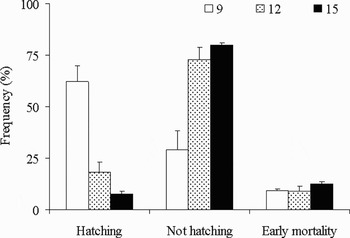
The encapsulation period extended for 61, 77 and 104 days at 15, 12 and 9°C, respectively. The ANOVA test evidenced differences among temperatures in the mean percentage of hatched capsules (ANOVA: F2,8 = 30.1; P < 0.001; Figure 1). The Tukey a posteriori analysis showed that significantly higher percentage of capsules hatched at 9°C with 62.3% (Tukey test, P < 0.05), meanwhile no significant differences were detected between 12 and 15°C (19.8% and 5.2% respectively; Tukey test, P > 0.05). Embryo mortality was divided into early and late mortality (see Materials and Methods). Early embryo mortality differed among temperatures (ANOVA: F2,8 = 1.28 P = 0.32; Figure 1). Capsules exposed to 15°C presented a significantly higher percentage of early embryo mortality with 12.1% (Tukey test, P < 0.05). No significant differences were detected between 9 and 12°C (Tukey test, P > 0.05). Late embryo mortality was also affected by temperature (ANOVA: F2,8 = 18.2; P < 0.01; Figure 1). The highest significant values were observed at 12 and 15°C, with no significant difference between them (Tukey test, P < 0.05). Capsules cultivated at 9°C showed the lowest late embryo mortality.
Percentage of hatched capsules of Chorus giganteus as a function of temperature. Embryo mortality (%) was also recorded at early and late developmental stages. Values are average + 1 SE.

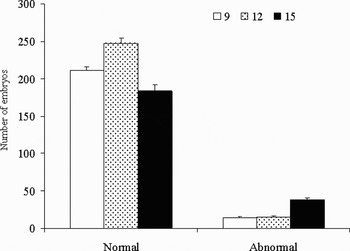
Temperature significantly affected the number of normal (ANOVA: F2,39 = 6.54; P < 0.05) and abnormal (ANOVA: F2,39 = 5.61; P < 0.05) hatched larvae per capsule (Figure 2). At 15°C the highest number of abnormal and the lowest number of normal veliger larvae were observed (Tukey test, P < 0.05, in both cases). No significant differences, in both normal and abnormal hatched larvae, were observed between 9 and 12°C (Tukey test, P > 0.05).
Number of normal and abnormal hatched larvae of Chorus giganteus as a function of temperature conditions. Values are average + 1 SE.

Intracapsular oxygen condition
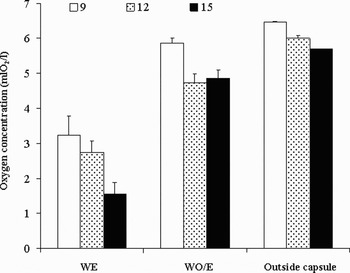
A significant interaction in the oxygen condition was observed between temperatures and environments (ANOVA: F4,45 = 4.0; P < 0.05; Figure 3). The increase in temperature from 9 to 15°C significantly reduced IO2T from 3.24 ml to 1.56 mlO2/l in capsules containing embryos (Tukey test, P < 0.05). Significant higher IO2T was recorded in empty capsules in respect to intact capsules, at all temperatures (Tukey test, P < 0.05), showing the capsules exposed to 9°C the highest values (5.88 mlO2/l; Tukey test, P < 0.05). No differences in the IO2T of empty capsules were detected between 12 and 15°C (Tukey test, P > 0.05). Oxygen outside capsules also significantly decreased with temperature (Tukey test, P < 0.05). IO2T inside capsules (with and without embryos) was lower at all temperatures in comparison with the oxygen tension recorded outside capsules (Tukey test, P < 0.05; Figure 3). This suggests that the capsule wall acts as a barrier to oxygen diffusion.
Oxygen concentration (mlO2/l) inside egg capsules of Chorus giganteus with (WE) and without pre-hatching embryos (WO/E) acclimated at 9, 12 and 15°C. The oxygen level was also recorded outside capsules. Values are average + 1 SE.

Metabolic rate
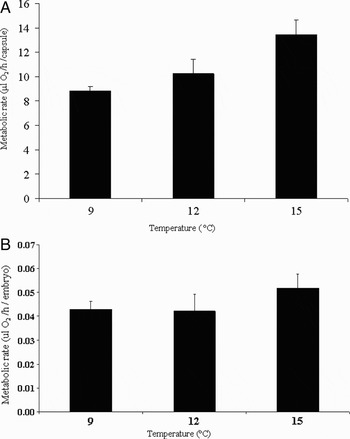
Control respiration rate (electrode and seawater) was on average less than 5% of embryo metabolic rate. After control correction, significant differences in the metabolic rate of the whole capsule were found among temperatures (ANOVA: F2,21 = 5.73, P < 0.05). As a general pattern, total metabolic rate increased with temperature (Tukey test, P < 0.05; Figure 4A). In contrast, metabolic rate per embryo did not differ among temperatures (ANOVA: metabolic rate per embryo: F2,21 = 0.90, P > 0.05; Figure 4B), however, a positive tendency was observed.
Metabolic rate of capsules (A) and pre-hatching embryos (B) of Chorus giganteus as a function of temperature. Values are average + 1 SE.

DISCUSSION
In this study we found that the capsule wall significantly reduces oxygen availability inside capsules of C. giganteus and this reduction increases as temperature increases. Higher temperatures and lower intracapsular oxygen levels affected the normal development of embryos, causing abnormal morphologies and failures in hatching. The negative relationship between intracapsular oxygen availability and temperature was explained by the increase in the total metabolic rate per capsule and the lower oxygen content of seawater at higher temperatures. These findings suggest that encapsulation in C. giganteus is highly constrained at high temperatures principally due to the reduction of the intracapsular oxygen availability, producing a negative effect on normal embryo development and survival.
Hypoxic conditions are observed inside egg masses of aquatic species suggesting that oxygen seems to be a major constraint for offspring aggregation in this environment (in amphibians: Crump, Reference Crump, Rosenblatt and Snowdon1996; in marine invertebrates: Booth, Reference Booth1995; Strathmann & Strathmann, Reference Strathmann and Strathmann1995; Cohen & Strathmann, Reference Cohen and Strathmann1996; Dick et al., Reference Dick, Faloon and Elwood1998; Lee & Strathmann, Reference Lee and Strathmann1998; Fernández et al., Reference Fernández, Bock and Pörtner2000). The low solubility and diffusion rate of oxygen in water are some of the main factors restricting oxygen supply for embryos inside aggregations. However, species with encapsulation exhibit an additional constraint to oxygen diffusion which is the capsule wall. Capsule walls show low oxygen diffusion rate. Oxygen diffusion in egg capsules of the cuttlefish S. apama was estimated to be about 10% in respect to pure water (Cronin & Seymour, Reference Cronin and Seymour2000). The only report for a marine gastropod capsule estimated a diffusion coefficient of approximately 10% of pure water for F. oregonesis (Brante, Reference Brante2005). The barriers for oxygen diffusion in capsules of aquatic species may promote intracapsular oxygen constraints. For example, oxygen availability inside capsules may reach 40% air saturation in the marine gastropod Acanthina monodon (Lardies & Fernández, Reference Lardies and Fernández2002) and approximately 50% in Fusitriton oregonensis (Brante, Reference Brante2005). Almost anoxic conditions were recorded inside capsules of the slipper limpet Crepidula fornicata (Brante et al., Reference Brante, Viard and Fernández2009).
In this work intracapsular oxygen availability in C. giganteus was significantly lower than the surrounding environment in capsules with or without embryos. The level of oxygen observed inside capsules with embryos (approximately 30% on average in respect to seawater) was coincident with previous reports in the same species (40%; Cancino et al., Reference Cancino, Gallardo, Torres, Leiva and Navarro2000). In addition, oxygen in capsules with embryos showed a decreasing tendency at higher temperatures. The last pattern may be explained by first, the negative relationship between water oxygen content and temperature, and second, by the positive relationship observed between oxygen consumption per capsule and temperature. The no significant differences observed between temperatures in the oxygen consumption estimated by embryo, in contrast to the differences found in the total metabolic rate, may be the result of a methodological issue. The embryonic metabolic rate per embryo was calculated dividing the metabolic rate of the whole capsule by the total number of embryos of the capsule. However, in the higher temperature about 16% of pre-hatching embryos were abnormal, in comparison to the 6% observed at the other two temperatures. It is possible that metabolic rate of viable embryos may be underestimated in the 15°C treatment given that abnormal embryos may perform lower physiological rates. In this way, we think that the positive relationship between the total metabolic rate per capsule and temperature is a better representative of the real tendency of the metabolic rate per normal embryo. In summary, the low levels of oxygen observed inside capsules of C. giganteus may be explained by the resistance to oxygen diffusion that the capsule wall imposes and the increase in the total oxygen consumption of embryos with temperature. Our results suggest that oxygen is a limiting resource for encapsulated embryos of C. giganteus.
Low levels of oxygen concentration inside aggregations may negatively affect embryo survival (Strathmann & Strathmann, Reference Strathmann and Strathmann1982; Chaffee & Strathmann, Reference Chaffee and Strathmann1984; Strathmann & Chaffee, Reference Strathmann and Chaffee1984; Strathmann & Strathmann, Reference Strathmann and Strathmann1995; Cancino et al., Reference Cancino, Gallardo, Torres, Leiva and Navarro2000; Brante et al., Reference Brante, Viard and Fernández2009). For example, survival of veliger larvae of C. fornicata decreased approximately to 11% at hypoxic conditions (15% air saturation; Brante et al., Reference Brante, Viard and Fernández2008). Cancino et al. (Reference Cancino, Gallardo and Torres2003) reported high embryo mortality in capsules exposed to 50% air saturation. In the present study we cannot account for the effect of temperature and oxygen on survival, separately; however, previous works on C. giganteus suggest that oxygen rather than temperature affects embryo viability (Cancino et al., Reference Cancino, Gallardo and Torres2003). In this way, the higher embryo mortality recorded at higher temperatures in the present study may be associated principally with the inadequate oxygen diffusion rate through the capsule wall and extracellular matrix to the embryos. In contrast, the lowest embryo mortality observed at 9°C corresponded to the highest level of intracapsular oxygen recorded. This temperature also matches with the mean sea temperature observed during the breeding season in Golfo de Arauco, where individuals were collected (Ahumada, Reference Ahumada1976, Reference Ahumada and Della Croce1994; Gallardo Reference Gallardo1981; Llancamil, Reference Llancamil1982). It is probable that the optimal temperature (9°C) for embryo development of C. giganteus observed in this study may be a result of natural selection acting on this population. Adaptations to local thermal conditions have been observed in the embryonic development and reproductive strategy of the marine gastropod C. concholepas (Fernandez et al., 2007). More studies are needed to determine thermal adaptation or plasticity in embryos of C. giganteus. Although it is clear that embryos of gastropod species may survive to sporadic hypoxic events activating anaerobic pathways, it is clear that at longer or chronic exposures to hypoxia, the energetic demand of embryos is not sustained and a systemic breakdown occurs.
Interestingly in a high proportion of capsules of C. giganteus exposed to high temperatures hatching was prevented. This phenomenon has been previously observed in capsules of this species exposed to low oxygen levels and it was not observed in capsules cultivated at high temperatures (Cancino et al., Reference Cancino, Gallardo and Torres2003). In this way, our results may be explained by the effect of hypoxia on hatching rather than temperature. Release of embryos of C. giganteus from the capsules occurs principally through mechanical degradation of the apical plug (Leiva et al., Reference Leiva, Muñoz and Navarro1998). According to Cancino et al. (Reference Cancino, Gallardo and Torres2003) it is not clear how hypoxia affects the degradation of the plug in this species, however, it is possible that the low level of oxygen affects larva behaviour or inhibits the production of hatching enzymes.
It is common to observe abnormal embryo shell development in capsules exposed to high temperatures and/or hypoxic conditions. Cancino et al. (Reference Cancino, Gallardo and Torres2003) showed that embryos of C. giganteus cultivated at hypoxic conditions (50% air saturation) produce abnormal shells, especially at higher temperatures. Similar effects on shell morphology were observed in larvae of C. fornicata (Maeda-Martínez, Reference Maeda-Martínez1985) and Crassostrea virginica (Baker & Mann, Reference Baker and Mann1994) exposed to low oxygen tensions. As a general tendency, in the present study, the number of abnormal embryos of C. giganteus increased at warmer seawater where the lower levels of intracapsular oxygen were recorded. Two phenomena may potentially explain this pattern. First, at higher temperatures and lower oxygen availability, embryos activate anaerobic pathways producing acidic end products and inducing a decrease in the intracapsular pH. It has been described that the acidification of the medium could be partially compensated by mobilization of CaCO3 away from the shells of embryos (De Zwaan, Reference De Zwaan and Hochachka1983). Second, if the intracapsular fluid becomes acidic, it might prevent the utilization of carbonates for shell formation, since in a low pH condition the balance of the carbonate equation will be displaced towards carbon dioxide and carbonic acid rather than towards carbonates. It is clear that a reduction in the oxygen available for embryos not only acts in a straightforward manner on its energetic machinery but also on the chemistry of shell formation.
Encapsulation protects embryos from many natural sources of mortality (for a review, see Przeslawski, Reference Przeslawski2004). However, according to our results encapsulation also may impose important restrictions for embryo development, especially at high temperatures. In a scenario of global warming, where a reduction in the oxygen concentration is expected in the sea, it is possible that species with encapsulation may be affected in a straightforward manner restricting its actual habitat range to high latitudes or moving towards the North and South Poles in order to inhabit places with the sufficient amount of oxygen for the normal embryo development. More studies are needed to try to quantify potential ecological implications of intracapsular oxygen limitation in species with encapsulation.
ACKNOWLEDGEMENTS
This research was financed by the Programa Acuicultura y Biotecnología Marina, 1(97), FONDAP, Chile (Subprograma Invertebrados) and FONDECYT (grant 1990451).