Transposition of the great arteries is the most common cyanotic congenital cardiac lesion that presents in neonates and is found in approximately 5% of all newborns with congenital cardiac disease.Reference Hoffman1 The heart demonstrates concordant atrioventricular and discordant ventriculoarterial connections, in which the aorta arises anteriorly from the right ventricle, whereas the pulmonary artery arises posteriorly from the left ventricle. The pulmonary and systemic circulations function in parallel rather than in series.Reference Planche, Lacour-Gayet and Serraf2
The most frequently associated malformation is a ventricular septal defect. Other associated lesions are aortic arch obstruction, atrioventricular valve anomalies, double outlet right ventricle, left ventricular outflow tract obstruction, and others.Reference Planche, Lacour-Gayet and Serraf2
There are a few surgical options for the repair of transposition of the great arteries: the arterial switch operation, the Senning and Mustard procedures (the so-called “atrial switch”) and the Rastelli operation. Some 35 years after the description by Jatene et al in 1975,Reference Jatene, Fontes and Paulista3 the arterial switch operation has become the therapeutic surgery of choice for transposition of the great arteries with excellent outcomes concerning the general health status.Reference Haas, Wotthe, Halger and Meisner4–Reference Williams, McCrindle and Ashburn6 According to some larger series of patients treated this way, the mid- and long-term results showed an increased incidence of supravalvar pulmonary stenosis.Reference von Bernuth5, Reference Hövels-Gürich, Seghave and Ma7 Neo-aortic valve regurgitation is reported to be progressive as well.Reference Ho Young, Woong-Han and Jae Gun8, Reference Losay, Touchot and Capderou9
Information about the influence of a ventricular septal defect on the atrioventricular valvular function after repair is scarce. Despite the existence of some studies focusing on the aortic valvar function after arterial switch, there is hardly any literature on the function of the atrioventricular valves, even though a ventricular septal defect in transposition of the great arteries is frequently closely related to these valves.
The purpose of this study was to investigate the valvar function after the arterial switch operation for transposition of the great arteries in patients with ventricular septal defect compared to patients with transposition of the great arteries and intact ventricular septum.
Methods
Patients
The institutional database of the Department of Thoracic and Cardiovascular Surgery and Paediatric Cardiology at the University Hospital Muenster was searched for patients with transposition of the great arteries who underwent the arterial switch operation between 1992 and 2007. We excluded all patients with associated congenital cardiac diseases like coarctation of the aorta, double outlet right ventricle, and pulmonary stenosis, patients who underwent other surgical treatment for transposition of the great arteries, and patients without complete records. All our patients received the same surgical and intensive care treatment.
Surgical techniques
Cardiac surgery was performed by four surgeons supervised by one surgeon and with cardiopulmonary bypass and circulatory arrest. The aorta was divided 2–4 millimetres above the commissures and the coronary arteries were excised with a button of the corresponding sinus of Valsalva. After mobilisation, the main pulmonary artery was transected 2–4 millimetres under the bifurcation, and coronary ostia were replanted in the corresponding sinus of the neo-aorta. The Lecompte manoeuvre, which causes displacement of the anterior aorta to a position posterior to the bifurcation of the pulmonary artery, was performed. Through the right atrium, ventricular septal defects were closed with a Dacron patch. A running suture was used at the caudal part, and a U-suture near the tricuspid valve.
Echocardiographic measurements
All patient notes were reviewed with special attention to the pre- and post-operative valvar function, as reported by the echocardiogram. Follow-up echocardiography was routinely undertaken 1 year post-operatively. The latest follow-up was defined as the last available echocardiographical investigation of the patient.
Valvar regurgitation was evaluated by Doppler echocardiography and graded utilising the criteria delineated by Jacob et alReference Jacob and Stewart10: non-existent or trivial regurgitation (0), mild (1), moderate (2), or severe (3) regurgitation.
On the basis of Doppler-derived gradients and Doppler characteristics, the levels of stenosis of the different valves were estimated.Reference Cheriex, Pieters, Janssen, de Swart and Palmans-Meulemans11–Reference Yousof, Shafei, Endrys, Khan, Simo and Cherian15 Obstructions to the pulmonary or aortic artery flow either at the valvar or supravalvar level have the same haemodynamic implications, and are referred to as pulmonary or aortic stenosis.
All echocardiograms were performed and reviewed by an experienced paediatric cardiologist.
The results of patients with transposition of the great arteries and intact septum were compared with those of patients with transposition of the great arteries and ventricular septal defect.
Statistics
Statistical analyses were carried out using SPSS 15.0 for Windows software (SPSS Inc., Chicago, Illinois, United States of America). Data were described as median and ranges or means with standard deviations, as appropriate.
To compare the pre- and post-operative degree of valvar regurgitation, the marginal homogeneity test was used. This was applied to compare the post-operative and the follow-up as well.
Both groups were compared using the chi-square test.
In all analyses, the level of significance was set at p less than 0.05.
Results
Patient characteristics
Between 1992 and 2007, there were 118 patients overall with transposition of the great arteries who underwent the arterial switch operation. More complex forms of transposition of the great arteries including aortic coarctation (n = 5), double outlet right ventricle (n = 2), and pulmonary stenosis (n = 4), patients who underwent Rastelli operation (n = 2) or Mustard and Senning procedures (n = 2), and patients without complete records (n = 5) were excluded. In total, five patients died after repair and one patient was lost to follow-up.
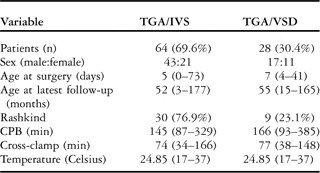
The characteristics of the included patients and the surgical details are depicted in Table 1.
Demographics and surgical details (n = 92).

CPB = cardiopulmonary bypass time; IVS = intact ventricular septum; TGA = transposition of the great arteries; VSD = ventricular septum defect
Data reported as median (range)
In the included 92 patients, simple transposition of the great arteries was present in 64 patients, and transposition of the great arteries and ventricular septal defect in 28 patients. The examined cohort contained 60 male – 71.7% without ventricular septal defect, 28.3% with ventricular septal defect – and 32 female – 65.6% without ventricular septal defect, 34.4% with ventricular septal defect – patients.
The median age at the arterial switch operation was 5.5 days with a range from 0 to 73 days in patients with transposition of the great arteries and intact ventricular septum, and 7.0 days with a range from 4 to 41 days in patients with transposition of the great arteries and ventricular septal defect.
In 39 patients (30 with transposition of the great arteries/intact ventricular septum, nine with transposition of the great arteries/ventricular septal defect) a pre-operative balloon atrial septostomy was performed before surgery.
All arterial switch operations were performed with cardiopulmonary bypass and hypothermia. The median cardiopulmonary bypass time was 145 minutes in patients with transposition of the great arteries and intact ventricular septum with a range from 87 to 329 minutes, and 166 minutes in patients with transposition of the great arteries and ventricular septal defect ranging from 93 to 385 minutes. The median aortic cross-clamp time was 74.5 minutes ranging from 34 to 166 minutes in patients with transposition of the great arteries/intact ventricular septum, and 77.0 minutes ranging from 38 to 148 minutes in patients with transposition of the great arteries/ventricular septal defect. The median temperature while using the heart–lung machine was 24.85 degree Celsius in both groups with a range from 17 to 37 degree Celsius.
The median age at the latest follow-up was 51.7 months in patients with transposition of the great arteries and intact ventricular septum ranging from 3.3 to 177.3 months, and 55 months in patients with transposition of the great arteries and ventricular septal defect ranging from 14.6 to 164.7 months.
There were no statistically significant differences between the two groups regarding these characteristics.
Reoperation
During the entire follow-up period, 13 patients (three with transposition of the great arteries/ventricular septal defect, 10 with transposition of the great arteries/intact ventricular septum) needed reintervention with three patients (transposition of the great arteries/intact ventricular septum) needing balloon dilation of severe pulmonary artery stenosis, and 10 patients (three with transposition of the great arteries/ventricular septal defect, seven with transposition of the great arteries/intact ventricular septum) needing reoperation. Of these 10 patients (five with transposition of the great arteries/intact ventricular septum) needed patch enlargement of a supravalvular pulmonary stenosis. One patient with transposition of the great arteries/intact ventricular septum required a valvuloplasty of his neo-aortic valve. Four patients developed complete heart block and received a pacemaker (three with transposition of the great arteries/ventricular septal defect, one with transposition of the great arteries/intact ventricular septum).
Valvar function
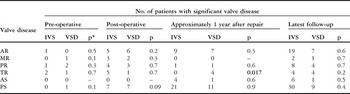
The valvar function of patients with transposition of the great arteries/intact ventricular septum and transposition of the great arteries/ventricular septal defect is summarised in Table 2.
Echocardiographic results of patients with TGA compared with reference group.

AR = aortic regurgitation; AS = aortic stenosis; IVS = intact ventriular septum; MR = mitral regurgitation; PR = pulmonal regurgitation; PS = pulmonal stenosis; TGA = transposition of the great arteries; TR = tricuspidal regurgitation; VSD = ventricular septal defect
*Differences between TGA/VSD – TGA without VSD
Pre-operatively
There was one patient with transposition of the great arteries/intact ventricular septum pre-operatively who had aortic valve regurgitation (mild 1), one with pulmonary valve regurgitation (mild 1), and two with tricuspidal valve regurgitation (mild 1, moderate 1).
Of the cohort with transposition of the great arteries/ventricular septal defect, one patient had mitral valve regurgitation (mild 1), two had pulmonary valve regurgitation (mild 1, moderate 1), one had tricuspidal valve regurgitation (mild 1), and one had pulmonary stenosis (mild 1).
The valvar function of any valve pre-operatively did not differ statistically significantly between the groups.
The post-operative echocardiograms of 78 patients (85%) were available – 53 with transposition of the great arteries/intact ventricular septum, 25 with transposition of the great arteries/ventricular septal defect.
A comparison of the post-operative echocardiograms also showed no statistically significant difference in the function of any valve between the groups.
Neo-aortic valve regurgitation was found in five patients with transposition of the great arteries/intact ventricular septum (mild 4, moderate 1) and in six patients with transposition of the great arteries/ventricular septal defect (mild 5, moderate 1).
There were three patients with transposition of the great arteries/intact ventricular septum who had mild mitral valve regurgitation (two patients with transposition of the great arteries/ventricular septal defect, mild 1, moderate 1).
There were four patients with transposition of the great arteries/intact ventricular septum who had neo-pulmonary valve regurgitation (mild 2, moderate 2) and five who had tricuspid valve regurgitation (mild 4, moderate 1). Of the patients with transposition of the great arteries/ventricular septal defect, three had neo-pulmonary valve regurgitation (mild 1, moderate 2) and one had mild tricuspid valve regurgitation.
Neo-pulmonary stenosis was detected in seven patients (mild 5, moderate 2) as well as in seven patients with transposition of the great arteries/intact ventricular septum (mild 2, moderate 3, severe 2).
At 1year post-operatively, the echocardiographical results of 73 patients (79%) were available – 47 with transposition of the great arteries/intact ventricular septum, 26 with transposition of the great arteries/ventricular septal defect.
There were nine patients with transposition of the great arteries/intact ventricular septum who had neo-aortic valve regurgitation (mild 9). This was also observed in seven patients with transposition of the great arteries/ventricular septal defect (mild 6, moderate 1).
There was one patient in each group with mild neo-pulmonary valve regurgitation.
There were four patients with transposition of the great arteries/intact ventricular septum who had neo-aortic stenosis (mild 2, moderate 2) versus one patient with transposition of the great arteries/ventricular septal defect (mild 1).
Neo-pulmonary stenosis was present in 21 patients with transposition of the great arteries/intact ventricular septum (mild 14, moderate 5, severe 3) and in 12 patients with transposition of the great arteries/ventricular septal defect (mild 9, moderate 2, severe 1).
The neo-aortic, neo-pulmonary, and mitral valvar function did not show a statistically significant difference between patients with transposition of the great arteries/intact ventricular septum and those with transposition of the great arteries/ventricular septal defect.
There were four patients with transposition of the great arteries/ventricular septal defect who had tricuspid regurgitation (mild 3, moderate 1), which was not seen in any patient with transposition of the great arteries/intact ventricular septum. This reached the level of significance (p = 0.017).
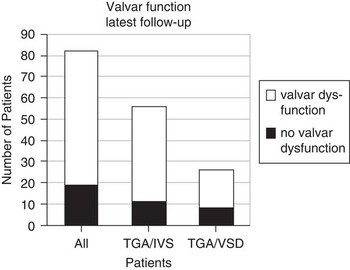
Last follow-up: the echocardiographical results of 82 patients (89%) were available (56 with transposition of the great arteries/intact ventricular septum, 26 with transposition of the great arteries/ventricular septal defect).
The valvar function in general of all patients with transposition of the great arteries/intact ventricular septum and transposition of the great arteries/ventricular septal defect at the last follow-up is depicted in Figure 1.
Total number of patients with and without valvar dysfunction at the last follow-up. TGA = transposition of the great arteries; IVS = intact ventricular septum; VSD = ventricular septal defect.

On follow-up, 19 patients with transposition of the great arteries/intact ventricular septum showed neo-aortic valve regurgitation (mild 18, moderate 1). Of the patients with transposition of the great arteries/ventricular septal defect, seven showed neo-aortic valve regurgitation (mild 6, moderate 1).
There were two patients with transposition of the great arteries/intact ventricular septum who had mitral valve regurgitation (mild 1, moderate 1) versus one patient with transposition of the great arteries/ventricular septal defect (mild 1).
Neo-pulmonary valve regurgitation was detected in eight patients with transposition of the great arteries/intact ventricular septum (mild 7, moderate 1) and 30 patients had neo-pulmonary stenosis (mild 19, moderate 10, severe 1). There were four patients with transposition of the great arteries/ventricular septal defect who had neo-pulmonary valve regurgitation (mild 4) and nine who had neo-pulmonary stenosis (mild 7, moderate 2).
Neo-aortic stenosis was present in six patients with transposition of the great arteries/intact ventricular septum (mild 3, moderate 3) versus one patient with transposition of the great arteries/ventricular septal defect (mild 1).
This echocardiogram showed no difference in tricuspid valvar function between patients with transposition of the great arteries/intact ventricular septum and those with transposition of the great arteries/ventricular septal defect. There were four patients in each group with mild tricuspid valve regurgitation.
The function of either valve at follow-up did not differ statistically significantly between both groups.
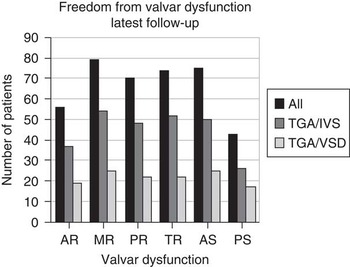
Freedom from any valvar dysfunction in patients with transposition of the great arteries/intact ventricular septum and in those with transposition of the great arteries/ventricular septal defect at the last follow-up is shown graphically in Figure 2, and is depicted for each valve.
Number of patients without valvar dysfunction at the last follow-up, subdivided for each valvar dysfunction. TGA = transposition of the great arteries; IVS = intact ventricular septum; VSD = ventricular septal defect; AR = aortic regurgitation; MR = mitral regurgitation; PR = pulmonal regurgitation; TR = tricuspidal regurgitation; AS = aortic stenosis; PS = pulmonary stenosis.

Progression
Aortic valvar function
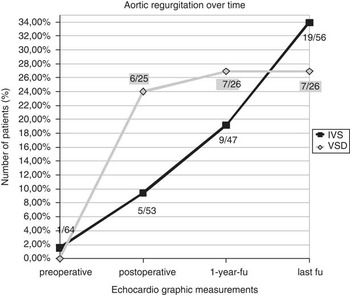
The degree of aortic regurgitation over time is depicted in Figure 3.
Number of patients with aortic regurgitation. VSD = ventricular septal defect; IVS = intact ventricular septum; fu = follow-up.

A comparison of the pre- and post-operative echocardiogram revealed that there was a statistically significant change of aortic valvar function in the group of patients with transposition of the great arteries/ventricular septal defect; no patient showed aortic regurgitation pre-operatively compared to six patients, who had mild neo-aortic valve regurgitation post-operatively (p = 0.02). The aortic valvar function in patients with transposition of the great arteries/intact ventricular septum did not change significantly.
A comparison of the post-operative and follow-up echocardiogram revealed that the neo-aortic valvar function changed statistically significantly in patients with transposition of the great arteries/intact ventricular septum, which was not the case for patients with transposition of the great arteries/ventricular septal defect. Of the 41 patients with transposition of the great arteries/intact ventricular septum having no neo-aortic valve regurgitation post-operatively, 12 developed mild neo-aortic valve regurgitation. In two of the four patients with mild regurgitation post-operatively, this improved and one patient with moderate neo-aortic valve regurgitation did not change (p = 0.02).
Neo-aortic valve regurgitation also changed statistically significantly in patients with transposition of the great arteries/intact ventricular septum when comparing the echocardiography 1 year post-operatively with the last follow-up. There were seven patients who developed mild neo-aortic valve regurgitation. Of the nine patients having mild neo-aortic valve regurgitation 1 year after repair, one improved and the other worsened. The difference between the 1-year post-operative check and follow-up reached the level of significance (p = 0.02). The neo-aortic valvar function in the group with transposition of the great arteries/ventricular septal defect did not change significantly over time.
Pulmonary valvar function
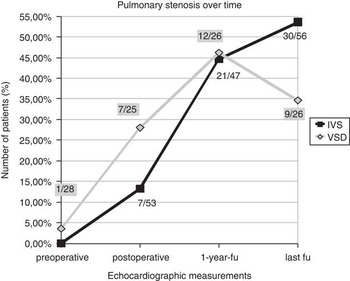
The degree of pulmonary stenosis over time is depicted in Figure 4.
Number of patients with pulmonary stenosis. VSD = ventricular septal defect, IVS = intact ventricular septum, fu = follow-up.

Both groups indicated a statistically significant difference between pre- and post-operative echocardiogram concerning pulmonary valvar function; there was no pulmonary stenosis detected pre-operatively, compared to seven patients with neo-pulmonary stenosis post-operatively in each group (p = 0.013).
Neo-pulmonary stenosis also changed statistically significantly in patients with transposition of the great arteries/intact ventricular septum by comparison of the post-operative echocardiogram and the 1-year follow-up echocardiography: Of the 36 patients having no neo-pulmonary stenosis post-operatively 10 developed mild stenosis and five developed moderate neo-pulmonary stenosis. Of the three patients having moderate neo-pulmonary stenosis post-operatively, two enhanced 1 year after repair, and in one patient the degree of neo-pulmonary stenosis became less severe. In one patient with severe neo-pulmonary stenosis, this remained constant. Overall, these changes were statistically significant (p = 0.001).
In the group with transposition of the great arteries/ventricular septal defect, there was no significant change between the post-operative and 1-year echocardiogram concerning neo-pulmonary stenosis.
A comparison of the post-operative and follow-up echocardiogram revealed that neo-pulmonary stenosis changed statistically significantly in patients with transposition of the great arteries/intact ventricular septum, which was not the case for patients with transposition of the great arteries/ventricular septal defect. There were 19 patients who developed neo-pulmonary stenosis (mild 14, moderate 5). Of the two patients with mild neo-pulmonary stenosis post-operatively, one had progressive valve disease, as well as one of the three patients having moderate neo-pulmonary stenosis. One patient with severe neo-pulmonary stenosis remained constant. The neo-pulmonary valvar function in the group with transposition of the great arteries/intact ventricular septum changed significantly over time. Overall, these changes were statistically significant (p < 0.001).
Of the 44 patients having no neo-pulmonary regurgitation 1 year after repair, six developed mild regurgitation and one developed moderate neo-pulmonary valve regurgitation at the latest follow-up. There was one patient with mild neo-pulmonary valve regurgitation who remained constant. Overall, the changes were statistically significant (p = 0.011). Thus, the neo-pulmonary valvar function in patients with transposition of the great arteries/intact ventricular septum showed significant changes in contrast to the group with transposition of the great arteries/ventricular septal defect. Interestingly, neo-pulmonary stenosis in this group seems to regress over time. This may be related to remodelling of the pulmonary artery and right ventricular outflow tract, which will not happen immediately after surgery.
No progression was observed for the mitral and tricuspid function in both groups.
Comment
Neonates born today with simple transposition of the great arteries or transposition of the great arteries/ventricular septal defect are routinely managed by the arterial switch operation in the neonatal period. The operation itself and the low incidence of late complications are well documented and do not require further discussion.Reference Haas, Wotthe, Halger and Meisner4, Reference von Bernuth5, Reference Hatle12, Reference Culbert, Ashburn and Cullen-Dean16–Reference Yacoub, Radley-Smith and Hilton19 Owing to the typically close relationship of the ventricular septal defect to the cardiac valves and the manipulation there during closure, one could expect an increased valvar dysfunction in patients with transposition of the great arteries/ventricular septal defect after repair in comparison to patients without a ventricular septal defect. Losay et alReference Losay, Touchot and Capderou9 analysed the follow-up data of 1156 patients with transposition of the great arteries after arterial switch operation and showed an increased risk of neo-aortic valve regurgitation in patients with a ventricular septal defect. Schwartz et alReference Schwartz, Gauvreau, del Nido, Mayer and Colan20 also found that neo-aortic valve regurgitation was frequently seen with an associated ventricular septal defect. They reported progressive neo-aortic root dilation of up to 10 years’ follow-up in a cohort of 355 patients, with a median follow-up of 5 years after arterial switch operation and an association between severe root dilation and ventricular septal defect. However, Marino et alReference Marino, Wernovsky and McElhinney21 could not identify ventricular septal defect as a risk factor for neo-aortic root dilatation, although there was a trend towards it (p = 0.058 in their series). In Hwang et alReference Hwang, Kima and Kwak22 series of 103 patients with a median follow-up period of 6.4 years, the existence of ventricular septal defect itself was not found to be a significant risk factor for neo-aortic valvar dysfunction. However, these studies focus mainly on the neo-aortic valve.
Our study indicates that the presence of a ventricular septal defect in patients undergoing arterial switch operation for transposition of the great arteries has only a minor bearing for the development of valvar dysfunction on the longer follow-up. Interestingly, the tricuspid valvar function on echocardiography 1 year post-operatively differs statistically significantly for both groups. Despite the closure of ventricular septal defects through the tricuspid valve in patients without transposition of the great arteries not seeming to affect the function of the tricuspid valve,Reference Gaynor, O'Brien, Rychik, Sanchez, DeCampli and Spray23, Reference Mullen, Lemermeyer, Schipper and Bentley24 this has not been shown for patients with transposition of the great arteries/ventricular septal defect: four patients with ventricular septal defect showed tricuspidal valve regurgitation in comparison to no patient with intact septum. The surgical technique to access the ventricular septal defect through the right atrium may have an influence on the tricuspid function: the surgeon retains the cusp that is closest to the ventricular septal defect with retractors, or makes an incision at the root of the cusp. The difference in tricuspidal valve regurgitation between the two groups cannot be seen on the last follow-up echocardiogram, indicating improvement over time. Our study cohort may be too small to clearly delineate this as a problem, and further attention will need to be paid to the function of the atrioventricular valves after arterial switch.
In contrast to our own observation, Serraf et alReference Serraf, Lacour-Gayet and Bruniaux25 were able to figure out a higher freedom from reoperation in patients with intact ventricular septum. Williams et alReference Williams, McCrindle and Ashburn6 did not identify the presence of ventricular septal defect as a risk factor for reoperation after arterial switch operation.
As in other studies,Reference von Bernuth5, Reference Hövels-Gürich, Seghave and Ma7, Reference Marino, Wernovsky and McElhinney21, Reference Hwang, Kima and Kwak22, Reference Formigari, Toscano, Giardini, Di Donato, Picchio and Pasquini26 our data demonstrated an increasing rate of neo-aortic regurgitation and neo-pulmonary stenosis over time (Figs 3 and 4). HwangReference Hwang, Kima and Kwak22, Losay,Reference Losay, Touchot and Capderou9 and Marino et alReference Marino, Wernovsky and McElhinney21 reported an increasing neo-aortic root dilatation. Formigari et alReference Formigari, Toscano, Giardini, Di Donato, Picchio and Pasquini26 analysed the data of 173 patients with a median follow-up of 8.2 years after arterial switch operation and found an increasing number of patients with neo-aortic regurgitation as well. This is comparable to our study. We noticed an increased rate of neo-aortic valve regurgitation at the last follow-up. But other than in the studies named above, we found neo-aortic valve dysfunction progression more frequently in patients with transposition of the great arteries/intact ventricular septum. Patients with transposition of the great arteries/ventricular septal defect only showed statistically significant change in aortic valvar function by comparing the pre- and post-operative echocardiogram – no aortic valve regurgitation pre-operatively, six patients with neo-aortic valve regurgitation post-operatively, seven patients with neo-aortic valve regurgitation at the last follow-up. Our data cannot clarify the aetiology of the incompetence of the neo-aortic valve. A possible explanation for the increased rate of neo-aortic valve regurgitation could be either the fact that the neo-aortic valve is morphologically a pulmonary valve, or due to the augmented diameter of the neo-aortic root after implantation of the coronary arteries into the neo-aortic root. It remains unclear whether the difference in the progression of neo-aortic valve dysfunction between patients with transposition of the great arteries/intact ventricular septum and those with transposition of the great arteries/ventricular septal defect is caused by the operative technique, or it is due to the cohort size.
The pulmonary valvar function showed comparable changes: patients with transposition of the great arteries/intact ventricular septum showed a higher rate and higher degree of neo-pulmonary stenosis at the last follow-up, whereas in patients with transposition of the great arteries/ventricular septal defect the only significant difference in pulmonary valvar function was noted between the pre- and post-operative echocardiogram. Our data cannot clarify the cause of the neo-pulmonary stenosis as well. It may be due to the fact that coronary arteries are typically excised with a button of the pulmonary wall and reimplanted into the aortic root. The defects in the pulmonary artery were filled in with bovine pericardium. Depending on the size of these patches, it could either wrinkle or cause tension in case the pulmonary bifurcation was not adequately mobilised before the Lecompte manoeuvre. Worsening neo-pulmonary stenosis is reported by other authors: Von BernuthReference von Bernuth5 reported progressive neo-pulmonary stenosis in a cohort of 181 patients, 10 of these with Taussig-Bing hearts, 1 year after arterial switch operation. Hövels-Gürich et alReference Hövels-Gürich, Seghave and Ma7 analysed the data of 60 patients with a median follow-up of 10.5 years and also found progressive neo-pulmonary stenosis. In our study, patients with transposition of the great arteries and intact ventricular septum had an aggravated neo-pulmonary regurgitation, one patient 1 year after repair, eight patients at the last follow-up. There was no significant change in patients with transposition of the great arteries/ventricular septal defect concerning neo-pulmonary valve regurgitation. The difference between the two groups concerning the incompetence of the semi-lunatic valves is not clearly evident from our data.
Even though most of the valvar dysfunctions observed in our study cohort were trivial to mild, and therefore haemodynamically probably not relevant, some patients developed more severe dysfunctions. The number of patients included in our study is not sufficient to identify risk factors for this development.
Study limitations
This is a retrospective case series from a single centre. The patients who fit the inclusion criteria are a sample of a larger cohort of patients who underwent the arterial switch operation, and selection bias may be present. The follow-up time varied within the cohort. Another limitation was the fact that post-operative and follow-up echocardiographic data were not available for all 92 patients.
Conclusion
In our series of patients with transposition of the great arteries, the presence of an associated ventricular septal defect seemed to have no major impact on the valvar function post-operatively. The two groups differ merely in tricuspidal valvar regurgitation 1 year after repair. There is a progression in valvar dysfunctions like neo-aortic valvar regurgitation and neo-pulmonary stenosis in both groups, especially in patients with transposition of the great arteries and intact ventricular septum. No statistically significant dysfunction was observed in the mitral valve.
Concerning the atrioventricular valves in transposition of the great arteries, our study has some relevance because most reports are focusing on the arterial valves and information about the atrioventricular valvular function after repair is scarce. Of course, our study can only be a first step. Further studies with a larger population and long-term follow-up will help to determine if those need further attention.