Introduction
Seasonal allergic rhinitis (SAR) is a highly prevalent chronic disease affecting about 23% of the adult European population with increasing, almost ‘endemic’, prevalence rates (Bauchau & Durham, Reference Bauchau and Durham2004; Bousquet et al. Reference Bousquet, Khaltaev, Cruz, Denburg, Fokkens, Togias, Zuberbier, Baena-Cagnani, Canonica, van Weel, Agache, Aït-Khaled, Bachert, Blaiss, Bonini, Boulet, Bousquet, Camargos, Carlsen, Chen, Custovic, Dahl, Demoly, Douagui, Durham, van Wijk, Kalayci, Kaliner, Kim, Kowalski, Kuna, Le, Lemiere, Li, Lockey, Mavale-Manuel, Meltzer, Mohammad, Mullol, Naclerio, O'Hehir, Ohta, Ouedraogo, Palkonen, Papadopoulos, Passalacqua, Pawankar, Popov, Rabe, Rosado-Pinto, Scadding, Simons, Toskala, Valovirta, van Cauwenberge, Wang, Wickman, Yawn, Yorgancioglu, Yusuf, Zar, Annesi-Maesano, Bateman, Ben Kheder, Boakye, Bouchard, Burney, Busse, Chan-Yeung, Chavannes, Chuchalin, Dolen, Emuzyte, Grouse, Humbert, Jackson, Johnston, Keith, Kemp, Klossek, Larenas-Linnemann, Lipworth, Malo, Marshall, Naspitz, Nekam, Niggemann, Nizankowska-Mogilnicka, Okamoto, Orru, Potter, Price, Stoloff, Vandenplas, Viegi and Williams2008a ). SAR is clinically defined as an immunoglobulin E (IgE)-mediated inflammation of the nasal mucosa in reaction to allergens and is characterized by symptoms including itching, sneezing, rhinorrhea and nasal obstruction. Beside these classical symptoms, a substantial number of patients complain about accompanying problems such as reduced physical and mental capacity and subdued mood (Kremer et al. Reference Kremer, den Hartog and Jolles2002; Marshall et al. Reference Marshall, O'Hara and Steinberg2002; Meltzer et al. Reference Meltzer, Nathan, Derebery, Stang, Campbell, Yeh, Corrao and Stanford2009; Virchow et al. Reference Virchow, Kay, Demoly, Mullol, Canonica and Higgins2011). After being neglected for a long time, these secondary psychological side-effects of allergic disorders have recently been shifting into the focus of both public awareness and research.
In initial studies using a naturalistic design, SAR patients reported significantly more subjective feelings of insufficiency in thinking and acting (Kremer et al. Reference Kremer, den Hartog and Jolles2002) and problems in paying attention or slowed thinking during the allergy season (Marshall et al. Reference Marshall, O'Hara and Steinberg2000). These statements are conceivably related to impairments in underlying cognitive functions associated with attention and adaptive control. These functions include the allocation of processing resources, their maintenance and adjustments to optimize performance, particularly when faced with conflicts and rapidly changing environments. However, objective evidence for deficits in these functions has so far been difficult to obtain under natural conditions, and the few available findings are inconsistent (Marshall & Colon, Reference Marshall and Colon1993; Marshall et al. Reference Marshall, O'Hara and Steinberg2000; Kremer et al. Reference Kremer, den Hartog and Jolles2002). In a laboratory setting, two studies revealed decrements in corresponding cognitive functions (i.e. sustained attention, working memory, divided attention) using allergen challenges to experimentally evoke symptoms (Wilken et al. Reference Wilken, Berkowitz and Kane2002; Hartgerink-Lutgens et al. Reference Hartgerink-Lutgens, Vermeeren, Vuurman and Kremer2009). In the study by Hartgerink-Lutgens et al. (Reference Hartgerink-Lutgens, Vermeeren, Vuurman and Kremer2009), SAR patients even showed a reduction in processing speed irrespective of allergen challenge, indicating that at least some cognitive changes might be of a lasting nature. This study also demonstrated that patients reported comparatively more subjective mental effort in short or easy tasks, suggesting that patients used increased compensatory and control strategies to overcome allergy-induced deficits. These laboratory studies provide valuable results on the impact of allergic stimulation on cognition and are unrivaled in their quality of experimental manipulation and control. However, they encounter limits in assessing the complexity of the real-life burden of SAR. Laboratory findings are further limited to acute allergic reactions, and do not capture the potential effects of chronic allergen exposure and the time course of potential impairments resulting from acute periods. To address these questions, naturalistic studies aligned to a high laboratory standard are needed.
Beside these methodological concerns, it is important to note that relevant mediating factors (e.g. allergy-related sample characteristics, sleep and mood variables) have been neglected in the majority of studies. Allergy-related sample characteristics include individually distinctive aspects of allergic disease, such as symptom severity, biological markers of allergic sensitization (i.e. total IgE level), the duration of allergic symptomatology per year, and the time since initial disease manifestation. It is likely that symptom severity could affect cognitive test performance directly due to watery eyes, sneezing or a runny nose, or indirectly through poor sleep due to nasal congestion (Virchow et al. Reference Virchow, Kay, Demoly, Mullol, Canonica and Higgins2011; Thompson et al. Reference Thompson, Sardana and Craig2013). Allergy-relevant immunological processes could also be involved. IgE, the initial antibody provoking the cascade of allergic reactions through histamine release, has been associated with depressive mood in atopic and bipolar disorders (Timonen et al. Reference Timonen, Jokelainen, Hakko, Silvennoinen-Kassinen, Meyer-Rochow, Herva and Räsänen2003; Manalai et al. Reference Manalai, Hamilton, Langenberg, Kosisky, Lapidus, Sleemi, Scrandis, Cabassa, Rogers, Regenold, Dickerson, Vittone, Guzman, Balis, Tonelli and Postolache2012). Long duration of disease and symptomatology could exhaust a patient's resources and result in changes of behavioral adaptation. SAR-induced sleep disturbances and worsening of mood in subjects with SAR during the pollen season have been repeatedly confirmed (Marshall & Colon, Reference Marshall and Colon1993; Marshall et al. Reference Marshall, O'Hara and Steinberg2002; Muliol et al. Reference Muliol, Maurer and Bousquet2008; Koinis-Mitchell et al. Reference Koinis-Mitchell, Craig, Esteban and Klein2012); both significantly contribute to performance in memory, cognitive control and attention (Bower, Reference Bower1981; Belenky et al. Reference Belenky, Wesensten, Thorne, Thomas, Sing, Redmond, Russo and Balkin2003; van Steenbergen et al. Reference Van Steenbergen, Band and Hommel2010; Benitez & Gunstad, Reference Benitez and Gunstad2012).
Based on previous research, the current study aimed to investigate the influence of SAR on performance under naturalistic conditions during a symptomatic and a non-symptomatic allergy period. Earlier findings in laboratory settings revealed significant effects of allergy on attentional functions (e.g. sustained attention, selective attention and processing speed) and those effects largely correspond with the self-reported difficulties of SAR patients. Accordingly, we focused on the assessment of functions related to attention with the aim of replicating and extending previous knowledge of SAR-induced impairments in sustained attention, selective attention and processing speed. In addition, to determine whether the regulation of effort to situational demands changes in SAR patients, dynamic aspects of attentional control (i.e. the ability to flexibly adjust attention and action to varying situational demands) were assessed.
In addition to potential alterations in attentional processes, we aimed to identify whether changes observed in SAR subjects are transient (e.g. limited to the manifestation of allergic symptoms) or stable (e.g. also detectable in non-symptomatic periods). We also focused on the influence of mediating mood, sleep and allergy factors. We predicted that with increasing severity of symptoms (along with mood and sleep worsening), potential impairments in attention and attention-related cognitive processes would be amplified.
Method
Study design
Forty-one patients suffering from SAR and 42 healthy, non-allergic participants were assessed in a longitudinal study performed between February and December 2012. Subjects were assessed during a symptomatic allergy period (‘on-season’) and also during a non-symptomatic period (‘off-season’). During the pollen season (March to October 2012), on-season assessment took place after patients experienced at least 2 weeks of allergic complaints (nasal congestion, rhinorrhea, sneezing, red or watery eyes; assessed using a symptom diary). All patients were off allergy medication (i.e. systemic or topical antihistamines, corticosteroids or mast cell stabilizers) at least 7 days prior to testing. To prevent possible sequence effects, the first testing condition (on-season versus off-season) was balanced across subjects, and a minimum time interval of 3 months between the two assessments was defined. The non-allergic control group was added to monitor potential effects other than allergy on the outcome variables and was treated in the same way as the SAR group. Assignment to testing condition in the control group was semi-randomized with test sessions in January, February, November and December being automatically classified as off-season to uncover potential allergy-independent seasonal variations in the assessed parameters (e.g. due to shorter days during winter). All SAR patients were clinically diagnosed by an allergist and had a positive skin prick test for at least one grass or tree pollen and/or an elevated total IgE level (>100 IU/ml serum), validating the diagnosis of SAR. SAR patients with current or recent immunotherapy or other perennial allergies were excluded from the study. Control subjects had no history of any atopic disorder and a negative skin prick test and/or low total IgE status (<100 IU/ml serum). As factors other than allergic hypersensitivity (e.g. parasites) could also account for increased IgE levels, if a subject showed increased IgE levels or a positive skin prick test for a single allergen but had never experienced any allergic symptoms, they remained in the control group. General inclusion criteria were: age between 18 and 45 years, no diagnosed psychiatric or central nervous system disease, no use of interfering medication, and no visual or auditory impairment that could disturb examination. The study was approved by the local ethics committee and written informed consent was obtained from all participants.
Assessment of allergy-related factors and symptom severity
Symptom severity was assessed with visual analog scales (VAS-SAR, according to Bousquet et al. Reference Bousquet, Reid, Van Weel, Baena Cagnani, Canonica, Demoly, Denburg, Fokkens, Grouse, Mullol, Ohta, Schermer, Valovirta, Zhong and Zuberbier2008b ; see also Buske-Kirschbaum et al. Reference Buske-Kirschbaum, Ebrecht and Hellhammer2010). For 10 items, patients rated the severity of nasal, eye and behavioral symptoms ranging from zero (not at all) to 100 (very strong). The sum score of all items was used as an overall indicator of symptom severity (Buske-Kirschbaum et al. Reference Buske-Kirschbaum, Ebrecht and Hellhammer2010). Additional disease-related factors such as duration of disease, age at disease manifestation and number of days with allergic symptoms prior to day of testing were evaluated by patients’ self-report. The standardized form of the Rhinoconjunctivitis Quality of Life Questionnaire (RQLQ-S, Juniper et al. Reference Juniper, Thompson, Ferrie and Roberts1999) was used to measure symptom-related disturbances in SAR sufferers in daily life. The RQLQ-S consists of 28 items on seven domains (nasal symptoms, ocular symptoms, general symptoms, sleeping disorders, practical problems, limitations of activity and emotional disorders). Scores ranged from 0 (not impaired at all) to 6 (severely impaired). The overall RQLQ score was calculated from the mean values of the 28 items. The Multidimensional Mood Questionnaire (Mehrdimensionaler Befindlichkeitsfragebogen, MDBF; Steyer et al. Reference Steyer, Schwenkmetzger, Notz and Eid1997) is a 24-item self-report measure that assesses current mental state on three dimensions: valence, alertness and calmness. The State Anxiety version of the State–Trait Anxiety Inventory (STAI-S; Laux et al. Reference Laux, Glanzmann, Schaffner and Spielberger1981) was applied to further focus on anxious mood aspects. Using 20 items, subjects rated their emotional state on a four-point Likert scale. The Pittsburgh Sleep Quality Index (PSQI; Buysse et al. Reference Buysse, Reynolds, Monk, Berman and Kupfer1989) was used to examine the effects of allergy on sleep parameters. In the PSQI, 19 items assess individual sleep quality, sleep latency, sleep duration, habitual sleep efficiency, sleep disturbances, use of sleep medication, and daytime dysfunction during the past 2 weeks.
Total IgE
A blood sample was obtained from each subject during on-season and off-season testing. Total serum IgE concentrations were determined using an enzyme-linked immunosorbent assay (ELISA; IBL, Germany) according to the manufacturer's instructions.
Assessment of cognitive performance
Cognitive performance was assessed with the Continuous Performance Task (CPT; Knye et al. Reference Knye, Roth, Westhus, Heine, Lauth and Hänsgen1996) and the Simon task (Simon, Reference Simon, Proctor and Reeve1990). The CPT is a computer-based standard task assessing sustained selective attention, psychomotor speed and impulsivity. Single letters were presented sequentially each second on a black screen. Subjects were instructed to immediately respond to the sequence of ‘O’ directly followed by ‘X’ while ignoring all other sequences. The overall duration of the task including a training phase was 17 min. Contrasting the performance in the first and second halves of the task provided information about the ability to sustain attention over a longer period [reaction time (RT) and error indices], while mean RT served as a measure of overall psychomotor speed. Omission errors (i.e. missing a ‘O-followed-by-X’ target sequence) and commission errors (i.e. responses to irrelevant non-target sequences) were analyzed as markers of selective attention and impulsivity respectively.
The Simon task represents a standard measure of more demanding attentional processes. By initiating a response conflict, it assesses the distractibility from task-irrelevant stimuli and flexibility in attentional control adjustments. We used a numerical version of the Simon task (Fischer et al. Reference Fischer, Dreisbach and Goschke2008; Plessow et al. Reference Plessow, Fischer, Kirschbaum and Goschke2011): target stimuli (digits 1–9 excluding 5) were presented either to the left or right of the screen center on a 17-inch monitor attached to an IBM-compatible personal computer. Subjects were instructed to respond to the identity of the presented target by manual key presses (‘press left key for digits smaller than five and press right key for digits larger than five’) irrespective of its location on the screen (i.e. right versus left side). Although the stimulus location has no task relevance, it automatically triggers the activation of the spatially corresponding response (e.g. a target presented on the left automatically activates a left response). Depending on the correspondence of stimulus location and required response key (based on stimulus identity), non-conflicting compatible (C; e.g. target ‘1’ presented on the left screen side requires a left key press) and incompatible trials (I; i.e. target ‘1’ displayed on the right screen side requires a left key press) are derived. In incompatible trials, this automatic activation needs to be overcome, resulting in additional performance costs (i.e. slower responses and/or increased error rates). This compatibility effect reflects the individual susceptibility to interference. Additionally, the sequential analysis of trials reveals that conflicting trials increase the attentional control for subsequent trials, resulting in a decreased compatibility effect in trials following an incompatible conflict trial compared to non-conflicting compatible trials (conflict adaptation effect; Gratton et al. Reference Gratton, Coles and Donchin1992; Stürmer et al. Reference Stürmer, Leuthold, Soetens, Schröter and Sommer2002). Each trial started with a centrally displayed fixation cross. After 1000 ms, targets were shown either 2.8 cm to the left or to the right of the fixation sign for 200 ms. Once a response was given (or following a response window of 1800 ms maximum after target onset), the fixation cross disappeared. Performance feedback was given for incorrect responses or misses (‘false’, ‘too slow’) for 300 ms. After a correct response a blank screen was shown for 300 ms. All trials finished with a blank screen for a random interval between 100 ms and 1000 ms. All subjects performed a practice block consisting of 16 trials and three test blocks with 64 trials each (total number of test trials: 192). Presentation software version 0.71 (Neurobehavioral Systems, Inc., USA) was used for stimulus presentation and data recording.
Data analysis
To evaluate changes in mood and cognitive performance across the two testing sessions, a series of two-way ANOVAs with the between-subject factor group (SAR patients versus healthy controls) and the within-subject factor season (on-season versus off-season) were conducted for CPT RT, RT and error indices, omission and commission error rates and also for PSQI, MDBF, STAI-S and total IgE levels. For significant group × season interactions on a p < 0.05 level, post-hoc analyses using independent t tests were applied to further compare group performance within a particular season and paired t tests to evaluate performance differences within one group across testing sessions. In the case of multiple comparisons due to interaction effects, p values were Bonferroni corrected. Because of lack of normal distribution, rank-transformed total IgE levels were used for further calculations.
For the Simon task, four-way repeated-measures ANOVAs with compatibility of the current trial (n; compatible versus incompatible), compatibility of the previous trial (n − 1; compatible versus incompatible) and season (on-season versus off-season) as within-subject factors and group (SAR patients versus healthy controls) as the between-subject factor were conducted for mean RTs and percentage of error rates. Furthermore, indices of the compatibility effect (I – C) and conflict adaptation [(cI – cC) – (iI – iC); with lowercase letters representing compatibility (c) or incompatibility (i) in the previous trial] were calculated (see van Steenbergen et al. Reference Van Steenbergen, Band and Hommel2010). The first trial of each block (2.4%), trials with identical target repetitions (7.23%), and post-error trials (3.5%) were excluded from all Simon task analyses. For RT analysis only, errors and RTs differing by more than 2.5 s.d. from each individual's condition-specific mean (6.1%) were also excluded. All statistical tests were performed at a 0.05 level of significance. To explore associations between cognitive performance and disease-related factors, Spearman correlations between the cognitive outcome measures and allergy characteristics, total IgE level during on-season, mood and sleep variables were conducted and linear regressions for significant correlations were applied.
Results
Demographic characteristics, self-reported measures and IgE levels
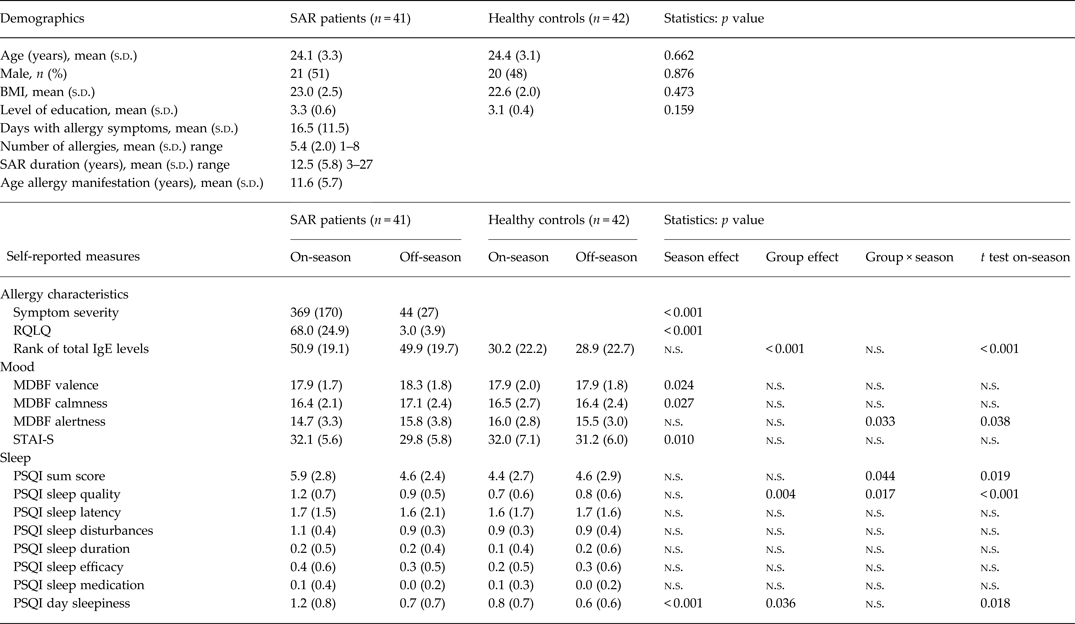
Demographic and allergy characteristics are displayed in Table 1. Groups did not differ regarding age, gender and body mass index (BMI). Groups also did not differ in the highest level of education. However, during on-season testing, SAR patients differed significantly from healthy controls in parameters of sleep and alertness and in total IgE levels. Compared to healthy controls, SAR patients experienced poorer sleep quality and increased daytime sleepiness and fatigue. Furthermore, significantly increased total IgE levels were found in SAR subjects during the allergy season. As expected, SAR patients showed significant worsening in symptom severity and quality of life in the on-season testing when compared to the off-season testing. An increase in state anxiety was also observed in patients during on-season testing.
Demographic characteristics and self-reported measures

SAR, Seasonal allergic rhinitis; BMI, body mass index; RQLQ, Rhinoconjunctivitis Quality of Life Questionnaire; IgE, immunoglobulin E; MDBF, Multidimensional Mood Questionnaire; STAI-S, State Anxiety version of the State–Trait Anxiety Inventory; PSQI, Pittsburgh Sleep Quality Index; n.s., non-significant.
Values are given as mean (s.d.) unless stated otherwise;
Performance on the Continuous Performance Task (CPT)

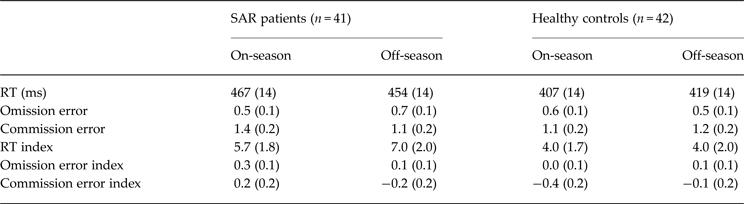
SAR, Seasonal allergic rhinitis; RT, reaction time.
Values are given as mean (standard error).
Cognitive performance
CPT
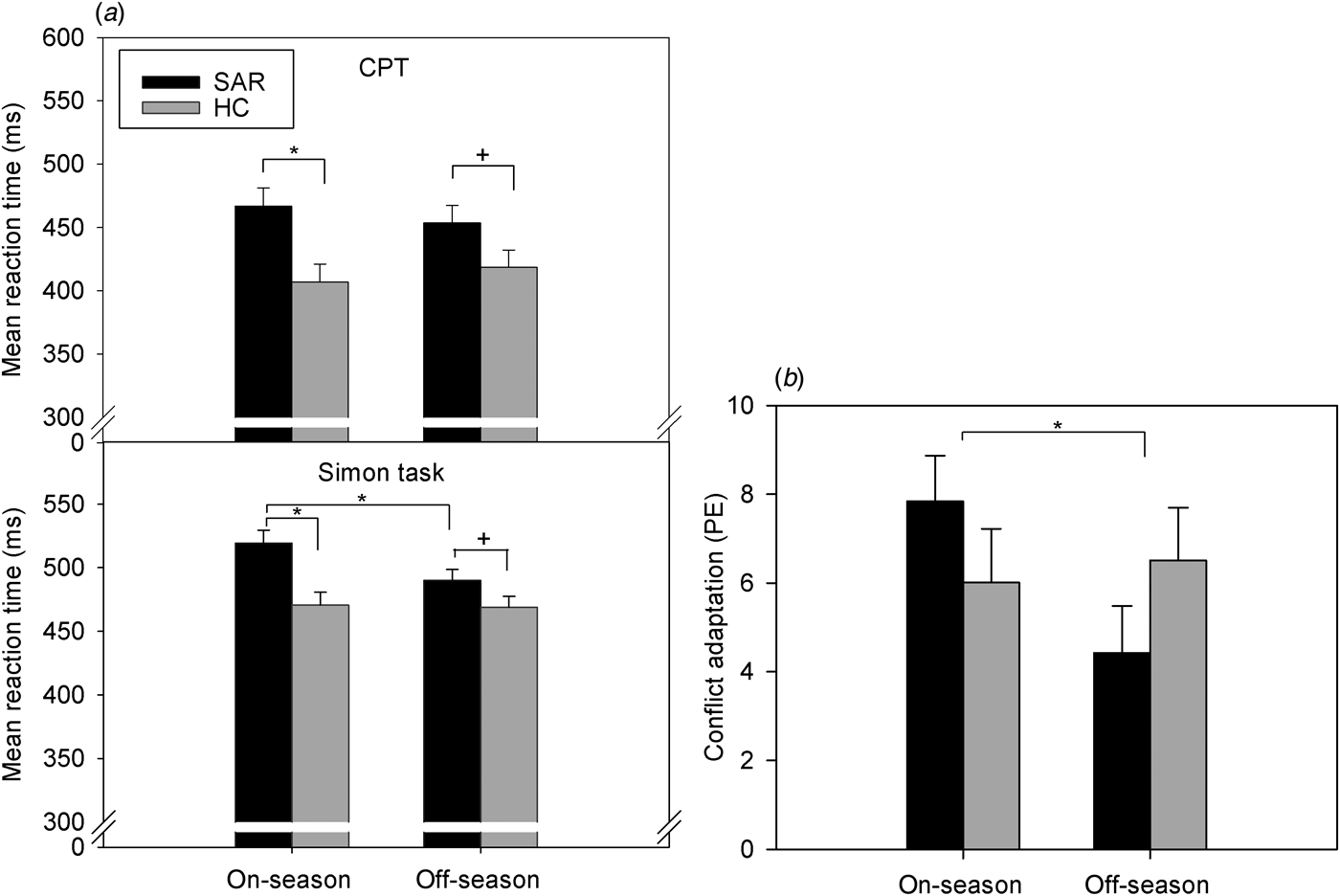
Values for mean RTs, error rates and indices are listed in Table 2. There was a significant main effect in mean RT between groups (F 1,81 = 7.78, p = 0.007, η 2 = 0.09), with SAR patients showing reduced processing speed during on-season (p = 0.005) and also during off-season (p = 0.04, one-tailed) compared to healthy controls (see Fig. 1 a). No season or interaction effect could be found for mean RT (p's > 0.22). Additionally, no effects of group, season or interaction for omission and commission errors and for RT and error indices (all p's > 0.149) were observed.
(a) Mean reaction times (in ms) in the Continuous Performance Task (CPT) and the Simon task for patients with seasonal allergic rhinitis (SAR) and healthy controls (HC) at both testing points (on-season versus off-season). (b) Conflict adaptation effects as percentage error (PE) in the Simon task for SAR patients and HC on-season versus off-season. Error bars indicate standard errors of the mean. *p < 0.05, + p < 0.05 (one-tailed).

Simon task
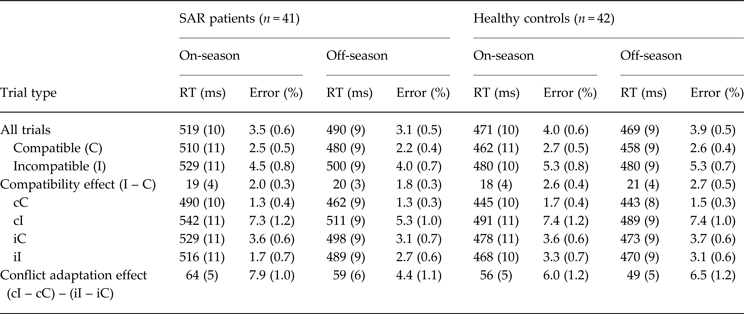
Values for mean RTs and percentage of error rates are listed in Table 3. Analysis of mean RTs showed a significant main effect for compatibility n (F 1,81 = 71.30, p < 0.001, η 2 = 0.47) and an interaction effect for conflict adaptation, compatibility n × compatibility n−1 (F 1,81 = 434.00, p < 0.001, η 2 = 0.84). No interaction effects of compatibility n or conflict adaptation with group and/or season were found (p's > 0.110). However, there was a significant interaction between group and season on mean RT (F 1,81 = 6.42, p = 0.013, η 2 = 0.07). Irrespective of task condition, SAR patients responded substantially slower than healthy controls at on-season (p = 0.001) and also to a lesser extent at off-season testing (p = 0.045, one-tailed; Fig. 1 a). The significance of the Simon effect (F 1,81 = 29.27, p < 0.001, η 2 = 0.27) and conflict adaptation (F 1,81 = 85.40, p < 0.001, η 2 = 0.51) could also be demonstrated in the analysis of error rates. However, there was a significant four-way interaction between conflict adaptation, group and season (F 1,81 = 5.19, p = 0.025, η 2 = 0.06). Post-hoc comparisons indicated a higher adaptation during on-season and a reduced adaptation effect off-season in the SAR group (p = 0.02) (Fig. 1 b). No change in conflict adaptation in healthy controls was observed (p's ⩾ 0.195). Post-hoc group comparisons for respective testing sessions failed to reach significance (on-season: p = 0.253; off-season: p = 0.195). No other significant interactions with season and/or group were detected (all p's ⩾ 0.377).
Performance on the Simon task

SAR, Seasonal allergic rhinitis; RT, reaction time.
Values are given as mean (standard error).
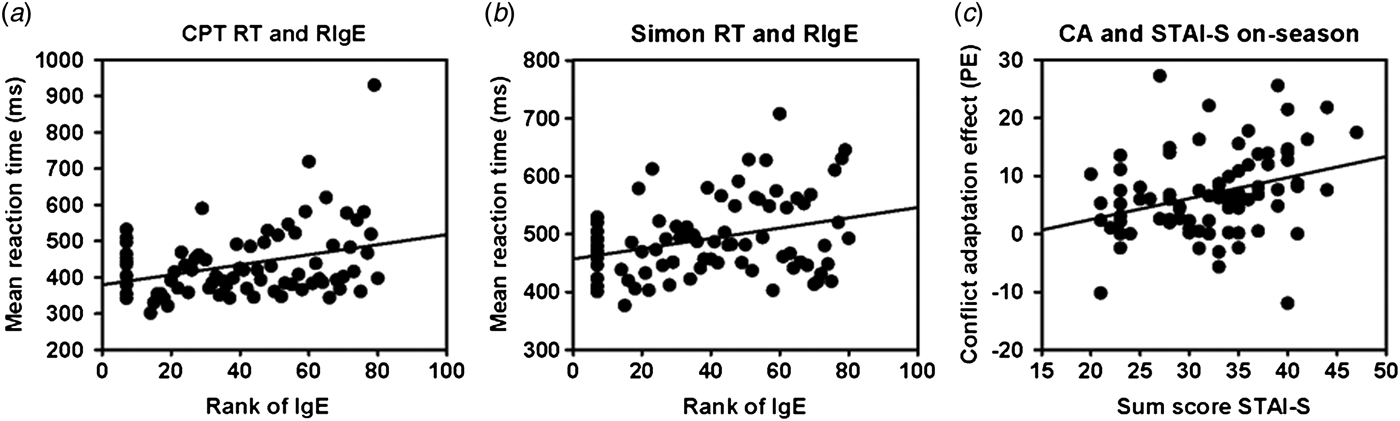
Correlation analysis revealed a positive association between the observed conflict adaptation effects in error rates and STAI-S scores (r = 0.34, p = 0.002; Fig. 2 c) and also in PSQI sleep quality scores (r = 0.23, p = 0.042) for on-season testing (data not shown). In a subsequent linear regression analysis including the factors STAI-S and PSQI sleep quality, only STAI-S proved to be a significant predictor of conflict adaptation (corrected R 2 = 0.09, p = 0.003; p = 0.254 for PSQI sleep quality). Furthermore, we found positive associations between total IgE levels and mean RT in the Simon task (r = 0.24, p = 0.029; Fig. 2 b) and mean RT in CPT (r = 0.27, p = 0.015; Fig. 2 a). No relationship of symptom severity, allergy duration, age of disease manifestation or allergy-related quality of life with cognitive performance during the symptomatic allergy season could be demonstrated (p's ⩾ 0.141).
Association between mean reaction time (RT in ms) in (a) the Continuous Performance Task (CPT) and (b) the Simon task with rank-transformed total immunoglobulin E (RIgE) level at on-season testing. (c) Amount of conflict adaptation (CA) as percentage error (PE) in the Simon task and the State Anxiety form of the Spielberger State–Trait Anxiety Inventory (STAI-S) at on-season testing.

Discussion
In this study we investigated performance in attention and dynamic attention control processes, and their potential determinants in patients with SAR and healthy controls during symptomatic and non-symptomatic allergy periods. The results provide substantial evidence for a reduction in psychomotor speed in SAR patients that persisted even in the absence of allergy symptoms. Furthermore, patients showed altered patterns of attentional control adjustments and a higher recruiting of cognitive control during the symptomatic period, whereas control adjustments were reduced during the non-symptomatic period. Allergy-induced performance changes were found to be related to IgE levels and mood, rather than subjective symptom complaints. These results contribute significantly to our understanding of SAR by identifying specific cognitive processes that are altered in patients with SAR under naturalistic conditions. Furthermore, they highlight the importance of looking beyond acute performance consequences and, for the first time, they provide evidence for an association of mood and IgE with these cognitive changes in SAR.
In comparing the performances of SAR patients with healthy controls, our first main finding is that patients show diminished performance in a sustained attention task during a symptomatic allergy period. This result supports the reported subjective complaints of allergy patients (Marshall et al. Reference Marshall, O'Hara and Steinberg2000) and previous studies that also detected poorer performance of SAR patients in a laboratory setting (Wilken et al. Reference Wilken, Berkowitz and Kane2002; Hartgerink-Lutgens et al. Reference Hartgerink-Lutgens, Vermeeren, Vuurman and Kremer2009). These studies all used overall RT and error analysis as major outcomes. Given that vigilance is defined as sustaining selective attention over a longer period of time, impairments would be expected to initially occur during middle or late phases of task processing. Therefore, we hypothesized that contrasting performances in the first and second halves of the tests would be a superior outcome measure. Against our expectations, there was no decrease in performance during the course of task processing. Instead, observed curtailments seemed to develop at the outset and may be somewhat better interpreted as a reduction in the speed of processing and/or reaction to task-relevant stimuli (i.e. impairment in psychomotor speed). Furthermore, this reduction in psychomotor speed persisted even in non-symptomatic allergy periods, which might reflect a stable cognitive deficit in SAR patients. However, no performance decrements in SAR patients were found for the applied measures of selective attention (i.e. omission errors in CPT) and impulsivity (i.e. commission errors in CPT).
Although no significant impairments in the ability to shield attention from conflicting task-irrelevant stimuli (i.e. the Simon effect) were found, the results from the applied Simon paradigm also support the assumption of stable psychomotor speed deficits in SAR patients. Specifically, we found a similar general reduction in RT irrespective of task condition (i.e. compatible versus incompatible trials) and season in SAR patients compared to healthy controls during performance of the Simon task. By using a naturalistic design, we therefore confirm a previous observation made by Hartgerink-Lutgens et al. (Reference Hartgerink-Lutgens, Vermeeren, Vuurman and Kremer2009), who reported slower reactions of SAR patients in a motor choice reaction task irrespective of symptom provocation.
A further major finding of the present study is the season-dependent change in the adjustment of attentional control. During symptomatic allergy periods, patients showed an increase in conflict adaptation. Accordingly, after processing a conflict (e.g. incompatible conflict trial), patients were more able to diminish the influence of task-irrelevant information (e.g. stimulus location) on the subsequent trial, which was not observed after non-conflicting trials. This indicates a highly flexible, exaggerated up- and down-regulation of (selective) attention based on environmental signals. On more speculative terms, this higher flexibility in the recruitment and regulation of attentional resources during acute allergy phases could represent a compensatory strategy to cover detriments caused by allergic rhinitis and could therefore be linked with the debate of increased mental effort in SAR patients. This assumption would be in line with Hartgerink-Lutgens et al. (Reference Hartgerink-Lutgens, Vermeeren, Vuurman and Kremer2009), who propose that the capacity to enhance attentional control will only be exhausted if task demands are too high or a high level of performance has to be maintained for too long. In this scenario, performance deficits would occur. The idea of mainly demanding functions (e.g. strategy-based thinking and acting) being impaired has also been confirmed in a complex simulation approach, trying to depict work-related impairments in a laboratory setting (Streufert & Satish, Reference Streufert and Satish2005). To our knowledge, this is the first time that dynamic aspects of attentional control have been investigated in SAR patients.
The second aim of the study was to explore associations between cognitive impairments in SAR patients and allergy-related factors. On an intuitive level, disease factors that are most uncomfortable (i.e. sleeping problems, severity of acute symptomatology) have commonly been interpreted as the causing factors for performance problems. In our study SAR subjects indeed experienced substantial sleeping problems and were suffering from acute allergy-related symptomatology with concurrent decreases in well-being. However, in contrast to previous assumptions, these variables did not explain the observed changes in cognitive performance in our study. Neither several nights of disturbed sleep nor unpleasant allergic symptoms such as watery eyes or a congested nose accounted for the observed slowing of information processing and changes in conflict adaptation. Instead, particular cognitive changes were found to be associated with specific disease factors. The reduction in information processing in both the sustained attention task and the Simon task was associated with total IgE levels whereas conflict-driven attention adjustment was associated with state anxiety.
IgE has long been thought to play a prominent role in the association of atopy and mood problems (Timonen et al. Reference Timonen, Jokelainen, Hakko, Silvennoinen-Kassinen, Meyer-Rochow, Herva and Räsänen2003; Hashizume et al. Reference Hashizume, Horibe, Ohshima, Ito, Yagi and Takigawa2005; Klokk et al. Reference Klokk, Götestam and Mykletun2007). However, to our knowledge, this is the first demonstration of a relationship between increased IgE levels and a decline in cognitive function (e.g. processing speed), which warrants further investigation. The mechanisms of how IgE affects cognitive processes are still unclear. Further evidence is necessary to determine whether total IgE is linked directly to cognition, or mirrors a more complex pattern of behavior-affecting immune parameters that are released in the IgE-mediated immunological cascade (e.g. histamine, cytokines). Based on recent research, increased amounts of pro-inflammatory cytokines released in the late phase of an allergic reaction (Ferreira, Reference Ferreira2003) are particularly predestined to cause behavioral and cognitive changes because of their ability to cross the blood–brain barrier (for review, see McAfoose & Baune, Reference McAfoose and Baune2009; Thayer & Sternberg, Reference Thayer and Sternberg2010; Capuron & Miller, Reference Capuron and Miller2011). Increased levels of pro-inflammatory cytokines have been related to decrements in processing speed, executive function and memory in immunologically challenged and unchallenged healthy populations and also in conditions of autoimmune diseases (Krabbe et al. Reference Krabbe, Reichenberg, Yirmiya, Smed, Pedersen and Bruunsgaard2005; Marsland et al. Reference Marsland, Petersen, Sathanoori, Muldoon, Neumann, Ryan, Flory and Manuck2006; Heesen et al. Reference Heesen, Schulz, Fiehler, Von der Mark, Otte, Jung, Poettgen, Krieger and Gold2010). In our study, SAR patients had a mean of 16 days of suffering from allergy symptoms prior to the on-season testing session. Thus, initiation of the allergic response, including activation of pro-inflammatory cytokines, is likely and may have contributed to the observed cognitive deficits during the pollen season.
The detected alteration of conflict-driven control adjustments in the current study was associated with and paralleled by a change in state anxiety. A corresponding relationship of attention control adjustment and negative mood states has previously been shown and discussed in the field of cognitive research (van Steenbergen et al. Reference Van Steenbergen, Band and Hommel2010, Reference Van Steenbergen, Booij, Band, Hommel and van der Does2012; Kuhbandner & Zehetleitner, Reference Kuhbandner and Zehetleitner2011; Padmala et al. Reference Padmala, Bauer and Pessoa2011; Dreisbach & Fischer, Reference Dreisbach and Fischer2012). In this context, van Steenbergen and colleagues have linked alterations in conflict adaptation with the mood-behavior model (MBM; Gendolla, 2000). The MBM posits that, based on its informative value, negative mood is an indicator of insufficient satisfaction with performance, and leads to increased demand appraisals and therefore effort mobilization. In line with this argument, such effort-increasing effects of negative mood (i.e. state anxiety) could contribute to the allergy-induced pattern of performance alterations in our study. Alternatively, SAR patients might somehow be more sensitive to aversive events during acute allergy periods. Studies have shown that the experience of a cognitive conflict can serve as an aversive signal that initiates the recruitment of adaptive control (see Dreisbach & Fischer, Reference Dreisbach and Fischer2012). A higher sensitivity for those aversive signals might therefore account for both the higher conflict adaptation effects and their correspondence to state anxiety.
To summarize, our data show that SAR represents a state that is linked to impairments in information processing and changes in attentional control adjustments that are, to some extent, not exclusively limited to periods of symptomatic allergic reactions. These cognitive alterations are widely unaffected by sleep impairments and subjective symptom severity, but may be influenced by mood and allergic inflammatory processes. The detected effects are small to medium. However, this range of effect sizes is not uncommon in psychological research and instead elucidates the complex interplay of several interacting factors in human cognition, of which the present study only targeted a limited number. Future studies should be encouraged by our data to further examine the impact of allergy on cognitive processes. In these studies, a larger sample size and direct measures of specific effort-processing strategies during task performance should be included. A comprehensive approach of methods and paradigms under consideration of further mediating or underlying factors such as cytokines, stress response and medication intake should be applied to fully understand SAR and its induced burden. Based on that knowledge, future therapy strategies might improve in a way that includes allergy symptoms in their entirety. The current study has contributed to this development by addressing the lack of knowledge in allergy-induced cognitive changes and their mechanisms.
Declaration of Interest
J.S. received funding for investigator-initiated research from ALK.