The Paul Mellon Centre for Studies in British Art (the Centre) was founded in central London in 1970 through a gift to Yale by the American philanthropist and collector of British art, Paul Mellon (1907–1999). The Centre is ‘an educational charity committed to promoting original, world-class research into the history of British art and architecture of all periods. We collaborate closely with the Yale Center for British Art, and are part of Yale University’.Footnote 1 The Centre's current home is in a pair of Georgian houses, numbers 15 and 16 Bedford Square, located in the heart of Bloomsbury.
The Centre fulfils its remit in many different ways. It runs events such as conferences, seminars, and workshops; offers fellowships and grants; publishes books on British art; and offers numerous learning opportunities, including a public lecture course and a ‘Yale in London’ programme for Yale University undergraduate students. Last, but not least, it houses important art-historical archives and a specialist library, both of which are free to use and open to all.
The Centre's Archives and Library are accessible to readers in the Public Study Room, a shared research space in the basement of 16 Bedford Square. The archive collections largely comprise the papers of British art historians but also include the Centre's own institutional archive. There are also two photographic archives: the Paul Mellon Centre Photographic Archive, recently reported on in this journal;Footnote 2 and the Tate Photographic Archive, formerly a curatorial resource at The Tate. There is also an openly accessible, reference only, research library - the subject of this article.
The library started as a small resource, used exclusively by staff, but has grown considerably in recent years and now houses nearly 25,000 books, 10,000 exhibition catalogues, 20,000 auction catalogues and 200 periodical titles. The library collections cover British painting, sculpture, drawing, prints, decorative arts, architecture and garden history from the medieval period to the present day. The holdings on British artists and architects, the British and Irish country house and the eighteenth-century Grand Tour are particularly strong.
Prior to 2012, the Centre had received a number of donations that had augmented existing holdings and fitted into the existing collection development policy. Eight hundred books from the library of the late architectural historian John Cornforth (1937-2004), bequeathed by him to the National Trust, were transferred to the Centre in 2004. These titles added considerably to the Centre's holdings on the history of the country house and on eighteenth-century decorative arts. In 2007, another significant gift was received: a collection of 400 books and country house guidebooks on seventeenth-century painting from the library of Sir Oliver Millar (1923-2007), Surveyor of the Queen's Pictures. The following year, 250 exhibition catalogues on twentieth-century artists and on the subject of the Grand Tour were given by the family of Sir Brinsley Ford (1908-1999). With all these donations, the emphasis was on selecting secondary material that would fill gaps in existing holdings, not developing the library in new directions and certainly not doing anything other than building stock. New publications still very much formed the core of the collection.
However, in 2012, when a new Director of Studies, Mark Hallett, joined the Centre, he made the decision to expand the collecting remit of the library chronologically and geographically as well as adding new subject areas. Before this time, only British art up to 1950 was collected and works on living artists were rarely bought. The definition of ‘British’ had mainly centred on the geographical British Isles as well as some parts of the former British Empire. Since 2012 titles on the following areas have been collected: contemporary art and works on established living artists;Footnote 3 books on photographers, decorative artists and crafts people; and material on the British art tradition throughout the world.
As may be imagined, this change presented challenges, not the least of which was filling the significant gaps in our holdings. The decision was made not to attempt to fill these gaps by purchase, unless in response to a particular institutional need. This was because there was not enough time available for staff to select and source the stock, and funds were insufficient to buy all the books required. This is the time when donated collections came into their own at the Centre: they formed a ready-made selection of stock to fill these gaps.
As a result of this expansion, offers of large donations became key to building the collection. It became clear from conversations with potential donors that other institutions did not often have the wherewithal to take large donations any longer, and so offers flooded in. These have not only augmented the Library's holdings in terms of book stock, but they have enabled us to develop many other new activities at the Paul Mellon Centre.
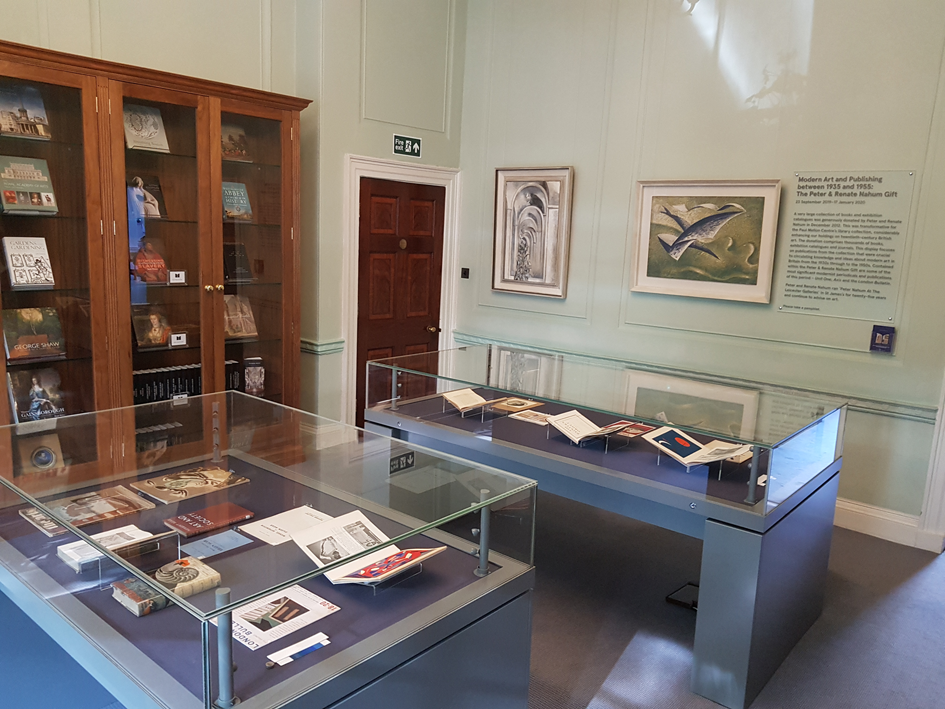
In recent years the number of the Centre's activities has increased exponentially. This is partly made possible by the fact that, in 2015, the Centre expanded into the adjoining building in Bedford Square, so it now has a dedicated lecture room, seminar room and teaching spaces as well as a modest exhibition space: The Drawing Room. The latter is a reception room in 16 Bedford Square, which houses the Centre's archive of its own publications and incorporates a small display space, consisting of one upright cabinet and two flat vitrines. The Centre's expansion has helped encourage new perspectives on the part of the Archives & Library team. Now, with each donation offered to the Centre, staff not only think about the gaps in the library holdings but also consider how these materials can give added value and how they might fit into the Centre's wider events and teaching programmes.
Drawing Room Displays
Since 2015 the Centre has put on three Drawing Room Displays a year. Curated by academic and other staff as well as librarians and archivists at the Centre, they are focussed on Archives & Library holdings, and on donated collections in particular. Approximately half of these displays are based on our archives and half on library materials.
These displays are enormously beneficial in spreading information about the Archives & Library. They encourage the Centre's staff to engage with the collections, deepening their knowledge and discovering new research interests. An exhibition on the John Moores Painting PrizeFootnote 4 in 2017, based on a donation of an entire run of these catalogues, led the curator into a new research interest and ultimately a university teaching post.
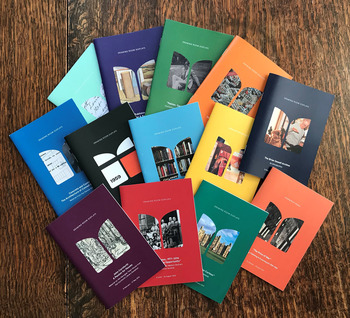
Each display is accompanied by an attractive colour pamphlet. These are the product of original research and feature an extensive list of the objects on show. They form a permanent record of the display and can be distributed to visitors and other libraries. An online version of the text appears on the Centre's website. It was decided early on that these pamphlets would be small and ‘pocketable’ and share a uniform design to make them collectable for visitors. There is also an article on each display in PMC Notes,Footnote 5 the Centre's triannual newsletter.
The Drawing Room Displays have encouraged new visitors to come to the Centre, many of whom subsequently engage with the Archives & Library collections. The Drawing Room also acts as a waiting room for visitors and those attending conferences and seminars who spend their time browsing the cases. Furthermore, the Room and its displays form a centrepiece for public outreach activities such as the Bedford Square Festival, hosted by the Centre and neighbouring institutions. The festival, held in Bloomsbury each summer since 2017, reaches out to members of the public, many of whom would not have known about the Centre before, and some of whom subsequently become readers in the Archives & Library.
Drawing Room Display pamphlets

Advertising through social media has the knock-on effect of increasing awareness of our collections. For a recent display entitled: Modern art and publishing between 1935 and 1955: The Peter & Renate Nahum gift Footnote 6, the curator, Deputy Director for Research Sarah Turner, presented a Facebook live tour that is still available to view on the Centre's website.Footnote 7 This facilitated access to the display for those unable to visit in person, something that the Centre's staff are increasingly attempting to do.
Group visits to the displays are frequently organised. For example, the Twentieth Century Society arranged a group visit to Modern art and publishing between 1935 and 1955 : The Peter & Renate Nahum gift Footnote 8 in January 2020 and the speaker from the Society brought similar ‘handling’ copies of books along to compare with what was in the vitrines, leading to an engaging and informative experience for staff and visitors alike.
In more than one instance, a display has encouraged a potential donor to give the Archives & Library another batch of material. A collection of Crittall Windows trade catalogues dating from the 1920s to the 1950s was gifted to the Library in 2016 after the donor had seen the Archives display: Concrete and controversy : The architecture of Connell Ward and Lucas Footnote 9.
Drawing Room Display Modern art and publishing between 1935 and 1955 : The Peter & Renate Nahum Gift

Informal displays
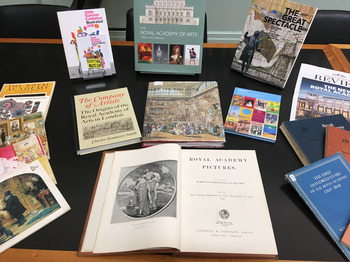
As well as the more formal Drawing Room Displays, Archives & Library staff regularly create smaller displays in the Centre's Public Study Room, often in conjunction with a group visit of students or members of a society, or for an evening event. The donated collections lend themselves well to these displays, as they are often very specialised and include more primary material and rare publications. For the Bedford Square Festival in 2018, the library staged a display of books on the history of the Royal Academy, based largely on donated materials that complimented a talk that was taking place elsewhere in the Centre that day.
Workshops and conferences
The Centre sometimes hosts a workshop or conference based around a donated collection. In 2018, a workshop and a visit to a church was held on the Victorian architect G. E. Street (1824–1881). The workshop, G. E. Street : celebrating the Paul Joyce Archive and Library,Footnote 10 was mainly focussed on the archive of Paul R. Joyce (1934-2014), which, donated by Michael Hall in 2016, offers a treasure-trove of material on Street's practice. The event, which attracted a large group of architectural historians, also featured a display of books about Street from the same collection.
Research projects
The Centre has embarked on a number of research projects in recent years and donated collections often support these. Royal Academy exhibition catalogues from both the art dealer Peter Nahum and his wife Renate, which were donated in 2012 and from the collection of the art critic Brian Sewell (1931-2015), which were donated in 2016, were particularly helpful for the research project The Royal Academy summer exhibition, 1769-2018Footnote 11. The outcomes of this project were two-fold: a major international loan exhibition that was held at the Royal Academy in 2018 entitled The great spectacle: The Royal Academy and its summer exhibitions 1769–2018, which was accompanied by a substantial scholarly catalogue; and, secondly, an award-winning digital publication The Royal Academy of Arts summer exhibition : A chronicle, 1769-2018Footnote 12. Similarly, the numerous country house guidebook donations the Centre has received over the years, including those bequeathed by the architectural historian Sir Howard Colvin (1919-2007) in 2008, have had a beneficial impact on the Centre's current digital research project on the country house, Art and the country house,Footnote 13 that is due to be published online in late 2020.
Bedford Square Festival display of books

Teaching
Donations are of increasing use for teaching at the centre. The Peter and Renate Nahum donation, with its collection of modernist journals and mid-twentieth century monographs and exhibition catalogues, has proved very exciting for teaching sessions of MA students from a number of universities. The inaugural Yale Graduate Summer School in 2019 also made use of this collection when Sarah Turner showcased the material she planned to use for her forthcoming Drawing Room Display: Modern art and publishing between 1935 and 1955 : The Peter & Renate Nahum gift.
Relationships with donors
Relationships with donors have been invaluable in the development of the library collections. Many donors continue to donate materials after the initial gift, often selecting material that they feel will be particularly welcome. Some have kindly loaned works of art from their collections to Drawing Room Displays, spoken about their collecting at events, and have been interviewed for the display pamphlet. These relationships are ongoing and rewarding for all concerned.
Creation of a defined focus for the collection
Another huge benefit is the ability to use gifts to help define the profile of the Archives & Library. Increasingly offers come along that add significant subject strengths to the existing collection. The library was fortunate to be offered books owned by Peter and Renate Nahum and Brian Sewell at the point when it started collecting the art of the 1950s onwards. These two collections alone added over 5000 items to the collection and have enriched the library's holdings dramatically. The Nahum and Sewell collections, along with a donation in 2017 of contemporary Grand Tour diaries and accounts, formerly belonging to Sir Brinsley Ford, have increased the Centre's holdings of primary material and contemporary publications from the late eighteenth to early twentieth centuries. Recent donations have concentrated on specific regions: the art historian Michael Liversidge's (1947-) donation in 2018 of 100 titles on Canadian art, most of which are scarce in UK libraries, and the Fleming-Wyfold Collection's gift in 2019 of its library of Scottish art, are both very welcome and will, no doubt form the basis of future Drawing Room Displays.
There have been many less obvious benefits of all these donations. They have informed us about conservation and the need to have robust acquisition procedures in place. Seeing how different people collect has been very enlightening. Some donors have spent years slowly curating their collections, and others have had many of their books given to them as review copies, which alerts us to the pitfalls of attributing meaning to the presence of a title in someone's library. Some annotate their books heavily, some stick hundreds of post-it notes in them, and others leave them barely touched. Occasionally a collection is received – as in the case of the recently acquired library of art historian Paul Oppé (1878-1957) - that is interesting for the study of the history of the book, containing fascinating provenance information such as bookplates and owners’ signatures, or rare armorial bindings. Archives and libraries are often donated together, leading to collaborations within the department. A recent example of how such collaboration can generate new kinds of study is our Research Collections Fellowship, which, awarded for the first time in 2020, funds research on the Centre's own collections.
In the immediate future, we are focusing in particular on the Paul Oppé Archive and Library, which provides an especially exciting opportunity for outreach and engagement. Adolph Paul Oppé was a British art historian, critic, art collector and museum official and his large collection of archival and library materials was accepted in lieu of inheritance tax by the UK Government and allocated to the Paul Mellon Centre in 2016. There are plans for a scholarly workshop on Oppé and his collection, followed by a related conference and a Drawing Room Display, all to be held in the next year or so.
Overall, large donations have been enormously enriching for the library at the Paul Mellon Centre over the past 20 years or so, and not only from the point of view of building the collection. They have raised the profile of the Centre as a whole, reaching out to and engaging with new audiences, and they have made staff look at the collections in a different way.
Author's note: The Paul Mellon Centre is enormously grateful to all those generous donors who have given their books throughout the 50 years of the Paul Mellon Centre's existence.