Introduction
Clinicians working with young people often use terms such as lability, dysregulation or instability to describe variations in mood. Mood lability can be operationalized as changes in mood that are noteworthy because of their amplitude, frequency or rapidity. However, such mood lability is hardly touched on by current diagnostic criteria. Although mood lability is mentioned as a possible associated feature of attention deficit hyperactivity disorder (ADHD) in DSM-IV (APA, 2000), it is not a criterion for any of the common child and adolescent disorders. Furthermore, questions have been asked recently about the relationship between bipolar disorder and mood lability in youth (McClellan et al. Reference McClellan, Kowatch and Findling2007).
A possible reason for the relative neglect of mood lability as a symptom is that it is not a specific marker of one disorder, or even of one group of disorders. For example, in a relatively small community sample of adolescents, those found to be emotionally labile suffered from a wide range of other disorders, such as attention deficit, conduct and anxiety disorders (Carlson & Kashani, Reference Carlson and Kashani1988); similarly, in a clinic-based questionnaire study, the symptom of labile mood loaded almost equally on hyperactive, conduct and emotional factors (Goodman, Reference Goodman1994). More recently, youth described as suffering from severe mood dysregulation have been shown to display a wide range of psychopathology, ranging from oppositional defiant disorder (ODD) and ADHD to depression and anxiety (Brotman et al. Reference Brotman, Kassem, Reising, Guyer, Dickstein, Rich, Towbin, Pine, Mcmahon and Leibenluft2007).
This breadth of associations between mood lability and psychiatric disorder casts doubts on its specificity and its overall value in psychopathology. Perhaps most obviously, mood lability could be the mere non-specific downstream consequence of a wide range of different disorders. Just as many forms of psychopathology disrupt, for example, peer relationships, so it is possible that psychiatric disorders lead to extreme emotional reactions.
Conversely, if the breadth of association of mood lability reduces its value as a diagnostic criterion, it may correspondingly increase its relevance as a cause of co-morbidity. The overlap of different domains of child and adolescent psychopathology is a common and puzzling occurrence (Caron & Rutter, Reference Caron and Rutter1991; Angold et al. Reference Angold, Costello and Erkanli1999). Shared risk factors for different disorders is one possible explanation (Klein & Riso, Reference Klein, Riso and Costello1994). Thus, it is possible that mood lability occurs in both internalizing and externalizing disorders because it represents a risk factor for both. Indeed, emotion lability (Caspi, Reference Caspi2000) and emotion dysregulation (Eisenberg et al. Reference Eisenberg, Sadovsky, Spinrad, Fabes, Losoya, Valiente, Reiser, Cumberland and Shepard2005) have been shown to predict future psychopathology and maladjustment.
Yet another possible explanation is that mood lability is the leading symptom of a distinct and, possibly, overlooked syndrome (Klein & Riso, Reference Klein, Riso and Costello1994; Neale & Kendler, Reference Neale and Kendler1995). Indeed, a long-standing question is whether labile mood may in fact be the manifestation of early-onset bipolar disorder (Carlson, Reference Carlson1984; Carlson & Meyer, Reference Carlson and Meyer2006). Characteristically, very high rates of co-morbidity with a wide range of psychopathology, including conduct, attention deficit and depression, have been proposed for those children deemed to be suffering from bipolar disorder (Carlson, Reference Carlson1998; Geller et al. Reference Geller, Zimerman, Williams, Delbello, Bolhofner, Craney, Frazier, Beringer and Nickelsburg2002; Axelson et al. Reference Axelson, Birmaher, Strober, Gill, Valeri, Chiappetta, Ryan, Leonard, Hunt, Iyengar, Bridge and Keller2006).
Therefore, the aim of this study was to answer the following questions: (1) How widely occurring a phenomenon is mood lability? and (2) Is mood lability relevant to psychopathology and, if so, in what way? We enquired about mood lability as a symptom and operationalized it as extreme changes in mood in the direction of the three most important valences, namely anger, sadness and cheerfulness. We asked about the individual's pattern of changes in mood as compared to other people their age. We addressed the following range of inter-related hypotheses.
Hypothesis 1
Mood lability is significantly associated with a wide range of psychopathology in the community. Confirmation of this in a large community sample will add considerable weight to previous findings (Carlson & Kashani, Reference Carlson and Kashani1988; Goodman, Reference Goodman1994).
Hypothesis 2
Mood lability is not merely a non-specific consequence of psychopathology or an index of symptom fluctuations. If mood lability were just a consequence of other psychiatric problems, then it should not occur when other psychopathology is controlled for. In line with this hypothesis, we predicted that mood lability would also occur in those not suffering from other psychiatric disorders. We also predicted that, in the presence of other psychiatric morbidity, mood lability would typically be associated with additional impairment even after controlling for this categorically or dimensionally defined psychopathology.
Hypothesis 3
Mood lability is not simply a marker for a bipolar disorder. We predicted that mood lability would show the same pattern and strength of morbid associations even in the absence of elation. We therefore predicted that our findings on mood lability would not be changed substantially after excluding from the analysis those with classical bipolar disorder or, more widely, those who exhibit manic elation. Given that elation is considered a defining or near-universal symptom of early-onset bipolar disorders (Axelson et al. Reference Axelson, Birmaher, Strober, Gill, Valeri, Chiappetta, Ryan, Leonard, Hunt, Iyengar, Bridge and Keller2006), it is unlikely that many cases of mood lability are due to underlying bipolar disorder in the absence of elation.
Hypothesis 4
Mood lability has been shown to span internalizing and externalizing disorders; our supposition was that the breadth of the associations of mood lability underlies wide-ranging co-morbidity. We therefore predicted that mood lability would be even more strongly associated with co-morbidity between internalizing and externalizing disorders than with ‘pure’ internalizing and externalizing disorders (i.e. internalizing disorders without externalizing disorders, and vice versa).
Method
Population
The 2004 British Child and Adolescent Mental Health Survey (B-CAMHS04) was carried out (n=7977) on representative groups of 5- to 16-year-olds. The design of the B-CAMHS04 survey has been described in detail elsewhere (Green et al. Reference Green, McGinnity, Meltzer, Ford and Goodman2005). In brief, in Great Britain ‘child benefit’ is a universal state benefit payable for each child in the family, and it has an extremely high uptake. The child benefit register was used to develop a sampling frame of postal sectors from England, Wales and Scotland that, after excluding families with no recorded postal code or subject to current revision of their record, was estimated to represent 90% of all British children. A total of 426 postal sectors (out of the 9000 covering Great Britain) were sampled with a probability related to the size of the sector, and stratified by regional health authority and socio-economic group.
Three years after the original survey (i.e. in 2007), families were approached again unless they had previously opted out or the child was know to have died. Of the original 7977, 5326 (67%) participated in the detailed follow-up. The rate of participation was lower for children and young people with the following characteristics as measured in the original survey in 2004: more psychopathology as indexed by dimensional and categorical measures, older, living with single parents, living with parents who were cohabiting rather than married, and greater family size. An inverse propensity score was used to generate sampling weights to adjust for these factors.
Measures
The Strengths and Difficulties Questionnaire (SDQ) is a 25-item questionnaire with robust psychometric properties (Goodman, Reference Goodman1997, Reference Goodman2001; Bourdon et al. Reference Bourdon, Goodman, Rae, Simpson and Koretz2005). It was administered to parents and youth to generate overall symptom and impact scores. The SDQ symptom score (also known as the total difficulties score) reflects hyperactivity, inattention, behaviour problems, emotional symptoms and peer problems. The SDQ impact score for mental health problems is generated by summing items covering distress and social impairment in family life, friendships, learning and leisure activities (Goodman & Scott, Reference Goodman and Scott1999).
The Development and Well-Being Assessment (DAWBA) was used in both surveys and has been extensively described previously (Goodman et al. Reference Goodman, Ford, Richards, Gatword and Meltzer2000; Ford et al. Reference Ford, Goodman and Meltzer2003). It is a structured interview administered by lay interviewers who also recorded verbatim accounts of any reported problems. The questions are closely related to DSM-IV (APA, 2000) diagnostic criteria and focus on current rather than lifetime problems. The κ statistic for chance-corrected agreement between two raters was 0.86 for any disorder (s.e.=0.04), 0.57 for internalizing disorders (s.e.=0.11), and 0.98 for externalizing disorders (s.e.=0.02) (Ford et al. Reference Ford, Goodman and Meltzer2003). Children were assigned a diagnosis only if their symptoms were causing significant distress or social impairment. The DAWBA interview was administered to all parents and to all children aged ⩾11 years; a shortened version of the DAWBA was mailed to the child's teacher. Further information on the DAWBA is available from www.dawba.com, including online and downloadable versions of the measures and demonstrations of the clinical rating process.
The 2007 survey incorporated for the first time some new questions on mood lability. The parents of 8- to 19-year-olds and the 11- to 19-year-olds themselves were presented with the following:
Some young people have a fairly steady mood, while other young people's mood swings up and down a lot with marked or rapid changes. For example, they may swing from being very cheerful to being very sad or angry, and then perhaps swing back again the other way just as quickly.
And then asked:
Does X [Do you] have marked or rapid mood changes?
To which they had the option of answering: No, A little, A lot.
Unless the answer was ‘no’, they were subsequently asked:
Are X's [your] moods generally:
Rapid? (No/Yes)
Marked? (No/Yes)
Unpredictable? (No/Yes)
Frequent? (No/Yes)
When you are in a strong mood (e.g. very happy, very angry, very sad), does this strong mood typically last: Minutes? Hours? Most of the Day or Longer?
In addition, they were presented with the following:
Some young people have episodes of going abnormally high. During these episodes they can be unusually cheerful, full of energy, speeded up, talking fast, doing a lot, joking around, and needing less sleep. These episodes stand out because the young person is different from their normal self.
And then asked:
Do you ever go abnormally high?
To which they may reply with: No, A little, A lot.
Analysis
Stata version 10 (StataCorp, 2007) was used. Logistic regression and linear regression were used for categorical and continuous dependent variables respectively, as described previously (Stringaris & Goodman, Reference Stringaris and Goodmanin press). All analyses were carried out using sampling weights designed to reweight the 2007 sample to the general population in 2004. This was achieved by generating a propensity score based on the 2004 factors (psychopathology, family structure, family size and age) that predicted participation in 2007 and constructing the weight from the inverse of this propensity score.
Ethical approval
The sampling design, the interviewing procedures, information leaflets and the interview schedule were granted approval by The Central Office for Research Ethics Committees (COREC) of the UK. Children provided assent for their own participation but did not have a veto over their parents' participation on the basis of their own informed consent.
Results
The mean age was 13.6 years (s.d.=3.3, range 7–19 years) with 51.5% male subjects. The weighted prevalences for DSM-IV disorders were: all disorders 10.4%; ADHD 2.6%; ODD 2.2%; conduct disorder (CD) 2.2%; depression 1.2%; anxiety 3.8%. Just two individuals definitely met the full DSM-IV criteria for a bipolar disorder (without relaxing the duration or symptom criteria), and a further five individuals probably met these criteria, with a combined prevalence of 0.1%. Of all those with a psychiatric disorder, 10.3% showed co-morbidity between internalizing and externalizing disorders.
According to parent report, 20.0% of their children had ‘a little’ mood lability and 6.1% had ‘a lot’ of mood lability. According to the youth self-report, 24.8% had ‘a little’ mood lability and 5.5% had ‘a lot’ of mood lability. The parent and youth reports were moderately associated: r=0.29 for the three-point scale, p<0.001; κ=0.17, p<0.001 for the dichotomized variables, with ‘no’ or ‘a little’ combined. Given the modest agreement between parent and youth report, all results are presented separately according to informant. For greater clarity, subsequent results are presented for dichotomized mood lability, counting mood lability as present only when ‘a lot’ was reported by the relevant informant. The analyses were repeated using the three-point scale (not shown); there were no significant departures from the results reported here.
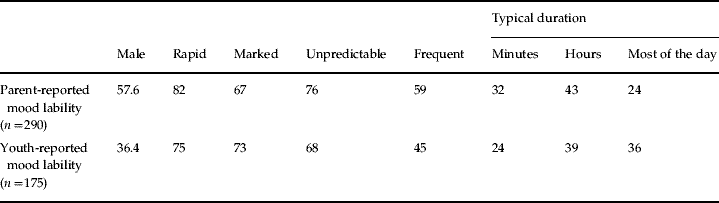
Table 1 shows the gender balance for parent- and youth-reported mood lability; boys and girls were equally likely to be reported to have labile mood by parents, whereas girls were significantly more affected than boys by self-report (p<0.001). There were no significant age trends (r=−0.03, p=0.06, for parent report; r=−0.02, p=0.29, for youth report). Table 1 also presents data on the rapidity, intensity, predictability, frequency and duration of the mood variation.
Characteristics of those reported to have ‘a lot’ of mood lability

Values are percentages.
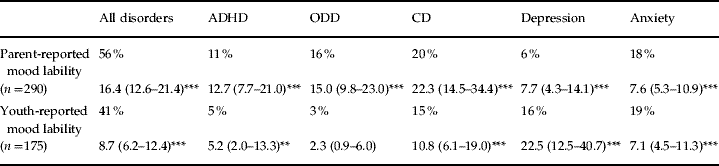
Table 2 shows the association of parent- and youth-reported mood lability with DSM-IV diagnoses. As judged by parent and youth report, lability of mood was associated with a wide range of diagnoses, although with some difference in emphasis. Thus, parent-reported mood lability was associated more strongly with externalizing disorders whereas self-reported mood lability showed a particularly strong association with depression. Of those with a DSM-IV disorder, ‘a lot’ of mood lability was reported by 33% of parents and 29% of youth.
Association of mood lability with DSM-IV diagnoses

ADHD, Attention deficit hyperactivity disorder; ODD, oppositional defiant disorder; CD, conduct disorder.
The proportion of individuals who have any DSM-IV diagnosis (‘All disorders’) and who have specific diagnoses, shown above the respective odds ratios (95% confidence intervals in parentheses) for parent- and youth-reported mood lability. The results are from a logistic regression model with diagnoses as the dependent variables and mood lability as the independent term.
** p<0.01, *** p<0.001.
In a multivariate logistic regression model, frequency (but not rapidity, markedness and unpredictability) emerged as a significant predictor of an association between psychiatric disorder and mood lability by both parent and youth report, whereas longer duration was only significant by youth report.
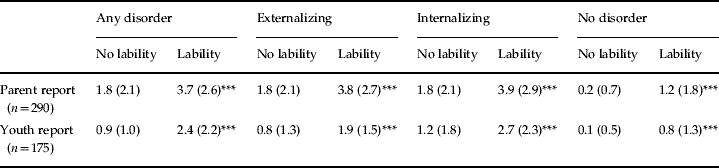
Table 3 shows that both parent- and self-reported lability were associated with increased impact and this was true for those with and without a psychiatric diagnoses; that is, mood lability was associated with increased impact even in the absence of a psychiatric disorder. Furthermore, labile mood remained a significant predictor of impact in a regression model adjusted not only for psychiatric diagnosis but also for psychiatric symptoms as assessed by the total SDQ score [parent report: B=0.75, p<0.001, confidence interval (CI) 0.6–0.9; youth report: B=0.7, p<0.001, CI 0.6–0.8].
Increased impact caused by mood lability

The impact scores, as means and standard deviations (in parentheses), are shown for those with mood lability and those without, for parent and youth report separately. Statistical comparisons between those with and without lability used t tests:
*** statistical significance at p<0.001.
Table 4 shows that mood lability is significantly associated with ‘pure’ internalizing and with ‘pure’ externalizing disorders but the highest odds ratios of association occurs with their overlap, the co-morbidity between internalizing and externalizing disorders. This was true even after adjusting for severity using the SDQ impact score as a covariate in the multinomial logistic regression models. Approximately 64% of those who were co-morbid for internalizing and externalizing disorders also displayed mood lability.
Mood lability and its relationship to ‘pure’ and co-morbid disorders

All models were run with and without adjustment for severity, using the Strengths and Difficulties Questionnaire (SDQ) impact score as a covariate.
The first three main columns report relative risk ratios and the fourth column odds ratios, with the respective confidence intervals in parentheses.
* p<0.05, *** p<0.001.
All the analyses described above were repeated after excluding individuals at medium or high risk of a bipolar disorder. The excluded individuals comprised not only the individuals who met conventional DSM-IV criteria for bipolar disorders (0.1% of the sample) but also those subjects who were reported to have ‘a lot’ of mood elevation as well as ‘a lot’ of mood lability (1.1% and 1.6% of the sample by parent and youth report respectively). This exclusion did not alter the pattern of results presented above, although odds ratios were slightly attenuated. For example, excluding individuals at medium or high risk of bipolar disorder reduced the odds ratios for the association between mood lability and any DSM-IV diagnosis from 16.4 to 13.5 by parent report, and from 8.7 to 8.0 by youth report.
Discussion
Using a large and representative community sample, we found that mood lability occurred relatively commonly in youth and that it was significantly associated with increased impairment. Adjusting for overall severity, mood lability was particularly associated with co-morbidity between internalizing and externalizing disorders. The pattern of results was similar when those children and adolescents with bipolar disorder or episodes of elation were excluded.
We found that mood lability occurs frequently in the general population of children and adolescents: approximately 6% parents and the equivalent proportion of young people reported ‘a lot’ of labile mood. The lack of an association with age does not support a link between mood lability and one particular age group, for example adolescence. Girls report more emotional lability that boys, perhaps reflecting higher levels of emotional reactivity (Hankin et al. Reference Hankin, Mermelstein and Roesch2007), although it is noteworthy that no gender difference was evident from parent report.
The modest degree of overlap between self- and parent-reported mood lability in our study is in line with what has been reported previously for related domains of psychopathology, namely depressive and manic symptoms (Thuppal et al. Reference Thuppal, Carlson, Sprafkin and Gadow2002). Our findings are also in keeping with previous reports of differences between reporting sources in child psychiatry (Angold, Reference Angold and Rutter2002), perhaps reflecting differences in the appreciation of internalizing symptoms by children and parents (Tillman et al. Reference Tillman, Geller, Craney, Bolhofner, Williams and Zimerman2004). In this paper we have chosen to present the findings for the two reports separately, rather than combine them in a single measure. Although parent- and self-reported mood lability share some very important features, most notably the pattern of relationship to co-morbidity, it is also important to appreciate that their correlation is relatively low and that, therefore, the two reporting sources may be tapping partly distinct constructs.
Our first hypothesis was confirmed: mood lability was significantly associated with psychopathology and did show a range of associations with both internalizing and externalizing disorders. This is a replication in a large sample of a pioneering study (Carlson & Kashani, Reference Carlson and Kashani1988) showing that adolescents reporting emotional lability suffered significantly more from both internalizing and externalizing symptoms compared with other symptomatic adolescents. In a series of more recent studies, children with hyper-arousal and irritability have been subsumed under the label severe mood dysregulation (SMD). These children show a wide range of associations with psychopathology from both internalizing and externalizing domains (Brotman et al. Reference Brotman, Schmajuk, Rich, Dickstein, Guyer, Costello, Egger, Angold, Pine and Leibenluft2006, Reference Brotman, Kassem, Reising, Guyer, Dickstein, Rich, Towbin, Pine, Mcmahon and Leibenluft2007). It is possible that SMD and mood lability share important properties, such as irritability. Future research should determine the extent to which mood lability is particularly associated with other symptom clusters and compare this to the patterns determined for SMD.
We have also adduced evidence in favour of our second hypothesis, showing that mood lability is not the mere consequence of psychiatric morbidity. First, almost half of the individuals with a lot of mood lability did not have a psychiatric disorder. Second, mood lability was strongly associated with impact even in those without a DSM-IV diagnosis and after adjustment for the overall level of other psychiatric symptoms. Third, the disproportionate association between mood lability and cross-domain co-morbidity (even when adjusting for overall severity) would be difficult to explain if mood lability were simply a consequence of overall severity.
We also found evidence in support of our third hypothesis, namely that the morbid associations and increased impact associated with mood lability were not the result of bipolar disorder. Had we tested this simply by excluding individuals with ‘classical’ bipolar disorder (i.e. meeting all the current criteria set out in DSM-IV), this would have been less convincing to researchers and clinicians who support the use of less stringent criteria to diagnose bipolar disorders in children and adolescents – a widely held, though debated, position (NIMH roundtable, 2001; Harrington & Myatt, Reference Harrington and Myatt2003; Pavuluri et al. Reference Pavuluri, Birmaher and Naylor2005; Carlson & Meyer, Reference Carlson and Meyer2006; McClellan et al. Reference McClellan, Kowatch and Findling2007). The symptom of elated mood is accorded particular importance by many. Hence, some consider elation a ‘cardinal symptom’ and do not diagnose early-onset and pre-pubertal mania in its absence (Geller et al. Reference Geller, Tillman, Craney and Bolhofner2004, Reference Geller, Tillman, Bolhofner, Zimerman, Strauss and Kaufmann2006). Others have found that, in children and adolescents, approximately 92% of those with bipolar I (BP-I) disorder and 82% of those with ‘bipolar disorder, not otherwise specified’ (BP-NOS) displayed elevated mood (Axelson et al. Reference Axelson, Birmaher, Strober, Gill, Valeri, Chiappetta, Ryan, Leonard, Hunt, Iyengar, Bridge and Keller2006). Thus, to test our third hypothesis, we adopted a broad view of bipolar disorder, excluding not only those we diagnosed with a ‘classical’ bipolar disorder (a relatively rare group in our survey, in line with the largest US-based study in youth; Costello et al. Reference Costello, Angold, Burns, Stangl, Tweed, Erkanli and Worthman1996) but also those with clear episodes of elevated mood, even if these were of the order of hours. The pattern of our results did not change after excluding those with narrowly and more broadly construed bipolar disorders. However, it is important to point out that some researchers (Mick et al. Reference Mick, Spencer, Wozniak and Biederman2005) regard certain forms of irritability in childhood as constituting manifestations of bipolar disorder. The symptom of irritability is very common in youth (Kim-Cohen et al. Reference Kim-Cohen, Caspi, Moffitt, Harrington, Milne and Poulton2003). This could consequently lead to a high false-positive rate of bipolar diagnoses and use of this particularly broad definition of bipolar disorder was therefore avoided here.
Our final hypothesis was based on the fact that symptoms, such as mood lability, that are associated with many different types of psychiatric disorders may offer clues about co-morbidity. The occurrence of co-morbidity in youth has been well documented (Caron & Rutter, Reference Caron and Rutter1991; Angold et al. Reference Angold, Costello and Erkanli1999). In keeping with our hypothesis, we found that mood lability was strongly associated with co-morbidity between internalizing and externalizing disorders. Moreover, we show that although mood lability was significantly associated with both ‘pure’ internalizing and ‘pure’ externalizing disorders, it was even more strongly associated with the co-occurrence of internalizing and externalizing disorders. By demonstrating this effect after adjusting for overall severity, we confirmed that this relationship was not simply the result of the increased severity caused by the co-occurrence of two illnesses.
These findings point to the possibility that mood lability represents a risk factor shared by both internalizing and externalizing disorders. This would mean that mood lability increases the risk for both internalizing and externalizing disorders and also for their co-occurrence, in accordance with a model previously proposed to explain psychiatric co-morbidity (Caron & Rutter, Reference Caron and Rutter1991; Klein & Riso, Reference Klein, Riso and Costello1994; Neale & Kendler, Reference Neale and Kendler1995). This is a particularly attractive formulation given what is already known about temperamental constructs. Thus, mood lability may be conceived of as a diathesis to react to comparatively trivial stimuli with intense emotional reactions that could be of variable duration. In one of the classic follow-up studies of temperament (Caspi et al. Reference Caspi, Henry, Mcgee, Moffitt and Silva1995), it was shown that ‘lack of control’, a temperamental factor encompassing elements of emotional lability, irritability, inattention and negativism, measured at age 3, predicted predominantly externalizing but also internalizing problems at the age of 15 years. Furthermore, when followed up at the age of 21, the temperamental dimension that included emotional lability predicted both antisocial behaviour and suicidality (Caspi et al. Reference Caspi, Henry, Mcgee, Moffitt and Silva1995). In one study of adults it was found that neuroticism, as a broad vulnerability factor, underlay most of the co-morbidity between internalizing and externalizing disorders (Khan et al. Reference Khan, Jacobson, Gardner, Prescott and Kendler2005).
If it were the case that the association between mood lability and psychiatric disorder were causal, in the direction of lability causing disorder, then abolishing mood lability (or interrupting its effect) would potentially reduce the rate of disorder by around a third, and the rate of co-morbid internalizing and externalizing disorder by two-thirds. This emphasizes the relevance of looking further into the relatively neglected topic of mood lability.
Despite benefiting from a large and representative sample, our study has important limitations. A ‘gold standard’ to measure mood lability is not available to use for comparisons. However, the tool we used to ascertain mood lability in this study shows good face validity and a pattern of results that is in keeping with previous findings. Another limitation of the present study is its cross-sectional nature; inferences about causality need to be drawn from future longitudinal and intervention studies. This applies in particular to our suggestion that mood lability may be a risk factor shared by both internalizing and externalizing disorders.
In summary, we found that mood lability occurs fairly commonly in youth and that it is strongly linked with impairment, suggesting that it is not merely a consequence of other psychopathology. Moreover, its relationship with co-morbidity suggests it could be an important factor in the aetiological pathway for both internalizing and externalizing problems. Future studies will be important to test this prediction and look further into the relationship between psychopathology and the processes that are thought to be involved in mood regulation, and explore psychological and pharmacological mechanisms for modulating these processes.
Acknowledgements
The B-CAMHS 2007 study was funded by the English Department of Health and the Scottish Executive.
Declaration of Interest
None.