In recent decades, parties that had long been excluded from national government – notably, greens, far right and far left parties – became part of government majorities in a number of European countries. Existing research has tried to understand when and under which conditions these parties take such a big decision (Akkerman et al. Reference Akkerman, Lange and Rooduijn2016; Dumont and Bäck Reference Dumont and Bäck2006; March Reference March2008; Minkenberg Reference Minkenberg2013; Olsen et al. Reference Olsen, Koß and Hough2010) and also why mainstream parties eventually choose to ally with them (de Lange Reference de Lange2012). Nevertheless, their behaviour once in government is generally a neglected field of study – with some noteworthy exceptions (Albertazzi and McDonnell Reference Albertazzi and McDonnell2005; Anghel and Thürk Reference Anghel and Thürk2019; Dunphy and Bale Reference Dunphy and Bale2011; Heinisch Reference Heinisch2003; Olsen et al. Reference Olsen, Koß and Hough2010).
This work focuses in particular on radical left parties joining government. Since the 1990s, a significant number of these parties have given up their traditional oppositional role and taken the big step of either entering a government coalition or granting external support to a (usually) minority government. Studies addressing the radical left in government have mainly examined either the pre-government phase (see, among others, Bale and Dunphy Reference Bale and Dunphy2011) by exploring the factors that made them choose (be chosen for) office for the first time, or the post-government stage, namely, the electoral consequences of such a choice (see, among others, Koß Reference Koß, Olsen, Koß and Hough2010; Newell Reference Newell, Olsen, Koß and Hough2010; Thesen Reference Thesen2016). However, this article examines the period in between – that is, the actual performance of these parties when in (or supporting) government – as we believe it is equally important. In this article, we analyse the performance of the Portuguese radical left parties during the socialist minority government established in 2015 with the support of the Portuguese Communist Party (Partido Comunista Português, PCP), the Greens (Partido Ecologista – Os Verdes, PEV) and the Left Bloc (Bloco de Esquerda, BE), commonly known as the Geringonça (Contraption).
The widening of the coalitional space to the left came quite late in Portugal (Freire Reference Freire2017) relative to both other Southern European countries such as Italy (1996–98 and 2006–8) and Spain (2004–8), and also countries with a strong radical left, such as France (1981–84 and 1997–2002) and most Scandinavian countries (1990s and 2000s). There can be no doubt that the economic crisis and the consequent beginning of the so-called austerity season, implemented in Portugal by a centre-right coalition (2011–15), played a crucial role in bringing about first negotiations and then an agreement among the left parties, which we argue would have been almost impossible in ‘normal’ circumstances. It was the fear of another legislature led by the centre-right coalition responsible for the approval of the harshest austerity measures that pushed these actors into finding a common ground for discussion and collaboration, and not their approach in ideological or policy terms (Freire et al. Reference Freire, Lisi, Lima, Freire, Lisi and Viegas2015: 400; Lisi Reference Lisi2016). As survey data shows, in fact, it was the distance between the (centre) right and (centre) left parties that increased rather than the gap between the radical left and mainstream left that narrowed (Lisi Reference Lisi2016). This is one of the main reasons why we believe that studying this particular case will add to the existing literature on the topic: if on the one hand this unprecedented decision was due to very contingent (economic and political) causes, on the other hand this agreement has lasted way longer than expected and, so far, has been positively evaluated by both the national electoral audience and the international markets and organizations (Fernandes et al. Reference Fernandes, Magalhães and Santana-Pereira2018).
Thus, it is central to explore how the collaboration between the three radical left parties and the mainstream Socialist Party (PS) has actually developed. Have the former managed to lose their ‘opposition mode’ or are they trying to keep ‘one foot in and one foot out of government’ (Tarchi Reference Tarchi2003: 154), as other radical parties in similar circumstances did in the past? Finally, are they profiting from their new role as supporting parties and, if so, how? We will try to answer these questions in two steps. First, we will test whether the radical left parties have been able to exploit their new role as supporting parties by negotiating significant policies with the mainstream PS in exchange for their support. We will do so by analysing the government agreements (individually) signed by the three parties and PS in 2015 and comparing their content with that of the legislation approved so far. Second, we will see whether the conduct of these parties in parliament has actually changed since 2015 by examining their voting behaviour, the volume of their legislative initiative (and its relative success rate) and their oversight activity in the current and past legislatures.
The article is divided into three sections: first, we will introduce the Portuguese case and its recent political developments; we will then present the theoretical framework and our main expectations; in the third section, we will explain the data and methods employed and report our findings.
The Portuguese radical left: from permanent opposition to government support
The economic crisis that hit the eurozone in 2008 had a big impact on the political systems of Southern Europe: governments fell apart, critical elections questioned the structure of many party systems, and new challenger parties entered the political and parliamentary arena (Hobolt and Tilley Reference Hobolt and Tilley2016; Vidal Reference Vidal2018). Furthermore, social democratic parties suffered a serious decline in the general elections held between 2008 and 2018. In this context, Portugal has been quite an exceptional case. The incumbent PS certainly suffered a serious defeat in the 2011 election, but its main opponent, the Social Democratic Party (PSD), obtained a significant victory. After the traditional honeymoon period, the support for the new coalition government composed of the PSD and the CDS – People's Party started to decline as the consequences of the economic crisis and conditions of the memorandum signed with the troika (the European Commission, the European Central Bank and the International Monetary Fund) took hold. According to polls, voting intentions moved back in favour of the PS in late 2012 – only 15 months after the dramatic defeat of 2011. Thus, the PSD was able to gain votes when the incumbent PS declined and vice versa and, more importantly, Portugal did not see the emergence of any new challenger from either the left or the right of the political spectrum. Competition to the PS, out of government, continued to come from traditional quarters, namely, the BE and PCP. The radical left parties were able to channel citizens’ discontent during the crisis and the so-called austerity season and then challenged the socialists from the usual left at the elections. So, several factors combine to make Portugal an exceptional and stimulating case to study in Southern Europe both during and after the peak of the crisis: the stability of its party system, the absence of any new competitive (populist) challenger and the successful union between mainstream and radical left anti-austerity parties from 2015 onwards.
It has become increasingly complicated to define the ‘radical left’ in Europe. However, following Luke March and Cas Mudde's (Reference March and Mudde2005) definition, both the PCP and the BE can be considered as radical left parties. They are radical as ‘they reject the underlying socio-economic structure of contemporary capitalism and its values and practices’ and ‘advocate alternative economic and power structures involving a major redistribution of resources from existing political elites’ (March and Mudde Reference March and Mudde2005: 25). And they are left as they identify ‘economic inequity as the basis of existing political and social arrangements and their espousal of collective economic and social rights as their principal agenda’ (March and Mudde Reference March and Mudde2005: 25). There are of course also significant differences between the two parties in terms of their origin, history, leadership and internal organization. Notwithstanding, when referring to the three parties together in this article, we will call them radical left parties (RLPs).
Although it is often said that the PCP was the loser when Portugal became a Western-style liberal democracy in its transition from authoritarianism and some predicted it would eventually become an irrelevant and marginalized party (Maxwell Reference Maxwell1989: 174), it is also one of the few orthodox communist parties in Europe that remains politically relevant. The party conserves its genetic imprint in terms of discourse, organization and territorial implementation. It continues to have close ties with organized labour, especially the most representative confederation of unions (CGTP) and its electoral strongholds have long been concentrated in the south and the outskirts of Lisbon. The PCP's success is particularly visible at the local level, as the party has been able to secure majorities in large cities as well as peripheral localities since the transition to democracy.
In certain aspects, the BE represents the antithesis of the PCP. It was born in 1999 as a fusion of smaller radical parties and movements (some comprising former PCP members) that favoured a more libertarian conception of party life than the PCP's traditional organizational model (Lisi Reference Lisi2013: 25). In terms of linkage with civil society, the BE has weaker connections to traditional unions than the PCP but maintains relevant links to social movements related to post-materialist issues, and to the representatives of precarious workers and other outsiders to the labour market. Unlike the PCP, the BE is a marginal party at the local level.
Finally, the PEV was founded in 1982 with a platform based on ecological issues. Its autonomy vis-à-vis the PCP is often questioned, as the party tends to keep a low profile and has never stood alone at elections for any level of government.Footnote 1 According to Carlos Cunha (Reference Cunha, Backes and Moreau2008: 196), the PEV is essentially a ‘communist front, and [is] only a political party in the legal sense’, while Jorge Fernandes et al. (Reference Fernandes, Magalhães and Santana-Pereira2018: 509) consider it to be a ‘satellite’ party. As a matter of fact, the PEV's political discourse and parliamentary behaviour are very similar to those of the PCP. However, two aspects have led us to include the PEV in this study. First, the party actually places greater emphasis on environmental issues than the PCP, and this is the source of occasional disagreements with its coalition partner in terms of parliamentary voting behaviour. Second, in comparison with the PCP, the PEV negotiated a longer, more detailed document with the PS in exchange for its parliamentary support.
The relative success of the radical left in Portugal should be understood in the context of the Portuguese transition to democracy (Costa Lobo et al. Reference Costa Lobo, Costa Pinto and Magalhães2016). The legacy of the almost 50-year authoritarian regime all but poisoned the ‘right-wing’ label. Thus, from a historical point of view the Portuguese party system emerged with a leftist imprint: the CDS was the only party represented in the constitutional assembly elected in 1974 that refused to describe itself as either communist, socialist or social democratic; but even the CDS preferred to call itself a ‘centrist’ rather than right-wing party.
Overall, as Robert Fishman (Reference Fishman2011) notes, one of the crucial features of Portuguese democratization was its revolutionary nature. The discourse and policy proposals of the radical left were therefore more likely to be accepted in the public sphere and its proponents could be integrated into the institutions and processes of liberal democracy. On the other hand, after the tumultuous years of the transition to democracy and the institutionalization of the new political order, the radical left's most significant actors concentrated on redistributive demands and rejected calls for political violence and revolutionary action, despite being permanently relegated to the opposition benches.
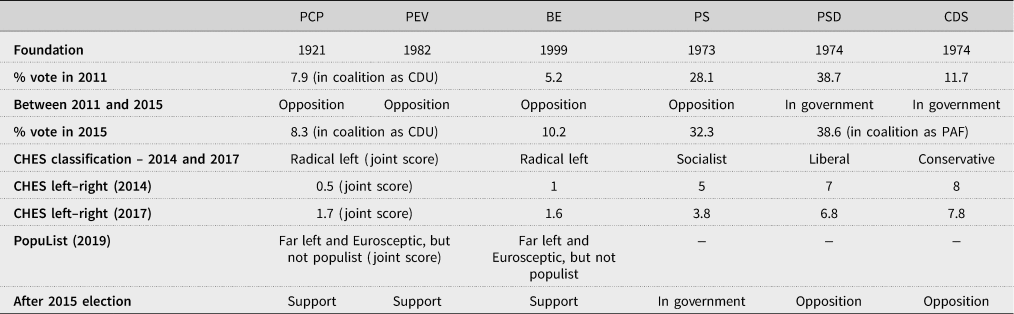
Table 1 summarizes relevant information from different sources about the six parties that were represented in parliament before the 2015 election. Focusing on the three parties that have signed agreements with the PS after the 2015 election, the Chapel Hill Expert Survey (CHES) labels the PCP/PEV coalition and the BE as ‘radical left’ parties. Also according to the CHES, the ‘left–right’ values that the three parties are given conform to this classification. Data from the 2014 CHES round suggest that the two most important issues for both the PCP/PEV coalition and the BE were ‘redistribution’ and ‘public services vs taxes’. For the BE, the third most important issues were ‘anti-elite’ and ‘corruption’ (tied), hinting that while populist themes are not completely absent from the party's imprint, they are not highly salient either. Moreover, according to the PopuList (Rooduijn et al. Reference Rooduijn, Van Kessel, Froio, Pirro, De Lange, Halikiopoulou, Lewis, Mudde and Taggart2019), while the PCP, PEV and BE can be described as far left and Eurosceptic parties, they are not considered populist parties.
Overview of the Portuguese Party System

In 2015, the RLPs together – the BE and the PCP in coalition with the Greens (CDU) – obtained 18% of the vote, with the BE doubling its 2011 result. In general terms, the election outcome represented a shift to the left: the PS, BE and CDU obtained 53% of the seats in parliament compared with 43% in 2011. Furthermore, these results revealed a trend towards smaller electoral support for governing parties: the PSD, CDS-PP and PS together gained only 71% of the votes, which is the lowest result since 1985 (Fernandes Reference Fernandes2016).
In the aftermath of the 2015 elections, two post-electoral scenarios were possible, both carrying a potential novelty: on the one hand, a centre-right coalition – which had never governed without an absolute majority in parliament; on the other hand, a PS government supported by the parties on its left. After a first unsuccessful mandate of the centre-right coalition, the Socialist leader António Costa was appointed prime minister, thus becoming the first to govern with the support of the RLPs in 40 years. In the previous weeks, the PS had negotiated and signed an agreement with each of the three RLPs. The government programme contemplated many reversal policies, such as restoring public sector wage cuts, increasing social benefits and lowering taxes for families and small and medium-size companies, in addition to stopping the privatization of public urban transport companies in Lisbon and Porto. The arrangements that originated from the 2015 election are close to the model of contract parliamentarism (Aylott and Bergman Reference Aylott and Bergman2004; Bale and Bergman Reference Bale and Bergman2006), in which the government has ‘an explicit written contract with one or more parties that remain outside the cabinet’ which ‘commits the partners beyond a specific deal or a temporary commitment’ and is ‘available to the public’ (Bale and Bergman Reference Bale and Bergman2006: 424). In the Portuguese case, the PS minority government actually created institutionalized relationships with the radical left support parties (Fernandes et al. Reference Fernandes, Magalhães and Santana-Pereira2018), and the agreements signed with them were clear, written and public, representing ‘more than a short-term or issue-focused understanding’ (De Giorgi and Santana Pereira Reference De Giorgi and Santana Pereira2016: 464).
Supporting government: a test for the Radical Left
To understand the strategic choice of RLPs to either join or support government, scholars have departed from the classical model of party behaviour based on the three goals of a party: policy, office, votes (Müller and Strøm Reference Müller and Strøm1999; Strøm Reference Strøm1990a). Coalitions are mostly based on policy and office considerations – that is, they are usually made between parties with the most similar policy preferences with as few of these parties as possible. But multiparty systems encompass such a broad range of issues that, in order to coalesce, parties either have to share a similar position on the most relevant issues or reposition themselves on some specific issues (Narud Reference Narud1996). For RLPs, the latter choice is harder and also more dangerous than for mainstream catch-all parties, as it is essential for them to distinguish their political and policy principles as clearly as possible from those of the other parties. Looking for compromise might mean partly sacrificing their identity and possibly being punished at the successive elections (Deschouwer Reference Deschouwer2008). So, what can affect the RLPs’ decision to become a coalition partner or support a government beside the strategic goals triangle that can be considered as the basis, albeit a rather theoretical one, of such a choice? Several factors might concur to influence this decision and can be systemic, institutional, historical or contingent (Bäck and Bergman Reference Bäck, Bergman and Pierre2016; Balampanidis et al. Reference Balampanidis2019; Nyblade Reference Nyblade, Müller and Narud2013; Strøm Reference Strøm1990b).
In some circumstances, as we have already said, the promise of increased legitimacy and potentially influencing policies away from a more right-wing course are seen as a worthwhile compensatory goal (Dunphy and Bale Reference Dunphy and Bale2011). In one of the most convincing research works on left parties in government, Jonathan Olsen and colleagues (Reference Nyblade, Müller and Narud2010) conclude that what matters above all is, on the one side, that social democratic parties consider the radical left, in that particular moment, as an essential ‘tactical partner’ and, on the other side, that the left parties find the mainstream social democrats as the lesser evil to either political irrelevance or a centre-right government (Olsen et al. Reference Olsen, Koß and Hough2010: 176, 177). So, a common negative goal might suffice for them to decide to cooperate with each other (at least at first). This seems to explain the Portuguese RLPs’ choice to support the mainstream PS in 2015, which at the time precisely represented the lesser of two evils.
But what happens to RLPs once the Rubicon has been crossed? They certainly have to confront a number of hard choices, given their purist ideological identity and the need to preserve it. Their major challenges are to keep respecting their political vision and policy principles and, at the same time, be able to compromise in order to have the possibility of influencing the content of legislation and implementing the policies that are particularly relevant for them. Generally speaking, the concrete achievements reached by most RLPs to date are no more than ‘modest’: nothing that could be defined as a positive evidence at election time that the RLPs had really turned dreams into realities (Dunphy and Bale Reference Dunphy and Bale2011: 493). Nonetheless, RLPs – notably in Portugal – might have learned a lesson from the experiences of their counterparts in other countries and, in particular, that ‘it may pay to negotiate a detailed and concrete government programme that can be referred to, as opposed to a vague and open-ended agreement that can be more easily manipulated by the larger parties’ (Dunphy and Bale Reference Dunphy and Bale2011: 501). The agreements reached by the Portuguese left parties, namely between the PS and each of the three RLPs, are actually quite concrete and, as noted above, the collaboration between the four parties in government seems to be an example of ‘contract parliamentarism’ – where supporting parties no longer play the loser's role.
This entails many challenges, not least that of combining idealism with policies that move beyond slogans and with the compromises participation in government necessarily involves. Can these challenges be overcome? As already noted, they can, helped by applying the knowledge gleaned from the experiences of other parties: first, government participation should be based on a clear programmatic agreement to which the party can always refer; second, certain core demands should be specified, failure to deliver on which would constitute grounds to leave the government; third, ideally some strategic cabinet portfolios should be acquired (Dunphy and Bale Reference Dunphy and Bale2011: 493). But in the case of the Portuguese RLPs, they deliberately chose not to share office with the PS.
Supporting without participating in government might mean responsibility without power (Bale and Dunphy Reference Bale and Dunphy2011), but at the same time possibly without blame. The three Portuguese parties tried to maximize the gains and limit the losses (criticisms) without committing to a proper coalition, and instead signing written agreements. They were able to insist on that as they were (electorally and numerically) in a stronger position than the parties in most of the existing cases of minority cabinets or contract parliamentarism referred to in the literature (Thesen Reference Thesen2016).
Going back to the ‘policy, office, votes’ triad, we assume that both the initial choice of RLPs in Portugal to support the government and their behaviour in parliament during the legislature have been influenced mainly by policy considerations. We consequently expect these parties, firstly, to attribute great importance to policy achievements as they will need to convince their electorate that they were right to support the socialist government; secondly, to try to show their voters they have not been compromised by keeping one foot in and one out of government.
We have four main expectations that we are going to test in the next section. The first ones have to do with the implementation of the agreements, which will allow us to examine the RLPs’ performance in their new role and the policy results they obtained. Since undoing austerity policies was the main objective of (and reason for) the alliance between the PS and the radical parties, our first hypothesis is that the policy pledges to reverse austerity measures were quickly addressed and that most of the relative legislative proposals were approved in the first year of the new government (H1 – Promptness hypothesis).
In addition to reversal policies, we also expect the agreements to contain new policy commitments. Nonetheless, given that RLPs are usually considered good policy-takers or veto players but not very successful policymakers (Bale and Dunphy Reference Bale and Dunphy2011), we expect their impact on law-making to be limited, albeit greater than in the past. We therefore expect new policy pledges to be only moderately addressed (H2 – New policy hypothesis).
Similarly, as regards general policymaking, we expect the RLPs to be only slightly more successful in their own legislative initiative in the current legislature than in the past (H3 – Policymakers hypothesis).
Finally, what strategy do the RLPs adopt in their new role as supporting parties? We expect these parties to try to exploit their new role in terms of policy gains while maintaining their distance from the government in the eyes of the media and the electorate. Hence, we expect to find a significant gap between their concrete behaviour, notably their level of consensus when voting on the government's legislation, and their symbolic behaviour in parliament. We hypothesize that, on the one hand, the RLPs will be far more cooperative in the law-making process than in the past, showing a certain sense of responsibility to their bigger partner and the public but, on the other hand, their scrutiny of the government in parliament will be the same as when in opposition (H4 – Action vs rhetoric hypothesis).
This will occur even though coalition/supporting parties usually present fewer questions than opposition parties (De Giorgi and Ilonszki Reference De Giorgi and Ilonszki2018) – because they generally have other tools for communicating with the executive and being informed about the majority's intentions. Portugal is no exception: since the start of the legislative term, a ‘coalition committee’ has met on a weekly basis to present the government's initiatives and to obtain the RLPs’ support in exchange for policy benefits (Fernandes et al. Reference Fernandes, Magalhães and Santana-Pereira2018). Nonetheless, the RLPs need to be seen by the media and the public to be keeping a distance from the government and continuing to question/scrutinize the government in parliament in the same way as when in opposition might meet this need.
Data and findings
Data
The empirical analysis relies on three main data sources. First, we developed an original data set with information about the political agreements that were signed between the PS and each of the RLPs. The three agreements were made publicly available and collected from each party's website. Content analysis was performed on each of the documents in order to extricate the policy pledges from political considerations and other types of sentences. Then, drawing from Terry Royed's (Reference Royed1996) and Catherine Moury's (Reference Moury2011a, Reference Moury2011b) approach, we classify each individual pledge according to three dimensions: concreteness (symbolic, negative commitment, undefined and real); content (reversal or new policy); and level of fulfilment (completely fulfilled, partially fulfilled and not fulfilled).Footnote 2 Two coders classified the agreements independently, reaching an initial agreement rate of approximately 93% across the three dimensions. All of the instances in which the initial coders’ classifications did not match were jointly analysed, and a consensual decision was made.
Second, we use a data set of Portuguese legislative bills approved in parliament since 2005 collected from the official website of the Portuguese parliament (Assembleia da República).Footnote 3 While we focus mostly on the period since 2015, we use earlier data in order to put the period under analysis in a longer-term perspective. This data set comprises mostly objective information collected directly from the parliament's website (initiator, type of law, parties’ voting behaviour). Subjective discretion was limited to the classification in terms of policy sector.
Third, we rely on an original data set that tracks the volume of parliamentary questions posed by various parties to the government from 2005 to 2018.Footnote 4 This source is based on objective information collected directly from the parliament's website open data platform, without any subjective coding decisions. Based on these three sources, we conduct a quantitative and qualitative assessment to address the research questions outlined above.
Analysis
The three documents and their appendices contain 174 pledges, of which 97 are unique and 77 are repetitions. The BE (55 pledges) and the PEV (75 pledges) documents are slightly longer than the PCP's (44 pledges), as they contain appendices which provide more details about some of the negotiated policy goals. Even though the agreements are formally autonomous, they contain several identical paragraphs with the same sets of goals. Nevertheless, a few objectives are only listed in the respective PEV and BE agreements.
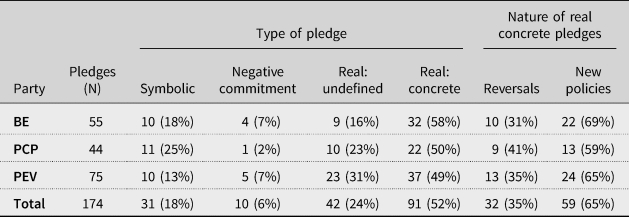
The agreements with the PS signed by the three RLPs include a significant number of concrete issues/pledges.Footnote 5 This is due, in particular, to the fact that the agreements contain many specific commitments on reverting to the pre-crisis status quo and the reversal of austerity measures. Examining the pledges contained in the agreements signed by the PS with its partners, the number of clearly defined pledges is close to 50% in the agreements signed by the PEV and the PCP, and around 58% of those signed by the BE (see Table 2). This signals that there was indeed an effort to focus on tangible policy proposals and not just on symbolic policy issues to close the deal (Fernandes et al. Reference Fernandes, Magalhães and Santana-Pereira2018). At the same time, the agreements contain many commitments that aimed to roll back policies inherited from the previous government. An analysis of the sets of concrete pledges reveals that among the three documents over one-third (35%) of these are reversals as opposed to commitments to pursue new policies. The weight of reversals in the share of concrete pledges ranges from 31% (BE) to 41% (PCP). This confirms that the main concern was to move away from the austerity-based mode of governance imprinted by the previous government – that, as we said, was also the main reason that brought the RLPs to support the mainstream PS in the first place.
Type of Pledges Contained in the Three Agreements

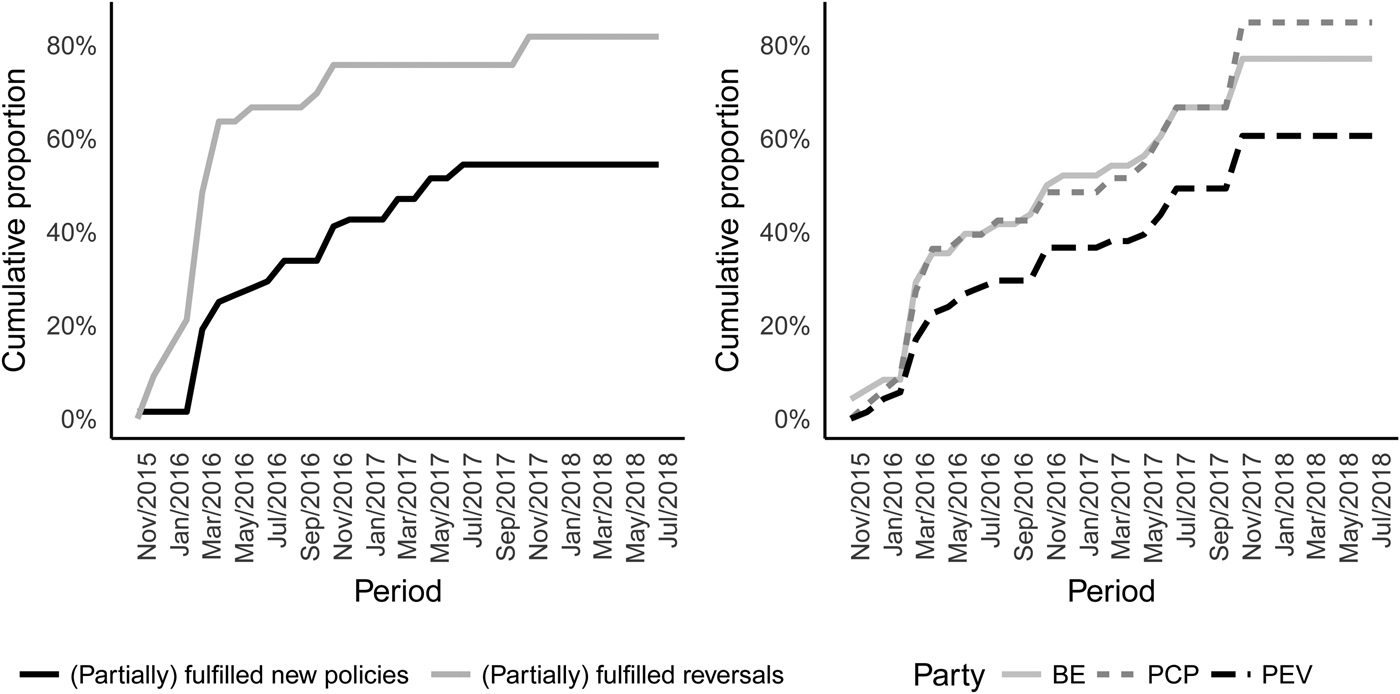
The first two hypotheses (H1 Promptness and H2 New policy) address the implementation of the agreements between the mainstream PS and the three RLPs. Figure 1 charts the evolution of the proportion of reversal and new policies implemented (either fully or partially) until July 2018. The figure highlights the initial reform impetus of the PS and its partners, particularly in the domain of reversals. By April 2016, about six months after the government took office, two-thirds of the promised reversals had already been addressed. Thereafter, the rhythm slowed down considerably, although there were significant increases following the approval of each annual budget. However, 84% of the promised reversals had been implemented by July 2018,Footnote 6 confirming our promptness hypothesis (H1). The fulfilment of pledges that imply the approval of new policies has been more gradual. Unlike reversals, whose fulfilment is concentrated around the time of the 2016 budget approval, the approval of new policies grew more or less continuously over time until the last budget negotiation and 80% of these have already been put forward. This contradicts our initial expectation in the new policy hypothesis (H2): while the initial months of the legislature were marked by the fulfilment of pledges on reversals, the rate of new policy proposals has since caught up steadily.Footnote 7
Cumulative Proportion of (Partially and Fully) Fulfilled Pledges Over Time by Type and Party (2015–18)

It should be noted that no further pledges were addressed between the approval of the 2018 national budget in November 2017 and the end of the third legislative session (July 2018). The pledges yet to be fulfilled cover many areas ranging from expanding access conditions to the national health service to improving train services. The fulfilment of some of these pledges would entail extensive reforms.
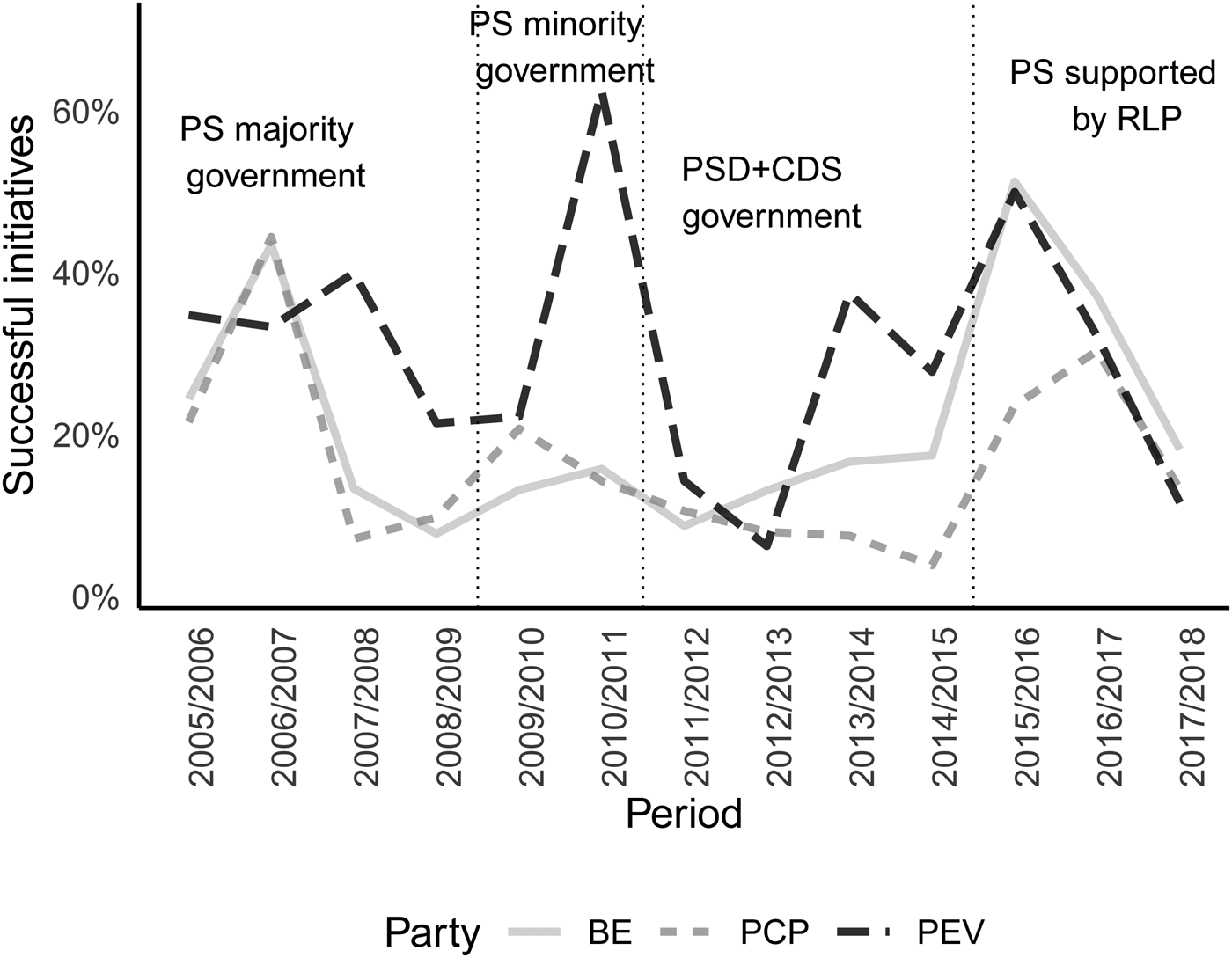
The Policymakers hypothesis (H3) relates to the RLPs’ ability to get new legislation (not related to the agreement) approved and tests whether this has increased significantly since late 2015. To this end, we perform a logistic regression using a data set of the legislative activity of the three parties. The dependent variable is the outcome of a proposed bill (success vs failure) and the independent variable is the legislative session. The results, which are plotted graphically in Figure 2, show that the likelihood of success of the bills proposed by the PCP and, especially, the BE increased during the 13th legislature. However, whereas the success rate of the PCP proposals is comparable with the previous legislatures when it was in opposition to the PS government (10th and 11th legislatures), the rate of bills initiated by the BE and eventually approved is unprecedented. A more detailed analysis shows that the BE's relatively high success rate is due to the first year of the legislature in particular and then declined to levels comparable to previous legislatures. Overall, this is in line with our hypothesis that RLPs would struggle to go beyond the previously negotiated pledges.
Success Rate of Legislative Proposals Introduced by the RLPs (2005–18)

Our fourth and last hypothesis concerns the expected gap between the RLPs’ concrete behaviour and their rhetoric in parliament (H4 Action vs rhetoric). We expected the RLPs to be more consensual than in the past in the law-making process due to their new role of supporting party, but at the same time to scrutinize the government as much as when they were in opposition.
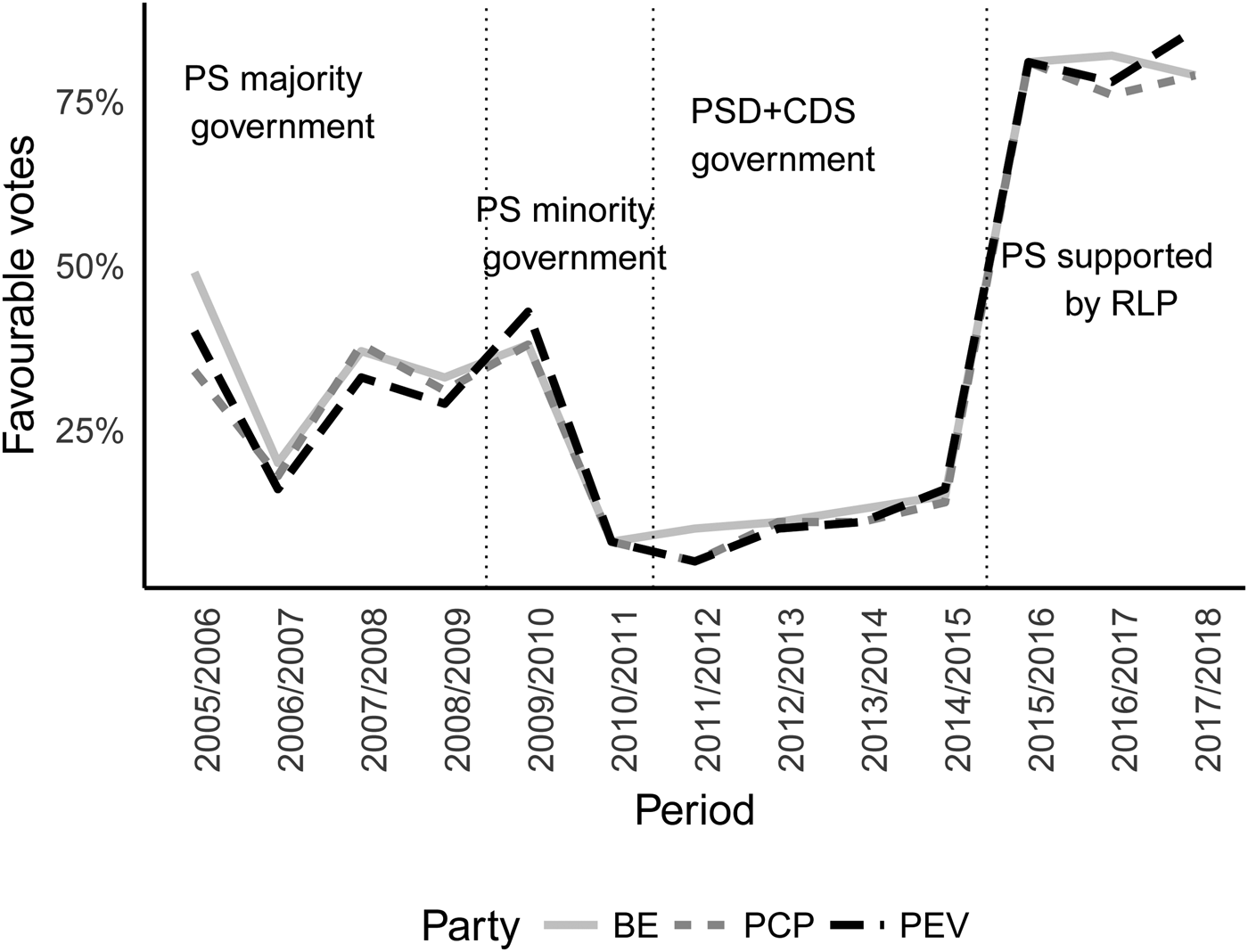
Consensus, measured as the proportion of favourable votes to government bills, increased greatly (Figure 3). In the 13th legislature, the three RLPs voted favourably on around 80% of government bills, which comes in stark contrast with previous legislative terms. In fact, this was necessary for the government to function properly as the minority PS needs at least two of its radical partners to approve legislation against the vote of the right-wing bloc in parliament.
Proportion of Favourable Votes to Government Bills (2005–18)

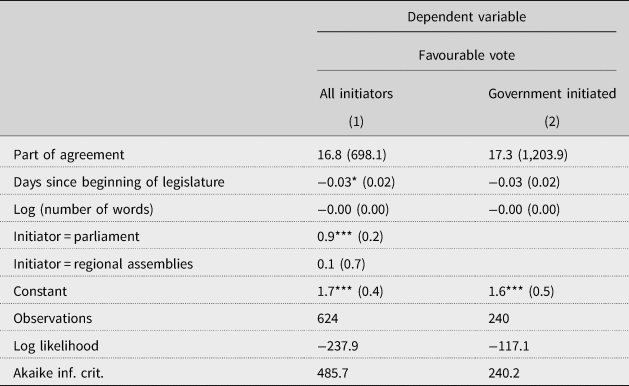
Our next step is to understand the drivers of the RLPs’ current degree of consensus vis-à-vis those in previous legislatures. Is this consensus explained solely by parliament's need to approve the pledges contained in the agreements with the parties? Or does the RLPs’ sense of responsibility towards the government lead to a spill-over effect to other laws that deal with matters outside the scope of the agreements? As a number of factors can be taken into account when analysing support for specific legislation, we conduct a regression analysis using several independent variables. First, we introduce a variable, part of agreement, to test whether formal inclusion in the agreement increases the probability of a bill being backed by the RLPs. The number of words in the draft law is then included as a measure of its complexity (which is usually negatively related to the level of consensus). The number of months since the beginning of the legislature is also included as a variable to account for the passage of time; we expect this to be negatively related to the level of consensus. We also account for the effect of the law initiator as parties might be more likely to vote against laws initiated by the government than against those that come from the parliamentary party groups. Thus, we test two separate models: the first takes into account votes for all bills and includes a variable describing the initiator; the second only includes the laws initiated by the government. The dependent variable, favourable vote, is coded as 1 if the vote is favourable and 0 otherwise.Footnote 8 Due to the binomial nature of the data, a logistic model is tested.
Table 3 displays the coefficients for two logistic regression models aimed at understanding how good the different predictors are. The coefficients have been standardized in order to enhance their interpretability. The results from the two models suggest that inclusion of a given subject in one of the party agreements does not make a favourable vote on laws more likely, as the values fail to reach statistical significance. Interestingly, the results of the first model show that bills initiated by parliament have a statistically significant higher likelihood to be favourably voted than other bills. Thus, the drastic change in RLPs’ legislative behaviour in the current legislature is due not only to the important pledges to be fulfilled, but also to a certain sense of responsibility among parties to support PS government as agreed. Although it is essential to examine the nature of these bills, the result is unequivocal: the RLPs act as true supporting parties in parliament and their level of consensus rose dramatically even vis-à-vis support given in previous majority or minority socialist governments (De Giorgi and Russo Reference De Giorgi, Russo, Giorgi E and Ilonszki2018) and this is not only explained by the agreement-related content of the bills.Footnote 9 Finally, according to the first model, which is tested against a larger number of observations, the radical parties became slightly less likely to vote favourably as time passed. It seems that the new Portuguese executive enjoyed a ‘honeymoon period’ – that is, a post-electoral period of popularity – not only with the press and the public, but also with its supporting parties (and this was also quite long-lasting).
Logistic Regression Coefficients of Favourable Votes on Legislative Bills in Parliament

Note: *p < 0.1; **p < 0.05; ***p < 0.01.
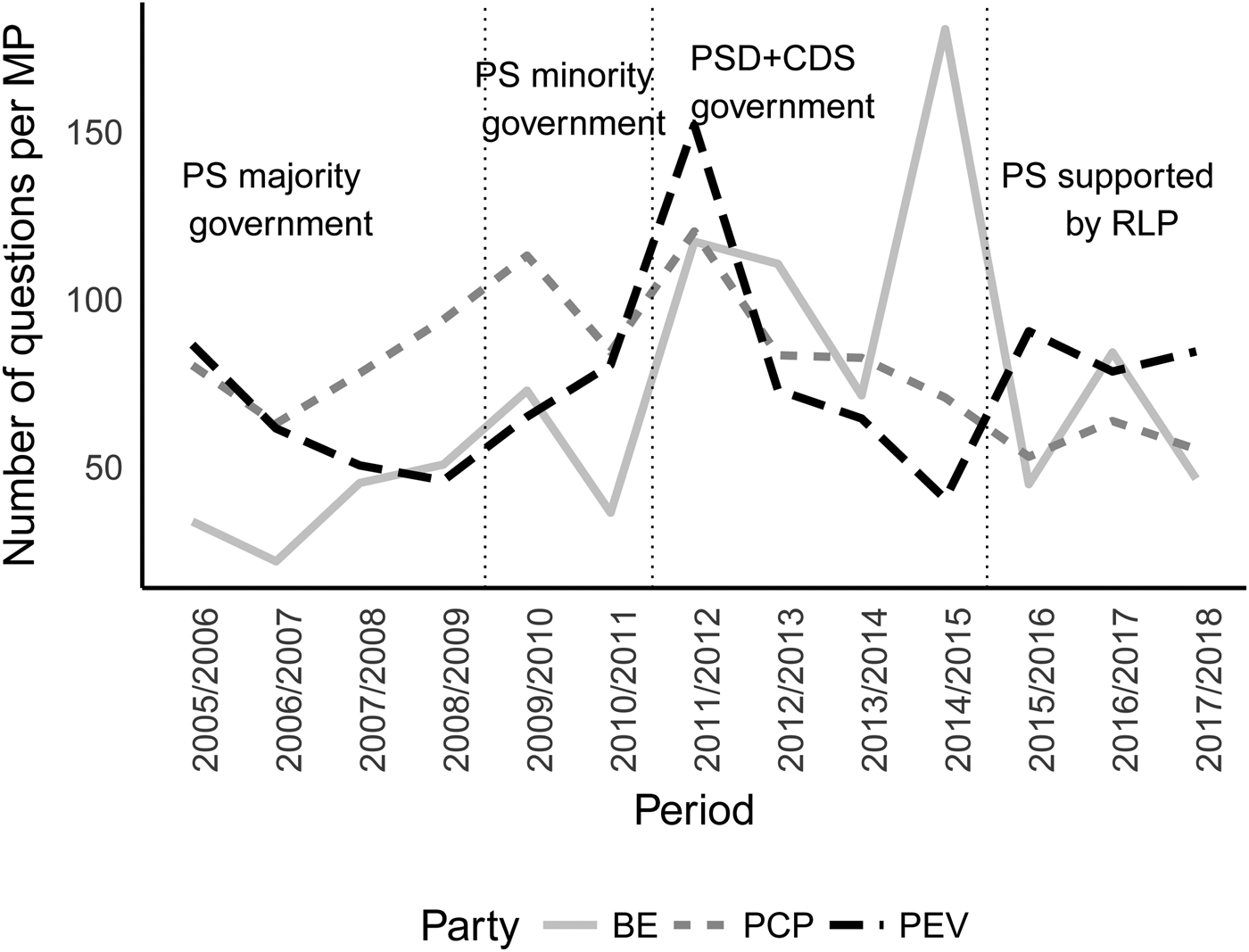
We conclude by analysing the evolution of the oversight activity. Contrary to what happened with voting behaviour, data on the parliamentary scrutiny shows that there is not a marked change in the number of questions tabled by the RLPs to the members of government (Figure 4). In the current legislature, the three parties have put forward about 50 questions per MP/year; although this is fewer than in the 12th legislature, which followed the bailout and the Memorandum of Understanding opposed by the RLPs, it is in line with some previous legislatures, notably when led by the PS. Examined in tandem, the results of these two variables may seem contradictory, but they are not. They are simply two sides of the same coin, or better, of the same strategy: while the radical parties conform and vote favourably on the PS government's proposals, they continue to press the executive with a similar number of questions to previous legislatures. In so doing, they avoid becoming mere rubber stamps in parliament and try to send a message to their voters.
Parliamentary Questions Weighted by Number of MPs per Party Parliamentary Group (2005–18)

Their willingness (and necessity) to stand apart is also confirmed by looking at their action outside the parliament. Two examples are certainly noteworthy: first, in their public statements (to the press or in party meetings) RLP leaders always refer to the government as a third person, as if they have nothing to do with it – though they have, as the marked decrease in the level of conflict shows. Second, since late 2015 the RLPs have engaged in a sort of permanent campaign, through the posting of boards on issues that are particularly relevant for them and their electorate. The PCP and BE have adopted similar but non-identical strategies on this, while the Greens have kept campaigning only on their own issues and not very frequently overall. Generally, boards have three broad objectives: advertising fulfilled pledges (and claiming ownership), presenting concrete pledges for future action and dissenting from the executive. The BE has increased its campaigning effort as compared with the past – when it was confined to opposition – and, at the same time, diversified its campaigns’ goals: from criticizing or alerting the government on very concrete issues, to advertising some remarkable fulfilled pledges (for instance, the approval of the minimum wage rise reform or the adoption of social energy tariffs). The PCP differs slightly from the BE in the content of the campaigns, but not in the amount. Specifically, the PCP issued more direct attacks on the government, displaying a more adversarial attitude.
Interestingly, between 2012 and 2014 – that is, in the years of the so-called austerity season – when the RLPs were in opposition, both the PCP and BE had used the permanent campaign strategy far less than in the current legislature. Since 2015 they have tried not to appear compromised with their (former) enemy, the PS, by employing rhetorical tools that could reach their voters’ ears more easily than the daily parliamentary activity. In other words, they try to demonstrate that they still are ‘fighting’ parties (Tarchi Reference Tarchi2003) both within and outside the parliament.
The action vs rhetoric hypothesis (H4) is thus validated. Indeed, with the exception of the new policy hypothesis (H2), all hypotheses posed at the beginning of our research were confirmed. Overall, the analysis shows that the three RLPs adopted a similar strategy after closing their deals with the government: they would approve most of the legislation proposed by the executive while keeping close scrutiny on its actions and presenting a critical stance in public when necessary though not refraining from taking credit for the perceived successes. The results have been the effective concretization of most of the policy pledges agreed upon with the government.
Conclusions
Party systems have faced the considerable disruption caused by the emergence of new players in elections and the decline of former power holders in many European democracies. If we look exclusively at the electoral arena, Portuguese politics seems to have been relatively untouched by this trend. Nevertheless, while little has changed in terms of electoral performance, the 2015 election – the first after the implementation of a deep austerity programme supervised by international actors – led to the unprecedented situation in Portugal of a minority socialist government backed by the radical left. The long-term consequences of the widening of the coalitional space have yet to be assessed, but nearly four years after they have assumed office we can say that the bulk of the (concrete) policy goals defined in the agreements between the PS and its partners have been fulfilled and that the three parties vote consensually on most of the legislation presented by the government.
As we said above, the reasons that brought the Portuguese parties to this government deal are mainly contingent and quite specific, but the outcome – a minority government supported by RLPs and based on a detailed, public, written agreement – is not. In other words, the Portuguese case gives the opportunity to test the theory of contract parliamentarism in a novel context: one Southern European country in the post-bailout period. In particular, we believe this work makes two main theoretical contributions. First, we show how the concept of contract parliamentarism can be leveraged in order to enhance our knowledge about the kind of conditions imposed by smaller parties in exchange for their support. Specifically, the case analysed here highlights the importance not only of concrete pledges for achieving desired results, but also of negotiating the timing of implementation as well as the substance of the policies.
Second, this case study also sets out a strategy for parties that agree to commit to support a government without taking ministerial office in return: the ability to pursue a discursive agenda of their own without having to be fully implicated in the less popular decisions, thus safeguarding their position in future electoral contests, is crucial. The parties under analysis clearly prioritized policy (and votes as well, no doubt) rather than office; however, their tendency to be successful policy-takers (and veto players) rather than effective policymakers remains nearly unchanged.
What have been the major gains of the Portuguese RLPs’ decision to support the socialist minority government? Our analysis shows that they have certainly achieved significant results in terms of policy, although it was easier to implement the pledges included in the government agreements (related to both reversal and new policies) than to initiate and approve brand-new legislation. Furthermore, although it is beyond the scope of this article and we should wait for the results of the 2019 general election for a proper analysis, the overall vote for the 2019 European Parliament election shows that the RLPs have been able to maintain almost untouched their electoral support in aggregate terms. While these were not national elections, it is interesting to note that the PCP (and PEV) had a worse electoral performance in 2019 than in 2014, while the opposite was true for the BE. Thus, we can conclude that, so far, the collaboration with the PS can been seen as a winning move for the RLPs, though with some potentially important differences in the electoral arena between the two main parties.
The findings of this article also open new research avenues for the Portuguese case and beyond. For Portugal, we should see how far the openness of the RLPs can be replicated in ‘ordinary’ times, that is, in circumstances other than the aftermath of a hard-hitting economic crisis – especially given the above-mentioned differences in terms of achievements between the individual RLPs. In broader terms, one of the aspects that may merit future attention has to do with the fact that, in the case under study, the party trying to reach executive power (for numerical reasons) needed the support of more than one partner. The extent to which such parallel negotiations yield different results from one-to-one conversations may be addressed in future work. Moreover, research dealing with the electoral consequences of supporting a minority government should also take into account the nature of the relationship and the extent to which the goals of the junior partners are achieved or left unaddressed. This may allow researchers to distinguish between variations of consequences of engaging in contract parliamentarism.
Acknowledgements
This research was funded by the Portuguese Foundation for Science and Technology through the Exploratory Project ‘Opposition Parties in Europe Under Pressure: Far from Power, Close to Citizens?’ (IF/00926/2015). We would like to thank the three reviewers for their valuable comments and suggestions. Previous versions of this article were presented at the Annual Conference of the Portuguese Political Science Association (Braga 2018), at the ECPR General Conference (Hamburg 2018) and at the Annual Conference of the Italian Political Science Association (Turin 2018). We thank participants in these conferences, especially Enrico Borghetto and Nicola Martocchia Diodati, for their feedback.
Supplementary information
To see the supplementary information for this article, https://doi.org/10.1017/gov.2019.25