Introduction
Cardiac surgery-associated acute kidney injury (CS-AKI) in neonates with congenital heart disease (CHD) is a heterogeneous disease process that both contributes to and is a consequence of fluid overload (FO). Reference Gist, Fuhrman, Stanski, Menon and Soranno1 CS-AKI and FO are common among neonates who undergo cardiopulmonary bypass where between 42 and 75% of neonates develop CS-AKI Reference Shi, Fan and Shu2,Reference Webb3 and between 26 and 65% of neonates develop FO. Reference Bailly, Alten and Gist4,Reference Mah, Hao and Sutherland5 Although concomitant CS-AKI and FO is predictive of the worst outcomes, Reference Gist, Selewski, Brinton, Menon, Goldstein and Basu6 both CS-AKI Reference Van den Eynde, Rotbi, Gewillig, Kutty, Allegaert and Mekahli7 and FO Reference Mah, Hao and Sutherland5 have also been independently associated with poor outcomes. Neonates who develop CS-AKI require longer intensive care unit (ICU) and hospital stays, more days of mechanical ventilation, and have a higher mortality rate when compared to neonates without CS-AKI. Reference Shi, Fan and Shu2 Neonates who develop FO after cardiac surgery have an increased risk of cardiac arrest, longer ICU stays, and an increased risk of mortality. Reference Mah, Hao and Sutherland5 Despite this increased risk of poor outcomes, diagnosis of CS-AKI and FO is often delayed, and treatment remains supportive. Reference Webb3
The diagnosis of CS-AKI has historically relied on traditional definitions of AKI based on serum creatinine (SCr) and urine output. Reference Ueno, Shiokawa and Takahashi8 There are major limitations of this definition in neonates after cardiac surgery including difficulty accurately characterising urine output, Reference Shi, Fan and Shu2,Reference Yuan9 such as in the setting of prophylactic peritoneal dialysis, a delay between the onset of renal injury and a change in SCr level Reference Askenazi, Koralkar and Hundley10 and variability in SCr levels based on sex, muscle mass, dilution from fluid accumulation, and maternal levels in the first week of life. Reference Filler, Guerrero-Kanan and Alvarez-Elías11 Thus, there is a need to identify alternative biomarkers that permit earlier and more accurate diagnosis of CS-AKI and FO.
Prior studies in adults and children after cardiac surgery have demonstrated an association between urine biomarkers and CS-AKI. Reference Webb3,Reference Baek, Lee and Jang12 However, studies in neonates have yielded mixed results Reference Shi, Fan and Shu2 partly due to incomplete characterisation of normal age- and disease-specific urine biomarker concentration ranges. Reference Sulemanji and Vakili13 One study of critically ill infants after cardiac surgery investigated the association between urine biomarkers and CS-AKI/FO phenotypes, Reference Thompson, Chamberlain and Hill14 but this relationship has not been explored exclusively in the neonatal population undergoing cardiac surgery. In this manuscript, we describe age- and disease-specific ranges of 14 urine biomarkers (cystatin C [uCysC], neutrophil gelatinase-associated lipocalin [uNGAL], kidney injury molecule-1 [uKIM1], albumin [uAlb], β-2 microglobulin [uβ2M], calbindin [uCal], clusterin [uClust], epidermal growth factor [uEGF], osteopontin [uOPN], osteoactivin [uOsteo], trefoil factor-3 [uTFF3], uromodulin [uUMOD], vascular endothelial growth factor [uVEGF], and α-glutathione S-transferase [uαGST]) at multiple perioperative time points in neonates with CHD undergoing cardiac surgery on cardiopulmonary bypass and explore their association with CS-AKI, FO, and CS-AKI/FO phenotypes.
Materials and methods
We performed a single-institution ancillary prospective cohort study of neonates with CHD enrolled in the Steroids to Reduce Systemic Inflammation after Infant Heart Surgery (STRESS) trial (NCT03229538) Reference Hill, Baldwin and Bichel15,Reference Hill, Kannankeril and Jacobs16 who underwent surgery with cardiopulmonary bypass in the first 28 days of life at Duke University Medical Center (Durham, NC, USA). As described in detail elsewhere, the STRESS trial was a multi-site, randomised, double-blind, placebo-controlled trial designed to evaluate the safety and efficacy of perioperative steroids in infants undergoing cardiac surgery on cardiopulmonary bypass. Reference Hill, Baldwin and Bichel15,Reference Hill, Kannankeril and Jacobs16 All infants approached for enrolment in the STRESS trial at Duke between June 2019 and May 2020 were given the option to opt-in to additional urine sampling. We excluded infants <37 weeks corrected gestational age at time of surgery and those who had pre-operative AKI or renal failure. Informed consent was obtained from all parents or legal guardians. The study was approved by the Duke Institutional Review Board.
We prospectively collected the following demographic and clinical data from the electronic health record (EHR): postnatal age at surgery; weight at surgery (anchor weight); sex; race; ethnicity; cardiac diagnosis; surgery performed, including the Society of Thoracic Surgeons – European Association for Cardio-Thoracic Surgery Congenital Heart Surgery Mortality (STAT) category, Reference Jacobs, Jacobs and Thibault17 cardiopulmonary bypass time, cross-clamp time, and use of sustained all-region (STAR) perfusion; Reference Prabhu, Nellis and Meza18 lowest intraoperative temperature; need for extracorporeal membrane oxygenation (ECMO) or repeat surgery; receipt of diuretic in the first 24 hours after surgery; lab values (e.g., creatinine and lactate) during the first 7 days after surgery; and total intake, output, and overall fluid balance over the first 72 hours after surgery.
Our primary outcome was the development of CS-AKI. We defined CS-AKI based on the modified neonatal Kidney Disease Improving Global Outcomes (KDIGO) criteria. Reference Ueno, Seki and Shiokawa19 Baseline creatinine was considered the last creatinine obtained prior to undergoing cardiopulmonary bypass. Maximum creatinine in the first 48 post-operative hours was used to determine CS-AKI. Reference Ueno, Seki and Shiokawa19
Our secondary outcome was the development of FO. FO was defined as at least 10% positive cumulative fluid balance at 48 hours since this degree of cumulative FO during this time frame has been associated with increased post-operative morbidity. Reference Lex, Tóth and Czobor20 Fluid balance was calculated using the cumulative fluid input and output methodology. Percent fluid balance was calculated by equation 1: Reference Goldstein, Akcan-Arikan and Alobaidi21
 $$\eqalign{ & {\rm{Percent\ fluid\ balance}} = ({\rm{Total\ Intake}}\ \left[ {{\rm{mL}}} \right] \cr & - {\rm{Total\ Output}}\ \left[ {{\rm{mL}}} \right])/\left( {{\rm{Anchor\ Weight}}\ \left[ {{\rm{kg}}} \right]} \right)*100 \cr} $$
where anchor weight was the dosing weight at time of surgery. Cumulative fluid balance defined continuously and the presence of FO defined categorically were evaluated at 24, 48, and 72 hours after surgery.
In an exploratory analysis, we investigated the association between urine biomarker concentrations and CS-AKI phenotype, defined as a combination of CS-AKI and FO (e.g., AKI-/FO-, AKI+/FO-, AKI-/FO+, and AKI+/FO+). Reference Krawczeski, Woo, Wang, Bennett, Ma and Devarajan22
Urine biomarker collection
Spot urine samples were collected directly from the metered collection column of the foley catheter at three perioperative time points: (1) pre-operative or before bypass; (2) in the early post-operative period, defined as 0 to <8 hours after separation from bypass; and (3) in the late post-operative period, defined as 8 to 24 hours after separation from bypass. Urine samples were centrifuged at room temperature at 2000 × g for 10 minutes, and the supernatants were stored in cryovials at −80°C. No additives or protease inhibitors were added. Urine samples were shipped to the Institute of Drug Safety Sciences at the University of North Carolina Eshelman School of Pharmacy where they were run through the Meso Scale Discovery Human Kidney Injury Multiplexed ELISA panels (Supplementary Item 1). Reference Gaies, Gurney and Yen23 Control samples with high, medium, and low levels of each analyte were measured using a minimum of 2 replicates on 11 runs over 5 days. All samples were run in duplicate.
Definitions
Vasoactive-inotropic score (VIS) was calculated based on inotrope and vasoactive dose, where moderate support equates to a VIS of 15. Reference Gaies, Gurney and Yen23 The definition of low cardiac output syndrome was derived from the Prophylactic Intravenous Use of Milrinone After Cardiac Operation in Pediatrics (PRIMACORP) study and was limited to the lab criteria of >30% difference in arterial and mixed venous saturation or a metabolic acidosis with lactate >5 in the first 24 hours after surgery or an increase in lactate of >2 on 2 successive blood gases within 4 hours apart. Reference Hoffman, Wernovsky and Atz24
Statistical analysis
The distribution of continuous variables was described using medians (25th–75th percentiles), and the distribution of binary or categorical variables was described with counts (percentages). Summary statistics were used to describe the neonates in the cohort. Neonates were categorised by CS-AKI stage (0–3) and as a binary variable (any versus no CS-AKI). Due to the lack of available data on the predictive ability of urine biomarkers in this population and the nature of this pilot study, no formal sample size calculations were performed. Changes in urine biomarkers over time and associations with CS-AKI and FO were graphically explored. All analyses were conducted in STATA SE (version 16.1, Stata Corps, College Station, TX), and graphs were created using the “ggplot2” package in R (version 3.2.0) and RStudio (version 2023.3.1).
Results
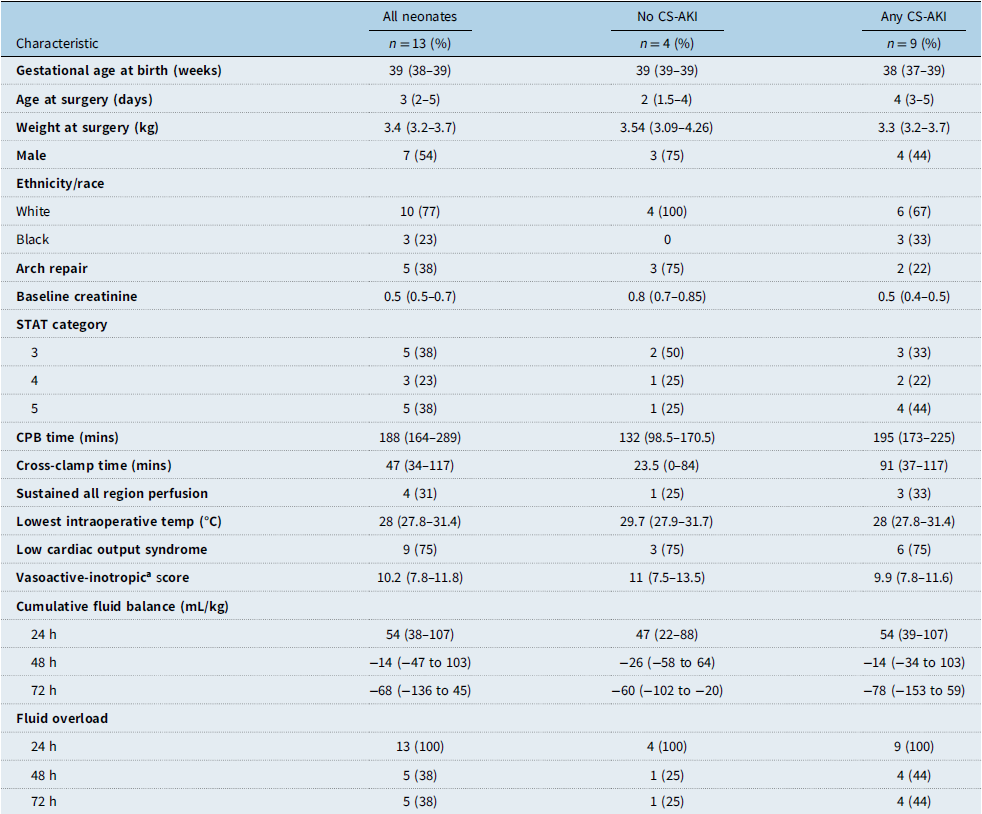
In total, 13 neonates met inclusion criteria. Neonate demographics are shown in Table 1. A total of 23 urine samples were collected: 6 in the pre-operative period; 11 in the early post-operative period; and 6 in the late post-operative period. Gestational age at birth was a median (25th–75th percentile) of 39 weeks (38–39 weeks). At surgery, postnatal age was 3 days (2–5 days), and weight was 3.4 kg (3.2–3.7 kg). Seven neonates (54%) were male. No infants received prophylactic peritoneal dialysis or other kidney-supportive therapies, and no infants died. Nine (69%) neonates were diagnosed with CS-AKI. All 13 (100%) neonates were fluid overloaded at 24 hours, with 5 (38%) neonates remaining fluid overloaded at 48 hours. Unadjusted urine biomarkers in all neonates at the three perioperative time points are shown in Supplementary Table 1, and trends are graphically shown in Figure 1. Overall, uαGST, uβ2m, uAlb, uCysC, uNGAL, uOPN, uUMOD, uClust, and uVEGF concentrations peaked in the early post-operative period before returning to pre-operative baseline or lower. uKIM1 increased across all three time points, whereas uTFF3 decreased over the study period. The remaining biomarkers, uCal, uClust, uEGF, and uOsteo did not have clear trends in relation to bypass.
Urine biomarkers over time in relation to bypass. Red vertical lines denote sampling time periods (pre-operative, early post-operative, and late post-operative). Y-axis is depicted as log scale. Dashed horizontal lines represent the median value of the biomarker during the sampling time period. αGST = α-glutathione S-transferase; Alb = albumin; β2M = β-2 microglobulin; Cal = calbindin; Clust = clusterin; CysC = cystatin C; EGF = epidermal growth factor; KIM1 = kidney injury molecule-1; NGAL = neutrophil gelatinase-associated lipocalin; Osteo = osteoactivin; OPN = osteopontin; TFF3 = trefoil factor-3; UMOD = uromodulin; VEGF = vascular endothelial growth factor.

Neonate demographics and clinical characteristics

Data are presented as counts (percentages) or medians (25th–75th percentiles). CS-AKI = cardiac surgery-associated acute kidney injury; STAT = Society of Thoracic Surgeons; CPB = cardiopulmonary bypass.
a Maximum value calculated in the first 24 hours after bypass.
Of the nine neonates who were diagnosed with CS-AKI, all (100%) had stage 1 CS-AKI. Unadjusted urine biomarkers by CS-AKI at the three perioperative time points are reported in Table 2. Early post-operative uCysC, uβ2m, uUMOD, and uVEGF were higher in neonates who developed CS-AKI, although the ranges were wide.
Unadjusted biomarkers by CS-AKI and FO at 48 hours at perioperative time points (presented as medians [25th–75th percentile])

αGST = α-glutathione S-transferase; Alb = albumin; β2M = β-2 microglobulin; Cal = calbindin; Clust = clusterin; CysC = cystatin C; EGF = epidermal growth factor; KIM1 = kidney injury molecule-1; NGAL = neutrophil gelatinase-associated lipocalin; Osteo = osteoactivin; OPN = osteopontin; TFF3 = trefoil factor-3; UMOD = uromodulin; VEGF = vascular endothelial growth factor.
Of the patients with CS-AKI, four (44%) developed FO at 48 hours, and of those with no AKI, one (25%) developed FO at 48 hours. Table 2 shows unadjusted urine biomarkers by FO status at the three perioperative time points. Similar to results seen with CS-AKI, uCysC, uβ2m, and uVEGF were higher in neonates who developed FO at 48 hours in the early post-operative period. Additionally, uNGAL and uαGST were higher in the early post-operative period and uKIM1, uClust, and uTFF3 were higher in the early and last post-operative periods in neonates who developed FO at 48 hours.
In an exploratory analysis of CS-AKI phenotypes, three infants (23%) were CS-AKI−/FO−, five infants (38%) were CS-AKI+/ FO−, one infant (8%) was CS-AKI−/ FO+, and four infants (31%) were CS-AKI+/ FO+. Supplementary Table 2 reports unadjusted biomarkers by CS-AKI phenotype at different perioperative time points. For neonates with the CS-AKI+/ FO+ phenotype, median uCysC and uαGST peaked notably higher in the early post-operative period compared to other phenotypes.
Discussion
In this study, we characterised 14 urine biomarkers at 3 perioperative time points and examined their association with CS-AKI and FO in neonates after cardiac surgery. The aim of this study was to (1) understand the normal time course of these biomarkers in the perioperative period and (2) identify which biomarkers may be most beneficial for further study to evaluate the utility in the early diagnosis of CS-AKI and/or FO. Overall, we found that uαGST, uβ2m, uAlb, uCysC, uNGAL, uOPN, uUMOD, uClust, and uVEGF peaked in the early post-operative period, uKIM1 increased over time, and uTFF3 decreased over time. The remaining biomarkers uCal, uClust, uEGF, and uOsteo did not have clear trends in relation to bypass.
CS-AKI was common in our population, although all CS-AKI was stage 1. The rate of CS-AKI in our cohort is consistent with prior literature, although our cohort may tend towards more mild disease. Reference Shi, Fan and Shu2 This is likely multifactorial and may be reflective of earlier age at surgery which may be before maternal SCr is cleared, and the use of STAR perfusion in 31% of neonates. CS-AKI is associated with increased morbidity and mortality in children. Reference Van den Eynde, Rotbi, Gewillig, Kutty, Allegaert and Mekahli7 In addition to pathophysiologic blood flow secondary to CHD in the pre-operative setting, cardiopulmonary bypass significantly contributes to CS-AKI. Specifically, bypass disrupts the relationship between renal oxygen supply and demand and decreases renal oxygenation after surgery through renal vasoconstriction and hemodilution. Reference Lannemyr, Bragadottir, Krumbholz, Redfors, Sellgren and Ricksten25 Impaired renal perfusion leads to a decrease in glomerular filtration rate via renal inflammation and vasoconstriction and cumulates in further damage to ischaemic tubules. Reference Olivero, Olivero, Nguyen and Kagan26 However, the use of SCr levels to define AKI has several limitations, especially in neonates: there is a delay in SCr rise after kidney injury, values vary based on patient characteristics such as sex and muscle mass, and SCr is reflective of maternal renal function in the first days of life. Reference Askenazi, Koralkar and Hundley10,Reference Filler, Guerrero-Kanan and Alvarez-Elías11 The latter limitation was highlighted in our results. Baseline creatinine was higher in neonates without CS-AKI group, suggesting that maternal creatinine levels could be a confounding variable when the diagnosis of CS-AKI relies on a change from baseline.
Because urine biomarkers reflect different mechanisms of renal function, they may serve to elucidate different mechanisms of renal injury and guide potential treatment. Reference Shi, Fan and Shu2 For example, NGAL and CysC are synthesised in the proximal tubules, increase before SCr in renal injury, and may reflect injury to proximal renal tubular cells. Reference Yuan9,Reference Goldstein, Ronco, Bellomo, Kellum and Ricci27 Alb, β2M, and αGST may be specific for proximal renal tubular injury, whereas OPN is secreted in the loop of Henle and the distal tubule, and Cal is found in the distal tubule and collecting duct and may be elevated with damage to these areas of the kidney. Reference Yao, Giel and Hong28 While KIM-1 is hardly detected in healthy kidneys, in the setting of ischaemia or nephrotoxic drugs, levels increase in the proximal tubule. Reference Yuan9 CysC may more accurately reflect glomerular filtration rates because it is not affected by age or muscle mass, like creatinine, but is freely filtered by the glomerulus. Reference Nakhjavan-Shahraki, Yousefifard and Ataei29 CysC, Cal, and Alb may also reflect abnormalities in renal protein reabsorption through their expression in the distal tubule. Reference Yao, Giel and Hong28 However, when population-specific “normal” values are unknown, the utility of these biomarkers is diminished.
There is currently a lack of consensus on the efficacy of urine biomarkers in predicting CS-AKI, with particularly sparse data for neonates. The most reported urine biomarker is uNGAL. Reference Van den Eynde, Schuermans and Verbakel30 A meta-analysis of 37 studies and 10 different biomarkers found that uNGAL had the greatest diagnostic test accuracy in predicting CS-AKI in children and may be a better predictor of CS-AKI in children than in adults. Reference Van den Eynde, Schuermans and Verbakel30 Other studies have reported weaker associations between uNGAL, and CS-AKI and trends may not appear until 48 hours after surgery, which may provide no advantage over current SCr-based diagnosis strategies. Reference Baek, Lee and Jang12 Interestingly, in our study, uNGAL was more closely associated with FO than CS-AKI. There are fewer data available for other urine biomarkers. There is some evidence that uKIM-1/creatinine level may help with the detection of early CS-AKI at specific perioperative time points, Reference Baek, Lee and Jang12 although most investigation has been done in adult populations and the predictive value of uKIM-1 may be less than that of uNGAL. Reference Van den Eynde, Schuermans and Verbakel30 While a meta-analysis found uCysC to be predictive of AKI in the general paediatric population, Reference Nakhjavan-Shahraki, Yousefifard and Ataei29 analysis of uCysC levels following paediatric cardiac surgery was less predictive. Reference Van den Eynde, Schuermans and Verbakel30 Further study into how specific biomarkers reflective of common mechanisms of CS-AKI may be able to predict CS-AKI earlier than current strategies.
The ability of urine biomarkers to predict FO is a novel area of study with the potential to guide clinical management. Reference Thompson, Chamberlain and Hill14 FO in neonates undergoing cardiac surgery is common and is associated with poor outcomes independent of CS-AKI. Reference Mah, Hao and Sutherland5 Similar to reported literature rates, FO at 48 hours was common in our cohort. Reference Bailly, Alten and Gist4,Reference Mah, Hao and Sutherland5 Multiple urine biomarkers were higher in the early post-operative period in neonates who developed FO at 48 hours, including uCysC, uβ2m, uVEGF, uNGAL, uKIM1, uClust, uTFF3, and uαGST. Further study into how these biomarkers may predict FO is warranted. The ability to detect which neonates will develop FO will allow for proactive fluid management and may improve outcomes. Evaluating neonates based on CS-AKI phenotypes may further risk stratify the highest-risk patients. Reference Gist, Fuhrman, Stanski, Menon and Soranno1 A recent study investigating CS-AKI in infants found that early post-operative uNGAL and uCysC levels significantly differed based on CS-AKI phenotype with the highest levels seen in the CS-AKI+/FO+ group. Reference Thompson, Chamberlain and Hill14 This is consistent with an analysis of the independent effects of FO and AKI on critically ill children, where FO and AKI together predicted the worst outcomes among phenotypes. Reference Gist, Selewski, Brinton, Menon, Goldstein and Basu6 Studies focused on urine biomarkers and CS-AKI phenotypes may best describe risk factors for poor outcomes but should be population-specific, especially in neonates where renal maturation will affect normal diagnostic measures. Reference Sulemanji and Vakili13
While our study was the first to describe ranges of 14 urine biomarkers in this population and explore their relationship with CS-AKI and FO, it has several important limitations. First, biomarker concentrations were not adjusted for urine output or urine creatinine concentrations. There is no consensus in the literature regarding whether absolute concentrations, concentrations normalised to urine creatinine to account for glomerular filtration rate, or concentrations normalised to urine output to evaluate the excretion rate are most useful in the interpretation of urine biomarker concentrations and their association with CS-AKI. Reference Lannemyr, Bragadottir, Krumbholz, Redfors, Sellgren and Ricksten25 Therefore, we used absolute biomarker concentrations as these are likely to be used in clinical practice. Second, all CS-AKI was stage 1 which limits our ability to comment on the association of these biomarkers with more severe AKI. Third, there is variability in defining the degree of FO and timing of FO that is clinically relevant. Our definitions were based on literature that associates 10% FO with poor outcomes in post-cardiac surgery populations. Reference Lex, Tóth and Czobor20 Fourth, we calculated fluid balance by intake and output which does not account for insensible losses but is a recommended calculation by the Pediatric Acute Disease Quality Initiative (ADQI) group. Reference Goldstein, Akcan-Arikan and Alobaidi21 Finally, as with most paediatric studies, our sample size was small and from a single centre. Additionally, our analysis is based on a variable number of samples from each time period, with only four neonates contributing three complete samples over the sampling period.
Our data can be used to inform future studies that interpret urine biomarker concentrations based on age and disease process in the context of CS-AKI and FO, as well as define clinically relevant end points. Establishing population-specific normal urine biomarker values and how deviations from these are associated with CS-AKI and FO in large cohorts may support more widespread implementation to improve outcomes after neonatal cardiac surgery.
Conclusion
In conclusion, in this single-centre prospective cohort study in neonates undergoing cardiac surgery, urine biomarkers varied based on CS-AKI and FO status, and by CS-AKI phenotype. Overall, uαGST, uβ2m, uAlb, uCysC, uNGAL, uOPN, uUMOD, uClust, and uVEGF peaked in the early post-operative period, uKIM1 increased over time, and uTFF3 decreased over time. uβ2M and uαGST were higher in the early post-operative period in neonates who developed CS-AKI. uClust, uCysC, uNGAL, uOPN, and uαGST were higher in the early post-operative period in neonates who developed FO. Future studies should evaluate larger cohorts to establish age- and disease-specific concentration ranges and possible associations between (1) uβ2M, uαGST and CS-AKI and (2) uClust, uCysC, uNGAL, uOPN, uαGST, and FO in a larger cohort of neonates undergoing cardiac surgery.
Supplementary material
The supplementary material for this article can be found at https://doi.org/10.1017/S1047951125000034.
Acknowledgements
Dr Thompson was supported by the Eunice Kennedy Shriver National Institute of Child Health & Human Development of the National Institutes of Health Award Number T32HD104576.
Financial support
This work was supported in part by the Duke University – Vanderbilt University Medical Center Trial Innovation Center (U24TR001608), part of the National Center for Advancing Translational Sciences Trial Innovation Network.
Competing interests
None.
Ethical standards
The authors assert that all procedures contributing to this work comply with the ethical standards of the relevant national guidelines on human experimentation and with the Helsinki Declaration of 1975, as revised in 2008, and have been approved by the Duke Institutional Review Board.