





Introduction
Delirium is defined by the Diagnostic and Statistical Manual of Mental Disorders, 5th Edition DSM-5 criteria, and guidelines recommend routine screening with a validated tool as its incidence is associated with worse pediatric cardiac ICU outcomes. 1–9 Delirium is a direct neurologic consequence of systemic physiologic perturbations including altered oxygen delivery to the brain, anaesthesia, and cardiopulmonary bypass, which are common in pediatric heart disease patients. 1,Reference Staveski, Pickler and Khoury5,Reference Patel, Biagas and Clarke6,Reference Alvarez, Palmer and Czaja10 Delirium symptoms must represent an acute change from baseline. 9 However, without the involvement of a primary caregiver, this can be difficult to detect given the spectrum of ages and developmental stages as well as alternative sensorium changes in patients being cared for in a pediatric heart centrer. Reference Leroy and Schieveld11–Reference Schieveld, Leroy, van Os, Nicolai, Vos and Leentjens13 Delirium is a disturbance in attention, awareness, and cognition and based on several studies in the adult ICU, observation of these symptoms can be particularly distressing to primary caregivers. Reference Lange, Medrzycka-Da Browska, Friganovic, Religa and Krupa14,Reference Lee, Yeom, Yoo and Hong15 Parents of children with heart disease face substantial psychological and emotional challenges in their role as caregivers and report significant prevalence of symptoms (e.g. distress, anxiety, depression, and post-traumatic stress). Reference Biber, Andonian and Beckmann16–Reference McWhorter, Christofferson and Neely20 Yet, Staveski and colleagues found that parental presence at the bedside was associated with a clinically important and statistically significant reduction in positive screening for delirium. Reference Staveski, Pickler and Khoury5
Collectively, the aformentioned literature indicates that delirium is an inherently prevalent and particularly challenging aspect of pediatric heart disease that benefits from engagement of a vulnerable parent population. This underscores the urgent need for comprehensive understanding of the parental experience and the role for education and supportive interventions designed to enhance psychological resilience among caregivers. Our study sought to identify and describe the specific impact of witnessing delirium as a parent or caregiver. Our secondary objective was to describe their experience of delirium education and additional support. We hypothesise that parents will report increased distress, fear of further episodes, and on-going daily impact when coupled with lower parental education and support and fewer helpful interventions for their child. We hypothesise these impacts will abate with time since the most recent episode.
Methods
The study procedures were in accordance with the ethical standards of the survey host institution (Nationwide Children’s Hospital) Institutional Review Board on human experimentation and in-line with the Helsinki Declaration of 1975. All subjects provided electronic informed consent. The study titled “Impact of a Child’s Delirium in Parental Experience in Children with Cardiac Disease” was approved on 6 June 2023, as STUDY00003365.
Study population
We sought to gather contemporary responses from parents across the United States of America and Canada who witnessed symptoms of delirium in their child with heart disease. Respondents were recruited via postings on parent social media groups including Mended Little Hearts, Canadian Congenital Heart Alliance, Sisters of Heart, and Conquering CHD. Additional recruitment was through notifications on centre-specific or disease-specific parent e-mail list-serves, announcements at local and regional conferences where parents of a child with heart disease were in attendance, and through flyers with a QR code posted in a variety of pediatric cardiac clinical spaces throughout North America. The survey link was open from August 2023 through March 2024. Respondents were eligible if they were the parent/caregiver of a child with heart disease who experienced symptoms of delirium, and they witnessed the delirium episode(s). Delirium was identified based solely on parental recollection of delirium diagnosis or delirium symptoms from a list provided in the survey introduction (Supplement 1). There was no linkage to medical records.
Survey design
This descriptive study was conducted utilizing a secure and privacy compliant electronic survey platform. Study investigators initially met via Zoom with five parents from Canada, and various regions of the United States who had a child with heart disease who had experienced delirium. Through collaboration and serial feedback, a four-part comprehensive survey was developed to gain a better understanding of the impact of pediatric delirium on parents (Supplement 1). Survey questions explored (1) demographic information, (2) the education parents/caregivers received on delirium, and (3) the impact the experience of delirium had on the parent/caregiver, including support they received. If a parent/caregiver responded that the delirium experience still impacted their daily life, they were prompted to complete the Impact of Event Scale-6, a validated screen for post-traumatic stress disorder. Reference Hosey, Leoutsakos and Li21–Reference Thoresen, Tambs, Hussain, Heir, Johansen and Bisson23 In part four, parents/caregivers were then given an opportunity to answer 17 questions describing up to five episodes of delirium they observed their child experience. Utilizing a certified medical translator, the survey was made available in English and in Spanish. REDCap survey implementation was supported by the Nationwide Children’s Heart Center Research Core research coordinators. No patient or parent identifiers were captured, and we utilised a secure, Health Insurance Portability and Accountability Act compliant, REDCap database for data collection. Reference Harris, Taylor and Minor24,Reference Harris, Taylor, Thielke, Payne, Gonzalez and Conde25
Data analysis
Survey responses were retained for analysis if the majority (≥50%) of demographic-level questions were completed. From these, episodes of delirium were retained for analysis if at least one episode-level question was completed. Demographic, episode, education, support, and impact characteristics were summarised as count (percent). Missing survey responses for characteristics of interest were excluded from both the numerator and denominator of calculated percentages. A cut-point of 1.75 of 6 potential points on the Impact of Event Scale-6 scale was used to indicate a positive post-traumatic stress disorder screen. Reference Ambler, Rhoads and Peterson22 Correlations between characteristics of a child’s delirium course and its impact on the caregiver were examined using Spearman’s rank correlation coefficient. This metric of correlation was chosen given its support for ordinal-type features such as those collected. In the case of binary Yes/No features, Yes was interpreted as a higher rank than No. Surveys missing the features of interest were excluded from calculation of the respective correlation coefficient. Statistical analysis was performed using R version 4.2.2.
Results
Demographics
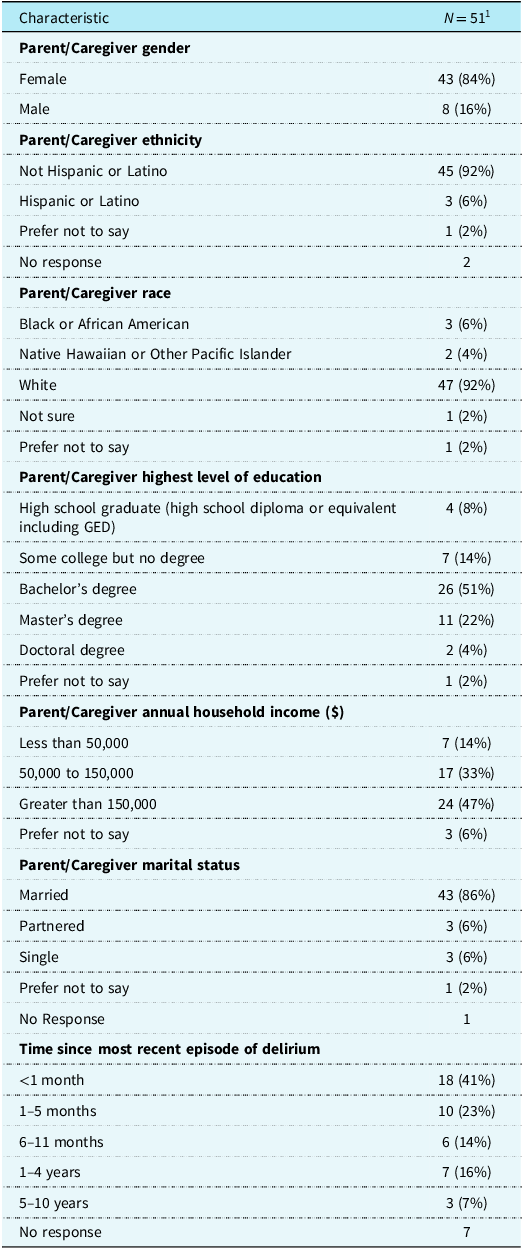
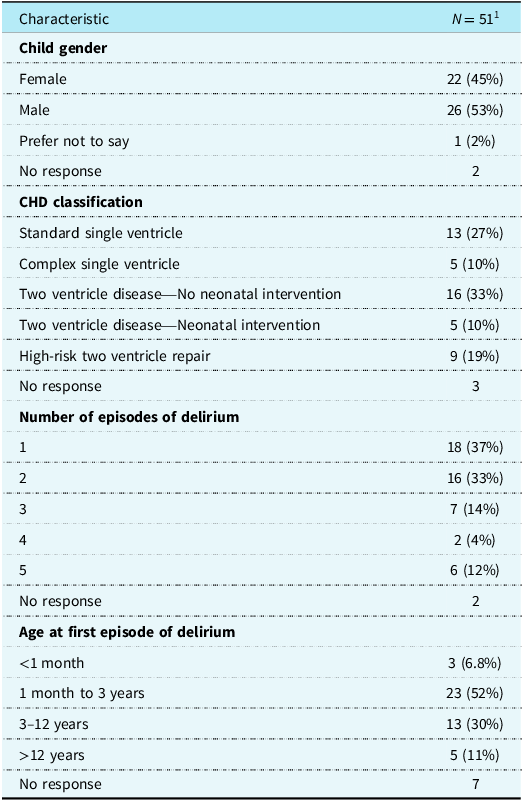
Fifty-one parents/caregivers responses to the survey were retained for analysis. Most parent/caregiver respondents were white (47, 92%), married (430, 86%), female (43, 84%), and had a bachelor’s degree or higher (39, 76%); nearly half (24, 47%) had a household income greater than $150,000 (Table 1). The children in the study had a wide variety of heart disease; 53% (25) were male, 76% (39) were less than 12 years old, and half (26, 51%) were less than 3 years old (Table 2). Approximatly one-third (18, 37%) of the children experienced only one episode, with a similar proportion experiencing two episodes (16, 33%) or 3 or greater episodes (15, 29%). The child’s first episode of delirium was described by 44 respondents, with 11% (5) occuring in Canada and 89% (39) occurring in the United States of America, with representation from all major geographic regions (Supplement 2).
Parent/Caregiver demographics

Table 1. Long description
The table presents the demographics of 51 parents/caregivers who responded to a survey. It includes characteristics such as gender, ethnicity, race, highest level of education, annual household income, marital status, and time since the most recent episode of delirium.
1 n (%).
Note: parent/caregiver demographics for the 51 included survey respondents.
Child demographics and delirium course

Table 2. Long description
The table presents the demographics of 51 children including child gender, CHD classification, and Number of episodes of delirium.
1 n (%).
Note: child demographics as well as attributes of delirium course.
Impact of witnessing delirium
The majority (40, 78%) of parent/caregiver respondents described witnessing their child experience delirium as “very distressing” or “extremely distressing” and 17 (33%) were “very fearful” or “extremely fearful” of further episodes of delirium. Of the 13 (26%) parents/caregivers who indicated their experience with delirium still impacts their daily life, seven screened positive by Impact of Event Scale 6 criteria for probable PTSD19 (Figure 1). Even without correction for multiple comparisons, none of the tested characteristics were significantly associated with the impact of the experience (level of distress, fear of further episodes, or impact on daily life) on the parent/caregiver. These include age at first episode of delirium, education received, support received, medications given, environmental changes made, number of episodes, nor time since most recent episode (Supplement 3).
Caregiver impact of delirium. Panels A, B, and C describe the caregiver impact of experiencing their child’s delirium. N = 51.

Parental support
Only 19 (37%) parents/caregivers reported receiving support related to their child’s delirium. Of those 19 who received support, the majority received it from the bedside nurse (17, 89%) or an ICU provider (8, 42%). One-fourth of parents/caregivers found the support to be “very helpful” or “extremely helpful” (Figure 2). The majority (46, 90%) of parents/caregivers expressed a desire for additional support. Most (31, 61%) wanted education surrounding delirium with nearly half (25, 49%) wanting information about “what I could do for my child,” and one-third (16, 31%) indicating they would have liked support from a psychologist or social worker directly for them as a parent. One-fourth of respondents (12, 24%) also expressed interest in having access to a parent support group.
Caregiver support received. Panel A describes the support received by the caregivers, and panel B demonstrates who provided support.

Discussion
Our survey identified important findings from parents/caregivers of children with heart disease who witnessed their child experience delirium. Most survey respondents described witnessing their child’s delirium as very or extremely disturbing with one-third feeling very or extremely fearful of further delirium episodes and 14% screening positive for post-traumatic stree disorder by the Impact of Event Scale-6 scale. In contrast to our hypothesis, no meaningful associations were detected in this exploratory sample to identify that distress, fear of further episodes, or on-going daily impact were associated with parental education and support or helpful interventions for the child, nor did it change with time elapsed. Only 37% of parents perceived they received support surrounding their child’s delirium, and if they did receive support, an overwhelming majority of that support came from bedside nurses. Finally, most parents wanted further information and education on delirium.
In this study, parents reported significant distress, fear, and symptoms consistent with post-traumatic stress disorder after witnessing their children experience delirium, which aligns with the findings in the general Pediatric ICU (PICU) literature. Abnormal behavior and emotional response of children have been identified as risk factors for parental stress during PICU hospitalisation. Reference Alzawad, Marcus Lewis, Ngo and Thomas26 Furthermore, fear and uncertainty in the PICU can be a predictor of post-traumatic stress disorder in parents. Reference Alzawad, Lewis, Kantrowitz-Gordon and Howells27 Some parents with distressing PICU memories were more likely to suffer from post-traumatic stress after discharge. Reference Abela, Wardell, Rozmus and LoBiondo-Wood28 Parental post-traumatic stress disorder rate of 14% (7 of 51 respondents) in our study is similar to the reported 18% in parents of children with cardiac disease Reference McWhorter, Christofferson and Neely20 and the 23% rate reported in a systematic review of parents of children following pediatric surgery. Reference Turgoose, Kerr and De Coppi29 The significant prevalence of post-traumatic stress disorder underscores the need for further investigation and targeted interventions for these parents.
Despite the distressing nature of witnessing delirium, less than half of the survey respondents reported receiving support related to their child’s delirium. One parent shared:
“…while we weren’t the patient, we could have been offered a break or help… My husband and I took hour long, exhausting shifts trying to keep him calm. This lasted 12+ hours … we were obviously exhausted and struggling through his delirium as well.”
Evidence from the general ICU literature suggests that parental resilience can be enhanced when clinicians overtly acknowledge the difficulty of witnessing a child’s delirium while highlighting the importance of parental presence and hands-on care to improve their child’s outcome. Reference Poole, Ryan and Walls30 Despite that evidence, a recent systematic review of the literature only quoted one study that discussed the need for parental presence at the bedside, given it was identified as a potential protective factor for delirium. Reference Fu, Yuan and Yang31 Empowering the whole multidisciplinary ICU team to engage with parents whose children are experiencing delirium is crucial. Interestingly, despite recruitment of survey participants via social media, zero respondents reported receiving support via social media. This contrasts with the findings that seeking or giving support is one of the major motivators of parents using social media as a health information source. Reference Frey, Bonfiglioli, Brunner and Frawley32 This discrepancy could be due to general under-recognition, stigma, or misunderstanding surrounding delirium.
Parents in our study wanted support in the form of education, which aligns with findings in the adult literature that caregivers who received delirium education reported lower levels of anxiety and depression compared to caregivers who did not. Reference Lee, Yeom, Yoo and Hong15 In the pediatric literature, Yoldas and associates authored one of the few delirium studies suggesting parents need more information surrounding care in the peri-operative period. Reference Yoldas, Sahutoglu, Kaynarca and Bor33 Health care professionals may not be proactive about providing delirium education to caregivers due to a perceived lack of expertise or they may wait to provide information until after the onset of symptoms. Reference Wood, Gandhi and Chapman34 In the general PICU, a recent focus groups analysis of providers and parents identified key components of delirium education to include: the early provision of information in multiple formats, clear descriptions of the common features of paediatric delirium, and an emphasis on fostering caregiver agency and collaboration between parents and staff. Reference Wood, Gandhi and Chapman34
Our study had over-representation of highly educated, English-speaking, wealthy, white parents compared to the known ethnic, native-language, and socio-economic diversity of those with pediatric heart disease in North America. Yet, we still found significant gaps in education and support as well as unrecognised stress on the caregivers, which may be worse among under-resourced groups. It is possible that this selection bias occurred because these individuals found delirium more impactful, or they had a more frequent presence at the bedside to witness these events. The selection bias also likely limited our ability to identify associations of outcomes with these socio-demographic factors. However, we must recognise the selection bias created by recruitment using social media and understand the limited generalisability of the population that utilises these virtual communities to the greater population of all heart disease caregivers. In addition, to be eligible, parents/caregivers had to recall their child experiencing symptoms that align with delirium or recall receiving a diagnosis of delirium, which both carry potential recall bias. Additionally, this study relied on parental report of delirium or delirium symptoms and was therefore limited by potential misdiagnosis. Our small sample size limited the statistical power to find meaningful associations with socio-demographic variables and thus these should be considered exploratory in nature. Lastly, survey information was collected at various time frames from each respondent’s experience witnessing their child’s delirium and thus may suffer from temporal bias.
This study offers actionable data for fostering holistic care and providing a family-centered approach to a child with heart disease at risk for or demonstrating symptoms of delirium. Implications for practice include recognition of the mental health impact on parents witnessing delirium and the need for strategies and policies that provide delirium education, enhancing communication about delirium, encouraging collaborative care, and offering supportive services to parents and caregivers. Further research is needed with a more diverse population, better controlled timing intervals and qualitative arms to better understand the impact of delirium on caregivers.
Supplementary material
The supplementary material for this article can be found at https://doi.org/10.1017/S1047951126123701.
Acknowledgements
The authors would like to acknowledge support from the Nationwide Children’s Heart Center Research Core, translational services, and Biostatistics Resource team.
Financial support
The research leading to these results received funding from Conquering CHD Ohio under Grant Agreement No. 60108-0001-0324.
Competing interests
The authors have no competing interests to declare that are relevant to the content of this article.
Ethical standards
The authors assert that all procedures contributing to this work comply with the ethical standards of the relevant national guidelines on human experimentation and with the Helsinki Declaration of 1975, as revised in 2008, and has been approved by the institutional committees the survey host institution, Nationwide Children’s, IRB on 6 June 2023 titled “Impact of a Child’s Delirium in Parental Experience in Children with Cardiac Disease” with study number: STUDY00003365.


 Open access

