Significant outcomes
• Factor analysis has shown that monoamine oxidase (MAO) and semicarbazide-sensitive amine oxidase (SSAO) are intrinsic components of, and most closely connected with, pathogenetic mechanisms of first episode of schizophrenia (FES).
• The present study is the first in the literature to investigate SSAO activity in FES.
• Endogenous intoxication is already formed in FES patients.
Limitations
• Measuring of malonedialdehyde (MDA) concentration for the evaluation of lipid peroxidation processes in FES patients is not sensitive enough.
• For the evaluation of functional albumin (conformational changes) in FES patients, the steady-state fluorescence spectroscopy must be replaced by a more sensitive method of subnanosecond fluorescent spectroscopy.
• It is advisable to compare more profound changes of investigated parameters in FES patients and chronic schizophrenic patients.
Introduction
Managing patients with FES is a complicated task for psychiatrists (Reference Cunningham Owens, Miller, Lawrie and Johnstone1). Early diagnosis and effective interventions are vital to achieving long-term positive outcomes among such kind of patients. It seems to be generally accepted that patients suffering from a FES tend to be more responsive to antipsychotic treatment than multiple-episode patients (Reference Buckley and Evans2). Prompt and efficient treatment of acute psychotic episode combined with the prevention of relapses will limit the increased morbidity of schizophrenia and will increase the level of patient's social functioning and the quality of life (Reference Ohlsen, O'Toole and Purvis3).
The current diagnosis of schizophrenia remains subjective for many reasons and one of them is the lack of disease markers (Reference Stöber, Ben-Shachar and Cardon4). The psychiatric clinic needs diagnostic, differential diagnostic and prognostic tests and tests for the evaluation of the efficacy of psychopharmacotherapy, psychotherapy and other types of interventions.
The identification of biological markers of psychosis is a fundamental step towards a better understanding of pathogenetic mechanisms of psychosis and holds the potential for developing more objective testing methods (Reference Huang, Leweke and Oxley5,Reference Jindal and Keshavan6).
Thus, the problem of investigating pathophysiological mechanisms of FES becomes more and more urgent. However, our knowledge of the pathogenesis of FES, despite rather intensive investigations, is still fragmentary (Reference Huang, Leweke and Oxley5–Reference Ohrmann, Siegmund and Suslow8). The most analysed works have been limited to studying one parameter or one process that did not give the possibility to have a more wide view on the metabolic picture that takes place during the disease.
Earlier, we have developed a complex of methods that gives us a possibility to assess different metabolic processes, such as monoamine metabolism, functional albumin, degree of endogenous intoxication, metabolism of endogenous amine-containing substances and lipid peroxidation processes (Reference Uzbekov and Misionzhnik9,Reference Uzbekov, Misionzhnik, Maximova and Vertogradova10). Using these approaches, it was shown that these processes are disturbed in chronic schizophrenia (Reference Uzbekov and Misionzhnik9).
Aims of the Study
The aim of the study was to answer the question whether the above-mentioned processes are changed in first-episode drug-naïve schizophrenic patients.
Material and methods
Subjects
The group of patients who were investigated clinically and biochemically consisted of 26 individuals with the first psychotic episode (11 women and 15 men, average age 28.2 ± 9.5 years). We obtained written informed consent from all patients and control subjects in accordance with ‘The Low of psychiatric care and guarantees of citizen's rights under its provision’ (The Federal Law of 22.08.2004 N 122-FZ, Russian Federation) and the Helsinki Declaration for experiments involving humans.
Inclusion criteria include: (1) age (more than 18 years); (2) first psychotic episode [Positive and Negative Syndrome Scale (PANSS) total score > 60]; (3) diagnosis of schizophrenia according to ICD-10; (4) the absence of previous antipsychotic treatment; and (5) stable physical health.
Exclusion criteria include: (1) alcohol and drug abuse; (2) severe somatic diseases; (3) abnormal conventional laboratory test results; and (4) any concomitant psychotropic medication before the entry to the trial. These exclusion criteria were considered before the referral to the study; therefore, in this study, we did not count those patients who were not referred. In addition, we can note that, in Russian population, the ratio of comorbidity of FES and substance abuse is at least twice lower than in western population. The recruitment strategy was the physician's referrals to the First Episode Clinic of Moscow Research Institute of Psychiatry.
In all cases, schizophrenia was diagnosed according to ICD-10 criteria (11): paranoid schizophrenia (F20.0) – 21 patients, undifferentiated schizophrenia (F20.3) – five patients. Duration of the illness on average was 1.5 years. Despite relatively long duration of the sub-psychotic period of the illness, none of the patients received any antipsychotic treatment before being admitted to the First Psychotic Episode Clinic of the Moscow Research Institute of Psychiatry.
The control group consisted of 15 volunteers who according to the clinical–biochemical parameters were healthy individuals and were comparable demographically and age-wise with the FES patients. Volunteer's selection was carried out using ‘Questionnaire of healthy persons’ (Research Institute of Mental Health, Siberian division of Russian Academy of Medical Sciences, Tomsk, Russia).
Biochemical measures
Biochemical parameters in all patients were estimated following the admission and before any treatment. For biochemical investigation, we have used the complex of methods that was developed in the Department of Brain Pathology (Reference Uzbekov, Misionzhnik, Maximova and Vertogradova10,Reference Uzbekov12).
The activities of platelet MAO and serum SSAO were estimated according to the method of McEwen and Cohen (Reference McEwen and Cohen13) in modifications of Voloshina and Moskvitina (Reference Voloshina and Moskvitina14) and Balakleevski (Reference Balakleevski15), respectively. The MDA concentration was estimated according to the method of Mihara and Uchiyama (Reference Mihara and Uchiyama16) in modification of Korobeinikova (Reference Korobeinikova17). For the evaluation of the degree of endogenous intoxication (endotoxicosis), we estimated the concentration of middle-mass endotoxic molecules (MMEM) in blood plasma by the method proposed by Babb et al. (Reference Babb, Farrell, Uvelli and Scribner18), as modified by Nikolaichik et al. (Reference Nikolaichik, Moin and Kirkovski19). The following scale expressed the degree of endotoxicosis: norm, 0 points (< 0.45 g/l), slight endotoxicosis, 1 point (0.46–0.90 g/l), medium degree, 2 points (0.91–1.40 g/l) and marked endotoxicosis, 3 points (≥1.41 g/l) (Reference Uzbekov12).
For the evaluation of functional albumin (conformational state of albumin molecule), we have used a steady-state fluorescence spectroscopy assay that determines the albumin-binding capacity (Reference Gryzunov, Miller, Dobretsov and Pestova20,Reference Moin, Misionzhnik, Kuznetsova, Gryzunov, Kirkovskiĭ, Uzbekov and Zubovskiĭ21). The method is based on the use of the fluorescent probe K-35 [N-(carboxyphenyl)imide 4-(dimethyl-amine)-l, 8-naphthalene dicarboxylic acid]. Albumin is the only serum protein with which K-35 specifically binds (Reference Gryzunov, Miller, Dobretsov and Pestova20). In the whole human serum, the ‘effective albumin concentration’ (EAC) and total albumin concentration (TAC) were estimated (Reference Uzbekov, Misionzhnik, Maximova and Vertogradova10,Reference Gryzunov, Miller, Dobretsov and Pestova20,Reference Moin, Misionzhnik, Kuznetsova, Gryzunov, Kirkovskiĭ, Uzbekov and Zubovskiĭ21). Fluorescence of the samples was read with activation at 430 nm and fluorescence at 530 nm. On the basis of these parameters, the specific coefficient of albumin-binding capacity, ‘reserve of albumin binding’ (RAB), was calculated according to the following formula: RAB = EAC/TAC × 100%. RAB is the portion (in %) of albumin-binding sites in serum or plasma that are not occupied by toxic metabolites. EAC and RAB values reflect the functional, conformational state of albumin; a decrease in these values indicates the extent of the disturbances in albumin (Reference Gyzunov, Syreytschikova and Komarova22) and the increase of endogenous intoxication (Reference Uzbekov and Misionzhnik9,Reference Uzbekov, Misionzhnik, Maximova and Vertogradova10).
Functional albumin parameters were estimated using a special kit (‘Probe-Albumin’ kit; Medical center ‘Zond’, Moscow, Russia) and special fluorescence analyser AKL-01 (Medical Center ‘Zond’; Moscow, Russia).
Statistics
Data were expressed as mean ± standard deviation. Data before the treatment were analysed using Student's t-test. Kolmogorov–Smirnov (K–S) test was used for the evaluation of the type of data distribution. Regression analysis was performed to determine the relationship of quantitative PANSS score with other independent quantitative variables (i.e., biochemical parameters). To determine the relationship between investigated variables, factor analysis was used. Principle factor analysis was performed using two methods of extraction, the principle components and multiple R 2. All these statistical methods were from Statistica for Windows, version 6.0. Statistical significance was implied by p-value <0.05.
Results
The severity of the disorder on admission to the clinic according to PANSS score was 75.5 ± 2.2 (i.e., moderately severe).
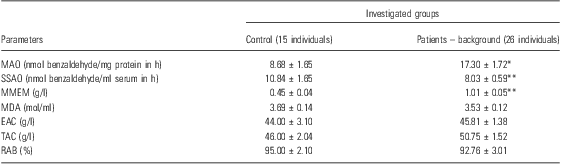
Before the treatment, FES patients were characterised by a significant increase in platelet MAO activity (99%; p < 0.01) and decrease of serum SSAO activity (26%; p < 0.001), in comparison with the control group (Table 1).
Activity and level of investigated parameters in the first-episode drug-naive schizophrenic patients and in healthy individuals (control)
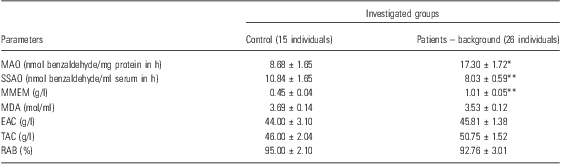
EAC, effective albumin concentration; MAO, monoamine oxidase; MMEM, middle-mass endotoxic molecules; RAB, reserve of albumin binding; SSAO, semicarbazide-sensitive amine oxidase; TAC, total albumin concentration.
*p < 0.01; **p < 0.001 – in comparison with control.
The MMEM concentration significantly exceeded control values (124%; p = 0.001). According to the endotoxicosis scale, 12 patients were characterised by slight, 12 patients by moderate and two patients had the high degree of endotoxicosis. In comparison with controls, there were no significant changes in MDA concentration or in parameters that characterised functional albumin (EAC and RAB).
The K–S test showed that all variables were normally distributed – the value of displacement was not <1.05. Thus, parametric methods of regression and factor analysis could be used for statistical analysis.
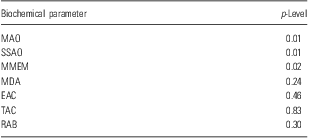
Regression analysis showed a significant relationship between three variables – MAO (p = 0.01), SSAO (p = 0.01) and MMEM (p = 0.02), with PANSS score (index of the severity of disease) (Table 3).
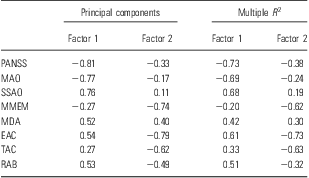
The relationship between biochemical variables was evaluated by factor analysis. From the results presented in Table 3, MAO, SSAO and PANSS parameters are covered by Factor 1, whereas MMEM, EAC and TAC are covered by Factor 2. It was determined that both methods of extraction (principle components and multiple R 2) gave very similar results.
Discussion
This investigation has shown that the first psychotic episode is characterised by pronounced metabolic disturbances: a significant increase of platelet MAO activity, which may reflect MAO activity in the brain (Reference Stahl23,Reference Chen, Wu and Shih24), and MMEM concentration and a decrease of SSAO activity.
Regression analysis has shown the significant relationship between MAO and SSAO activities and MMEM concentration and the severity of disease (PANSS) (Table 2).
Relationship of biochemical variables with parameter of clinical status (PANSS) of FES patients (according to regression analysis)
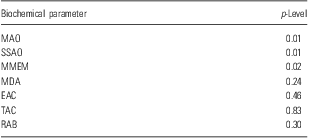
EAC, effective albumin concentration; MAO, monoamine oxidase; MDA, malonedialdehyde; MMEM, middle-mass endotoxic molecules; PANSS, positive and negative syndrome scale; RAB, reserve of albumin binding; SSAO, semicarbazide-sensitive amine oxidase; TAC, total albumin concentration.
Factor analysis revealed that two biochemical parameters (MAO and SSAO) and parameter of the severity of schizophrenia (the PANSS score) belong to Factor 1. Variables MAO and PANSS have positive correlation, whereas variables SSAO and PANSS have negative correlation (Table 3). On the basis of these data, it is possible that, with aggravation of the severity of the disease, there might be an increase of MAO activity and decrease of SSAO activity. This suggests that MAO and SSAO are intrinsic components of, and most closely connected with, pathogenetic mechanisms of FES.
Structure of relationships between investigated parameters (factor loadings according to factor analysis)
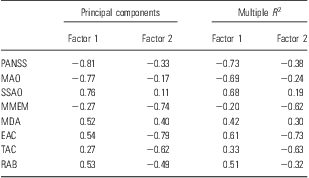
EAC, effective albumin concentration; MAO, monoamine oxidase; MDA, malonedialdehyde; MMEM, middle-mass endotoxic molecules; PANSS, positive and negative syndrome scale; RAB, reserve of albumin binding; SSAO, semicarbazide-sensitive amine oxidase; TAC, total albumin concentration.
The variables MMEM, EAC and TAC belong to Factor 2 and are positively connected. These variables are more weakly connected with the values of PANSS score. It is possible that these parameters are unspecific components of pathogenetic mechanisms, although they exert their pathological influences on the development of the disease. Previously, we showed that the MMEM concentration is a reflection of the intensity endogenous intoxication. The fact that MMEM belongs to the Factor 2 supports our hypothesis that endogenous intoxication is a non-specific component of the pathogenesis of mental disorders (Reference Uzbekov and Misionzhnik9,Reference Uzbekov, Misionzhnik, Maximova and Vertogradova10).
There is a relative deficiency of biochemical studies of the relationship of the pathogenetic mechanisms of FES and the present results may seem controversial. Thus, Spivak et al. (Reference Spivak, Kosower and Zipzer25) showed that platelet MAO activity in drug-naïve schizophrenic patients was unchanged relative to healthy volunteers. However, these authors did not indicate whether FES patients were included or whether the assays were performed after a suitable wash-out period. At the same time, it has been shown that in chronic schizophrenic patients the platelet MAO activity was lower than in controls (Reference Coron, Campiob and Thibaut26,Reference Ertugrul, Ucar, Basar, Demir, Yabanoglu and Ulug27). In our investigations, we found a significant increase of platelet MAO activity both in chronic schizophrenic (Reference Uzbekov and Misionzhnik9,Reference Mosolov, Uzbekov, Saikin, Misionzhnik, Tsukarzi and Molodetskikh28,Reference Uzbekov, Misionzhnik, Neduva and Malin29) and FES patients.
The disturbance of MAO activity in FES patients may be indicative of damage of membrane structures (this enzyme is an integral component of the external mitochondrial membrane), resulting in the appearance in the blood of different toxic end products (Reference Prilipko, Erin, Beliaev, Piatnitskii and Siuniakov30). Changes in MAO activity can disturb the equilibrium between dopamine, from one side, and serotonin and epinephrine, from the other, that play important roles in the pathophysiology of the condition. An increase of MAO activity is accompanied by the increased production of hydrogen peroxide. It is known (Reference Beckman and Ames31,Reference Gorkin32) that hydrogen peroxide formed in the reaction of deamination catalysed by MAO represents the main source of free radicals (through the Fenton reaction) in the brain. Thus, the elevation of MAO activity in these patients can induce the activation of free radical processes and lipid peroxidation, as well as an increase in the blood level of toxic products (aldehyde and ammonia) that are formed in the reaction of deamination. Taken together, these results suggest that an increased MAO activity precipitates a cascade of negative biochemical events.
Serum SSAO is considered to be an enzyme that is involved in the oxidation both xenobiotics and endogenous amino-containing metabolites (Reference Boomsma, Bhaggoe, van der Houwen and van der Meiracker33–Reference Strolin Benedetti, Whomsley and Baltes35). The precise physiological and pathophysiological role of this enzyme is not known. A decrease of SSAO activity in chronic schizophrenic patients has been reported (Reference Baron, Asnis, Gruen and Levitt36). However, the present study is the first to investigate SSAO activity in FES patients. SSAO can convert some endogenous amines, such as methylamine and aminoacetone, into highly toxic compounds – formaldehyde and methylglyoxal, respectively, as well as acrolein (Reference Boomsma, Bhaggoe, van der Houwen and van der Meiracker33,Reference Gong and Boor34,Reference Callingham, Crosbie and Rous37). Therefore, it is possible that an increase in the blood concentrations of these substances following stressful life events for example, i.e. schizophrenia, can exert harmful influences. It is supposed that increase of toxic metabolite concentrations in FES patients promotes the intensification of endogenous intoxication. We propose that, as concentration of toxic products is increasing, the compensatory mechanisms of allosteric inhibition of the enzyme can snap into action. As a result, the SSAO activity, as well as the production of excessive quantities of toxic metabolites, has to decrease. However, all these suppositions have to be investigated.
In previous studies, we proposed that the degree of endogenous intoxication can serve as a parameter of intensity of the disturbances of homoeostasis (Reference Uzbekov and Misionzhnik9,Reference Uzbekov, Misionzhnik, Maximova and Vertogradova10). Endogenous intoxication (endotoxicosis) is a pathophysiological process that is characterised by the formation and accumulation in tissues and body fluids of different substances and metabolites (endotoxins), in excessive concentrations or in forms that are not characteristic for the normal metabolism (Reference Uzbekov and Misionzhnik9,Reference Uzbekov, Misionzhnik, Maximova and Vertogradova10,Reference Umanskii, Pinchuk and Pinchuk38). Increased level of MMEM, free radical processes and lipid peroxidation, reactions catalysed by MAOs and SSAO, impairments in functional albumin and so on make a major contribution to the development of endotoxicosis (Reference Uzbekov and Misionzhnik9,Reference Uzbekov, Misionzhnik, Maximova and Vertogradova10). Our findings (Reference Stöber, Ben-Shachar and Cardon4) that in FES patients MMEM concentration was elevated more than twofold support this thesis. It is postulated that, during the development of the mental disorders, there is an activation of catabolic processes that increase the concentration of different MMEM components (Reference Uzbekov and Misionzhnik9,Reference Uzbekov, Misionzhnik, Neduva and Malin29,Reference Turianitsa, Mishanich and Rostoka39). Many components of MMEM fraction possess neurotoxic properties and inhibit different metabolic and physiological processes (Reference Chalenko40–Reference Ringoir, Vanholder and Massry42). They exert toxic effects in concentrations that are much lower than urea or aromatic amines (Reference Umanskii, Pinchuk and Pinchuk38). Earlier, we have shown that in patients with chronic paranoid schizophrenia two additional MMEM subfractions disappeared after plasmapheresis when the patients were in remission (Reference Uzbekov and Misionzhnik9).
Investigation of other biochemical (MDA) and biophysical parameters (EAC) did not show significant changes. Regression analysis did not reveal significant relationship between the severity of the disease (PANSS score) and variables EAC and RAB (Table 2). However, despite insignificant changes of EAC (Table 1), factor analysis has shown that parameter ECA belongs to Factor 2 (Table 3), with a high level of significance. EAC is a parameter reflecting albumin functional and conformational state (Reference Gyzunov, Syreytschikova and Komarova22). We speculate that factor analysis indicates very early stages of conformational changes in albumin that can exert influence on the pathophysiology of FES because of disturbances in main albumin properties – transport, detoxification and antioxidant status (Reference Uzbekov, Misionzhnik, Maximova and Vertogradova10,Reference Kragh-Hansen, Chuang and Otagiri43). However, when a conventional steady-state fluorimetric method was used, there were no significant differences in functional albumin (EAC and RAB) between FES patients and healthy volunteers. However, our preliminary data have shown that significant conformational changes in albumin of FES patients can be detected when the highly sensitive method of pulse laser fluorescent spectroscopy with subnanosecond resolution was used (Reference Gryzunov, Smolina and Uzbekov44,Reference Uzbekov, Misionzhnik and Shmukler45).
In our previously published studies on chronic schizophrenic patients, the parameters that were measured were also changed and differed significantly from control values (Reference Uzbekov and Misionzhnik9,Reference Gyzunov, Syreytschikova and Komarova22,Reference Mosolov, Uzbekov, Saikin, Misionzhnik, Tsukarzi and Molodetskikh28). Thus, we hypothesise that, from pathophysiological point of view, the FES is the initial step in the development of pathologically disturbed biochemical status that is characteristic of chronic schizophrenia.
Acknowledgements
The authors are grateful to Professor Brian Leonard (Pharmacology Department, National University of Ireland, Galway, Ireland) for his fruitful discussions. The authors thank Mrs. Lena Skokina and Nina Danilova for excellent technical assistance.
This study was supported by grant #3156 from International Science and Technology Center (ISTC).
Authors’ contributions: Study Design: Marat Uzbekov, Isaak Gurovich. Data collection: Eduard Misionzhnik, Alexander Shmukler, Tatjana Moskvitina. Analysis: Marat Uzbekov, Eduard Misionzhnik, Tatjana Moskvitina. Statistical analysis: Marat Uzbekov, Alexander Shmukler. Literature search: Marat Uzbekov, Alexander Shmukler. Manuscript draft: Marat Uzbekov. Discussion: all authors. All authors contributed to and have approved the final manuscript.
Declaration of interest: The authors declare that they have no conflict of interest.