I. INTRODUCTION
Recently, the study on room temperature ferromagnetic semiconductors has become an attractive topic for many research groups due to their promising potential in spintronic applications. Reference Wolf, Awschalom, Buhrman, Daughton, von Molnár, Roukes, Chtchelkanova and Treger1,Reference Gu, Jiang, Xu and Yan2 Among the semiconductors, ZnO is a leading candidate due to its ability to sustain ferromagnetism at room temperature. Reference Pal and Giri3 Conventionally, room temperature ferromagnetism (RTFM) in ZnO can be achieved by doping them with transition metals in low concentrations, the so-called dilute magnetic semiconductors (DMSs). Reference Yoon, Chen, Heiman, Yang, Sun, Victoria and Harris4,Reference Xu, Schmidt, Hartmann, Hochmuth, Lorentz, Setzer, Esquinazi, Meinecke and Grundmann5 RTFM has been reported in ZnO doped with TMs, such as Co, Fe, Cr, and Ni, which make ZnO promising for spintronic applications. Reference Yoon, Chen, Heiman, Yang, Sun, Victoria and Harris4,Reference Ramachandran, Tiwar and Narayan6–Reference Schwartz, Kittilstved and Gamelin9 However, besides the issues of stability and reproducibility, it remains controversial whether RTFM is intrinsic or due to extrinsic origin DMS containing TM ions often form nanoclusters of a metallic phase embedded in the matrix, which produce confusing magnetic behaviors. Reference Liu, Yun, Xiao, Cho, Moon, Morkoc, Abouzaid, Ruterana, Yu and Walukiewicz10 Recent studies have shown that this limitation potentially can be overcome via d0-ferromagnetism, where the spin-polarized charge transfer between nonmagnetic elements and crystalline ZnO can be utilized to induce ferromagnetism at room temperatures. Reference Pan, Yi, Shen, Wu, Yang, Lin, Feng, Deng, Van and Yin11,Reference Ferhat, Zaoui and Ahuja12 It has been reported that doping thin films of ZnO by 2p light elements such as C and N Reference Herng, Lau, Wei, Wang, Zhao, Tanemura and Akaile13,Reference Yu, Lin, Sun and Chou14 and/or metals such as Li and Cu Reference Chawla, Jayanthi and Kotnala15,Reference Xing, Yi, Tao, Liu, Wong, Zhang, Li, Wang, Ding, Sum, Huan and Wu16 can give rise to ferromagnetic ordering. In spite of the considerable efforts undertaken to understand the magnetic properties of DMSs with and without magnetic cation doping, many models have been suggested; the detailed underlying mechanism is still not clear.
Surface functionalization of ZnO nanostructures is an advanced technique, which enables the alternating electronic structure close to the surface for better nanoscale applications. It has been shown that electrical, optical, and magnetic properties of ZnO nanostructures can be tuned not only by impurity doping but also via surface functionalization with organic molecules. Reference Lao, Li, Wong and Wang17–Reference Ortega, Chen, Suzuki and Garitaonandia21 More recently, a significant number of experimental and theoretical results have pointed out the possibility to induce ferromagnetic behavior in ZnO nanostructures due to the surface bonds. Reference Garcia, Merino, Pinel, Quesada, de la Venta, González, Castro, Crespo, Llopis, González-Calbet and Hernando20–Reference Liu and Jiang25 These results suggest that the alternation of the electronic structure due to the surface bonds is responsible for the appearance of ferromagnetic behavior. On the basis of first-principles total-energy calculations, Liu and Jiang Reference Liu and Jiang25 have proposed that the atoms in the adsorbates with lesser electronegativity than that of O in ZnO plays a crucial role in the activation of RTFM in ZnO nanostructures.
It is expected that TOP functionalization on the ZnO film surface alters the electronic structure close to the surface and thus modifies the electronic, optical, and magnetic properties of ZnO. The proposed explanation is based on the occurrence of superficial Zn–P bonds on TOP functionalization, which causes charge redistribution in ZnO films due to the different electronegativity values of P atom (2.19) in TOP and O atom (3.44) at the surface of ZnO films. In principle, when a molecule adsorbs on an oxide surface, it can interact with the oxygen and/or metal centers. Reference Rodriguez26 For oxides, it is known that the chemical properties of metal centers usually depend on the number of oxygen vacancies around them. Reference Henrich and Cox27,Reference Kung28 There can be huge variations in chemical reactivity of metal oxides by facilitating the formation of oxygen vacancies through metal doping. In the present work, the doping of V ions causes structural perturbations in the ZnO lattice that makes easier the loss of oxygen vacancies. Reference Jayalakshmi, Gopalakrishnan, Panigrahi and Balasubramanian29 The occurrence of O vacancies on V doping enhances the reactivity of TOP molecules toward the ZnO film, which favors the formation of more Zn–P bonds at the ZnO film surface.
In the present work, an attempt is made to activate RTFM in ZnO films by surface functionalization with TOP molecules. Based on our experimental results, the origin of RTFM in TOP-functionalized ZnO films has been discussed in detail.
II. EXPERIMENTAL DETAILS
Initially, pure and V-doped ZnO films have been grown on a sapphire substrate by RF sputtering. The targets of pure ZnO, Zn0.95V0.05O, and Zn0.90V0.10O have been prepared by the conventional solid-state reaction route. The detailed deposition parameters and conditions have already been reported. Reference Jayalakshmi, Gopalakrishnan, Panigrahi and Balasubramanian29 The thickness of all the films is found to be around 150 nm. The grown pure and V-doped ZnO films have been subsequently functionalized with TOP by the spin coating technique. The trioctylphosphine purchased from Sigma Aldrich (India) has been used without further processing. With the aid of a micropipette, TOP was spread over the ZnO film and was allowed to adsorb for 1 min. After the prescribed time allowed for adsorption, the spin coater was immediately spun at the rate of 3000 rpm for 30 s. Before every coating step, the ZnO film was prefired at 100 °C for 1 min in air. The above process of prefiring and coating has been repeated 5 times to achieve uniform coverage of TOP molecules over the surface of the ZnO film. Then, the final annealing was performed in an air ambience at 100 °C for 5 min.
The structural analysis of pure and V-doped ZnO films before and after TOP functionalization has been performed by x-ray diffractometer (Ultima III, Rigaku, Japan) using Cu Kα radiation. The surface topography and roughness measurements of the pure and V-doped ZnO films before and after TOP functionalization have been performed by tapping mode atomic force microscopy (AFM; Nanoscale E from Digital Instruments) under ambient conditions. Wettability of the film was studied by the measurement of the contact angles (CAs) of water drops on the surface of the film. An investigation of the effect of TOP functionalization on the hydrophobicity of the ZnO films was carried out by measuring the CAs before and after TOP functionalization. CA measurement was carried out with a CA goniometer equipped with a CCD camera (Holmarc, Ho-IAD-CAM-01, India). To obtain a stable CA, all measurements were carried out at 30 s after dropping the water droplet on the ZnO film surfaces. X-ray photoelectron spectroscopy (XPS; XM 1000 Omicron Nano Technology GmbH, Germany) analysis was performed on pure and V-doped ZnO films before and after TOP functionalization using Al Kα radiation to investigate the chemical bond formation of TOP on the ZnO film surface. Photoluminescence (PL) properties of the pure and V-doped ZnO films before and after TOP functionalization were obtained with a He–Cd laser (with a wave length of 325 nm) as an excitation source. The magnetic properties of pure and V-doped ZnO films before and after TOP functionalization have been investigated using Lakeshore 7404 vibrating sample magnetometer (VSM) at room temperature.
III. RESULTS AND DISCUSSION
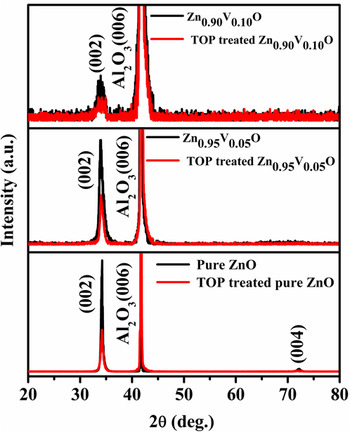
Figure 1 shows the x-ray diffraction (XRD) patterns of pure and V-doped ZnO films before and after TOP functionalization. XRD results indicate that all the films are single crystalline and have a preferred (002) orientation, i.e., along c-axis is perpendicular to the substrate surface. No trace of any other residual phases has been observed. The full-width at half-maximum (FWHM) of pure and V-doped ZnO films are 0.4100, 0.8933, and 1.4893 (in degrees), respectively. The diffractogram of TOP-functionalized pure and V-doped ZnO films shows identical peaks but slightly weaker when compared to the as-deposited pure and V-doped ZnO films. The FWHM of TOP-functionalized pure and V-doped ZnO films are found to be 0.43491, 0.94361, and 1.5695 (in degrees), respectively. The slightly weaker reflection as well as increase in FWHM observed in TOP-functionalized pure and V-doped ZnO films might be attributed to the adsorption of TOP molecules on the ZnO film surface. The XRD pattern of pure and V-doped ZnO films before and after TOP functionalization is not significantly different, which indicates that the TOP functionalization process has not affected the ZnO crystal structure.
XRD patterns of pure and V-doped ZnO films before (black line) and after (red line) TOP functionalization.

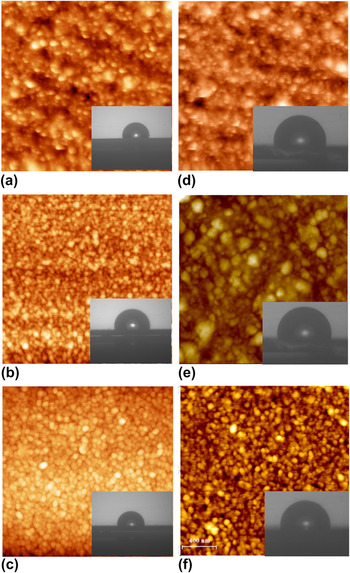
AFM measurements and the CA measurements provide the evidence of the successful functionalization of TOP molecules on the ZnO film surface. Figure 2 shows the tapping mode AFM images of pure and V-doped ZnO films before (left panel) and after (right panel) TOP functionalization. Qualitatively, the grains of pure and V-doped ZnO films are not masked, and no island formation has been seen on TOP functionalization, indicating that the TOP functionalization process has not affected the ZnO film surface. The root mean square (rms) roughness values of pure and V-doped ZnO films are 5.17, 4.86, and 4.03 nm; whereas rms roughness values of TOP-functionalized ZnO films are 5.13, 4.91, and 4.09 nm, respectively. The rms roughness of TOP-functionalized ZnO films is fairly consistent with their corresponding prefunctionalized ZnO films, indicating that the TOP functionalization has not induced any disorder in the ZnO film surface.
AFM images of as-deposited (a) pure ZnO (b) Zn0.95V0.05O (c) Zn0.90V0.10O films (left panel), right panel (d)–(f) are their respective TOP-functionalized ZnO films. Inset: the photograph of their corresponding CA measurements.

Controlling and/or modifying the surface wettability are important, which involve the interaction between a liquid and a solid in contact. The wettability of any solid surfaces can be determined by water CA measurements. For the present study, the water CA measurements were performed to ascertain the quality of ZnO films before and after TOP functionalization. The inset of Fig. 2 shows the typical water droplet on the pure and V-doped ZnO film surface before (left panel) and after (right panel) functionalization. The CAs of pure and V-doped ZnO films are 103, 97, and 94°, whereas their respective TOP-functionalized ones are 105, 100, and 97°. Interestingly, both prefunctionalized and functionalized ZnO films exhibit hydrophobic behavior, as the value of CA is found to be greater than 90°. The hydrophobic behavior of prefunctionalized pure and V-doped ZnO films is attributed to the higher rms roughness. The higher rms roughness of the films causes air trapping in the crevices, which prevents water from adhering to the film resulting in the hydrophobicity of the ZnO film surface. Reference Kwong, Wong, Wong and Wong30 The slightly higher value of the CA in TOP-functionalized ZnO films is attributed to the longer alkyl chain of TOP molecules adsorbed on the ZnO film surface.
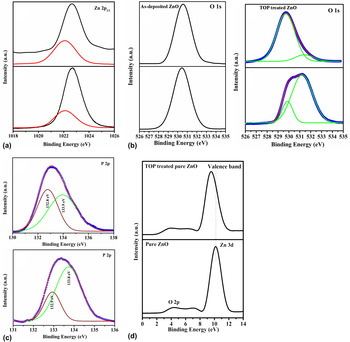
High-resolution region spectra of the key elemental composition provide detailed individual component information such as chemical shift, indicating changes of bonding among individual elements etc. Systematic XPS investigations were performed on pure ZnO and Zn0.90V0.10O films before and after TOP functionalization to study the chemical bonding of phosphorus in TOP with the ZnO film surface. Figure 3(a) shows the Zn 2p 3/2 peak obtained from the as-deposited (a) pure ZnO and (b) Zn0.90V0.10O films before and after surface functionalization with TOP. It is evident from Fig. 3 that TOP functionalization has altered the electronic states of ZnO. The peaks of the Zn 2p 3/2 component of the as-deposited pure and V-doped ZnO films located at 1022.7 eV correspond to Zn bonded to O in ZnO. However, the peak shows a shift of about 0.6 eV toward the lower binding energy on TOP functionalization. This shift is due to the degradation of the crystal lattice symmetry, which causes the electrical cloud surrounding the Zn atom to be asymmetric. Reference Ong, Zhang and Ho31,Reference Cao, Zhao, Zhang, Shen, Lu, Yao, Li, Bai and Fan32 In comparison with the Zn 2p 3/2 component of as-deposited pure and V-doped ZnO films, the binding energy for the Zn 2p 3/2 component of TOP-functionalized ZnO films gets shifted from 1022.7 to 1022.1 eV, thereby suggesting the existence of a chemical bond between ZnO and TOP molecules.
(a) XPS spectra of Zn 2p 3/2 component of pure ZnO and Zn0.90V0.10O films before (black line) and after (red line) TOP functionalization. (b) O 1s component of pure ZnO and Zn0.90V0.10O films before (left panel) and after (right panel) TOP functionalization. (c) P 2p component of pure ZnO and Zn0.90V0.10O films on TOP functionalization. (d) Valence band spectra of pure ZnO before and after TOP functionalization.

With XPS, it is possible to elucidate the binding nature of TOP molecules on the ZnO film surface. Figure 3(b) represents the O 1s component of pure and V-doped ZnO films before (left panel) and after (right panel) TOP functionalization. The as-deposited pure and V-doped ZnO films show O1s peak at 530.4 eV, which originates from the O2− ions present in a stoichiometric wurtzite ZnO lattice. Reference Coppa, Davis and Nemanich33 On TOP functionalization, the O 1s peak appears broadened with a probability of dual components. Low energy O 1s lines (a shift of binding energy about 0.6 eV as compared to the as-deposited ZnO film) are attributed to the formation of fewer Zn–P bonds at the ZnO film surface, whereas high energy lines around 531 eV correspond to phosphorus bonding with the nonbridging oxygen states, P–O–Zn bonds. The evolution of intensity around 531 eV of the O 1s peak in the TOP-functionalized pure ZnO film favors the formation of P–O–Zn bonds. The doping of V ions into the ZnO matrix facilitates the formation of oxygen vacancies. The presence of oxygen vacancies on V doping favors the formation of Zn–P on TOP functionalization which is evidenced from the relative decrease in the intensity of the peak around 531 eV. Similar bridging of phosphorus with ZnO (i.e., P–O–Zn) has been reported by Pugel et al. Reference Pugel, Vispute, Hullavarad, Venkatesan and Varughese34
High-resolution XPS scans reveal two distinct forms of phosphorus in pure and V-doped ZnO films on TOP functionalization as shown in Fig. 3(c). The XPS peak of P 2p 3/2 can be well fitted by two sub-peaks: a peak centered around 133 eV, which is attributed to the Zn–P bonds, and a peak centered around 134 eV, which is attributed to the P–O bonds. Reference Pugel, Vispute, Hullavarad, Venkatesan and Varughese34 A two-peak fit to the P 2p peak of the TOP-functionalized pure ZnO film shows an evolution of maximum intensity of the peak around 134 eV, indicating dominance of P–O bonds; whereas the P 2p peak of the TOP-functionalized V-doped ZnO film shows a weak peak around 134 eV. It is clear that the presence of oxygen vacancies on V doping favors the formation of Zn–P on TOP functionalization. It is reported that only due to the amphoteric nature of phosphorus, it has a tendency to form both donors and acceptors in ZnO. Reference Allenic, Guo, Chen, Katz, Zhao, Che, Hu, Liu, Zhang and Pan35 The existence of both Zn–P and P–O bonds confirms the amphoteric nature of phosphorus in ZnO.
Figure 3(d) shows the valence band spectra of pure ZnO films before and after TOP functionalization. For pure ZnO, the peak around 10.2 eV and the broad band around 7.5 and 4.2 eV are known to originate from Zn 3d, O 2p orbitals, and the part of O 2p orbitals hybridized with Zn 4s and 4p ones (i.e., Zn 4sp–O 2p hybrid states) and O 2p states, respectively. The valence band spectrum of ZnO is in very good agreement with valence band spectra of ZnO already reported. Reference Cong, Peng, Wei, Han, Wu, Liu, Zhu, Wang, Lu, Ye, Zhu, Qian, Su, Hong, Zhong, Ibrahim and Hu36,Reference Liu, Rodriguez, Chang, Hrbek and Pedan37 On TOP functionalization, Zn 3d states move to a lower energy by 0.6 eV with respect to that of pure ZnO. A similar shift of about 0.6 eV in valence band spectra of ZnO films toward the lower binding energy has already been reported on phosphorus-doped ZnO quantum dots. Reference Wu, Zeng, He, Lin, Jiang, Ye and Zhao38 The peak shift at the core level as well as at the valence level of TOP-functionalized ZnO films is ascribed to the change in electrostatic potential due to the different chemical bond formation on TOP functionalization. The charge redistribution that occurred in the TOP-functionalized ZnO films is attributed to the lower electronegativity value of the P atom in the TOP molecule as compared to the O atom coordinated to the Zn atom at the ZnO film surface.
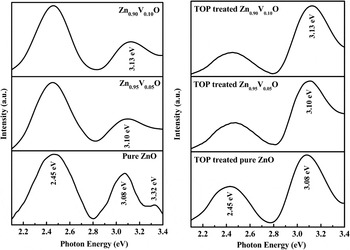
The PL spectra of the pure and V-doped ZnO films before and after TOP functionalization are presented in Fig. 4. Before TOP functionalization, a strong and broad visible emission as well as a weak ultraviolet emission peak is observed. The UV emission peak of ZnO centered about 3.08–3.13 eV is attributed to the excitonic recombination. Reference Singh, Mukherjee, Sengupta, Im, Peterson and Whitten39 The visible emission centered about 2.45 eV is attributed to some of the dangling bonds existing on the surface of the ZnO thin films from oxygen vacancies forming defect state and the electron in this state can also combine with the hole to emit PL. Reference Jayalakshmi, Saravanan and Balasubramanian40 The peak intensity ratio of ultraviolet to visible emission (I UV/I visible) is usually used to characterize the optical quality of the material. Reference Lin, Chen, Liao and Chen41 The peak intensity I UV/I Vis ratios of pure and V-doped ZnO films before TOP functionalization are 0.904, 0.573, and 0.488. The decrease in the values of I UV/I Vis on V doping indicates that the incorporation of V ions into ZnO causes structural defects such as oxygen vacancies. They induce extra electronic states in the band gap, which act as electron/hole trapping centers that potentially quench PL in the ultraviolet region. Reference Jung, Kim and Park42
Room temperature PL spectra of pure ZnO and V-doped ZnO films before (left panel) and after (right panel) TOP functionalization.

It has become one of the most promising methods to tailor UV emission because the adsorption of organic molecules forms covalent bond with the ZnO surface. TOP molecules are covalently bonded with the available Zn atoms at the ZnO film surface as evidenced from the XPS measurements. This would reduce the amount of dangling bonds and the associated loss of coordination, precisely the loss of coordination in the oxygen atom at the ZnO film surface. The peak intensity I UV/I Vis ratios of pure and V-doped ZnO films on TOP functionalization are found to be 1.630, 2.081, and 2.475. On TOP functionalization, the peak intensity and the I UV/I Vis ratios are found to be enhanced. This indicates the change of defect states on TOP functionalization. The TOP functionalization results in the decrease of nonradiative centers, and more carriers participate in the band gap emission, which is represented by the increase of ultraviolet emission. In the present study, the quenching of visible emission might occur via Zn–P and P–O bonds upon the surface functionalization with TOP. This has already been supported by our XPS results.
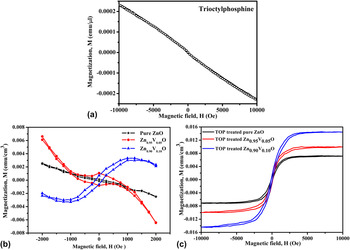
Figure 5 presents the room temperature magnetization curves of (a) pure trioctylphosphine (b) as-deposited pure and V-doped ZnO films, (c) TOP-functionalized pure and V-doped ZnO films. From Fig. 5(a), it is clear that the TOP molecules exhibit diamagnetic behavior when they stand alone. Prior to plotting the M–H curve of pure and V-doped ZnO films, the diamagnetic substrate component has been subtracted from the as-obtained magnetic signal. The magnetic response of the pure ZnO film is diamagnetic, the same as its bulk counterpart. On the contrary, the pure ZnO film exhibits a clear ferromagnetic behavior on TOP functionalization. The absence of any deliberate magnetic doping in pure ZnO confirms that the origin of the observed ferromagnetic behavior on TOP functionalization must be intrinsic. The saturation magnetization of TOP-functionalized pure and V-doped ZnO films are 0.007, ∼0.01, and ∼0.015 emu/cm3. The enhanced ferromagnetic behavior in TOP-functionalized ZnO films is attributed to the formation of fewer Zn–P bonds at the surface. The lowering of the electronegativity value of the P atom (2.19) than that of the O atom (3.44) results in the production of localized electrons in P atoms causing the system to be spin polarized. The charge redistribution that occurred in TOP-functionalized ZnO films is well evidenced from the peak shift observed both at core-level and at valence-level spectra of TOP-functionalized ZnO films as compared to its corresponding as-deposited films. In TOP-functionalized ZnO films, the localized electrons in the P atom bring in magnetic moment and induce spin polarization of neighboring atoms at the surface. Thus, the observed ferromagnetic behavior in TOP-functionalized ZnO films is due to the difference in electronegativity of the P atom in the TOP and O atom at the surface of ZnO.
Magnetization versus magnetic field measurements of (a) pure trioctylphosphine, (b) pure and V-doped ZnO films before TOP functionalization, and (c) pure and V-doped ZnO films after TOP functionalization.

IV. CONCLUSION
In summary, an activation and/or enhancement of RTFM in pure and V-doped ZnO films on TOP functionalization is realized. TOP functionalization on the ZnO film surface is identified by XPS measurements. The peak position of the P 2p peak shows the existence of both Zn–P and P–O bonds on the ZnO film surface on TOP functionalization. The coexistence of the Zn–P and P–O bonds implies the amphoteric nature of phosphorus in ZnO. From the XPS spectra of TOP-functionalized ZnO films, it is evident that the presence of oxygen vacancies favors the formation of Zn–P bonds. The relative intensity ratio of I UV/I Vis is found to be enhanced on TOP functionalization, which is attributed to the quenching of visible emission via the formation of Zn–P and P–O bonds. The enhanced ferromagnetic behavior in TOP-functionalized ZnO films is attributed to the difference in electronegativity of the P atom in the TOP and O at the surface of ZnO.
ACKNOWLEDGMENT
The authors acknowledge the DST, Government of India for the VSM facility under the FIST program sanctioned to the Department of Physics, NIT, Tiruchirappalli.